

Key Takeaways
- Chicago’s psychiatric shortage is concentrated at subacute, long-term residential, and integrated dual diagnosis levels, not acute beds, leaving treatment-resistant cases without a clinical next step 1, 6.
- Illinois Medicaid’s 60-day initial authorization with 30-day continued stay reviews often runs shorter than clozapine titrations, rapid-cycling bipolar observation, or concurrent substance use stabilization actually require 10.
- Before accepting a placement, compare level of care, weekly structured clinical hours against Illinois’ 25-hour ASAM-aligned floor, on-site clozapine protocols, and whether psychiatric and substance use treatment share one plan 9.
- Out-of-state referrals like ViewPoint in Prescott typically enter the conversation only after South Chicago hospitals and discharge planners exhaust in-state subacute and residential options that match clinical need 11.
When Local Options Have Already Failed Your Family
You have probably already called more numbers than you can count. A short admission at a Chicago hospital that stabilized the crisis but discharged before medications reached a therapeutic dose. An IOP referral that could not hold someone still actively using. A community mental health center with a waitlist longer than the last hospitalization lasted. If you are reading this, you are not starting the search. You are somewhere in the middle of it, tired, and looking for something that will actually work for a person whose diagnosis has not responded to standard care.
What you are running into is not a lack of good clinicians in Chicago. It is a specific mismatch between what a treatment-resistant case needs and what Illinois has capacity to provide. Roughly one in five U.S. adults lives with a mental illness, and a smaller share of that group carries the kind of serious, persistent conditions that require intensive, sustained care 2. In Illinois, an estimated 4.8% of adults had serious mental illness in the past year based on 2021–2023 data 4. Those are the cases that fill acute beds, cycle back through emergency departments, and need levels of care that Chicago simply does not have enough of.
This article names the gap by level of care, explains why the authorization rules stack against long treatment courses, and walks through what to ask before you accept the next placement. It also acknowledges what many Chicago discharge planners already know: for the most complex presentations, families are increasingly looking outside Illinois, and out-of-state programs like ViewPoint Dual Recovery in Prescott, Arizona have become part of those conversations.
The Specific Gap: It’s Not Beds in General, It’s the Right Kind of Bed
How Thin U.S. Inpatient Capacity Actually Is
When a hospital tells you there are no beds, they usually mean it. The national supply is genuinely small. A 2023 analysis of CMS-certified facilities found the U.S. has just 28.4 inpatient psychiatric beds per 100,000 population, more than 30 beds short of the 60-per-100,000 benchmark the literature supports as adequate 6. That is not a rounding gap. It is less than half of what the evidence base considers a functional supply for a country of this size.
The same study documents declines in psychiatric beds within short-term acute care hospitals over the last decade, which matters directly for you 6. Short-term acute beds are the beds attached to general hospitals, the ones your loved one is most likely to end up in after an ER visit. When those beds shrink, ER holds get longer, discharges happen sooner than clinicians would like, and the pressure to send someone home stabilized-but-not-well grows.
Two things follow from that number. First, the shortage you are experiencing in Chicago is not a Chicago-only failure. It is a national baseline that any large metropolitan area is sitting on top of. Second, and this is the harder truth, even if Illinois hit the 60-bed benchmark tomorrow, a raw bed count would not tell you whether the right kind of bed exists for a treatment-resistant case. A locked acute unit stabilizing someone in a 5-to-7-day stay is a very different resource than a subacute program that can keep a patient long enough for a clozapine titration to reach therapeutic levels, or a residential dual diagnosis program equipped for co-occurring substance use.
Hold that 28.4 number in mind as the floor. The rest of this section explains why the ceiling matters even more.
Illinois Demand: What the Prevalence Numbers Actually Predict
Now put Chicago on top of that thin national floor. Based on SAMHSA’s 2021–2023 estimates, 4.8% of Illinois adults had a serious mental illness in the past year 4. That is the subset carrying diagnoses like schizophrenia spectrum disorders, severe bipolar illness, and major depressive disorder with significant functional impairment. These are the patients who cycle through emergency departments, get stabilized, and end up back on a waitlist within months.
Illinois’ adult population runs in the millions, so 4.8% translates into a very large group of people who may need something more than an outpatient appointment at some point in a given year. Not all of them will need residential or subacute care. Many will do well with community mental health and medication management. But a meaningful slice, the treatment-resistant slice, is the one competing for the smallest and most specialized beds in the system.
The pressure is not only adult. Illinois Healthcare and Family Services documented 108,457 crisis calls in a recent reporting period, including 103,777 driven by an active crisis and involving 19,560 unique children and youth 7. Crisis volume that high does not resolve at the phone line. A share of those calls escalates into ER visits, and a share of those ER visits ends with a clinician deciding a young person needs a level of care that is genuinely hard to find in-state.
The uncomfortable arithmetic is this: demand for high-acuity psychiatric and dual diagnosis care in Illinois is not a projection. It is already showing up in crisis lines, ERs, and community mental health centers. What is missing is the receiving end, the beds and programs that can hold complex cases long enough to actually change the clinical trajectory.
Reading the Shortage by Level of Care, Not by Total Bed Count
Here is where the conversation with a Chicago hospital or a discharge planner often gets confusing. You hear “we found a bed” and feel relief, then discover a week later that the bed was a 5-day acute stabilization slot, not a program built to hold someone through a full course of treatment. That is not a communication failure. It reflects how psychiatric capacity is actually organized: several distinct levels of care, each with its own purpose, staffing model, and typical length of stay. Shortages do not spread evenly across those levels. They concentrate.
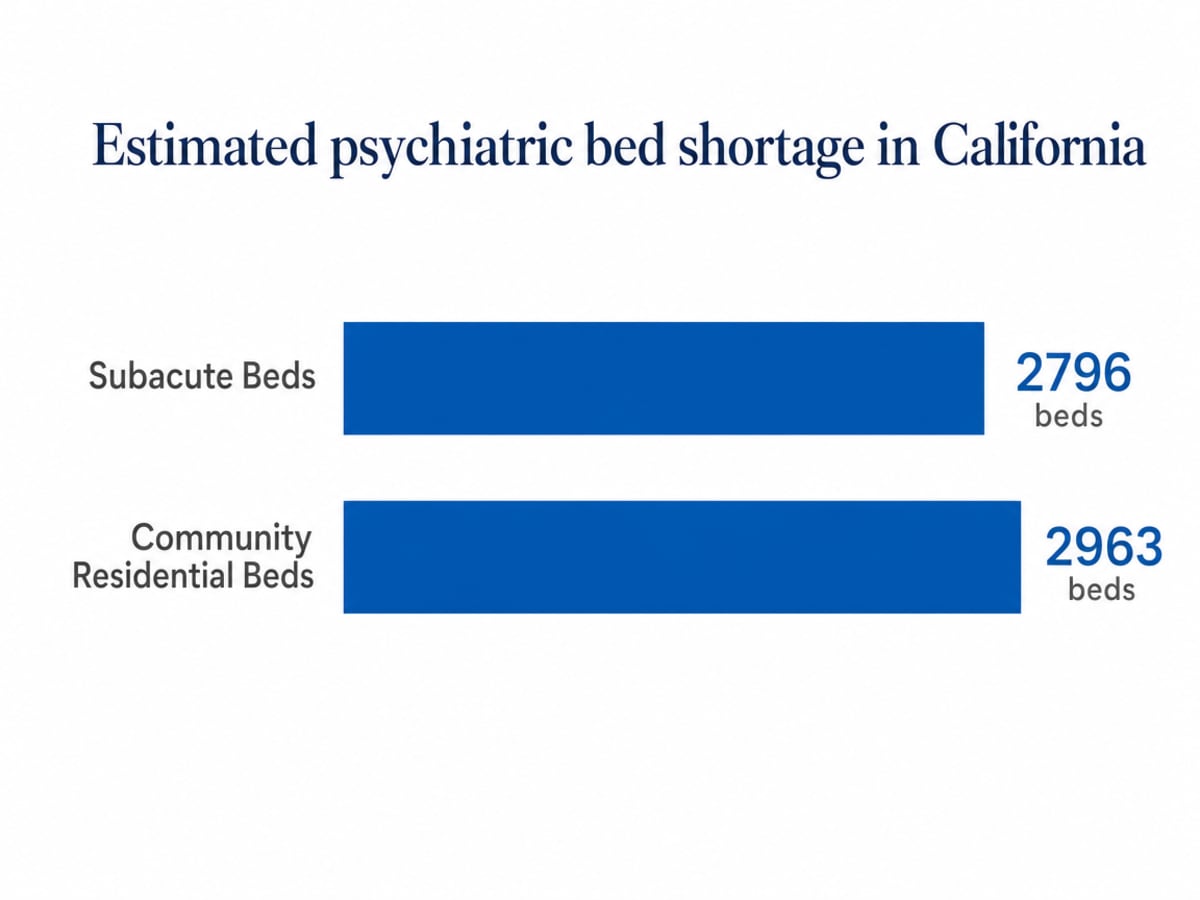
The clearest illustration of that concentration comes from outside Illinois. RAND’s methodology for California, which is a useful framework rather than an Illinois estimate, identified a shortage of roughly 2,796 subacute beds and 2,963 community residential beds statewide 1. Two things stand out about those numbers. First, the shortages are large. Second, they land specifically at the subacute and community residential levels, the ones that serve patients who are stable enough to leave a locked acute unit but not stable enough to go home. That is exactly the profile of a treatment-resistant patient midway through a medication trial or a dual diagnosis stabilization.
Applied conceptually to Chicago, this is the shape of the problem you are running into. Acute psychiatric beds exist. They are hard to get into, and they discharge fast. What thins out sharply is the next step down: subacute care, long-term residential programs, and integrated dual diagnosis settings that can keep someone through the weeks it takes for a clozapine titration to reach therapeutic effect, or for co-occurring substance use to actually stabilize alongside psychiatric symptoms.
Why the 60-Day Authorization Cycle Fails Treatment-Resistant Cases
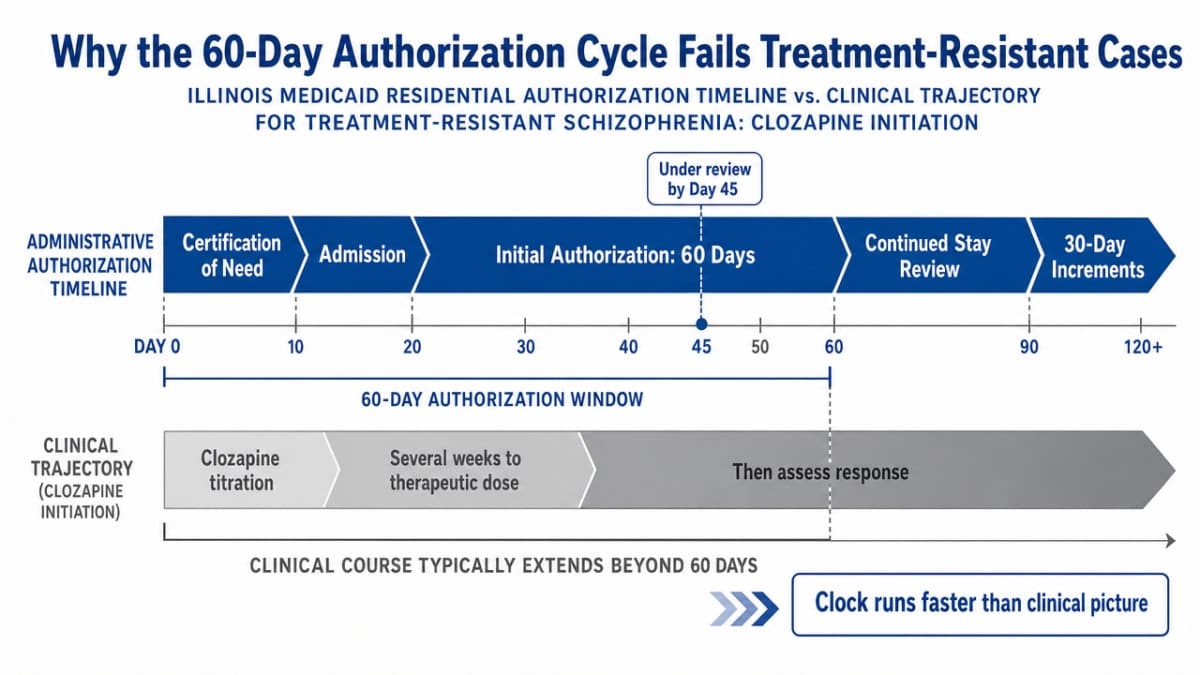
If you have ever gotten a call from a utilization reviewer telling you your family member’s stay is under review at day 45, you already know what this section is about. Illinois Medicaid requires a Certification of Need before admission to designated residential treatment facilities and initially authorizes 60 days of treatment, with any subsequent stay contingent on continued stay review in 30-day increments 10. On paper, that sounds reasonable. In practice, it sets a clock that runs faster than the clinical picture of a treatment-resistant case.
Think about what 60 days actually buys for the diagnoses this article is about. A clozapine titration for treatment-resistant schizophrenia typically runs several weeks just to reach a therapeutic dose, and that is before you know whether the response justifies staying the course. Rapid-cycling bipolar illness needs enough observed time to see the cycles, not just a single mood state. Co-occurring substance use does not resolve on the same timeline as the psychiatric symptoms it is tangled with; stabilizing both at once takes longer than stabilizing either alone. Sixty days is often the point at which a real clinical trajectory is just becoming visible.
The continued stay review is where the mismatch gets sharper. Every 30 days after that initial window, the program has to document ongoing medical necessity in terms a reviewer will accept 10. That framework is built for episodes with clear endpoints. It is not built for conditions where progress looks like a smaller relapse, a lower dose, or a week without a hospitalization. Clinicians know how to write those notes. They also know how often the answer comes back asking whether a step-down would be appropriate, right at the moment the patient is finally responding.
None of this is a Chicago-specific failure of judgment. It is the structure. But it is worth naming plainly, because it explains something you have probably lived through: the pattern of a loved one getting almost stable, getting discharged, and being back in an ER within weeks. When you evaluate the next placement, ask directly how the program handles authorization pushback and whether their typical length of stay for treatment-resistant cases actually reflects clinical need rather than the initial 60-day window. That single question tells you a lot about whether the setting can hold your family member long enough to matter.
What a Real High-Acuity Residential Program Should Look Like
Once you accept that the shortage is really a level-of-care shortage, the next question is what a program capable of holding a treatment-resistant case actually looks like on paper. This is the part where marketing language stops helping. Every website says “individualized” and “integrated.” What you need is a shorter list of concrete features you can ask about on the phone.
Start with clinical intensity. Illinois Medicaid sets a floor for residential SUD providers: they must deliver a planned regimen of clinical services for a minimum of 25 hours per week, and all services must align with American Society of Addiction Medicine (ASAM) criteria 9. That 25-hour floor is a useful reference point even when you are calling programs outside Illinois. If a residential program cannot describe a weekly clinical schedule that meets or exceeds it, in structured psychiatric and substance use treatment, not just milieu time, it is not built for a high-acuity case.
Second, ask about medication strategy in specifics. For treatment-resistant schizophrenia, the concrete question is clozapine: does the program run clozapine protocols on site, handle the monitoring, and staff prescribers who are comfortable titrating it? For rapid-cycling bipolar, the question is whether the psychiatric team can observe mood cycles long enough to actually adjust the regimen rather than discharging on the first stable week.
Third, ask about integration. A dual diagnosis program worth the label treats psychiatric symptoms and substance use in the same treatment plan, with psychiatrists and therapists in the same case conferences. Parallel tracks running in the same building are not the same thing.
Fourth, ask about length of stay. Illinois’ 60-day initial authorization with 30-day continued stay reviews 10 is the frame most families have been living inside. Programs that base duration on clinical response rather than the initial authorization window behave differently, and that difference is often what changes the trajectory.
Programs like ViewPoint in Prescott are one of the out-of-state options Chicago families reach for when this checklist comes up empty locally. Whether you end up there or somewhere else, use these four items to sort the calls.
Downstream Pressure: Crisis Volume, South Chicago, and the Referral Bottleneck
The bed shortage does not stay upstream. It shows up as pressure on the parts of the system families actually touch: the crisis line, the ER, and the neighborhood hospital that catches whoever the state cannot place.
Illinois Healthcare and Family Services logged 108,457 crisis calls in a recent reporting window, with 103,777 driven by an active crisis and 19,560 unique children and youth involved 7. That volume is the leading edge of demand. A crisis call is not a treatment plan. It is a moment where a clinician decides whether a young person can be de-escalated at home, sent to an ER, or moved to a higher level of care. When the higher-level options are thin, more of that volume settles into shorter, less specialized placements that were not designed for treatment-resistant cases.
South Chicago is where you can see the pattern land in one community. The 2022 community needs assessment for that area identified mental illnesses and substance use disorders, alongside a third cluster of chronic conditions, as the most frequent and resource-intensive causes of inpatient hospitalization, with mood (affective) disorders alone accounting for 8.5% of inpatient stays 11. That is a neighborhood whose local hospitals are absorbing a disproportionate share of the psychiatric and dual diagnosis burden without a matching supply of subacute or long-term residential beds to discharge into.
The referral bottleneck follows from that. A South Chicago hospital stabilizes a patient with co-occurring schizophrenia and stimulant use, then spends days trying to place them somewhere that can hold both diagnoses. If nothing opens, the patient goes home on a discharge plan that everyone in the room knows is thinner than the case warrants. Two weeks later, they are back. This is the loop that eventually pushes discharge planners to widen the search beyond Illinois.
Questions to Ask Before You Accept the Next Placement
By the time you are on the phone with a fifth or sixth program, the calls start to blur. Every intake coordinator sounds reassuring. Every website mentions the same categories of care. What actually separates a placement that will help from one that will land you back in the same ER in three weeks is a short list of specific questions. Write them down before you dial.
Ask what level of care the bed is, not just whether it is available. A locked acute stabilization slot, a subacute program, a long-term residential setting, and an integrated dual diagnosis program do very different work. If the person on the phone cannot describe the level cleanly, that is your answer.
Ask about the weekly clinical schedule in hours. Illinois’ own residential SUD standard sets a floor of 25 structured clinical hours per week aligned with ASAM criteria 9. Use that as a reference point regardless of state. If the schedule sounds lighter, or if the coordinator describes mostly milieu time, the program is not built for a treatment-resistant case.
Ask about clozapine directly if schizophrenia is on the chart. Do prescribers run the protocol on site? Who handles the monitoring? Ask about integration: are psychiatrists and therapists in the same case conferences, or working parallel tracks? And ask what typical length of stay looks like when the clinical picture warrants more than the initial authorization window 10. The answers will sort your list fast.
Why Chicago Discharge Planners Increasingly Look Out of State
Nobody in a Chicago hospital wants to send a patient to Arizona. Discharge planners here have relationships with local programs, know the intake coordinators by first name, and would rather place someone twenty minutes from their family than two time zones away. The out-of-state referral is not a preference. It is what happens after the in-state list runs out.
The pattern usually looks like this. A patient with treatment-resistant schizophrenia and co-occurring stimulant use stabilizes on an acute unit. The team knows a 60-day Illinois residential authorization 10 will not carry the case through a full clozapine titration and concurrent substance use stabilization. They start calling. The subacute and long-term residential slots that would actually fit are the exact levels of care the field has documented as thinnest, the pattern RAND quantified in California and that plays out here in a different form 1. When the calls come back either full or scoped to shorter stays, the search widens.
Out-of-state programs enter the conversation at that point, not before. Chicago families increasingly turn to options like ViewPoint Dual Recovery in Prescott, Arizona because the program is built around the things this article has named as scarce locally: treatment duration driven by clinical response rather than an initial authorization window, clozapine protocols run on site for treatment-resistant schizophrenia, and integrated psychiatric and substance use treatment in a single plan rather than parallel tracks.
If you are a Chicago-area family who has run the local list and hit the same wall, reaching out directly is a reasonable next step. The distance is real. So is the gap that put you on the phone in the first place.
If You’re a Case Manager or Outpatient Psychiatrist Making the Referral
A quick audience shift here: this section is for the clinician on the other end of the phone, not the family. If you are a Cook County case manager, hospital discharge planner, or outpatient psychiatrist writing the referral, you already know the pattern. The chart supports a higher level of care than the local list can deliver, and you are building the paper trail that will justify sending the patient farther than anyone would prefer.
Document what the shortage actually is in this case, not the shortage in the abstract. Name the level of care needed, subacute or long-term residential with integrated psychiatric and substance use treatment, and note where in-state options either lack availability or scope their length of stay below what the clinical picture requires. Reference Illinois’ 60-day initial authorization structure with 30-day continued stay reviews 10 when the projected treatment course clearly exceeds what that window reliably supports.
For treatment-resistant schizophrenia, spell out the clozapine plan and the monitoring cadence. For dual diagnosis, document why parallel outpatient tracks have not held. Programs like ViewPoint in Prescott receive Chicago-area referrals through exactly this kind of documentation. A clean, specific letter moves faster than a general one.
Start a confidential review of complex cases today
Receive expert feedback on long-term psychiatric care options for treatment-resistant situations.
Frequently Asked Questions
Why can’t we find a long-term psychiatric bed in Chicago for a treatment-resistant family member?
The shortage is concentrated at the levels of care you actually need. Acute stabilization beds exist, but subacute and long-term residential capacity is where the system thins out, a pattern RAND documented in California as a methodology example 1. On top of that, national inpatient supply sits at 28.4 psychiatric beds per 100,000, well under the 60-bed benchmark the literature supports 6.
What should I ask a residential program to know if it can actually handle a high-acuity dual diagnosis case?
Ask four things. What level of care is the bed? How many structured clinical hours per week does the program deliver, using Illinois’ 25-hour ASAM-aligned floor as a reference 9? Are clozapine protocols run on site with prescribers comfortable titrating? And are psychiatric and substance use treatment integrated in one plan, or run as parallel tracks? Clean answers on all four sort your list quickly.
Why does the 60-day authorization cycle keep cutting our loved one’s stay short?
Illinois Medicaid authorizes 60 days of residential treatment initially, with continued stay reviews every 30 days after that 10. For treatment-resistant conditions, 60 days is often where clinical progress is just becoming visible. Clozapine titrations, rapid-cycling bipolar observation windows, and concurrent substance use stabilization all run longer than that. The review structure was built for episodes with clean endpoints, not sustained trajectories.
Why are Chicago discharge planners referring families to out-of-state programs like ViewPoint?
Not by preference. Local planners exhaust in-state options first. When subacute and long-term residential slots come back full or scoped to shorter stays than the case warrants, they widen the search. Programs like ViewPoint Dual Recovery in Prescott, Arizona are built around what is scarce locally: treatment duration driven by clinical response, on-site clozapine protocols, and integrated psychiatric plus substance use treatment in one plan.
How do I know when it’s time to stop cycling through local ERs and short inpatient stays?
Watch the pattern, not the individual admission. If your family member has stabilized on an acute unit, discharged before medications reached therapeutic effect, and returned to an ER within weeks more than once, the level of care is mismatched. Short stays are not failing because of bad clinicians. They are failing because the case needs a longer, more integrated setting than the current placement is built to provide.
As a case manager or outpatient psychiatrist, what should I document to support an out-of-state referral?
Name the specific level of care needed, subacute or long-term residential with integrated psychiatric and substance use treatment, and document where in-state options either lacked availability or scoped length of stay below clinical need. Reference Illinois’ 60-day initial authorization with 30-day continued stay reviews when the projected course clearly exceeds that window 10. For treatment-resistant schizophrenia, spell out the clozapine plan and monitoring cadence.
References
- Adult Psychiatric Bed Capacity, Need, and Shortage in California. https://www.rand.org/pubs/research_reports/RRA1824-1-v2.html
- National Institute of Mental Health: Mental Illness Statistics. https://www.nimh.nih.gov/health/statistics/mental-illness
- Illinois Children’s Mental Health Partnership Annual Report 2024 (IDPH). https://dph.illinois.gov/content/dam/soi/en/web/idph/publications/idph/topics-and-services/life-stages-populations/maternal-child-family-health-services/child-health/icmhp/icmhp-annual-report-2024.pdf
- NSDUH Behavioral Health Barometer: Illinois, Volume 8. https://www.samhsa.gov/data/report/nsduh-behavioral-health-barometer-illinois-volume-8
- NSDUH State Releases – CBHSQ Data (SAMHSA). https://www.samhsa.gov/data/data-we-collect/nsduh-national-survey-drug-use-and-health/state-releases
- Inpatient Psychiatric Bed Capacity Within CMS-Certified U.S. Facilities, 2011–2023. https://pmc.ncbi.nlm.nih.gov/articles/PMC12310024/
- Illinois Healthcare and Family Services 2023 Annual Report (Selected Behavioral Health Data). https://hfs.illinois.gov/content/dam/soi/en/web/hfs/sitecollectiondocuments/2023annualreport230401.pdf
- Expert Report to HFS (2024) – Behavioral Health System Data. https://hfs.illinois.gov/content/dam/soi/en/web/hfs/sitecollectiondocuments/05282024expertreport.pdf
- Illinois Department of Healthcare and Family Services – Healthcare Transformation Application (2024). https://hfs.illinois.gov/content/dam/soi/en/web/hfs/sitecollectiondocuments/ilhealthcaretransappvl07022024.pdf
- Illinois Administrative Code tit. 89, § 139.500 – Medical Necessity and Utilization Review of Services. https://www.law.cornell.edu/regulations/illinois/Ill-Admin-Code-tit-89-SS-139.500
- Transformation Data & Community Needs Report – South Chicago (2022). https://hfs.illinois.gov/content/dam/soi/en/web/hfs/sitecollectiondocuments/transformationdataandcommunityneedsreportdecember2022southchicago.pdf