

Key Takeaways
- Short psychiatric admissions fail because factitious disorder requires weeks of consistent engagement with one clinician before trust and boundary-testing can translate into any therapeutic progress 2.
- Psychotherapy is the only intervention shown to affect factitious behavior; antidepressants and antipsychotics treat comorbid depression or psychosis but do not alter the fabrication pattern 4, 9.
- Direct confrontation typically triggers disengagement and symptom escalation, while a face-saving, stepwise approach from a trusted clinician preserves the treatment relationship 7, 8.
- Families should plan for non-adherence and AMA discharges as features of the disorder, not failure, and expect guarded prognosis focused on behavioral control rather than cure 1, 11.
Why Standard Programs Fail for Factitious Disorder
You have probably already lived through this: a promising hospitalization, a discharge with unfulfilled recommendations, and a relapse into fabricated symptoms, leading to another emergency room visit and the same cycle. This pattern is not a failure of your family’s effort but a predictable outcome when short-term, medically framed care is applied to a chronic psychiatric disorder like Munchausen syndrome, which is described in literature as poorly codified and having a generally poor prognosis in the short and medium term 11. Standard programs are designed for crisis stabilization and quick handoffs, a model ill-suited for this condition. Adherence to treatment is often suboptimal, and patients frequently leave against medical advice 3. Most treatment occurs in brief hospital settings, which limits long-term outcomes 2.
When a program fails, it’s often due to a mismatch between the disorder’s complexity and the care provided. A three-day admission cannot foster a therapeutic relationship with someone whose identity revolves around the sick role. Medication, while useful for co-occurring conditions, does not address the core behavioral patterns of factitious disorder.
This article will explore the structural reasons why standard care collapses for this diagnosis, what research recommends, and how an extended-stay, psychiatry-led model differs. We offer an honest assessment of why this condition is so challenging and how a different approach can provide more effective support.
Structural Limitations of Standard Care
Short Stays Prevent Meaningful Engagement
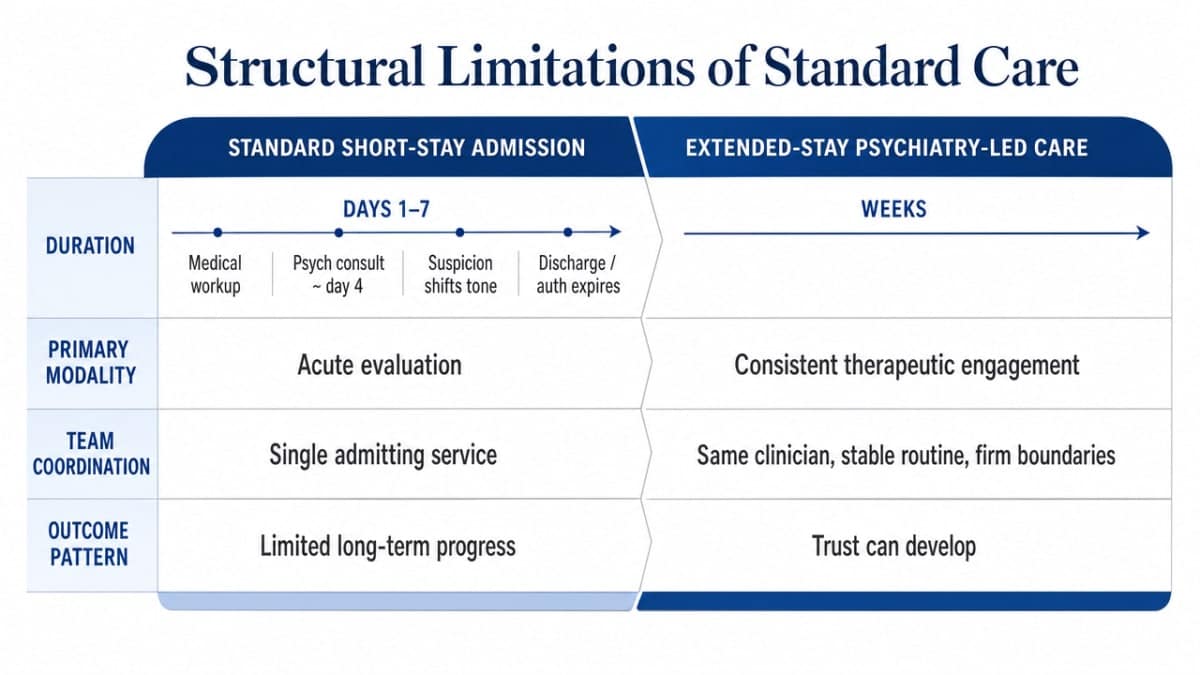
Consider a typical psychiatric admission for someone with Munchausen syndrome. The initial days are spent on medical workups. A psychiatric consult might occur by day four, and if fabrication is suspected, the clinical tone shifts. Often, by day seven, the patient has left, or insurance authorization has expired, leading to discharge planning.
This brief window is insufficient for the disorder’s demands. The literature explicitly states that short hospital stays limit long-term outcomes 2. Building a therapeutic relationship with someone whose identity is deeply intertwined with the sick role requires weeks of consistent interaction with the same clinician, a stable routine, and firm boundaries before trust can develop.
Beyond the time constraint, short admissions typically involve a single admitting service, often medical, with psychiatry as an afterthought. However, systematic reviews of factitious disorder management emphasize the need for a comprehensive psychiatric assessment, an individualized treatment plan, a designated primary clinician, and a fully informed multidisciplinary team 6. These elements cannot be established within a brief stabilization period.
The failure is structural, not personal. Comparing standard short-stay admissions with extended-stay, psychiatry-led models reveals four key differences:
- the duration available for engagement,
- the primary treatment modality (medical stabilization versus psychotherapy),
- the coordination of the interprofessional team, and
- the outcome pattern (frequent discharges against medical advice 3 versus sustained follow-up).
These distinctions are crucial for effective care.
Medication-First Approaches Miss the Core Behavior
Families often observe prescribers attempting to address factitious disorder with medication—new antidepressants, antipsychotics, or mood stabilizers. Despite these interventions, fabricated symptoms frequently recur, sometimes in new forms or with new specialties in different locations.
This isn’t due to prescriber negligence but reflects the evidence base, which points to treatment approaches not typically integrated into acute care. Clinical literature highlights three central findings:
- first, psychotherapy is the only currently effective treatment for factitious disorder 4.
- Second, standard psychiatric medications, including antidepressants and antipsychotics, show no direct benefit for the factitious behavior itself 9. While they can treat co-occurring depression or psychotic symptoms, they do not impact the fabrication pattern.
- Third, long-term psychotherapy and follow-up are consistently recommended 3.
This creates a clear mismatch: standard programs prioritize medication management, symptom stabilization, and short authorization windows. However, the disorder responds to sustained relational work over months, delivered by clinicians who can maintain engagement without requiring rapid symptom improvement. When medication is the primary focus, psychotherapy becomes a secondary activity, often scheduled infrequently with available therapists, which contradicts research-backed approaches and negatively impacts outcomes.
The Cycle of Non-Adherence and AMA Discharges
One of the most challenging aspects for families is that even in well-designed programs with skilled clinicians, most patients with this diagnosis decline or drop out of therapy 5, 4. This pattern is a defining feature of the disorder within the field.
In practice, this manifests as a familiar cycle: an admission starts well, but as a clinician approaches the underlying pattern, a lab result contradicts a symptom, or a family visit creates discomfort, the patient leaves. Clinical literature directly notes that adherence to treatment plans is generally suboptimal, and patients frequently leave against medical advice 3. The next admission often begins elsewhere, without access to previous records, restarting the cycle.
This cycle is not a result of family actions but an inherent characteristic of the disorder operating within a system designed for simpler problems. Progress in this diagnosis is often subtle: staying past the first therapy session, returning after leaving, or agreeing to see the same psychiatrist twice. These are significant markers of progress, as they represent entry points to the long-term engagement essential for any further therapeutic work.
The Nuance of Confrontation in Factitious Disorder
Families often witness direct confrontations where a doctor presents evidence of fabrication, leading the patient to leave and seek care elsewhere. While this approach feels honest, it typically results in disengagement and escalation of maladaptive behaviors 8.
Current clinical literature recommends a face-saving, stepwise confrontation delivered by a trusted clinician, carefully timed, and designed to preserve the possibility of continued treatment rather than forcing an admission of fabrication 7. The patient’s active participation is a prerequisite for any subsequent progress 7, and this cannot be coerced.
The distinction between direct and face-saving confrontation is critical. Direct confrontation often leads to disengagement, escalation of behaviors in new settings, and a longer path back to therapeutic contact 8. The face-saving approach, framed as concern for underlying suffering rather than exposure of a lie, keeps the door open for continued care.
The practical implication is that confrontation, when necessary, should be handled by a clinician with sufficient time, team support, and a plan for follow-up. This combination is rare in short-stay settings but is standard practice in programs designed for long-term management of this diagnosis.
The ViewPoint Model: Extended-Stay, Psychiatry-Led Care
Consistent Clinician and Coordinated Team
Families often observe their loved one cycling through numerous clinicians across multiple hospitalizations, each hearing a different version of their story. This fragmentation undermines consistent care.
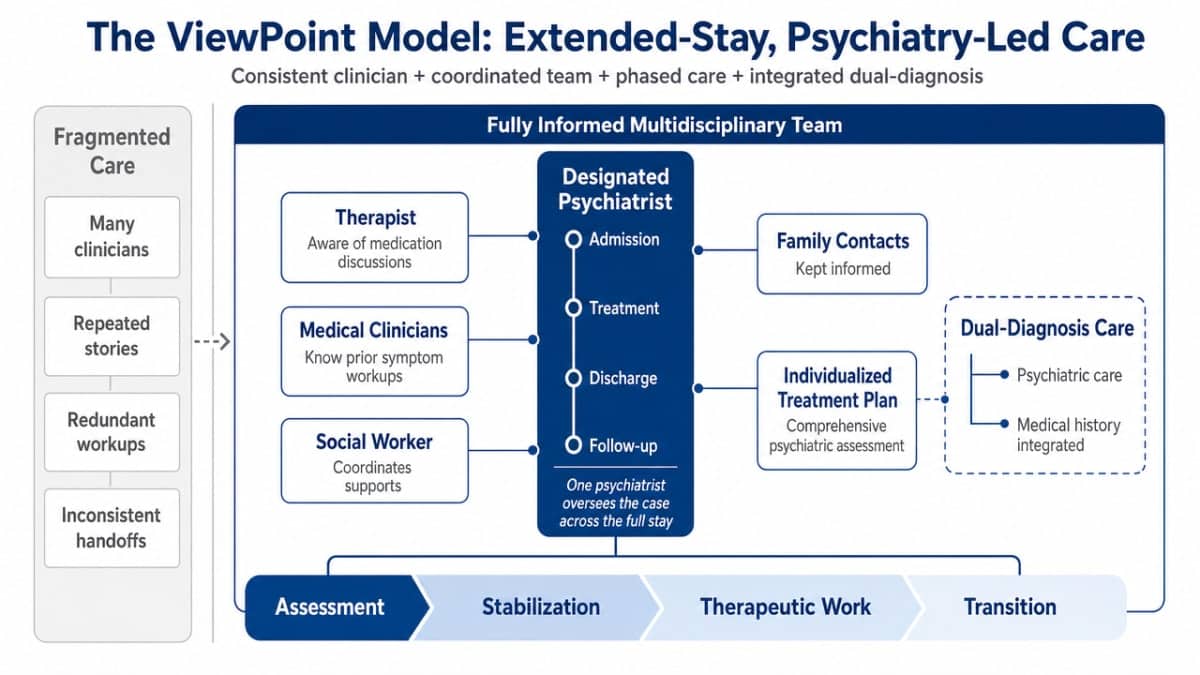
Systematic reviews of factitious disorder management recommend a comprehensive psychiatric assessment, an individualized treatment plan, a designated primary clinician, and a fully informed multidisciplinary team 6. These elements are designed to function as an integrated structure.
In practice, this means a single psychiatrist oversees the case from admission through discharge and follow-up. The therapist is aware of medication discussions, medical clinicians know previous symptom workups, preventing redundant referrals, and social workers and family contacts are kept informed. This integrated approach ensures a shared understanding of the patient’s pattern.
Munchausen syndrome is best managed by an interprofessional team including a psychiatrist, psychologist, primary care provider, social work, and nursing staff 9. Such a team provides a consistent, honest picture of the patient’s condition, maintained by professionals who will remain involved long-term. When a patient tests boundaries, the team responds with a unified, informed approach.
Time as a Therapeutic Element
While length of stay is often viewed as a cost factor, for factitious disorder, it is a crucial therapeutic ingredient. Research consistently supports long-term psychotherapy and follow-up 3, indicating that patients who persist in long-term therapy achieve more favorable outcomes 4. Such persistence is impossible within a typical seven-day authorization.
An extended-stay model redefines the role of time. The initial weeks are foundational, allowing the designated psychiatrist to become a familiar figure. This period enables the patient to test boundaries, observe staff responses, and recalibrate within a consistent environment. Face-saving, stepwise work on underlying behaviors becomes possible only after this groundwork, which often takes weeks 7.
Historically, some literature recommended long-term, sometimes closed-ward settings for Munchausen syndrome 10, a recommendation now controversial regarding autonomy. However, a modern extended-stay model is voluntary, with individualized care duration determined by clinical need, not insurance timelines. Patients can still leave, but the program and its consistent team remain available if they return or choose to stay. This structure offers a different kind of opportunity than a short-term stabilization bed.
Integrated Treatment of Comorbidities
A critical insight is that the prognosis for Munchausen syndrome is influenced more by co-occurring conditions than by the fabrication pattern itself. Comorbid depression, anxiety, and substance use disorders are common, and patients with these comorbidities may have better long-term outcomes than those with personality disorders as their primary comorbidity 9. The presence of comorbid psychiatric conditions significantly shapes the clinical course 5, necessitating a treatment approach that addresses these factors.
If a patient has been self-medicating with alcohol or drugs, or struggling with untreated depression or trauma, these are not secondary issues but integral parts of the treatment. A dual-diagnosis program, where psychiatric and substance use treatment are integrated within the same team, aligns with evidence-based recommendations.
This approach also clarifies the role of medication. While antidepressants and antipsychotics do not treat factitious behavior, they can effectively treat co-occurring depression or psychotic symptoms. Psychiatry-led care ensures that medication decisions are based on the patient’s complete clinical picture, not just the most prominent symptom. Prioritizing psychiatric care and reducing unnecessary medical procedures is a consistent recommendation in liaison psychiatry literature 1.
The Reality of Prognosis and Treatment Goals
An honest prognosis for Munchausen syndrome is often guarded, particularly in the short and medium term, and its management remains poorly codified across the field 11. No single technique has robust evidence 6. Any program promising a quick “fix” is not supported by the literature.
The goal shifts for this diagnosis. Liaison psychiatry literature suggests focusing on behavioral and symptomatic control rather than cure, while still addressing underlying emotional suffering 1. This reframe is not a lowered standard but an honest working target for a chronic disorder.
Within this framework, meaningful progress is achievable. Reducing unnecessary medical procedures prevents iatrogenic harm. Maintaining connection with a consistent psychiatric team, even imperfectly, offers protection that repeated new admissions cannot. Treating comorbid depression, anxiety, and substance use within an integrated plan can significantly improve the long-term outlook 9.
While families naturally desire more, a psychiatry-led, extended-stay program can genuinely offer a structured environment designed for sustained engagement, staffed by professionals who understand the significance of a patient remaining in treatment beyond the initial weeks. This sustained engagement is paramount.
Considering ViewPoint for Complex Cases
You don’t need to be certain to reach out. Most families contacting us for such cases are exhausted by repetitive cycles and seeking a program that truly understands the complexity of factitious disorder.
Several indicators suggest that an extended-stay, psychiatry-led model like ViewPoint is the appropriate next step:
- if short admissions have consistently ended prematurely;
- if medications have not impacted the core factitious behavior, aligning with research 9;
- if co-occurring conditions like depression, substance use, or trauma are present but have been fragmented across different providers 5; or
- if previous direct confrontations led to disengagement 8.
ViewPoint is specifically designed for these complex cases. We offer a single psychiatrist overseeing the treatment plan, an interprofessional team that collaborates consistently, a length of stay determined by clinical need rather than arbitrary authorizations, and dual-diagnosis care that integrates treatment for co-occurring conditions. We do not promise a cure, as the honest literature does not support one 11. Instead, we provide a structured environment capable of sustaining the engagement this diagnosis truly requires.
If you’ve been navigating this challenge alone, reaching out is not a commitment. It’s an opportunity for a conversation with professionals who recognize and understand this pattern.
Request expert review for complex psychiatric cases
Gain clarity on next-step options for challenging Munchausen syndrome presentations.
Frequently Asked Questions
Why do most psychiatric programs fail for Munchausen syndrome?
Most programs are designed for short admissions focused on medical stabilization and quick discharge, which is inadequate for factitious disorder. Adherence is often suboptimal, and patients frequently leave against medical advice 3. Brief hospital stays limit long-term outcomes 2, preventing the formation of necessary therapeutic engagement.
Can medication treat factitious disorder?
Medication does not treat the core factitious behavior itself; antidepressants and antipsychotics show no direct benefit for the fabrication pattern 9. However, medications can effectively treat co-occurring conditions like depression, anxiety, or psychotic symptoms. The key distinction is that while medication supports the overall clinical picture, the fabrication pattern primarily responds to sustained psychotherapy 4.
Should we confront our family member about their behavior?
Direct confrontation is generally discouraged as it often leads to disengagement from care or worsening behaviors 8. Current literature recommends a face-saving, stepwise approach from a trusted clinician, framed as concern for underlying suffering rather than exposure of a lie 7. If direct confrontation has been attempted and resulted in disengagement, it’s important to understand that this intuition often backfires with this diagnosis.
What does an extended-stay, psychiatry-led program do differently?
In an extended-stay, psychiatry-led program, the length of stay is determined by clinical need, not short-term authorizations. A single psychiatrist leads the case, supported by an interprofessional team including psychology, primary care, social work, and nursing 9. Care is built around a comprehensive assessment, an individualized plan, and a designated primary clinician 6. This structure provides the weeks necessary for psychotherapy, the only intervention with demonstrated effectiveness 4.
Is recovery from Munchausen syndrome actually possible?
The prognosis is often guarded, particularly in the short and medium term, and management remains poorly codified 11. However, meaningful engagement over time is possible. Patients who persist with long-term therapy tend to have more favorable outcomes 4. The working goal is behavioral and symptomatic control, not cure, while addressing underlying emotional suffering 1.
What if our loved one refuses to stay in treatment?
Refusal to stay in treatment is often part of the diagnosis. Most patients decline therapy, and many who start drop out 5. In a program designed for this condition, the team remains available if the patient returns. Milestones like staying past week three, returning after leaving, or agreeing to see the same psychiatrist multiple times are crucial entry points to longer-term engagement.
References
- Munchausen Syndrome in the Context of Liaison Psychiatry. https://pmc.ncbi.nlm.nih.gov/articles/PMC10944582/
- Munchausen Syndrome Presented as Guillain-Barré Syndrome: A Case Report. https://pmc.ncbi.nlm.nih.gov/articles/PMC11704981/
- Munchausen Syndrome. https://pubmed.ncbi.nlm.nih.gov/32239233/
- Factitious Disorder – StatPearls – NCBI Bookshelf. https://www.ncbi.nlm.nih.gov/books/NBK557547/
- Factitious Disorder Overview – StatPearls – NCBI Bookshelf. https://www.ncbi.nlm.nih.gov/books/NBK518999/
- Management of Factitious Disorders: A Systematic Review. https://depts.washington.edu/psychres/wordpress/wp-content/uploads/2017/07/100-Papers-in-Clinical-Psychiatry-Psychosomatic-Medicine-Management-of-factitious-disorders-a-systematic-review.pdf
- Factitious Disorders in Everyday Clinical Practice. https://pmc.ncbi.nlm.nih.gov/articles/PMC7505250/
- Factitious Disorder Imposed on Self: Diagnostic Challenges and Management. https://pmc.ncbi.nlm.nih.gov/articles/PMC12950992/
- Munchausen Syndrome – StatPearls. https://www.ncbi.nlm.nih.gov/books/NBK518999/?report=reader
- Munchausen’s Syndrome: A Clinical Review. https://www.ncbi.nlm.nih.gov/pmc/articles/PMC2561446/pdf/jnma00225-0067.pdf
- [Factitious disorder imposed on self and Munchausen syndrome: An update]. https://pubmed.ncbi.nlm.nih.gov/38658265/