Key Takeaways
- Eating disorders and substance use often share the same roots in trauma, emotion dysregulation, and the need for control, so treating one in isolation lets the other expand to fill the gap 13, 4.
- Sequential and parallel treatment models create a substitution loop that mislabels patients as treatment-resistant, while clinical consensus favors simultaneous care under one multidisciplinary team 6, 8.
- Genuine integration means one team holds both diagnoses in a single plan, sequencing medical stabilization first, then trauma-informed work, CBT, and DBT that target shared drivers 4, 2, 9.
- Integrated care reliably improves psychiatric symptoms but shows weaker gains for substance use retention, so length of stay, aftercare, and how programs handle the addiction side deserve direct questioning 12, 5.
Why Standard Care Keeps Failing You
You already know the pattern. An eating disorder program tells you to stabilize your weight and food behaviors first, then get sober somewhere else. An addiction program tells you to complete detox and 30 days of sobriety before they’ll touch the restricting, the purging, or the binge cycle. You bounce. You relapse. Someone labels you treatment-resistant, and it starts to feel like the label belongs to you rather than to the system that keeps handing you off.
That exhaustion is legitimate, and the research backs up what you’ve been living. Both conditions are frequently expressions of the same underlying system, sharing genetic vulnerabilities, neurological response patterns, and histories of trauma or adverse childhood events 4. When one is treated in isolation, the other tends to escalate to fill the gap. Clinical reviews of co-occurring eating disorders and substance use disorders reach the same conclusion: both should be addressed simultaneously through a multidisciplinary approach, not sequenced across unrelated facilities 8.
The stakes of getting this wrong are not abstract. People carrying both diagnoses face significantly higher mortality and medical risk than those with either condition alone 18. That is why the rest of this guide focuses on what integrated dual diagnosis care actually looks like inside one program, what it can genuinely change, and where its limits still are. You deserve a framework built for the presentation you actually have, not two half-answers stitched together.
One System, Two Expressions: The Shared Drivers Behind ED and SUD
Trauma, Control, and Emotion Dysregulation as the Common Engine
If you have lived with both an eating disorder and substance use, you already suspect that they are not two unrelated habits sharing the same body. They tend to rise and fall together, trade places, and answer the same underlying question: how do you get through the next hour without being overwhelmed?
The research reads that way too. Reviews of shared risk factors describe both conditions as maladaptive strategies for managing distress, regulating emotion, and exerting perceived control over internal experience 13. Restricting food and using a substance can each quiet an unbearable feeling, produce a predictable body state, or create a small pocket of agency inside a life that feels chaotic. When one behavior is removed without addressing the underlying function, the other tends to expand.
Trauma sits underneath a large share of these presentations. Psychiatric comorbidity is the norm in eating disorder treatment, and traumatic events and lifetime PTSD are frequently major contributors 2. SAMHSA identifies genetics, neurological response patterns, and a history of trauma or adverse childhood events as shared etiological factors across eating disorders and substance use disorders 4. That is a clinical way of saying what you may already know: the two behaviors often trace back to the same wound.
Emotion dysregulation is the connective tissue clinicians point to most. It is why targeting emotion regulation directly, rather than only restriction or drinking, is increasingly viewed as essential in integrated treatment for co-occurring presentations 17.
How Often Substance Use and Eating Disorders Actually Overlap
Prevalence numbers in this space get thrown around loosely. You have probably seen the phrase “up to 50%” attached to almost any combination of eating and substance behaviors. The real picture is more specific, and the specificity matters for how you and your clinicians should plan care.
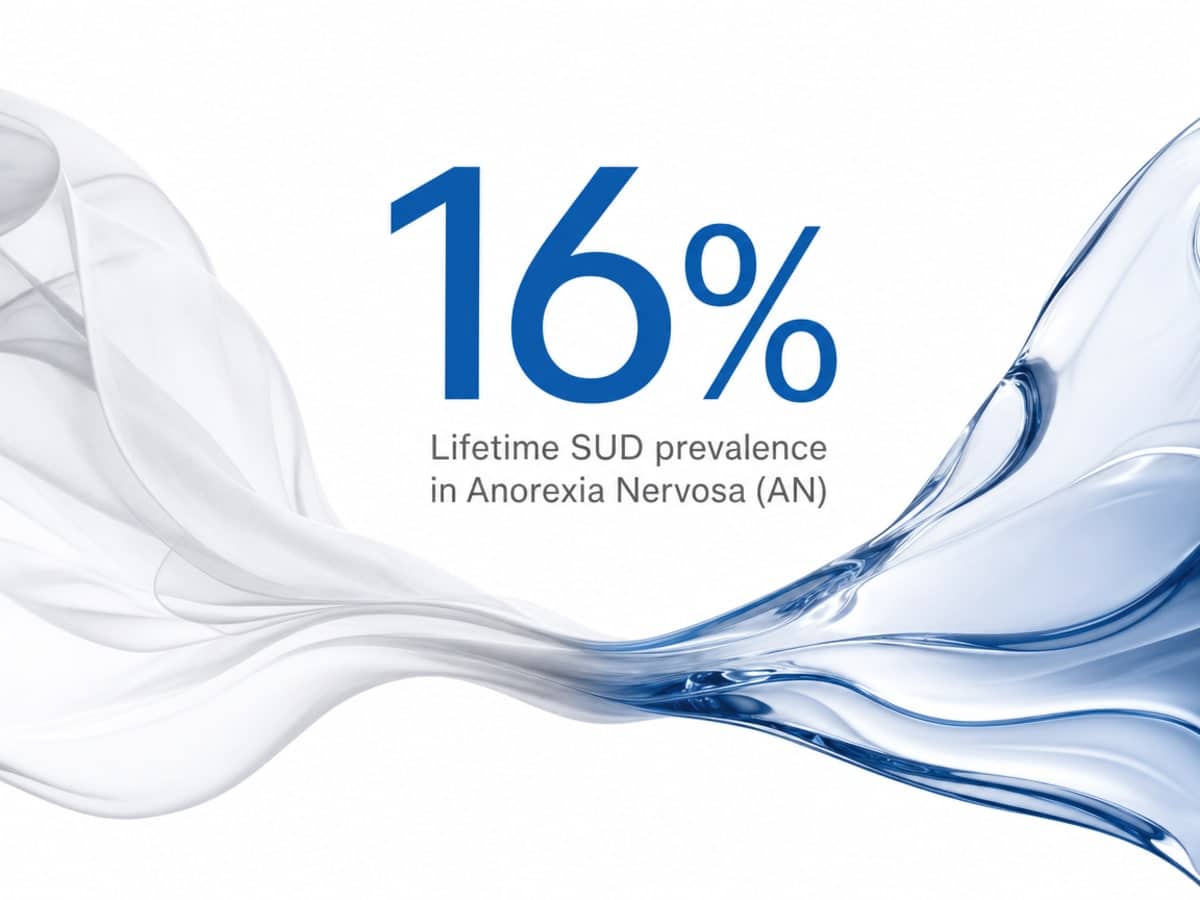
A 2021 systematic review and meta-analysis of anorexia nervosa found a pooled lifetime substance use disorder prevalence of 16%, with a sharp split by subtype: 18% in the binge/purge presentation versus 7% in the restricting presentation 10. In other words, someone with binge/purge anorexia is roughly two and a half times more likely to also meet criteria for a substance use disorder than someone with restricting anorexia. Blanket statistics obscure that gap. Treatment plans that ignore it tend to miss the patients who most need integrated care.
Broader reviews describe the overall relationship in similar terms: roughly 20 to 30 percent of people with either an eating disorder or a substance use disorder carry the other diagnosis as well 1. That is not an edge case. It is a substantial share of the caseload at any serious psychiatric program, and it is the population most likely to be labeled treatment-resistant when handed between siloed services.
If you fall into the binge/purge or binge-eating end of the spectrum, take the elevated risk seriously. Ask any program you consider how it screens for substance use throughout treatment, not only at intake, and how it adjusts the plan when substance use surfaces mid-course. The subtype-specific data exists so that assessment can be sharper than a single blanket number allows 10.
Which Substances Show Up, and Why They Fit the ED Pattern
The substances that most commonly appear alongside eating disorders are not random. They tend to pair with the function the eating behavior is already serving, which is part of why removing one without understanding the other so often backfires.
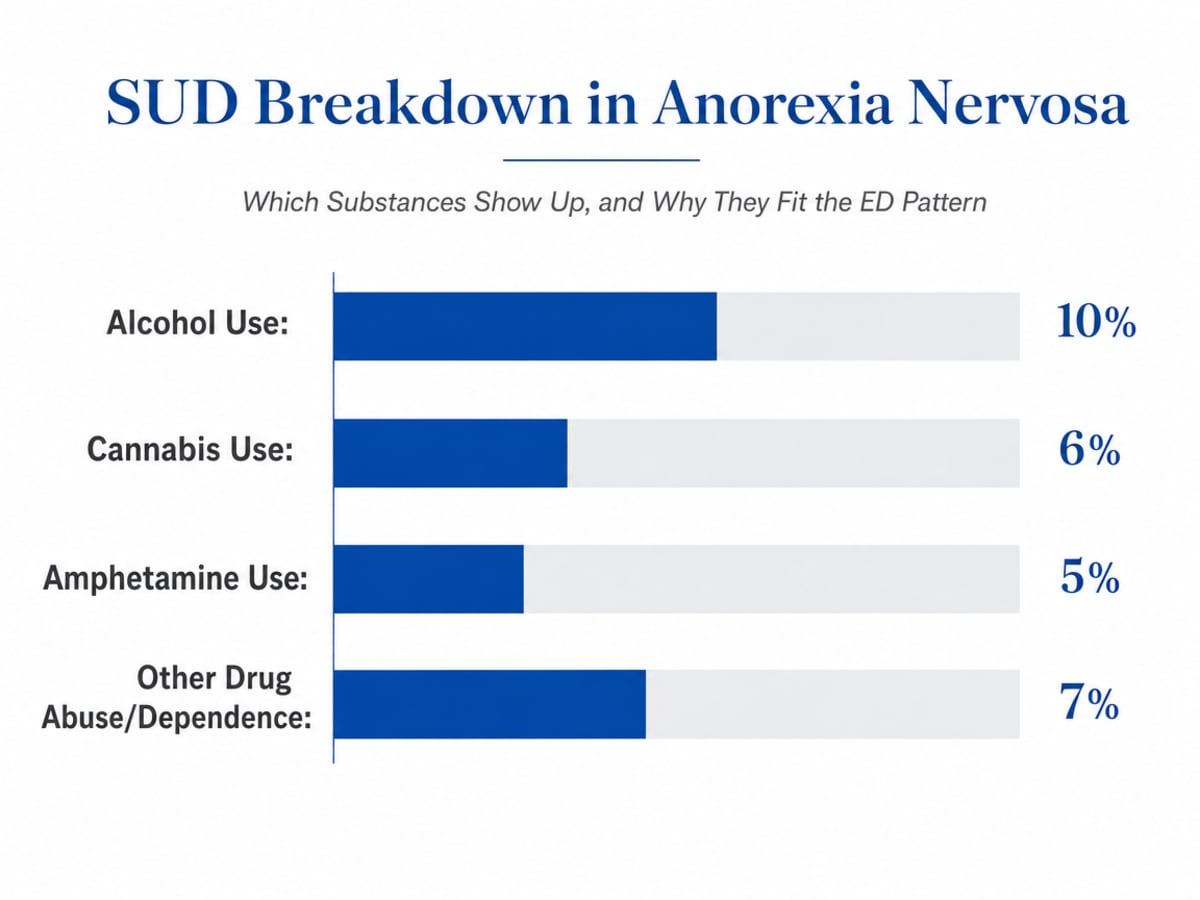
Inside that 16% pooled substance use disorder prevalence in anorexia nervosa, the breakdown is telling:
- Alcohol use disorder around 10%
- Cannabis use disorder around 6%
- Amphetamine use disorder around 5%
- Other drug abuse or dependence around 7% 1
These categories overlap in individual patients, which is why the components sum higher than the pooled overall figure. The pattern is worth sitting with rather than skimming.
Alcohol fits neatly with both restriction (low-calorie disinhibition, blunting hunger and anxiety at the end of the day) and with binge/purge cycles (loosening restraint, then intensifying shame and compensation the next morning). Stimulants like amphetamines directly suppress appetite and support restriction, which is why they show up disproportionately in patients whose eating disorder is organized around control of weight and food intake. Cannabis often enters as an anxiety and sleep aid, sometimes as a way to make eating tolerable again after prolonged restriction. Other drug use, including opioids and sedatives, tends to cluster with trauma symptoms and severe emotion dysregulation.
When you look at what is being used and when, you get information about what the eating disorder is doing for the person, not just what it is doing to them. A program that treats amphetamine use as a separate addiction problem, disconnected from the restriction it is fueling, will keep missing the point. Integrated assessment starts here.
Why Sequential and Parallel Treatment Fail Treatment-Resistant Patients
The ‘Treat the Eating Disorder First’ Loop
You have probably heard some version of it. “We need your weight stable before we address the drinking.” Or the reverse: “Get 30 days sober, then we can talk about the binge-purge cycle.” On paper, sequencing sounds cautious. In practice, it sets up a loop that punishes the exact people it claims to protect.
Here is how the loop runs. You enter an eating disorder program. Restriction and purging quiet down under structure and meal support. The anxiety and trauma symptoms those behaviors were muffling get louder. Substance use, which no one on the unit is really tracking, quietly escalates as a substitute. You discharge. Within weeks, the drinking or the stimulants pull you into a crisis, and an addiction program takes you in. That program tells you to focus on sobriety. Your eating stops being anyone’s clinical priority. Restriction returns, or the binge-purge cycle does, because the function it served never got replaced. Six months later, you are back where you started, with a heavier chart and a new label: treatment-resistant.
What Integrated Care Actually Looks Like Inside One Program
Integrated care is not the same as parallel care with better paperwork. That distinction matters, because a lot of programs that call themselves “dual diagnosis” are actually running two treatment tracks that happen to share a parking lot.
In a sequential model, one condition waits its turn. You finish an eating disorder stay, then start a separate addiction admission, then maybe find a trauma therapist later. In a parallel model, you attend an eating disorder program by day and an outpatient addiction group by night, with two clinicians who rarely speak and treatment plans that sometimes contradict each other. In a genuinely integrated model, one team holds both conditions inside a single treatment plan. The psychiatrist prescribing for withdrawal knows what refeeding is doing to your labs. The therapist working on restriction knows what your last drink was and why. Safety-first stabilization comes before deep trauma processing, but nothing is deferred to a future admission that may never happen 3.
SAMHSA’s guidance sharpens the point: both eating and substance use disorders must be treated for the best outcomes, though initial care should address the most serious immediate threats to health and safety 4. That framing gives clinicians permission to stabilize a dangerous withdrawal or a critically low weight first without splitting the person into two files. Multidisciplinary reviews recommend that where possible, eating disorder and substance use treatment be combined within the same program, using an integrated treatment plan and a single team 15.
For treatment-resistant patients, this structural difference is often what changes the trajectory. When one team owns both problems, the substitution loop between behaviors has fewer places to hide.
The Clinical Backbone of Integrated Dual Diagnosis Care
Safety First: Medical Stabilization, Detox, and Mortality Risk
Integration does not mean everything happens at once. It means one team decides what has to happen first, and why, without shipping you somewhere else to do it.
The starting question is medical. Patients with co-occurring eating disorders and substance use disorders carry significantly higher mortality and medical risk than those with either condition alone 18. A body in active alcohol withdrawal, benzodiazepine dependence, or opioid dependence needs medically supervised detox. A body that has been restricting, purging, or laxative-loading needs cardiac monitoring, electrolyte correction, and careful refeeding. When both are happening in the same person, the risks compound in ways an outpatient setting is not equipped to hold.
SAMHSA’s guidance is direct on sequencing: both conditions must be treated for the best outcomes, but the initial phase of care should address the most serious immediate threats to health and safety 4. In practice, that means a psychiatrist managing your withdrawal protocol is reading the same labs as the medical team tracking your potassium and phosphorus during refeeding. Detox is not outsourced to a separate facility that hands you back a week later 8. Stabilization is the first shared task, not the first handoff.
Trauma-Informed Sequencing Without Re-Traumatization
Once you are medically stable, the question becomes what to do with the trauma that so often sits underneath both the eating and the substance use. For years, clinicians worried that trauma work would destabilize either condition and pushed it to some indefinite “later.” Newer evidence has changed that stance.
Brewerton’s review of integrated treatment for eating disorders, PTSD, and substance use disorders describes trauma-focused therapies being delivered alongside ED and SUD care once safety is established, rather than deferred 2. The sequencing matters. You do not start with the hardest memory on day three. You start with stabilization, skills, and a working understanding of how your symptoms function. Then evidence-based PTSD treatment enters the plan as one thread among several 14.
Trauma-informed does not mean trauma-focused every session. It means the whole team assumes trauma may be part of the picture and structures care so you are not asked to prove you deserve gentleness. Predictable routines, informed consent for every intervention, and the option to pause processing when your eating or substance urges spike are not extras. They are the reason integrated trauma care can happen at all without setting recovery back.
CBT, DBT, and Transdiagnostic Skill-Building
The therapies that carry the most evidence for co-occurring eating disorders and substance use are the ones that treat both behaviors as expressions of the same underlying process rather than two separate problems requiring two separate curricula.
Cognitive behavioral therapy adapted for ED–SUD does this by targeting the shared beliefs. Perfectionism, all-or-nothing thinking, and the conviction that you cannot tolerate a difficult feeling without a behavior to blunt it show up in both restriction and drinking, both binge cycles and stimulant use. Integrated CBT protocols challenge those beliefs across symptom sets in the same session rather than parceling them out 16. Anxiety and negative affect are treated as drivers of both, which is why working on one behavior in isolation tends to leave the other intact.
Dialectical behavior therapy earns its place for a related reason. Emotion dysregulation is the transdiagnostic mechanism connecting the two conditions, and DBT trains the specific skills, such as distress tolerance, emotion regulation, and mindfulness, that address it directly 9. Reviews of transdiagnostic approaches now describe emotion regulation as a critical target for anyone carrying both diagnoses 17.
You will still do individual work on your eating and your substance use. But the skills you build should apply to both, because the feelings driving them are the same feelings.
The Multidisciplinary Team You Should Expect
A genuinely integrated program is staffed for both conditions, not staffed for one and referring out for the other. That distinction is easy to miss on a website and hard to miss inside a treatment plan.
Clinical reviews of multidisciplinary care for ED–SUD describe teams that include psychiatry, psychology, internal medicine, nutrition, and addiction expertise, coordinated around a single treatment plan 15. Concurrent psychotherapy, medical and nutritional management, and addiction-specific interventions run together rather than in sequence 7. The psychiatrist adjusting your medications knows what your dietitian is doing with meal structure. The therapist working on urges knows what withdrawal did to your sleep last week.
When you evaluate a program, ask who is at the table for your case and how often they actually meet. A weekly team meeting where your psychiatrist, therapist, dietitian, and medical clinician review the same plan is the operational marker of integrated care. Without it, you have parallel services with a shared address.
An Honest Look at What Integrated Care Does and Doesn’t Fix
Integrated care is the right structural answer, and it is not a cure. Those two statements have to live together, or the argument for this model gets sold on promises it cannot keep.
There is also a formal gap in the field. Reviewers note that no empirically supported, standardized integrated treatment protocol currently exists specifically for co-occurring eating disorders and substance use, even as clinical consensus continues to endorse simultaneous treatment 5. Programs are assembling integrated care from adjacent evidence bases rather than following a single manualized playbook.
What that means for you is practical. Integration is the floor, not the ceiling. Ask about length of stay, aftercare, and how the program handles the substance use side specifically, because that is where the evidence is thinnest and where your engagement matters most.
How the ViewPoint Dual Recovery Model Applies These Principles
ViewPoint Dual Recovery in Prescott, Arizona is built around the structural principles the research keeps pointing to: one team, one treatment plan, both conditions addressed inside the same admission. The facility is Joint Commission-accredited and staffed for 24/7 board-certified psychiatry, which matters when withdrawal, refeeding, and psychiatric symptoms are moving at the same time. Medical stabilization is not outsourced to a separate detox facility and then handed back a week later 8.
The model also takes seriously what integrated care cannot promise. Meta-analytic data show integrated dual diagnosis programs move psychiatric symptoms more reliably than they move substance use retention 12. ViewPoint’s response is individualized treatment duration based on clinical need rather than insurance timelines, which gives the substance use work, trauma processing, and skill-building room to actually take hold rather than ending on a calendar date.
If you have been cycling between ED programs and addiction programs and want to know whether a single integrated setting can hold both, that is the conversation to have with a ViewPoint clinician.
Questions to Ask Before Choosing a Program
By the time you are researching another program, you have earned the right to ask harder questions than the intake brochure invites. Use these to separate genuine integration from parallel services with a shared address.
- Who owns both diagnoses on my chart? One team with one treatment plan, or two tracks that email each other 15?
- How do you sequence detox and refeeding when both are needed? Is medical stabilization handled on-site or outsourced 8?
- When does trauma work enter the plan? Deferred to “later,” or integrated once safety is established 2?
- What therapies target the shared drivers? Ask specifically about CBT adaptations and DBT skills for emotion regulation 9, 16.
- Is length of stay set by clinical need or by an insurance calendar? The honest answer matters, given how retention affects substance use outcomes 12.
If a program cannot answer plainly, that is your answer.
Clarify your next steps for dual diagnosis care
Receive expert feedback on your best integrated treatment options for eating disorders and substance use overlap.
Frequently Asked Questions
Can an eating disorder and substance use disorder really be treated at the same time?
Yes, and clinical consensus now favors it. Reviews of co-occurring eating disorders and substance use disorders repeatedly conclude that both should be addressed simultaneously through a multidisciplinary approach rather than sequenced across separate facilities 8. SAMHSA’s guidance is aligned: treat both, and let immediate safety threats determine what stabilizes first 4.
Why did previous treatment programs tell me to address one condition before the other?
Sequencing was standard practice for years, partly because programs were staffed for one condition and referred out for the other. Newer clinical reviews argue that high comorbidity requires treatments targeting both disorders at once, because removing one behavior without addressing shared drivers often lets the other escalate 6. The delay was structural, not a reflection of your progress.
How does trauma factor into co-occurring eating disorders and substance use?
Trauma and adverse childhood experiences are among the shared etiological factors linking both conditions 4. Psychiatric comorbidity is the norm in eating disorder treatment, and lifetime PTSD is frequently a major contributor 2. Once you are medically stable, trauma-focused work can be integrated into the plan rather than deferred to a later, separate admission that may never happen 14.
What kinds of therapies are used in integrated dual diagnosis care?
Expect cognitive behavioral therapy adapted to target the beliefs driving both restriction/binge cycles and substance use 16, plus dialectical behavior therapy for emotion regulation, distress tolerance, and mindfulness 9. Trauma-focused therapies enter once safety is established 2. Medical management, nutrition, and psychiatric medication coordinate alongside these, delivered by a single team rather than parallel providers 15.
Is residential treatment necessary, or can integrated care happen in outpatient settings?
It depends on medical risk. Patients with both eating disorders and substance use disorders face significantly higher mortality and medical risk than those with either condition alone 18. When active withdrawal, unstable weight, purging, or severe electrolyte disturbances are present, residential care with on-site medical monitoring is often the safer starting point 8. Outpatient integration can follow stabilization.
What should I look for in a program that claims to treat both conditions?
Ask whether one team owns both diagnoses under a single treatment plan, or whether two tracks run in parallel with occasional emails 15. Confirm that detox and refeeding can happen on-site when both are needed 8. Ask when trauma work enters the plan, and whether length of stay follows clinical need rather than an insurance calendar 12.
References
- Novel potential pharmacological approaches in treating eating disorders and comorbid substance use disorders. https://pmc.ncbi.nlm.nih.gov/articles/PMC12276861/
- The integrated treatment of eating disorders, posttraumatic stress disorder, and substance use disorders. https://pmc.ncbi.nlm.nih.gov/articles/PMC10213703/
- Evidence-Based Care for Clients with Co-Occurring Substance Use Disorders and Eating Disorders (SAMHSA Advisory). https://library.samhsa.gov/product/advisory-evidence-based-care-clients-co-occurring-substance-use-disorders-eating-disorders/pep25-02-010
- Evidence-Based Care for Clients with Co-Occurring Substance Use Disorders and Eating Disorders (Full PDF). https://library.samhsa.gov/sites/default/files/advisory-eating-disorders-sud-pep25-02-010.pdf
- Managing Co-occurring Substance Use Problems in Eating Disorder Treatment. https://pubmed.ncbi.nlm.nih.gov/41708259/
- The comorbidity of substance use disorders and eating disorders in women: prevalence, etiology, and treatment. https://pubmed.ncbi.nlm.nih.gov/20074863/
- Assessment and Treatment of Co-occurring Eating Disorders and Substance Use Disorders. https://pmc.ncbi.nlm.nih.gov/articles/PMC3417144/
- A clinical approach to the assessment and management of co-occurring eating disorders and substance use disorders. https://pmc.ncbi.nlm.nih.gov/articles/PMC4226257/
- Correlates of co-occurring eating disorders and substance use disorders: A case for dialectical behavior therapy. https://eatingdisorders.ucsd.edu/sites/default/files/eatingdisorders/files/publications/Correlates%20of%20co-occurring%20eating%20disorders%20and%20substance%20use%20disorders%20%20a%20case%20for%20dialectical%20behavior%20therapy.pdf
- The prevalence of substance use disorders and substance use in anorexia nervosa: a systematic review and meta-analysis. https://pmc.ncbi.nlm.nih.gov/articles/PMC8666057/
- Clients With Substance Use and Eating Disorders. https://library.samhsa.gov/product/clients-substance-use-and-eating-disorders/sma10-4617
- Integrated vs non-integrated treatment outcomes in dual diagnosis: A systematic review and meta-analysis. https://pmc.ncbi.nlm.nih.gov/articles/PMC10157410/
- Substance use disorders and eating disorders: A comprehensive review of shared risk factors and clinical implications. https://pmc.ncbi.nlm.nih.gov/articles/PMC3417113/
- Trauma, PTSD, and comorbid substance use and eating disorders: Clinical considerations. https://pmc.ncbi.nlm.nih.gov/articles/PMC10151153/
- Multidisciplinary treatment approaches for eating disorders with comorbid substance use. https://pmc.ncbi.nlm.nih.gov/articles/PMC10123705/
- Cognitive-behavioral therapy for eating disorders with co-occurring substance use: Adaptations and outcomes. https://pmc.ncbi.nlm.nih.gov/articles/PMC9908595/
- Emotion regulation as a transdiagnostic target in eating disorders and substance use disorders. https://pmc.ncbi.nlm.nih.gov/articles/PMC10651234/
- Mortality and medical risk in patients with co-occurring eating disorders and substance use disorders. https://pmc.ncbi.nlm.nih.gov/articles/PMC10184126/