

Key Takeaways
- When a Prescott program says a case is “too acute,” it reflects that facility’s unit-specific acuity plan under Arizona rule R9-10-315, not a judgment on the person 12.
- Yavapai County’s higher rural SMI prevalence and thinner behavioral health workforce mean most local programs keep their acuity ceiling low, making specialty capacity harder to find 13.
- Arizona’s SMI designation unlocks ACC-RBHA coordination and community residential access, and Non-Title XIX funding covers uninsured adults through the same network 1, 3, 5.
- Before choosing a program, compare 24/7 psychiatry, clozapine and ANC monitoring capability, integrated dual diagnosis care on one team, and whether discharge follows clinical stabilization or an authorization window 9, 10.
When a Program Says Your Loved One Is “Too Acute”
Being told a program cannot admit your loved one is one of the hardest phone calls a family can get. It usually comes after weeks of preparation, insurance calls, and a fragile agreement from the person you love that yes, this time, they will go. Then someone on the other end of the line uses a phrase like “we’re not equipped for this level of acuity,” or “the case is too complex for our setting,” and you are back where you started, only more tired.
That phrase is not a verdict on your family member. It is a description of the facility.
Most residential and outpatient programs are built around a middle band of psychiatric acuity, where symptoms are serious but stable enough for standard antipsychotic regimens, group-based programming, and a length of stay that fits inside what insurance is willing to authorize. When a case involves active psychosis, treatment-resistant schizophrenia, rapid-cycling bipolar disorder, severe depression with psychotic features, or a substance use disorder layered on top of any of these, the same program that helps others is honest enough to say it cannot help yours. Arizona regulation actually anticipates this: inpatient behavioral health facilities are required to develop unit-specific acuity plans that define who they can safely treat 12.
So the question is not whether your loved one is “too much.” The question is which facility was built for this. In Prescott, ViewPoint Dual Recovery is one of the places structured, from staffing to protocols, to take the calls other programs decline.
What Treatment-Resistant Actually Means in a Prescott Context
The Clinical Definition Behind the Denial Letter
“Treatment-resistant” is not a label anyone hands out casually, and it is not a comment on how hard your loved one has tried. In schizophrenia, the term has a specific clinical meaning: symptoms that persist after adequate trials of at least two different antipsychotic medications at therapeutic doses and durations. The American Psychiatric Association’s 2020 practice guideline responds to that pattern with a direct recommendation—clozapine 9. In bipolar disorder, treatment resistance often looks like rapid cycling, breakthrough mood episodes on standard mood stabilizers, or a mixed features presentation that keeps slipping out of control between appointments.
Arizona law adds a second layer to this picture. Under A.R.S. § 36-550, a person is considered seriously mentally ill when a mental disorder produces emotional or behavioral impairment severe enough that they cannot remain in the community without long-term supportive treatment 3, 4. More than 70 standardized diagnoses can qualify—psychotic disorders, bipolar disorders, major depression, other mood disorders, anxiety disorders, and personality disorders among them 7.
So when a program says your loved one is “too complex,” they are usually describing two overlapping realities at once. The illness has not responded to standard first-line care, and the level of functional impairment now sits outside what a general behavioral health setting is staffed to manage. Both are clinical facts. Neither is a failure on your part.
Why Yavapai County Families Face a Thinner Bench
There is a reason the local search feels harder than it should. Prescott sits inside a rural Arizona reality that the numbers describe plainly. The Arizona Center for Rural Health reports that 19.24% of Arizona adults experienced mental illness in the prior year, and that the prevalence of serious mental illness runs higher in non-metro areas—5.2%—compared to 4.0% in large metro and 5.1% in small metro counties 13. Yavapai County falls on the higher-need side of that split, while sitting in a workforce region the same report identifies as chronically short on psychiatrists, prescribing psychiatric providers, and specialty behavioral health staff 13.
That combination has a practical consequence for families. When more people in your county meet SMI criteria and fewer clinicians are available to treat them, admissions coordinators are forced to be conservative. A program that can safely manage moderate depression, first-episode psychosis stabilized on risperidone, or a straightforward alcohol use disorder will decline a rapid-cycling bipolar case with concurrent stimulant use—not because the case is untreatable, but because that program was not built for it. The math of rural staffing keeps their acuity ceiling low.
This is also why a specialized Prescott facility matters more here than it would in a large metro area. Families in Phoenix or Tucson can call ten programs before finding the right fit. In Yavapai County, that phone list is short, and the ceiling on what most of those numbers can accept is lower than the acuity your loved one is presenting with. Knowing which door is actually built to open for treatment-resistant cases saves days you may not have.
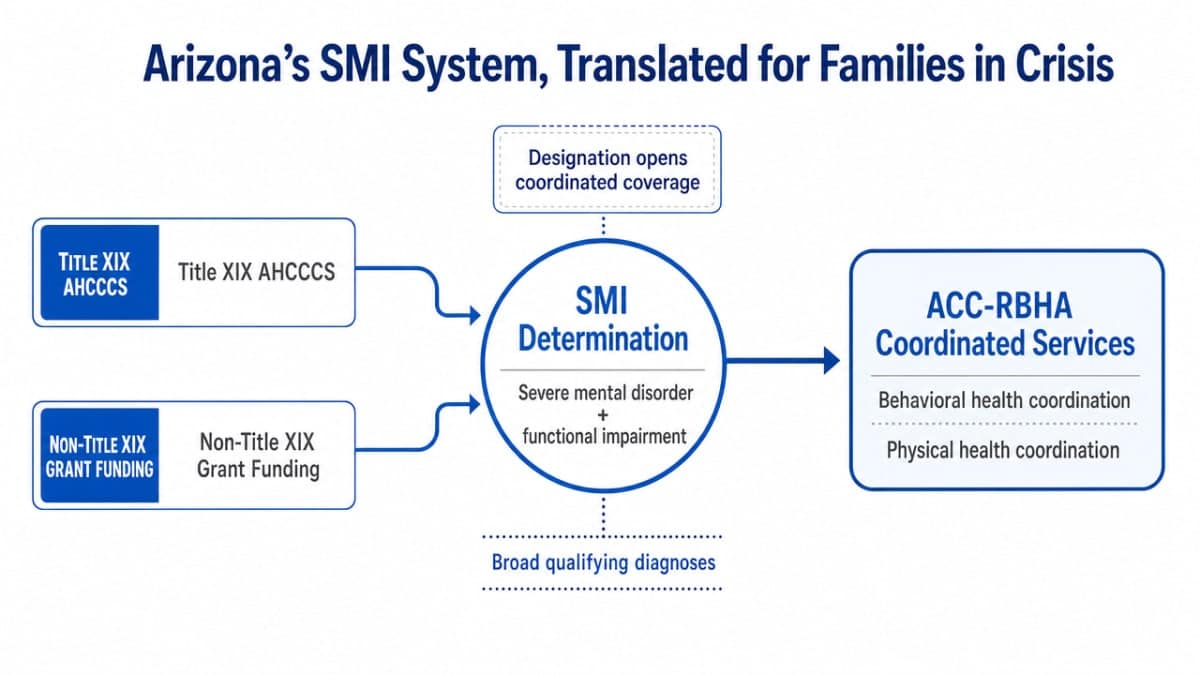
Arizona’s SMI System, Translated for Families in Crisis
The SMI Designation and Why It Opens Doors
The SMI designation is a piece of paperwork that changes what your loved one has access to. Under Arizona law, it is granted when a mental disorder produces emotional or behavioral impairment severe enough that the person cannot remain in the community without long-term supportive treatment 3, 4. The list of qualifying diagnoses is broad—more than 70 conditions across psychotic disorders, bipolar disorders, major depression, other mood disorders, anxiety disorders, and personality disorders can meet criteria when the functional impairment is present 7.
What the designation actually unlocks is coordinated coverage. Once an adult is designated SMI, an AHCCCS Complete Care Regional Behavioral Health Agreement plan—the ACC-RBHA—becomes responsible for coordinating both their physical and behavioral health services in the geographic area where they live 1, 2. That includes access to the community residential treatment system AHCCCS is statutorily required to maintain under A.R.S. § 36-550.01 for adults whose illness is severe enough that ordinary outpatient care will not hold them 5.
The designation also carries protections written directly into Title 9, Chapter 21: the right to appropriate services matched to individual need, the right to treatment in the least restrictive setting that is clinically safe, and the right to freedom from unnecessary seclusion 4. If your loved one has been cycling through emergency rooms, brief inpatient stays, and short residential admissions, pursuing an SMI determination is often the step that changes what the next admission looks like.
ACC-RBHA Coverage, Non-Title XIX Funding, and the Centralized Determination Process
Coverage in Arizona’s SMI system runs on two tracks, and knowing which one your loved one falls into shortens the phone tree considerably.
If they are enrolled in AHCCCS—the state’s Medicaid program—the ACC-RBHA in your region coordinates their care as Title XIX benefits. Since October 1, 2022, that same ACC-RBHA also holds their physical health coverage, so a single plan is responsible for the psychiatrist, the primary care visits, and the residential placement 1, 2. If your loved one is not eligible for AHCCCS because of income, immigration status, or other factors, Arizona provides Non-Title XIX SMI services through state grant funding, delivered through the same ACC-RBHA network 3. Uninsured does not mean unenrolled.
The determination itself now runs through a centralized contractor rather than the local behavioral health office. In 2020, DBHS moved SMI eligibility decisions to Crisis Response Network as a single third-party evaluator, aiming to make the process more consistent across the state 8. In practice, that means the evaluation your loved one completes in Prescott is scored against the same criteria being applied in Flagstaff, Tucson, or Yuma. A performance audit of the broader system has flagged that not every SMI-designated adult receives the full range of services they are entitled to 7, which is one more reason a facility built for higher acuity matters.
What Advanced Protocols Look Like in Practice
Clozapine for Treatment-Resistant Schizophrenia—Titration, ANC Monitoring, and Why It Is Still Underused
Clozapine is the medication most families of someone with treatment-resistant schizophrenia have heard about but never actually seen prescribed. There is a reason for the gap. The American Psychiatric Association’s 2020 practice guideline is unusually direct on this point—patients with treatment-resistant schizophrenia should be treated with clozapine 9. It is the only antipsychotic with strong evidence for symptoms that have not responded to at least two adequate trials of other agents, and the guideline does not endorse antipsychotic polypharmacy as a primary substitute 15.
So why is it not the default answer after a second failed trial? Because clozapine carries a monitoring burden that most outpatient clinics and general residential programs are not staffed to carry. Titration has to start low and move up slowly over weeks to manage sedation, orthostatic drops in blood pressure, and the risk of seizures at higher doses. Absolute neutrophil count testing—the ANC draw—runs weekly for the first six months, then every two weeks, then monthly, because clozapine can suppress the bone marrow’s production of infection-fighting white cells. A prescriber has to be enrolled in the federal REMS program to write for it at all.
One Team for Psychiatric and Substance Use Care
When your loved one has both severe psychiatric illness and a substance use disorder, the old model was to treat them in sequence—stabilize the psychosis at one program, then send them somewhere else for the opioid use disorder, or insist on 30 days of sobriety before a psychiatric admission would even schedule an intake. Families know how that ends. The person relapses because the underlying disorder was never addressed, or the psychiatric symptoms flare because the medication regimen was paused during a detox that was not equipped to hold them.
Current guidance has moved firmly the other direction. SAMHSA’s clinical guidance identifies integrated care as the preferred model for co-occurring disorders, where substance use and mental disorders are treated concurrently to address the full range of a client’s symptoms 10. A 2026 review of dual disorder management reaches the same conclusion, finding that integrated treatment models—one team delivering both addiction and psychiatric services within the same setting—produce better outcomes and are more cost-effective than parallel or sequential care 11.
In practice, that means the psychiatrist adjusting your loved one’s mood stabilizer is in the same clinical meeting as the therapist working on relapse prevention, and both are reading the same chart. Medication decisions account for the substance history. Recovery work accounts for the psychiatric symptoms. Nothing has to be translated between two organizations that were never designed to talk to each other.
Unit-Specific Acuity Planning Under R9-10-315
There is a specific line in Arizona’s behavioral health licensing rules that explains why one facility can accept your loved one and another cannot. Ariz. Admin. Code § R9-10-315 requires that an acuity plan be developed, documented, and implemented for each unit in a behavioral health inpatient facility 12. That plan defines, in writing, the level of clinical need the unit is staffed and equipped to safely manage.
An acuity plan is not a marketing document. It sets staffing ratios during high-risk hours, spells out how quickly a psychiatrist is available on-site or by call, describes how the unit handles active psychosis or acute suicidality, and identifies the presentations that fall outside the unit’s ceiling. When an admissions coordinator tells you their program is not equipped for your loved one’s acuity, they are usually reading straight from that document.
The practical consequence is that acuity capacity is a facility-level decision, not a matter of individual willingness. A program designed around treatment-resistant psychiatric presentations writes a higher ceiling into its acuity plan and staffs to match—more psychiatric coverage, tighter medical oversight, and protocols already in place for the cases others send elsewhere.
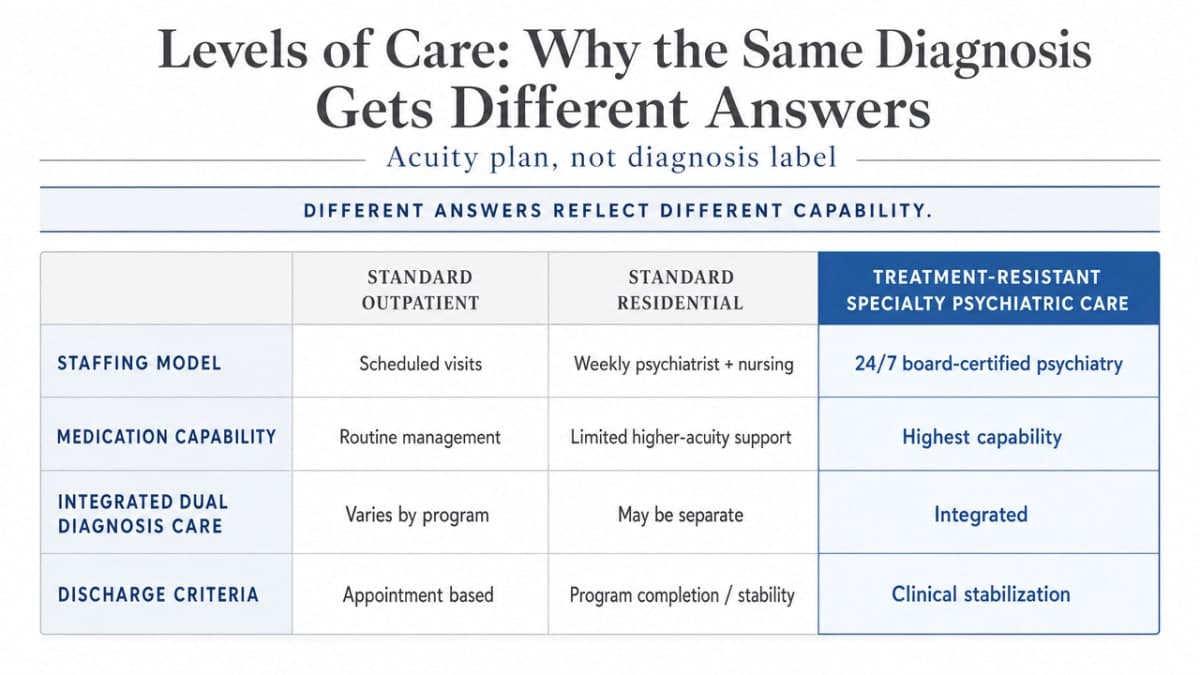
Levels of Care: Why the Same Diagnosis Gets Different Answers
Two adults with the same chart diagnosis of schizoaffective disorder can walk into three different Prescott-area programs and get three different answers about admission. That is not inconsistency. It is the acuity plan doing its job. What actually differs between levels of care is not the diagnostic label but the staffing model, the medication capability, the presence or absence of integrated substance use treatment, and what determines when the stay ends.
The table below lays out those four variables across the three levels of care most families end up considering.
| Capability | Standard outpatient | Standard residential | Treatment-resistant specialty psychiatric care |
|---|---|---|---|
| 24/7 board-certified psychiatry on-site or on-call | No; scheduled appointments, often weeks apart | Limited; typically weekly psychiatrist contact with nursing coverage | Yes; psychiatrist-led care matched to clinical acuity 12 |
| Clozapine initiation and ANC monitoring | Rare; usually referred out | Uncommon; monitoring burden often exceeds staffing | Available as a first-line response to treatment-resistant schizophrenia per APA guideline 9, 15 |
| Integrated psychiatric and substance use treatment on one team | No; parallel referrals | Sometimes; often sequential rather than concurrent | Yes; one team, one chart, concurrent care per SAMHSA and current dual disorder guidance 10, 11 |
| What ends the stay | Symptom check-ins and appointment cadence | Insurance authorization windows | Clinical stabilization documented against the treatment plan |
Read across the treatment-resistant column and the pattern is straightforward. The clinical ceiling is higher because the staffing, the medications, and the co-occurring care are all present in the same building, on the same team, under an acuity plan written to hold that level of complexity 12. Your loved one is not getting a different diagnosis at a specialty facility. They are getting a program built to treat the diagnosis they already have.
Clinically-Determined Treatment Duration vs. the Utilization Clock
Most families of someone with treatment-resistant illness have watched a stay end because the authorization ran out, not because their loved one was stable. The person came home on a medication regimen that had been changed three days earlier, without enough time to see whether the new dose held. Two weeks later, the crisis was back.
That pattern is not a clinical decision. It is a utilization decision, and the two are not the same.
Arizona’s own regulatory framework points the other direction. Title 9, Chapter 21 protects the right to appropriate mental health services based on individual need and the right to treatment in the least restrictive setting that is clinically safe—both framed around the person, not the payer 4. The APA’s 2020 schizophrenia guideline treats hospitalization and step-down decisions as clinical judgments tied to symptom severity, self-care capacity, and risk, not to a preset day count 9.
When a specialty psychiatric facility sets length of stay by clinical stabilization documented against the treatment plan, a clozapine titration gets the weeks it actually needs. A rapid-cycling mood episode is watched through a full cycle before discharge. Your loved one leaves when the plan says they are ready, not when the calendar does.
How ViewPoint Dual Recovery Is Structured for the Cases Others Decline
The size of the population your family is part of is easy to lose sight of when you are the one making the phone calls. NIMH counted 15.4 million U.S. adults with serious mental illness in 2022—6.0% of the adult population—and only 66.7% received any mental health treatment in the prior year 14. A meaningful share of that untreated third are people whose illness is severe enough that ordinary programs cannot hold them. That is the population ViewPoint Dual Recovery in Prescott is built around.
ViewPoint is a Joint Commission-accredited psychiatric treatment facility, licensed by Arizona ADHS and LegitScript certified, that specializes in treatment-resistant psychiatric conditions and dual diagnosis. What that translates to in day-to-day capability is specific. Board-certified psychiatrists lead treatment, which is what makes clozapine titration and same-day medication adjustments possible rather than aspirational 9, 15. Psychiatric and substance use care are delivered by one integrated team working from a single treatment plan, in line with SAMHSA guidance and current dual disorder consensus 10, 11. Treatment duration is set against clinical stabilization documented in the treatment plan, not against an authorization window.
Under Arizona licensing rules, the program’s acuity plan defines what it is staffed to safely treat 12. ViewPoint’s is written for the higher end of that ceiling—active psychosis, treatment-resistant schizophrenia, rapid-cycling bipolar disorder, severe depression with psychotic features, and co-occurring substance use disorders layered on top. That is the ceiling other Prescott-area programs are describing when they say a case is beyond them.
When to Call, and What to Have Ready
Call when standard care is no longer holding. If your loved one has failed two or more antipsychotic trials, is cycling in and out of emergency rooms, has been discharged early because insurance stopped authorizing days, or has been told a program cannot admit them because of active psychosis, suicidality, or a co-occurring substance use disorder, the next call should be to a facility built for that ceiling rather than another program at the same level.
Do not wait for the SMI designation paperwork to be finalized before reaching out. Designation matters for long-term coordination through the ACC-RBHA 1, 2, but a specialty psychiatric admission does not have to wait for it. The determination process now runs through a centralized contractor, which can add weeks 8.
Have these ready when you call:
- a list of every psychiatric medication your loved one has tried, at what dose, and for how long;
- recent hospitalization dates and discharge summaries if you have them;
- any current diagnoses;
- a description of substance use in the last 90 days;
- and insurance information, including AHCCCS enrollment status.
ViewPoint Dual Recovery in Prescott accepts calls about cases other programs have declined. That is what the facility is structured to do.
Find Out If Advanced Care Fits Your Needs
Connect with experts to see if high-acuity treatment is right for your situation.
Frequently Asked Questions
What makes a case ‘too acute’ for most Prescott-area programs?
Usually it is not the diagnosis itself but the presentation on the day of intake. Active psychosis, acute suicidality, rapid-cycling mood episodes, or a co-occurring substance use disorder can push a case past what a program’s unit-specific acuity plan is written to hold 12. That plan defines the staffing and clinical capability the unit can safely offer, and admissions decisions follow it.
Does my loved one need an SMI designation before ViewPoint can help?
No. The SMI designation matters for long-term coordination through an ACC-RBHA and for access to Arizona’s community residential system 1, 2, 5, but a specialty psychiatric admission does not have to wait for it. Because determinations now run through a centralized third-party contractor, the process can add weeks 8. You can pursue designation in parallel with getting your loved one into care.
What is clozapine, and why do so few programs offer it?
Clozapine is the antipsychotic the American Psychiatric Association’s 2020 guideline recommends specifically for treatment-resistant schizophrenia 9. It requires slow titration, weekly absolute neutrophil count monitoring at first, and REMS-enrolled prescribers. Most outpatient clinics and general residential programs are not staffed to carry that monitoring burden, which is why clozapine remains underused even when it is the guideline-indicated answer 15.
How is dual diagnosis care handled when psychiatric symptoms and substance use are both severe?
Concurrently, on one team. SAMHSA identifies integrated care as the preferred model for co-occurring disorders, treating both conditions at the same time rather than in sequence 10. Current dual disorder guidance reaches the same conclusion, finding that one team delivering both addiction and psychiatric services produces better outcomes than parallel referrals 11. Medication decisions and recovery work happen inside the same treatment plan.
Who decides when my loved one is ready to step down from residential care?
In a specialty psychiatric setting, the treatment team does, based on documented clinical stabilization against the treatment plan rather than an authorization window. Arizona’s own rules protect the right to appropriate services matched to individual need and treatment in the least restrictive setting that is clinically safe 4, and the APA guideline treats step-down decisions as clinical judgments tied to symptoms, self-care, and risk 9.
What information should I have ready when I call about admission?
A list of every psychiatric medication your loved one has tried, at what dose, and for how long. Recent hospitalization dates and discharge summaries if you have them. Current diagnoses. A description of substance use in the last 90 days. Insurance information, including AHCCCS enrollment status and whether an SMI designation is in place or in progress 2, 3. Call even if pieces are missing.
References
- Behavioral Health Contracts. https://www.azahcccs.gov/AHCCCS/Initiatives/CareCoordination/behavioralhealth.html
- Behavioral Health Services. https://www.azahcccs.gov/Members/BehavioralHealthServices/
- SMI Designation. https://www.azahcccs.gov/Members/AlreadyCovered/MemberResources/SMIDesignation.html
- Arizona Administrative Code Title 9, Chapter 21 (Behavioral Health Services for the Seriously Mentally Ill). https://apps.azsos.gov/public_services/Title_09/9-21.pdf
- Statewide Community Residential Treatment Plan. https://www.azahcccs.gov/Members/BehavioralHealthServices/Statewide_Community_Residential_Treatment_Plan.html
- AHCCCS Statewide Community Residential Treatment Plan. https://www.azahcccs.gov/Members/Downloads/BehavioralHealthServices/AHCCCS_Statewide_Community_Residential_Treatment_Plan_61119.pdf
- DHS – Behavioral Health Services for Adults with Serious Mental Illness in Maricopa County. https://www.azauditor.gov/sites/default/files/2023-11/06-09_0.pdf
- Transitioning Behavioral Health Services. https://directorsblog.health.azdhs.gov/transitioning-behavioral-health-services/
- The American Psychiatric Association Practice Guideline for the Treatment of Patients With Schizophrenia (2020). https://www.med.unc.edu/psych/epi-nc/wp-content/uploads/sites/720/2024/01/APA-2020-guidelines-1.pdf
- Substance Use Disorder Treatment for People with Co-Occurring Disorders: Treating the Whole Person. https://library.samhsa.gov/sites/default/files/pep20-06-04-006.pdf
- Concurrent (Dual) Disorder Management Guidelines. https://pmc.ncbi.nlm.nih.gov/articles/PMC13117480/
- Ariz. Admin. Code § R9-10-315 – Behavioral Health Services. https://www.law.cornell.edu/regulations/arizona/Ariz-Admin-Code-SS-R9-10-315
- The Arizona Behavioral Health Workforce (Full Report). https://crh.arizona.edu/sites/default/files/2022-03/20210702_AZ_BH_WorkforceReport_FINAL_0.pdf
- Mental Illness. https://www.nimh.nih.gov/health/statistics/mental-illness
- Treatment-Resistant Schizophrenia. https://pmc.ncbi.nlm.nih.gov/articles/PMC7725152/