Key Takeaways
- Depression and alcohol use disorder frequently reinforce each other, carrying worse prognosis and higher suicide risk than either condition alone, which is why single-focus treatment keeps missing 11.
- Anxiety disorders paired with alcohol, cannabis, or sedatives often involve self-medication, substance-induced symptoms, and shared vulnerability at once, so treating only the use leaves the engine running 16.
- PTSD with opioid or alcohol use responds best when trauma work isn’t postponed; federal guidance says co-occurring substance use should not block recommended PTSD treatment 15.
- Bipolar disorder commonly co-occurs with alcohol and cannabis use — pooled prevalence is roughly 42% for alcohol use and 20% for cannabis use among people with bipolar disorder — so one team tracking mood, use, and prescriptions together makes sense 10.
- Schizophrenia-spectrum conditions with stimulant, cannabis, or alcohol use affect roughly four in ten patients, yet many programs decline the complexity rather than treating both pieces 9.
- Major depression with illicit drug use carries about 3.80 times the odds of co-occurrence, and sorting independent from substance-induced symptoms takes weeks of coordinated observation 7.
- Social or generalized anxiety paired with stimulants or cannabis often hides behind functional performance; in a nationally representative sample, about 14.96% of adults with a current anxiety disorder also had at least one substance use disorder 8.
When one program treats half of what you’re carrying
You already know something is off, and you already know it isn’t just one thing.
Maybe the drinking got heavier after the depression settled in, and now you can’t tell which one is driving. Maybe the cannabis started as a way to sleep through the racing thoughts, and now the mood swings are worse than before. If that sounds familiar, the program didn’t fail because you weren’t trying. It treated half of what you were carrying.
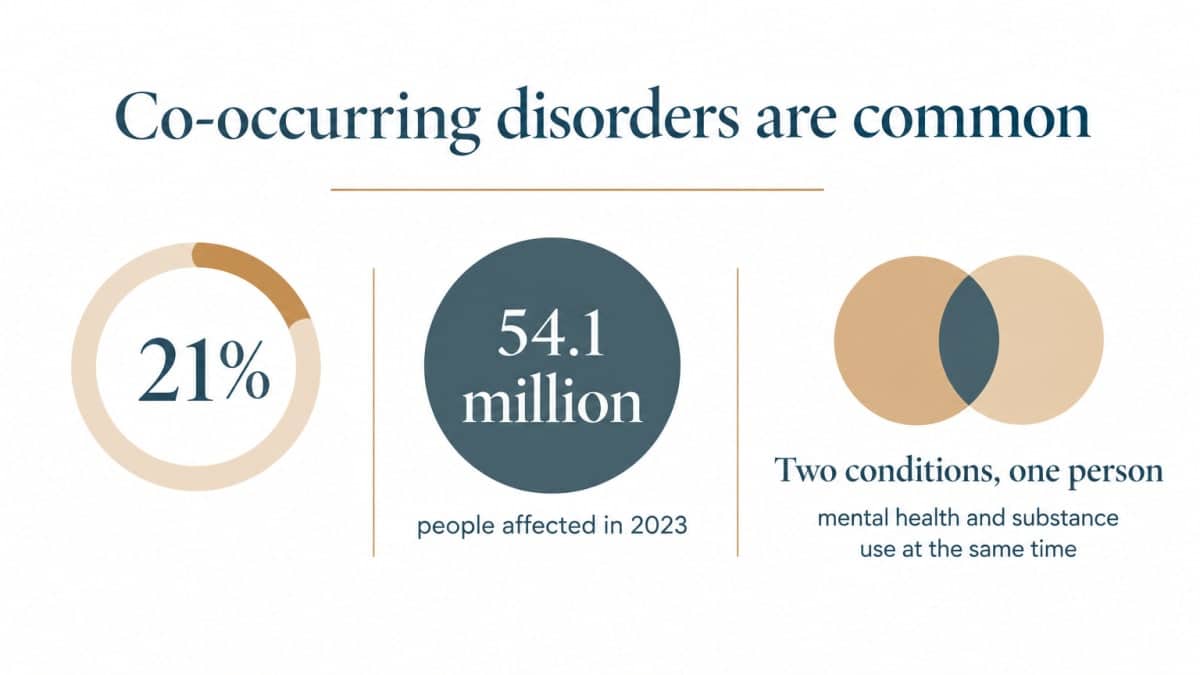
What you’re looking at has a name. Clinicians call it a co-occurring disorder, or dual diagnosis — the same thing, two labels. It means at least one mental health condition and at least one substance use disorder, happening at the same time, in the same person 3. No single pairing defines it. The combinations are as varied as the people living them 1.
And it is common. According to the 2023 National Survey on Drug Use and Health, 21.0% of U.S. adults — about 54.1 million people — had either serious mental illness or a substance use disorder in the past year 4. That figure counts either condition, not just both together, but it sketches the scale of what sits underneath this topic. You are not an unusual case. You are inside a very large group of people whose care has to account for more than one thing at once.
What follows are seven pairings you may recognize — not as diagnoses to self-apply, but as patterns to put a name to. Naming the pattern is where real care starts.
What “dual diagnosis” actually names
Here’s the plain version: dual diagnosis and co-occurring disorder mean the same thing. Two labels, one situation. You have at least one mental health condition and at least one substance use disorder, at the same time 3. That’s it. There is no secret third category, and no required pairing — depression with alcohol, PTSD with opioids, bipolar disorder with cannabis, schizophrenia with stimulants all count, and so do combinations that don’t make the top of any list 1.
What the label doesn’t tell you is which one started first. Sometimes the mental health piece came first and the substance was a way to turn the volume down. Sometimes heavy use pulled mood or anxiety symptoms into the room and they stayed. Clinicians sort this out through assessment over time — watching whether symptoms persist beyond intoxication and withdrawal — rather than guessing at the first visit 11.
The point of the label isn’t to put you in a box. It’s to make sure both pieces get treated in the same place, by people talking to each other, instead of being handed off between programs that each see only half.
Seven pairings that show up in real life
Depression and alcohol use disorder: the drink that quiets the room
You come home, pour one, and the noise in your head goes down a notch. Then two. Then the morning hits and the weight is heavier than it was yesterday, so by evening the drink makes sense again. That loop has a clinical name, and it’s one of the most common pairings there is.
Co-occurring alcohol use disorder and depressive disorders travel together more often than either shows up alone, and when they do, the combination is tougher than either piece on its own. The research is blunt about it: this pairing carries greater severity, worse prognosis, and higher risk of suicidal behavior than either condition by itself 11. That’s not meant to scare you. It’s meant to explain why a program that only addresses the drinking, or only addresses the mood, keeps missing.
The epidemiology backs up what you already sense. In a meta-analysis of population surveys, the pooled odds ratio for alcohol use disorder with major depression was 2.42 7. That’s not a rare overlap. That’s a pattern.
There’s one wrinkle worth knowing. Alcohol itself can produce depressive symptoms that fade once the drinking stops — what clinicians call substance-induced depression — and that looks almost identical to independent depression in the first few weeks 11. A good assessment watches whether the low mood persists past intoxication and withdrawal before locking in the plan. That’s not stalling. That’s getting it right so the medication, therapy, and sequencing actually match what you’re living.
Anxiety disorders and alcohol, cannabis, or sedative use: the edge that won’t settle
You take the edge off with a glass of wine before the dinner. You hit the cart before the meeting. You keep a bottle of something next to the bed for the 3 a.m. spiral. It works, until it doesn’t — until the anxiety is louder on the days you don’t use, and the use is louder every month.
Anxiety disorders and substance use disorders are both common on their own. Lifetime rates in the United States run about 28.8% for anxiety disorders and 14.6% for substance use disorders 16. Put them in the same body and the interaction gets messy fast. Researchers describe three ways this pairing shows up:
- Self-medication (you use because the anxiety hurts)
- Substance-induced symptoms (the use is making the anxiety worse)
- Shared vulnerability (something about biology or history pulls both in the same direction) 16
In real life, you can be living all three at once.
The odds data make this harder to dismiss as coincidence. Alcohol use disorder is associated with roughly 2.11 times the odds of any anxiety disorder in population surveys 7. If you’ve been told your drinking is a willpower issue while nobody asks about the panic that started it, that framing missed half of what you’re carrying.
The reason this pairing matters for care: when self-medication, substance-induced symptoms, and shared vulnerability can all be in play at once, treating only the use leaves the anxiety running the engine. Both pieces have to be in the same room.
PTSD and opioid or alcohol use disorder: the body that won’t stand down
The nightmares came back after the accident, or after the deployment, or after the thing nobody in your family talks about. Opioids made the body stop bracing. Alcohol made the memory stop replaying. Neither one was the plan — they just worked, and then they didn’t.
PTSD with a co-occurring substance use disorder is a well-documented pairing, and the field has been studying how to treat both at once for years. A systematic review of psychological treatments for concurrent PTSD and SUD found that most of the ten protocols studied produced pre-to-post reductions in PTSD and/or substance use symptoms, though few clearly outperformed standard SUD treatment 13. A more recent review focused on adults with a history of adverse childhood experiences was more cautious: effects on PTSD outcomes were small and inconsistent, and there was no clear evidence of benefit on SUD outcomes 14. Translation: the research is honest about not having one perfect protocol yet. That doesn’t mean nothing works. It means your care plan needs to be built, not pulled off a shelf.
Bipolar disorder and cannabis or alcohol use: the cycle that won’t hold
You felt the mood stabilizer start to work, and then a few drinks on a Friday turned into a rough weekend, and by Tuesday the sleep was gone. Or the cannabis took the manic edge off until it didn’t — until the cycles got shorter and the lows got longer and the plan you had with your psychiatrist stopped matching your actual week.
Bipolar disorder and substance use disorders travel together at rates that surprise people who assume this is rare. A meta-analysis of clinical studies pooled the prevalence at approximately:
- 42% for alcohol use
- 20% for cannabis use
- 17% for other illicit drug use among people with bipolar disorder 10
Those are clinical samples, not the general population, so the numbers reflect people already in care — but they tell you how often the pairing shows up when clinicians actually look for it.
What makes this pairing specifically hard for care planning: when use is also in play, the same symptom can be independent, substance-induced, or both, and medication decisions get harder without the full picture 12. Treating the bipolar disorder in one office and the use in another, with no shared chart, usually means two providers chasing a cycle neither one can see fully. The pairing responds better when the same team is tracking mood, use, and medications on the same timeline.
Schizophrenia-spectrum conditions and stimulant, cannabis, or alcohol use: the pattern most programs decline
If you or someone you love is living with a schizophrenia-spectrum condition and using substances, you have probably been told some version of “we can’t take him until he’s clean,” or “we don’t treat psychosis here.” You’ve been bounced between a psychiatric unit and a rehab, and neither one wanted to hold both pieces.
This pairing is common, not fringe. A systematic review and meta-analysis of studies published from 1990 through 2017, covering 123 articles and 165,811 participants, estimated that 41.7% of people with schizophrenia-spectrum disorders had any substance use disorder, with:
- Cannabis at 26.2%
- Alcohol at 24.3%
- Illicit drugs at 27.5%
- Stimulants at 7.3% 9
Roughly four in ten. That is not a rare presentation that programs can politely refuse — that is the baseline reality of the diagnosis across decades of data.
Here is the honest nuance. The VA/DoD schizophrenia clinical practice guideline recommends clozapine for treatment-resistant schizophrenia, and for schizophrenia with a comorbid substance use disorder, it states that current evidence is insufficient to recommend a specific integrated, non-integrated, or psychosocial model in addition to usual care 17. Translation: the research hasn’t crowned one treatment model as universally superior for this pairing. That doesn’t mean the pairing is untreatable. It means it needs clinicians who can hold psychiatric complexity — including clozapine protocols for treatment-resistant cases — while also addressing the use.
If you’ve been turned away because the presentation was “too complex,” that was a limit of the program, not a verdict on the person. Specialized facilities exist for exactly this reason.
Major depressive disorder and illicit drug use: when the fog gets heavier
This one is different from the alcohol pairing even though it rhymes with it. The depression is heavier, and the substance is something stronger — cocaine on hard weeks, pills from someone’s medicine cabinet, something you were offered at a party years ago and kept using. The fog is not the kind you can push through with a walk.
The association between illicit drug use disorders and major depression is one of the stronger ones in the epidemiology. In a meta-analysis of population surveys, the pooled odds ratio for illicit drug use disorder with major depression was 3.80 7. Among a nationally representative U.S. sample of 43,093 adults, about 19.97% of people with a current mood disorder also had at least one substance use disorder 8. One in five. If you’re carrying both, you are in a very large group whose care has to account for the overlap.
What tends to go wrong: a depression protocol built around a weekly therapist and an SSRI loses traction fast if the use isn’t on the same chart. And a drug treatment program that treats depression as a side effect of use often sends someone home still carrying the mood disorder that pulled them in. The sorting — independent depression, substance-induced symptoms, or both — takes time and a clinician willing to watch over weeks, not minutes.
Social or generalized anxiety and stimulant or cannabis use: the push-pull of needing to show up
You can’t get through the morning without something to flatten the dread, and you can’t get through the afternoon without something to turn you back on. Cannabis to come down. Stimulants to show up. The anxiety never actually leaves — it just moves to the next hour.
This pairing shows up quietly because the person running it often looks functional from the outside. Deadlines met. Meetings attended. Nobody at work knows. The epidemiology makes clear it’s not uncommon: about 14.96% of adults with a current anxiety disorder in the NESARC sample also had at least one substance use disorder 8. In meta-analytic odds terms, illicit drug use disorder is associated with roughly 2.91 times the odds of any anxiety disorder 7.
Here’s the trap. Researchers describe anxiety-plus-substance pairings through three overlapping frames — self-medication, substance-induced symptoms, and shared vulnerability — and in real life a person can be living all three at once 16. The use looks like it’s helping until it isn’t, and by then it has its own grip.
A program that treats this as a stimulant problem or a cannabis problem alone usually misses that the anxiety is the engine. One that treats the anxiety without touching the use often watches the person relapse the first week a deadline hits. Both pieces have to be addressed on the same timeline, by people comparing notes.
Why separate tracks keep failing these pairings
If you’ve been through a program that handled one side and watched the other side come back, here’s what probably happened in the chart room: nobody was looking at both at the same time.
Separate tracks fail these pairings for a few concrete reasons:
- Sequencing. A substance use program that says “get stable, then we’ll refer you out for the depression” leaves the mood disorder running in the background while you work through the early weeks of sobriety on your own. By the time the referral opens up, the mood has often pulled the use back in.
- Medication. Decisions about antidepressants, mood stabilizers, or anti-anxiety medications get harder when active use is on the table, because the same symptom can be independent, substance-induced, or both — and a prescriber working without the full picture is guessing 12.
- Sorting. Distinguishing an independent depressive disorder from alcohol-induced depressive symptoms takes weeks of observation past intoxication and withdrawal, not a single intake 11. A split system rarely has the shared timeline to do that work.
The research is now pointing in one direction, carefully. An umbrella review of 28 systematic reviews found that integrated or coordinated treatment generally outperformed treating one condition alone or running parallel, uncoordinated services 18. “Generally” is doing honest work in that sentence — the evidence is strongest for common mental-health conditions and more limited for severe psychotic presentations 17. But the direction is clear: when the same team sees both pieces, the plan stops contradicting itself.
What integrated care actually looks like
When clinicians talk about integrated care, they mean something specific. SAMHSA describes three delivery models for co-occurring disorders:
- Coordinated care, where separate providers talk to each other on a shared plan
- Co-located care, where mental health and substance use services sit under the same roof
- Fully integrated care, where one team treats both conditions together from the first visit
The frame underneath all three is “no wrong door” — if you walk in for either condition, you get screened and treated for the other too 2.
In practice, that looks like one chart. One intake that asks about mood, sleep, trauma, and use in the same conversation. A psychiatrist and a therapist comparing notes about whether the depression is lifting as the drinking stops, or whether it’s staying put and needs its own treatment 11. Medication decisions made with the full picture in view, not guessed at from half of it 12. Phased work that sequences stabilization, active treatment, and relapse prevention around what you can actually hold that week 3.
It’s not magic, and the research is careful. For common depression and anxiety pairings, integrated or coordinated treatment generally does better than parallel services that don’t share a timeline 18. For schizophrenia with substance use, the evidence hasn’t crowned one model yet 17. What stays true across both: when the same team sees both pieces, the plan stops arguing with itself.
Explore Care For Co-Occurring Conditions
Discuss how your mental health and substance use symptoms fit together and what care may be appropriate.
Frequently Asked Questions
Is dual diagnosis the same as co-occurring disorder?
Yes. They are two labels for the same clinical situation: at least one mental health condition and at least one substance use disorder, happening in the same person at the same time 3. Clinicians tend to use “co-occurring disorder” in current federal guidance, and “dual diagnosis” in everyday conversation. Either term fits your experience if both pieces are present.
How do I know if my depression caused the drinking or the drinking caused the depression?
Honestly, you probably can’t know on your own, and a good clinician won’t guess at the first visit. Alcohol can produce depressive symptoms that fade once drinking stops, and that looks almost identical to independent depression for weeks 11. The sorting usually takes watching whether low mood sticks around past intoxication and withdrawal. That observation is what tells the team which treatment to lead with, and in what order.
Can I get PTSD treatment if I’m still using substances?
In most cases, yes. The VA/DoD Clinical Practice Guideline for PTSD suggests that a co-occurring substance use disorder should not preclude recommended PTSD treatments 15. Safety, withdrawal, and sequencing still shape the plan — some stabilization usually comes first — but you don’t have to be fully abstinent before trauma work begins. If a program told you to “get clean first,” that’s not what the current federal guideline says.
Why do separate programs for mental health and substance use keep falling short?
Because the two conditions interact, and separate programs rarely share a chart or a timeline. Medication decisions get harder when active use is on the table 12, and distinguishing independent symptoms from substance-induced ones takes weeks of coordinated observation 11. An umbrella review of 28 systematic reviews found integrated or coordinated treatment generally outperformed parallel, uncoordinated services for common mental-health and substance-use pairings 18. One team, one plan, less contradiction.
How common is it to have both a mental health condition and a substance use disorder?
Common enough that your pairing is not an outlier. In a nationally representative U.S. sample, about 19.97% of adults with a current mood disorder also had at least one substance use disorder, and about 14.96% of adults with a current anxiety disorder did too 8. In clinical samples, the overlap runs higher — pooled prevalence is approximately 42% for alcohol use among people with bipolar disorder 10.
What does integrated treatment actually mean in practice?
It means both conditions are treated by the same team, on the same plan, from the first visit. SAMHSA describes three models — coordinated, co-located, and fully integrated care — with a “no wrong door” approach: walk in for either condition and you’re screened and treated for both 2. In practice, that looks like one intake asking about mood, trauma, sleep, and use together, and prescribers making medication decisions with the full picture.
References
- Redirecting to /substance-use/treatment/co-occurring-disorders. https://www.samhsa.gov/substance-use/treatment/co-occurring-disorders
- Managing Life with Co-Occurring Disorders – SAMHSA. https://www.samhsa.gov/mental-health/serious-mental-illness/co-occurring-disorders
- Substance Use Disorder Treatment for People with Co-Occurring Disorders. https://library.samhsa.gov/sites/default/files/pep20-06-04-006.pdf
- Results from the 2023 National Survey on Drug Use and Health. https://www.samhsa.gov/data/sites/default/files/reports/rpt47095/National%20Report/National%20Report/2023-nsduh-annual-national.pdf
- 2023 NSDUH Detailed Tables | CBHSQ Data – SAMHSA. https://www.samhsa.gov/data/report/2023-nsduh-detailed-tables
- ARIZONA – National Survey on Drug Use and Health. https://www.samhsa.gov/data/sites/default/files/reports/rpt56188/2023-nsduh-sae-state-tables_0/2023-nsduh-sae-state-tabs-arizona.pdf
- Prevalence of comorbid substance use, anxiety and mood disorders in epidemiological surveys, 1990-2014: A systematic review and meta-analysis. https://pubmed.ncbi.nlm.nih.gov/26072219/
- Prevalence and Co-Occurrence of Substance Use Disorders and Independent Mood and Anxiety Disorders. https://pmc.ncbi.nlm.nih.gov/articles/PMC6527250/
- Prevalence of comorbid substance use in schizophrenia spectrum disorders in community and clinical settings, 1990-2017: Systematic review and meta-analysis. https://pubmed.ncbi.nlm.nih.gov/30153606/?dopt=Abstract
- Prevalence of comorbid bipolar and substance use disorders in clinical settings, 1990-2015: Systematic review and meta-analysis. https://pubmed.ncbi.nlm.nih.gov/27476137/
- Alcohol Use Disorder and Depressive Disorders. https://pmc.ncbi.nlm.nih.gov/articles/PMC6799954/
- Efficacy, tolerability, and safety of serotonergic antidepressants in mood, anxiety, and substance-use disorders: A systematic review and meta-analysis. https://pubmed.ncbi.nlm.nih.gov/30102078/
- Psychological treatments for concurrent posttraumatic stress disorder and substance use disorder: a systematic review. https://pubmed.ncbi.nlm.nih.gov/22406920/
- Treatment of post-traumatic stress disorder and substance use disorder in adults with a history of adverse childhood experiences: A systematic review of psychological interventions. https://pubmed.ncbi.nlm.nih.gov/36845903/
- VA/DoD Clinical Practice Guideline for Management of Posttraumatic Stress Disorder and Acute Stress Disorder. https://healthquality.va.gov/guidelines/MH/ptsd/va-dod-cpg-ptsd-full-cpg-edited-111624-v5-81825.pdf
- Anxiety and Substance Use Disorders: A Review. https://pmc.ncbi.nlm.nih.gov/articles/PMC2904966/
- VA/DOD Clinical Practice Guidelines. https://www.healthquality.va.gov/guidelines/MH/scz/VA-DOD-CPG-Schizophrenia-Quick-Reference-Guide_final_508v232024.pdf
- Effectiveness of Psychosocial Interventions for Adults With …. https://pmc.ncbi.nlm.nih.gov/articles/PMC12682421/