Key Takeaways
- Arizona licenses a specific tier of secure behavioral health residential care for people with serious mental illness who are chronically resistant to treatment, distinct from standard psychiatric programs 1.
- Treatment-resistant schizophrenia has defined clinical criteria — 80% adherence over 12 weeks and less than 20% symptom reduction after adequate trials of two antipsychotics — and clozapine is the endorsed next step 10, 11.
- With 66.5% of Arizona overdose deaths involving stimulants and shifting prescribing patterns for buprenorphine and stimulants, dual diagnosis cases require integrated concurrent treatment rather than sequential handoffs 12, 6.
- When vetting an Arizona program, confirm the ADHS license class, on-site clozapine capability, coordination of buprenorphine or stimulant regimens, and whether one team stays assigned to the case.
When Standard Psychiatric Care Keeps Missing
You have already done the work. The intake calls, the 30-day stays, the outpatient rotations, the medication trials that started with promise and drifted into the same familiar wall. Maybe it was your third program. Maybe your seventh. Maybe you are the family member watching someone you love cycle through a system that keeps discharging them a little more tired than the last time.
That exhaustion is real, and it is not a personal failure.
What it usually signals is a mismatch between the acuity of the case and the design of the program. Standard psychiatric care is built for the middle of the bell curve — one primary diagnosis, a predictable medication response, a treatment window that fits a benefit authorization. When a case sits outside those assumptions, the protocol does not bend. The patient does.
Arizona has a specific tier of behavioral health care built for the cases standard programs decline. State rules recognize secure, 24-hour residential settings for individuals with serious mental illness who are chronically resistant to treatment for a mental disorder 1. That regulatory language exists because the clinical reality exists: treatment-resistant schizophrenia, rapid-cycling bipolar, and dual diagnosis do not respond to more of the same at a longer duration.
This guide walks you through what “complex” actually means in a clinical sense, what advanced protocols look like on the ground, and how ViewPoint Dual Recovery in Prescott is structured for the presentations other programs consider too complicated to hold.
What ‘Treatment-Resistant’ Actually Means, Clinically
“Treatment-resistant” is one of those phrases that can feel like a verdict when a clinician says it out loud. It is not.
In the peer-reviewed literature, it is a defined clinical category with numbers attached. For schizophrenia, the working criteria come down to two thresholds you can actually hold a provider to:
- Adherence: the patient has taken at least 80% of prescribed doses over a 12-week window, verified rather than assumed.
- Response: symptoms have reduced by less than 20% after an adequate trial — typically six weeks or more at therapeutic dosing of at least two different antipsychotics 10.
If both boxes are checked and the psychosis is still driving daily life, the case meets criteria. That is the point where the treatment plan is supposed to change, not repeat.
What that looks like in practice is more specific than most families are told. Adequate dosing means the medication reached a serum level that should have worked, not just that a script was written. Adherence at 80% means someone was actually tracking it — pill counts, pharmacy refill data, sometimes blood levels — not relying on self-report during a rushed appointment. And “adequate trial” means the medication was given enough time to work before being swapped out, which is a step many outpatient rotations skip when a patient looks unstable.
When those criteria are met, guidelines are clear about the next step. Clozapine is endorsed as the primary treatment of choice for treatment-resistant schizophrenia, with medication compliance and co-occurring substance use flagged as factors that must be sorted out before or alongside that decision 11. In other words, the field already knows what to do next. The bottleneck is usually access to a program equipped to do it.
Bipolar disorder has its own version of this pattern. Rapid cycling — four or more mood episodes in a year — often signals a case that is not going to be stabilized by a standard mood-stabilizer monotherapy, and requires a psychiatrist willing to build a layered regimen and watch it closely. Depression that has not responded to two adequate trials of different antidepressant classes belongs in the same conversation. So does a substance use disorder that keeps returning after 30-day stays because the underlying mental illness was never treated in the same room.
If you are the one living this, here is what the definition should give you: language. When you can say “we hit the adherence threshold, we did the six-week trial at therapeutic dose, and symptoms did not drop 20%,” you are no longer negotiating with a system that treats your case as vague. You are naming a specific clinical situation that has a specific next protocol.
That is the tier ViewPoint Dual Recovery is built to work at — where the definition is met and the next step is a real one, not another repeat of what already did not work.
The Arizona Regulatory Tier You Should Be Looking For
Not every behavioral health license in Arizona means the same thing. If you are looking at programs and they all describe themselves in similar language, the license class is one of the clearest ways to sort them.
Any mental health or substance use treatment facility operating in Arizona must be licensed by the Arizona Department of Health Services (ADHS), and accreditation from a body like the Joint Commission can affect how state inspections are handled 5. That is the floor. It tells you a program is legitimate. It does not tell you a program is built for a case that has already failed lower-acuity care.
The specific category you want to understand is the behavioral health residential facility (BHRF). Under state rules, a BHRF is defined as a setting that treats individuals whose behavioral health issue limits their ability to be independent, and the population explicitly includes people with schizophrenia, bipolar disorder, depression, personality disorders, and substance abuse 3. When ADHS issues that license, it is not a generic wellness designation. It is a scope-of-service authorization, and Article 7 of the state code requires applicants to specify exactly which services they provide, to which age groups, and under what conditions 2.
There is a further tier that matters for the reader of this article. Arizona rules recognize a secure behavioral health residential facility as one that provides “secure twenty-four-hour on-site supportive treatment and supervision by staff with behavioral health training for persons who have been determined to be seriously mentally ill, who are chronically resistant to treatment for a mental disorder” 1. Read that phrase carefully. “Chronically resistant to treatment” is the exact clinical reality this guide is about. The state built a licensing category around it because the need is real and the staffing model is different.
When you are vetting a program, ask two direct questions. What ADHS license class do you hold, and what is the documented scope of services on file with the state? Anything vague there is a signal. A program equipped for the presentations you have already been through should be able to answer both without hesitation — and ViewPoint Dual Recovery, licensed by ADHS and Joint Commission–accredited, operates inside exactly that framework.
Advanced Medication Management: Clozapine and the Prescribing Landscape
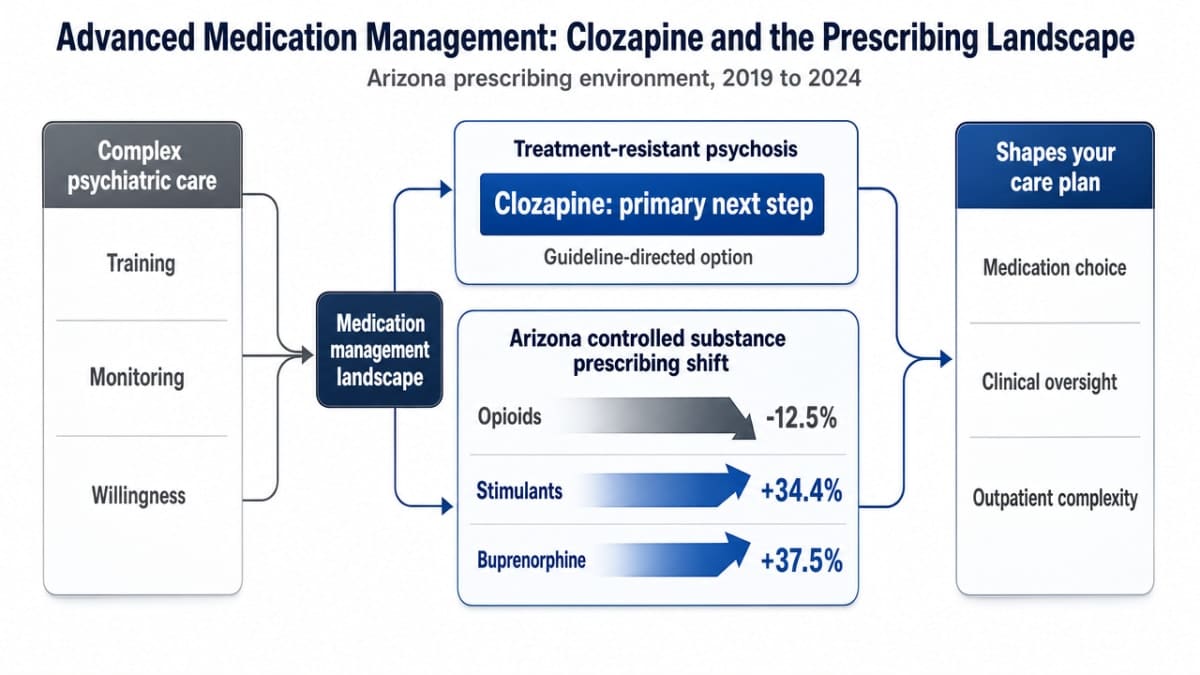
Medication is where complex psychiatric care gets either sharper or more scattered. When you have been through multiple trials, the question is no longer “what should we try next” in a vague sense — it is whether the person prescribing has the training, the monitoring infrastructure, and the willingness to use the medications that most outpatient settings avoid.
Two things shape that landscape in Arizona right now: what the guidelines say about the medications specifically indicated for treatment-resistant psychosis, and what the wider prescribing environment looks like around them. Both matter for your care plan.
Clozapine as the Primary Next Step in Treatment-Resistant Psychosis
If you have met the clinical criteria for treatment-resistant schizophrenia and no one has raised clozapine yet, that is worth naming out loud.
Clozapine is endorsed in the literature as the primary treatment of choice for treatment-resistant schizophrenia, with the caveat that medication compliance and co-occurring substance use should be classified as potentially contributory factors and worked through as part of the decision 11. In plain terms: before or alongside starting clozapine, a real program confirms the adherence data is solid and that active substance use is being treated in the same setting, not left as a separate problem.
Clozapine is also the medication most outpatient psychiatrists are reluctant to start. It requires an ongoing monitoring protocol — regular blood draws to watch white blood cell counts, close tracking for metabolic and cardiac side effects, and a prescriber comfortable with dose titration over weeks. That level of oversight is difficult in a 15-minute med-check model. It fits naturally inside a specialized psychiatric program where a board-certified psychiatrist is on the team and labs, nursing, and clinical response happen under one roof.
That is the practical reason clozapine capability matters when you are vetting a program. It is a marker of what the medical side is actually built to do.
Arizona’s Shifting Prescribing Patterns and What They Mean for Your Care
The medication picture around you has changed more than you may realize in the last five years, and it changes how a psychiatrist has to think about a complex case.
In 2024, Arizona pharmacies dispensed 3,935,380 opioid prescriptions — a 12.5% decrease compared to 2019. Over the same period, stimulant prescriptions rose to 2,100,102, a 34.4% increase, and buprenorphine prescriptions climbed to 367,127, a 37.5% increase 13. Opioids down, stimulants and buprenorphine up. That is the environment your prescriber is working inside.
Each shift has direct implications for a treatment-resistant or dual diagnosis case:
- More people arriving at care are already on prescribed stimulants for ADHD or related presentations, which interacts with psychotic-spectrum symptoms and mood cycling in ways that need a careful review — not a reflexive continuation and not a reflexive discontinuation.
- More patients are on buprenorphine for opioid use disorder, which needs to be coordinated with, not paused for, psychiatric medication changes.
- The drop in opioid prescribing does not mean opioid risk is gone; it means the illicit supply is doing more of the work, which raises the stakes on integrated withdrawal management.
A psychiatrist working a complex case in Arizona has to hold all of this at once: the antipsychotic strategy, any controlled stimulant already on board, medication-assisted treatment for opioid use disorder, and whatever mood stabilizer or antidepressant is layered in. That is not a solo-prescriber task. It is why the medication side of ViewPoint Dual Recovery is set up around a board-certified psychiatric team rather than a rotating outpatient schedule.
Integrated Dual Diagnosis: Treating Both Conditions at Once
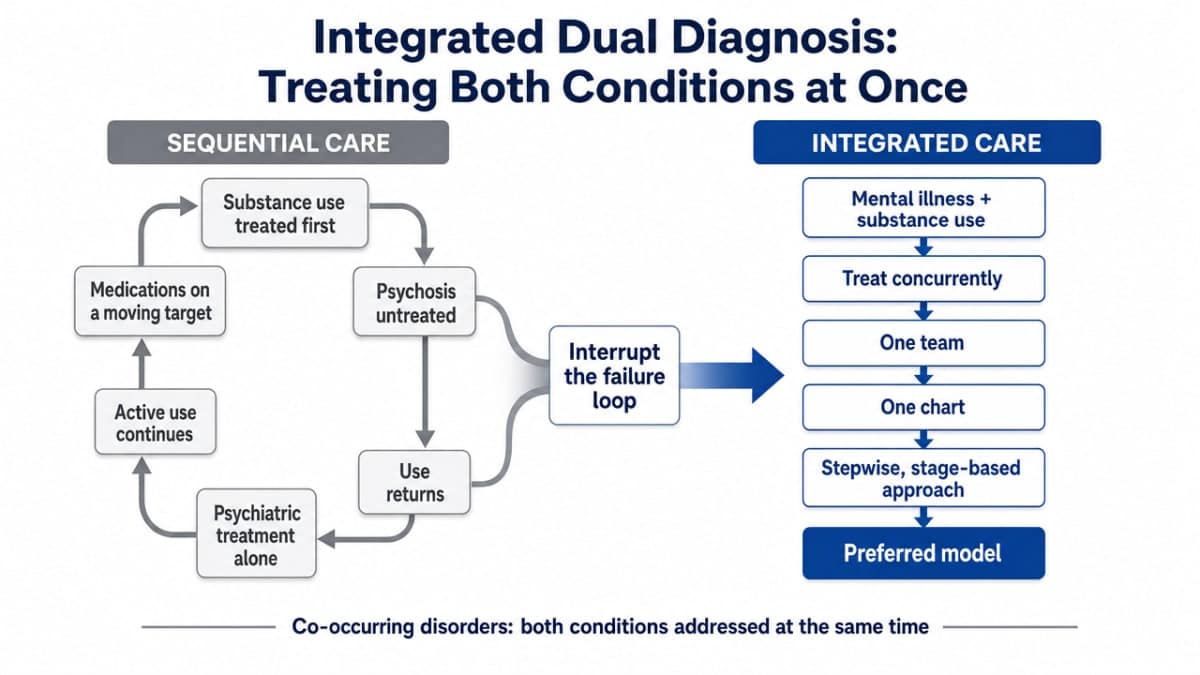
When a mental illness and a substance use disorder are both in the room, the order you treat them in changes the outcome. Try to sober someone up while their psychosis is untreated and the substance use tends to come back. Treat the psychiatric side without addressing active use and the medications you are titrating are landing on a moving target.
Why Sequential Care Keeps Failing Co-Occurring Patients
You have likely lived some version of this loop. A 30-day rehab handles the substances but tells you to follow up with a psychiatrist later. A psychiatric admission stabilizes medications but sends you home with a referral to an outpatient addiction group. Two systems, two intake processes, two sets of clinicians who never quite talk to each other.
That is sequential care, and it is the design flaw underneath most repeat admissions.
Integrated care replaces the handoff. Federal guidance describes it as delivering mental health and substance use treatment concurrently, using specific models like assertive community treatment, integrated case management, dual recovery mutual-support programs, motivational interviewing, and combined psychopharmacological interventions 7. In a residential setting, that means the psychiatrist adjusting your antipsychotic is in the same weekly team meeting as the therapist working your relapse triggers and the nurse tracking your medication-assisted treatment. One case, one plan, one team.
At ViewPoint Dual Recovery, that architecture is the point. When both conditions are treated in the same room by clinicians who share a chart, the medication decisions stop working against the recovery decisions.
The Overdose Risk Environment for Untreated Dual Diagnosis in Arizona
There is a reason integrated care matters more in Arizona right now, and it is worth naming directly.
In the prior 12-month reporting period, Arizona recorded 2,464 overdose deaths. Of those, 70.8% involved at least one opioid and 66.5% involved at least one stimulant 12. Those percentages add up to more than 100 because a large share of deaths involved both classes at the same time — the polysubstance pattern that has become the dominant driver of mortality in the state.
For someone with untreated psychosis, rapid-cycling bipolar, or severe depression layered underneath that use pattern, the risk profile is not additive — it compounds. Psychiatric symptoms drive use. Use destabilizes medications. Destabilized medications worsen symptoms. Somewhere in that spiral, a relapse after a period of reduced tolerance becomes an overdose.
Integrated dual diagnosis treatment interrupts the spiral at more than one point. It treats the psychiatric drivers so the reason to use quiets down. It manages withdrawal and cravings medically so early sobriety is survivable. And it keeps both threads in front of the same team so a medication change on one side gets weighed against the risk on the other.
You are not exaggerating the stakes. The data says you are reading the situation correctly, and it says the response has to be built for both conditions at once.
A Care Team That Stays on One Case Together
Here is a question worth asking any program you are considering: who is actually in the room when decisions about your case get made, and how often are they in that room together?
The answer separates coordinated care from parallel care. In parallel care, a psychiatrist writes a note, a therapist writes a note, a case manager writes a note, and the notes live in the same chart without ever meeting. In coordinated care, the same team looks at the same case at the same time, and the plan that comes out of that meeting is one plan — not three.
NIMH describes coordinated specialty care for schizophrenia as a model that combines medication, psychotherapy, case management, family education, and supported employment or education under one team 8. That is the shape of care built for a serious psychiatric illness, and it is the shape that makes a difference for treatment-resistant presentations specifically. When the psychiatrist adjusting an antipsychotic knows what came up in yesterday’s trauma-focused session, dose decisions get more precise. When the therapist knows a medication change is scheduled for Thursday, the therapy work anticipates it instead of getting blindsided by it.
For a dual diagnosis case, the same principle applies with an extra layer. The addiction side of the plan and the psychiatric side of the plan cannot sit in different meetings. A craving pattern is a psychiatric signal. A mood shift is a relapse signal. Reading them separately means missing what they are telling you together.
At ViewPoint Dual Recovery, the team stays assigned to the case. The same board-certified psychiatrist, the same therapist, the same family counselor — meeting together, working the same chart, revising the same plan. That continuity is quiet, and it does not make for a flashy brochure. But it is the reason cases that have not held together elsewhere start to hold together here. A stable week is not a small thing when you have not had one in a while. It is real evidence that the architecture is working.
How to Vet a Program Built for Complex Cases
By the time you are reading a page like this, you already know the intake process well enough to hear the difference between a real answer and a rehearsed one. Use that. The programs equipped for cases that have already failed lower-acuity care will not flinch at direct clinical questions.
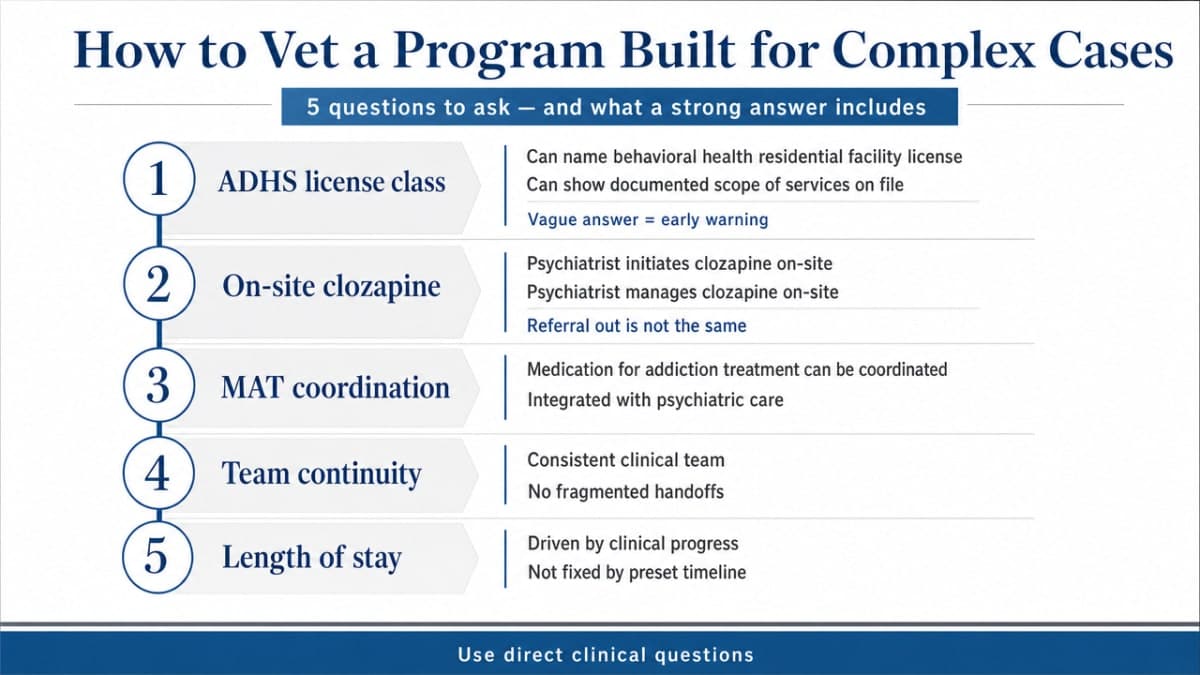
Here is what to ask, and what a good answer sounds like.
What ADHS license class do you hold, and what is your documented scope of services? A program built for chronically treatment-resistant SMI should be able to name its behavioral health residential facility license and point to the scope of services on file with the state 2. Vague answers here are the earliest signal that the program is not designed for the tier of care you need.
Do you have a psychiatrist who initiates and manages clozapine on-site? If the answer is “we can refer out for that,” the program is not equipped for treatment-resistant psychosis. Clozapine is the primary treatment of choice for TRS, and running it well requires the monitoring infrastructure to live inside the facility 11.
How do you handle a patient who arrives on buprenorphine or a prescribed stimulant? Listen for whether the program coordinates those medications into the psychiatric plan or asks you to pause them. Pausing is a red flag for a dual diagnosis case.
Who sits in the weekly treatment team meeting, and does the same team stay on my case? You want to hear psychiatrist, therapist, nursing, and family counselor — in the same room, on the same chart, week over week.
How is treatment length decided? The answer should be clinical progress, not benefit authorization.
ViewPoint Dual Recovery, licensed by ADHS and Joint Commission–accredited, is built to answer all five without hedging 5.
ViewPoint Dual Recovery in Prescott: Where This Architecture Lives
Everything the earlier sections describe — the clinical definition of treatment resistance, the ADHS licensing tier, clozapine-capable psychiatry, integrated dual diagnosis, a team that stays on one case — is not theoretical. It is the operating model of ViewPoint Dual Recovery, a program accredited by The Joint Commission in Prescott, Arizona built specifically for the presentations other facilities decline.
Prescott matters here. The setting is quiet, high-desert, and far enough from the noise of a larger city that stabilization work can actually happen. The clinical intensity is not quiet, though. Board-certified psychiatrists lead the team, medication management is designed to include the protocols outpatient settings tend to avoid, and the addiction side of a dual diagnosis case is treated in the same room as the psychiatric side rather than referred out.
If you are the person who has been through it, or the family member who has been carrying it, here is what is worth holding onto. You are not asking for something unreasonable when you ask for a program built for your actual case. Arizona has a regulatory tier for exactly this level of need, and ViewPoint is licensed and structured to work at it. A stable week is a real win. A stable month is a foundation. That is the ground this program is built to help you find.
Clarify Next Steps for Complex Case Care
Receive tailored clinical feedback to guide treatment for challenging mental health presentations.
Frequently Asked Questions
What makes a psychiatric case ‘complex’ rather than standard?
Complexity usually means one of three things showing up together: a diagnosis that has not responded to adequate medication trials, more than one condition in the picture (like schizophrenia plus a substance use disorder), or a symptom pattern like rapid cycling that does not fit a standard medication template. When any of those are true, a program built for the middle of the bell curve is not going to hold the case, and a higher-acuity setting like ViewPoint Dual Recovery becomes the right fit.
How do I know if a program is actually equipped to handle treatment-resistant schizophrenia?
Ask whether a board-certified psychiatrist on staff initiates and manages clozapine on-site, since clozapine is the primary treatment of choice for treatment-resistant schizophrenia and requires ongoing monitoring inside the facility. Ask how the program verifies medication adherence and tracks symptom response over time. If the answer is that they refer clozapine out, or that adherence is self-reported, the program is not built for this tier of case. You deserve a direct answer here.
Why do standard 30-day programs keep failing when substance use and mental illness are both present?
Because most 30-day programs treat the substance side and refer the psychiatric side out, or the other way around. That handoff is where the loop starts. When the two conditions are treated in different rooms by clinicians who never meet, medication decisions and recovery decisions end up working against each other. Integrated care, where both threads sit in front of the same team on the same chart, is the design difference that stops that pattern.
What Arizona license should a facility hold to treat chronically treatment-resistant SMI?
Look for a behavioral health residential facility (BHRF) license through the Arizona Department of Health Services, and ask specifically about the secure 24-hour treatment authorization. State rules define that category as care for people determined to be seriously mentally ill and chronically resistant to treatment for a mental disorder 1. Ask to see the documented scope of services on file with the state — a real program will show you without hesitation.
Can a family member start the admissions process on behalf of the patient?
Yes, and it is common. Many people who end up at ViewPoint Dual Recovery are first contacted about by a spouse, parent, adult child, or sibling who has been carrying the situation. You can gather records, describe the treatment history, and start the conversation before your loved one is ready to make the call themselves. That preparation is not overstepping. It is often what makes admission possible when the patient is exhausted from repeated cycles.
How is ViewPoint Dual Recovery in Prescott different from a general treatment program?
The scope is narrower and the clinical depth is greater. ViewPoint is built specifically for treatment-resistant psychiatric conditions and dual diagnosis, with board-certified psychiatry available, advanced medication protocols including clozapine, and one integrated team that stays on your case rather than handing it between departments. Treatment length is set by clinical progress, not by a 30-day template. If lower-acuity programs have already tried and not held, this is the tier built for what comes next.
References
- Behavioral Health Residential Facilities Rules Update and …. https://www.azdhs.gov/documents/licensing/residential-facilities/training/behavioral-health-residential-facilities-rules.pdf
- TITLE 9. HEALTH SERVICES CHAPTER 10. DEPARTMENT OF HEALTH SERVICES (Behavioral Health Residential Facilities – Article 7). https://www.azdhs.gov/documents/licensing/residential-facilities/article-7.pdf
- Residential Health Care Institution Licensing Process – The …. https://www.azdhs.gov/documents/licensing/residential-facilities/training/residential-licensure-process.pdf
- SMI Annual Behavioral Health Report (SFY 2024) – AHCCCS. https://www.azahcccs.gov/shared/Downloads/Reporting/2025/2025_SMI_AnnualBeahvioralHealthReport.pdf
- Arizona Summary — State Residential Treatment for Behavioral Health Conditions. https://aspe.hhs.gov/sites/default/files/2021-08/StateBHCond-Arizona.pdf
- Substance Use Disorder Treatment for People with Co-Occurring Disorders. https://library.samhsa.gov/sites/default/files/pep20-06-04-006.pdf
- Adoption of Integrated Care for People with Co-Occurring Mental Health and Substance Use Conditions. https://aspe.hhs.gov/sites/default/files/documents/e2ccdd7991f1de5060983598cb66624f/adoption-integrated-care.pdf
- Schizophrenia – National Institute of Mental Health (NIMH). https://www.nimh.nih.gov/health/publications/schizophrenia
- Behavioral Health Residential Facility Initial Checklist. https://www.azdhs.gov/documents/licensing/residential-facilities/forms/behavioral-health-initial-checklist.pdf
- Treatment Resistant Schizophrenia: Clinical, Biological, and Therapeutic Aspects. https://pmc.ncbi.nlm.nih.gov/articles/PMC6395548/
- Treatment-Resistant Schizophrenia. https://pmc.ncbi.nlm.nih.gov/articles/PMC7725152/
- ADHS Opioid Update (PowerPoint Presentation). https://www.substanceabuse.az.gov/sites/default/files/meeting-documents/materials/4._adhs_opioid_update.pdf
- Arizona Controlled Substances Prescription Monitoring Program (CSPMP) Annual Report 2024. https://pharmacypmp.az.gov/resources/arizona-controlled-substances-prescription-monitoring-program-cspmp-annual-report-2024