Key Takeaways
- Treat Joint Commission accreditation as a proxy site visit: outside surveyors have already observed medication passes, handoffs, and safety systems you cannot inspect from three states away.
- Verify three separate credentials — Arizona ADHS licensure, Joint Commission accreditation, and LegitScript certification — because each covers a different failure mode: legal authority, clinical behavior, and business integrity.
- Demand a concrete definition of ‘integrated’ care: one team, one master plan treating both diagnoses simultaneously, since non-integrated settings produce poor dual diagnosis outcomes 2.
- Ask how the program measures its own fidelity to the integrated model, because IDDT delivered without supervision discipline shows no gains in functioning, psychopathology, or motivation 7.
- Run the admissions call in sequence — verify paperwork first, then probe acuity, integration, fidelity, and 24/7 psychiatric coverage — so specificity, not marketing language, drives your decision.
- Ask about day 31 before day one: durable change often requires 18 months of continuing care, and relapse rates stay high without a strong integrated handoff 4.
- Read reviews for descriptions of clinical mechanics and request tracked outcome metrics at 30, 90, and 180 days rather than accepting testimonials or generic praise.
When You’re Three States Away and the Last Program Didn’t Hold
You’ve done this before. Maybe twice. Maybe more. There was the hospitalization that stabilized your loved one for a week, the 30-day program that ended with a polite discharge summary, the outpatient plan that fell apart by the second missed appointment. Now you’re on your kitchen table with a laptop open to a facility website in a state you’ve never visited, and someone in admissions is going to call you back in an hour.
You can’t fly out this week. You can’t walk the halls, watch a shift change, or ask the nurse in the medication room how she handles a patient on a clozapine titration. What you can do is learn to read the signals that tell you whether the place on your screen is doing the work it claims to do — or just running a nicer website than the last program.
That’s what this guide is for. Not a generic rehab checklist. A way to vet a dual diagnosis hospital alternative for a treatment-resistant case from a distance, using the same signals a regulator or surveyor would use if they walked in the door tomorrow. SAMHSA’s own guidance for families starts in the same place: any program you consider should be licensed and accredited, full stop.1 The rest of this article shows you what those words actually protect you from — and where they stop, so you know which questions you still have to ask yourself.
Accreditation as a Remote Site Visit
Here’s the shift that changes everything about vetting from a distance: The Joint Commission has already been inside the building. Their surveyors have already done the walkthrough you can’t do. They’ve watched a real med pass, pulled real charts, sat in on a real treatment team meeting, and asked staff to explain — in their own words — how they handle a patient who arrives in psychosis with fentanyl still in their system.
That’s what a JCAHO survey actually is. Not a paperwork audit. A multi-day, on-site inspection where trained clinicians observe how the facility behaves when nobody’s rehearsing. They check whether the crash cart is stocked and in date. They watch a shift-change handoff and listen for whether the incoming nurse hears about the patient’s suicidal ideation or just their room number. They pull medication records and trace a single dose from the pharmacy to the patient’s mouth. They ask three different staff members the same safety question and see if the answers match.
When you can’t fly out yourself, this is the closest proxy you’re going to get. SAMHSA’s family guidance treats licensure and accreditation as the baseline — the first filter, not the last one — precisely because these are the checks a family cannot physically perform.1 A state license tells you a facility is legally allowed to operate. Accreditation tells you an outside team has watched it operate and signed off.
ViewPoint Dual Recovery holds Joint Commission accreditation, which means the same surveyor scrutiny has been applied to its Prescott location, its clozapine protocols, its psychiatric team, its handoffs between the psychiatrist and the addiction therapist working the same case. You’re not taking the facility’s word for it. You’re taking the word of the people who watched.
One honest caveat before you exhale: accreditation verifies process and safety systems. It confirms the facility does what it says it does, consistently, against a national standard. It does not, on its own, tell you how your specific loved one will do. That’s a different question, and later sections give you the language to ask it. For now, know this — when a program carries current Joint Commission accreditation, someone qualified has already walked the halls you can’t walk. That’s not the whole vetting job. It’s the part you no longer have to do alone.
Three Credentials, Three Different Guarantees
What Each Credential Actually Verifies
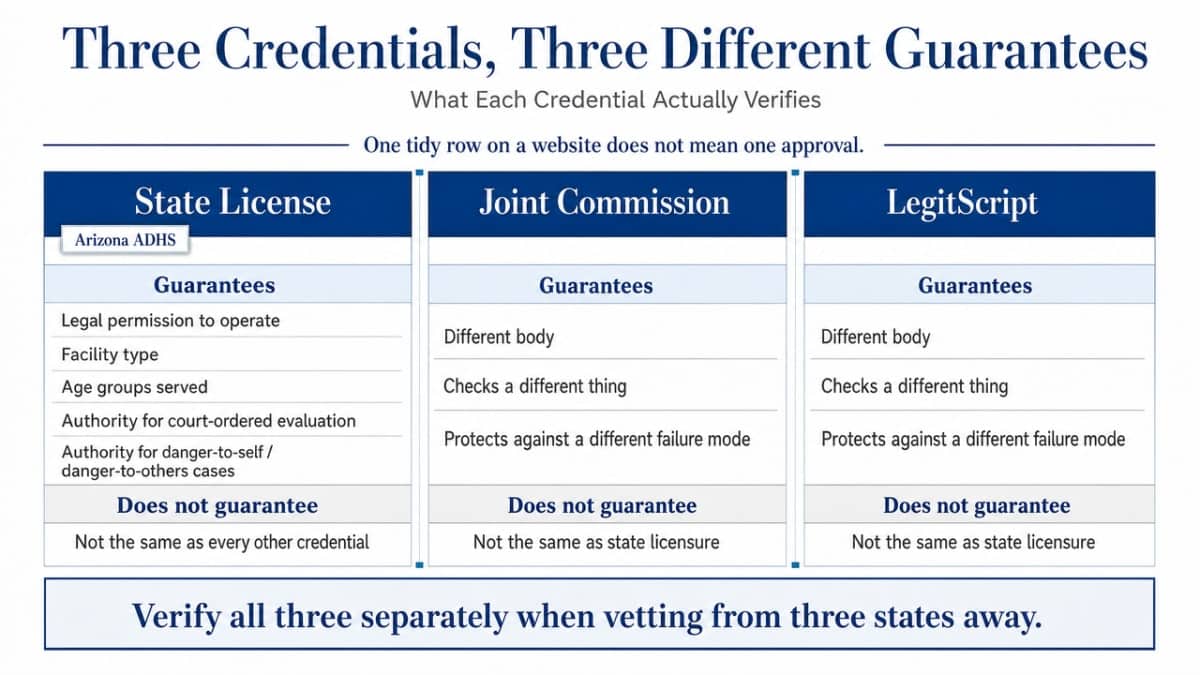
Most facility websites list their credentials in one tidy row: state license, Joint Commission seal, LegitScript badge. It reads like a single stamp of approval. It isn’t. Each of those credentials is issued by a different body, checks a different thing, and protects you from a different failure mode. If you’re vetting from three states away, knowing which one covers what changes the questions you ask next.
State licensure (Arizona ADHS) is the legal permission slip. In Arizona, a behavioral health inpatient facility has to be licensed to operate at all, and the license spells out what kind of facility it is, which age groups it can serve, and whether it has authority to handle court-ordered evaluation or the danger-to-self and danger-to-others cases that define a real treatment-resistant admission.11 It sets minimums — staffing ratios, physical plant requirements, incident reporting. It does not, on its own, say the care inside is good. It says the doors are legally allowed to be open.
Joint Commission accreditation is the clinical behavior check. SAMHSA’s family guidance names accreditation alongside licensure as a baseline quality signal precisely because it goes further than the license does.1 Surveyors evaluate medication management from prescription to administration, staff competence in behavioral health emergencies, safety systems like ligature risk and elopement protocols, and whether the facility performs against national standards on an ongoing basis — not just on the day it filed its paperwork. This is the credential doing the work a family can’t do from a laptop.
LegitScript certification is the business-integrity check. It vets the treatment operation itself — its ownership, its marketing claims, whether it’s running the deceptive patient-brokering schemes that have plagued this industry. It doesn’t audit the clinical floor. It confirms you’re not talking to a scam wearing a clinical costume.
ViewPoint Dual Recovery carries all three: Arizona ADHS licensure, Joint Commission accreditation, and LegitScript certification. Read that as three separate outside bodies signing off on three separate things — the legal right to operate, the clinical behavior on the floor, and the honesty of the business itself. Any facility missing one of those three has a gap you’ll want to ask about directly.
How Arizona’s Regulatory Stack Fits Together
If your loved one is heading to a facility in Arizona, it helps to know who is actually watching. The state’s oversight isn’t one office — it’s a stack, and the stack was reshuffled recently.
At the top of it sits the Arizona Department of Health Services. In 2024, ADHS announced a restructuring so that a dedicated Behavioral Health Facilities Licensing bureau would take over licensing for most behavioral health settings — sober living homes, counseling facilities, outpatient treatment centers, and residential behavioral health facilities.13 Behavioral health inpatient facilities, though, sit under the Medical Facilities Licensing side, alongside general and special hospitals.11 That distinction matters when you’re vetting a hospital alternative, because “inpatient” in Arizona means the facility is regulated at the higher-acuity tier — the tier that can legally treat someone meeting criteria for danger to self, danger to others, or grave disability.10
For you, three states away, this is more than trivia. When you call ADHS’s Behavioral Health Provider Training and Licensing Resources page and confirm a facility’s license is active, you’re checking one layer.9 When you verify accreditation on The Joint Commission’s Quality Check, you’re checking the second. If either lookup comes back missing, stale, or under corrective action, you have a specific, factual reason to slow down — not a gut feeling, but a paper trail. ViewPoint is a licensed Arizona behavioral health provider offering non-residential psychiatric and dual diagnosis treatment with current Joint Commission accreditation, which means you can verify both layers yourself before the admissions call resumes.
What ‘Integrated’ Has to Mean Before You Trust the Word
Almost every facility website uses the word “integrated.” It’s on the homepage, in the brochure PDF, in the admissions script. What it means varies wildly, and the difference between the versions is the difference between your loved one getting better and coming home in the same shape they left.
Here’s the technical definition, the one the research uses: integrated dual diagnosis treatment means the mental health condition and the substance use disorder are treated at the same time, by the same clinical team, in the same treatment plan. Not psychiatry this month and rehab next month. Not the psychiatrist on one floor and the addiction counselor on another, comparing notes by email. One team, one plan, both problems addressed as the connected system they actually are.
Why this matters for a treatment-resistant case: when your loved one has rapid-cycling bipolar disorder driving compulsive stimulant use, or trauma symptoms driving opioid relapse, treating one condition while ignoring the other tends to make the ignored one worse. The SAMHSA evidence report reviewing eight controlled studies of integrated dual diagnosis programs found that integrated programs outperformed non-integrated ones across the outcomes that matter to a family — substance use, psychiatric symptoms, housing stability, hospitalization rates, arrests, functional status, and quality of life.2 The same report is blunt about what happens when a program lacks integration: dual diagnosis clients in mental health settings without integrated substance use interventions have poor outcomes. Full stop.
Washington State’s best-practices guidance reaches the same conclusion and adds a piece you need for your list of questions: dual diagnosis patients who participate in more outpatient continuing care after discharge show better substance use, psychiatric, and employment outcomes.3 Integration isn’t just about what happens inside the 30 or 60 days at the facility. It’s about whether the same integrated logic follows your loved one home.
So when the admissions counselor tells you the program is integrated, you have three specific things to confirm:
- Does the psychiatrist and the addiction clinician sit on the same treatment team for your loved one’s case, or are they parallel services that don’t actually meet?
- Is there one master treatment plan that names both diagnoses and how each intervention addresses both, or two separate plans stapled together?
- When the facility hands off to aftercare, does it hand off to a provider who can continue integrated care — or does it split the handoff between a psychiatrist and a separate addiction program, undoing the integration on discharge day?
ViewPoint’s clinical model puts the board-certified psychiatrist and the therapist on the same case, collaborating on one plan for treatment-resistant psychiatric conditions with co-occurring substance use — including the trauma-driven and clozapine-managed presentations where sequential care tends to fail. That’s the technical version of the word. Ask any facility you’re considering to describe theirs in the same concrete terms. If they can’t, the word on their website is decoration.
The Fidelity Question Accreditation Can’t Answer
Accreditation confirms the facility runs the systems it says it runs. It does not, by itself, tell you whether the integrated dual diagnosis model on the brochure is being delivered with discipline every day, on every case, by every clinician. That gap between “we do IDDT” and “we do IDDT with fidelity” is where a lot of treatment-resistant cases quietly fall through.
Here’s what the research shows, and it’s worth sitting with for a minute. When a large state behavioral health system implemented Integrated Dual Disorder Treatment as a high-fidelity evidence-based model — meaning close adherence to the protocol, ongoing supervision, measured competencies — the outcome improvements were significant.8 But when researchers looked at IDDT rolled out in routine clinical practice, without the same fidelity discipline, the results were narrower: patients used alcohol and drugs on fewer days, but there was no significant improvement in psychopathology, day-to-day functioning, therapeutic alliance, or motivation to change. The training itself didn’t clearly improve clinicians’ knowledge or motivational interviewing skills.7
Read those two studies together and the lesson lands hard. The same treatment name can produce meaningfully different outcomes depending on how tightly the program holds itself to the model. For a treatment-resistant case — the kind where standard rehab and standard psychiatric stabilization already didn’t hold — the difference between a high-fidelity program and a name-only program is the difference between another discharge summary and actual movement.
So when you’re on the phone with admissions, this is the question layer accreditation can’t answer for you. Ask directly:
- How does the program measure its own fidelity to the integrated care model?
- Who supervises the psychiatrist and the addiction clinician on shared cases, and how often?
- What outcome metrics does the facility track past discharge, and can they describe what changed for patients like your loved one — not in marketing language, but in specifics?
- What kind of continuing training and supervision do clinicians receive, and how is motivational interviewing skill actually assessed?
A program that answers these questions with concrete detail — supervision schedules, fidelity checklists, outcome tracking windows — is telling you it’s watching itself the way surveyors watched it. A program that answers with brochure phrases is telling you the label is doing the heavy lifting. You’ve already lived through one program where the label was doing the heavy lifting. You don’t need to live through another.
The Afternoon Phone-Call Sequence
Verify the Paperwork Before You Talk to Admissions
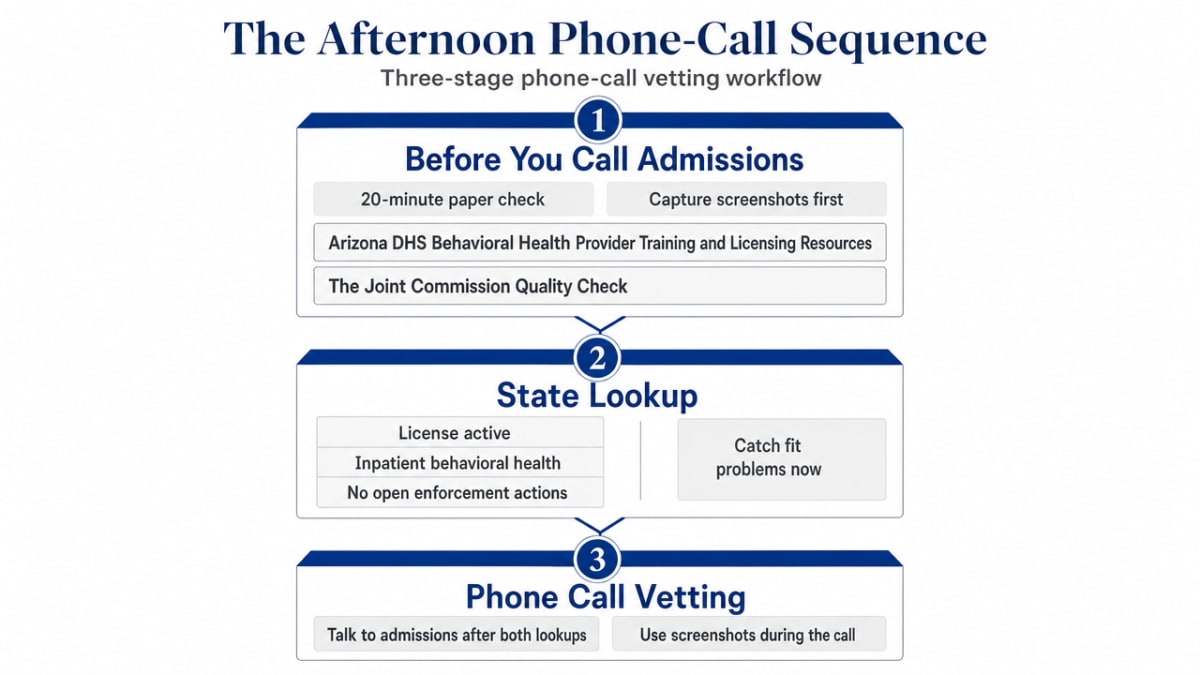
Before you dial admissions, spend twenty minutes doing what a surveyor would do first: check the paper. You want two lookups done and screenshotted before anyone with a sales incentive is on the line with you.
Start with the state. Go to the Arizona Department of Health Services Behavioral Health Provider Training and Licensing Resources page and search the facility by name.9 You’re confirming three things: the license is active, it’s the right type for your loved one’s acuity (behavioral health inpatient, not outpatient or residential), and there are no open enforcement actions. If a facility is treating danger-to-self or danger-to-others cases without inpatient authority, that’s a fit problem you want to catch now.10
Then go to The Joint Commission’s Quality Check and search the facility. You’re looking for a current accreditation with no expiration flag and no gap in the record. SAMHSA’s family guidance treats licensure and accreditation as the paired baseline for any program worth considering.1 If either one is missing or stale, you have a factual reason to stop.
Save both screenshots. Note the license number and the accreditation date. You’ve just given yourself a paper trail the admissions counselor can’t talk you out of.
The Clinical Call: Scripts You Can Read Off the Page
Now the harder call. This is the one where you’re going to feel outmatched — the counselor does this fifty times a week, and you’re doing it while trying not to cry into a coffee cup. Read from the page. That’s what the page is for.
Open with the acuity question: “My loved one has [treatment-resistant bipolar / schizophrenia on clozapine / trauma-driven opioid use]. Walk me through how a case like that gets handled in your program from admission through week two.” You’re not asking whether they treat it. You’re asking them to describe the actual clinical sequence. Vague answers are answers.
Then the integration question, phrased so they can’t route around it: “On a shared case, does the same psychiatrist and the same addiction clinician sit on one treatment team, or are they parallel services? Is there one master treatment plan naming both diagnoses, or two?” The research is unforgiving on this — dual diagnosis patients in settings without truly integrated substance use interventions have poor outcomes.2 You want to hear “one team, one plan.”
Then the fidelity question, which is the one accreditation can’t answer for you: “How does your program measure its own fidelity to the integrated model? Who supervises the clinicians on shared cases, and how often?” When IDDT gets rolled out without fidelity discipline in routine practice, patients cut their drug and alcohol days but don’t gain on functioning, psychopathology, or motivation.7 The counselor’s specificity here — supervision schedules, competency checks, named protocols — is what separates a program watching itself from a program wearing a label.
Close with medication: “Who covers psychiatry overnight and on weekends? Are there board-certified psychiatrists on staff, and do you have experience with clozapine titration and monitoring?” For a treatment-resistant case, the answer to this is not optional. ViewPoint’s board-certified psychiatric team and clozapine protocols exist because that acuity requires them. If the facility on your call can’t match that answer, note it.
The Continuity Call: What Happens on Day 31
The last call is the one most families skip, and it’s the one that determines whether the work inside the facility holds. Ask about discharge before you ask about admission.
The systematic review of integrated treatment for dual disorders is direct: relapse rates stay high without strong aftercare, and comprehensive integrated care needs 18 months or more to produce durable change.4 Whatever happens in the first 30 or 60 days is a starting point, not the finish. Washington State’s best-practices guidance adds the corollary — dual diagnosis patients who participate in more outpatient continuing care after discharge do better on substance use, psychiatric symptoms, and employment.3
So the questions are concrete. “Who plans the discharge, and when do they start? Do you hand off to a provider who continues integrated care, or do you split the handoff between psychiatry and a separate addiction program? How do you coordinate with an out-of-state family — do you help us find a provider near home who can pick up the same treatment plan? What does your team do if my loved one relapses in month three?”
A program that answers with names, timelines, and a written aftercare protocol is treating day 31 as part of the treatment. A program that answers with “we give you a list” is handing you back the problem you started with.
Reading Satisfaction and Outcome Signals From a Distance
Accreditation and licensure get you past the front door. What sits behind the door — how patients and families actually experienced the care — is a different signal, and one you can partially read from three states away if you know where to look.
Start with treatment satisfaction. The systematic review of dual diagnosis client satisfaction found that programs with an explicit dual diagnosis focus produced greater client satisfaction than standard programs without that focus.5 That’s a useful filter for reading reviews. When you scroll through what former patients and families have written, look for language that describes the integration itself — the psychiatrist and the therapist talking to each other, one plan addressing both diagnoses, staff who understood a complex presentation without flinching. Generic “they saved my life” reviews are warm but thin. Reviews that describe the clinical mechanics are the ones telling you something.
Then ask the facility directly for its own outcome tracking. Not testimonials — tracked metrics. What percentage of patients complete the recommended length of stay? What does the facility measure at 30, 90, and 180 days post-discharge? How often do patients return to a higher level of care? A program that treats day 31 as part of the treatment has answers.3 A program that doesn’t will pivot to marketing language. That pivot is your signal.
See If Advanced Dual Diagnosis Care Fits
Clarify next steps for complex, treatment-resistant psychiatric and substance use challenges with professional guidance.
Frequently Asked Questions
Is Joint Commission accreditation the same as a state license?
No. A state license is the legal permission to operate — in Arizona, a behavioral health inpatient facility has to hold one to open its doors at all. Joint Commission accreditation is a separate, voluntary review by outside surveyors who evaluate clinical behavior, safety systems, and medication management against national standards. SAMHSA’s family guidance treats both as baseline signals, not substitutes.1
How do I verify a facility’s accreditation and licensure from out of state?
Two lookups, twenty minutes. Search the facility on the Arizona Department of Health Services Behavioral Health Provider Training and Licensing Resources page to confirm an active license at the right acuity tier.9 Then search The Joint Commission’s Quality Check for current accreditation with no gaps. Screenshot both. If either lookup comes back stale or missing, you have a factual reason to pause before the admissions call resumes.
What does ‘integrated’ dual diagnosis treatment actually mean?
It means the psychiatric condition and the substance use disorder are treated at the same time, by the same clinical team, under one master treatment plan — not sequential care, not parallel services in different offices. The SAMHSA evidence report found integrated programs outperform non-integrated ones on substance use, psychiatric symptoms, hospitalization, and functional status.2 If a facility can’t describe integration in those concrete terms, the word is decoration.
If a program is accredited, why do I still need to ask about fidelity and outcomes?
Accreditation confirms the facility runs the systems it claims to run. It doesn’t measure how tightly clinicians hold to the integrated model day to day. When IDDT was rolled out in routine practice without fidelity discipline, patients cut their drug and alcohol days but showed no significant gains in psychopathology, functioning, or motivation.7 Ask about supervision schedules, competency checks, and post-discharge outcome tracking to close that gap.
What questions should I ask about aftercare before admission?
Ask who plans discharge and when it starts, whether the handoff continues integrated care or splits it between psychiatry and a separate addiction program, and how the team coordinates with an out-of-state family to find a local provider. The systematic review of integrated treatment notes that durable change often needs 18 months or more, and relapse rates stay high without strong continuing care.4
How is a hospital alternative different from a psychiatric hospital for treatment-resistant cases?
A psychiatric hospital typically stabilizes an acute crisis over days. Meaning it can treat danger-to-self, danger-to-others, and grave disability cases10 — while offering clinically-driven treatment duration, board-certified psychiatric leadership, and integrated dual diagnosis care. For treatment-resistant presentations, that longer runway is often what stabilization alone couldn’t deliver.
References
- Quality Treatment for Mental Health, Drugs and Alcohol. https://www.samhsa.gov/find-support/learn-about-treatment/finding-quality-treatment
- Integrated Treatment for Co-Occurring Disorders: The Evidence. https://library.samhsa.gov/sites/default/files/ebp-kit-the-evidence-10242019.pdf
- Co-Occurring Mental Health and Substance Abuse Disorders (Best Practices). https://www.dshs.wa.gov/sites/default/files/BHSIA/dbh/documents/cobestpract.pdf
- Review of integrated mental health and substance abuse treatment for patients with dual disorders. https://www.ncbi.nlm.nih.gov/books/NBK67188/
- Dual diagnosis clients’ treatment satisfaction – a systematic review. https://www.ncbi.nlm.nih.gov/pmc/articles/PMC3101156/
- [Efficacy of integrated dual disorder treatment for dual disorder patients: a systematic literature review]. https://pubmed.ncbi.nlm.nih.gov/29638237/
- Effectiveness of Integrated Dual Diagnosis Treatment in Routine Clinical Practice. https://pubmed.ncbi.nlm.nih.gov/30352668/
- Integrated Dual Disorder Treatment Implementation in a Large State Behavioral Health System. https://pubmed.ncbi.nlm.nih.gov/27234036/
- Behavioral Health Provider Training & Licensing Resources (Arizona Department of Health Services). https://www.azdhs.gov/licensing/bbhl-facilities/index.php
- Article 3. Behavioral Health Inpatient Facilities (Arizona Licensing Rules). https://www.azdhs.gov/documents/director/administrative-counsel-rules/rules/rulemaking/hci/inpatient/hci-bh-inpatient-facilities-new-rules-2014.pdf
- Licensing HCI Bureau Overview (Arizona). https://goyff.az.gov/sites/default/files/meeting-documents/materials/licensing_hci_bureau_overview.pdf
- Arizona Licensing Rule Text (includes accreditation-related licensing provisions). https://grrc.az.gov/sites/default/files/June%20Final%20Files_1.pdf
- Restructuring our licensing bureaus to better address the needs of the state. https://directorsblog.health.azdhs.gov/restructuring-our-licensing-bureaus-to-better-address-the-needs-of-the-state/