Key Takeaways
- Bipolar II is defined by at least one hypomanic episode plus at least one major depressive episode, with no lifetime history of full mania 1.
- Hypomania often feels like relief or productivity rather than illness, which is why bipolar II frequently gets missed and treated as unipolar depression for years.
- Quetiapine is the only first-line treatment listed for acute bipolar II depression, while antidepressants used without a mood stabilizer carry real risk of switching, mixed symptoms, or rapid cycling 3.
- Depression that outlasts two or more adequate treatment trials, rapid cycling, mixed features, or co-occurring substance use are signals to seek specialized integrated care rather than continue in a general setting 2, 3.
The Diagnosis That Often Gets Missed First
If you’ve spent years being treated for depression that never fully lifts, that experience is real, and it matters. Many people who end up with a bipolar II diagnosis start somewhere else first — usually with a diagnosis of major depression, sometimes with anxiety, sometimes with a label that keeps shifting every few years. The depressive episodes are what bring you into a clinic. The hypomania, the part that would actually point a clinician toward bipolar II, often slips past because it can feel like relief, productivity, or finally being okay.
That’s the quiet problem at the center of this condition. Bipolar II is defined by at least one hypomanic episode and at least one major depressive episode, with no history of full mania 1. Hypomania is shorter and less destructive than mania, so you might not have flagged it, and neither did the person prescribing your antidepressant.
This guide walks through what bipolar II actually is, how clinicians piece together a diagnosis from your lifetime mood pattern rather than a single test 1, what the evidence says about treatment, and when a more specialized care setting is the right next step.
Understanding Bipolar II: Episode Types and Distinctions
The Two Episode Types That Define It
Bipolar II lives in the space between two very different mood states. To meet the diagnosis, you need a history of at least one hypomanic episode and at least one major depressive episode, and you can’t have ever had a full manic episode 1. That last part is what separates bipolar II from bipolar I. If mania shows up at any point in your life, the diagnosis shifts.
Hypomania is a distinct period where your mood is noticeably elevated, expansive, or irritable, paired with a jump in energy or goal-directed activity. It is a clear change from how you normally function — not just a good week 1. People around you can usually tell something is different, even if you can’t.
The depressive episode is the heavier side. A period of persistent low mood, loss of interest, changes in sleep and appetite, slowed thinking or restlessness, worthlessness, and sometimes thoughts of death or suicide 1. For most people with bipolar II, this is the side that takes up the most calendar time, which is why depression is usually what gets treated first.
Hypomania vs. Mania vs. Major Depression
These three episode types get blurred together constantly, and the differences matter for your diagnosis and your treatment plan. Hypomania and mania share a lot of surface features — elevated mood, racing thoughts, less need for sleep, more talking, risky decisions — but they aren’t the same episode on a sliding scale. They cross different clinical lines 1.
- Hypomania
- is shorter and less severe than mania. You function, sometimes better than usual on paper. Hospitalization isn’t typically needed. It can still damage relationships, finances, and sleep, but the damage tends to be quieter and easier to explain away 1.
- Mania
- is more severe and sustained. Functioning breaks down and hospitalization is often necessary for safety 1. A single lifetime manic episode moves the diagnosis to bipolar I.
- Major depressive episodes
- look the same in both bipolar I and bipolar II: persistent low mood, lost interest, sleep and appetite shifts, fatigue, worthlessness, and possible suicidal thinking 1. In bipolar II, these episodes are often recurrent and frequently more disabling than the hypomania that officially defines the diagnosis 3.
The practical upshot: bipolar II is not bipolar I with the volume turned down. It’s a different pattern, with the depressive side doing most of the harm and the hypomanic side doing most of the hiding.
What Hypomania Actually Feels Like
Here’s the trap: hypomania often doesn’t feel like a problem. It feels like the version of you that finally got it together.
You wake up before your alarm and you’re not groggy. Ideas arrive faster than you can write them down. You answer every email, start three new projects, text people you’ve been meaning to text for months. You need less sleep — maybe four or five hours — and you still feel sharp. You might feel more charming, funnier, more attractive. Confident in a way that’s been missing for years. If you’ve just climbed out of a depressive stretch, this can feel like proof that the depression was the aberration and this is who you really are 1.
Then the edges show. Your thoughts start racing instead of flowing. You interrupt people. You open a credit card, book a trip, start a fight on social media at 2 a.m., or sleep with someone you wouldn’t normally. Irritability creeps in — small annoyances feel like personal attacks. You take on more than you can finish, then can’t understand why your coworkers look worried 1.
Hypomania marks a clear shift from your usual self, visible enough that people close to you notice, even if you don’t 1. That’s the diagnostic line. The emotional line is harder. You may remember the episode as one of your best weeks. A partner or sibling may remember it as the week they couldn’t reach you.
This is why hypomania gets missed in appointments. No one walks into a clinic to report feeling great. If a prescriber only hears about the depression, they treat the depression — and the mood pattern underneath keeps running.
The Depressive Side People Live With Longest
Most of your bipolar II calendar isn’t the hypomania. It’s the depression — recurrent episodes that often feel heavier than what friends mean when they say they’ve been down 3.
What this side looks like day-to-day is familiar if you’ve lived it. Sleep that either won’t stop or won’t come. A body that feels weighted. Food that tastes like nothing, or constant snacking that doesn’t satisfy. Concentration that slips — you reread the same email three times. Shame that circles: about work you didn’t do, calls you didn’t return, the version of yourself you were during the last hypomanic stretch. Thoughts of death can show up here too, and they deserve to be named, not minimized 1.
Why ‘Bipolar Lite’ Is the Wrong Frame
You’ve probably heard someone — maybe even a clinician — describe bipolar II as the lighter version. The one without the hospitalizations. The one you can mostly manage with a little therapy and some sleep hygiene. That framing is wrong, and it has consequences for how seriously you take your own treatment plan.
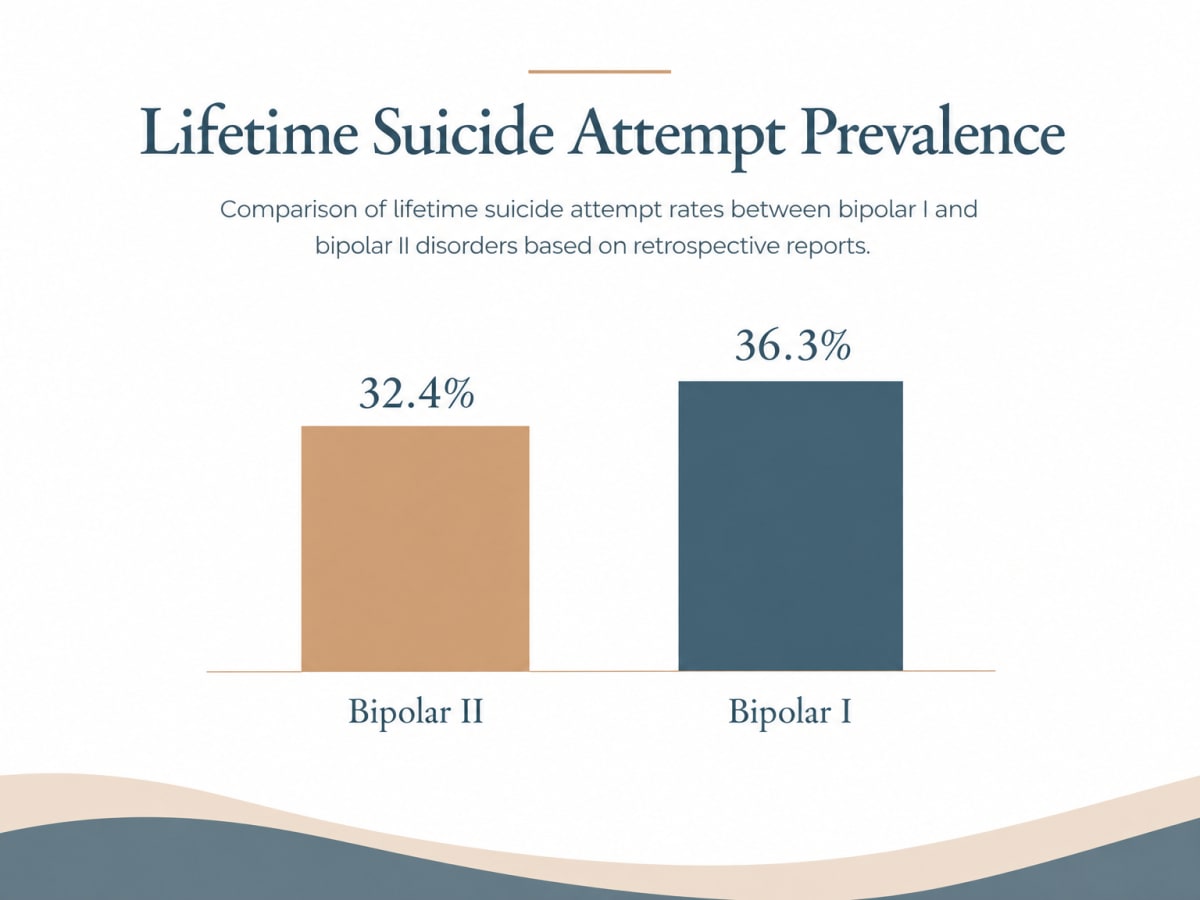
The clearest way to see this is through suicide risk. In a review and meta-analysis pooling retrospective reports across studies, 32.4% of people with bipolar II reported a lifetime suicide attempt, compared with 36.3% of people with bipolar I — a difference that wasn’t statistically significant 8. These numbers come with real limits: they’re based on people recalling past attempts, drawn from clinical samples that skew toward more severe illness, and they don’t tell you about any single person’s risk. But they are enough to end the ‘milder’ conversation.
What drives that risk in bipolar II isn’t a dramatic manic crisis. It’s the depression — recurrent, long, often undertreated because it got labeled unipolar for years. Taking your diagnosis seriously, including the parts that feel quiet, is part of staying safe.
How Clinicians Actually Diagnose Bipolar II
The Longitudinal Interview and Screening Tools
There is no blood test for bipolar II. There is no brain scan that settles it. The diagnosis comes from a clinician sitting with you long enough to map your mood pattern across your whole life, not just the stretch that brought you in 1. That means questions about your worst depressive episodes, your best weeks, your sleep, your family history, your relationships, your spending, and the times other people worried about you even when you felt fine.
A good evaluation goes backward in time. When did your first depressive episode happen? Have there been periods — even short ones — when you needed much less sleep and still felt wired? Did a parent, sibling, or grandparent ever get diagnosed with bipolar disorder, treated with lithium, or hospitalized for a mood episode? These threads matter more than any single appointment 1.
Validated screening tools help structure the conversation. The VA/DoD 2023 guideline suggests using an instrument like the Mood Disorder Questionnaire, the Hypomania Checklist, or the Bipolar Spectrum Diagnostic Scale when bipolar disorder is suspected in specialty mental-health care 2. These are not diagnostic by themselves — a positive screen means a longer conversation, not a label.
What Gets Ruled Out First
Before bipolar II lands as the working diagnosis, a careful clinician checks what else could explain the pattern. A physical exam and medical testing help rule out other illnesses that can mimic mood symptoms 1. Substance use can also produce mood swings that look a lot like hypomania or depression, so a current and past substance-use history is part of the interview 2.
Other psychiatric conditions overlap too. ADHD, anxiety disorders, trauma-related conditions, and some personality presentations can share features with bipolar II. The deciding question is usually whether you have discrete episodes — distinct periods lasting days or weeks that mark a clear change from your baseline — or a more continuous pattern 1. Getting that right is what makes the diagnosis stick.
Treatment That Reflects the Bipolar II Evidence
Medication: What the Guidelines Actually Say
Bipolar II treatment doesn’t borrow its prescription from bipolar I, and that matters when you’re reading your discharge summary or asking your prescriber why they chose what they chose. The CANMAT and ISBD 2023 update is the clearest map here. For an acute bipolar II depressive episode, quetiapine is the only first-line treatment listed. Second-line options include lithium, lamotrigine, bupropion, sertraline, venlafaxine, lumateperone, and ECT 3.
That short first-line list isn’t a mistake. It reflects how little bipolar-II-specific trial evidence exists compared with bipolar I. A 2025 systematic review of lithium and lamotrigine in bipolar II pulled from 2,326 records and found only 10 randomized trials covering 645 participants, with the overall evidence judged scarce and of very low certainty 4. A smaller single-blind randomized comparison of lithium and lamotrigine in 44 people with newly diagnosed bipolar II over 20 weeks found comparable efficacy among completers, with lamotrigine showing fewer severe side effects — useful information, but a small study 5.
Lumateperone is FDA-approved for depressive episodes associated with bipolar I or bipolar II in adults, as monotherapy or adjunctively with lithium or valproate 6. A post hoc analysis suggested relevance for mixed-feature presentations, though it pooled bipolar I and II participants and shouldn’t be read as definitive bipolar-II-specific proof 7.
Antidepressants are where this gets careful. Guidelines reserve them mainly for pure, nonmixed depression and flag real risk of switching, mixed symptoms, or rapid cycling when used without a mood stabilizer 3. If your current prescriber hasn’t walked you through why they picked what they picked, that’s a reasonable question to bring to the next appointment.
Psychotherapy and the Case for Combining Both
Medication isn’t the whole plan. Therapy aimed at your sleep, your daily rhythms, and your closest relationships does measurable work in bipolar II depression — not as a soft add-on, but as a core piece.
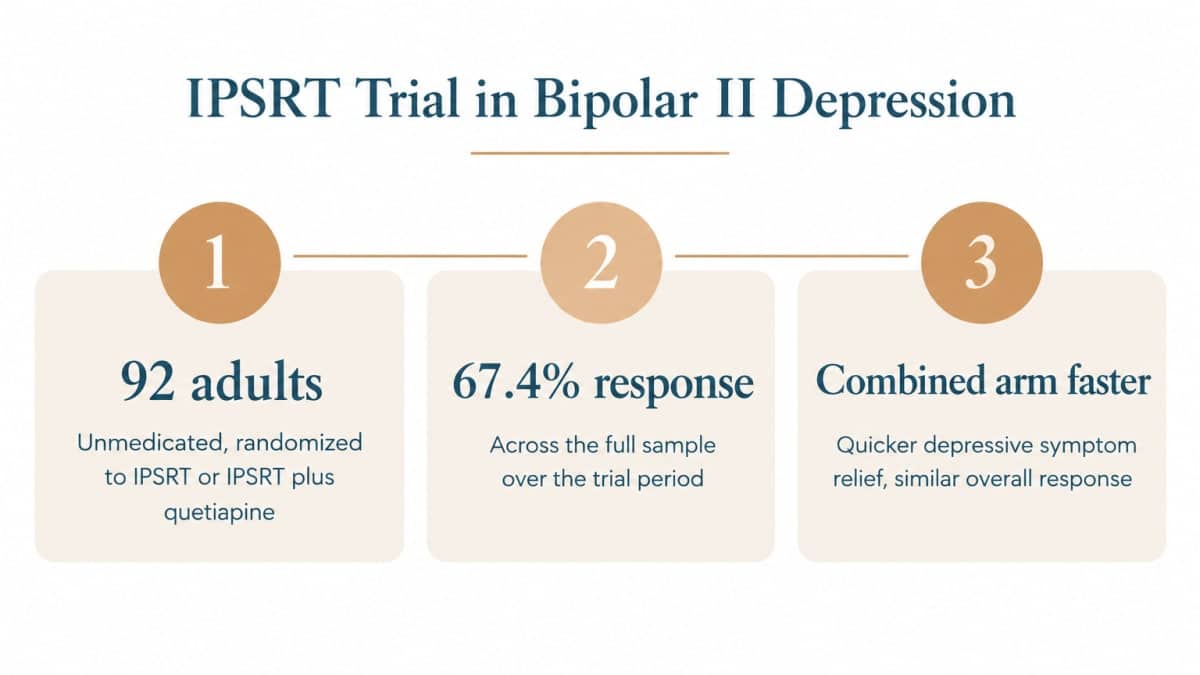
Interpersonal and social rhythm therapy, or IPSRT, focuses on stabilizing the daily patterns that bipolar mood swings tend to disrupt: when you wake up, when you eat, when you see people, when you wind down. In a randomized controlled trial of 92 unmedicated adults with bipolar II depression, IPSRT alone and IPSRT combined with quetiapine both improved symptoms over time, with a 67.4% response rate across the full sample. The combined arm improved more quickly on depressive symptoms, though overall response rates didn’t differ significantly between the two groups 9.
What that means for you: therapy focused on routine and relationships is a real treatment, not a placeholder while you wait for a pill to work. Adding medication can speed up the depression lifting, which matters when you’re in a long episode and losing ground at work or at home.
Other evidence-informed approaches used alongside medication include cognitive behavioral therapy, family-focused therapy, and psychoeducation about mood tracking, sleep protection, and early warning signs 3. The right mix depends on your episode history, your support system, and what you’ve already tried. If therapy hasn’t been part of your plan, raising it is a legitimate next move.
When Standard Treatment Isn’t Working
Sometimes the first plan doesn’t hold. The depression keeps coming back, a medication helps for three months and then stops, side effects become unlivable, or hypomania slips through despite a mood stabilizer. That’s not a personal failure — it’s information. Treatment-resistant bipolar II depression is common enough that major guidelines carve out specific next steps.
The VA/DoD 2023 guideline flags several options when standard treatment stalls:
- Repetitive transcranial magnetic stimulation, or rTMS, is one.
- Short-term light therapy is another, particularly when seasonal pattern plays a role.
- Electroconvulsive therapy, or ECT, remains the strongest tool for severe, treatment-resistant, or safety-critical depressive episodes 2. CANMAT and ISBD also list ECT among second-line options for acute bipolar II depression 3.
Before you escalate interventions, a careful clinician usually goes back and checks the basics:
- Is the diagnosis still right, or has the picture shifted — mixed features, rapid cycling, something else running underneath?
- Are substances or sleep disruption pulling the floor out?
- Are the medications at therapeutic doses and taken consistently?
- Have antidepressants been quietly contributing to cycling 3?
If you’ve been through two or more adequate trials of guideline-concordant treatment without a durable response, that is the point where asking about a care setting built for complex bipolar presentations — ideally one with 24/7 psychiatric coverage and the ability to coordinate medication strategy, therapy, and any co-occurring conditions in one place — is reasonable, not dramatic.
Complex Presentations That Need a Different Setting
Not every bipolar II case fits the clean textbook arc of discrete hypomanias, discrete depressions, and a medication that holds. Some presentations run harder, and the care setting has to match.
Rapid cycling is one. Mixed features, where depressive and hypomanic symptoms show up in the same episode, are another. Both complicate medication decisions, especially around antidepressants, which carry higher risk of worsening the pattern in these presentations 3. Co-occurring substance use is common and changes everything about safety, medication choice, and relapse risk; the VA/DoD guideline explicitly flags integrated treatment for people with bipolar disorder and a substance-use disorder rather than treating them in separate silos 2. Trauma history that was never addressed, long-standing anxiety, or a depression that has outlasted two or more adequate guideline-concordant treatment trials all point in the same direction 3.
If that’s your picture — multiple episode types in one year, substances tangled into the mood pattern, prior programs that treated one piece and missed the others — a facility with 24/7 psychiatric coverage, advanced medication management, and genuinely integrated dual diagnosis care is a reasonable escalation, not an overreaction. In Prescott, Arizona, ViewPoint Dual Recovery is one setting built for exactly that complexity.
Building a Safety Plan You Can Actually Use
A safety plan isn’t a crisis-line magnet on the fridge. It’s a short, specific document you write when you’re well, so a future version of you — tired, in a long depressive episode, or coming down off a hypomanic stretch — doesn’t have to think it up from scratch.
Keep yours concrete. Name your early warning signs: sleeping less than five hours for two nights, spending above a dollar amount you set in advance, canceling on people you usually see, thoughts that your family would be better off without you. List two people you’ll text — by name, not role — and what you’ll say to them. Write down your prescriber’s number, your therapist’s number, and 988. Note which medications you have at home and ask your prescriber whether reducing access during depressive stretches is reasonable 2.
Review it with someone who knows you. Update it after every episode. The plan works because it’s yours, not because it’s perfect.
What to Do Next
If you’ve read this far and recognized yourself in it, that recognition is worth something. Here’s what to do with it.
- Write down your mood pattern before your next appointment. Not a diary — a timeline. When did your first depressive episode happen? Have there been stretches when you needed less sleep, moved faster, spent more, or felt unusually sharp? When family members have worried, what were they worried about? Bring this to a clinician who evaluates bipolar II specifically, not just depression 1.
- If you’ve already been diagnosed, ask your prescriber how your current medications line up with bipolar II treatment guidelines, and whether therapy focused on sleep and daily rhythms belongs in your plan 3, 9.
- If your depression has outlasted two or more adequate treatment trials, if substances are tangled in, or if episodes keep returning, specialized integrated care is a reasonable next step — not an overreaction. You’ve carried this long enough.
Explore Care for Complex Bipolar 2
Discuss your symptoms and learn whether specialized treatment may fit your needs.
Frequently Asked Questions
Is bipolar II milder than bipolar I?
No. Hypomania is shorter and less destructive than mania, but bipolar II is driven by recurrent, often long depressive episodes that carry serious risk. Lifetime suicide-attempt rates in bipolar I and bipolar II are not statistically different in pooled retrospective data 8. Different pattern, comparable seriousness.
How is bipolar II different from regular depression?
Can antidepressants alone treat bipolar II depression?
Usually not safely. Guidelines reserve antidepressants mainly for pure, nonmixed depression and flag real risk of mood switching, mixed symptoms, or rapid cycling when they’re used without a mood stabilizer 3. For acute bipolar II depression, quetiapine is the only first-line option listed, with lithium, lamotrigine, and others as second-line 3.
How long does it take to get an accurate bipolar II diagnosis?
There’s no single test. Diagnosis depends on your lifetime symptom pattern — severity, duration, frequency, family history — pieced together across one or more careful appointments 1. Screening tools like the MDQ, HCL, or BSDS help structure the conversation, but a positive screen means a longer interview, not an immediate label 2.
Do I need medication, therapy, or both for bipolar II?
Often both. In a randomized trial of 92 unmedicated adults with bipolar II depression, interpersonal and social rhythm therapy alone and combined with quetiapine both improved symptoms, with a 67.4% response rate overall; the combined arm improved more quickly 9. Therapy that stabilizes sleep and daily rhythms is a real treatment, not a placeholder.
When should I look for specialized bipolar II care instead of a general provider?
If your depression has outlasted two or more adequate guideline-concordant treatment trials, if rapid cycling or mixed features are showing up, or if substance use is tangled into the mood pattern, that’s the point to ask about specialized care 2, 3. A setting with 24/7 psychiatric coverage and integrated dual diagnosis treatment matches that complexity.
References
- Bipolar Disorder – National Institute of Mental Health (NIMH). https://www.nimh.nih.gov/health/publications/bipolar-disorder?concern=/
- VA/DoD Clinical Practice Guideline for the Management of Bipolar Disorder – Quick Reference Guide. https://www.healthquality.va.gov/guidelines/MH/bd/VA-DoD-CPG-BD-Quick-Reference-GuideFinal508.pdf
- The CANMAT and ISBD Guidelines for the Treatment of Bipolar Disorder: Summary and a 2023 Update of Evidence. https://pmc.ncbi.nlm.nih.gov/articles/PMC11058959/
- Lithium and lamotrigine for the treatment of bipolar II disorder. https://pubmed.ncbi.nlm.nih.gov/40288449/
- A Single-Blind Randomized Comparison of Lithium and Lamotrigine in the Treatment of Bipolar II Disorder. https://pubmed.ncbi.nlm.nih.gov/34181361/
- CAPLYTA (lumateperone) capsules, for oral use. https://www.accessdata.fda.gov/drugsatfda_docs/label/2025/209500s016lbl.pdf
- The Efficacy of Lumateperone in Patients With Bipolar Depression With Mixed Features. https://pubmed.ncbi.nlm.nih.gov/37103915/
- Suicide attempts in bipolar I and bipolar II disorder: a review and meta-analysis of the evidence. https://pmc.ncbi.nlm.nih.gov/articles/PMC4536929/
- Psychotherapy Alone and Combined With Medication as Treatments for Bipolar II Depression: A Randomized Controlled Trial. https://pubmed.ncbi.nlm.nih.gov/28703949/