Key Takeaways
- Standard 28-day rehabs fail this population because borderline traits like emotional dysregulation, impulsivity, and abandonment sensitivity collide with rigid group structures, producing predictable dropout and relapse 1, 3.
- Evidence-based psychotherapies for co-occurring PD and SUD—DBT-SUD, dynamic deconstructive psychotherapy, and dual-focus schema therapy—require at least six months and treat both conditions concurrently rather than sequentially 1, 14.
- Integrated care means one team, one plan, and stage-matched interventions where a slip becomes clinical data rather than grounds for administrative discharge 6, 8.
- Plan for the mismatch between clinical need and authorization windows: length of stay tied to a calendar, deferred personality work, or polypharmacy without clear targets signals a program unlikely to hold 2, 9.
Why the last rehab didn’t hold
You completed a 28-day program, perhaps multiple times. You detoxed, attended groups, and left with a discharge plan. Yet, within weeks, the familiar struggles returned: conflict, emptiness, and the certainty of isolation, leading back to substance use and shame.
What often goes unacknowledged is that if a personality disorder underlies your substance use, a standard rehab program was never equipped to address your specific needs. The emotional volatility, impulsivity, and fear of abandonment that fuel addiction are precisely the traits that make short, rigid, group-focused programs ineffective. Dropout and relapse in this population are not personal failings but predictable clinical outcomes of this comorbidity, extensively documented in treatment literature 1, 3.
This understanding is crucial because the solution isn’t more willpower or stricter rules. It requires a different kind of program—one that treats both conditions simultaneously, employs therapies specifically designed for this combination, and measures treatment duration by clinical progress rather than arbitrary authorization windows 8, 14. This article explores what such a program entails, the supporting evidence, and key questions to ask when evaluating treatment options.
The comorbidity that breaks standard programs
How often personality disorders sit underneath addiction
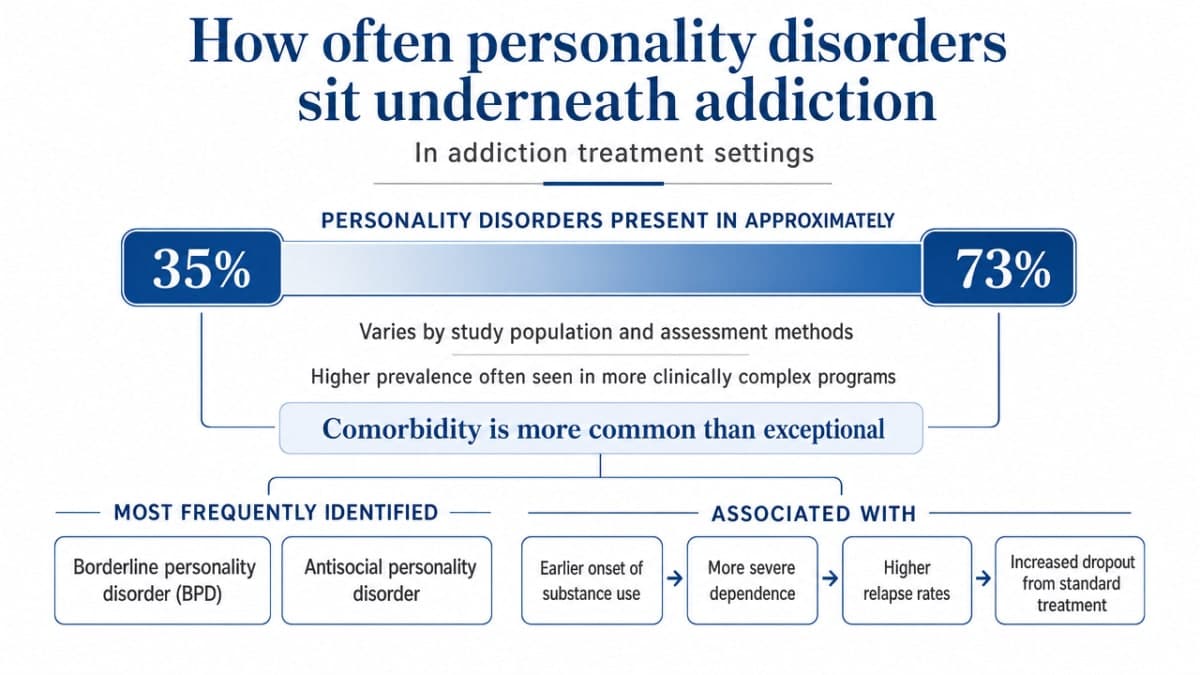
If you’ve ever felt like you were the only one struggling to “just do the program,” the statistics might surprise you. Narrative reviews indicate that personality disorders are present in approximately 35% to 73% of individuals in addiction treatment settings, depending on the study population and assessment methods 1. This range reflects various settings, with higher prevalence often observed in more clinically complex programs. Regardless, personality disorder comorbidity is more common than exceptional in addiction treatment.
Borderline personality disorder (BPD) and antisocial personality disorder are the most frequently identified. Their presence is associated with earlier onset of substance use, more severe dependence, higher relapse rates, and increased dropout from standard treatment 1. Therefore, if your last program ended prematurely or your discharge summary mentioned “non-compliant,” you were likely part of the demographic most frequently encountered by such programs, yet least effectively supported. Acknowledging this reality is the first step toward seeking appropriate care.
The mechanism: why BPD traits collide with rehab mechanics
Consider the structure of a typical 28-day program: fixed duration, intensive group therapy, a points-and-privileges system, strict rules with consequences, confrontational group feedback, and a fluctuating peer group. While this framework can be effective for straightforward substance dependence, it often triggers individuals with co-occurring borderline features.
BPD traits—such as intense, rapidly shifting emotions, impulsivity under stress, an unstable sense of self, and a heightened sensitivity to abandonment—do not disappear upon admission. They persist. Consequently, a peer’s critical feedback can escalate into a shame spiral, rule enforcement may feel like rejection, and a counselor’s absence can be perceived as abandonment. The urge to leave, confront, or self-medicate is not a lack of motivation but the disorder manifesting in an environment unprepared to manage it 1, 3.
This explains the consistent outcome data: co-occurring PD and SUD predict higher relapse and treatment dropout rates than either condition alone 1, 3. The same emotional dysregulation driving substance use also drives premature exits from treatment. Standard programs often misinterpret these exits as motivational issues, whereas evidence points to a fundamental mismatch between the clinical presentation and the treatment environment 13, 14. If your previous treatment ended abruptly, this pattern is diagnostic and indicates the need for a different, more tailored approach.
What the 28-day model gets structurally wrong
Duration: the six-month floor the evidence keeps returning to
The evidence consistently points to a minimum treatment duration that challenges conventional rehab models. A narrative review of psychotherapies for co-occurring personality disorder and substance use reveals that every evidence-based treatment requires at least six months 1. This is not a preference but a clinical necessity. Specialized approaches like DBT-SUD, dynamic deconstructive psychotherapy, and dual-focus schema therapy are designed to unfold over months because the foundational skills of emotion regulation and relational stability cannot be acquired in just four weeks.
Comparing this to the typical 28, 30, or 60-day programs offered by the addiction industry highlights a significant disparity. A 28-day stay represents only about 15% of the shortest clinically indicated treatment arc for this presentation. Relapsing at day 45 is not a sign of weak will; it often means discharge occurred during what most PD-focused protocols consider the early-middle stage, leaving individuals with insufficient time to consolidate gains.
Sequencing: why ‘get sober first, then treat the PD’ backfires
The common advice to “get sober first, then work on personality issues” is, for this comorbidity, a detrimental approach. The very traits that impede sustained abstinence—emotional crises, impulsive decisions, and the belief that therapists will eventually abandon them—are precisely what personality-focused therapies are designed to address. Delaying treatment for these issues until stable sobriety is achieved is akin to expecting a wound to heal before it’s cleaned.
Clinical literature strongly refutes this sequential logic. Reviews on BPD with comorbid addiction advocate for treating both conditions as early as possible, in a thematically hierarchical manner, prioritizing life-threatening behaviors, then addressing substance use and personality symptoms concurrently within a single treatment plan 14. A study on Good Psychiatric Management demonstrated that simultaneous treatment of BPD and SUD improved outcomes in both areas, even in shorter formats 5. The literature clearly indicates that psychotherapy for this pairing requires an integrative approach, not a phased one 13.
If a program suggests you return once sober, they are defining their limitations, not your readiness for treatment.
The therapies that were actually built for this
DBT-SUD: dialectical abstinence, attachment, and cue exposure
Dialectical Behavior Therapy (DBT) is arguably the most tailored intervention for individuals with co-occurring BPD and SUD. It is the only BPD treatment supported by a Cochrane review, with randomized trials extending its efficacy to substance use disorders, PTSD, mood disorders, and eating disorders 4. DBT’s effectiveness stems from its focus on developing capacities often lacking in this population: regulating emotions before they lead to impulsive actions, tolerating distress without resorting to substances, and maintaining relationships despite internal urges to withdraw.
DBT-SUD is an adaptation specifically for individuals with co-occurring substance use, incorporating three key elements:
- First, dialectical abstinence involves a full commitment to sobriety while simultaneously planning for how slips will be managed clinically, not punitively. Both realities are held.
- Second, attachment strategies involve clinicians actively working to maintain connection between sessions, recognizing that the risk of dropout is highest during periods of disengagement.
- Third, cue exposure teaches individuals to tolerate triggers in a therapeutic setting until their power diminishes 6.
While not a miracle cure, trial data shows that DBT significantly reduces drug use and increases treatment retention in drug-dependent women with BPD compared to treatment-as-usual 6. Systematic reviews confirm that DBT and dynamic deconstructive psychotherapy reduce substance use, self-harm, and dropout, though no single therapy is deemed superior 11. For you, this means DBT-SUD is one of the few frameworks designed to address the specific patterns that have historically led to premature treatment exits.
Dynamic deconstructive psychotherapy and dual-focus schema therapy
Beyond DBT, other effective therapies exist for this complex comorbidity, addressing aspects that skills training alone may not reach.
Dynamic deconstructive psychotherapy (DDP) was developed for individuals with BPD and co-occurring substance use who have not responded to other treatments. It is a relational therapy that helps individuals process and integrate emotional experiences they typically dissociate or numb, fostering a more coherent sense of self. Systematic reviews indicate DDP’s effectiveness in reducing substance use, self-harm, and treatment dropout, comparable to DBT 11.
Dual-focus schema therapy (DFST) targets deeply ingrained, self-defeating patterns—core beliefs about being flawed, unlovable, or destined for abandonment—that perpetuate substance use even after acute cravings subside. It is consistently cited in review literature as having a strong evidence base for this comorbidity 3, 12.
No single therapy among these has been proven superior 3, 11. The critical factor is engaging in one of these evidence-based approaches with a trained clinician for a sufficient duration to achieve lasting change.
Good Psychiatric Management as an entry point
Not all programs immediately offer specialized DBT-SUD or DDP teams, and not everyone is ready for a year-long protocol from the outset. This is where Good Psychiatric Management (GPM) becomes valuable. GPM is a structured, practical approach to BPD that can be delivered by any trained clinician. A study on a brief GPM variant showed improvements in general and BPD-specific symptoms in patients with and without co-occurring SUD. Authors suggest GPM can serve as an effective entry-level treatment for dual-diagnosis cases, preparing individuals for more intensive, specialized work 5. For those re-entering treatment after a difficult experience, GPM can provide a stable foundation, addressing both conditions concurrently from day one and facilitating readiness for deeper therapeutic engagement.
Medication’s real job in this picture
It is common for individuals with borderline traits and a substance use disorder to accumulate multiple prescriptions, often due to successive crises or different providers. Understanding the evidence-based role of medication in this context is crucial, as it is often narrower than typical treatment histories suggest.
Practically, this means medication serves a supportive role. It can stabilize a depressive episode, alleviate withdrawal symptoms, or address a specific comorbid condition long enough for psychotherapy to take effect. It is not the primary treatment. If your current regimen includes five or six medications without clear targets for each, it warrants a discussion with a psychiatrist specializing in this comorbidity, rather than simply adding more prescriptions.
What integrated dual-diagnosis care looks like day to day
One team, one plan, stage-matched interventions
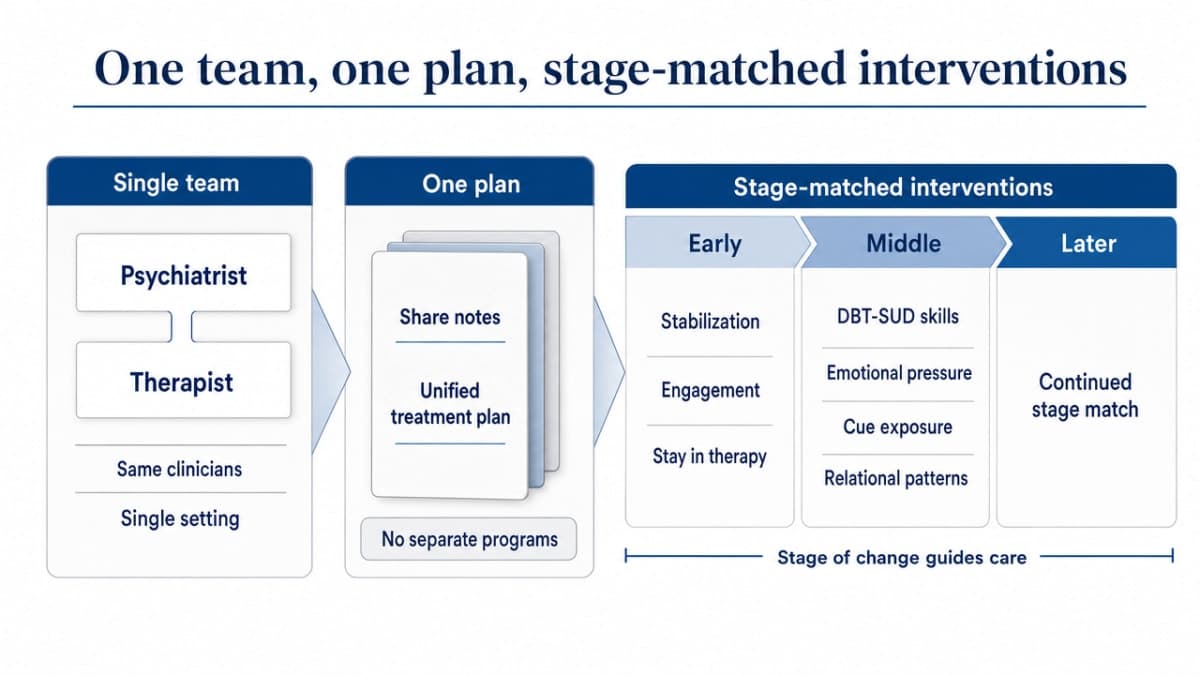
Integrated care is a specific operational model where the same clinicians, within a single setting, deliver coordinated mental health and substance use interventions 8. This means your psychiatrist and therapist collaborate as one team, sharing notes and adjusting a unified treatment plan. You avoid the burden of navigating separate mental health and addiction programs, having to translate your case between providers.
Underpinning this structure is the principle that interventions should be tailored to your stage of change, rather than a fixed curriculum 7, 9. Early in treatment, the focus might be on stabilization, engagement, and building tolerance for remaining in therapy. In the middle stages, it could involve practicing DBT-SUD skills under emotional pressure, cue exposure, and addressing relational patterns. Later stages concentrate on consolidation and developing relapse prevention strategies for a highly reactive nervous system.
At ViewPoint’s individualized dual-diagnosis model, this translates to one integrated team, a single treatment plan that addresses both conditions as primary from day one 10, and a treatment duration determined by your clinical response, not a predetermined calendar.
How relapse is handled without ejection
Integrated care fundamentally differs from traditional programs in its approach to relapse. In standard settings, a slip often leads to administrative discharge, forcing you to restart elsewhere. For individuals with BPD traits, this sequence can reinforce existing beliefs about abandonment and failure.
DBT-SUD incorporates a different response from the outset. Dialectical abstinence involves a full commitment to sobriety, coupled with an explicit, pre-planned strategy for how a slip will be addressed clinically rather than punitively 6. A relapse becomes valuable data—revealing triggers, missing skills, and necessary plan adjustments—not grounds for termination. Attachment strategies ensure you remain connected to your clinician between sessions, particularly during the high-risk period following a slip when shame often leads to disengagement 6.
This approach is not about rewarding substance use, but about maintaining engagement in treatment long enough for genuine, lasting change to occur.
For referring clinicians: what to look for in a program
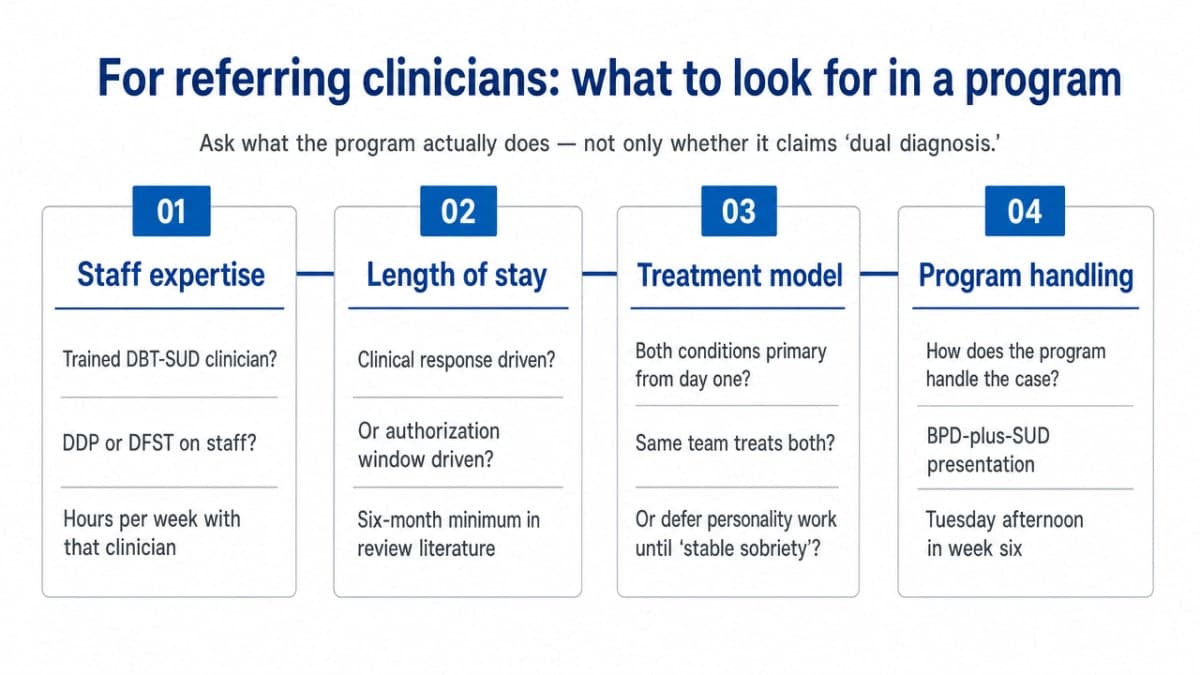
For discharge planners, case managers, and outpatient clinicians, the referral question extends beyond simply asking if a program treats “dual diagnosis.” Most programs will claim to. The crucial screening question is what the program actually does with a BPD-plus-SUD presentation on a Tuesday afternoon in week six.
Before making a referral, consider asking:
- Is there a trained DBT-SUD, DDP, or DFST clinician on staff, and how many hours per week will the patient spend with them 11, 13?
- Is the length of stay determined by clinical response, or by an authorization window that falls short of the six-month minimum indicated by review literature 1?
- Are both conditions treated as primary from day one by the same team, or is personality work deferred until “stable sobriety” 8, 14?
- How does the program handle a slip—as clinical data or grounds for administrative discharge 6?
- Is pharmacotherapy adjunctive and time-limited, with active efforts to deprescribe polypharmacy when appropriate 2?
Vague answers suggest the referral may not be successful. Specific, evidence-aligned responses indicate a program capable of effectively managing such complex cases.
A longer conversation about a plan built for your clinical picture
If you’ve read this far, you understand something your last discharge summary didn’t: the pattern wasn’t about you, but about the mismatch. A treatment plan designed for straightforward substance dependence was asked to contain a nervous system also grappling with borderline traits, and the container failed before the therapeutic work could take hold 1, 14.
The next step isn’t another 28-day trial. It’s a deeper discussion about a plan tailored to your unique clinical picture—one where both conditions are treated as primary from day one by the same team 8, where the therapy is DBT-informed and aligned with evidence for this comorbidity 4, 6, and where treatment duration is determined by your progress, not an authorization window. This is the foundation of the individualized dual-diagnosis model at ViewPoint’s Prescott, Arizona team. Staying engaged past week six, utilizing distress tolerance skills instead of substances, and allowing a clinician to support you through challenging times are compounding victories. You don’t have to navigate this alone.
Clarify Next Steps for Complex Dual Diagnosis Cases
Gain expert clarity on your patient’s ideal dual diagnosis treatment path in just one conversation.
Frequently Asked Questions
Why do standard 28-day rehabs keep failing when a personality disorder is also present?
The emotional dysregulation, impulsivity, and fear of abandonment associated with personality disorders often lead to early exits from rigid, group-focused programs. Co-occurring personality disorder and substance use disorder predict higher relapse and dropout rates than either condition alone. Specialized therapies for this combination typically require at least six months, not four weeks 1, 3.
Should the substance use disorder be treated first, before addressing the personality disorder?
No. Current literature advocates for treating both conditions simultaneously within an integrated plan, prioritizing life-threatening behaviors first 14. Even brief Good Psychiatric Management has shown to improve BPD symptoms regardless of SUD presence, and concurrent treatment enhances outcomes across both domains 5. Delaying personality disorder treatment until stable sobriety is achieved hinders recovery.
What therapies actually have evidence for co-occurring BPD and substance use?
Key evidence-based therapies include DBT-SUD, dynamic deconstructive psychotherapy (DDP), dual-focus schema therapy (DFST), and Good Psychiatric Management (GPM) as an entry point 1, 11, 13. DBT is the only BPD treatment supported by a Cochrane review and has demonstrated efficacy across SUD, PTSD, and mood disorders 4. While effective, systematic reviews acknowledge that no single therapy has been proven superior 3, 11.
How long does treatment realistically take for this comorbidity?
Every psychotherapy with a strong evidence base for co-occurring personality disorder and substance use disorder is designed to last at least six months. This extended duration is necessary for the consolidation of emotion regulation and relational skills 1. The length of stay should be determined by clinical progress—such as stability in the therapeutic relationship, reductions in self-harm, and effective skills application under stress—rather than a fixed calendar or authorization window 9.
What role do medications play when someone has both a personality disorder and addiction?
Psychotherapy is the primary treatment for BPD, even with comorbidities. Medication should be adjunctive and time-limited, with polypharmacy and unsafe drugs actively avoided 2. Medications can help stabilize severe depressive episodes, ease withdrawal, or address specific comorbid conditions, allowing psychotherapy to take hold. If a regimen includes multiple medications without clear therapeutic targets, a review by a specialist is warranted 2.
What happens if I relapse during a longer integrated program?
In a DBT-SUD framework, a slip is treated clinically rather than resulting in administrative discharge. Dialectical abstinence involves a full commitment to sobriety, with the team proactively planning how a lapse will be managed. Attachment strategies ensure continued connection with your clinician during the high-risk period following a slip 6. A relapse is viewed as data—indicating triggers or missing skills—not grounds for termination.
References
- Comorbidity of Personality Disorder among Substance Use Disorder Patients: A Narrative Review. https://pmc.ncbi.nlm.nih.gov/articles/PMC6241194/
- Pharmacological Management of Borderline Personality Disorder and Common Comorbidities. https://pmc.ncbi.nlm.nih.gov/articles/PMC10276775/
- Borderline Personality Disorder and Comorbid Addiction. https://pmc.ncbi.nlm.nih.gov/articles/PMC4010862/
- Dialectical Behavior Therapy as Treatment for Borderline Personality Disorder. https://pmc.ncbi.nlm.nih.gov/articles/PMC6007584/
- Effects of Substance Use Disorder on Treatment Process and Outcome in Borderline Personality Disorder. https://pmc.ncbi.nlm.nih.gov/articles/PMC5828425/
- Dialectical Behavior Therapy for Substance Abusers. https://pmc.ncbi.nlm.nih.gov/articles/PMC2797106/
- Substance Use Disorder Treatment for People with Co-Occurring Disorders. https://library.samhsa.gov/sites/default/files/pep20-06-04-006.pdf
- Integrated Treatment for Co-Occurring Disorders: The Evidence. https://library.samhsa.gov/sites/default/files/ebp-kit-the-evidence-10242019.pdf
- Integrated Treatment for Co-Occurring Disorders. https://library.samhsa.gov/sites/default/files/ebp-kit-building-your-program-10112019.pdf
- Substance Use Disorder Treatment for People With Co-Occurring Disorders. https://www.psychiatry.wisc.edu/wp-content/uploads/2023/05/SAMHSA-TIP-42.pdf
- A systematic review of interventions for co-occurring substance use and borderline personality disorders. https://pubmed.ncbi.nlm.nih.gov/25919396/?dopt=Abstract
- A systematic review of interventions for co-occurring substance use and borderline personality disorders. https://pubmed.ncbi.nlm.nih.gov/21742460/
- Psychotherapy of personality disorders and concomitant substance dependence. https://pubmed.ncbi.nlm.nih.gov/18852571/
- Borderline personality disorder and comorbid addiction. https://pubmed.ncbi.nlm.nih.gov/24791755/