Key Takeaways
- Standard Phoenix-area residential programs are often built for primary substance use cases and cycle out treatment-resistant psychiatric patients who need clozapine protocols, integrated psychiatry, and longer stays.
- Integrated dual diagnosis care, where one team treats both disorders under a shared plan, outperforms parallel treatment on symptoms, hospitalization, and housing stability 1.
- Before admitting, verify Arizona ADHS licensing, ask about joint case review, clozapine and AUD pharmacotherapy capability, 24/7 psychiatry, and whether length of stay is driven by clinical response or payer authorization.
- For treatment-resistant, co-occurring cases that have failed multiple Valley stays, a 90-minute drive up I-17 to a program with the clinical bandwidth to hold the case can be the shorter path to stability.
When the Third Rehab Didn’t Hold: Rethinking the Search
You already know how this story goes. A 30-day stay somewhere off Camelback or down in Chandler. A discharge date that arrived before your loved one was actually stable. A few good weeks, then a relapse, then another intake packet, then the same conversation with a different admissions coordinator who promises this time will be different.
If you’re reading this, standard care hasn’t held. That is not a moral failure and it is not a sign that treatment can’t work. It usually means the acuity of the case has outpaced what the program was built to handle. Dual diagnosis, when it involves treatment-resistant schizophrenia, rapid-cycling bipolar disorder, severe trauma, or a substance use disorder that keeps destabilizing the psychiatric picture, needs a different clinical setup than a first-time 28-day residential program can offer.
Why Standard Programs Cycle Treatment-Resistant Patients Back Into Crisis
The Acuity Mismatch Most Valley Programs Weren’t Built to Hold
Most residential rehabs in the Phoenix area were designed around a specific patient: someone with a primary substance use disorder, maybe a co-occurring anxiety or mood diagnosis, who will benefit from 28 to 45 days of structure, group work, and a step-down to outpatient. That model works for a large share of people who walk through the door. It was not built for the case you are living with.
When the psychiatric side of the picture is treatment-resistant schizophrenia, rapid-cycling bipolar disorder, or a trauma history driving the substance use, the standard program runs into limits fast. Group therapy alone does not stabilize a patient who needs a clozapine titration and weekly blood monitoring. A counselor without prescribing authority cannot re-sequence mood stabilizers when a manic episode breaks through mid-stay. And when psychiatric acuity spikes, many residential programs will transfer the patient out to an inpatient psych unit rather than hold and treat.
The scale of this population near Phoenix is not small. In Maricopa County, there are an estimated 139,267 adults with serious mental illness, and roughly 6,291 of them were identified as having chronic mental illness across a five-year window 9. That is the pool of people for whom standard residential care tends to under-deliver, either by discharging early, by parallel-tracking the psychiatric and addiction work with two teams that barely talk, or by lacking the medication expertise the case actually requires. If your loved one keeps returning to the same starting point after each stay, the mismatch is usually here.
What Rising Overdose and Hospitalization Numbers Say About Local Capacity
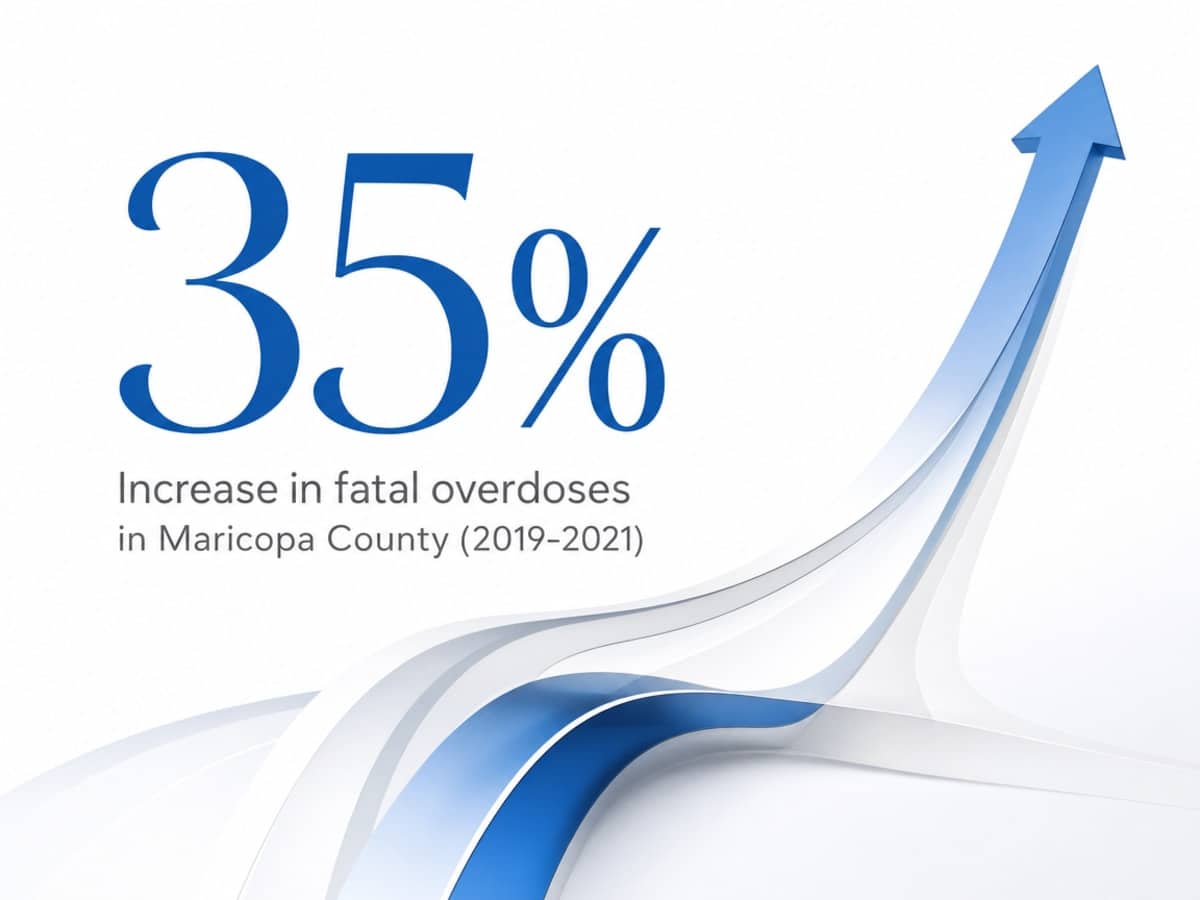
Between 2019 and 2021, the rate of fatal overdoses among Maricopa County residents rose 35%, with 1,963 fatal overdoses recorded in 2021, most of them among people under 45 6. This surge in demand strains programs, especially those handling complex cases. A residential facility can staff for a predictable mix of alcohol and opioid use disorder with mild-to-moderate depression. Adding treatment-resistant psychosis, active suicidal ideation, or a stimulant-induced manic episode changes what the shift needs to look like, what medications need to be on the formulary, and how quickly a psychiatrist has to be reachable. Many programs respond to that pressure by narrowing their admissions criteria. If your loved one has been told they are “too complex” for a program, or accepted and then transferred out within days, this is often what is happening behind the scenes.
The same trend shows up in psychiatric hospitalization, which is climbing in Maricopa County and cycling patients between crisis stabilization and short residential stays without ever landing them in a program that can hold the whole picture at once. When capacity is squeezed, insurance timelines shorten, discharge planning gets thinner, and the patients who need the longest, most integrated care are the ones most likely to fall through. That is the argument for looking beyond the closest facility. It is not that the Valley lacks talented clinicians. It is that regional demand has outpaced the supply of programs built specifically for treatment-resistant, co-occurring cases, and a program 90 minutes north with board-certified psychiatrists leading treatment may simply have the clinical bandwidth to hold what your local options cannot.
What Integrated Care Actually Looks Like (and How to Verify It)
Integrated vs. Parallel Treatment: The Distinction That Predicts Outcomes
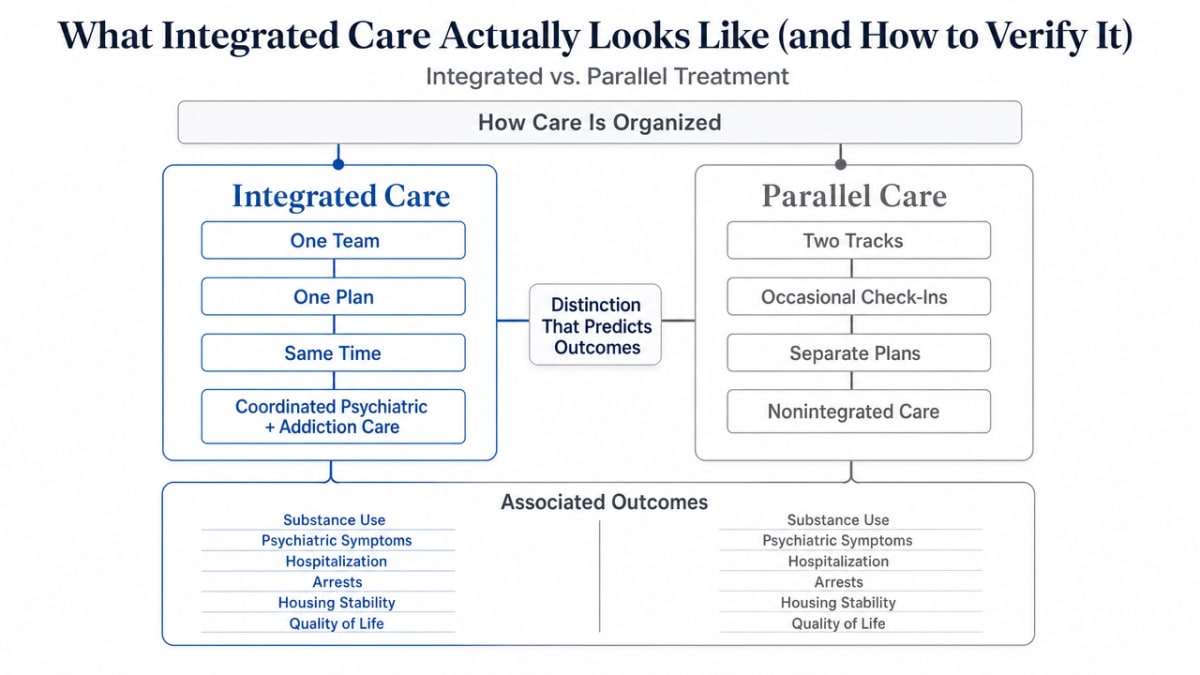
Almost every program in Arizona will tell you they treat dual diagnosis. The word does a lot of work in marketing copy and very little of it in the treatment plan. What actually matters is whether the psychiatric care and the addiction care are delivered by one team, in one plan, at the same time, or whether they run on two parallel tracks that occasionally check in with each other.
SAMHSA’s evidence review is blunt about the difference. Integrated dual diagnosis treatment, where the same clinicians address the mental illness and the substance use in a coordinated plan, outperforms nonintegrated care on substance use, psychiatric symptoms, hospitalization, arrests, housing stability, and quality of life 1. SAMHSA’s clinical guidance goes further and names integrated care the preferred model, with the specific expectation that both disorders are treated concurrently by providers trained in both 2.
Parallel treatment is what most people have already tried. The psychiatrist manages the medications on one side of town. The substance use counselor runs group on the other. Nobody owns the whole case. When something destabilizes, each side assumes the other will handle it, and the patient falls into the gap. If you have watched this pattern repeat, you are not imagining it. The model itself is the problem, and swapping in a different program built the same way will produce a similar result.
Fidelity Markers to Ask Any Program About Before You Admit
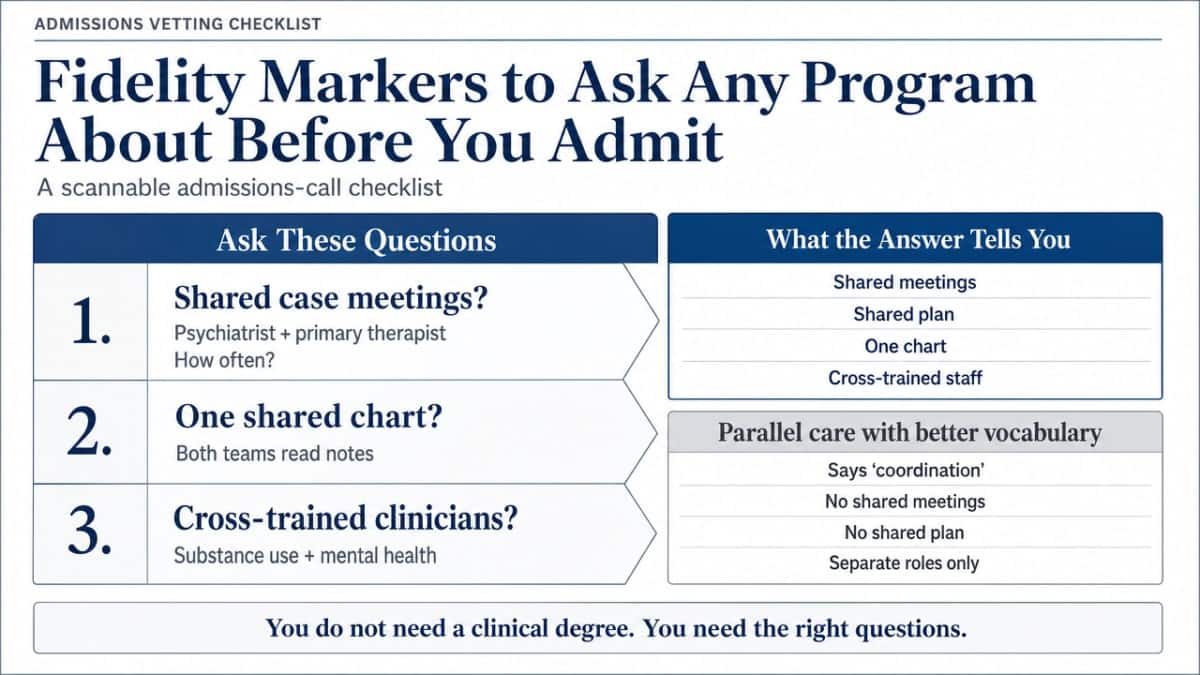
You do not need a clinical degree to vet a program. You need a short list of questions that separate integrated care from a rebrand. SAMHSA’s implementation guide describes the fidelity standards a program should meet to actually deliver integrated treatment, and those standards translate into things you can ask on an admissions call 3.
Start with staffing. Ask whether the psychiatrist and the primary therapist meet together about your loved one’s case, how often, and whether treatment notes live in one chart both teams read. If the answer involves the word “coordination” but not shared meetings or a shared plan, that is parallel care with better vocabulary. Ask whether clinicians are cross-trained in both substance use and mental health, which is the SAMHSA benchmark 2, or whether the addiction counselors and the psychiatric team hold separate specialties that only overlap at discharge.
Ask about stage-wise treatment. Integrated programs meet patients where they are in the change process rather than requiring abstinence commitment on day one before psychiatric work can begin 2. If the intake process front-loads addiction-focused confrontation while a bipolar episode is still active, the sequencing is wrong for a treatment-resistant case.
Ask what happens when psychiatric acuity rises mid-stay. A program built for dual diagnosis holds and treats. A program that transfers to an inpatient psych unit at the first sign of decompensation is telling you, honestly, what its ceiling is. Then ask about discharge planning: who arranges outpatient psychiatric follow-up in the Valley, who talks to your existing prescriber, and how the medication list gets handed off. Integrated care is measured as much by what happens on day 45 as by what happens on day one 3. If admissions cannot describe the handoff in detail, the program is unlikely to execute it well.
Medication Sophistication: Clozapine Protocols, AUD Pharmacotherapy, and the Psychiatrist Question
Medication is often where the treatment-resistant case actually turns. It is also where standard programs quietly opt out. If your loved one has cycled through two or three atypical antipsychotics without lasting response, the next evidence-based step is usually clozapine, which requires weekly-to-biweekly blood monitoring, a REMS registry, and a psychiatrist comfortable managing the titration and side-effect profile. Not every residential facility can run that protocol on site. Ask directly whether clozapine is on formulary, whether the program has active patients on it, and who monitors the labs.
The same question applies on the substance use side. The APA’s alcohol use disorder guideline recommends evidence-based pharmacotherapy, including naltrexone and acamprosate, embedded in a comprehensive person-centered plan 4. The broader APA substance use disorder guideline sets similar expectations for opioid and other substance use disorders 5. A program that treats medication as an afterthought, or that reserves it for the most severe cases, is under-using tools that meaningfully change outcomes for co-occurring alcohol and opioid use.
Then there is the psychiatrist question itself. How often does a board-certified psychiatrist actually see the patient? Weekly is common. Daily during an active medication change is what a treatment-resistant case often needs. Ask whether psychiatry is available 24/7 for medication decisions when something shifts on a Saturday night, or whether the on-call clinician is a nurse without prescribing authority. For the case you are trying to stabilize, the difference is not academic. It is the difference between adjusting a medication in six hours and waiting until Monday, by which point the crisis has usually already made its own decision.
Length of Stay Driven by Clinical Response, Not Authorization Cycles
Here is the pattern you have likely watched happen. Day 21, the medications finally start working. Day 24, sleep normalizes. Day 27, the discharge planner mentions the insurance authorization is ending. Day 30, your loved one is home, still fragile, and by week six they are back in a Valley emergency department.
The problem is not the patient. The problem is that a length of stay tied to an authorization cycle rarely matches the clinical arc of a treatment-resistant, co-occurring case. SAMHSA’s implementation guide is explicit that integrated dual diagnosis treatment is a longitudinal process, and the outcomes it points to, including reduced hospitalization and improved housing stability, come from programs willing to hold patients through the stage-wise work rather than discharging on a calendar 3. The APA’s substance use disorder guideline sets the same expectation: treatment length should be driven by clinical response and functional recovery, not a fixed number of days 5.
The Maricopa County data show what happens when this gets it backwards. Inpatient hospitalization rates for mood, depressive, and schizophrenic disorders rose from 2017 to 2021 and now sit substantially higher than emergency department rates for the same conditions 11. That is the readmission cycle taking a measurable shape. Ask any program you are considering one question: who decides when your loved one is ready to leave, the treatment team or the payer? If the honest answer is the payer, you have already seen how that ends.
Arizona Licensing, Court-Ordered Care, and Family Notification: What to Verify
Before you sign anything, verify two things about any Arizona facility you are considering: it is properly licensed, and it will keep you in the loop.
Licensing is not paperwork trivia. Arizona statute makes operating a residential care institution without a license a class 6 felony, with civil penalties of $5,000 to $10,000 per day of violation 8. Ask any program for its Arizona Department of Health Services license number and confirm it on the ADHS licensing portal. If admissions cannot produce that number in a phone call, stop there. The same bill mandates that families be notified within 72 hours of the initial evaluation 8, which means you should not be sitting in silence for a week wondering how intake went.
If a court order is part of the picture, the terminology matters. Arizona law defines a specific category of secure behavioral health residential facility for individuals determined to be seriously mentally ill and chronically resistant to treatment, placed or committed by court order 7. That is a distinct license from a standard behavioral health residential program. If your loved one is under a court-ordered treatment plan, ask directly whether the facility holds that designation or whether it accepts voluntary admissions only, and confirm how the treatment team coordinates with the court and any assigned guardian.
The Phoenix-to-Prescott Drive: Honest Logistics
Admissions Day, Transportation, and What Happens If a Patient Decompensates Before Intake
Prescott sits about 90 minutes north of most Phoenix zip codes, straight up I-17 and then west on AZ-69. From Scottsdale or Tempe, add 15 minutes. From the west Valley, subtract a few. The drive climbs from roughly 1,100 feet in the Valley to about 5,400 feet in Prescott, and by the time you exit the freeway the landscape has shifted from saguaro to ponderosa pine. That elevation change matters more than it sounds. Patients often notice the temperature drop and the quieter air on the drive up, and it can be the first time in weeks the person in the passenger seat has slept for more than an hour.
On admissions day, do not plan to drive alone with a patient who is actively decompensating. If you can, bring a second adult so one person can focus on the road and the other on the patient. Pack a bag the night before with insurance cards, medication bottles in their original containers, a current med list, prescriber contact info, and any court paperwork. Leave the Valley early enough to hit intake with time to spare rather than arriving frayed at 4:55 p.m.
If the patient decompensates before the intake date, do not white-knuckle it to Prescott. Call the admissions team first. A program built for treatment-resistant, co-occurring cases should have a plan for exactly this scenario, which may include coordinating with a Valley crisis stabilization unit or an inpatient psychiatric bed for a few days until the patient is safe to transport. SAMHSA’s implementation guidance frames integrated care as a longitudinal process that begins before the residential admission, not on day one 3. If the answer you get is “just get here when you can,” that is a program signaling its ceiling. If the answer is a concrete bridge plan, that is the clinical bandwidth you were looking for.
Family Visitation, Communication, and Staying Involved From the Valley
The 90-minute drive is a real thing, and it is also not the barrier families sometimes fear. A Saturday visit means leaving the Valley around 9 a.m. and being home for dinner. Many families settle into a rhythm of one in-person visit every week or two, with scheduled phone or video family sessions filling the gap between. Ask the program up front how visitation is structured, whether family therapy happens in person or by video, and what the schedule looks like for the first two weeks when contact is often more limited by clinical need than by geography.
Between visits, ask three specific questions. Who on the treatment team is your point of contact, how often will they call you, and what triggers an unscheduled call. Arizona law requires families to be notified within 72 hours of the initial evaluation 8, but a program built for complex cases should be doing more than the legal minimum. You should hear from the psychiatrist or lead therapist within the first week, not the billing office. If you have a standing outpatient prescriber in the Valley, tell the team on day one and ask them to loop that clinician in on the medication plan. The handoff back to the Valley starts the day your loved one arrives, not the week they leave.
If You’re a Referring Clinician or Case Manager Vetting This Facility
Audience shift: this section is written for outpatient psychiatrists, therapists, PCPs, and case managers in the Phoenix metro who are evaluating a Prescott-area referral, not for the patient or family. Skip ahead if that is not you.
You already know what you are trying to avoid. A patient you have stabilized twice this year, cycling back with a fresh crisis, gets accepted into a residential program that quietly narrows its clinical scope once intake reviews the chart. Two weeks in, they are transferred to inpatient, discharged home, and back on your schedule. When you vet a dual diagnosis facility for a treatment-resistant case, the questions worth asking are narrower than the marketing suggests.
Ask whether psychiatry and the therapy team operate from a shared treatment plan with documented joint case review, which is the fidelity standard SAMHSA’s implementation guide names for integrated dual diagnosis treatment 3. Ask whether clinicians are cross-trained in both SUD and mental health rather than siloed by specialty 2. Confirm clozapine capability and REMS monitoring on site, AUD pharmacotherapy per APA guidance 4, and 24/7 board-certified psychiatric coverage for after-hours medication decisions. Then ask who owns the handoff back to your practice: who calls you within the first week, who sends the discharge medication reconciliation, and who coordinates the outpatient appointment before the patient leaves the building.
A Straight Answer on When Traveling Is the Shorter Path to Stability
Here is the honest calculus. If the case is a first-episode, primary substance use disorder with a mild mood component, a Valley program is likely the right call and the drive is unnecessary. If you have already been through two or three residential stays, if the psychiatric side is treatment-resistant, if medications have stalled at a ceiling standard formularies do not cross, then 90 minutes on I-17 is not the long path. It is the short one.
The metric that matters is not miles. It is whether the next admission holds long enough for the medication and integrated therapy work to actually take 1. A program 30 minutes from your house that discharges on day 28 into another crisis is farther from stability than a program 90 minutes north that keeps the case until the clinical picture changes. ViewPoint Dual Recovery in Prescott was built for the case that has not held elsewhere. If that describes what you are living with, call admissions and ask the questions in this article. The answers will tell you whether the drive is worth making.
Clarify Your Dual Diagnosis Treatment Path Today
Gain tailored clinical insight to guide your next steps toward effective care in the Phoenix area.
References
- Integrated Treatment for Co-Occurring Disorders: The Evidence. https://library.samhsa.gov/sites/default/files/ebp-kit-the-evidence-10242019.pdf
- Substance Use Disorder Treatment for People with Co-Occurring Mental Disorders. https://library.samhsa.gov/sites/default/files/pep20-06-04-006.pdf
- Integrated Treatment for Co-Occurring Disorders: Building Your Program. https://library.samhsa.gov/sites/default/files/ebp-kit-building-your-program-10112019.pdf
- The American Psychiatric Association Practice Guideline for the Pharmacological Treatment of Patients With Alcohol Use Disorder. https://pubmed.ncbi.nlm.nih.gov/32867516/
- Practice Guideline for the Treatment of Patients with Substance Use Disorders: Second Edition. https://integrationacademy.ahrq.gov/resources/18791
- Maricopa County OUD/SUD Needs Assessment Final Report (2023). https://www.maricopa.gov/DocumentCenter/View/86245/OUD-SUD-Needs-Assessment-Final-Report?bidId=
- Arizona Revised Statutes §36-425.06 – Secure Behavioral Health Residential Facilities. https://www.azleg.gov/ars/36/00425-06.htm
- SB1624 – Residential Care Institutions Licensing Enforcement. https://www.azleg.gov/legtext/56leg/2r/bills/sb1624p.htm
- The Impact of Supportive Housing on the Costs of Chronic Mental Illness in Arizona. https://morrisoninstitute.asu.edu/sites/g/files/litvpz841/files/housing_is_health_care_report_2021.pdf
- Mental Health, Substance Use, and Homelessness – Background Report. https://morrisoninstitute.asu.edu/sites/g/files/litvpz841/files/114_mental_health_substance_use_and_homelessness_background_report_web.pdf
- Coordinated Community Health Needs Assessment – Population Data Report (Maricopa County). https://www.maricopa.gov/DocumentCenter/View/96640/CCHNA-Population-Data-Report