

Key Takeaways
- Dual diagnosis means a mental health condition and substance use disorder occurring together, with symptoms that borrow from each other — depression can mask drinking, withdrawal can mimic anxiety 1, 2.
- Timing is the clinician’s sharpest tool: symptoms that persist beyond roughly four weeks of abstinence often point to a primary psychiatric disorder rather than substance effects 17.
- Sequential ‘get sober first’ care is out of step with current guidance — AHRQ, SAMHSA, and NIMH all recommend treating both conditions concurrently in one coordinated team 1, 3, 13.
- When asking a provider for help, confirm they assess and treat both conditions from day one, address trauma directly, and will engage even if abstinence isn’t yet realistic 14, 16.
When Two Conditions Hide Inside Each Other
You’ve been watching something for a while now. Maybe it’s the way the drinking picked up after the panic attacks got worse. Maybe it’s the cannabis that started as sleep help and now runs the day. Maybe your adult son’s bipolar episodes keep landing him near stimulants, and no one seems to treat both at once.
What you’re seeing has a name. Clinicians call it co-occurring disorders, or dual diagnosis — at least one mental health condition and at least one substance use disorder happening in the same person, often tangled together 1, 2. The hard part isn’t that these conditions are rare. It’s that they hide inside each other. Depression looks like a hangover. Withdrawal looks like anxiety. A psychiatric medication stops working, and no one checks the drinking. A rehab program sends someone home still carrying untreated trauma.
This guide is for the pattern you’ve already noticed. You’ll learn what the symptoms actually look like when two conditions overlap, how clinicians sort out what’s driving what, and what competent, integrated care should sound like when you ask for it.
What Dual Diagnosis Actually Means
Co-Occurring Disorders in Plain Language
Dual diagnosis is just a shorter way of saying co-occurring disorders: at least one mental health condition and at least one substance use disorder happening in the same person at the same time 1. That’s it. Depression and heavy drinking. PTSD and opioids. Bipolar disorder and stimulants. Anxiety and daily cannabis.
Here’s what makes this hard to see clearly. The two conditions don’t sit politely in separate rooms. They borrow each other’s symptoms. Alcohol can look like depression. Depression can look like a hangover that never really lifts. Withdrawal from one substance can mimic a panic disorder. A psychiatric medication can stop working when drinking picks up, and nobody connects the two 4.
You don’t need a clinical degree to notice the pattern. You just need to know that when symptoms don’t quite add up — when one condition keeps undercutting treatment for the other — that mismatch is often the clue.
How Common This Really Is
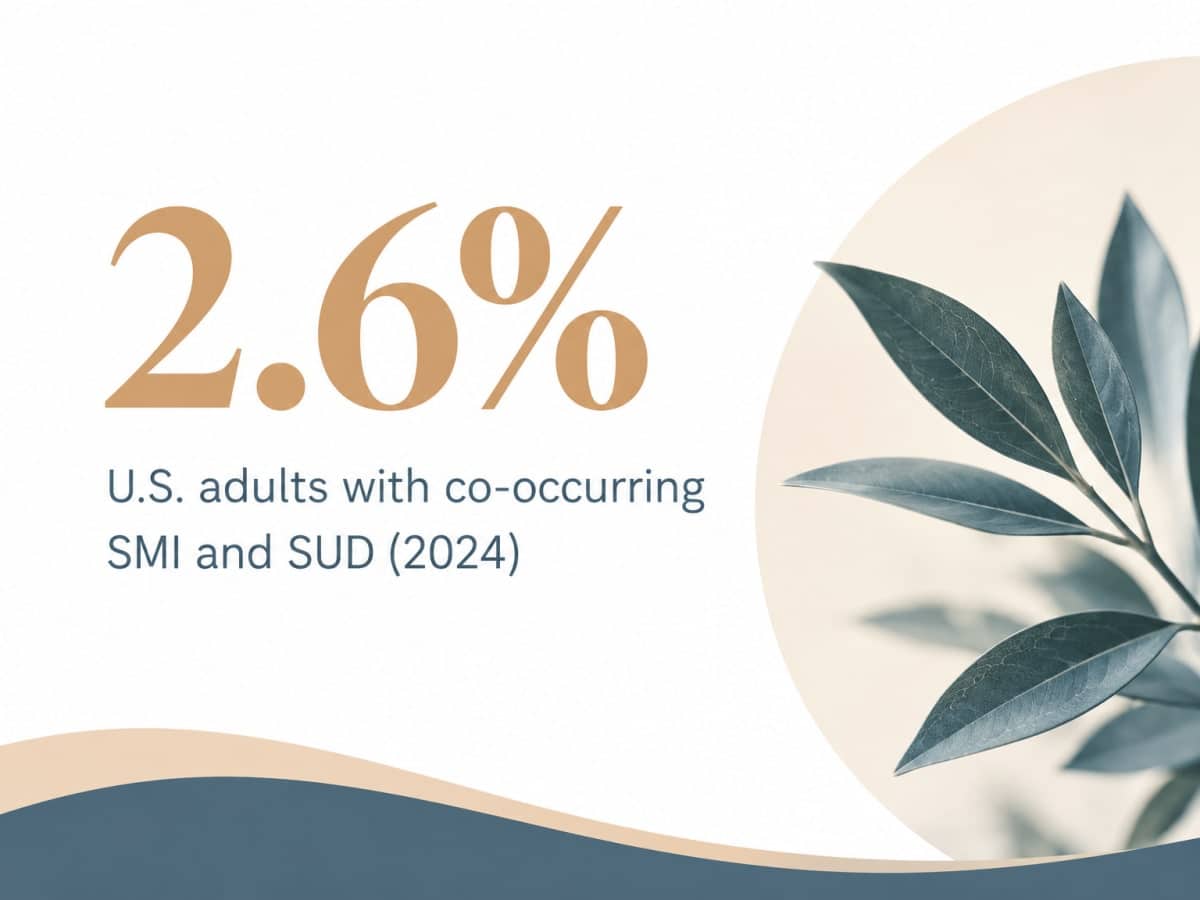
If you’re wondering whether what your family is going through is rare, it isn’t. In 2024, about 8.1% of U.S. adults had co-occurring any mental illness and a substance use disorder, and 2.6% had co-occurring serious mental illness and a substance use disorder 18, 20. Those numbers come from SAMHSA’s National Survey on Drug Use and Health, which samples adults living in households — so people who are unhoused, hospitalized, or incarcerated may not be fully represented in these estimates 18.
Translate that for a second. 8.1% of adults is not a niche clinical problem. It’s the person three rows ahead at a school assembly. It’s a coworker. It’s often the reason a family’s third attempt at treatment didn’t hold.
The 2.6% figure is narrower — serious mental illness paired with addiction — but it describes the people most likely to be told their case is “too complex” by programs that only handle one half of what’s going on.
The Symptom Map: What You Might Be Seeing
Behavioral and Social Signs
Start with what’s visible from across the room. Behavioral changes are usually the first thing a family notices, even before anyone uses the word “disorder.” SAMHSA lists sudden mood swings, irritability, suspiciousness, pulling away from friends and hobbies, unexplained money problems, and continuing to use a substance even when it’s clearly hurting relationships or work 2.
Read that list again, slowly. Does it describe one bad month, or the last two years?
Social signs often hide in plain sight. The friend group changes. Phone calls get shorter. A reliable coworker starts missing deadlines. A teenager who used to come to Sunday dinner now has an excuse every week. On the substance side, you might see secretive drinking, hidden bottles, prescription refills that don’t match the dates, or new people who always seem to be around when things get worse 2.
None of these on their own prove anything. Together, over months, they tell a story. If you’re already keeping a mental tally, trust that instinct — you’re seeing something real.
Physical Signs Your Body Keeps Score Of
The body shows the strain before anyone says it out loud. Common physical signs clinicians watch for include tremors, slurred speech, impaired coordination, drowsiness, agitation, abnormal pupils, and changes in vital signs during intoxication or withdrawal 6. SAMHSA also notes sleep disruption and appetite changes as frequent early flags 2.
Sleep is often the loudest signal. Someone who used to sleep through the night now wakes at 3 a.m. and can’t get back down without a drink or a pill. Mornings get rough. The hands shake until the first beer or the first dose. Over time, weight shifts, skin changes, old injuries flare up because self-care has slipped 8.
Cognitive and Emotional Signs
This is where the two conditions blur most. Cognitive and emotional signs that show up in co-occurring disorders include confusion, impaired judgment, unusual speech or affect, paranoia, hallucinations, and suicidal thoughts 6. On the mental health side, you’ll often hear flatness in the voice, persistent sadness, waves of worry that don’t match the situation, or sudden anger that burns off and leaves shame behind.
The emotional pattern is the harder read. Someone drinking heavily may describe hopelessness that sounds exactly like major depression — because during intoxication, withdrawal, and craving, alcohol produces dysphoria, sadness, worry, and irritability that overlap substantially with psychiatric symptoms 7. The feelings are real. The source is what’s complicated.
If you’re hearing any mention of suicide, self-harm, or “everyone would be better off without me,” treat that as urgent — not as drama, not as attention-seeking. Suicidal ideation is one of the specific signs that should trigger immediate assessment, even if substances are involved 6.
Where the Two Conditions Amplify Each Other
Here’s the part most symptom checklists miss. Dual diagnosis isn’t two separate problems sitting next to each other — it’s two conditions that borrow each other’s symptoms and make each worse. That overlap is the diagnostic signal, not a complication to work around.
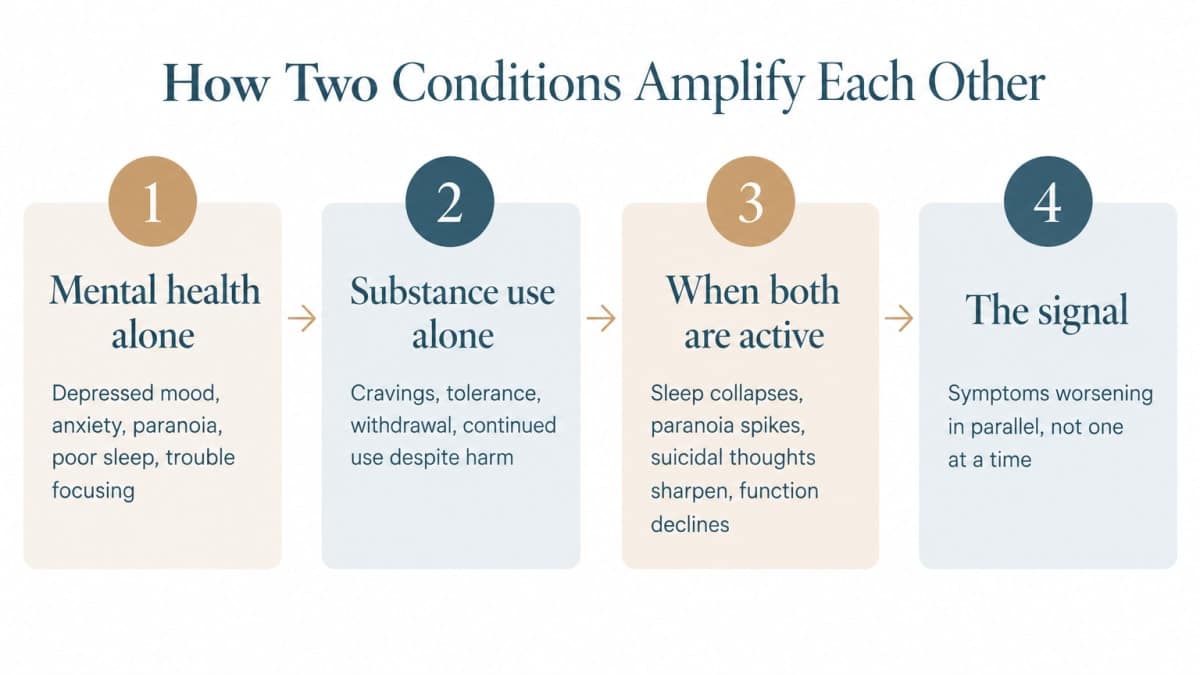
Think of it in three columns:
- Mental health column: depressed mood, anxiety, paranoia, trouble sleeping, trouble concentrating.
- Substance use column: cravings, tolerance, withdrawal, giving up activities, continued use despite harm 2, 8.
- Overlap column — the signs that show up when both are active: sleep that collapses completely, paranoia that spikes, suicidal thoughts that get sharper, functional decline at work and home, and the stubborn pattern of continued use despite clear damage 2, 6.
What you’re looking for in that middle column is amplification. Anxiety alone is hard. Anxiety plus daily cannabis plus poor sleep plus a shrinking social world is a different animal. Depression alone responds to treatment. Depression paired with heavy drinking often doesn’t — because the alcohol keeps re-triggering the mood symptoms the medication is trying to lift 7.
If you notice symptoms getting worse in parallel rather than one at a time, that’s the pattern. That’s what a good assessment will want to hear about — not just the drinking, not just the depression, but how they move together 4.
The Clinician’s Timing Lens
Intoxication, Withdrawal, and What Comes After
Here’s the question a good clinician will keep asking: when exactly do the symptoms show up? Not just what they look like, but when in the cycle of use they appear. That timing is the single most useful piece of information you can bring to an assessment.
Think of three windows:
- During intoxication, symptoms can look like a mental health crisis — slurred speech, impaired judgment, agitation, sudden mood swings, even paranoia or hallucinations depending on the substance 6.
- During withdrawal, the picture shifts: tremors, racing heart, sweating, insomnia, anxiety that feels bottomless, and sometimes seizures or perceptual disturbances with alcohol 8.
- The window after — the days and weeks when the substance is out of the system and you can start to see what remains.
Most families only track what’s happening right now. Clinicians want the pattern over time. When did the panic start — before the drinking, or after a weekend of cutting back? When did the voices begin — during a stimulant binge, or on a quiet Tuesday months into sobriety? Writing down a rough timeline of use and symptoms, even if it’s imperfect, gives a provider something real to work with 3.
Substance-Induced or a Primary Disorder?
This is the question that keeps families stuck in diagnostic limbo, so let’s name it directly. Are the symptoms being caused by the substance, or is there a separate mental health condition underneath that would still be there if the substance were gone?
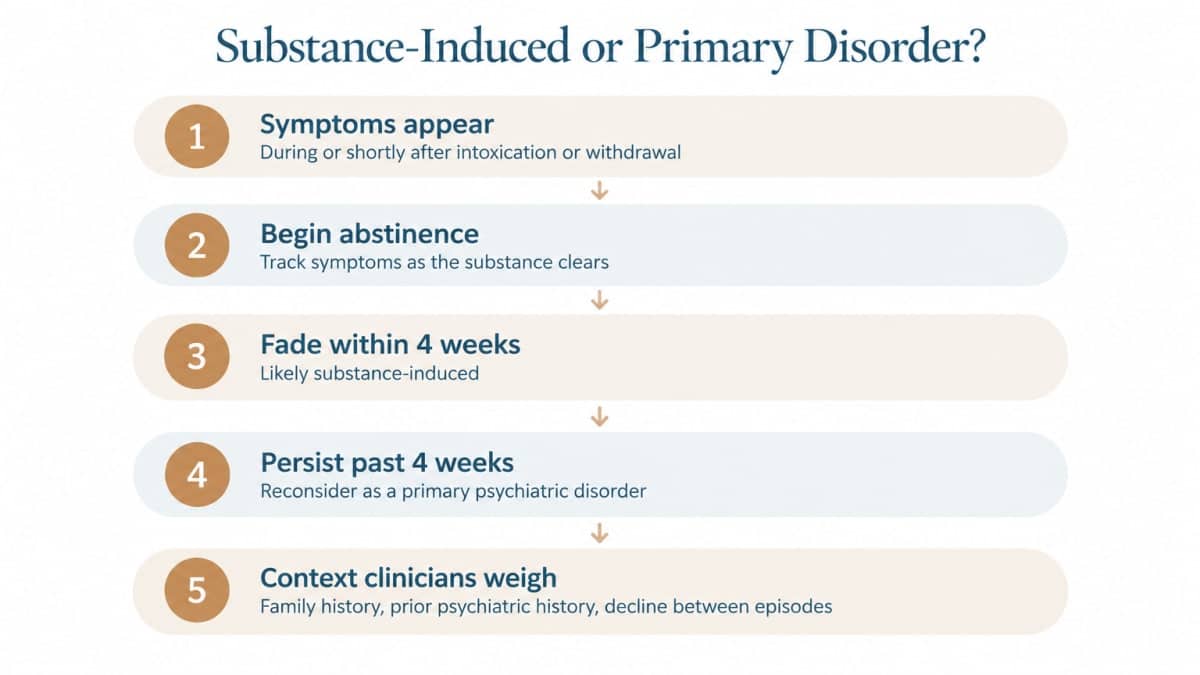
Clinicians use timing and persistence to sort this out. Substance-induced symptoms — including substance-induced psychosis — generally begin during or shortly after intoxication or withdrawal and tend to fade as the substance clears. Symptoms that persist beyond roughly four weeks of abstinence may need to be reconsidered as a primary psychiatric disorder rather than a substance effect 17. That four-week benchmark is not a rigid rule. The same review that offers it also emphasizes that the line between substance-induced and primary illness remains clinically ambiguous, and that repeated substance-induced episodes can increase the risk of a later primary psychotic illness 17.
What does this mean for you? If your loved one has had a few weeks of sustained abstinence and the paranoia, the depression, or the intrusive memories are still there, that’s important information — not a sign that treatment failed. It’s often the clearest window a clinician gets into what’s actually underneath.
Family history matters here too. So does prior psychiatric history that predated any substance use, and the degree of functional decline between episodes 17. Bring what you know. Even partial history is better than none.
Alcohol’s Shape-Shifting Symptoms
Alcohol deserves its own section because it’s the substance that confuses diagnosis most often. It’s legal, it’s social, and its symptoms map almost perfectly onto depression and anxiety — which is why so many people get diagnosed with one condition and treated for years before anyone untangles the drinking.
During intoxication, withdrawal, and craving, alcohol produces sleep disruption, worry, dysphoria, sadness, and irritability that overlap substantially with psychiatric symptoms 7. Read that again. A person drinking heavily can present with every clinical feature of major depression — and the depression is real — but the engine driving it may be the alcohol itself. Treating the depression without touching the drinking rarely holds.
The reverse is also true. Depression, PTSD, and ADHD are each associated with increased risk of alcohol use disorder, and people often drink specifically to quiet symptoms they’ve carried for years 8. The alcohol works, briefly, and then makes everything worse.
Two things to notice at home. First, does the mood lift noticeably during longer stretches without drinking, or does it stay flat? Second, does the drinking escalate when the mental health symptoms spike? Both patterns tell a clinician something useful 7.
Why Recognition Matters More Than It Feels Like It Should
You might be reading this and thinking: okay, but what difference does naming it make? The person is still drinking. The depression is still there. Why does putting a label on the overlap matter?
Here’s why. The gap between what people need and what they actually get is enormous — and recognition is the first door that opens the right kind of care. According to CDC data on recent overdose deaths, about 37% of people who died from drug overdoses had evidence of a mental health diagnosis, and only around 20% were receiving mental health or substance use treatment at the time of their death 10. Read that twice. The mental health piece was there in the record — but the coordinated care wasn’t.
That’s the pattern recognition changes. When no one connects the drinking to the depression, treatment keeps missing. Antidepressants get prescribed and quietly fail. A rehab stay ends and the untreated anxiety comes roaring back within weeks. The person — your person — looks like a treatment failure, when what actually failed was the framing.
Naming the overlap isn’t about adding a diagnosis to a chart. It’s about getting both conditions in front of someone qualified to treat them together 1. That shift — from “one problem at a time” to “both at once” — is what the next sections are about.
Why Sequential Care Keeps Failing People
The ‘Get Sober First’ Problem
If you’ve heard this before, you’re not imagining it: “We can’t treat the depression until you’re six months sober.” Or the reverse — “We can’t admit her for the drinking while she’s on those psychiatric meds.” Each door closes politely, and your person ends up outside both of them.
The reason is simple. Untreated depression keeps feeding the drinking. Untreated drinking keeps re-triggering the depression. Asking someone to fix one condition first, alone, is asking them to climb out of a hole while the other condition keeps digging. If a provider has told you to “get sober first,” that advice is out of step with current guidance — and it’s okay to say so.
What Integrated Care Actually Looks Like
Integrated doesn’t mean two providers who occasionally email each other. It means one coordinated team — usually a psychiatrist, a therapist, and often a case manager or peer support specialist — treating both conditions from day one, in the same place, working from the same chart 3, 13.
What that looks like in practice: a single intake that covers mental health history, substance use history, trauma, medical conditions, medications, and safety risks together — not three separate assessments at three separate agencies. Medication decisions that account for the drinking or drug use, not pretend it isn’t happening. Therapy sessions where you can talk about the panic attack and the relapse in the same hour without being told one belongs down the hall.
The evidence supports this. A 2026 umbrella review of 28 systematic reviews found that integrated coordinated treatment was generally better than treating one condition alone, and usually better than parallel uncoordinated services — though no single psychosocial approach wins for everyone 15. That last part matters. Integrated care is the frame; the specific therapy inside it still has to be matched to the person 4.
When Trauma Is in the Mix
If trauma is part of the picture — childhood abuse, combat, assault, a loss that never got processed — the sequencing conversation gets even more fraught. People are often told to stop drinking before they can begin trauma work, which leaves them trying to white-knuckle sobriety while the memories that drove the drinking are still live and loud.
Here’s what the research actually says. A 2024 systematic review and network meta-analysis of PTSD plus alcohol or other drug use disorders found that integrated trauma-focused therapy was more effective for PTSD symptoms than integrated non-trauma-focused therapy, substance-focused psychotherapy, or other comparison therapies at the end of treatment 14. In other words, waiting to address the trauma until the substance use is “handled” isn’t supported by the evidence for PTSD symptom relief.
The same review noted that different approaches had different effects on alcohol outcomes versus PTSD outcomes 14. That’s honest. It means the trauma piece and the substance piece may each need their own tools, delivered together.
If Your Loved One Isn’t Ready to Stop Using
This is the hardest version of the problem — and the one most families actually live with. The person you love is not ready to quit. They may never say the words “I need help.” Does that mean treatment is off the table until they do?
No. A 2024 paper on harm reduction and co-occurring opioid use disorder and trauma-related disorders describes a prestabilization phase — care that meets people before they’re ready or able to engage in conventional trauma-focused treatment 16. The authors argue that harm-reduction practices prioritize flexibility and improve outcomes and survival in opioid use disorder treatment 16.
Translation for you at home: safety first, engagement second, abstinence when it becomes possible. Keeping someone alive and connected to a team — even while they’re still using — is not giving up. It’s the beginning of care, not the opposite of it.
What to Ask a Provider — and What to Say First
Before the appointment, write down what you’ve been seeing. Not polished — just honest. When did the drinking or drug use start? When did the mood changes, panic, or paranoia show up in relation to it? What happens during longer stretches without the substance? Any family history of mental illness or addiction? Any trauma that still gets stirred up? You don’t need to have answers — you need to bring the pattern 3.
Then ask the provider five direct questions:
- Do you assess and treat mental health and substance use together, in the same place, from day one — or do you refer one out?
- Who’s on the team, and does a psychiatrist review medications alongside the substance use picture 3, 13?
- If abstinence isn’t realistic right now, will you still work with us 16?
- How do you handle trauma if that’s part of what’s driving the use 14?
- What does “treatment-resistant” mean here, and what happens if the first approach doesn’t hold?
If the answers sound like two separate programs loosely stapled together, keep looking. Integrated care that treats both conditions concurrently exists precisely for the cases other programs call too complex. You’ve already done the hardest part — you noticed.
Get Clarity on Both Conditions
A clinical assessment can help clarify whether integrated care fits your mental health and substance use needs.
Frequently Asked Questions
How do I tell the difference between substance-induced symptoms and a separate mental health disorder?
You usually can’t tell on your own, and that’s okay — this is one of the hardest calls in psychiatry. Clinicians watch timing and persistence. Symptoms that begin during or shortly after intoxication or withdrawal and fade as the substance clears are more likely substance-induced; symptoms that persist beyond roughly four weeks of abstinence often point to a primary disorder, though the line stays clinically ambiguous 17.
Can depression or anxiety be caused by drinking, or is it the other way around?
Both happen, and often at the same time. Alcohol produces sleep disruption, worry, dysphoria, sadness, and irritability during intoxication, withdrawal, and craving that overlap substantially with psychiatric symptoms 7. At the same time, depression, PTSD, and ADHD are each associated with higher risk of alcohol use disorder, because people often drink to quiet symptoms they’ve carried for years 8. Direction isn’t always clear — treat both.
Why do some providers tell people to get sober before treating their mental health condition?
It’s an older model that current federal guidance has moved away from. AHRQ states that treating one disorder before the other may undermine improvement from either condition and recommends concurrent treatment when possible 13. SAMHSA’s clinical protocol and NIMH agree that integrated care treats both at once 1, 3. If a provider insists on sequential care, it’s reasonable to look for a program that treats both together.
What should an integrated assessment for co-occurring disorders actually cover?
A single intake should cover mental health history, substance use history, trauma, medical conditions, current medications, functioning, and safety risks together — not three separate workups at three agencies 3. Expect questions about symptom timing relative to use, family psychiatric history, and prior treatment attempts. The team should include a psychiatrist who reviews medications alongside the substance use picture, not in isolation 13.
What can I do if my loved one isn’t ready to stop using?
Keep them alive and connected. A harm-reduction framework for co-occurring opioid use disorder and trauma describes a prestabilization phase — care that meets people before they’re ready for conventional treatment, prioritizing flexibility, safety, and engagement 16. Look for providers who will work with someone who is still using. Staying in contact with a team is the beginning of care, not giving up on it.
When do dual diagnosis symptoms become a safety emergency?
Treat any mention of suicide, self-harm, or wanting to disappear as urgent, even when substances are involved — suicidal ideation is a specific sign requiring immediate assessment 6. Alcohol withdrawal with tremors, sweating, racing heart, confusion, seizures, or hallucinations is a medical emergency, not willpower 8. New paranoia, hallucinations, or severe agitation also warrant emergency evaluation. Call 988 or go to an emergency department.
References
- Finding Help for Co-Occurring Substance Use and Mental Disorders. https://www.nimh.nih.gov/health/topics/substance-use-and-mental-health
- Co-Occurring Disorders. https://www.samhsa.gov/mental-health/what-is-mental-health/conditions/co-occurring-disorders
- Substance Use Disorder Treatment for People With Co-Occurring Disorders. https://library.samhsa.gov/sites/default/files/pep20-06-04-006.pdf
- Navigating the Complex Intersection of Substance Use and Psychiatric Disorders: A Comprehensive Review. https://pubmed.ncbi.nlm.nih.gov/38398311/
- Managing Life with Co-Occurring Disorders – SAMHSA. https://www.samhsa.gov/mental-health/serious-mental-illness/co-occurring-disorders
- Screening and Assessment of Co-occuring Disorders in the Justice System. https://library.samhsa.gov/sites/default/files/pep19-screen-codjs.pdf
- Mental Health Issues: Alcohol Use Disorder and Common Co-occurring Conditions. https://www.niaaa.nih.gov/health-professionals-communities/core-resource-on-alcohol/mental-health-issues-alcohol-use-disorder-and-common-co-occurring-conditions
- Understanding Alcohol Use Disorder. https://www.niaaa.nih.gov/publications/brochures-and-fact-sheets/understanding-alcohol-use-disorder
- About Behavioral Health | Mental Health. https://www.cdc.gov/mental-health/about/about-behavioral-health.html
- Substance Use & Mental Health. https://www.cdc.gov/mental-health/about-data/substance-use-mental-health.html
- Reported Non–Substance-Related Mental Health Disorders Among Persons Who Died of Drug Overdose—44 States and the District of Columbia, 2022. https://www.cdc.gov/mmwr/volumes/73/wr/mm7334a3.htm
- Interventions targeting patients with co-occuring severe mental illness and substance use (dual diagnosis) in general practice settings – a scoping review of the literature. https://pubmed.ncbi.nlm.nih.gov/39097682/
- The Role of Primary Care and Integrated Behavioral Health in Polysubstance Use. https://integrationacademy.ahrq.gov/products/topic-briefs/polysubstance-use
- Project harmony: A systematic review and network meta-analysis of psychotherapy and pharmacologic trials for comorbid posttraumatic stress, alcohol, and other drug use disorders. https://pubmed.ncbi.nlm.nih.gov/37971855/
- Effectiveness of Psychosocial Interventions for Adults With Substance Use Disorder That Have a Co-Occurring Common Mental Health Disorder: An Umbrella Review. https://pubmed.ncbi.nlm.nih.gov/41192364/
- A Harm Reduction Framework for Integrated Treatment of Co-Occurring Opioid Use Disorder and Trauma-Related Disorders. https://pubmed.ncbi.nlm.nih.gov/38165922/
- Substance Use Disorders and the Psychosis Spectrum. https://pmc.ncbi.nlm.nih.gov/articles/PMC12942059/
- Results from the 2024 National Survey on Drug Use and Health. https://www.samhsa.gov/data/sites/default/files/reports/rpt56287/2024-nsduh-annual-national/2024-nsduh-annual-national-html-071425-edited/2024-nsduh-annual-national.htm
- Highlights for the 2023 National Survey on Drug Use and Health. https://www.samhsa.gov/data/sites/default/files/NSDUH%202023%20Annual%20Release/2023-nsduh-main-highlights.pdf
- 2024 National Survey on Drug Use and Health: Graphics to Support Estimates from the Annual National Report. https://www.samhsa.gov/data/sites/default/files/reports/rpt56287/2024-nsduh-nnr-figure-slides.pdf