

Key Takeaways
- Patients with both complex trauma and psychosis are routinely excluded from trauma programs and psychosis programs alike, leaving a category of care that neither system claims.
- Childhood adversity raises the odds of psychosis roughly 2.8-fold across 349,265 participants, making trauma history a core clinical variable rather than a footnote 3.
- Dissociation is the frequently missed third element that mimics psychotic symptoms, and screening it at intake changes voice work, pacing, and sequencing decisions 5.
- Choosing a program means confirming psychiatry and trauma clinicians share one case conference, dissociation is screened early, substance use is treated concurrently, and length of stay follows the clinical picture.
The Patients Who Fall Between Two Programs
You already know the pattern. A patient with a documented trauma history and active psychotic symptoms calls a trauma-focused program and gets told they’re not appropriate for admission until the psychosis is stabilized. They call a psychosis program and are told trauma work will have to wait, indefinitely, because it might destabilize them. The trauma clinic points toward psychiatry. Psychiatry points back toward the trauma clinic. Nothing moves.
This is not an unusual case. It is a category of patient.
Complex trauma and psychotic symptoms show up together far more often than the split between programs would suggest, and the people who live at that intersection are the ones most likely to be described as treatment-resistant, non-compliant, or too high-acuity for outpatient care 9. What they usually are is under-treated. Their trauma has been deferred so many times it has become part of the clinical picture. Their psychosis has been managed medication-only because no one wanted to open the trauma work.
If you are a referring clinician, a discharge planner, or a family member who has already made these calls, you are not misreading the system. The exclusion is real, and it has clinical roots as much as administrative ones. Federal guidance is explicit that trauma-related symptoms should not block access to mental health treatment, yet the practical reality on intake calls is often the opposite 7.
The rest of this piece walks through why the overlap is so common, what the current evidence actually supports, and what a program has to look like to hold both presentations at once.
Why Trauma History Is the Rule, Not the Exception, in Psychosis
If you have spent any time taking psychiatric histories on a psychosis unit, the pattern is familiar. The trauma is there. It usually just wasn’t the reason for admission.
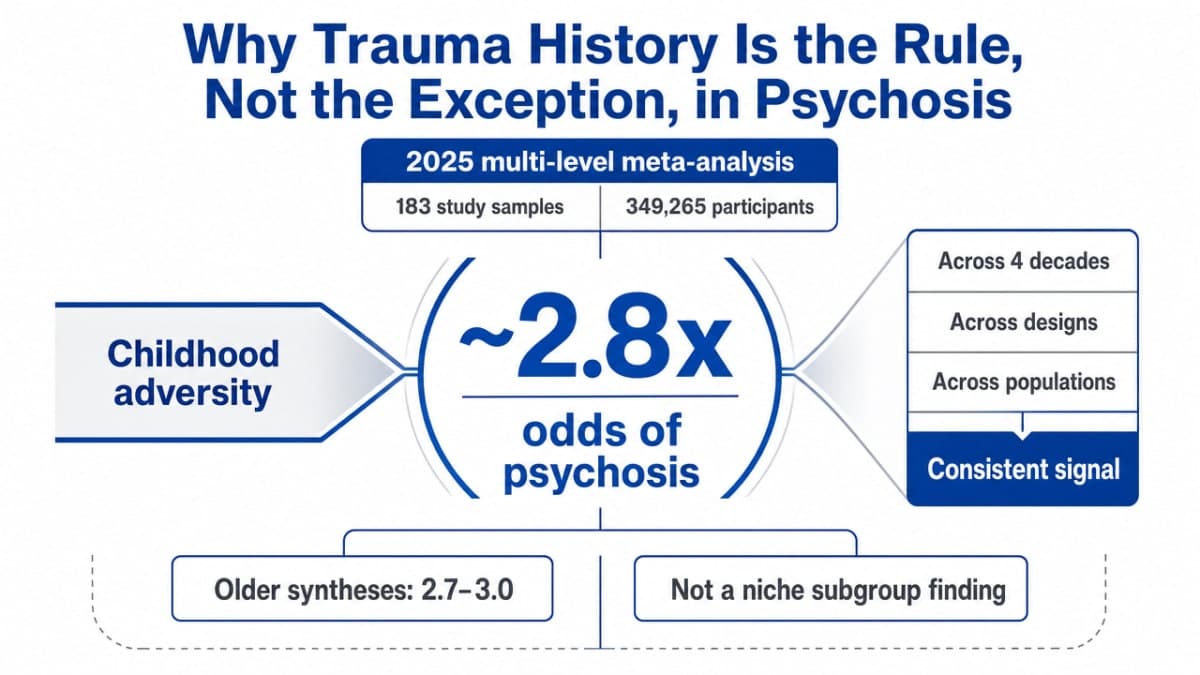
The largest analysis to date puts a number on what clinicians have been noticing for years. A 2025 multi-level meta-analysis pooled 183 study samples covering 349,265 participants and found that people who experienced childhood adversity had roughly 2.8 times the odds of developing psychosis compared with those who did not 3. That is not a niche subgroup finding. It is a signal that runs across four decades of research, across designs, and across populations.
Older syntheses landed in the same range, with odds ratios clustering between 2.7 and 3.0 for the childhood adversity to psychosis link 10. When the numbers keep converging like that, treating trauma history as a footnote in a psychosis workup stops making clinical sense.
The relationship also runs both directions. Trauma raises the risk of psychotic experiences, and psychotic experiences (involuntary holds, restraint, terrifying voices, loss of housing or custody) generate their own trauma load 9. By the time someone reaches a treatment-resistant designation, you are often looking at layered trauma: what came before the first episode, and what the illness and the system added on top of it.
The clinical question is no longer whether trauma belongs in the psychosis conversation. It is how to hold both without destabilizing the patient in the process, which is where the next sections turn.
How the Two Presentations Shape Each Other
Bidirectional Symptom Loops
Trauma and psychosis do not sit next to each other in the chart. They feed each other.
A patient hears a critical voice that echoes an abusive parent. The voice becomes more distressing because the affect it triggers is not just auditory; it is a memory response with a face and a history attached. The distress raises arousal, arousal fragments sleep, sleep loss worsens perceptual disturbance, and the voice returns louder. What began as a psychotic symptom is now also a trauma reminder, and what began as a trauma response is now also a psychotic escalation 9.
The other direction runs just as clearly. A first hospitalization involving restraints, an involuntary hold, or a frightening loss of reality can itself meet criteria for a traumatic event. The illness generates new trauma. That trauma then shapes the next episode: hypervigilance around providers, avoidance of psychiatric settings, mistrust that reads on the unit as paranoia 9.
By the time a patient carries a treatment-resistant label, these loops have usually been running for years. Standard psychosis care that targets only the positive symptoms leaves the trauma engine intact. Standard trauma care that waits for full remission of psychosis waits forever. If you have watched this cycle repeat, you already know why sequencing the two problems back-to-back rarely produces the second appointment.
Dissociation as the Missing Third Element
Dissociation is the piece most programs quietly skip, and it is often the piece that explains why treatment keeps stalling.
A 2025 systematic review pooled 40 studies covering 6,941 participants and found a moderate association between developmental trauma and dissociation, r = 0.33, with dissociation serving as a plausible mediating pathway between early adversity and later psychotic symptoms 5. That is not a small side effect. It is a mechanism.
The clinical problem is that dissociative phenomena and psychotic phenomena share surface features. Hearing a voice can be a hallucination or a dissociated self-state speaking. A gap in memory can be a negative symptom, a medication effect, or a dissociative amnesia. Depersonalization can look like flat affect. When a program only carries a psychosis lens, these get collapsed into the psychotic column and treated with antipsychotics that do not touch the dissociative process at all. The patient does not improve, the dose goes up, and the record reads treatment-resistant.
What changes when dissociation is on the assessment: the voice work looks different, the grounding work becomes central, and the trauma memory processing is paced around dissociative capacity rather than around symptom counts alone. Sequencing decisions also shift, because a patient who dissociates heavily under distress needs stabilization skills before any memory-focused work, regardless of where the psychotic symptoms sit that week 5.
If dissociation was never screened, the treatment plan you inherited was working with two of three variables.
Shared Neurobiological Substrate
The overlap is not only clinical. It shows up in the brain.
A 2025 neuroimaging review pulled together 31 studies covering 1,761 psychosis patients and 1,775 controls or siblings, and mapped structural and functional differences in adults with psychosis who also had developmental trauma histories 6. The findings point toward shared circuitry rather than two unrelated disorders happening to co-occur. Regions involved in threat processing, memory integration, and self-referential thought carry the fingerprints of both trauma exposure and psychotic illness.
The authors are careful, and you should be too. The imaging evidence is preliminary, the samples are heterogeneous, and the causal direction cannot be settled from cross-sectional scans 6. What the data do support is a clinical stance: when trauma history and psychotic symptoms appear in the same patient, treating them as biologically unrelated problems requiring two disconnected teams is not a neutral choice. It is a choice that ignores what the imaging is starting to show.
The practical translation is simpler than the neuroscience. Medication decisions, therapy pacing, and case formulation all improve when the team is holding one integrated picture instead of two partial ones.
What the 2025 Evidence Actually Shows About Integrated Treatment
The honest version of the current evidence base is more useful than the marketing version. Here it is.
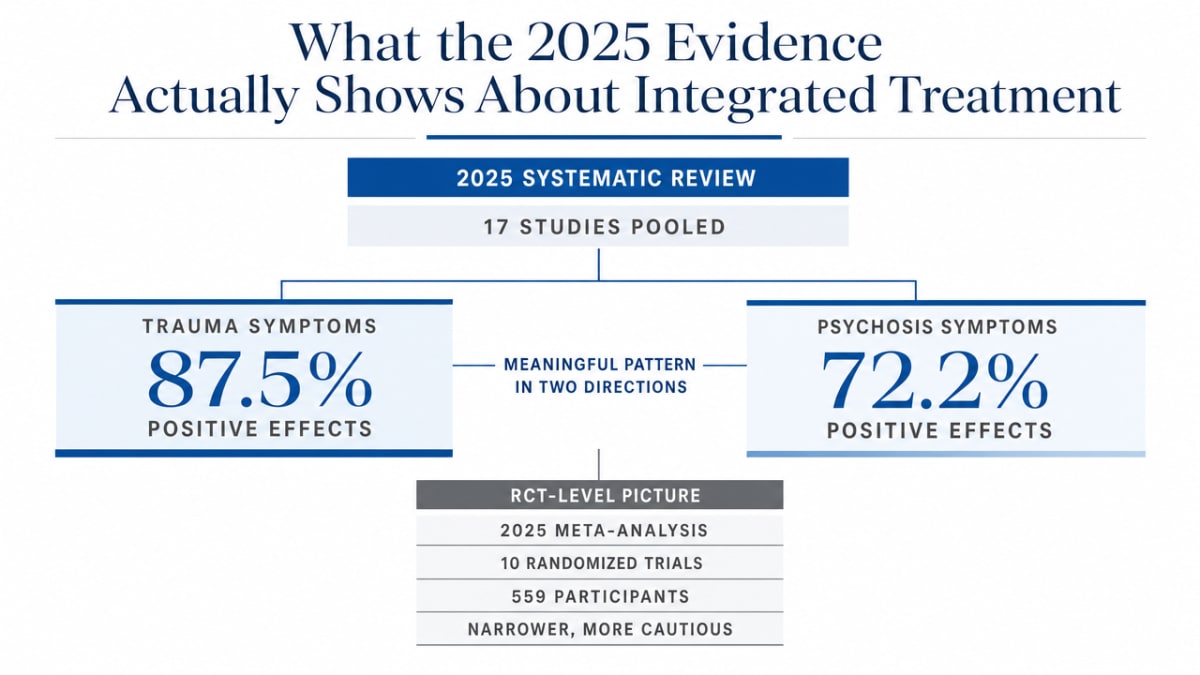
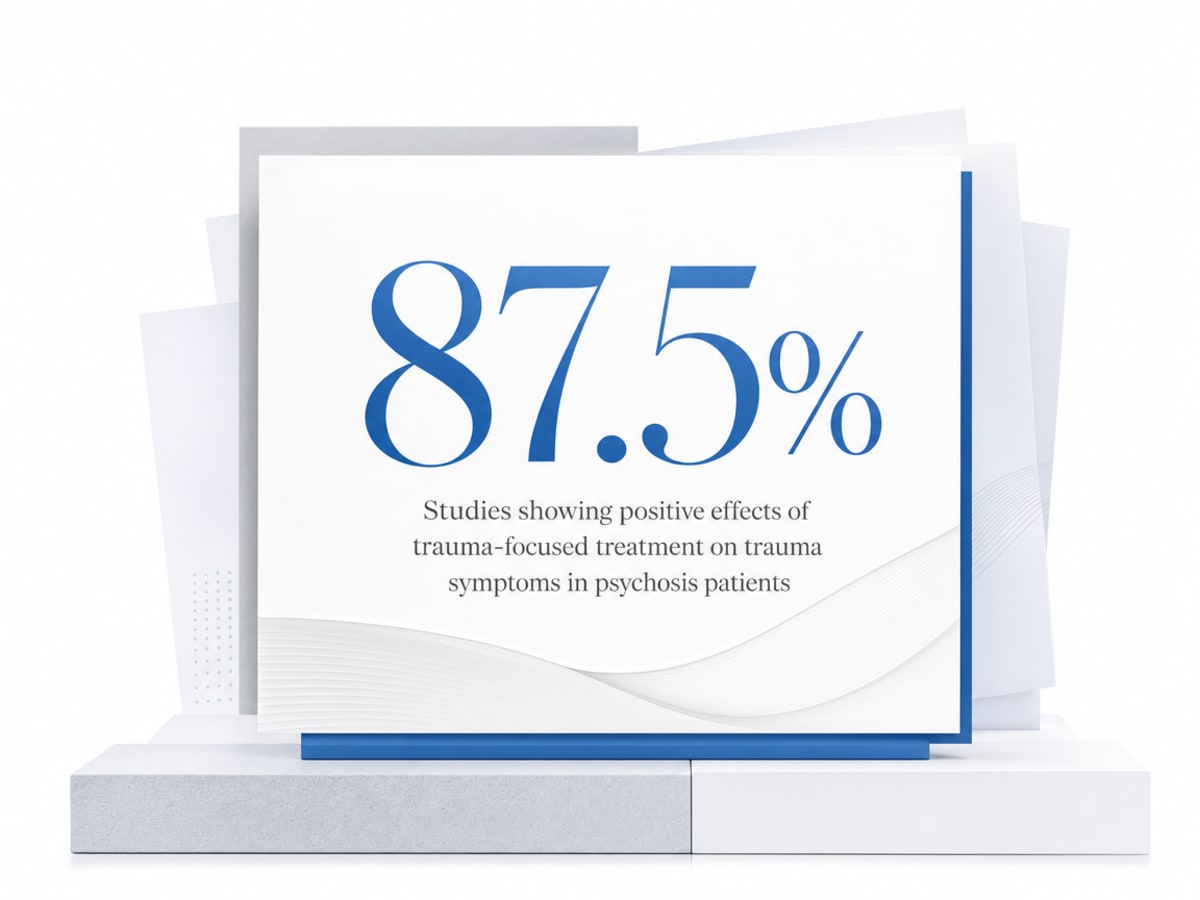
A 2025 systematic review of trauma-focused treatment in psychosis pooled 17 studies and reported that 87.5% of them showed positive effects on trauma symptoms, while 72.2% showed positive effects on psychosis symptoms 1. That is a meaningful pattern in two directions. Trauma-focused work in this population is not just tolerated; it moves the trauma numbers in most studies that measure it. And it moves the psychosis numbers less often, but often enough that treating the two together is no longer a fringe position.
The RCT-level picture is narrower and more cautious. A 2025 meta-analysis of psychological interventions for people with co-occurring psychotic and traumatic-stress symptoms included 10 randomized trials with 559 participants and found a statistically significant reduction in traumatic-stress symptoms post-treatment, with a small-to-moderate effect size of g = 0.33 2. Effects on total psychotic symptoms and on functioning were not significant in the pooled analysis, and the authors flag substantial risk of bias and small trial counts as real limits 2. If someone tells you the evidence is overwhelming, they have not read it. If someone tells you it is absent, they have not read it either.
A newer 2026 synthesis of trauma-focused psychological interventions for psychosis adds symptom-level nuance. Pre-post analyses showed medium reductions in delusions and smaller reductions in hallucinations 4. That maps onto what many clinicians report at bedside: the belief system built around threat, mistrust, and self-blame often loosens with trauma work faster than the auditory phenomena do. It also argues against promising patients that voices will resolve on the same timeline as intrusive memories.
Two practical implications follow from reading the evidence honestly. First, tolerability data are consistent enough across recent reviews that a blanket exclusion of active psychosis from trauma-focused work is no longer defensible on safety grounds alone 1, 2. Second, treatment planning should set separate expectations for trauma symptom trajectories, delusional content, and hallucinatory experiences, because the response curves are not identical 4. Programs that promise uniform improvement across all three are not describing the literature you can actually cite.
The takeaway for referring clinicians is narrower than the field sometimes claims and larger than the exclusion-based intake calls suggest. Integrated trauma-psychosis treatment has enough evidence to be offered, enough uncertainty to be paced carefully, and enough symptom-specific pattern to be planned with realistic milestones.
What a Trauma-Informed Psychosis Intake Actually Screens For
A trauma-informed psychosis intake is not a longer form. It is a different lens applied to five domains that standard psychosis workups tend to skim.
- Dissociative symptoms.
- This is the domain most likely to be missed on a psychiatric admit. Depersonalization, derealization, time loss, identity shifts, and voices that feel like other selves are asked about directly, not inferred from a negative-symptom scale. A 2025 review of 40 studies covering 6,941 participants found a moderate association between developmental trauma and dissociation (r = 0.33), which is enough to make dissociation a standing question on intake rather than a specialty referral 5. If the previous team never screened for it, you are looking at a chart that may have mislabeled dissociative phenomena as psychotic ones.
- Developmental trauma timeline.
- Not a checklist. A timeline. When did the adversity start, how long did it run, who was the source, and what was the caregiving environment doing at the same time. Chronic, relational, early-onset trauma shapes the treatment plan differently than a single adult-onset event, even when the current symptoms look similar.
- Voice content and relational themes.
- The content of hallucinations matters clinically, not just the presence. Voices that echo a specific abuser, replay a specific scene, or organize around themes of worthlessness, threat, or surveillance carry information about the trauma structure underneath. Delusional systems built around persecution, contamination, or being watched often track the same themes. This is where trauma work and psychosis work meet in the same sentence.
- Substance use overlay.
- Current use, pattern of use, and what the substance is doing for the patient (sleep, voice suppression, affect regulation, trauma avoidance). Federal guidance is direct that trauma has to be managed inside co-occurring disorder treatment rather than after it 8.
- Medication and prior-treatment history.
- What was tried, at what dose, for how long, and why it stopped. Which programs declined admission and on what grounds. This is where the pattern of being handed between trauma and psychosis services usually shows up in writing.
An intake that covers these five domains produces a formulation you can actually plan against.
Sequencing Decisions: Stabilization First or Concurrent Trauma Work
The old rule was simple: stabilize first, then trauma. The problem is that stabilization rarely arrives on a clean date. Voices soften, then return under stress. Sleep improves for two weeks, then collapses. If you wait for a stable baseline before opening trauma work, you often wait past discharge.
The current evidence supports a more useful framing. Trauma-focused interventions have been delivered to people with active psychotic and traumatic-stress symptoms across 10 randomized trials with 559 participants, with tolerability strong enough that a blanket exclusion on safety grounds is no longer defensible 2. That does not mean everyone starts memory processing on day three. It means the sequencing decision belongs on a case level, not a program level.
Three factors move the decision in practice:
- Dissociative capacity. A patient who loses time or fragments under mild distress needs stabilization skills and grounding work in place before any memory-focused intervention, regardless of where the psychotic symptoms sit 5.
- Current risk. Command hallucinations, suicidal intent, or acute substance use raise the threshold for opening trauma content in the same week 8.
- What the patient can name. If the trauma is already intruding daily through nightmares, flashbacks, or voice content that replays the event, the trauma work has effectively already started. Refusing to name it does not delay it.
Concurrent work does not mean simultaneous exposure. It means the trauma formulation is on the whiteboard from week one, informing medication choices, therapy pacing, and how the team responds when symptoms flare. Memory processing is titrated in when the window opens, and paused when it closes, rather than deferred to a later admission that usually does not happen 1, 7.
What this looks like in a chart: the treatment plan names both diagnoses, both goals, and the specific signals that will move the trauma work forward or hold it steady. That is the sequencing decision, made once and revisited weekly.
When Substance Use Enters the Picture
Substance use is not a separate third problem. In this population, it is usually part of how the first two are being managed.
Alcohol quiets the voices for a few hours. Cannabis blunts the hyperarousal that trauma leaves behind, then destabilizes the psychosis the next day. Stimulants push through the flat, dissociated mornings. Opioids muffle the affect that comes up when memories intrude. When you ask what the substance is doing for the patient, the answer is almost always a symptom that no one has treated.
Federal guidance is direct on the point: trauma is present across co-occurring disorders and has to be addressed inside the treatment plan, not scheduled for after sobriety 8. The same guidance warns against assuming that treating the substance use will resolve the trauma symptoms on its own. Both have to be treated together 8. Add active psychosis to that picture and the sequential model breaks down completely, because none of the three problems waits politely for the others.
A program that can hold this combination screens for what each substance is doing, adjusts medication with that pattern in view, and paces trauma work around use, cravings, and withdrawal windows rather than requiring a clean date before the real work starts 7, 8.
What to Look For in a Program That Can Actually Hold the Combination
If you have already made the intake calls, you know most of what to ask. Here is what separates a program that can hold this combination from one that will hand the patient back after two weeks.
Psychiatry and trauma expertise on the same team, not on referral. Ask who prescribes and who does the trauma work, and whether they sit in the same case conference every week. If the trauma clinician has to email the outside psychiatrist to change a PRN, the sequencing decisions will lag behind the symptoms.
Dissociation is screened at intake, not discovered in month two. A program that cannot tell you how it distinguishes dissociative phenomena from psychotic ones is going to miss the mechanism that stalled the last admission 5.
The treatment plan names both diagnoses and both trajectories. Ask to see, in principle, how the plan sets separate milestones for trauma symptoms, delusional content, and hallucinatory experiences. Uniform improvement promises do not match the literature 4.
Substance use is treated inside the plan, not required to resolve before it. A clean-date prerequisite is a signal the program is not built for the co-occurring picture federal guidance describes 8.
Length of stay is set by the clinical picture. Trauma-psychosis work paces around dissociative capacity and risk windows, which do not follow a 30-day template 7.
If a program cannot answer these five questions on the first call, the patient will end up between programs again.
The ViewPoint Clinical Model for Trauma-Psychosis Presentations
ViewPoint’s clinical model treats the trauma-psychosis combination as a specialty, not an exclusion criterion. That framing shapes how the intake runs, who sits in the case conference, and how the treatment plan gets built.
Board-certified psychiatry is available on site, working from the same case formulation as the therapists doing the trauma work. Medication decisions, including clozapine protocols for treatment-resistant presentations, are made in the same room where the trauma pacing is discussed, so a change in one does not lag a week behind the other. Dissociation is screened at intake rather than discovered mid-admission, which changes how voice content, memory gaps, and identity shifts get formulated from day one 5.
Substance use is treated inside the plan, not held as a prerequisite, in line with what federal co-occurring disorder guidance actually recommends 8. Treatment duration follows the clinical picture rather than an insurance template, which matters when dissociative capacity and risk windows dictate the pace of trauma work 7.
If a patient has already been handed between a trauma program and a psychosis program, ViewPoint’s team is built to hold what fell between them.
Clarify Your Complex Trauma and Psychosis Needs
Discover if integrated trauma and psychosis care is the right fit for your unique clinical challenges.
Frequently Asked Questions
Why do most trauma programs decline patients with active psychosis?
The stated reason is safety: concern that trauma processing will destabilize someone with active psychotic symptoms. The practical reason is staffing. Most trauma programs do not have on-site psychiatry that can manage antipsychotic changes in real time, so active psychosis becomes an exclusion by default. Federal guidance is explicit that trauma symptoms should not block mental health treatment, but the intake reality often runs the other way 7.
Can trauma-focused therapy be done safely while someone still has psychotic symptoms?
Yes, with pacing. A 2025 meta-analysis of 10 RCTs covering 559 participants with co-occurring psychotic and traumatic-stress symptoms found that trauma-focused interventions were tolerated and reduced traumatic-stress symptoms, with a small-to-moderate effect size 2. The authors flag limits: small trial counts and risk of bias. Safety is about titration and team capacity, not about waiting for full remission before starting.
How is dissociation different from psychosis, and why does it matter for treatment?
Dissociation and psychosis share surface features. A voice can be a hallucination or a dissociated self-state. A memory gap can be a negative symptom or dissociative amnesia. The pathways differ, and antipsychotics do not treat dissociative processes 5. If dissociation is not screened at intake, phenomena get collapsed into the psychotic column, doses climb, and the record reads treatment-resistant when the mechanism was never addressed.
Should psychiatric stabilization come before trauma work, or can they happen together?
Both diagnoses belong on the treatment plan from week one. Memory processing is titrated in when the window opens and paused when it closes, rather than deferred to a later admission that usually does not happen. The sequencing decision depends on dissociative capacity, current risk, and whether trauma content is already intruding through nightmares, flashbacks, or voice themes 1, 5. Program-level exclusions rarely fit the patient in front of you.
What should I ask a program to confirm they can treat both trauma and psychosis?
Five questions separate capacity from marketing. Do psychiatry and trauma clinicians sit in the same weekly case conference? Is dissociation screened at intake? Does the plan set separate milestones for trauma symptoms, delusions, and hallucinations 4? Is substance use treated inside the plan rather than required to resolve first 8? Is length of stay set by the clinical picture rather than an insurance template 7?
How does active substance use change the treatment plan for trauma and psychosis?
Substance use is usually part of how the trauma and psychosis are being managed. Alcohol quiets voices, cannabis blunts hyperarousal, stimulants push through dissociated mornings. Federal guidance is direct that trauma has to be addressed inside co-occurring disorder treatment, not after sobriety, and that treating the substance use alone will not resolve the trauma 8. The plan paces trauma work around use, cravings, and withdrawal windows.
References
- Trauma-Focused Treatment in Psychosis: A Systematic Review. https://pubmed.ncbi.nlm.nih.gov/40590118/
- Psychological Interventions for Persons With Co-occurring Psychotic and Traumatic-Stress Symptoms: A Systematic Review and Meta-analysis. https://pubmed.ncbi.nlm.nih.gov/41148173/
- What Do Four Decades of Research Tell Us About the Association Between Childhood Adversity and Psychosis: An Updated and Extended Multi-Level Meta-Analysis. https://pubmed.ncbi.nlm.nih.gov/40165558/
- Trauma-focused psychological interventions for psychosis. https://pmc.ncbi.nlm.nih.gov/articles/PMC12885351/
- The experience and role of dissociation in psychosis following developmental trauma: A systematic review. https://pubmed.ncbi.nlm.nih.gov/40058297/
- Brain structure and function in adult survivors of developmental trauma with psychosis: A systematic review. https://pubmed.ncbi.nlm.nih.gov/40952386/
- TIP 57 Trauma-Informed Care in Behavioral Health Services. https://library.samhsa.gov/sites/default/files/sma14-4816.pdf
- Substance Use Disorder Treatment for People With Co-Occurring Disorders. https://www.psychiatry.wisc.edu/wp-content/uploads/2023/05/SAMHSA-TIP-42.pdf
- Links between trauma and psychosis (Review). https://pmc.ncbi.nlm.nih.gov/articles/PMC10347243/
- Childhood Trauma in Schizophrenia: Current Findings and Clinical Implications. https://pmc.ncbi.nlm.nih.gov/articles/PMC6448042/
- Childhood trauma and psychosis. https://pubmed.ncbi.nlm.nih.gov/24012077/