Key Takeaways
- Integrated dual diagnosis care in Prescott means one team, one plan, and one shared chart handling both psychiatric and substance use conditions — not two providers working in parallel or in sequence 10.
- Evidence supports integrated outpatient and residential models for keeping people engaged and reducing substance use, though fidelity to the model matters more than the label a program uses 1, 2.
- Prescott’s landscape includes the Bob Stump VA domiciliary for veterans and a narrower pool of private residential options, with AHCCCS covering many co-occurring disorder services when facilities are in-network 8.
- Before admitting, confirm ADHS licensing, ask who writes the plan and prescribes medications, and learn how the team handles relapse and trauma — deferred trauma work or discharge-on-relapse signals parallel care 11.
When Half-Treatment Stops Working
If you’ve been through a program that treated only half of what you’re dealing with, you already know how that ends. The detox went fine. The mood crashed two weeks later. Or the psychiatric hospital stabilized the crisis, sent you home with a prescription, and no one asked about the drinking that started the spiral. Within a month, you were back where you started, tired and quietly wondering if anything actually works.
It does. But not when the two halves of your life are treated as two separate problems, in two separate buildings, by two teams that never talk. Substance use and mental health conditions feed each other. Research from the National Institute on Drug Abuse (NIDA) highlights that individuals with substance use disorders are frequently diagnosed with mental disorders, and vice versa, with each condition influencing the other’s progression 6. Treating one while ignoring the other tends to fail the person in front of you.
That’s the case for integrated dual diagnosis care. In Prescott, a handful of programs are set up to deliver it, and many more say they do without actually doing it. This guide is here to help you tell the difference — plainly, without the marketing gloss — so the next decision you make is the one that finally holds.
What ‘Integrated’ Actually Means (and What It Doesn’t)
One Team, One Plan, One Chart
The word “integrated” gets used loosely in behavioral health marketing, so it helps to pin it down. SAMHSA’s guiding principles describe integrated treatment as a unified approach that meets a person’s addiction, mental disorder, and related needs inside a single plan 10. Not two plans stapled together. One plan, written by clinicians who share a chart and a hallway.
The IDDT model — Integrated Dual Disorder Treatment — is the most studied version of that idea. It exists because people with severe mental illness and substance use disorders kept falling through the cracks between systems that were never built to talk to each other. In IDDT, the same team delivers both the psychiatric care and the addiction care, in the same organization, at the same time 3, 9.
What that looks like in practice is smaller than it sounds. The psychiatrist adjusting your medication knows you drank last Thursday because your counselor told her at Wednesday’s team meeting — not because you had to repeat the story to a new provider two weeks later. Your therapist knows why the new mood stabilizer might make you drowsy in group. The case manager knows the family session got tense and can prepare the next one. One chart. One team. One conversation about you, happening continuously.
Integrated vs. Parallel vs. Sequential Care
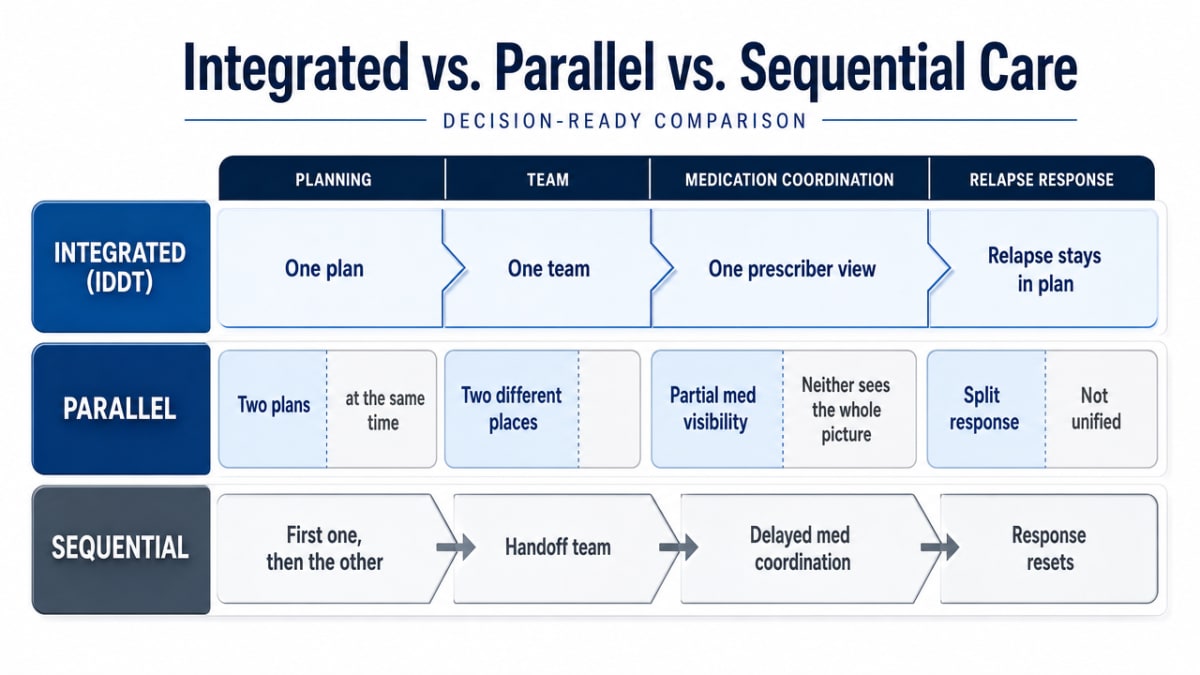
Most programs that call themselves “dual diagnosis” fall into one of three buckets, and only one of them is actually integrated. The differences matter because they shape how the program will respond when things get hard — which they will.
- Integrated (IDDT) care
- Means one treatment plan, one clinical team, one prescriber view of your medications, and relapse handled as a clinical event inside the plan you already have 3, 9. If you drink on a Saturday pass, you don’t get discharged from the mental health side. The team adjusts, meets, and keeps going.
- Parallel care
- Means two plans running at the same time in two different places. A psychiatrist somewhere, a substance use counselor somewhere else. Both may be competent. Neither sees the whole picture. Medications get prescribed on one side without full knowledge of what’s happening on the other. Relapse on the addiction side often means losing your slot there while the psychiatric side keeps going, or vice versa — the two teams weren’t built to hand back and forth.
- Sequential care
- Means one disorder first, then the other. Get sober, then we’ll treat your PTSD. Stabilize the psychosis, then we’ll address the meth use. For people whose disorders drive each other, sequential care usually stalls at step one. SAMHSA’s guidance is explicit that a unified plan across both conditions is the standard, not a nice-to-have 10.
When you’re looking at a Prescott program, this is the fault line. A comparison across four dimensions — planning, team, medication coordination, and relapse response — sorts most facilities within a single phone call. The visual below lays it out so you can hold it up against what a program is actually offering you.
What the Evidence Says—Honestly
Where Integrated Care Clearly Helps
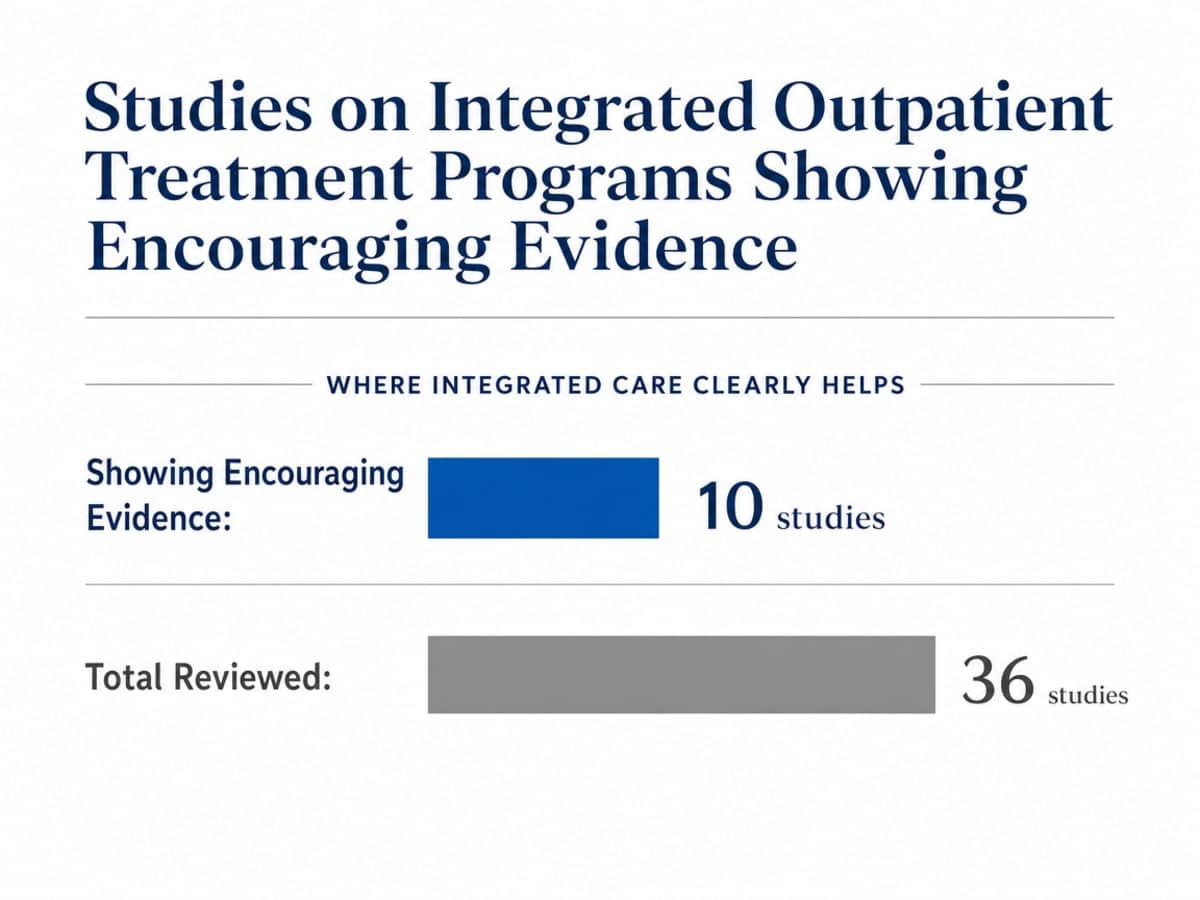
The strongest signal in the research comes from a review by Drake and colleagues that pulled together 36 studies on integrated treatment for people with co-occurring disorders. Out of those 36, 10 comprehensive integrated outpatient programs produced encouraging results for two specific things: keeping people engaged in treatment and reducing substance use over time 1. That’s a real finding, and it’s worth holding onto — but the scope matters. These were outpatient programs, not every model of care under every roof, and even in that review the results on hospital use and psychiatric symptom reduction were less consistent. Read the study for what it actually shows and it still points the same direction: when psychiatric and addiction services are delivered together by one team, more people stay, and more people use less.
Residential care has its own evidence base, which matters more for anyone considering a Prescott inpatient program. A peer-reviewed implementation study found that high-fidelity integrated treatment can be delivered inside a residential hospital setting, with strong clinician commitment, low staff turnover, and significant in-program clinical improvement — at lower cost than routine hospital care 2. That’s the closest match to what a well-run Prescott residential program should look like on the inside: a coordinated team that actually stays, working from one plan that actually holds.
Where the Evidence Gets Mixed
You deserve the honest version of this, because it’s the part most program brochures leave out. Not every controlled study finds that integrated care beats treatment-as-usual on every outcome. A 2019 review of integrated psychosocial interventions for people with co-occurring alcohol use disorder and mental health conditions concluded that systematic reviews found no significant differences versus usual care on alcohol use, substance use, functioning, or life satisfaction — with limitations like low retention and wide variation across the interventions studied 7. Other reviews of the broader literature have flagged similar issues, noting that some randomized trials of integrated treatment have produced inconclusive results 5.
What Integrated Care Looks Like in a Week
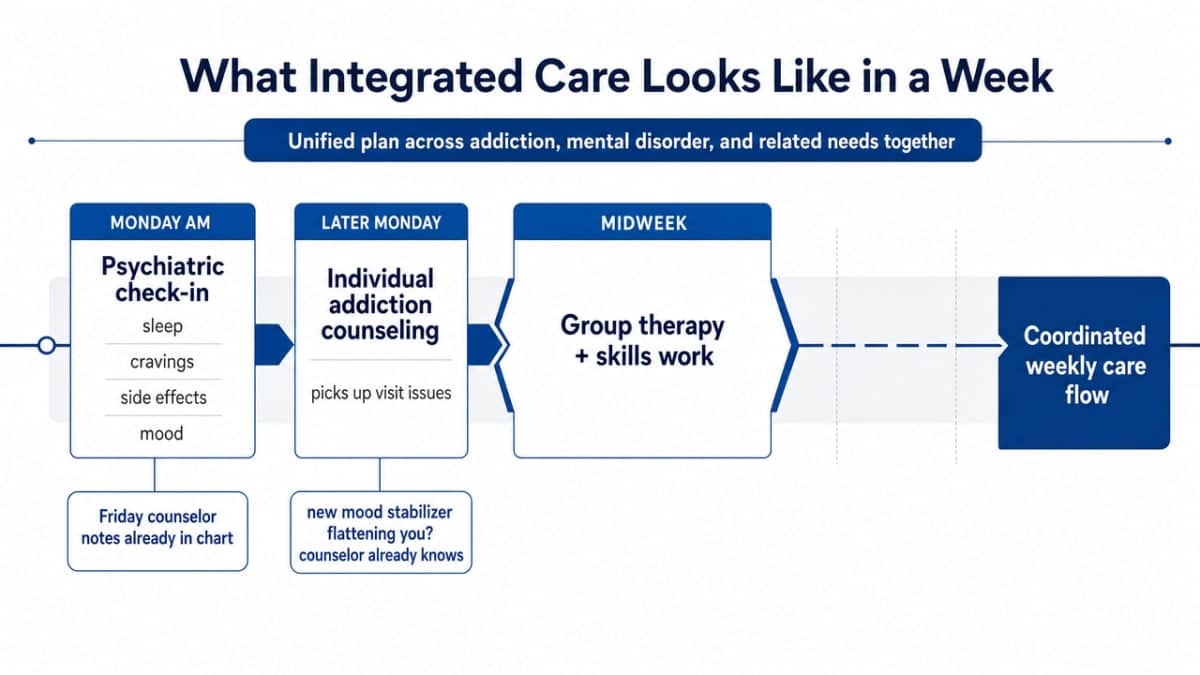
The abstract model is easier to grasp when you can picture the schedule. A week inside an integrated program has a shape, and that shape is what SAMHSA’s guiding principles describe as a unified plan that meets addiction, mental disorder, and related needs together rather than in shifts 10.
Monday morning usually starts with a psychiatric check-in. The prescriber reviews how the weekend went — sleep, cravings, side effects, mood — with notes already in the chart from the counselor who saw you Friday. Medication adjustments happen here, not in a separate appointment three weeks out. Later that day, individual addiction counseling picks up whatever the psychiatric visit surfaced. If the new mood stabilizer is flattening you, your counselor knows before you sit down.
Midweek is where group therapy and skills work live. Groups in an integrated program are built for people carrying both diagnoses, so the conversation doesn’t force you to hide half of your life to fit in. Trauma-focused sessions run alongside, because for many people the substance use and the psychiatric symptoms both trace back to something older. SAMHSA is direct that trauma-related disorders shouldn’t keep anyone out of mental health or substance use treatment — they need to be addressed inside the plan, not routed around it 11.
Family sessions typically anchor later in the week, once the team has enough to share and enough to ask for. A case manager keeps the through-line: housing, benefits, the follow-up appointment after discharge, the phone call to the outpatient prescriber who will take the handoff 10.
What makes it integrated isn’t the number of sessions. It’s that every session on that calendar informs every other one, because one team is running the plan. Staying engaged for a full week — showing up, saying the hard thing in group, taking the medication as prescribed — is a real win. That’s the pace progress actually moves at.
The Prescott and Northern Arizona Context
Local Residential Capacity and Payment Realities
Prescott sits inside a Northern Arizona behavioral health landscape that’s smaller and more spread out than what you’d find in Phoenix or Tucson, and that shapes what integrated care looks like here. The largest single piece of residential behavioral health capacity in the region is federal: the Bob Stump VA Medical Center in Prescott includes a 120-bed domiciliary as part of its Mental Health Residential Rehabilitation Treatment Program, serving veterans across the northern half of the state 8. If you or your family member is a veteran, that’s a genuine option worth calling first.
For everyone else, the private residential and inpatient options in Prescott are the ones you’ll be evaluating, and the pool is narrower than most families realize when they start searching. That’s not a bad thing. A smaller number of programs, done well, is the whole point. The peer-reviewed evidence on residential integrated care found that high-fidelity implementation was feasible in a hospital residential setting, with strong clinician commitment and low staff turnover — and produced meaningful in-program clinical improvement at lower cost than routine hospital care 2. That’s the standard to hold a Prescott program to: is the team stable, is the fidelity real, and does what happens on the unit actually match what the brochure describes.
Cost, Licensing, and What AHCCCS Covers
Two practical filters narrow the Prescott list quickly. First: licensing. Any legitimate residential or inpatient behavioral health facility in Arizona is licensed by the Arizona Department of Health Services, and that license is public. If a program can’t tell you their ADHS license status on the first call, that’s a hard stop.
Second: payment. AHCCCS — Arizona’s Medicaid program — covers behavioral health services including treatment for co-occurring disorders, and many Prescott families rely on it. Coverage details, prior authorization rules, and which specific facilities are in-network shift, so verify with AHCCCS and the facility directly before you assume anything about length of stay or level of care. On the cost question in general, the residential integrated treatment study is the honest anchor: high-fidelity integrated care was delivered at lower cost than routine hospital care 2. Beyond that, be skeptical of any Prescott program quoting outcome percentages or dollar figures without showing you the math.
When the Case Is Called ‘Treatment-Resistant’
What Treatment-Resistant Actually Means
“Treatment-resistant” sounds like a verdict. It isn’t. In clinical shorthand, it usually means a person hasn’t responded to two or more adequate trials of standard treatment — the right medication at the right dose for long enough, or a full course of a therapy that should have moved the needle. That’s a description of what’s happened so far, not a prediction of what’s possible next.
For dual diagnosis, the label often hides a simpler story. Someone was treated for the psychiatric condition while the substance use kept undoing the progress, or treated for addiction while an untreated mood or psychotic disorder kept pulling them back. NIDA’s comorbidity research makes the point directly: the two conditions shape each other’s course, and treating one without the other tends to fail 6. What looks like resistance is sometimes the predictable result of care that only addressed half the picture.
If you or your family member carries that label, it’s worth taking seriously and worth not taking as final.
Three Presentations That Need Real Integration
Dual diagnosis isn’t one thing. Three presentations show up often in Prescott programs, and each one asks something different from the team.
Complex bipolar or schizophrenia-spectrum illness with substance use. For rapid-cycling bipolar disorder with alcohol use, or schizophrenia with stimulant or cannabis use, medication strategy is delicate and consequential. The IDDT model was built specifically for people with severe mental illness and co-occurring substance use, on the evidence that one team handling both improves quality of life more than fragmented care 3, 9. In practice, that means a psychiatrist who can run advanced protocols — including clozapine when it’s clinically indicated — while the addiction side of the team keeps working the substance use in parallel, not on a waiting list.
Trauma-driven relapse. For many people, the substance use isn’t the starting point. It’s what made an untreated trauma survivable for a while. Programs that require someone to be “clean first” before trauma work can begin often lose them to relapse before that day arrives. SAMHSA is explicit that traumatic stress symptoms should not keep anyone out of mental health or substance use treatment, and that trauma needs to be addressed inside the plan 11. Real integration means trauma-focused therapy sits on the same weekly schedule as the addiction work, not after it.
Prior treatment failures with a mood or anxiety disorder underneath. This is the most common presentation labeled “treatment-resistant” in Prescott intake calls: three or four programs, each competent, none coordinated. The fix isn’t a fancier intervention. It’s the basics done together — one plan, one prescriber view, one team that stays 10. That’s the version of care most likely to hold this time.
How to Evaluate a Prescott Program Before You Admit
Seven Questions to Ask on the First Call
The first phone call tells you more than most brochures. You’re not trying to interview a program like a clinician — you’re trying to hear whether one team runs the plan or whether “integrated” is a word on the website. Seven questions get you most of the way there.
Who writes my treatment plan, and how many plans will I have? The answer you want is one plan, written by a team that includes both a psychiatric prescriber and an addiction clinician 10. Two plans is parallel care.
Does the same team handle both the psychiatric care and the substance use care? In an IDDT-style program, the answer is yes — same organization, same team, same meeting 3, 9. If the program refers out for one side, you’re being asked to coordinate care yourself.
How often does the team meet about my case? Weekly, at minimum. Ask what happens at that meeting and who’s in the room.
Who prescribes and adjusts my medications, and how do they hear about what happens in group or counseling? You want a prescriber inside the team, not a consultant who reads notes later.
What happens if I relapse during treatment? In an integrated program, relapse is a clinical event the team responds to, not grounds for discharge from one side of care.
How is trauma addressed, and do I have to be “clean first”? SAMHSA is clear that trauma shouldn’t be a gatekeeper to treatment 11.
Are you licensed by Arizona ADHS, and can you confirm your license number? A legitimate program answers this immediately.
Red Flags That Signal Parallel Care in Disguise
Some answers should slow you down. If the intake person can’t name the psychiatrist by name, or says the prescriber “comes in on Tuesdays” without a clear role in the team, that’s a program where medication decisions live outside the treatment plan. If the substance use side and the mental health side use different phone numbers, different intake packets, or different clinical directors, you’re looking at two programs sharing a lobby.
Watch for how relapse is described. “We hold people accountable” often translates to discharge, and discharge from an integrated program should be rare, not routine. Watch for trauma being deferred — “we address that in aftercare” is a sequential-care answer, not an integrated one 11.
Be cautious about quoted success rates. There’s no standardized reporting for dual diagnosis outcomes, and confident percentages usually aren’t sourced. The honest programs will tell you what they do, who does it, and what the plan is if the first approach doesn’t hold. That’s the version worth admitting to.
What Realistic Progress Looks Like
Progress in dual diagnosis treatment rarely looks like the before-and-after story a brochure wants to tell. It looks like a full week where you kept every appointment. A conversation with your prescriber that got a medication dose right on the third adjustment instead of the tenth. A family session that ended with a plan instead of a fight. A weekend you almost drank and didn’t, and then told your counselor about it on Monday.
That pace is not a consolation prize. It’s what the research actually describes. The integrated care evidence base is strongest on two outcomes: people stay engaged in treatment longer, and their substance use goes down over time 1. Those are the wins that stack into a life that holds. Symptom scores move more slowly, and setbacks are part of the arc, not the end of it.
What changes with real integration is the response to hard days. A missed group in a parallel program is a note in a chart no one reads together. In an integrated program, it’s on the agenda at the next team meeting, and someone calls you 10. Small difference on paper. The difference between staying and leaving in practice.
If you’re weighing a program in Prescott, hold it to that standard, and give yourself credit for the small wins as they come.
Start Your Coordinated Dual Diagnosis Assessment Today
Connect with a clinical team for a personalized dual diagnosis treatment plan tailored to your unique needs.
Frequently Asked Questions
How is dual diagnosis treatment different from going to rehab and seeing a psychiatrist separately?
In an integrated program, one team handles both the psychiatric care and the addiction care under a single treatment plan, sharing one chart and meeting about your case together 3, 9. Seeing a rehab and a psychiatrist separately is parallel care — two competent providers who rarely coordinate, so medication decisions and relapse response happen in isolation from each other.
Does AHCCCS cover dual diagnosis treatment in Prescott?
AHCCCS covers behavioral health services for co-occurring disorders, and many Prescott families use it to access residential and outpatient care. Coverage specifics, prior authorization, and in-network status vary by facility and change over time, so verify directly with AHCCCS and the program before assuming what your length of stay or level of care will look like.
What should I ask a Prescott program to know if their care is truly integrated?
Ask who writes the treatment plan, whether the same team handles both the psychiatric and substance use sides, and how often they meet about your case 10. Ask what happens if you relapse — in a real integrated program, that’s a clinical event the team responds to, not grounds for discharge. Confirm the Arizona ADHS license on the first call.
My family member has relapsed after several programs. Is that what ‘treatment-resistant’ means?
Not necessarily. Clinically, treatment-resistant usually means two or more adequate treatment trials haven’t produced the expected response. But for dual diagnosis, repeated relapse often reflects care that only addressed one side — psychiatric or addiction — while the other kept undoing the progress 6. What looks like resistance is sometimes the predictable result of fragmented care.
How long does dual diagnosis treatment usually take before we see progress?
Progress moves in weeks and months, not days. The strongest evidence base points to engagement and reduced substance use as the outcomes that shift first, with symptom scores moving more slowly 1. A full week of showing up, an accurate medication adjustment, a hard conversation in group — those are the wins that stack into a life that holds.
Can integrated treatment work for someone with severe mental illness like schizophrenia or bipolar disorder?
Yes — the IDDT model was built specifically for people with severe mental illness and co-occurring substance use, on evidence that one team handling both improves quality of life more than fragmented care 3, 9. For rapid-cycling bipolar disorder or schizophrenia-spectrum illness, that means a psychiatrist who can run advanced medication protocols while the addiction side of the team works in parallel.
References
- Review of integrated mental health and substance abuse treatment for patients with dual disorders. https://pubmed.ncbi.nlm.nih.gov/9853791/
- Implementing Residential Integrated Treatment for Co-Occurring Disorders. https://pmc.ncbi.nlm.nih.gov/articles/PMC3746518/
- Integrated Dual Disorder Treatment | Center for Evidence-Based Practices. https://case.edu/socialwork/centerforebp/practices/substance-abuse-mental-illness/integrated-dual-disorder-treatment
- Co-Occurring Mental Health and Substance Abuse Disorders: Best Practice Guidelines. https://www.dshs.wa.gov/sites/default/files/BHSIA/dbh/documents/cobestpract.pdf
- Co-Occurring Disorders in Substance Abuse Treatment. https://pmc.ncbi.nlm.nih.gov/articles/PMC2200799/
- NIDA Research Report: Comorbidity – Substance Use Disorders and Other Mental Illnesses. https://www.drugabuse.gov/publications/research-reports/comorbidity-substance-use-disorders-other-mental-illnesses
- Integrating Treatment for Co-Occurring Mental Health Conditions. https://pmc.ncbi.nlm.nih.gov/articles/PMC6799972/
- About Us | VA Northern Arizona Health Care. https://www.va.gov/northern-arizona-health-care/about-us/
- Co-Occurring Disorders Integrated Dual Disorders Treatment (IDDT) Toolkit. https://portal.ct.gov/-/media/dmhas/cosig/iddttoolkitpdf.pdf
- Chapter 2—Guiding Principles for Working With People Who Have Co-Occurring Disorders. https://www.ncbi.nlm.nih.gov/books/NBK571016/
- Trauma-Informed Care: A Sociocultural Perspective. https://www.ncbi.nlm.nih.gov/books/NBK207195/