Key Takeaways
- Fentanyl’s storage in fat tissue makes older heroin-era induction protocols risky, because you can appear fully withdrawn while still carrying enough drug to trigger precipitated withdrawal 1.
- Three induction pathways now fit fentanyl pharmacology: standard, high-dose, and micro-induction, with methadone or extended-release naltrexone as equally valid first-line options depending on history 6, 7.
- Psychiatric conditions have to be treated in parallel with opioid use disorder, not after it — integrated care reduces substance use, hospitalization, and arrests while improving housing stability 2, 3.
- When choosing a program, ask directly about fentanyl-adapted induction, on-site psychiatric medication management, and how lapses are handled, since these answers separate holding programs from ones that discharge you 4, 8.
Why the old opioid recovery playbook stopped working
If you have tried to get off opioids in the last few years, you already know something has shifted. The playbook a treatment center handed you in 2015 — a week of medically supervised detox, a standard buprenorphine start on day two or three, then 28 days of group therapy and a handshake goodbye — does not hold up against fentanyl. You may have lived that failure firsthand. A lot of people have.
The scale is worth naming once, so the rest of this makes sense. In 2024, illegally-made fentanyls were involved in 65.1% of U.S. overdose deaths, and 67.5% of those deaths had at least one identifiable opportunity for intervention — a prior nonfatal overdose, a recent release from jail or treatment, a bystander who could have acted, a prescriber contact that never happened 9. Two out of three deaths had a door that could have opened. It didn’t.
That gap is not a story about weak willpower. It is a story about clinical systems built for heroin and prescription pills trying to manage a drug that behaves differently in your body, clears differently from your tissue, and provokes a much more violent reaction when older induction protocols are used unchanged.
The playbook is not broken because you are hard to help. It is broken because fentanyl changed the pharmacology, and treatment has been slow to catch up. The rest of this article walks through what actually works now — the induction pathways, the medications, the psychiatric care that has to run alongside all of it — and what to ask for when you make the next call.
What fentanyl breaks in standard buprenorphine induction
Standard buprenorphine induction was built around a simple assumption: wait until you are in moderate withdrawal from a shorter-acting opioid like heroin or oxycodone, then take your first dose. Buprenorphine, a partial agonist with a high affinity for the opioid receptor, slides in and gives you relief. That sequence works when the opioid clearing your system is predictable.
Fentanyl is not predictable. It is highly lipophilic, which means it stores in your fat tissue and leaks back into your bloodstream long after you last used. You can feel like you are in withdrawal, show clear signs on the standard clinical scale, and still have enough fentanyl on your receptors to trigger precipitated withdrawal the moment buprenorphine displaces it. That reaction is worse than the withdrawal you walked in with — vomiting, bone-deep pain, agitation, sometimes for hours. If it has happened to you, you know why people do not come back for a second try.
Clinical guidance now recognizes that fentanyl users need induction strategies built around this pharmacology, not the older heroin-era timeline 1. That includes waiting longer, using larger initial doses to overcome receptor occupancy, or starting with tiny doses while you continue using — an approach called micro-induction that would have been unthinkable a decade ago 4. The medication still works. The induction just has to meet fentanyl on its own terms.
Three induction pathways that actually work for fentanyl users
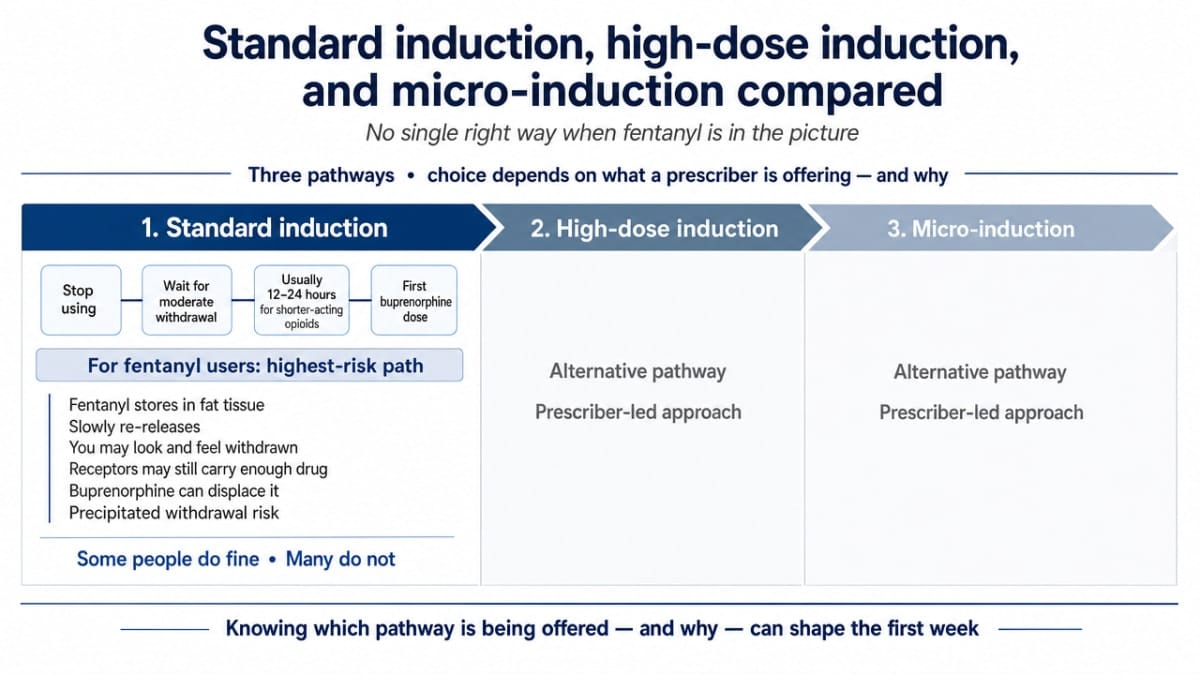
Standard induction, high-dose induction, and micro-induction compared
There is no single right way to start buprenorphine when fentanyl is in the picture. There are three, and knowing which one a prescriber is offering you — and why — is often the difference between a first stable week and another precipitated withdrawal that sends you back out the door.
Standard induction is the older protocol. You stop using, you wait until you are in moderate withdrawal (usually 12 to 24 hours for shorter-acting opioids), and then you take your first dose of buprenorphine. For fentanyl users, this is the highest-risk path. Because fentanyl stores in fat tissue and slowly re-releases, you can look and feel withdrawn while still carrying enough drug on your receptors to trigger precipitated withdrawal the moment buprenorphine displaces it 1. Some people do fine on standard induction. Many do not. Prescribers who still default to it for fentanyl users are working from an outdated playbook.
High-dose induction takes the opposite approach. Instead of tiptoeing in, the first dose is larger — often 16 mg or more, sometimes stacked over the first few hours — with the goal of quickly saturating the receptor and overriding whatever fentanyl remains 1. You still have to be in clear withdrawal to start, but the larger initial dose reduces the window in which a partial displacement can go wrong. It is used most often in emergency departments and inpatient settings where you can be monitored.
Micro-induction flips the sequence entirely. You keep using your usual opioid — including fentanyl — while the prescriber starts you on very small doses of buprenorphine, sometimes 0.5 mg or less, and titrates upward over days 4. Because the doses are so small, they do not displace enough fentanyl to trigger withdrawal. Over roughly a week, the buprenorphine level rises, the fentanyl use tapers, and the crossover happens without the cliff. If precipitated withdrawal has already knocked you out of treatment once, this is often the path worth asking for by name.
When methadone or extended-release naltrexone is the better call
Buprenorphine is not the only medication for opioid use disorder, and for some people it is not the right first choice. Two other options carry the same evidence base and belong in the conversation 6, 7.
Methadone is a full opioid agonist dispensed through federally regulated opioid treatment programs. If you have been using large amounts of fentanyl for a long time, if repeated buprenorphine inductions have not held, or if you need the structure of daily dosing and on-site counseling to stay engaged, methadone is often the more stable option. It does not carry the precipitated withdrawal risk that buprenorphine does, because it occupies the receptor as a full agonist rather than displacing what is already there.
Extended-release naltrexone — a monthly injection — works differently. It blocks the opioid receptor entirely, so there is no agonist effect at all. That also means you have to be fully off opioids for roughly 7 to 10 days before your first shot, which is a real barrier when you are coming off fentanyl. It tends to fit best after a stabilized inpatient stay, or for people who have been abstinent through incarceration or a controlled setting and want to avoid returning to any opioid agonist.
None of these three medications is a lesser choice. ASAM and SAMHSA treat them as equivalent first-line options, and the right one depends on your history, your co-occurring conditions, and what has already failed 6, 7. Ask your prescriber which they recommend, and ask them why.
Why psychiatric care has to run in parallel, not after
The dual-diagnosis reality most programs still get wrong
You have probably been told some version of this: get clean first, then we can look at your depression, your trauma, your bipolar diagnosis. Stabilize on medication, do 90 days, and if you’re still struggling emotionally at the end of it, then the psychiatric side of things becomes a conversation.
That sequence has cost people their recovery, and the research is now clear about why. Among patients in opioid agonist treatment, co-occurring psychiatric conditions are the norm rather than the exception, and integrated care models that treat both together are more effective than standard non-integrated approaches 2. When your PTSD is untreated during a buprenorphine start, the nightmares and hypervigilance drive use. When your bipolar depression rolls in during month two of a program that only offers addiction counseling, no one adjusts the mood stabilizer that would keep you engaged. You leave. You relapse. The chart says you failed treatment. What actually failed was the sequencing.
The reason you started using fentanyl was rarely just fentanyl. For a lot of people it was pain — physical, psychiatric, or both — that no one had adequately treated. If a program addresses only the opioid dependence and leaves the underlying condition sitting there, you are essentially being asked to hold a lid on a pot that is still boiling. That works for a while. It does not work for long.
What integrated care actually changes
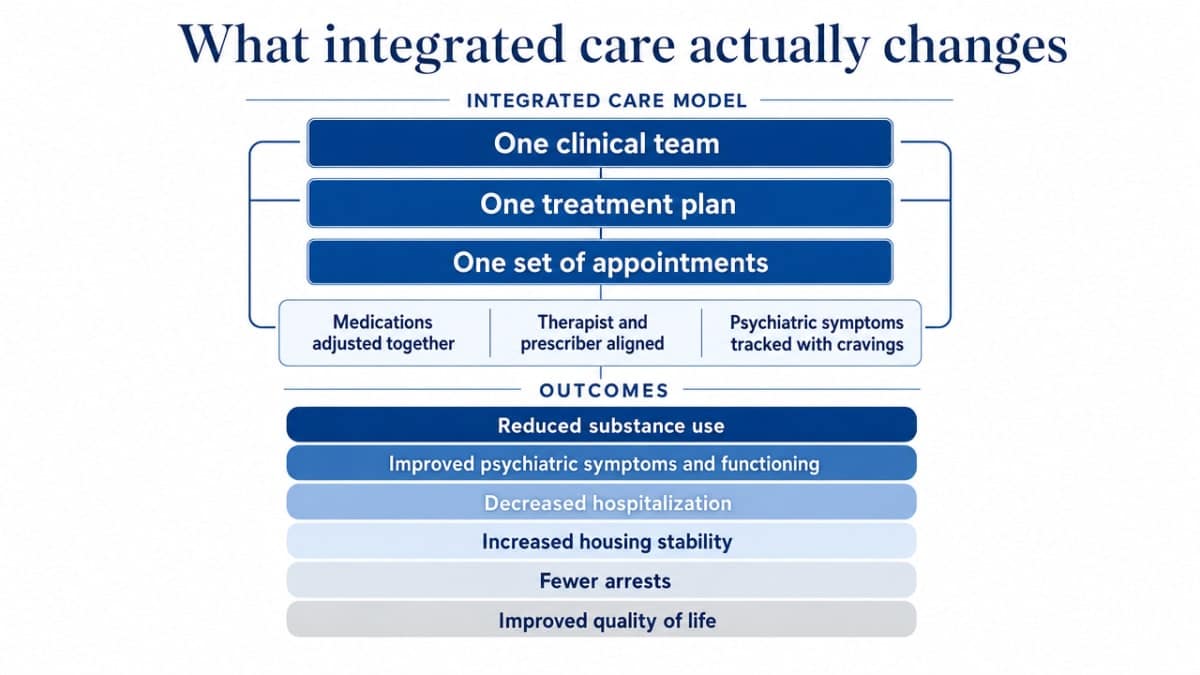
Integrated care is not a scheduling trick where your addiction counselor and your psychiatrist happen to work in the same building. It means one clinical team, one treatment plan, one set of appointments that account for both diagnoses at the same time. Your buprenorphine dose and your antidepressant get adjusted with each other in mind. Your therapist knows what your prescriber changed last week. Your psychiatric symptoms are tracked with the same seriousness as your cravings.
The outcome data is worth taking seriously. When mental health and substance use disorders are treated together in an integrated model, patients experience reduced substance use, improved psychiatric symptoms and functioning, decreased hospitalization, increased housing stability, fewer arrests, and improved quality of life compared with non-integrated care 3. That is not one soft outcome. It is a stack of them, across the parts of your life that fall apart first when treatment fails.
Notice what is on that list. Housing. Arrests. These are the things you actually lose when a program treats the addiction and ignores the mania, or treats the depression and ignores the fentanyl use. Integrated care keeps you housed because it keeps you stable enough to hold housing. It keeps you out of the ER because your antipsychotic is being managed by someone who also knows what your induction week looked like.
When serious mental illness is also in the picture
If you are living with schizophrenia, schizoaffective disorder, or a rapid-cycling bipolar illness alongside fentanyl use, you have probably run into a specific wall: addiction programs that say they cannot manage your psychiatric medications, and psychiatric programs that say they cannot manage your opioid use disorder. You get bounced between the two, and neither one holds you.
You are not imagining this gap. A recent review of co-occurring OUD and serious mental illness found that while integrated pharmacologic and psychosocial treatment is pivotal for improving outcomes, comprehensive clinical guidelines for this population are still lacking 8. Translation: the field agrees you need both, at the same time, but there is no cookie-cutter protocol. Care has to be built around your specific combination.
That is exactly the situation where a specialized dual-diagnosis facility matters. Someone has to manage your clozapine or lithium levels while your buprenorphine is being titrated. Someone has to recognize when a psychiatric crisis is driving use versus when withdrawal is mimicking a mood episode. If a program has told you before that your case is too complex, what they were really saying is that their model was built for a simpler patient. The right place will treat that complexity as the point, not the disqualifier.
Withdrawal, precipitated withdrawal, and what to ask a prescriber
Fentanyl withdrawal is not the flu. It is a physiological event that peaks harder and lasts longer than most people expect from what they read online, in part because fentanyl’s storage in fat tissue means your body keeps releasing small amounts for days after your last use. If you have tried to white-knuckle it before and given up on day three thinking something must be wrong with you, nothing was wrong with you. The timeline you were handed was the wrong timeline.
Precipitated withdrawal is a different animal. It is what happens when buprenorphine displaces fentanyl from your receptors before enough of it has cleared, and it hits within an hour of your first dose. Sweating, vomiting, muscle spasms, a level of agitation that makes staying in the room feel impossible. It is the single most common reason people walk out of a buprenorphine start and do not come back 1. Knowing it can happen is not enough. You need a prescriber who is planning around it.
Before you agree to an induction, ask directly:
- Which induction protocol are you using, and why that one for me?
- Have you inducted fentanyl users before?
- What happens at 2 a.m. on day two if I am in precipitated withdrawal — do I call you, go to an ER, or is there a plan on paper?
- Am I a candidate for micro-induction so I do not have to stop using before I start 4?
A prescriber who treats those questions as reasonable is the kind you want. One who bristles is telling you something.
Naloxone and harm reduction as ongoing treatment, not a handout
Somewhere in your history with treatment, someone probably handed you a naloxone kit at discharge and considered the box checked. That is not what harm reduction is. It is what happens when a program treats overdose prevention as a compliance step instead of a piece of your ongoing care.
CDC guidance is clear that patients at risk for opioid overdose should have naloxone readily available and be connected to evidence-based MOUD as a linked pair, not as separate errands 5. Your prescriber should be co-prescribing naloxone at every visit, checking that you still have it, that it has not expired, and that someone in your household knows how to use it. If you are on buprenorphine or methadone, your overdose risk drops, but it does not disappear — especially during any gap in dosing or after a period of reduced tolerance.
Fentanyl test strips belong in this same category. So does an honest conversation with your prescriber about lapses without losing your medication. A program that discharges you for a positive screen is not practicing harm reduction. One that adjusts the plan and keeps you in the room is 5.
Why Arizona-specific access to integrated care matters
National overdose numbers can feel abstract until you look at what fentanyl is doing in the state you actually live in. In Arizona in 2024, fentanyl was identified in approximately 3 out of 4 non-fatal opioid overdoses (n=4,036) 10. Every one of those was a survivor. Every one was someone who ended up in an ER, a bathroom, a friend’s car — and lived. That is a population of people, likely including you or someone you love, who have a window right now to get into treatment.
What that window opens onto depends heavily on where you are. Arizona has expanded harm-reduction infrastructure — statewide naloxone, fentanyl test strips, and drug disposal distribution funded through state opioid response dollars 10— but the harder ask is finding a program that can hold a fentanyl-adapted induction and psychiatric care under one roof. Rural counties often have one and not the other. A methadone clinic without a psychiatrist. A behavioral health group without a MOUD prescriber on staff. That gap is where people get lost between systems.
Local access to integrated dual-diagnosis care shortens the distance between a survived overdose and a treatment plan that actually addresses both sides of what you are carrying. That distance, more than any statistic, is what determines whether the next call gets made.
Chronic-care management: what long-term recovery actually looks like
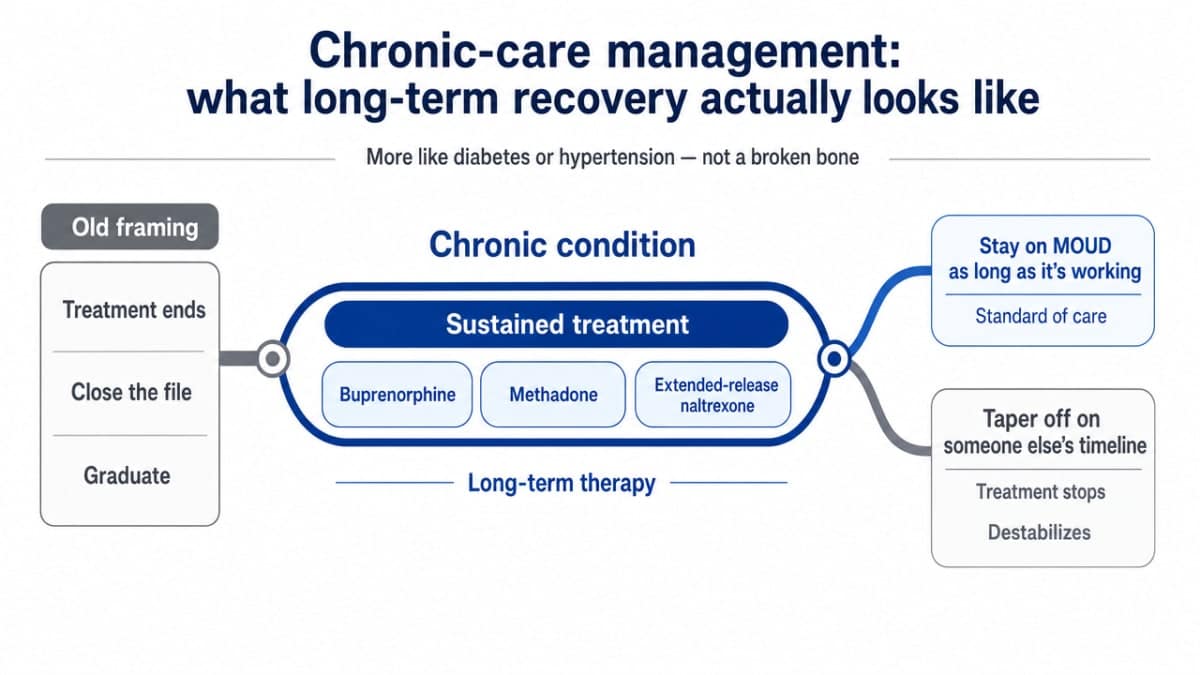
Somewhere along the way, someone probably told you that treatment ends. Ninety days, six months, a year sober and you graduate, close the file, and go live your life. That framing has hurt a lot of people. Opioid use disorder involving fentanyl behaves more like diabetes or hypertension than like a broken bone — it is a chronic condition that responds to sustained treatment and destabilizes when treatment stops. ASAM and SAMHSA both frame MOUD as a long-term therapy, not a bridge to abstinence you eventually walk off of 6, 7.
What that means practically: staying on buprenorphine, methadone, or extended-release naltrexone for as long as it is working is the standard of care, not a failure to progress. People who taper off MOUD on someone else’s timeline — an insurance clock, a program’s 90-day model, a family member’s discomfort with the medication — relapse at rates that should not surprise anyone. If your medication is holding you, that is the treatment working. That is not something to graduate from.
Chronic-care management also means the appointments do not stop when the crisis stops. Your first stable month is not the finish line. It is the point at which the real work becomes possible — the trauma therapy you could not tolerate during active use, the psychiatric medication adjustments that need months to settle, the slow rebuilding of a life that got small while you were surviving. A program that keeps you engaged after the acute phase, through the flat middle where nothing dramatic is happening, is doing something right.
Every kept appointment is a win. Every honest conversation with your prescriber about a craving, a lapse, a bad week is a win. This is what recovery looks like when it lasts.
Finding a program that will not turn you away
If you have been told before that your case is too complex — the psychiatric diagnosis is too severe, the fentanyl use is too active, the last discharge was too messy — you already know how thin the ground is between programs that will actually hold you and programs that will move you along. What you are looking for is narrower than a treatment center. You are looking for a program that treats fentanyl-adapted MOUD and psychiatric care as one job, not two.
A few direct questions cut through the marketing fast:
- Do you offer micro-induction, and have you inducted fentanyl users this month 1, 4?
- Who on staff manages psychiatric medications, and how do they coordinate with the prescriber running my buprenorphine or methadone 2?
- What happens if I use during treatment — is the plan adjusted, or am I discharged?
- Are you set up for people with schizophrenia, bipolar disorder, or PTSD alongside OUD 8?
A program that answers plainly is the kind that will still be answering the phone at week six. If you need a starting point, SAMHSA’s treatment locator lists authorized MOUD practitioners nationwide 11. Facilities like ViewPoint Dual Recovery exist for exactly the cases other programs pass on.
Find the Right Fentanyl Recovery Path Forward
Get expert guidance on your next steps for fentanyl addiction and mental health recovery.
Frequently Asked Questions
Can buprenorphine actually work if I’ve been using fentanyl?
Yes. Buprenorphine is effective for opioid use disorder in people using fentanyl and other highly potent synthetic opioids 1. What has to change is the induction approach, not the medication. If a standard start knocked you into precipitated withdrawal before, ask about high-dose induction or micro-induction. Same medicine, different on-ramp.
What is precipitated withdrawal, and how do I avoid it?
Precipitated withdrawal is what happens when buprenorphine displaces fentanyl on your receptors before enough has cleared, triggering intense withdrawal within an hour of your first dose 1. You avoid it by working with a prescriber who plans around fentanyl’s storage in fat tissue — waiting longer, using a larger initial dose to override receptor occupancy, or starting a micro-induction while you keep using 4.
How is micro-induction different from standard buprenorphine induction?
Standard induction requires you to stop using and wait until you are in moderate withdrawal before your first dose. Micro-induction reverses that. You continue using your usual opioid, including fentanyl, while a prescriber starts you on very small buprenorphine doses and titrates upward over roughly a week 4. The crossover happens gradually, which sharply reduces the risk of precipitated withdrawal 1.
Do I have to be sober before I can get psychiatric treatment?
No, and any program telling you otherwise is working from an outdated model. Integrated care that treats mental health and substance use disorders at the same time produces better outcomes than sequential approaches, including reduced substance use and improved psychiatric symptoms 2, 3. Your depression, PTSD, or bipolar illness needs attention from day one, not after you have proven something.
Is medication for opioid use disorder just replacing one drug with another?
No. SAMHSA is direct about this: medications for opioid use disorder are effective and save lives, particularly when combined with counseling and support services 6. Buprenorphine, methadone, and naltrexone stabilize your brain chemistry so you can work, sleep, and engage in therapy. That is treatment for a chronic medical condition, not a substitution. ASAM treats these medications as first-line care 7.
What happens if I’ve already been kicked out of treatment for using?
You are not out of options. A discharge for continued use usually reflects a program’s model, not your prognosis. Look for a facility that adjusts the plan after a lapse instead of ending care, offers micro-induction so you do not have to stop using before starting 4, and manages psychiatric medications on-site 8. SAMHSA’s treatment locator lists authorized MOUD practitioners nationwide 11.
References
- How Should Clinicians Treat Patients Presenting with Fentanyl Opioid Use Disorder (FOUD). https://medicine.wright.edu/sites/medicine.wright.edu/files/2024-10/pcss-fentanyl-guidance.pdf
- Exploring dual diagnosis in opioid agonist treatment patients. https://pmc.ncbi.nlm.nih.gov/articles/PMC11092244/
- Dual Diagnosis (UConn Pain Center educational handout). https://health.uconn.edu/pain-center/wp-content/uploads/sites/235/2020/02/Dual-Diagnosis-1.31.20.pdf
- Management of Opioid Use Disorder: Update on the Changing Clinical and Regulatory Landscape. https://www.medschool.umaryland.edu/media/som/microsites/dacs/Management-of-Opioid-Use-Disorder-Update-on-the-Changing-Clinical-and-Regulatory-Landscape.pdf
- Clinical Guidance for Healthcare Providers: Opioid Overdose Prevention (CDC). https://www.cdc.gov/overdose-prevention/hcp/clinical-guidance/index.html
- Medications for Substance Use Disorders (SAMHSA). https://www.samhsa.gov/medications-substance-use-disorders
- American Society of Addiction Medicine (ASAM) National Practice Guideline for the Use of Medications in the Treatment of Addiction Involving Opioid Use. https://pmc.ncbi.nlm.nih.gov/articles/PMC4605275/
- Co-occurring opioid use disorder and serious mental illness. https://pubmed.ncbi.nlm.nih.gov/36734070/
- SUDORS Dashboard: Fatal Drug Overdose Data. https://www.cdc.gov/overdose-prevention/data-research/facts-stats/sudors-dashboard-fatal-overdose-data.html
- ADHS Opioid Update (Presentation). https://www.substanceabuse.az.gov/sites/default/files/meeting-documents/materials/4._adhs_opioid_update.pdf
- Facts about Fentanyl. https://www.dea.gov/resources/facts-about-fentanyl