Key Takeaways
- Federal parity rules require mental-health benefits to be treated comparably to medical ones, giving Hawaii families real ground to question stricter prior authorization or network limits on mainland psychiatric care 1.
- Hawaii’s crisis-line calls rose 11.61% between FY 2022 and FY 2023 14, and state planners describe transportation, financial, and geographic barriers along with a substantial unmet treatment gap 12, 15.
- Emergency care while traveling must be covered without prior approval, but a planned mainland admission requires full verification — network status, level-of-care coverage, medical necessity, and prior authorization — before travel 5.
- Before booking a flight, Hawaii families can have ViewPoint Dual Recovery’s insurance team run cross-state verification and deliver a written coverage summary covering what’s authorized and estimated patient responsibility 7.
The 2,500-Mile Question Before You Book a Flight
You’re sitting at the kitchen table with an insurance card in one hand and a printout about a mainland psychiatric program in the other. Someone you love needs help that hasn’t worked here, and the next step means a flight, a rental car on the other end, and days away from home. Before any of that, you need to know one thing: will the coverage actually be there when you arrive?
That question lands differently when you live in Hawaii. You can’t drive over for a tour on a Saturday. You can’t ask a neighbor if they’ve been to the facility. And every piece of this decision — the airfare, the hotel, the time off work — depends on an answer you can’t get by walking in the front door.
The good news is that verifying coverage for mainland psychiatric care is a defined process, not a leap of faith. Federal parity rules shape what your plan has to justify when it limits mental-health benefits 1. Your plan has to give you a plain-language Summary of Benefits and Coverage you can start with 7. And a mainland facility’s insurance team can run the cross-state verification on your behalf, so travel is only something you commit to after coverage is clear.
This guide walks you through how that works, step by step, before you ever buy a ticket.
Why Hawaii Families Look Beyond the Islands
You probably didn’t start here. Most Hawaii families who end up researching a mainland program have already worked through local psychiatrists, outpatient groups, and whatever inpatient options were available on their island. Sometimes those options were a good fit. Sometimes the waitlist was too long, the specialty wasn’t local, or the same crisis kept repeating. If you’ve reached the point of reading an article about cross-state insurance verification, you’ve already carried a lot.
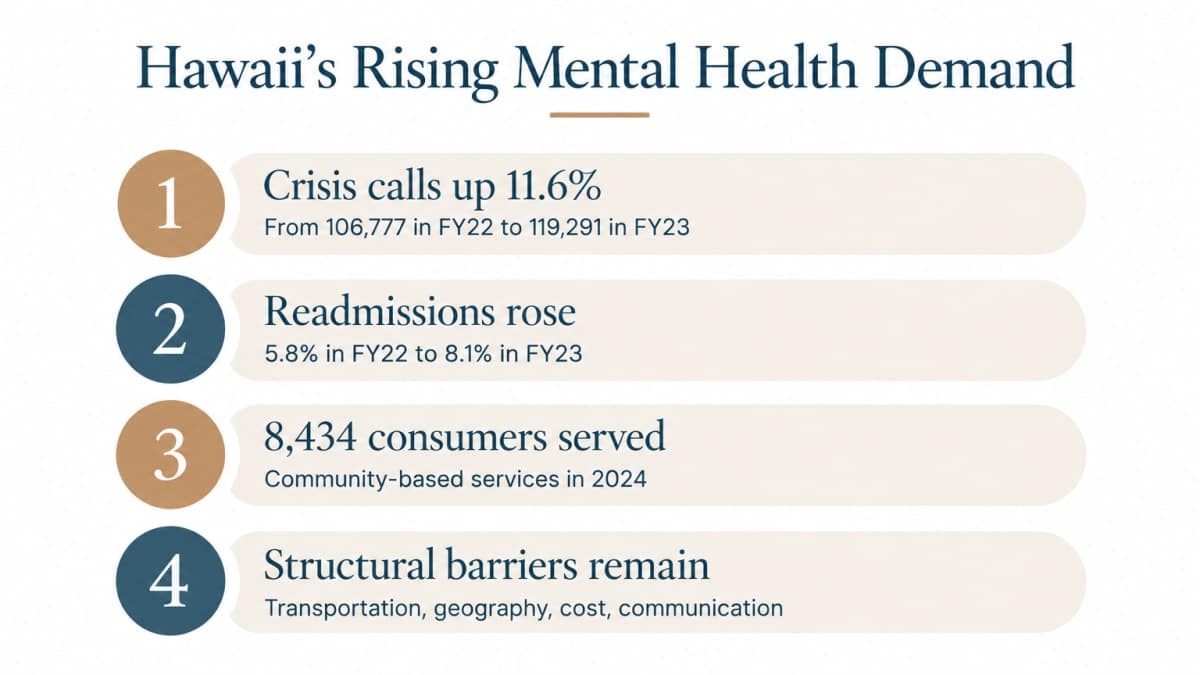
The state’s own data shows how much pressure the system is absorbing. Hawaii’s crisis-line call volume climbed from 106,777 in FY 2022 to 119,291 in FY 2023, an 11.61% increase in a single year 14. That same report tracked a public mental-health system readmission rate that moved from 5.8% in FY 2022 to 8.1% in FY 2023 14. Hawaii’s Adult Mental Health Division reported, in a planning-period figure, serving 8,434 consumers through community-based services in 2024, and the state’s own planning documents describe a substantial unmet treatment gap for mental illness and substance-use disorders 15.
None of that means mainland care is better. It means demand is real. State planners also point to transportation, financial, communication, and geographic barriers as structural features of island life, not personal failures of the people trying to get help 12.
So looking off-island isn’t giving up. It’s a reasonable next step when the clinical need is specific and the local options have been honestly exhausted. The question that follows is practical, not philosophical: before anyone boards a plane, will the insurance actually cover what’s being planned?
What Cross-State Verification Actually Confirms
Cross-state verification isn’t one phone call. It’s a stack of questions a mainland facility’s insurance team works through with your plan, in a specific order, before anyone tells you a flight is a good idea. Each question has a real answer, and each answer either moves the admission forward or flags something you need to know now rather than at the airport.
Your Plan Type Changes the Playbook
The first thing worth sorting out is what kind of coverage you actually have, because the rules behind each type are different. A commercial plan through an employer, a plan you bought on the Marketplace, Hawaii Medicaid (Quest), and Medicare each follow their own path when the care is happening in another state.
Commercial and Marketplace plans fall under the federal Mental Health Parity and Addiction Equity Act, which requires mental-health and substance-use benefits to be treated comparably to medical and surgical benefits 1. That matters because things like prior authorization, network composition, and out-of-network reimbursement are considered nonquantitative treatment limitations the plan has to be able to justify 1. Translation: your plan can’t quietly make it harder to get a residential psychiatric admission than it would be to get a comparable medical admission, and if it does, that’s something you can challenge.
Hawaii Medicaid (Quest) follows a different process for out-of-state care. Your Quest plan’s member services line is the right first call for the exact requirements that apply to your situation, including any approval, documentation, and provider-acceptance rules for non-emergency mainland treatment.
If your coverage is through a self-funded employer plan, your state external-review rights work differently, which matters later if you need to appeal 10. Knowing your plan type up front saves you from running the wrong playbook.
Network Status, Level of Care, and Medical Necessity
Once the plan type is clear, three questions do most of the work in a cross-state verification. Each one can quietly change what you’ll owe or whether the admission moves forward at all.
Is the mainland facility in-network, out-of-network, or available through a single-case agreement? Network status drives your cost share and whether the plan will consider the admission at all. Online directories are a starting point, not an answer. A 2022 GAO review of behavioral-health access found that stakeholders reported inaccurate or outdated directories and difficulty finding in-network providers accepting new patients 13. That’s why the facility’s insurance team calls the plan directly and asks, in writing when possible, whether this specific facility is contracted for this specific service.
Does the plan cover the level of care being recommended? Psychiatric treatment runs a ladder — outpatient, intensive outpatient, partial hospitalization, residential, and inpatient. Parity rules specifically cover intermediate levels of care and prohibit stricter restrictions based on geographic location, facility type, or provider specialty than the plan uses for comparable medical care 3. If your plan covers skilled nursing for medical rehabilitation, for example, it generally can’t apply tougher rules to a comparable psychiatric residential level without being able to justify why.
Does the admission meet the plan’s medical-necessity criteria? Every plan uses clinical criteria — often based on diagnosis, symptom severity, failed outpatient treatment, or risk indicators — to decide whether a level of care is appropriate. The mainland facility’s clinical team documents how your family member meets those criteria. A facility experienced with complex cases builds documentation around the specific questions a plan reviewer will ask.
Prior Authorization and Parity: What the Plan Must Justify
Prior authorization is where cross-state verification lives or dies. It’s the plan’s formal yes before an admission, and for a planned mainland psychiatric stay, you almost always need one. Your Summary of Benefits and Coverage will tell you whether prior authorization applies to the services being planned 7, but the specifics come from the plan’s utilization review team.
Here’s the piece that often gets missed: prior authorization itself is a nonquantitative treatment limitation under federal parity rules 1. So are the plan’s network composition and its out-of-network reimbursement rates. Under the 2024 final MHPAEA rules, plans have to document the factors, evidentiary standards, and operation of those limitations and show they aren’t more stringent for mental-health benefits than for comparable medical ones 4. Plans also have to actually evaluate whether these rules create unequal access to mental-health and substance-use care, and make changes when the data shows they do 2.
None of this means the plan will say yes. Parity is a comparative standard, not a guarantee that any specific facility or level of care is covered. But it does mean the questions you’re asking, and the answers the facility’s insurance team is pushing for, have real rules behind them. You’re not negotiating from thin air.
The Verification Sequence That Happens Before You Travel
When a mainland facility’s insurance team is doing its job, cross-state verification follows a sequence. The order matters because each step either clears the next one or surfaces a problem while you still have time to adjust. For a Hawaii family, that means knowing whether coverage is likely before airfare is purchased, not after a bag is already packed.
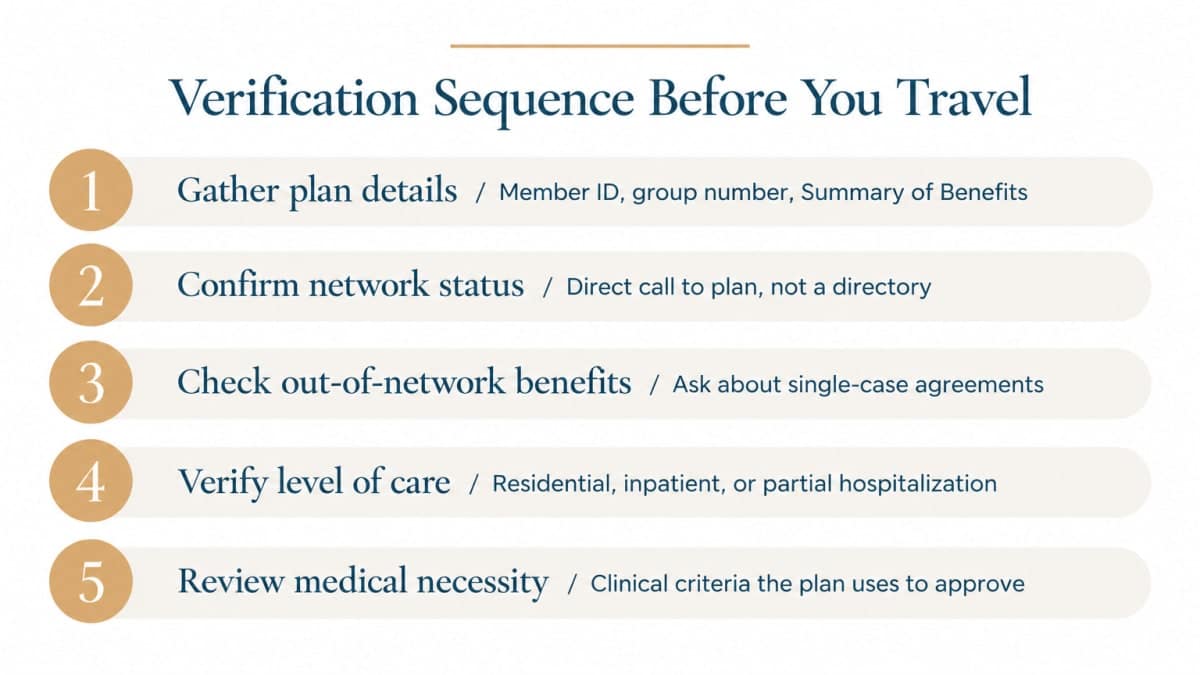
Here is the sequence that typically runs before you commit to travel:
- Collect plan details and the Summary of Benefits and Coverage. The team gathers the member ID, group number, dependent information, and the plain-language SBC your insurer is required to provide 7. That document is the starting map for covered services, cost sharing, limitations, and exceptions.
- Confirm network status and out-of-network benefits for the specific mainland facility. This is a direct call to the plan, not a directory screenshot. The team asks whether the facility is contracted for the exact service being planned, and if not, what the out-of-network benefits look like, including whether a single-case agreement is possible.
- Confirm level-of-care coverage and medical-necessity criteria. The team asks the plan to spell out what it covers at the recommended level — residential, inpatient, partial hospitalization — and which clinical criteria it uses to approve that level. Parity rules apply to intermediate levels of care and to restrictions based on geographic location and facility type, which gives the team room to push on uneven answers 3.
- Submit prior authorization with clinical documentation. The facility’s clinical team writes the medical-necessity case and files the authorization request. For a planned mainland admission, this step almost always happens before travel.
- Deliver a written coverage summary to the family. You receive something you can read at your kitchen table: what’s authorized, what the estimated patient responsibility looks like, what still needs to happen, and what travel timing makes sense.
Getting that written summary in hand is a real win. It’s the moment the 2,500-mile question stops being hypothetical and starts being a plan.
Emergency Care While Traveling vs. a Planned Mainland Admission
This is a distinction worth drawing clearly, because families often blur the two and end up either delaying a real emergency or expecting emergency rules to cover a planned trip. They don’t work the same way.
If someone is in a true psychiatric emergency while traveling on the mainland — actively suicidal, in acute psychosis, medically unstable — the rule is simple: go straight to the nearest hospital. Your insurer cannot require prior approval before out-of-network emergency-room services, and emergency care has to be covered even when the hospital isn’t in your plan’s network 5. Under the No Surprises Act, out-of-network cost-sharing for covered emergency services generally cannot exceed the in-network amount, and emergency behavioral-health services furnished in an emergency department can qualify under those protections 6.
A planned mainland admission is a different world. When you’re choosing a specific residential or inpatient program weeks ahead, booking flights, and arriving at a scheduled intake, that is not an emergency in your plan’s eyes. The No Surprises Act does not convert a planned out-of-network psychiatric admission into an in-network service 6. You need the full verification sequence — network status, level-of-care coverage, medical-necessity review, and prior authorization — finished before you travel.
If you’re unsure which situation you’re in, trust the clinical picture in front of you. Emergencies get the ER. Planned admissions get the paperwork, and that paperwork is a win worth taking the time to do right.
Questions to Ask Your Plan, and Why Each One Matters
If you’re the one making the verification call, you don’t need to sound like an insurance expert. You need a short list of questions, and a reason behind each one. Keep this list next to your laptop when you call the member services number on the back of the card.
“Is this specific mainland facility in-network for the service we’re planning? If not, what are my out-of-network behavioral health benefits?” Network status drives cost share and whether the plan will even consider the admission. Get it on the record, because a 2022 GAO review found directory listings aren’t always current 13.
“Is residential psychiatric treatment a covered level of care under my plan, and what are the medical-necessity criteria?” Parity rules apply to intermediate levels of care and prohibit stricter rules based on facility type or geographic location than comparable medical care would face 3. Ask them to send the criteria in writing.
“Does this admission require prior authorization, and what documentation do you need?” Prior authorization is itself a nonquantitative treatment limitation the plan must be able to justify as comparable to medical/surgical rules 1. Knowing the exact documentation list up front keeps the clinical team from having to resubmit.
“Will you confirm these benefits in writing, with a reference number?” A verbal yes isn’t enough. A written benefits summary with a call reference number is what protects you if the claim is later processed differently than you were told.
If Coverage Is Denied: The Appeal Path Hawaii Families Can Use
A denial letter is not a locked door. It’s a decision point with rules behind it, and plans have to follow a defined process to issue one and to review it when you push back. For a Hawaii family who has already done the hard work of verifying benefits and submitting a prior authorization, understanding the appeal path matters, because the clock starts the moment the denial arrives. The good news is that both federal and Hawaii-specific routes exist, each with its own timeline, and your mainland facility’s clinical and insurance teams can help you build the file.
Internal and External Appeal Timelines
The first path after a denial is an internal appeal — you’re asking the same plan to look again, usually with additional clinical documentation from the mainland facility’s treatment team. For Marketplace coverage, the plan generally has to respond within 15 days on a prior-authorization request, 30 days on services not yet received in ordinary cases, and 72 hours on urgent-care situations 8. Those timelines give you a working framework for when to expect an answer and when to escalate.
If the internal appeal is denied, you move to external review, where an independent reviewer outside the plan evaluates the decision. A standard external review generally has to be decided within 45 days, and an expedited external review within 72 hours when the clinical picture can’t wait 9. External reviewers can look at medical-necessity determinations, appropriateness, level-of-care disputes, experimental-treatment questions, and certain provider-network denials 9 — exactly the categories that come up in a planned mainland psychiatric admission.
A few things worth knowing before you file. The appeal routes and deadlines are different for employer self-funded plans, Medicare, and Medicaid, and the denial notice itself will tell you which process applies to your coverage 8. Urgent cases almost always qualify for expedited review on both the internal and external side, and if someone’s clinical safety depends on timing, you say that in the request. Every day you spend assembling the file is a day the clock has already started, so starting early is itself a step forward.
Hawaii’s State External Review, in Honest Terms
Hawaii runs its own state external-review program through the Insurance Division for certain private health-plan denials. You generally have 130 days after the denial to request a review, which is a longer window than many families expect 10. The program handles standard, expedited, and investigational-procedure reviews, and there’s a $15 filing fee that gets refunded if the independent review organization sides with you 10. The process is not available for Medicare, Medicaid, or self-funded employer plans where the carrier is only acting as a third-party administrator, so the first question is whether your coverage qualifies 10.
Here’s the honest part. In the state’s most recent reporting year, from July 1, 2024, through June 30, 2025, the Insurance Division received 31 external-review requests. The reported outcomes break down as seven overturned in the member’s favor, 25 upheld, and 6 withdrawn, as published by the Insurance Division; those category counts, as reported, do not sum to the 31-request total 11. That’s a small sample, and most denials in that window were not reversed. But seven were — meaning a well-documented appeal with strong clinical records is a real path, not a formality.
If you’ve reached this stage, the mainland facility’s clinical team becomes central. The strongest appeals pair your plan’s own medical-necessity criteria with specific documentation of why the recommended level of care fits. That’s work worth doing, and it’s work you don’t have to do alone.
How ViewPoint Dual Recovery’s Insurance Team Confirms Hawaii Coverage
ViewPoint Dual Recovery’s insurance team runs cross-state verification for out-of-state families as part of the daily workload. For a Hawaii family, that means the people on the other end of the phone know which questions to ask and know how to document a complex clinical case in the language a plan reviewer actually uses.
Here’s what the team confirms before you commit to travel. They collect your plan details and request your Summary of Benefits and Coverage so there’s a shared starting document 7. They call your plan directly to confirm whether ViewPoint is in-network for the specific service, or what the out-of-network benefits look like, instead of relying on a directory that a 2022 GAO review found may be out of date 13. They ask the plan to spell out level-of-care coverage and medical-necessity criteria, which parity rules say should be comparable to what the plan uses for medical care 3. Then ViewPoint’s clinical team builds the prior-authorization request around those exact criteria 1.
What you receive at the end is a written coverage summary — what’s authorized, what you’re likely to owe, and what travel timing makes sense. If an appeal is needed, the team stays with you through it. You don’t verify alone.
Your Next Step: Verify Before You Travel
You don’t have to figure this out alone, and you don’t have to buy a ticket before you have answers. The whole point of cross-state verification is that coverage gets confirmed first, in writing, so travel is a decision you make with real information in hand.
If a mainland program is on your short list, the next move is small and concrete: start ViewPoint Dual Recovery’s Verify Insurance process. Share your plan details, and the insurance team runs the sequence — benefits, network status, level-of-care coverage, medical-necessity criteria, and prior authorization — then sends you a written summary you can read at your kitchen table 7. That document is the moment the 2,500-mile question becomes a plan. One phone call from Hawaii is a real step forward.
Check Coverage Before Planning Mainland Care
Get guidance on your treatment options and take the first step toward confirming Hawaii insurance coverage.
Frequently Asked Questions
Can my Hawaii health insurance cover psychiatric treatment at a mainland facility?
Often yes, but coverage depends on your specific plan, the facility’s network status, the level of care, and whether prior authorization is approved. Federal parity rules require mental-health benefits to be treated comparably to medical benefits 1, but parity is not a guarantee that any specific mainland facility or residential level will be covered. Direct verification with your plan is the only reliable answer.
What is the difference between emergency care while traveling and a planned mainland admission?
Emergency care has to be covered even at an out-of-network hospital, and insurers can’t require prior approval before emergency-room treatment 5. A planned mainland admission is different. It needs full verification — network status, level-of-care coverage, medical-necessity review, and prior authorization — finished before you fly. The No Surprises Act does not turn a planned out-of-network psychiatric stay into an in-network service 6.
Does Hawaii Medicaid (Quest) pay for non-emergency treatment on the mainland?
Hawaii’s state external-review program does not apply to Medicaid denials, per the Hawaii Insurance Division 10. Call your Quest plan’s member services line to confirm the exact requirements and appeal path for your situation before planning non-emergency mainland care.
What questions should I ask my insurance plan before booking a flight?
Ask whether the specific mainland facility is in-network and what your out-of-network behavioral-health benefits look like. Ask whether residential psychiatric treatment is a covered level of care and what the medical-necessity criteria are 3. Ask whether prior authorization is required and what documentation is needed 1. Then ask the representative to confirm every answer in writing with a reference number before you commit to travel.
What happens if my plan denies coverage for a mainland psychiatric admission?
You file an internal appeal first. For Marketplace coverage, plans generally respond within 15 days on prior-authorization requests, 30 days on standard pre-service denials, and 72 hours on urgent cases 8. If that’s denied, you can request external review — 45 days standard, 72 hours expedited 9. Hawaii’s state external-review program gives you 130 days to request review with a refundable $15 fee 10.
Who runs the cross-state verification, and what do I receive at the end?
ViewPoint Dual Recovery’s insurance team runs the sequence on your behalf — collecting plan details and your Summary of Benefits and Coverage 7, confirming network status and level-of-care criteria directly with your plan, and submitting prior authorization with clinical documentation. What you receive is a written coverage summary: what’s authorized, your estimated patient responsibility, and what travel timing makes sense before you book a flight.
References
- The Mental Health Parity and Addiction Equity Act (MHPAEA). https://www.cms.gov/marketplace/private-health-insurance/mental-health-parity-addiction-equity
- Departments of Labor, Health and Human Services, and Treasury Issue Final Rules Strengthening Access to Mental Health and Substance Use Disorder Care. https://www.cms.gov/newsroom/press-releases/departments-labor-health-and-human-services-treasury-issue-final-rules-strengthening-access-mental
- Affordable Care Act Implementation FAQs – Set 17 – CMS. https://www.cms.gov/cciio/resources/fact-sheets-and-faqs/aca_implementation_faqs17
- Fact Sheet: Final Rules under the Mental Health Parity and Addiction Equity Act (MHPAEA). https://www.dol.gov/agencies/ebsa/about-ebsa/our-activities/resource-center/fact-sheets/final-rules-under-the-mental-health-parity-and-addiction-equity-act-mhpaea
- Getting emergency care. https://www.healthcare.gov/using-marketplace-coverage/getting-emergency-care/
- No Surprises Act Overview of Key Consumer Protections. https://www.cms.gov/files/document/nsa-keyprotections.pdf
- Summary of Benefits & Coverage & Uniform Glossary. https://www.cms.gov/marketplace/health-plans-issuers/summary-benefits-coverage
- Internal appeals. https://www.healthcare.gov/appeal-insurance-company-decision/internal-appeals/
- External Review. https://www.healthcare.gov/appeal-insurance-company-decision/external-review/
- External Review of Health Plan Disputes. https://cca.hawaii.gov/ins/external-review-of-health-plan-disputes/
- Annual External Review Report. https://cca.hawaii.gov/ins/files/2026/01/2025-External-Review-Report-to-Leg.pdf
- STRATEGIC PLAN & IMPLEMENTATION GUIDE 2026-2028. https://health.hawaii.gov/amhd/files/2026/09/AMHD-Strategic-Plan-and-Implementation-Guide-2026-2028-1.pdf
- Mental Health Care: Access Challenges for Covered Consumers and Relevant Federal Efforts. https://www.gao.gov/products/gao-22-104597
- REPORT TO THE THIRTY-SECOND LEGISLATURE. https://health.hawaii.gov/opppd/files/2024/03/37_Final-SCMH-2024-Report-to-the-Governor-and-Legislature-Corrected-011424.pdf
- Corrected – Public Comment Period Draft MHBG FY26 to FY27 MHBG Application. https://health.hawaii.gov/amhd/files/2025/08/Ver2-Public-Comment-Period-Draft_MHBG-FY26-FY27-MHBG-Application.pdf