

Key Takeaways
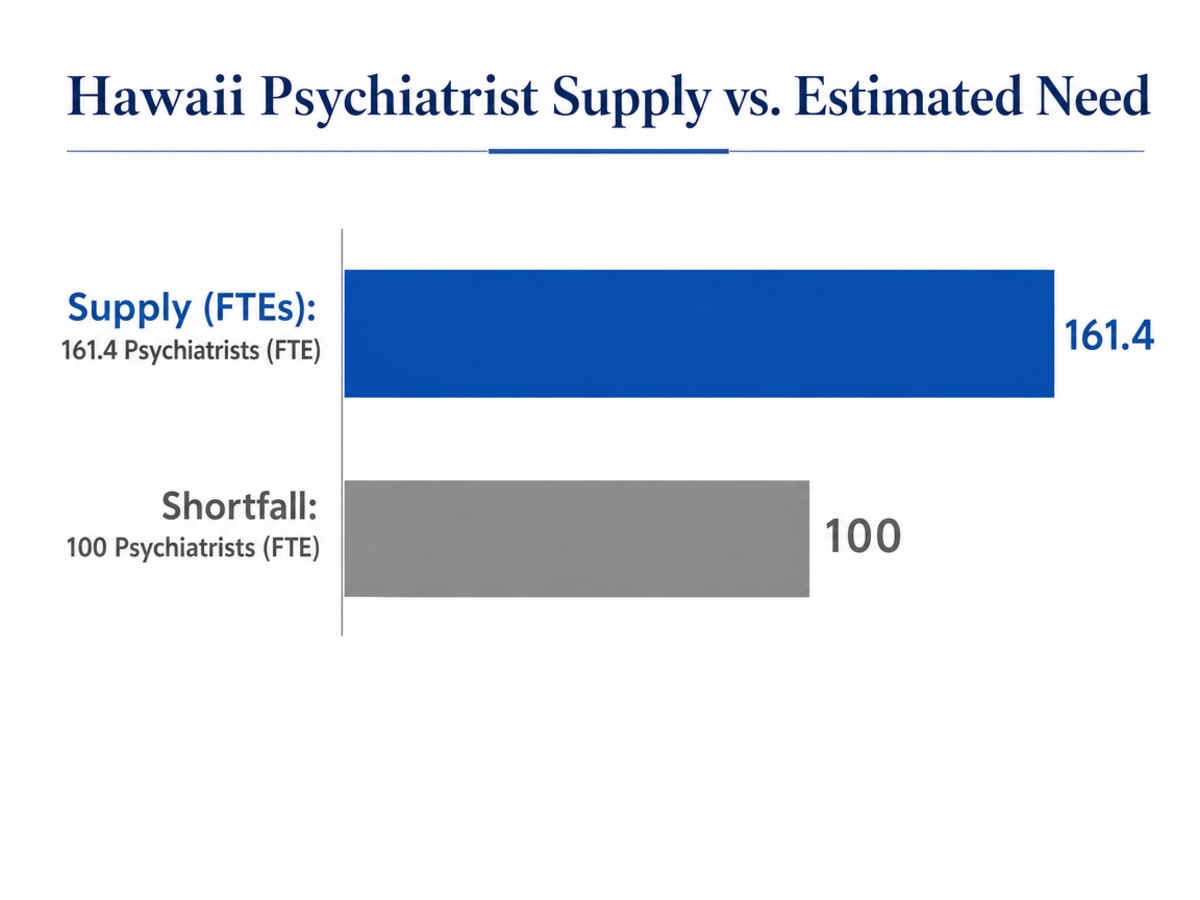
- Hawaii’s Substance Use State Plan confirms no long-term dual-diagnosis care exists on the neighbor islands, and a documented psychiatrist shortfall exceeds 100 FTEs statewide 1, 2.
- Neighbor-island residents needing inpatient psychiatric care are flown to Oʻahu and often held in an ER until a bed opens, reflecting thin adult inpatient capacity 11.
- Vet any mainland program on four points: Joint Commission accreditation, 24/7 board-certified psychiatric coverage, one integrated dual-diagnosis team, and discharge planning that reaches back to specific Hawaii providers.
- Med-QUEST covers out-of-state care when treatment is unavailable in Hawaii, but requires prior authorization, a clinical justification letter, and written acceptance from the receiving facility — save every local denial as documentation 5.
When Island Care Runs Out of Options
If you’re reading this at midnight after another ER visit, another canceled intake, another provider saying “we can’t take this case” — you already know the shape of the problem. The care your loved one needs isn’t sitting on the next island over. It may not be sitting anywhere in Hawaii at all.
That isn’t your failure. It’s the shape of the system. Hawaii’s Substance Use State Plan is direct about it: there are no long-term treatment options for dual disorders on the neighbor islands, and people who need that level of care have to go to Oʻahu — or beyond 2. When a case involves treatment-resistant psychiatry, complex medication strategies, or co-occurring substance use that hasn’t responded to standard programs, the honest answer is often a mainland facility.
This guide is written for you: the family member who has done the local calls, sat through the waitlists, and is now trying to figure out how to vet a psychiatric treatment center from 2,500 miles away. You’ll get a straight look at why island capacity runs out, what to ask any mainland program before you book a flight, and how the logistics actually work when the trip crosses an ocean. Every step you’ve already taken counts.
Why Hawaii’s Psychiatric System Hits a Ceiling for Complex Cases
The Workforce Gap Behind the Waitlists
The waitlists you’ve been sitting on aren’t a scheduling glitch. They’re a math problem. A peer-reviewed workforce study of Hawaii’s psychiatrist supply found the state has roughly 161.4 full-time-equivalent psychiatrists, and depending on how you model need, the shortfall runs more than 100 psychiatrists to meet current demand statewide 1. That study used population data and service utilization to estimate how many psychiatrist FTEs each island actually needs — so the gap you’re feeling on the phone is the same gap the researchers measured on paper.
What that means in practice: when a case is straightforward, the system can usually absorb it, eventually. When a case is complex — treatment-resistant schizophrenia, rapid-cycling bipolar, trauma layered with substance use — the pool of clinicians who can actually manage it shrinks fast. Most of the psychiatrists who exist are on Oʻahu. The rest are stretched across islands where a single provider may be the only option for hundreds of miles of ocean.
The 2025 State Council on Mental Health report to the Governor and Legislature names workforce shortages as one of the key ongoing threats to a continuous system of care 3. So if you’ve been told “we can’t take this case” or “the next opening is in four months,” you’re not being brushed off. You’re running into a ceiling that the state itself has documented.
No Long-Term Dual-Diagnosis Beds on the Neighbor Islands
And even on Oʻahu, capacity is finite. When a program can take a dual-diagnosis patient, it may not be equipped for the treatment-resistant end of the spectrum — the person who has cycled through detox and short-term stabilization, who needs clozapine management, or who carries trauma that requires a specialized track alongside substance use care. That’s the acuity threshold at which “more of the same, closer to home” stops being an option.
The integrated-treatment research is clear that co-occurring conditions do better when psychiatric and substance use care happen together, in one program, by one team — not in parallel referrals bouncing between two agencies 12. When the neighbor islands cannot offer that model at all, and Oʻahu’s version of it is full or not calibrated for the case, mainland placement becomes the honest answer. Not the first choice. The next available one.
ER Boarding and Inter-Island Transfers to Oʻahu
You may already know what boarding looks like from the inside. Your loved one is in an ER. There’s no psychiatric bed available. Hours turn into a day. A day turns into two. The 2023 Report to the Legislature describes exactly this pattern: for neighbor-island patients who need inpatient psychiatric care, the practice is to fly them to Oʻahu and hold them in an Oʻahu hospital ER until a bed opens 11. The report also documents how thin adult inpatient capacity is — Castle Medical Center has 29 adult beds, Hawaii State Hospital has 202, and neither has youth beds 11.
Think about what that means for a family. The transfer to Oʻahu isn’t the treatment. It’s the waiting room for the treatment. Your loved one is now on a different island, in an ER, and the bed they were flown for may still be days away. You’re calling a nurse’s station across a channel of ocean, trying to get an update on someone you can’t be next to.
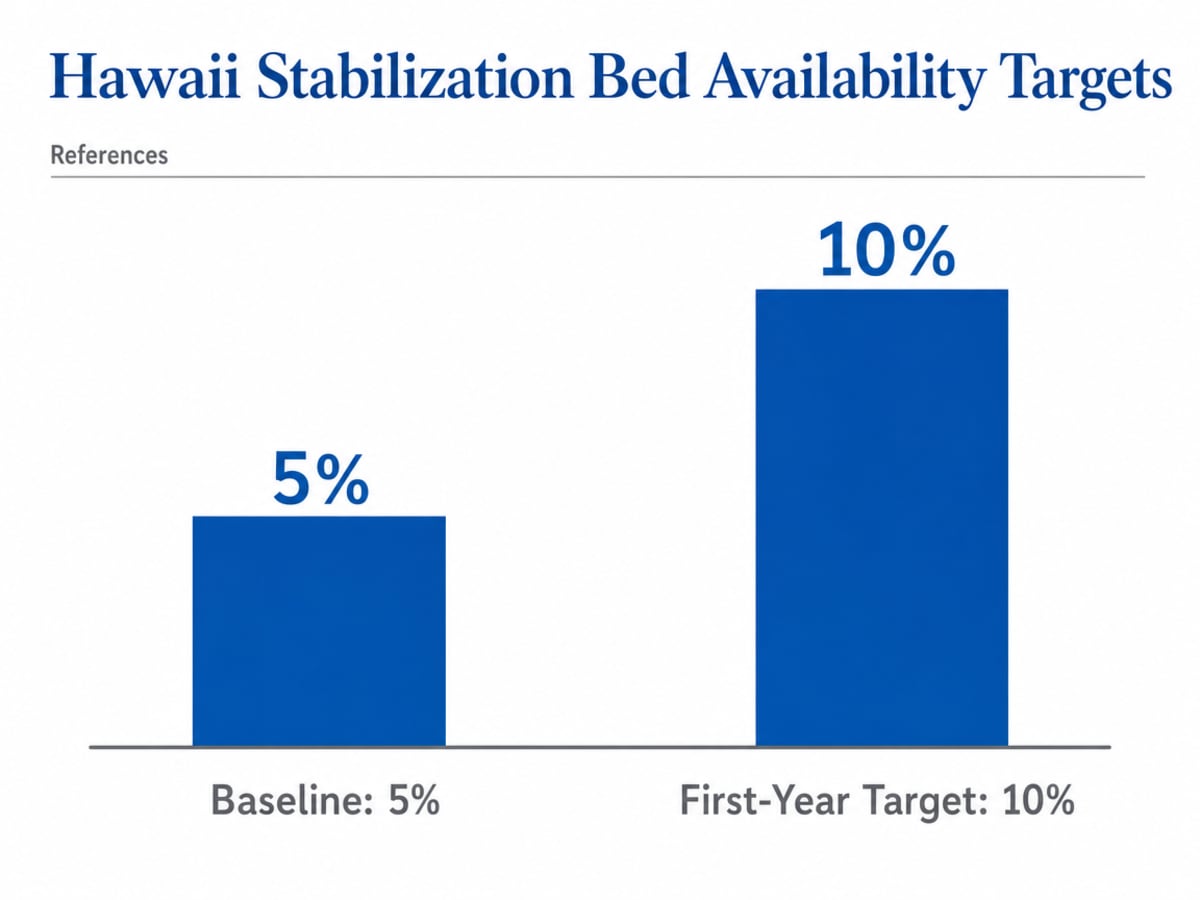
Hawaii’s stabilization-bed plans set a target of raising the monthly percentage of stabilization beds available for crisis placement from a 5% baseline to 10% 8 — a real effort, and a signal that the constraint is well known. If your family has already lived through an ER hold or an inter-island transfer, mainland admission stops feeling like a leap. It starts feeling like the first step where someone finally has room for the whole case.
What to Ask Any Mainland Psychiatric Facility Before You Book a Flight
Independent Accreditation and 24/7 Psychiatric Coverage
Before anything else, ask two questions. Who accredits you? And who is the psychiatrist on-call at 3 a.m.?
Accreditation matters because it’s the one signal you can verify from Hawaii without setting foot in the building. The Joint Commission is the most widely recognized independent body for behavioral health facilities in the U.S. Ask the admissions coordinator to name their accrediting organization, when their last survey was, and whether they’ll email you the certificate. A facility that hesitates on any of those three questions is telling you something. A facility that answers plainly, in one sentence, is telling you something else.
Then ask about psychiatric coverage. Not “do you have psychiatrists on staff” — every program says yes. Ask who is board-certified in psychiatry, how many hours per week they see patients, and who covers nights and weekends. For a treatment-resistant case, or one involving clozapine or complex medication changes, you want a board-certified psychiatrist reachable around the clock, not a nurse practitioner phoning an on-call doctor across three time zones.
Write the answers down. You’re going to call three or four programs, and by the second call, the details blur.
Integrated Dual-Diagnosis, Not Parallel Tracks
This is the question that separates real dual-diagnosis programs from ones that just use the phrase in marketing.
Ask: “When my loved one arrives, who assesses both the psychiatric and the substance use side, and are they the same team?” SAMHSA’s TIP 42 is explicit that everyone in substance use treatment should be screened for mental disorders, and everyone in mental health treatment should be screened for substance misuse — one intake, one clinical picture, not two 6. The research review on integrated treatment goes further and finds that integrated approaches produce superior outcomes compared with non-integrated approaches for co-occurring conditions 12.
What you’re listening for is a team that meets together about your loved one. Psychiatrist and therapist reviewing the same chart. Medication decisions made in light of substance use history. Trauma work coordinated with sobriety plans, not scheduled against them.
What you don’t want to hear: “We treat the addiction first, then refer out for the psychiatric piece.” Or the reverse. That’s parallel care. It’s what your loved one may have already tried on-island, and it’s often why they’re still struggling. If the facility can’t describe integrated care in concrete terms — same team, same treatment plan, same weekly meeting — keep calling.
A Family Communication Rhythm That Survives a Time Zone Gap
Hawaii is two hours behind the West Coast and five hours behind the East Coast for most of the year. Arizona sits three hours ahead of Hawaii. That gap shapes every call you’ll try to make.
Ask the facility, plainly: how does family communication actually work? You want specifics. Is there a scheduled weekly family call with the treatment team, or only ad-hoc updates? Who is your point person — an admissions coordinator, a case manager, a therapist? What are their working hours in your time zone, not theirs? What’s the fastest way to reach someone in a crisis at 9 p.m. Hawaii time, which is midnight where the facility sits?
Also ask about consent. Your loved one is an adult. For the team to share clinical information with you, they need a signed release. A good admissions coordinator will walk you through that on the first call, not leave you guessing after admission.
And ask what family therapy looks like from a distance. Video sessions with a therapist who knows the case. Not a generic Zoom link. Not a monthly “family day” you can’t attend from another time zone. Communication is the thread that keeps you connected across the ocean. Make sure it’s real before you commit.
Discharge Planning That Reaches Back to Hawaii
The best time to ask about discharge is before admission. Not the week your loved one is coming home.
Ask the facility who owns the discharge plan and when they start building it. A strong program begins discharge planning in the first two weeks, not the last. Then ask the harder question: does anyone on their team know the Hawaii provider landscape? Can they help identify an outpatient psychiatrist, a therapist, and a substance use program on your specific island — not just anywhere in the state?
This is where the ocean gets real. On a mainland-to-mainland discharge, a case manager can call across state lines and set up a warm handoff. From a mainland facility back to Molokaʻi or Hilo, the receiving providers may be scarce, booked out, or nonexistent. The 2025 State Council on Mental Health report names continuity of care as an ongoing gap at the state level 3.
Ask for a written discharge summary sent directly to the Hawaii providers, a medication list with a 30-day supply, and a scheduled follow-up appointment before the plane leaves the mainland. If they can commit to those three things, discharge will hold.
The Logistics of an Ocean Between You and the Program
Med-QUEST Prior Authorization for Out-of-State Care
If your loved one has Med-QUEST coverage, the mainland admission runs through one gate before anything else moves: prior authorization for out-of-state care. The Med-QUEST provider manual is specific about the rule. Out-of-state medical transportation and services are authorized when appropriate treatment is not available in Hawaii, and the request needs prior authorization, clinical justification, and acceptance by the receiving out-of-state provider 5.
Read that again, because each phrase does work. “Not available in Hawaii” is the standard you’re documenting. That’s why the earlier calls to local programs matter — the denials, the waitlists, the “we can’t take this case” notes are your evidence. “Clinical justification” means a treating provider in Hawaii, usually a psychiatrist or a hospital case manager, writes a letter explaining the diagnosis, what has been tried, and why the required level of care is not available in-state. “Acceptance by the out-of-state provider” means the mainland facility has to formally agree, in writing, to admit your loved one.
Practical steps: ask your loved one’s current Hawaii provider to start the clinical justification letter early, even before you’ve picked a facility. Ask the mainland admissions coordinator whether they’ve handled Med-QUEST prior authorizations before and who on their side owns the paperwork. Keep every denial letter from local programs — those denials are the strongest documentation you have that off-island care is necessary.
Airfare, Escorts, and the First 48 Hours on the Mainland
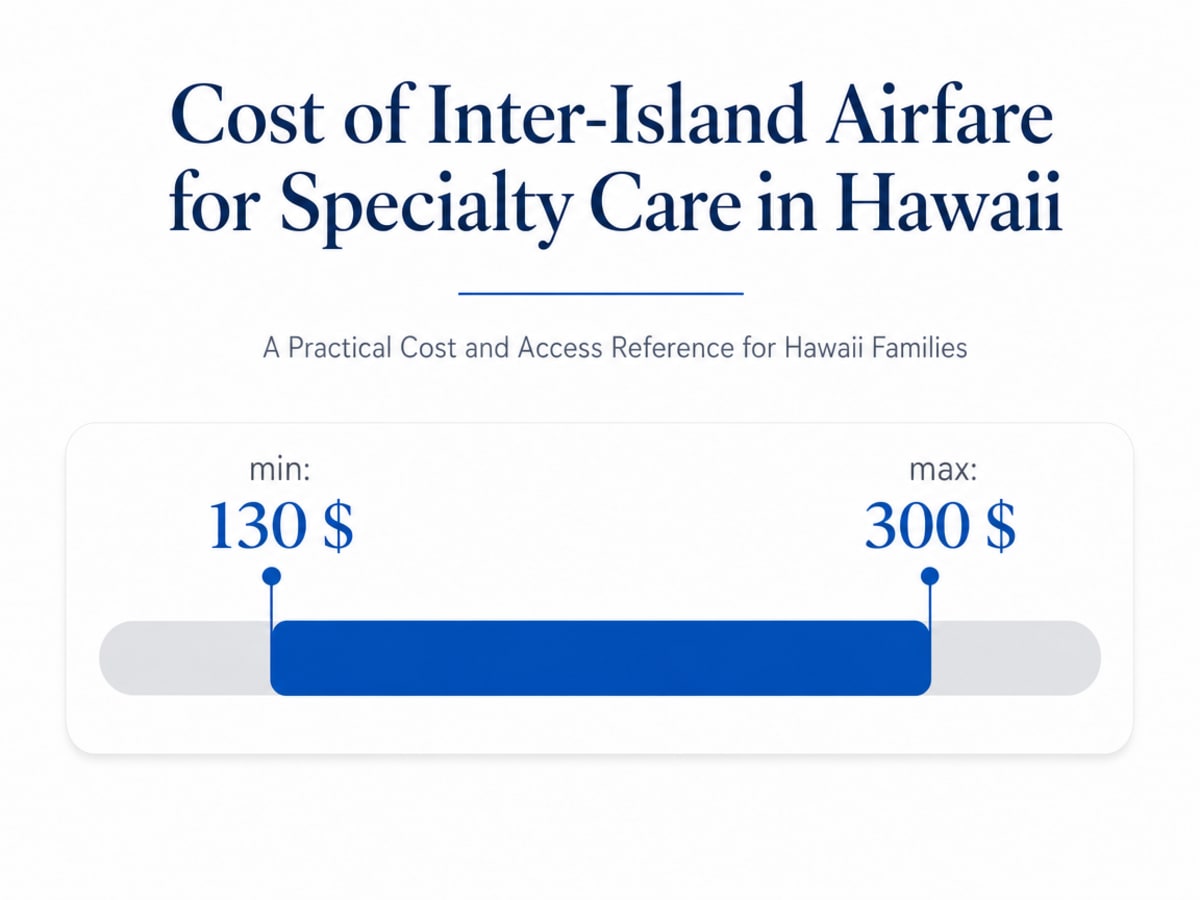
Start with a number you already know. HRSA’s Title V narrative for Hawaii reports that neighbor-island residents typically travel to Oʻahu for specialty care, with roundtrip airfare running roughly $130 to $300 4. If your family lives on Hilo or Kahului, you’ve probably already paid that fare more than once this year. Mainland travel is a longer day, but the underlying logic is the same — the ticket is the smaller cost. What matters is who is on the plane and what happens when it lands.
Ask the mainland facility whether they recommend or require a travel escort for the flight. For someone who is acutely symptomatic, actively withdrawing, or a flight risk in the literal sense, a family escort or a professional transport service can be the difference between an admission that happens and one that unravels at LAX. Some programs coordinate this. Some expect the family to arrange it. Ask which.
Then ask about the first 48 hours. Who meets the plane? Is there ground transport from the airport to the facility, or do you need to book it? Who does the intake assessment on arrival, and when does the first psychiatrist visit happen? If your loved one lands at 9 p.m. mainland time and doesn’t see a doctor until Monday morning, you need to know that before you buy the ticket.
A Practical Cost and Access Reference for Hawaii Families
Keep this on your fridge or in a notes app. It’s the shortlist of what you’ll actually be tracking as the admission comes together.
| Logistics Item | What to Expect | Source ||—|—|—|| Neighbor-island roundtrip airfare to Oʻahu | Approximately $130–$300 | 4 || Long-term dual-diagnosis care on neighbor islands | Not available; travel to Oʻahu or mainland required | 2 || Med-QUEST out-of-state authorization | Prior authorization, clinical justification, and out-of-state provider acceptance required | 5 || Neighbor-island inpatient psychiatric pathway | Flight to Oʻahu; wait in Oʻahu ER until a bed opens | 11 |
The pattern under all of this:
- Local calls first, so the denials become your documentation.
- Clinical justification letter from a Hawaii provider.
- Written acceptance from the mainland facility.
- Travel plan with an escort if the case calls for one.
- Ground transport confirmed.
- A named clinician on the receiving end who knows the plane is coming.
You won’t do all of this in one afternoon. You’ll do it in phone calls spread over a week or two, with a notebook, and probably a few nights where you don’t sleep well. Every item you check off is one less thing that can go wrong at 30,000 feet.
How ViewPoint Dual Recovery Fits the Hawaii Criteria
Now measure ViewPoint Dual Recovery against the same checklist you’d apply to any mainland program. Not because it’s the only option, but because the criteria are the same ones you’ve been building throughout this guide.
Accreditation: ViewPoint is Joint Commission-accredited and LegitScript certified, licensed by Arizona ADHS. That’s the answer you want in one sentence when you ask “who accredits you?”
24/7 psychiatric coverage: Board-certified psychiatrists are based in Prescott, not on call from another state. For a case involving clozapine protocols, rapid-cycling bipolar, or treatment-resistant schizophrenia, that around-the-clock reach is the difference between a plan and a scramble.
Integrated, not parallel, dual-diagnosis care: The clinical model puts psychiatrists and therapists on the same case together, meeting on the same treatment plan. That’s the standard SAMHSA describes in TIP 42 6 and the outcome pattern the integrated-treatment research points to 12. It’s also the model your loved one may not have been able to access on-island.
Treatment duration set by clinical need, not by an insurance timeline: For treatment-resistant cases, the extra two or three weeks often matter more than the first two.
Admissions coordination built for complex cases: ViewPoint’s admissions team works with families across time zones and states, including Med-QUEST prior-authorization pathways where they apply. If you’re calling from Hilo at 8 p.m., ask them directly: have you supported a Hawaii admission before? What did the paperwork look like? Who on your team owns the flight arrival? Those are the questions that tell you whether the criteria on paper match the criteria in practice.
The Emotional Weight of Sending Someone You Love Across an Ocean
Let’s name what this actually feels like. You are considering putting your husband, your daughter, your mother on a plane to a place you’ve never been, to be cared for by people you’ve only spoken to on the phone. That’s hard. It should be hard. The distance is real, and pretending otherwise won’t help you sleep tonight.
And yet — look at what you’ve already done. You’ve made the calls no one wanted to make. You’ve sat in ERs. You’ve read a document like this one at an hour when most people are asleep. That is love doing the work of logistics, and it counts.
The families who come out of this steadiest are usually the ones who let two things be true at once. Yes, the ocean is wide. And yes, a Joint Commission-accredited program with a board-certified psychiatrist on call and a treatment team meeting weekly about your loved one is often closer, in the ways that matter, than a local waitlist that hasn’t moved in three months.
When you’re ready, call ViewPoint’s admissions team and ask them directly how they’ve supported Hawaii families before. That conversation is free, and it’s the next honest step.
Start your journey to expert mainland care
Connect with clinicians who understand Hawaii’s unique challenges and can guide your next steps with confidence.
Frequently Asked Questions
Why would a Hawaii family need to consider a mainland psychiatric treatment center?
Because the highest-acuity care your loved one needs may not exist on the islands. Hawaii’s Substance Use State Plan states there are no long-term treatment options for dual disorders on the neighbor islands, and people needing that level of care must travel to Oʻahu or beyond 2. When Oʻahu programs are full or not calibrated for treatment-resistant cases, a mainland facility becomes the realistic next step.
Does Hawaii Medicaid (Med-QUEST) cover out-of-state psychiatric treatment?
Yes, when appropriate treatment isn’t available in Hawaii. The Med-QUEST provider manual authorizes out-of-state medical services and transportation under those conditions, but it requires prior authorization, clinical justification from a Hawaii provider, and formal acceptance from the receiving out-of-state facility 5. Keep denial letters from local programs — those documents help prove the in-state unavailability standard that anchors the whole approval process for you.
What should I ask a mainland facility to confirm it can handle a dual-diagnosis case?
Ask whether one team handles both the psychiatric and substance use sides on the same treatment plan. SAMHSA’s TIP 42 calls for screening every patient on both dimensions at intake, not through separate referrals 6. The integrated-treatment research finds that integrated approaches produce superior outcomes compared with parallel or sequential care for co-occurring conditions 12. If they describe two teams working separately, keep calling.
How do families stay in contact across a five-hour time zone gap during treatment?
Ask for specifics before admission. Who is your named point person, what are their working hours in Hawaii time, and is there a scheduled weekly call with the treatment team? A signed release of information needs to be in place so clinicians can actually talk with you. Family therapy sessions should happen by video with a therapist who knows your loved one’s case, not through a generic link.
What accreditation should a mainland psychiatric facility have?
The Joint Commission is the most widely recognized independent accreditor for behavioral health facilities in the U.S. Ask the admissions coordinator to name their accrediting body, share the date of their last survey, and email you the certificate. State licensure by the facility’s health department is a baseline requirement. Certifications like LegitScript add another layer of verification. Clear, one-sentence answers to these questions tell you a lot.
How does discharge planning work when the patient is returning to Hawaii?
A strong program starts discharge planning in the first two weeks, not the last. Ask the facility to identify outpatient providers on your specific island, send a written discharge summary directly to those providers, supply a 30-day medication list, and confirm a follow-up appointment before the flight home. Hawaii’s 2025 State Council on Mental Health report names continuity of care as an ongoing statewide gap 3, so nail down the handoff early.
References
- Does Hawai‘i Have Enough Psychiatrists? Assessing Mental Health Workforce Needs in the State of Hawai‘i. https://pmc.ncbi.nlm.nih.gov/articles/PMC5375008/
- Substance Use State Plan 2022. https://health.hawaii.gov/substance-abuse/files/2023/05/Draft-State-Plan-2022-May-2023-Edition.pdf
- State Council on Mental Health 2025 Annual Report to the Governor and Legislature. https://health.hawaii.gov/opppd/files/2025/09/Final-SCMH-2025-Report-to-the-Governor-and-Legislature-.pdf
- Select a State. https://mchb.tvisdata.hrsa.gov/Narratives/AnnualReport7/a0ac94c0-8538-417e-85c9-da6ac5c06603
- Chapter 16 Medicaid Provider Manual – Med-QUEST. https://medquest.hawaii.gov/content/dam/formsanddocuments/resources/Provider-Resources/provider-manuals/PMChp16.pdf
- TIP 42, Substance Use Disorder Treatment for People With Co-Occurring Disorders. https://library.samhsa.gov/sites/default/files/SAMHSA_Digital_Download/PEP20-02-01_004.pdf
- Advisory: Substance Use Disorder Treatment for People with Co-Occurring Disorders (based on TIP 42). https://www.samhsa.gov/resource/ebp/advisory-substance-use-disorder-treatment-people-co-occurring-disorders-based-tip-42
- FY 2024-2025 Mental Health Block Grant Plan State of Hawai’i Due …. https://health.hawaii.gov/amhd/files/2023/08/HI-MHBGApp_DRAFTforPublicComment.pdf
- Overdose Prevention Strategy – Harm Reduction. https://www.hhs.gov/overdose-prevention/harm-reduction
- Drug Overdose Deaths Involving Other Drugs. https://www.cdc.gov/drugoverdose/deaths/other-drugs.html
- Report to the Thirty-Second Legislature, State of Hawaii, 2023 (Adult Mental Health Division / State Council on Mental Health). https://health.hawaii.gov/opppd/files/2023/01/Report-to-the-Legislature-334-110-SCMH-2023-FINAL-rev.pdf
- Integrated Treatment of Substance Use and Psychiatric Disorders. https://pubmed.ncbi.nlm.nih.gov/28668119/