Key Takeaways
- Low self-esteem often predates substance use and pulls it forward, with negative self-perception at 19 predicting worse substance problems by 27 even after controlling for baseline use 7.
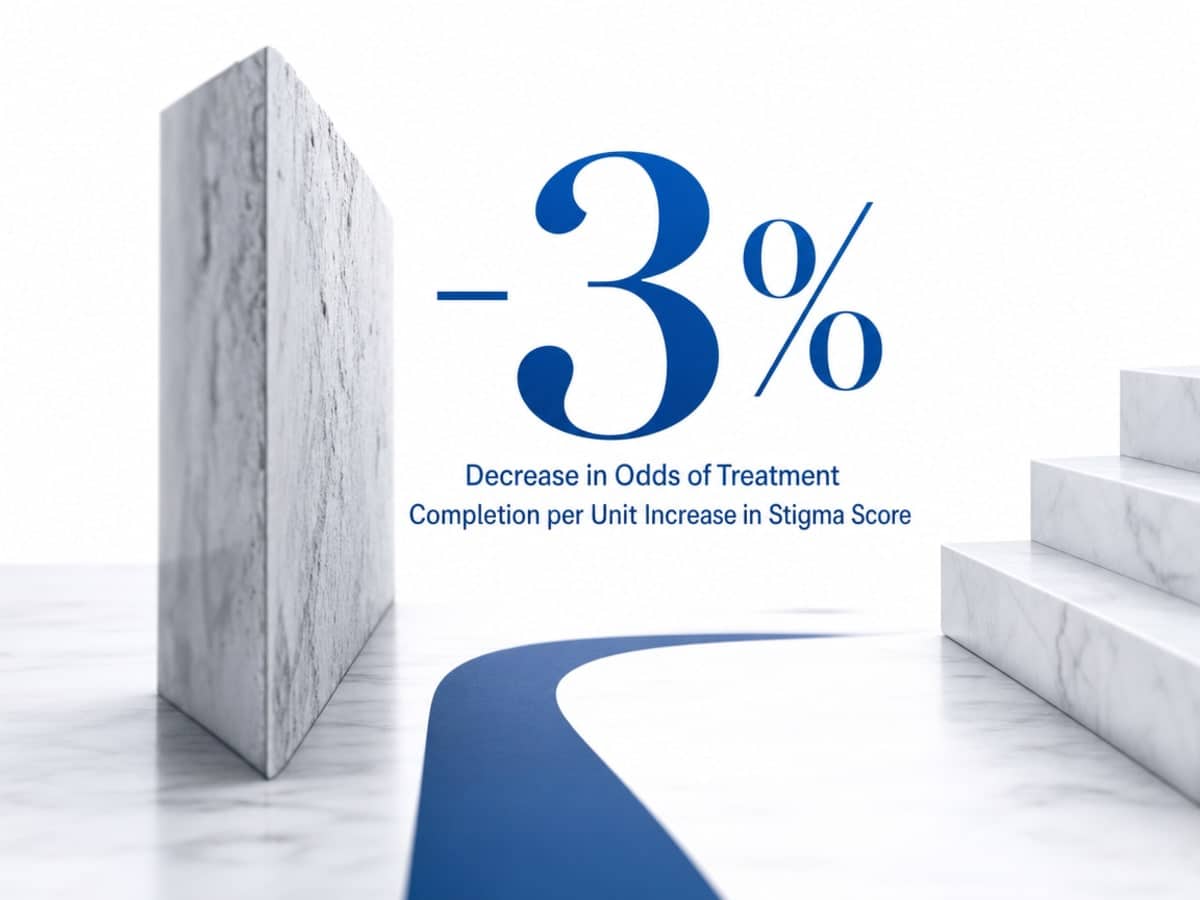
- Self-stigma works differently than public stigma, eroding recovery indirectly through negative emotion and reduced self-efficacy, and each unit of stigma at intake drops completion odds by 3% 6.
- Short 28-day programs teach behavioral coping but leave the shame architecture intact, and treating depression alone rarely lifts the underlying self-worth belief driving both conditions 11.
- Shifting self-concept requires sustained therapeutic engagement where editing stops, hope rebuilds in small moments, and treatment length is set by case depth rather than a billing calendar 3.
When Treatment Keeps Not Sticking
You’ve done this before. Maybe more than once. The intake paperwork, the phone taken away, the group circle, the discharge plan with the color-coded relapse prevention worksheet. You left with new language for your triggers and a sponsor’s number in your phone. And then, sometime later — three weeks, six months, a year — the drink or the pill or the pipe found you again.
If that pattern sounds familiar, you’re not reading this because you lack willpower. You’re reading it because something underneath the using never got touched.
Here’s what a lot of short programs don’t tell you: for many people, the drinking or the drugs are the visible layer. Underneath is a quieter, older belief — that you are somehow defective, unworthy, too much, not enough. Clinicians call it low self-esteem or internalized shame. You might just call it the way you’ve always felt about yourself when the room goes quiet.
That belief doesn’t dissolve because you learned to name your emotions on a whiteboard. It doesn’t dissolve because you sat through twenty-eight days of groups. Research on alcohol-dependent patients shows that low self-esteem tends to travel with depression and other psychiatric conditions, not as a side effect of drinking but as part of the underlying weight people carry into treatment 1, 11.
The rest of this article walks through why that weight matters, how it silently blocks the work you’re trying to do, and what it actually takes to shift it.
The Shame-Substance Loop Runs Underground
Low Self-Worth Comes First, Then Escalates
There’s a common story about addiction: you drank or used, things got bad, and now you feel terrible about yourself. Cause and effect, in that order. It’s a tidy story, and it’s not wrong exactly — using does damage self-worth. But it misses the part that started earlier.
A longitudinal study followed people from age 19 to 27 and tracked how they saw themselves — their social acceptance, their romantic appeal, their basic sense of being worth something. The people who held more negative views of themselves at 19 went on to develop worse substance-related problems by 27. That link held even after researchers controlled for how much they were already drinking or using at the start 7. Self-perception wasn’t just riding along with substance use. It was pulling it forward.
That matters for you because it reframes what you’re dealing with. If a quiet belief that you’re not quite okay showed up before the bottle or the pills did, then the substance was doing a job. It was numbing something. Softening something. Making a self you couldn’t stand feel bearable for a few hours.
Then the loop closes. You use to escape the feeling. Using produces its own shame — the hangover mornings, the promises broken, the look on someone’s face. That shame lowers self-worth further. Which makes the next use feel more necessary, not less. The same study noted that lower self-esteem also tracked with more maladaptive coping strategies, meaning the tools people reached for tended to make things worse over time 7.
You didn’t fail at recovery. You’ve been running against a current that most programs never actually name.
Why Depression and Low Self-Esteem Show Up Together
If you’ve been told you have depression, or you suspect you do, this next piece will probably feel familiar. The two — depression and low self-esteem — travel together so often that clinicians treating alcohol dependence expect to find both in the same person.
One study of patients seeking treatment for alcohol dependence measured self-esteem and depression side by side. The self-esteem scores came in significantly below population norms, and they correlated tightly with the severity of depressive symptoms. The lower the self-worth, the heavier the depression 11. A separate study of alcohol-dependent inpatients found that lower self-esteem at baseline was significantly associated with current depression and other psychiatric disorders — meaning self-esteem wasn’t standing alone as a mood problem, it was a marker of a bigger psychiatric picture underneath 1.
Here’s what that means practically. If you go into a program that treats the drinking or drug use in one lane and hands off the depression to a prescriber in another lane, the thing sitting under both — the belief that you’re fundamentally not okay — often doesn’t get worked on directly. You get a medication that lifts your mood a notch. You get a relapse prevention plan. And the core self-concept that’s feeding both the depression and the reach for a substance stays where it was.
Treating depression alone doesn’t always lift self-esteem 11. That’s not a failure of the medication. It’s a signal that self-worth is its own clinical target, one that needs its own time in the room. When care is integrated — psychiatric and therapeutic working from the same case — the shame layer stops being the thing everyone talks around.
Self-Stigma Is Not the Same as Public Stigma
The Distinction That Changes Treatment
- Public stigma
- What happens out there. It’s the co-worker who stops inviting you to lunch after you disclose. It’s the doctor who talks past you once your chart mentions opioids. It’s the news story that treats addiction as a moral failing. That kind of stigma is real, and it does damage.
- Self-stigma
- What happens in here. It’s when you take those messages — the ones the culture broadcasts and the ones your own family may have handed you — and you agree with them. You start to believe you are the weak one, the broken one, the one who can’t be trusted around your own life. The judgment moves from outside your skin to inside your head, and now it doesn’t need anyone else to keep it going.
A 2019 systematic review looking at perceived stigma and treatment outcomes found that stigma tends to work on recovery indirectly — through negative emotions and eroded self-efficacy — rather than as a single visible obstacle you could point to and remove 5. Qualitative studies in the same review kept surfacing the same words from patients: worthlessness, shame 5.
The distinction matters clinically. Public stigma can be addressed with policy, education, and support networks. Self-stigma has to be worked on in a therapeutic relationship, over enough time to actually catch the beliefs, hold them up to the light, and start to loosen their grip. That’s not something a psychoeducation module fixes in an afternoon.
How Self-Stigma Blocks You From Asking for What You Need
Here’s how self-stigma quietly runs the show, even when you’re doing everything right on paper.
You show up to group. You do the homework. But when the therapist asks how the week actually went, you edit. You leave out the near-miss on Thursday. You don’t mention that you sat in your car for twenty minutes outside a liquor store on Sunday. You tell yourself you’ll bring it up next week, when you have it more together. You never bring it up.
That editing is self-stigma at work. If part of you believes you’re already the failure everyone suspects, then admitting a struggle feels like handing over evidence. So you protect the image and starve the treatment.
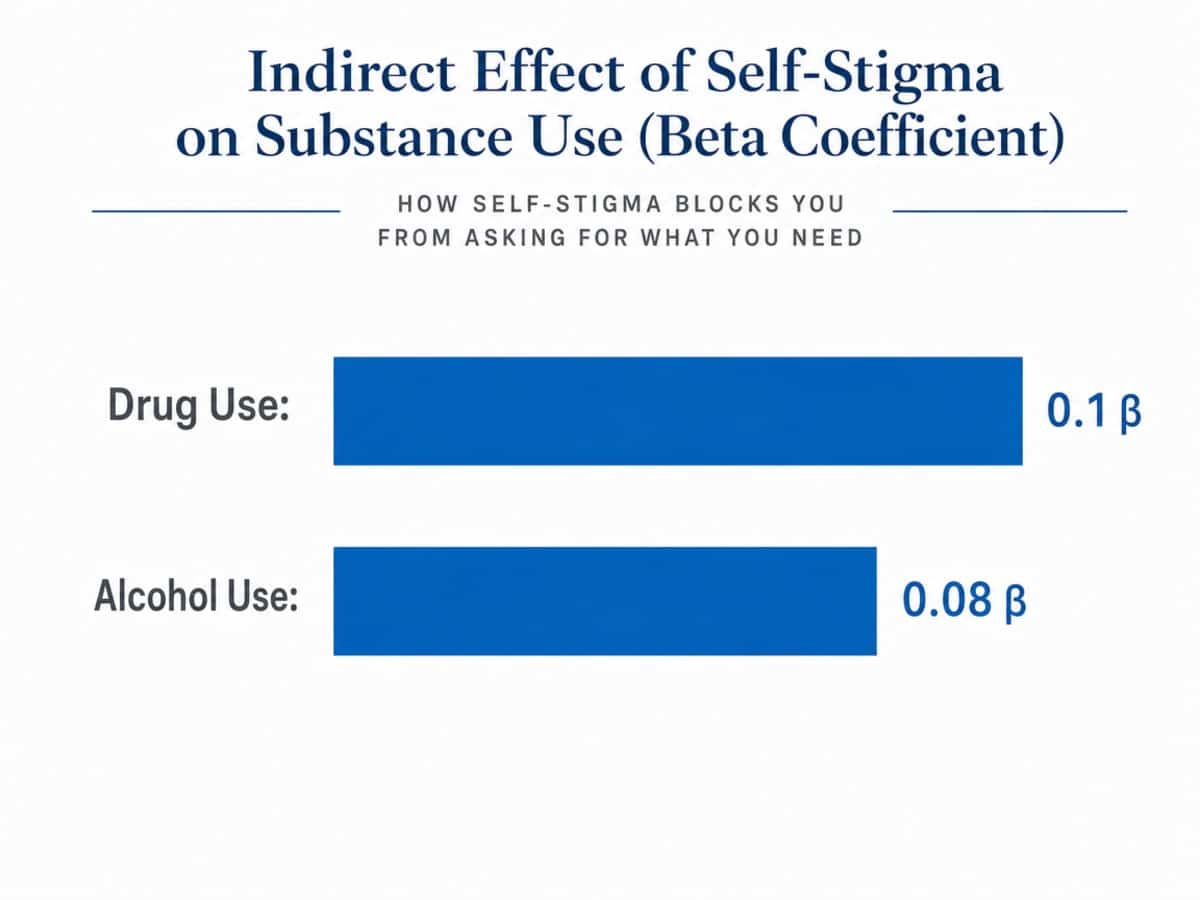
A peer-reviewed study on self-stigma and help-seeking measured this pathway directly. Researchers found that self-stigma of help seeking had an indirect effect on drug use (β = 0.10, p < 0.001) and on alcohol use (β = 0.08, p < 0.001), working through attitudes toward asking for help 4. The more shame someone carried about needing support, the less positively they viewed help-seeking, and the more they used. The effect on drug use ran slightly stronger than on alcohol use, but both were statistically robust 4. The 2024 ECHO Idaho clinical synthesis reached the same conclusion from a different angle: self-stigma inhibits help-seeking, impairs psychological flexibility, and limits treatment engagement 3.
Which means the person sitting quietly in the back row of group, the one who nods at the right times and never asks the question they came in with — that person may be working harder than anyone. Just in the wrong direction. Real engagement requires enough time and enough safety to let the editing stop.
Why 28 Days Leaves the Shame Architecture Intact
What Short Programs Actually Teach
Twenty-eight days is a billing convention, not a clinical finding. It’s the length insurance grew comfortable authorizing, and a lot of programs built their curriculum around that ceiling. What fits inside those four weeks is largely behavioral: identify your triggers, name your emotions, learn urge-surfing, build a relapse prevention plan, meet a sponsor, plan aftercare.
Those skills are real and worth having. If you left a program with a better vocabulary for what happens in your body before a craving, that was not wasted time.
But notice what didn’t happen. Nobody spent six weeks with you tracing where the belief came from that you were the problem in your family. Nobody helped you sit with the specific memory you’ve been drinking around for fifteen years. Nobody stayed in the room long enough for you to stop performing recovery and start being honest about the parts of yourself you can’t stand.
The 2024 ECHO Idaho clinical synthesis makes this explicit: self-stigma inhibits help-seeking, impairs psychological flexibility, and limits treatment engagement 3. Coping-skills training does not touch those layers directly. You can learn every regulation technique in the workbook and still leave with the same private conviction that you’re broken underneath. When that conviction is intact, the skills become tools you don’t quite believe you deserve to use.
The Completion Problem Nobody Screens For
Before we get to whether a program works, there’s an earlier question: do you actually finish it? A lot of people don’t. And the reasons often have less to do with logistics than with what you walked in carrying.
The study measured perceived stigma — what patients anticipated from others — but the pathway to dropout runs through the inside. When you expect to be judged, you brace. When you brace, you don’t disclose. When you don’t disclose, the clinicians in the room are working with an edited version of your life, and the treatment they build has gaps where the truth should be. The systematic review evidence points in the same direction: stigma acts on outcomes indirectly, through eroded self-efficacy and negative emotion, rather than as one visible barrier 5.
Almost no short program screens for this at intake. You’re asked about your substance history, your medications, your prior treatment episodes. You’re rarely asked, in any structured way, how much shame you carry about needing to be there. So the variable that quietly predicts whether you’ll walk out early is the one nobody names.
Longer treatment does not automatically fix this. But it creates the one condition that shorter programs cannot: enough time for the shame to become visible, be spoken out loud, and start to lose its grip before discharge arrives.
What Deeper Work on Self-Worth Actually Looks Like
Beyond Coping Skills: Psychological Flexibility and Self-Concept
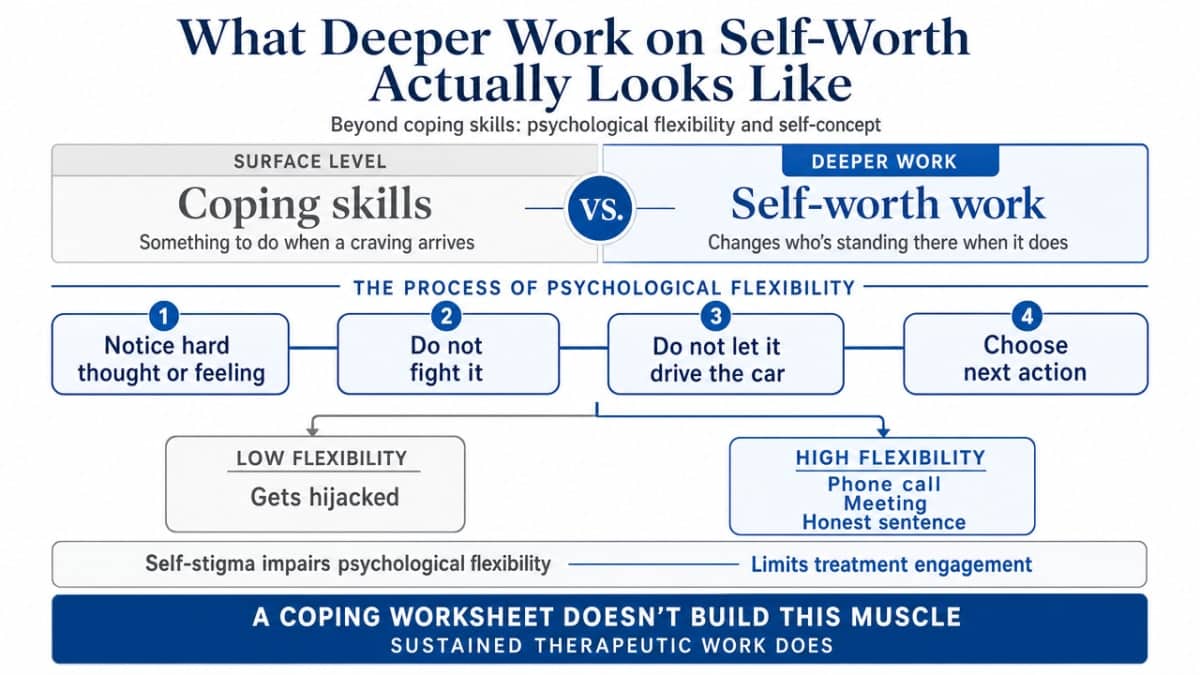
Coping skills give you something to do when a craving arrives. Deeper work on self-worth changes who’s standing there when it does.
The difference matters more than it sounds. Psychological flexibility is a clinical term for something specific: the ability to notice a hard thought or feeling — including the belief that you’re worthless — without either fighting it or letting it drive the car. Someone with high flexibility can feel the shame move through and still choose the phone call, the meeting, the honest sentence. Someone with low flexibility gets hijacked. The 2024 ECHO Idaho synthesis names this directly, noting that self-stigma impairs psychological flexibility and limits treatment engagement 3. The coping worksheet doesn’t build that muscle. Sustained therapeutic work does.
What that work actually looks like, week over week: a therapist who knows your history well enough to catch the exact moment you start editing yourself in session. Time to trace a specific belief — I ruin things, I’m the burden, nobody stays — back to where it was installed, often long before your first drink. Space to feel what that origin story brings up without needing to numb it by the end of the hour. And enough continuity that the therapist is still there next Tuesday, and the Tuesday after that, when the belief tries to re-form.
Self-concept doesn’t shift in a psychoeducation slide. It shifts when someone sees the parts of you that you’ve been hiding and doesn’t flinch. That takes weeks, not days.
Restoring Hope as a Clinical Task, Not a Mood
Hope sounds like a feeling. In recovery, it functions more like a working assumption — the quiet belief that effort you put in today might actually reach somewhere. Without it, the calendar gets very heavy.
A 2022 study of patients with substance use disorders looked at how internalized shame relates to recovery expectations. The researchers found that self-devaluation, guilt, and poor self-regulation were linked to lower optimism and weaker expectancies of success in the future 9. Abstinence self-efficacy — the sense that you actually can stay stopped when it matters — tracked with confidence in recovery 9. Put plainly: when the shame is loud, hope goes quiet. And when hope goes quiet, the work of recovery starts to feel pointless before it even begins.
That’s why clinicians who take self-worth seriously treat hope as something to rebuild deliberately, not something that will show up on its own once the drinking stops. It gets rebuilt in small, specific moments: naming a small win without dismissing it. Noticing that you told the truth in group when the old pattern would have edited. Watching a therapist take a piece of your story seriously that you’d always assumed made you unlovable.
None of that fits inside a discharge deadline. It accrues. Which is why programs that give the clinical team enough time to actually be with you — through the collapses, the small returns, the honest sentences — are the ones where hope has room to become something you can lean on again.
Time as a Clinical Variable
Most of what a program can do for you is a function of how long it has to do it. That sounds obvious until you notice how rarely time gets talked about as a treatment ingredient. Medications have doses. Therapies have modalities. Time gets treated like scaffolding — a container the real work happens inside — when in fact it is one of the active elements.
Consider what needs to happen for self-worth to actually shift. A belief installed decades ago has to be noticed in real time, spoken out loud to someone who won’t look away, revisited enough Tuesdays in a row that the pattern loses its automatic pull, and slowly replaced with something the nervous system can trust. That sequence has a floor. You cannot compress it into a discharge deadline set by billing.
ViewPoint’s model treats treatment length as a clinical variable rather than an insurance ceiling. Duration is set by what your case actually needs — the depth of the co-occurring depression, the layers of trauma feeding the shame, the pace at which your particular self-concept starts to loosen — not by a calendar someone else picked. For treatment-resistant psychiatric conditions and dual diagnosis cases, that flexibility is often the difference between another discharge and something that holds.
The evidence supports treating time this way:
- Self-stigma work depends on sustained therapeutic engagement, not brief exposure 3.
- Depression that sits underneath alcohol use rarely lifts through substance-focused work alone 11.
- Integrated psychiatric and therapeutic care needs weeks in the same room to do what it’s built to do.
You don’t need a longer version of what didn’t work. You need enough time for a different kind of work to happen.
If You’ve Been Through Treatment Before
If you’ve done rehab and it didn’t hold, please read this carefully: that history is not a verdict on you. It’s information about what the last program had time to address and what it didn’t.
A lot of people who cycle back through treatment have been working on the top layer — the drinking, the pills, the behaviors — while the belief underneath about who they are went untouched. When self-stigma stays intact, it keeps eroding engagement even in people who show up faithfully, because negative self-emotion and reduced self-efficacy quietly do their work on outcomes 5. That’s not weakness. That’s an unaddressed clinical variable.
What tends to be different in longer, individualized care is not the modality list. It’s the room the schedule makes for the harder conversation — the one where you stop editing, where a therapist stays with you through the collapse and the return, where a psychiatrist and a therapist work the same case instead of two parallel ones. ViewPoint’s model is built for cases that didn’t respond to the standard length, with duration set by what the work actually requires. If the last time didn’t hold, the next time doesn’t have to be a longer version of the same. It can be a different kind of room.
See Where Self-Esteem Gaps Are Blocking Progress
Get clear clinical insight into how self-worth impacts your recovery path.
Frequently Asked Questions
Can low self-esteem actually cause addiction, or is it just a side effect of using?
Both can be true, but the timing matters. A longitudinal study following people from 19 to 27 found that more negative self-perception at 19 predicted worse substance problems at 27, even after controlling for how much they were already using 7. Low self-worth often shows up first and pulls use forward. Then using deepens the shame, and the loop tightens.
What’s the difference between self-stigma and public stigma in recovery?
Public stigma is judgment from other people — employers, doctors, strangers. Self-stigma is when you take those messages and agree with them, so the judgment lives inside your own head. Systematic review evidence shows self-stigma tends to affect recovery indirectly, through eroded self-efficacy and negative emotion, rather than as one visible barrier 5. That’s why it needs sustained therapy, not just education.
Why do I keep relapsing after completing a 28-day program?
Short programs are built around behavioral skills — trigger identification, urge-surfing, relapse prevention plans. Useful tools, but they don’t touch the belief underneath that you’re defective. The 2024 ECHO Idaho clinical synthesis notes that self-stigma inhibits help-seeking and impairs psychological flexibility 3. If the shame architecture stays intact, the skills you learned become tools you don’t quite believe you deserve to use.
Will treating my depression fix my low self-esteem?
Not always. In alcohol-dependent patients, low self-esteem and depression correlate tightly, but they’re not the same target 11. Medication may lift your mood a notch without shifting the core belief that you’re not okay. Self-worth is its own clinical focus that needs its own time in the therapy room, especially when depression and substance use have been braided together for years.
How long does it take to address shame and self-worth in treatment?
Longer than a discharge deadline set by billing. A belief installed decades ago has to be noticed, spoken to someone who won’t look away, and revisited enough weeks in a row that the pattern loses its automatic pull. The 2024 clinical synthesis is direct: self-stigma work depends on sustained therapeutic engagement, not brief exposure 3. Individualized length is set by the case, not the calendar.
If I’ve failed treatment before, does that mean recovery won’t work for me?
No. It means the last program had time to address the top layer and not what was underneath. Systematic review evidence shows self-stigma keeps eroding engagement through negative emotion and reduced self-efficacy even in people who show up faithfully 5. That’s an unaddressed clinical variable, not a character verdict. A different kind of room, with enough time in it, can hold what the last one couldn’t.
References
- The relationship of self-esteem and self-efficacy to treatment outcomes of alcohol-dependent men and women. https://pubmed.ncbi.nlm.nih.gov/17453609/
- The association between perceived stigma and substance use disorder treatment outcomes: a review (Table of included studies). https://www.ncbi.nlm.nih.gov/pmc/articles/PMC6311321/table/t2-sar-10-001/
- Stigma in Substance Use: Counseling Techniques for SUDs (ECHO Idaho CME PDF). https://cme.wwami.uidaho.edu/sites/default/files/media/2024-10/Stigma%20in%20Substance%20Use.pdf
- Stigma, Help Seeking, and Substance Use. https://files.eric.ed.gov/fulltext/EJ1260094.pdf
- The Association Between Perceived Stigma and Substance Use Disorder Treatment Outcomes: A Review. https://pubmed.ncbi.nlm.nih.gov/30643480/
- Perceived stigma and its role in substance use disorder treatment completion. https://pubmed.ncbi.nlm.nih.gov/40743445/
- Self-Perception and Relative Increases in Substance Use Problems From Adolescence to Early Adulthood. https://pmc.ncbi.nlm.nih.gov/articles/PMC7978475/
- Self-esteem and the Initiation of Substance Use Among Adolescents. https://pmc.ncbi.nlm.nih.gov/articles/PMC6973773/
- Self-stigma, Hope for Future, and Recovery. https://pmc.ncbi.nlm.nih.gov/articles/PMC9678179/
- Exploring Perceptions of Self-Stigma of Substance Use and Current Alcohol and Marijuana Use Behaviors in Young Adults. https://pubmed.ncbi.nlm.nih.gov/38578784/
- Self-esteem and depression among patients seeking treatment for alcohol dependence. https://pmc.ncbi.nlm.nih.gov/articles/PMC3863588/