Key Takeaways
- Missouri out-of-state psychiatric placement decisions hinge on three coverage lanes: MO HealthNet managed care with PCP-initiated approval, commercial plans under RSMo 376.1361 and 376.1363, and self-funded ERISA plans governed by the 2024 MHPAEA final rule 6, 4, 13.
- With 18 CCBHCs serving all 114 Missouri counties, packets must directly explain why community-level programming cannot deliver the treatment-resistant specialty care the member needs 10, 11.
- Commercial carriers generally decide within 36 hours, including one working day, after receiving complete information, so submit a single labeled packet and capture the unique confirmation number on receipt 4, 5.
- Case managers should sort each file into its coverage lane, build the clinical and credentialing packet in the order the reviewer reads, and lean on a receiving facility’s verification team to carry the administrative load.
When the Missouri File Needs an Out-of-State Answer
You already know the file in front of you. Treatment-resistant schizophrenia or rapid-cycling bipolar with a co-occurring substance use disorder, a stack of failed medication trials, two or three in-state admissions that stabilized the acute risk but did not change the trajectory. The member’s PCP has flagged that local options are tapped out. Now you need to decide whether an out-of-state psychiatric placement is defensible, authorizable, and documentable under the specific plan on the member’s card.
These are the hardest files on your desk this week, and that is a fair thing to name. The clinical complexity is real, and the administrative load that comes with it, pulling records, confirming receiving-facility credentials against Missouri’s delivery-setting language 1, tracking the utilization review clock 4, issuing or capturing confirmation numbers 5, is not a sign the case is weak. It is the job.
What follows walks you through the three coverage lanes that control the answer, the in-state adequacy argument Missouri’s CCBHC buildout forces you to address, and the documentation that holds up on review. You will also see where a receiving facility’s verification team can carry part of the load so your clinical case gets decided on its merits.
The Three Coverage Lanes That Govern Your Decision
MO HealthNet Managed Care: The PCP-Initiated Out-of-State Rule
If your member is enrolled in a MO HealthNet managed care plan, the out-of-state question is answered by a specific procedural rule before it is answered by any clinical argument. Non-emergency care delivered outside Missouri or one of its bordering states must be approved before services are received, and the approval request runs through the member’s primary care provider contacting the managed care plan 6. That changes who you work with first. You are not driving the authorization yourself; you are organizing the clinical record so the PCP can submit a defensible request.
Build the file assuming two layers of review. The managed care plan will apply its own medical necessity criteria, and for residential levels of care, prior authorization is required and continued-service requests go through a clinical consultant who reads the treatment plan for documented need 7, 8. Keep one caveat visible to the family and to your own notes: an approved prior authorization is not a guarantee of payment, and eligibility has to be verified on the date of service 8. That is the lane. Clean PCP engagement, residential PA on file, and continued-stay documentation ready before day one.
Commercial and Employer Plans Under RSMo 376.1361 and 376.1363
Commercial and fully insured employer plans operating in Missouri are governed by the state’s utilization review statutes, and those statutes give you leverage you can plan around. Under RSMo 376.1361, the carrier’s UR program has to use documented clinical review criteria grounded in sound clinical evidence, apply them consistently, and collect only the information necessary for the review 3. That is the standard your packet is answering to, and it means you can ask, in writing, which criteria set the reviewer applied and whether the clinical information in front of them was complete.
RSMo 376.1363 then sets the operational tempo. For determinations requiring review, the carrier generally decides within 36 hours, including one working day, after obtaining all necessary information, and any adverse determination has to include the principal reasons, the clinical rationale, and appeal instructions 4. Two practical consequences follow. First, the clock does not start until the file is complete, so a scattered submission costs you more time than a dense one. Second, the adverse-determination letter is itself a document you work with, because the clinical rationale tells you exactly what the appeal has to rebut.
Self-Funded ERISA Plans Under the 2024 MHPAEA Final Rule
If the card belongs to a self-funded ERISA plan, Missouri’s utilization review statutes do not reach the plan directly, and your analytical anchor shifts to federal parity. The September 2024 MHPAEA final rules took effect November 22, 2024, with staggered applicability starting with plan years on or after January 1, 2025, and they put real weight on the nonquantitative treatment limitations you encounter every day 13. Prior authorization standards, medical management techniques, network composition, geographic and facility-type restrictions, and out-of-network reimbursement methods all have to be analyzed for parity with how the plan treats comparable medical and surgical benefits 13.
What that means in your workflow is simple to say and harder to execute. When a self-funded plan tells you an out-of-state psychiatric residential placement is restricted because of geography or facility type, or that it will only reimburse at an out-of-network rate that makes placement impossible, those are NQTLs. You can request the plan’s comparative analysis in writing. Missouri’s own parity hook in RSMo 376.1551 confirms the same federal standard applies to covered Missouri plans 2, but on self-funded files the federal rule is the one carrying the argument.
Comparing the Three Review Pathways Side by Side
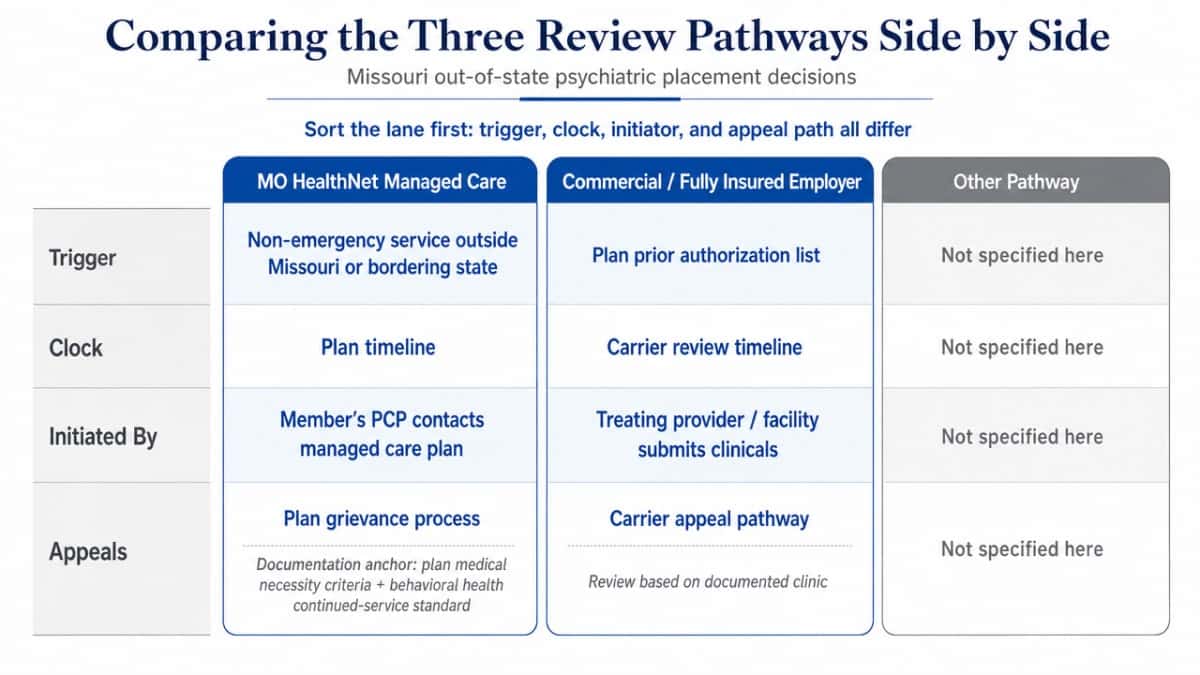
Before you start building the clinical packet, sort which lane you are actually in. The documentation does not change much, but the trigger, the clock, the person who initiates the request, and the appeal pathway all do. A compact matrix helps keep the three straight when you are juggling several files at once.
- For MO HealthNet managed care, the prior authorization trigger is any non-emergency service outside Missouri or a bordering state; the member’s PCP initiates by contacting the managed care plan; the documentation anchor is the plan’s medical necessity criteria plus the behavioral health manual’s continued-service standard; and appeals follow the plan’s grievance process 6, 7.
- For commercial and fully insured employer plans, the trigger is the plan’s prior authorization list; the carrier runs the review on documented clinical criteria; the decision clock is 36 hours, including one working day, after receipt of all necessary information; and adverse determinations must carry clinical rationale and appeal instructions 3, 4.
- For self-funded ERISA plans, the plan’s NQTLs govern the trigger and the network and geographic restrictions, and your parity analysis under the 2024 MHPAEA final rule shapes both the submission and any appeal 13.
In-State Adequacy: Documenting Around Missouri’s CCBHC Buildout
Here is where a lot of out-of-state packets quietly fall apart. Missouri’s community mental health network looks, on paper, like it should absorb almost any file. The Department of Mental Health reports 18 Certified Community Behavioral Health Clinics serving all 114 Missouri counties, with a required service array that covers 24/7 crisis care, screening and diagnosis, person-centered treatment planning, outpatient mental health and substance use treatment, targeted case management, psychiatric rehabilitation, and peer and family support 10. The CCBHO regulation at 9 CSR 30-6 reinforces the point, requiring a comprehensive service array specifically aimed at people with the most serious and complex mental illnesses and substance use disorders 11. A reviewer looking at your out-of-state request is going to see that footprint before they see your clinical narrative.
So your packet has to answer the obvious question in advance: why does this member need something a CCBHC cannot deliver? The honest answer is usually not that the local clinic is bad. It is that community-level programming, even when the full service domain is present, is built for longitudinal community tenure rather than treatment-resistant specialty care, like clozapine initiation under 24/7 psychiatric monitoring, structured management of rapid-cycling bipolar disorder, or integrated residential dual-diagnosis treatment with simultaneous psychiatric and substance-use intensity. Write that distinction into the record. Name the specific CCBHC or CCBHO the member has engaged, the services received, the clinical response, and the gap between what that program is scoped to provide and what this presentation needs.
What Belongs in a Defensible Placement Packet
Diagnostic Evidence and Treatment History
Start the packet with a current psychiatric evaluation that names the primary diagnosis in the specific terms the reviewer will match against the plan’s clinical criteria. For a treatment-resistant presentation, that means treatment-resistant schizophrenia with the trial history that supports the label, rapid-cycling bipolar I with cycle frequency documented, or a co-occurring substance use disorder with severity specifiers. Vague diagnostic shorthand is where otherwise strong cases lose the room.
Then build the treatment history as evidence, not narrative. List each medication trial with dose, duration, response, and reason for discontinuation. Name the therapies attempted, the levels of care previously used, and the admissions, inpatient, PHP, IOP, residential, with dates and discharge summaries attached. Missouri’s utilization review statute expects documented clinical review criteria applied to pertinent clinical information 3, and that cuts both ways. The reviewer owes you a documented standard; your file owes them the clinical substance that standard was designed to evaluate. A clean trial table does more work on a complex file than three pages of prose.
Risk, Functional Impairment, and Crisis Context
Risk documentation is where the packet earns its medical necessity argument. Record current and historical suicide and self-harm risk, aggression, elopement history, medication nonadherence patterns, and any recent hospitalizations or ED visits with the precipitant for each. Score what you can, LOCUS or the plan’s accepted instrument, and attach the completed form rather than paraphrasing it.
Functional impairment belongs on the same page. Document the member’s current ability to maintain safety, housing, employment or school, medication adherence, and basic ADLs, and tie each impairment to the clinical presentation driving it. If 988 or statewide mobile crisis response has been engaged, say so, name the dates, and describe what stabilization achieved and where it fell short 12. That distinction, acute stabilization worked but longitudinal specialty treatment is what the member needs, is often the sentence the reviewer is looking for before approving a residential level of care out of state.
Receiving-Facility Credentials That Match Missouri’s Delivery Language
Missouri’s mental health coverage statute contemplates delivery through hospitals, residential treatment programs, and other entities that are certified by DMH, nationally accredited, or licensed by Missouri 1. For an out-of-state program the DMH certification path does not apply, so your credentialing packet has to lean on the other two: the receiving state’s licensure and national accreditation. Attach both.
For ViewPoint Dual Recovery, that means the Arizona Department of Health Services license on the facility and Joint Commission accreditation on the program, which Missouri DMH itself recognizes among qualifying accreditations alongside CARF International and the Council on Accreditation 9. Include the accreditation certificate, the state license, the NPI and tax ID, the medical director’s credentials, and the program description that shows the specific clinical capacity the member needs, 24/7 board-certified psychiatric coverage, advanced medication management including clozapine protocols, and integrated dual-diagnosis treatment. The reviewer should not have to hunt for any of it. One PDF, labeled, in the order the plan asks for it.
Proposed Plan, Length of Stay, and Discharge Criteria
Close the packet with a proposed treatment plan the reviewer can price. Name the admission level of care, the clinical goals tied to the diagnoses and risk factors already documented, the therapies and medication strategy the receiving team intends to use, and the expected length of stay with the clinical milestones that would support step-down. For MO HealthNet residential requests, continued-service review is run by a clinical consultant against a treatment plan that documents the need for the requested therapies 7, so write the initial plan in the format that continued-stay review will later test.
Discharge criteria belong in the first submission, not the thirtieth day. Specify the step-down level, the proposed in-state providers for aftercare, the medication plan at discharge, and the family and community supports that will carry the member home. A packet that already answers “what does success look like and where does this member land afterward” reads as clinically serious, not open-ended.
Managing the 36-Hour Clock Without Losing the Confirmation Trail
The utilization review clock is the one piece of this file you can actually control, so treat it that way. Under RSMo 376.1363, the carrier generally has 36 hours, including one working day, after obtaining all necessary information to issue a certification or an adverse determination, and that determination has to carry the principal reasons, the clinical rationale, and appeal instructions 4. The phrase that matters is after obtaining all necessary information. A packet that trickles in across three faxes and two portal uploads resets your own tempo even when the statute is on your side.
So submit the file as a single, labeled package the first time. Diagnostic evaluation, trial table, risk documentation, in-state adequacy narrative, receiving-facility credentials, and proposed plan with length of stay and discharge criteria, in that order, with a cover index. The moment the request lands, Missouri requires the utilization review entity to issue a unique confirmation number, so capture it on receipt and attach it to every subsequent communication about the file 5. That number is your audit trail. It is also what a receiving facility’s verification contact needs to speak intelligently with the plan on continued-stay questions later.
Then run the clock. Note the timestamp of your complete submission, the confirmation number, and the 36-hour / one-working-day deadline on the same line in your file. If the carrier requests additional information, log the request, send the response the same business day when you can, and reset the completeness marker. If the deadline passes without a determination, you have a documented procedural issue to raise, not a vague complaint. A clean clock is a small win worth claiming, and it is often the difference between a decision on the clinical merits and a decision shaped by missing paper.
Reading an Adverse Determination and Building the Appeal
An adverse determination on a complex file is frustrating, and it is also useful. Under RSMo 376.1363, the notice has to spell out the principal reasons for the denial, the clinical rationale, and the appeal instructions 4. Read it the way you would read a chart note: slowly, with a highlighter. The rationale tells you which criterion the reviewer applied, which clinical facts they weighted, and, often, which part of your packet they did not see or did not accept.
Sort the denial into one of three buckets before you draft anything.
- If the carrier questioned medical necessity, your appeal rebuts the specific criterion cited, usually with a stronger trial table, updated risk documentation, or a peer-to-peer with the receiving psychiatrist.
- If the carrier leaned on network or geography, name it as a nonquantitative treatment limitation and ask, in writing, for the plan’s comparative analysis under the 2024 MHPAEA final rule 13.
- If the denial rests on incomplete information, that is a RSMo 376.1361 problem 3, and your appeal reframes the packet as complete and consistent with the plan’s own documented criteria.
One bucket, one argument, same confirmation number on every page.
Working With a Receiving Facility’s Verification Team
You do not have to carry the administrative side of an out-of-state placement alone, and on a treatment-resistant file you probably should not. A receiving facility’s verification team exists to pick up the paper so your clinical judgment stays at the center of the request. At ViewPoint Dual Recovery, a Joint Commission-accredited psychiatric program in Prescott, Arizona focused on treatment-resistant and dual-diagnosis presentations, verification is set up as a direct line to Missouri case managers rather than an intake funnel aimed at families.
Here is what the handoff looks like in practice. You send the benefit information and the clinical summary; the verification team runs the eligibility and benefits check, confirms the plan’s out-of-network and out-of-state posture, identifies the specific prior authorization pathway, and flags any plan-specific NQTLs that need a parity argument on the front end 13. On MO HealthNet files, the team coordinates with the member’s PCP on the managed care submission path 6. On commercial files, they package the clinical records in the order the carrier’s criteria read in, capture the unique confirmation number the moment it is issued 5, and track the 36-hour clock with you so a missing-information request does not quietly reset your tempo 4.
They also carry the credentialing documentation forward, the Arizona license, the Joint Commission accreditation Missouri DMH recognizes 9, the program’s clinical capacity description, so you are not rebuilding that section from scratch on every file. When continued-stay review comes up, the receiving clinical team writes the update against the plan’s criteria and the verification team routes it with the same confirmation number attached. Starting through ViewPoint’s Verify Insurance process puts that workflow in motion on the same business day.
If You Manage a Panel of Complex Behavioral Health Files
A quick scope shift: if you are running a panel rather than a single file, the workflow above has to be a template, not an improvisation. Build a standing out-of-state placement packet skeleton you can populate per member, with slots already labeled for the diagnostic evaluation, the trial table, the risk and functional documentation, the in-state adequacy narrative tied to the member’s local CCBHC engagement 10, the receiving-facility credentials, and the proposed plan.
Keep a shared tracker that lives one row per file: coverage lane, confirmation number 5, complete-submission timestamp, 36-hour deadline 4, and next clinical touchpoint. On a panel of treatment-resistant cases, your wins are not dramatic. They are a clean confirmation number captured on receipt, a complete packet that starts the clock cleanly, and a receiving-facility verification contact who already knows your member’s file by name. Those small, repeatable mechanics are what keep complex placements moving.
Clarify Complex Placement Needs With Expert Input
Quickly determine if advanced dual diagnosis care matches your member’s clinical profile and documentation.
Frequently Asked Questions
When does MO HealthNet require prior approval for out-of-state psychiatric placement?
Any non-emergency care delivered outside Missouri or one of its bordering states must be approved before services are received, and the member’s primary care provider initiates the request by contacting the MO HealthNet managed care plan 6. For residential levels of care, prior authorization is required and continued-service reviews follow 8. Keep the eligibility-is-not-payment caveat on your note.
What is the decision clock for a commercial plan under Missouri utilization review law?
Under RSMo 376.1363, the carrier generally has 36 hours, including one working day, after obtaining all necessary information to issue a certification or an adverse determination 4. The clock does not start until the file is complete, so submit as a single labeled package. Any adverse determination must carry the principal reasons, clinical rationale, and appeal instructions you will use to respond.
What documentation does Missouri expect in a defensible out-of-state placement packet?
Expect the current psychiatric evaluation, diagnoses, a trial table of medications and prior levels of care, risk and functional impairment, in-state adequacy narrative, receiving-facility credentials, and a proposed plan with length of stay and discharge criteria. Missouri utilization review requires documented clinical criteria applied to pertinent clinical information 3, and residential continued-service review tests the treatment plan against documented need 7.
How do I justify out-of-state placement when Missouri has 18 CCBHCs covering every county?
Address the footprint directly. Missouri’s 18 CCBHCs serve all 114 counties with a required service array covering crisis, assessment, treatment, case management, and rehabilitation 10, and CCBHOs are scoped for serious and complex presentations 11. Name the specific clinic engaged, services received, clinical response, and the gap between community-level programming and the treatment-resistant specialty care the member actually needs.
How does the 2024 MHPAEA final rule change my analysis for self-funded ERISA plans?
The September 2024 final rules put real weight on nonquantitative treatment limitations, including prior authorization, medical management, network composition, geographic and facility-type restrictions, and out-of-network reimbursement methods 13. When a self-funded plan restricts an out-of-state psychiatric residential placement on those grounds, name the NQTL in writing and request the plan’s comparative analysis. Missouri’s parity hook at RSMo 376.1551 echoes the federal standard 2.
What should I expect from a receiving facility’s verification team?
Expect eligibility and benefits verification, confirmation of the plan’s out-of-network and out-of-state posture, identification of the prior authorization pathway, and parity flags on plan-specific NQTLs 13. The team captures the unique confirmation number on receipt 5, tracks the 36-hour clock with you 4, and carries credentialing forward, including the Joint Commission accreditation Missouri DMH recognizes 9. Start through ViewPoint’s Verify Insurance process.
References
- Revised Statutes of Missouri, RSMo Section 376.1550. https://revisor.mo.gov/main/OneSection.aspx?section=376.1550
- Revised Statutes of Missouri, RSMo Section 376.1551. https://revisor.mo.gov/main/OneSection.aspx?section=376.1551
- Revised Statutes of Missouri, RSMo Section 376.1361. https://revisor.mo.gov/main/OneSection.aspx?section=376.1361
- Revised Statutes of Missouri, RSMo Section 376.1363. https://revisor.mo.gov/main/OneSection.aspx?section=376.1363
- Revised Statutes of Missouri, RSMo Section 376.1364. https://revisor.mo.gov/main/OneSection.aspx?section=376.1364
- Managed Care Participants FAQ. https://mydss.mo.gov/managed-care-participants-faq
- Behavioral Health Services Manual. https://mydss.mo.gov/sites/mydss/files/media/file/2026/05/Behavioral%20Health%20Services%20Manual.docx
- Comprehensive Community Support Manual. https://mydss.mo.gov/sites/mydss/files/media/file/2026/04/Comprehensive-Community-Support-Manual-04-13-2026.docx
- Certification. https://dmh.mo.gov/behavioral-health/certification
- Certified Community Behavioral Health Clinics (CCBHCs). https://dmh.mo.gov/behavioral-health/ccbhc
- Department of Mental Health, Chapter 6: Certified Community Behavioral Health Organizations. https://www.sos.mo.gov/CMSImages/AdRules/csr/current/9csr/9c30-6.pdf
- Crisis Services. https://dmh.mo.gov/behavioral-health/treatment-services/specialized-programs/crisis-services
- Fact Sheet: Final Rules under the Mental Health Parity and Addiction Equity Act (MHPAEA). https://www.dol.gov/agencies/ebsa/about-ebsa/our-activities/resource-center/fact-sheets/final-rules-under-the-mental-health-parity-and-addiction-equity-act-mhpaea