Key Takeaways
- Escalate to specialty psychiatric care when patients meet defensible triggers like refractory depression after two adequate trials, unstable bipolar, active psychosis, or severe PTSD with SUD 3.
- Run five decision questions — safety, severity, recent hospitalizations, failed trials, and complex comorbidity — and escalate when two or more come back positive 10.
- Recognize the bounce-back pattern: dual diagnosis patients routed to single-track programs return decompensated because acuity outpaced program capability, not because of negligence.
- Treat state licensure, Joint Commission or CARF, and LegitScript as the accreditation floor that filters unsuitable programs before clinical vetting begins.
- Verify 24/7 board-certified psychiatry and capability for clozapine, LAIs, MAOIs, and lithium monitoring — the medication tools that define whether treatment-resistant cases can be held.
- Ask by name whether dual diagnosis care is integrated, parallel, or sequential; only integrated care treats psychiatric and substance use axes on one team, one plan 2.
- Match the facility tier to acuity using psychiatric coverage, medication complexity, SUD integration, length-of-stay flexibility, and closed-loop communication rather than bed availability.
- Send a focused records packet at handoff and require admission confirmation, medication reconciliation, and a discharge summary returned on a defined timeline — with a named liaison.
When Primary Care Has Already Done Its Job
You’ve run the workup. You’ve trialed the SSRIs, checked the TSH, screened for substance use, and had the conversation more than once. The patient in front of you isn’t a diagnostic puzzle anymore — they’re a acuity mismatch. Refractory depression after two adequate antidepressant trials, a bipolar presentation destabilizing between visits, active psychotic features, or a PTSD picture tangled with alcohol use that neither problem will resolve alone 3. Primary care did what primary care can do. The next move is finding a facility that can actually hold this patient.
That’s where most referral guides stop being useful. They tell you when to refer — a threshold you already recognized weeks ago — and skip the harder question: where, and how to vet the facility on the other end of the phone call before you send someone with treatment-resistant illness into a program that will discharge them in 14 days no better than they arrived.
This guide is written for that gap. It gives you a working vetting framework — accreditation floor, psychiatric coverage depth, dual diagnosis capability, closed-loop communication — so the handoff protects both the patient and the referring clinician.
The Clinical Threshold for Specialty Escalation
Diagnosis-Based Referral Triggers You Can Defend
You don’t need another mnemonic. You need a defensible diagnostic threshold that stands up in a chart note and to the next clinician who inherits the case. The VA VISN 2 Primary Care/Psychiatry Behavioral Health Service Agreement gives you exactly that — a working list of presentations that belong in specialty psychiatric care rather than in a primary care behavioral health slot 3.
The list is short and clinically honest:
- Depression or anxiety refractory to two adequate antidepressant trials.
- Unstable bipolar disorder.
- Active schizophrenia and other psychotic disorders.
- Severe PTSD.
- Personality disorders driving functional collapse.
- Dementia with behavioral disturbance.
- Substance use — frequently concomitant with any of the above 3.
When you see one of these on your problem list, the referral question isn’t whether, it’s where the patient will actually get held.
The trauma piece has its own overlay. The VA/DoD PTSD guideline is explicit that referral to specialty mental health is indicated when PTSD travels with severe or unstable comorbidity — concurrent psychotic or bipolar disorder being the named examples 1. That’s the patient you’ve probably been managing on an SSRI and a sleep agent while the alcohol use climbed. Trauma with SUD and a mood or psychotic overlay isn’t a primary care disorder. It’s a specialty case that needs a facility built to hold all three problems in the same treatment plan.
Treat the VISN 2 list as a point-of-care checklist. If the chart hits any single trigger, you have documented, guideline-backed grounds to escalate — and to insist on a facility that matches the acuity rather than the nearest available bed.
Severity, Safety, and Failed Trials: The Decision Matrix
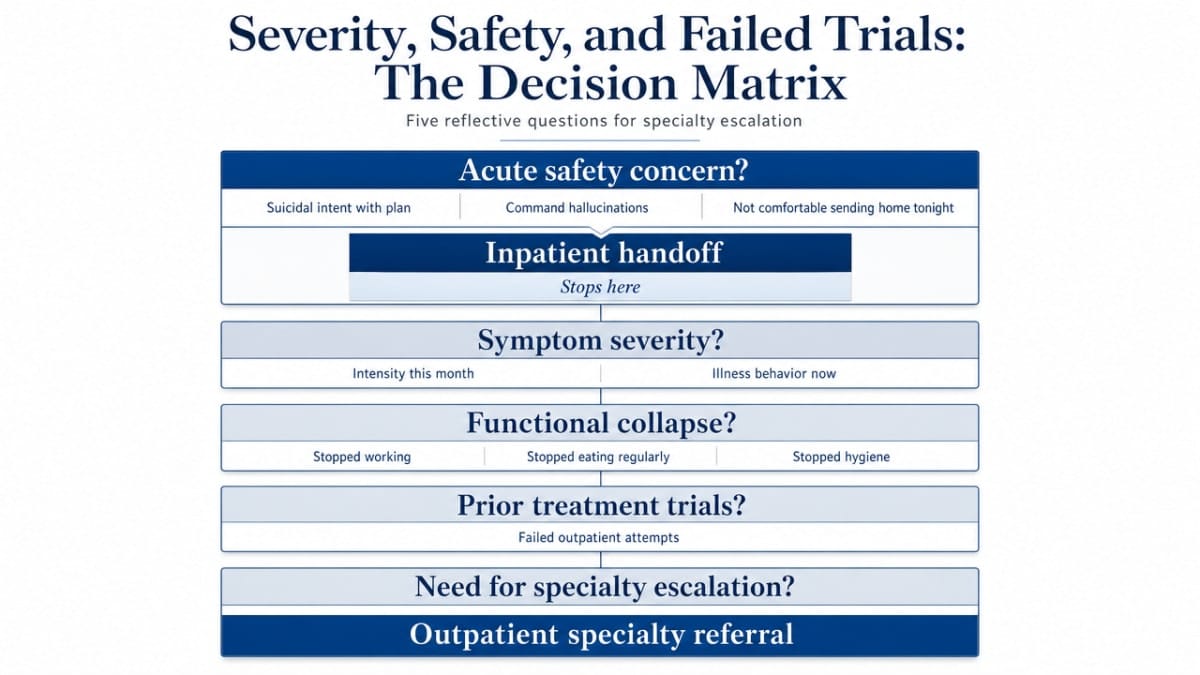
Diagnosis alone doesn’t finish the decision. Two patients with the same DSM label can sit on opposite sides of the referral line depending on how the illness is behaving this month. Table 2 from the Pediatric Clinics referral-decision analysis distills the judgment call into five reflective questions any PCP can run in the exam room 10.
Is there an acute safety concern? Suicidal intent with plan, command hallucinations, or a patient you would not be comfortable sending home tonight. That’s not a referral to an outpatient program — that’s an inpatient handoff, and the answer stops there 10.
How severe are the symptoms, and how much function has collapsed? A patient who has stopped working, stopped eating regularly, or stopped participating in their own hygiene is telling you the illness has outrun outpatient intensity. The clinical decision-making literature identifies symptom severity, functional impairment, and comorbid substance use as the primary drivers clinicians actually weigh when they escalate 5.
Have there been recent hospitalizations? A second admission in the same quarter is a system signal. Whatever the last discharge plan was, it didn’t hold.
Have previous treatments failed? Two adequate antidepressant trials without response. A mood stabilizer that couldn’t prevent the last manic switch. An SSRI plus therapy that hasn’t touched the PTSD after six months. Table 2 is direct: when previous treatment has failed or the response to first-line medications is inadequate, referral to specialty care is warranted 10.
Are the comorbidities complex? Psychosis plus stimulant use. Bipolar plus alcohol. PTSD plus opioid dependence. Any of these combinations mean a program that treats only one axis will discharge the patient with the other axis fully intact — and the whole picture will recompensate within weeks.
Run those five questions in order. If two or more come back positive, you’re not making a marginal call anymore. You’re documenting an evidence-based decision to escalate, and the burden shifts to finding a facility whose capability actually matches what the matrix just described.
The Referral Failure Mode Every PCP Has Lived
You know how this goes. You called the number, the intake coordinator was warm, the patient got a bed, and two weeks later they’re back in your exam room — dischargedtive, off the clozapine trial someone was supposed to start, drinking again, and now more demoralized than when they left. The referral didn’t fail because the facility was negligent. It failed because the acuity of the patient exceeded the capability of the program, and nobody flagged the mismatch on the front end.
The clinical literature is direct about this: severe mental illness with complex comorbidity needs collaborative stepped care with specialty backup, not a general behavioral health slot 9. The vetting work happens before the referral, not after the bounce-back.
Vetting Criteria: Accreditation Floor vs. Clinical Ceiling
The Accreditation Floor: Licensure, Joint Commission, LegitScript
Accreditation is the minimum, not the answer. Treat it as a filter that eliminates programs you shouldn’t consider, then move on to the clinical questions that actually decide whether the patient will be held.
Three markers form the floor:
- State licensure through the relevant health department confirms the facility is legally operating as a behavioral health treatment center under the applicable regulatory framework — in Arizona, that means ADHS licensure as an outpatient treatment center or behavioral health inpatient facility, with the documentation on file to prove it.
- Joint Commission or CARF accreditation signals that an external body has audited the facility against consensus standards for governance, medication safety, staffing, and continuous quality improvement.
- LegitScript certification, though less well known clinically, matters because it screens for consumer protection and marketing integrity — a program that can’t clear LegitScript is one that shouldn’t be on your referral list regardless of how the intake call sounds.
Ask for all three by name when you call. Any facility staffed to accept a PCP referral will produce them without friction. If the answer stalls, that alone tells you what you needed to know. A program that can’t clear the floor won’t clear the ceiling either — and the ceiling is where treatment-resistant and dual diagnosis patients actually live.
The Clinical Ceiling: 24/7 Psychiatry, Clozapine, LAIs, MAOIs
Once the floor is verified, the vetting shifts to what the facility can actually do clinically. This is where most PCP referrals go wrong — not because the accreditation was fake, but because the accredited program didn’t have the psychiatric depth to manage the medication regimen your patient needs.
Start with coverage. Ask whether board-certified psychiatry is available 24/7 on-site or on-call, not just a psychiatric nurse practitioner rotating in twice a week. For refractory psychosis, rapid-cycling bipolar, and severe PTSD with comorbidity, the medication decisions don’t wait for Tuesday’s prescriber slot. A patient decompensating overnight needs someone who can order, adjust, or hold a medication in real time.
Then get specific about medication complexity. Can the facility initiate and monitor clozapine? That’s a proxy question — a program equipped for clozapine has the REMS enrollment, the ANC monitoring workflow, the metabolic surveillance, and the psychiatric confidence to run the protocol. If clozapine is off the table, treatment-resistant schizophrenia is off the table. Ask the same about long-acting injectable antipsychotics, MAOIs, lithium at therapeutic monitoring, and ketamine or ECT referral pathways for treatment-resistant depression.
These aren’t esoteric questions. They’re the medication tools that define whether a facility can hold the hardest 5–10% of your behavioral health caseload — the patients guideline literature identifies as needing collaborative stepped care with specialty backup rather than a general behavioral health slot 9. If the intake coordinator can’t answer, ask to speak with the medical director. A program serious about complex cases will put you through.
Integrated vs. Parallel vs. Sequential Dual Diagnosis Care
Every treatment center says it handles dual diagnosis. Very few actually do. The distinction that matters — and the one your patient will feel within the first two weeks — is which model the facility uses to treat the co-occurring mental illness and substance use disorder.
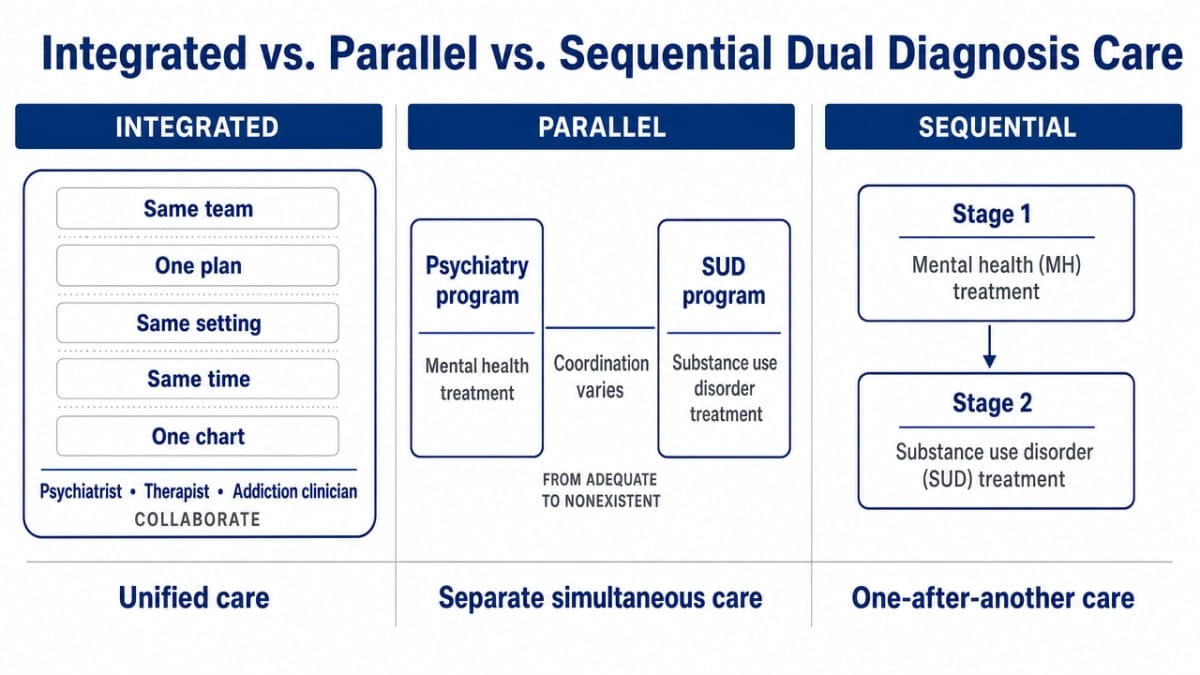
SAMHSA’s Treatment Improvement Protocol lays out three models, and the differences are operational, not semantic 2.
- Integrated care
- The same clinical team treats both the psychiatric disorder and the substance use disorder within the same treatment plan, in the same setting, at the same time. Psychiatrist, therapist, and addiction clinician collaborate on one chart.
- Parallel care
- The patient sees two separate teams simultaneously — psychiatry at one program, SUD treatment at another — with coordination that ranges from adequate to nonexistent.
- Sequential care
- One problem is treated first and the other is deferred, usually with the assumption that the patient must be sober before psychiatric treatment can begin. That assumption fails most treatment-resistant patients, because the untreated psychiatric axis is what’s driving the substance use.
The SAMHSA guidance is direct: co-occurring disorders require a coordinated, team-based approach spanning primary care, psychiatry, and behavioral health professionals working from a shared plan 2. When you’re vetting a facility, ask the model by name. “Do you provide integrated dual diagnosis treatment, or do you refer the substance use component out?” A truly integrated program will describe a single team, a single treatment plan, and psychiatry that is present for the SUD groups — not two programs stapled together at intake. If the answer sounds like parallel or sequential care dressed up in integrated language, the trauma-with-SUD or bipolar-with-alcohol patient you’re referring will get half the treatment they need, and you’ll see them back in your office within the quarter.
Facility Capability Tiers: A PCP’s Comparison Table
Once you accept that not every accredited facility can hold a treatment-resistant or dual diagnosis patient, the vetting question gets sharper: which tier of program are you actually calling? Three tiers show up on most PCP referral lists, and they behave very differently once your patient walks through the door. The table below maps them against the criteria that decide whether the handoff holds — psychiatric coverage depth, medication complexity, dual diagnosis model, length-of-stay flexibility, and closed-loop communication back to you 2, 3.
| Capability | Community Outpatient / IOP | General Inpatient Psychiatric Unit | Specialty Treatment-Resistant / Dual Diagnosis |
|---|---|---|---|
| Psychiatric coverage | Prescriber 1–2 days/week; often NP-led | Psychiatry on-service during admission; coverage narrows after discharge | Board-certified psychiatry 24/7, on-site or on-call |
| Medication complexity handled | Standard SSRIs, SNRIs, first-line mood stabilizers | Acute stabilization, LAIs, lithium initiation; clozapine varies | Clozapine protocols, MAOIs, complex polypharmacy, LAI maintenance |
| SUD integration | Usually parallel or sequential; SUD referred out | Detox and medical stabilization; behavioral SUD work deferred | Integrated model — one team, one plan for psychiatric + SUD axes 2 |
| Length-of-stay flexibility | Fixed curriculum, often 30–90 days | Acute stay driven by safety, typically 3–10 days | Clinically driven duration rather than insurance-timed discharge |
| Closed-loop PCP communication | Varies by program | Discharge summary; med rec inconsistent | Admission confirmation, med reconciliation, discharge plan returned to referring PCP |
Read the table diagnostically. A patient with situational depression and mild alcohol use fits the left column. A patient with acute suicidality needs the middle column tonight. But the patient the VA VISN 2 agreement flags — refractory depression after two adequate trials, unstable bipolar, active psychosis, severe PTSD with SUD — belongs in the right column, and referring them left or center is where the bounce-back cycle starts 3. Match the tier to the acuity, not to the nearest available bed.
The Closed-Loop Communication Standard
What to Send at Handoff and What to Expect Back
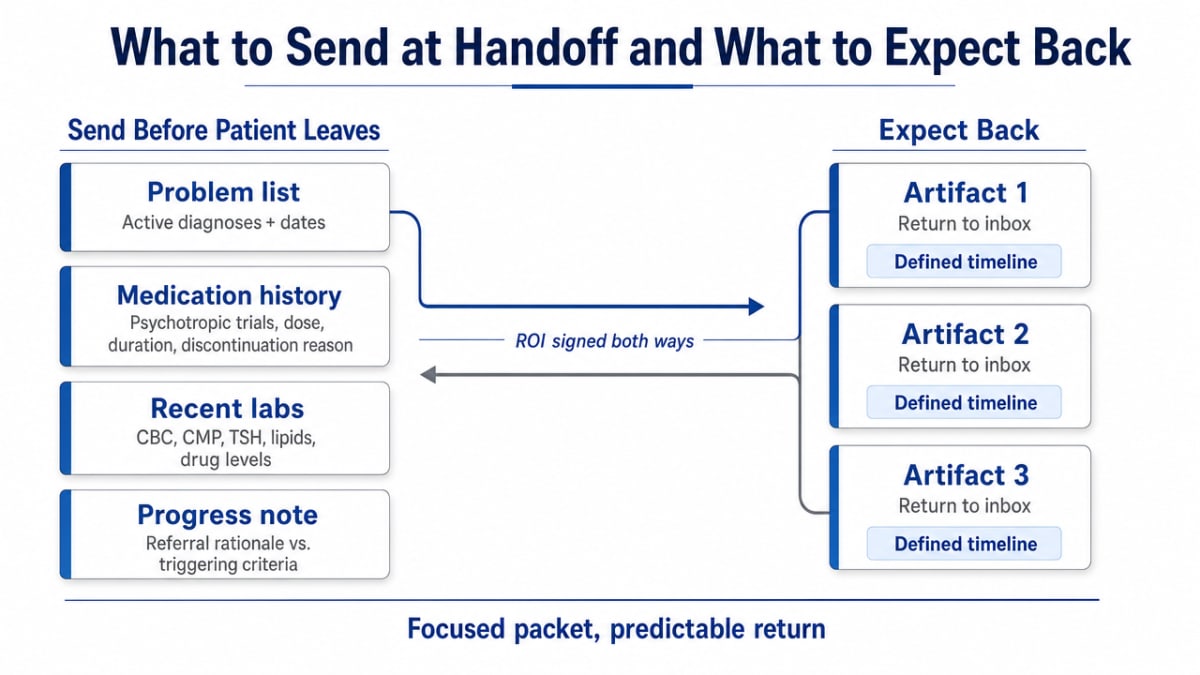
A referral without a records packet is a hope, not a handoff. Before the patient leaves your office, send the receiving facility a focused clinical summary — not the full chart, which will be ignored, but the four documents the admitting psychiatrist actually needs on day one:
- The problem list with active diagnoses and dates.
- The medication history including every psychotropic trial with dose, duration, and reason for discontinuation.
- The most recent labs (CBC, CMP, TSH, lipids, and any drug levels).
- Your progress note documenting the referral rationale against the criteria that triggered it 3.
Add the ROI signed both ways so information can move in both directions without a second phone call.
Then define what you expect back, in writing, before you send. Three artifacts should return to your inbox on a predictable timeline:
- An admission confirmation within 24 hours of intake.
- A medication reconciliation once the initial psychiatric assessment is complete.
- A discharge summary with the aftercare plan before or on the day the patient leaves.
A facility built for PCP referrals will name a specific liaison — case manager, clinical coordinator, or medical director — and give you a direct line rather than a general intake number. If the facility can’t tell you who will call you and when, assume no one will.
Collaborative Stepped Care After Discharge
Discharge is a transition point, not an endpoint. The behavioral health integration literature is direct that severe illness with complex comorbidity does best under collaborative stepped care, where specialty services stabilize the acute picture and primary care carries the maintenance work with specialty backup on standby 9. Your role after discharge is not passive.
Schedule the first post-discharge visit inside seven days, before the patient leaves the facility if possible. Verify the medication list against what was actually prescribed at discharge, not what appears in an old chart. Confirm the specialty follow-up appointment is on the calendar and that the patient has transportation to it. Watch for the early relapse signals the discharge summary should have flagged — sleep disruption, medication nonadherence, return to substance use — and keep the facility’s direct line accessible for a rapid re-escalation if the picture shifts. Stepped care only works when the step back up is as easy as the step down.
Arizona Regulatory Context for Referring Clinicians
If you practice in Arizona and refer to a Prescott or Phoenix-area facility, the state’s colocation framework is worth knowing once. Arizona has directed its health department to adopt licensing provisions that facilitate colocation and integration of outpatient treatment centers providing medical, nursing, and health-related services with behavioral health services 4. SB1283 operationalized that intent — colocators must designate common areas, assign legal responsibility for shared personnel, and maintain shared records under federal and state confidentiality laws, with patient consent required for cross-access 7, 8.
The practical consequence for you: a colocated medical-behavioral site is a legitimate structure in Arizona, not a workaround. Treatment areas can be shared under posted hours and signage rules 6. That means when a facility describes integrated psychiatric and medical care on one campus, the regulatory scaffolding exists to support it — and you can ask for the colocation designation on file as one more verification point during vetting.
ViewPoint Dual Recovery: A Verified Capability Profile
Applying the vetting framework above to a specific facility looks like this. ViewPoint Dual Recovery, based in Prescott, Arizona, is a Joint Commission-accredited psychiatric treatment center licensed by Arizona ADHS and LegitScript certified — the three floor markers you should be asking about on any intake call. That clears the filter. The clinical ceiling is where the profile becomes relevant to the patients this article is about.
Board-certified psychiatry is available 24/7, which means medication decisions for a decompensating patient don’t wait for the next scheduled prescriber slot. Advanced medication management includes clozapine protocols — the practical proxy for whether a program can hold treatment-resistant schizophrenia — alongside the broader polypharmacy work that refractory mood disorders and rapid-cycling bipolar require. Dual diagnosis care is delivered as an integrated model rather than parallel or sequential: psychiatrists and therapists collaborate on a single treatment plan that addresses the psychiatric axis and the substance use axis in the same setting, consistent with the coordinated team-based approach SAMHSA identifies for co-occurring disorders 2. Length of stay is determined by clinical stabilization rather than an insurance-timed discharge, which matters for the patients the VA VISN 2 agreement flags — refractory depression, unstable bipolar, active psychosis, severe PTSD with SUD — where premature discharge is what drives the bounce-back cycle 3.
For PCP referrals, ViewPoint provides a direct admissions line, admission confirmation, medication reconciliation after initial psychiatric assessment, and a discharge summary returned to the referring clinician. If the patient in front of you fits the acuity profile this guide describes, that’s the pathway to use.
Discuss complex cases directly with clinical experts
Connect for a case review to clarify next steps for your treatment-resistant or dual diagnosis patient.
Frequently Asked Questions
What accreditation should I verify before referring a patient to a psychiatric facility?
Ask for three markers on the intake call: state licensure through the relevant health department (in Arizona, ADHS), Joint Commission or CARF accreditation, and LegitScript certification. A facility staffed for PCP referrals produces all three without friction. Treat accreditation as the floor that filters out programs you shouldn’t consider, then move directly to the clinical ceiling questions — psychiatric coverage depth, medication complexity, and dual diagnosis model.
How do I tell whether a facility genuinely handles dual diagnosis versus just claiming to?
Ask the model by name. SAMHSA describes three: integrated (one team, one plan, both axes treated simultaneously), parallel (two teams, coordination varies), and sequential (one problem first, the other deferred) 2. A genuinely integrated program describes a single team where psychiatry is present for SUD groups. If the answer sounds like parallel or sequential care in integrated language, your trauma-with-SUD or bipolar-with-alcohol patient will get half the treatment.
When should I escalate a patient to specialty psychiatric care rather than manage in primary care?
Run the five reflective questions from the referral-decision literature: acute safety concern, symptom severity and functional impairment, recent hospitalizations, previous treatment failure, and complex comorbidity 10. Two or more positives means escalate. The VA VISN 2 diagnostic triggers — refractory depression/anxiety after two adequate trials, unstable bipolar, active psychosis, severe PTSD, personality disorders driving collapse, and substance use — give you defensible, chart-ready grounds 3.
What records should I send at handoff, and what should I expect back from the facility?
Send four documents: the active problem list with diagnosis dates, the psychotropic medication history with dose, duration, and reason for discontinuation, recent labs (CBC, CMP, TSH, lipids, drug levels), and your progress note documenting the referral rationale. Include a bidirectional ROI. Expect back an admission confirmation within 24 hours, a medication reconciliation after initial psychiatric assessment, and a discharge summary with aftercare plan on or before discharge day.
How do I know if a facility can manage complex medications like clozapine, LAIs, or MAOIs?
Ask directly. Clozapine capability is the sharpest proxy — a program running clozapine has REMS enrollment, ANC monitoring workflow, and metabolic surveillance in place. Then ask about long-acting injectables, MAOIs, lithium with therapeutic monitoring, and referral pathways for ketamine or ECT. If the intake coordinator can’t answer, request the medical director. A program serious about treatment-resistant cases will put you through without hesitation.
What is my role in follow-up care after the patient is discharged from a specialty facility?
Collaborative stepped care puts you back in the maintenance seat with specialty backup on standby 9. Schedule the first post-discharge visit inside seven days, ideally before the patient leaves the facility. Verify the medication list against the actual discharge orders, confirm the specialty follow-up appointment is booked, and watch for early relapse signals — sleep disruption, nonadherence, return to substance use. Keep the facility’s direct line accessible for rapid re-escalation.
References
- VA/DoD Clinical Practice Guideline for the Management of Posttraumatic Stress Disorder and Acute Stress Disorder. https://www.ptsd.va.gov/professional/articles/article-pdf/id88356.pdf
- Chapter 7—Treatment Models and Settings for People With Co-Occurring Disorders. https://www.ncbi.nlm.nih.gov/books/NBK571024/
- Primary Care / Psychiatry Behavioral Health Service Agreement (VA VISN 2). https://www.mentalhealth.va.gov/coe/cih-visn2/Documents/Clinical/Operations_Policies_Procedures/VISN_2_PCBH_Service_Agreement_Final.pdf
- Chapter 34, Laws 55th Legislature – Licensing Provisions for Health Care Institutions. https://www.azleg.gov/legtext/55leg/2r/laws/0034.htm
- Decision-Making for Referral to Mental Health Specialty Care in Integrated Primary Care. https://www.ncbi.nlm.nih.gov/pmc/articles/PMC7988467/
- 36-439.04. Colocation; outpatient treatment centers; health care providers. https://www.azleg.gov/ars/36/00439-04.htm
- House Summary for SB1283 – Colocation at Outpatient Treatment Centers. https://www.azleg.gov/legtext/52leg/1r/summary/h.sb1283_03-23_15_houseengrossed.pdf
- Senate Health & Human Services Committee Summary – SB1283. https://www.azleg.gov/legtext/52leg/1r/summary/s.1283hhs.pdf
- Integrating Behavioral Health into Primary Care. https://pubmed.ncbi.nlm.nih.gov/33135754/
- TABLE 2 – Decision-Making for Referral to Mental Health Specialty Care. https://pmc.ncbi.nlm.nih.gov/articles/PMC7988467/table/tbl0002/