Key Takeaways
- Call the Empire Plan’s MHSU Program before starting any mental health or substance use care to secure network-level benefits and avoid non-network penalties 1.
- Empire Plan network benefits cover inpatient psychiatric and SUD stays at no cost, outpatient visits for a $25 copayment, and IOPs at $25 per day 12.
- Request network-level benefits for out-of-state or non-participating facilities in advance through MHSU, providing clinical rationale and previous in-network treatment history 9.
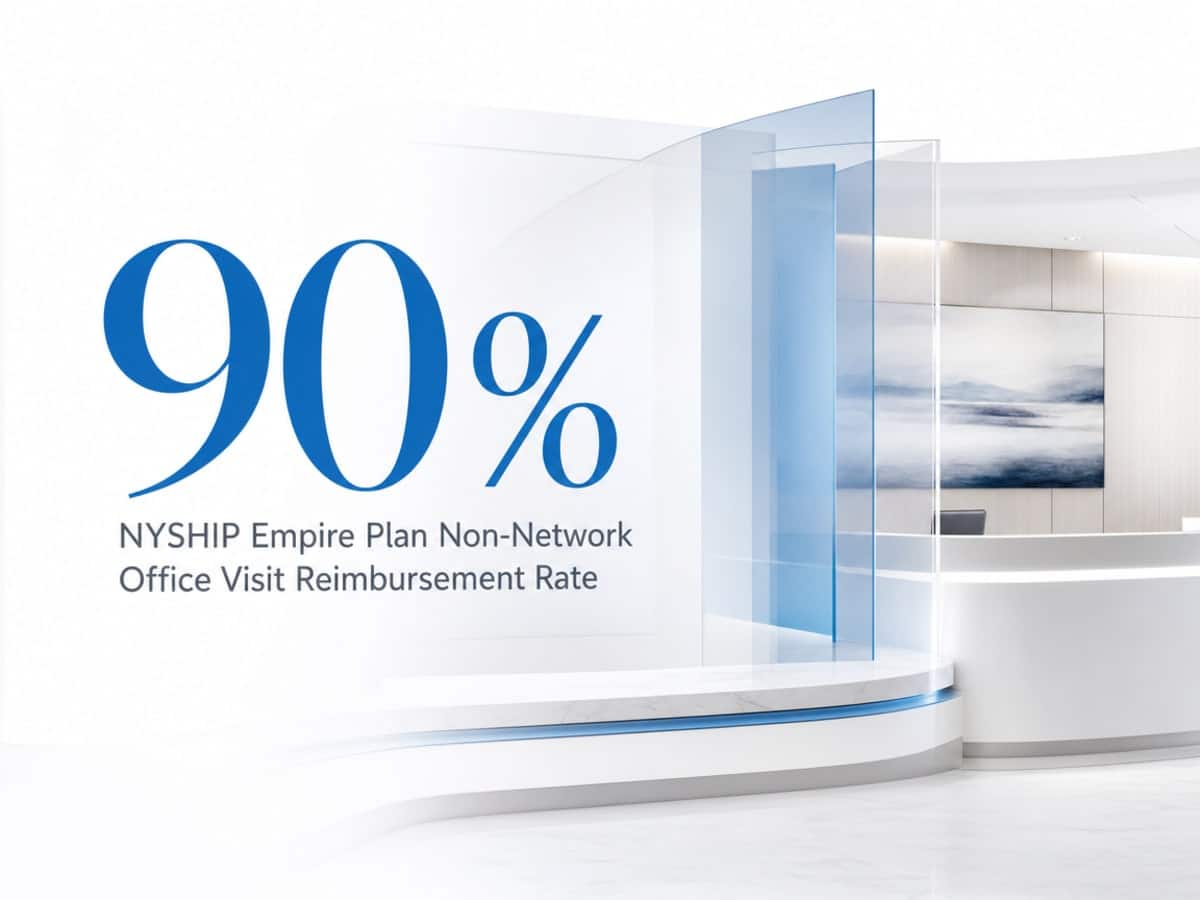
- Non-network reimbursement under MHSU pays 90% of billed charges for office visits, with a coinsurance maximum that caps out-of-pocket exposure for extended stays 3, 8.
- Cost differences between scenarios are substantial: the same inpatient stay can be fully covered with an MHSU call or trigger 10% coinsurance without one 12, 13.
- Integrated dual diagnosis programs lasting 18 months or longer show stronger outcomes, aligning with NYSHIP’s unlimited-when-medically-necessary network coverage 7, 12.
- Retirees receiving out-of-state hospital care should direct billing to the local Blue Cross Plan using code YLS, while still calling MHSU first for behavioral health 15, 1.
- During benefits verification, expect the facility to confirm whether they will pursue network-benefit approval, estimate coinsurance exposure, and identify if the COE pathway applies 9, 10, 4.
The Critical First Call: NYSHIP’s MHSU Program
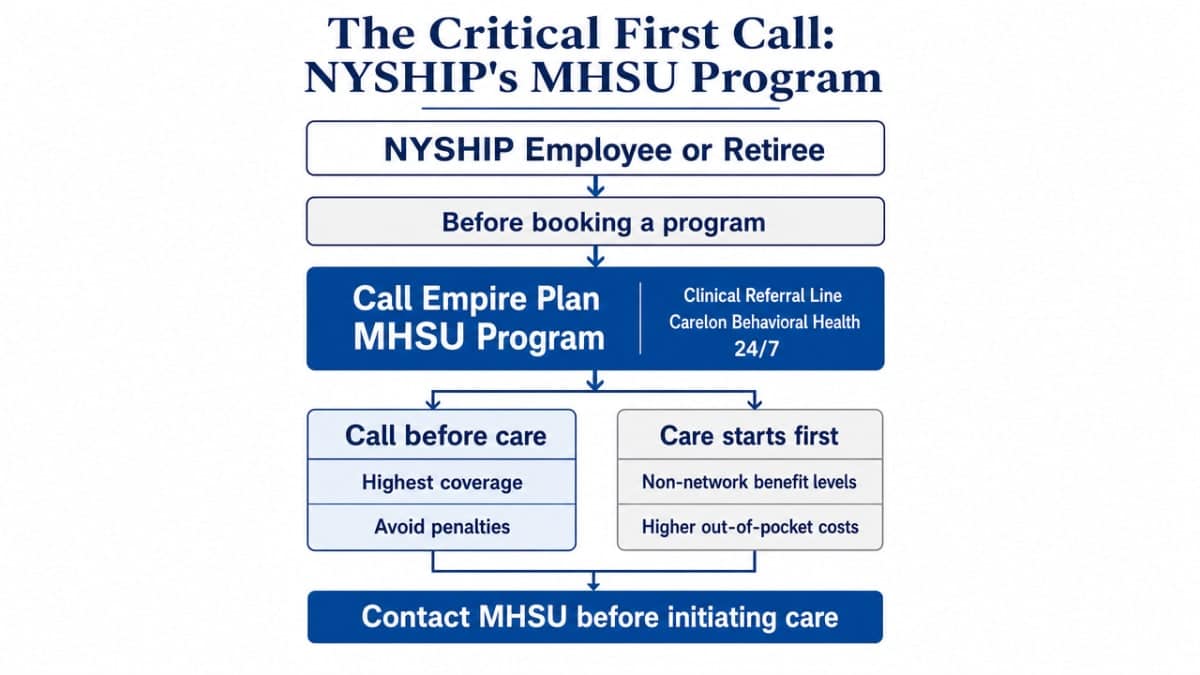
If you are a New York State government employee or retiree covered by NYSHIP, navigating mental health and substance use (MHSU) benefits can be complex. Before booking a program or signing admission forms, a crucial first step is contacting the Empire Plan’s Mental Health and Substance Use (MHSU) Program line. This call is essential for maximizing your coverage and avoiding unexpected costs.
The MHSU Clinical Referral Line, operated by Carelon Behavioral Health, is available 24/7 at 1-877-7-NYSHIP (select option 3 twice) 11. Clinicians on this line assist in finding appropriate care and initiating the preauthorization process. This call serves to open a file, obtain a reference number, and document your case before any claims are billed, providing clarity and reducing financial uncertainty.
Understanding Empire Plan Coverage for Mental Health and Substance Use
Maximizing Benefits: Calling MHSU First
Contacting the MHSU Program before starting care and adhering to their recommendations ensures your benefits are at their highest possible level 12. This is a fundamental aspect of how the plan processes claims.
Under network benefits, inpatient mental health and substance use services are covered at no cost 12. Outpatient office visits with a network mental health practitioner require a $25 copayment per visit 13. If a higher intensity of care is recommended, such as an Intensive Outpatient Program (IOP) with an approved provider, the copayment is $25 per day 12. Telehealth services are covered under the same benefit structure, offering flexibility for those needing specialized care or balancing treatment with work.
In contrast, out-of-network services typically involve 20% coinsurance for outpatient visits and 10% coinsurance for inpatient services, with precertification often required 13. The substantial difference between a $25 copayment and a percentage of potentially high residential psychiatric or dual diagnosis rates underscores the importance of the initial MHSU call.
Network benefits are also described as “unlimited when medically necessary” 12. This provision is particularly important for treatment-resistant cases, ensuring that care duration is determined by clinical need rather than arbitrary session limits, once medical necessity is established.
Navigating Non-Network Benefits and Costs
Non-network benefits provide a viable coverage option, especially for individuals seeking specialized treatment for treatment-resistant or dual diagnosis conditions that may not be available within the network. However, bypassing the MHSU call or admitting to a non-participating facility without preauthorization can lead to less predictable out-of-network costs.
Under non-network provisions, members are responsible for the annual deductible, followed by coinsurance until the coinsurance maximum is met. After reaching this maximum, covered charges are paid at 100% of the allowed amount 8. Specifically, the Summary of Benefits and Coverage (SBC) outlines 20% coinsurance for outpatient services and 10% coinsurance for inpatient services out-of-network, with precertification required for some services 13. These percentages can translate to significant costs when applied to residential psychiatric or dual diagnosis programs.
It is important to note that if the Empire Plan denies a request for network-level benefits at a non-participating provider, covered services are still eligible for coverage, but under the out-of-network provisions with applicable deductible and coinsurance 10. This means a denial does not eliminate coverage but alters the financial calculation.
The primary reason for contacting MHSU first is to formally document your clinical history and provider request. This record influences subsequent payment decisions and provides a basis for requesting network-benefit review, particularly when considering out-of-state care.
Comprehensive Care Under One MHSU Program
The MHSU Program serves as a unified access point for a broad spectrum of care levels. This includes:
- Crisis intervention
- Outpatient therapy
- Medication management
- Intensive Outpatient Programs (IOPs)
- Partial hospitalization
- Inpatient psychiatric or substance use admissions
All are managed by Carelon Behavioral Health 2. You do not need to pre-determine the specific category of care; the Clinical Referral Line clinicians will guide you through this assessment 2.
The 24/7 availability of the line is critical, providing support whether you are calling during a crisis or planning a future residential admission 11. This accessibility extends across the nationwide network of Empire Plan participating providers 11.
For substance use disorder care, an additional pathway exists: paid-in-full benefits are available for treatment received at a Center of Excellence (COE) through the Hazelden Betty Ford Foundation, provided prior authorization is obtained 1. This COE pathway may also include allowances for travel, lodging, and meals 4. It is crucial to specifically mention this COE option when you call MHSU so the clinician can confirm its applicability to your situation.
Securing Out-of-State or Non-Network Care at Network Rates
Requesting Network-Level Benefits for Non-Participating Facilities
If the most suitable treatment program for your clinical needs is located out-of-state, or if specialists for conditions like treatment-resistant schizophrenia, rapid-cycling bipolar disorder, or complex dual diagnoses are not available within the Empire Plan’s participating network, you still have options. The Empire Plan may approve network-level benefits at a non-participating facility in specific circumstances 9.
This approval is not automatic and must be requested in advance through the MHSU Program. The Clinical Referral Line clinicians at Carelon Behavioral Health are responsible for logging the request, gathering the clinical rationale, and submitting it for review 2.
When making this call, be precise. Identify the facility and the recommended level of care (e.g., residential, inpatient psychiatric, or structured dual diagnosis program). Explain previous in-network treatment attempts and why they were unsuccessful. The reviewer will assess whether appropriate care is reasonably available within the network for your specific clinical situation, making your treatment history a key piece of evidence.
Always request and record a reference number for your request. Inquire about the decision timeline and what documentation the out-of-state facility should submit. If approved, your covered services at the non-participating facility will be paid under network provisions 9. If denied, coverage shifts to out-of-network provisions, subject to deductible and coinsurance 10. This process provides a clear financial framework for your treatment planning.
Understanding Non-Network Reimbursement Calculations
A common misunderstanding in Empire Plan behavioral health coverage concerns non-network reimbursement. For non-network office visits under the MHSU Program, the plan pays 90% of billed charges. Once the applicable coinsurance maximum is met, covered services are paid at no cost 3. The term “billed charges” is crucial here, as it differs from the “allowed amount” used for other non-network services under the Empire Plan, where reimbursement is calculated against an allowed amount, with deductible and coinsurance applied 10. This distinction explains why general statements about “what out-of-network pays” can be misleading.
The coinsurance maximum is another vital component of non-network benefit calculations. Under non-network provisions, once your out-of-pocket coinsurance exceeds this maximum, covered charges are paid at 100% of the allowed amount for the remainder of the plan year 8. This ceiling prevents long inpatient stays or extended residential programs from resulting in open-ended bills. While it does not eliminate initial costs, it provides a cap on your total coinsurance responsibility.
In practice, the initial weeks of care typically incur the highest coinsurance burden, which then decreases as you approach the maximum. Facilities experienced with Empire Plan claims can often provide an estimate of your financial responsibility before admission, offering valuable clarity for your treatment decision.
Special Provisions for Substance Use Disorder Treatment
For substance use disorder treatment, a specific pathway exists outside the standard network and non-network tiers. Paid-in-full benefits are available for treatment received at a Center of Excellence (COE) through the Hazelden Betty Ford Foundation, provided prior authorization is obtained 1. When this COE pathway is applicable, allowances for travel, lodging, and meals may also be available 4.
It is important to distinguish this from general out-of-state coverage. This COE arrangement is specific to the Hazelden Betty Ford network; travel allowances do not automatically apply to other out-of-state substance use programs. However, standard MHSU network or non-network benefits would still apply to those facilities. Prior authorization for the COE benefit is mandatory; you must contact MHSU, specifically request the COE benefit, and obtain authorization before admission 4.
If your primary clinical need is psychiatric with a secondary substance use component, or if the required dual diagnosis program is outside the COE arrangement, the process for requesting network-level benefits at a non-participating facility (as described in the previous section) would be the appropriate route. Knowing which pathway applies before contacting MHSU can streamline the authorization process.
Cost-Sharing Scenarios for NYSHIP Members
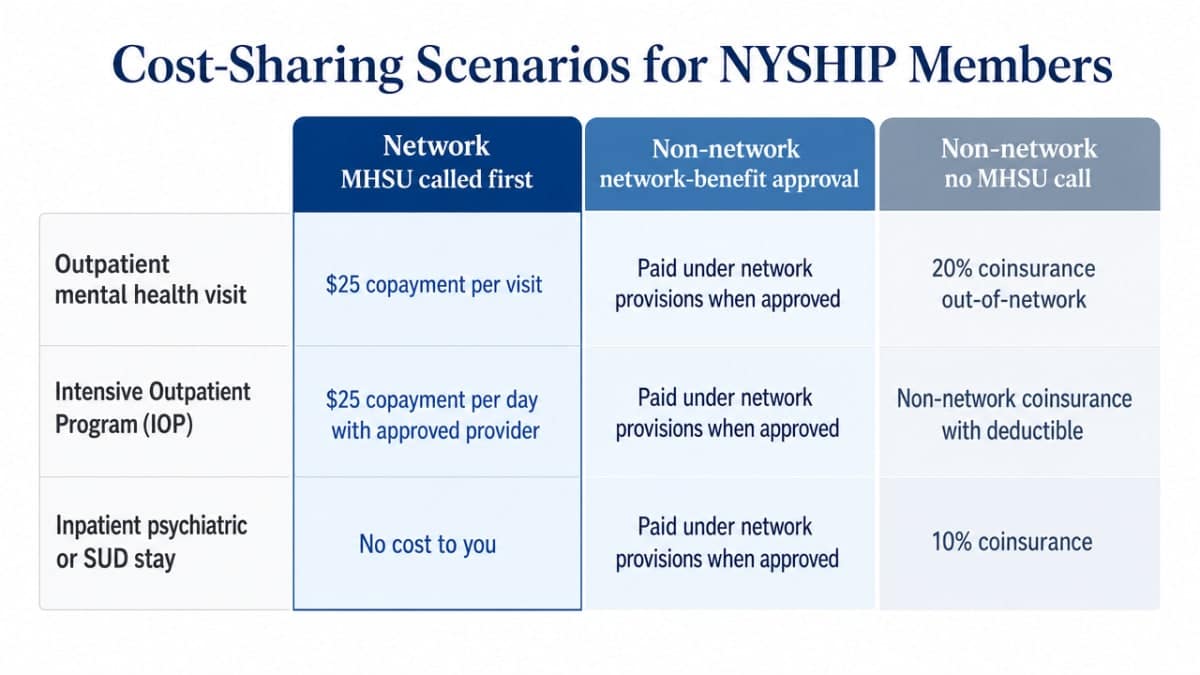
Understanding the financial implications of different treatment scenarios is crucial for NYSHIP members. The following table illustrates three common situations, highlighting how the same treatment can result in vastly different costs depending on how MHSU requirements are met.
| Service | Network (MHSU called first) | Non-network with network-benefit approval | Non-network, no MHSU call |
|---|---|---|---|
| Outpatient mental health visit | $25 copayment per visit 12 | Paid under network provisions when approved 9 | 20% coinsurance out-of-network 13 |
| Intensive Outpatient Program (IOP) | $25 copayment per day with approved provider 12 | Paid under network provisions when approved 9 | Non-network coinsurance with deductible 10 |
| Inpatient psychiatric or SUD stay | No cost to you 12 | Paid under network provisions when approved 9 | 10% coinsurance out-of-network 13 |
| Preauthorization | Handled through the MHSU call 1 | Required, requested through MHSU in advance 10 | Not on file; benefits default to non-network 10 |
The “Non-network with network-benefit approval” column represents a pathway many families are unaware of. If a specialized program is out-of-state, an approved network-benefit request can align its payment structure with that of an in-network provider 9. Conversely, the “Non-network, no MHSU call” column, while not a complete denial of coverage, defaults to deductible and coinsurance calculations against an allowed amount, which is harder to estimate in advance 10.
A treatment facility experienced with Empire Plan claims can help clarify which scenario applies to your situation before admission, transforming a stressful decision into a well-informed one.
Evidence-Based Treatment for Treatment-Resistant and Dual Diagnosis Cases
For individuals with treatment-resistant conditions or dual diagnoses, standard care approaches may have proven insufficient. This history is vital both clinically and when advocating for specialty programs with MHSU. It is also important to consider the evidence supporting integrated dual diagnosis treatment.
A 2023 systematic review found that integrated care for co-occurring disorders significantly improved psychiatric symptoms compared to non-integrated treatment 6. While it did not show clear superiority for substance use outcomes or treatment retention, this indicates that integrated care can be highly effective for individuals where the psychiatric component, such as rapid-cycling bipolar, treatment-resistant depression, or complex trauma, significantly impacts recovery.
Further research highlights the importance of program duration. Comprehensive integrated programs lasting 18 months or longer demonstrated significant reductions in substance use, meaningful remission rates, and decreased hospital utilization, whereas shorter interventions yielded less consistent results 7. This suggests that the length and comprehensiveness of care are critical factors for treatment-resistant cases.
NYSHIP’s policy of “unlimited when medically necessary” for network MHSU benefits 12is advantageous here. If your treating clinician documents the need for an extended course of care, the plan’s structure supports this without arbitrary cutoffs. When requesting network-level benefits at a specialty facility through MHSU, it is beneficial to present your clinical history, outlining previous treatments, their outcomes, and how the recommended program length aligns with evidence for your specific presentation.
NYSHIP Retirees Seeking Out-of-State Care
For NYSHIP retirees who reside or travel out of New York State, your Empire Plan coverage remains active. However, the administrative procedures for billing may differ slightly. Understanding these nuances beforehand can prevent billing complications during a stressful admission.
When receiving hospital services outside New York State, instruct the hospital to submit bills to the local Blue Cross Plan using code YLS 15. This code identifies you as an Empire Plan enrollee and ensures correct claim routing. Facilities accustomed to NYSHIP patients will be familiar with this code; for others, you may need to provide it during intake. Having “YLS” readily available can be very helpful.
For behavioral health services, the MHSU call remains the essential first step, even when calling from out-of-state 1. The Clinical Referral Line serves all members regardless of location. While network benefits are provided for emergency services in the United States, for planned care, the same process for requesting network-level benefits at a non-participating facility applies 15.
The coinsurance maximum is particularly beneficial for retirees. Once your out-of-pocket expenses for non-network inpatient and outpatient care exceed this maximum, the Empire Plan covers 100% of covered non-network charges for the remainder of the plan year 15. This ceiling is a key financial planning element, rather than focusing solely on the initial day-one coinsurance rate.
What to Expect During a Benefits Verification Call
Initiating a benefits verification call with a treatment facility can feel daunting. However, a productive call primarily involves the facility gathering necessary information from you and then performing the follow-up with the MHSU Program on your behalf.
Before calling, have ready:
- Your Empire Plan ID card
- The name and date of birth of the individual seeking care
- Their diagnosis or working diagnosis from the treating clinician
- A brief summary of previous treatments and their outcomes
- If you have already contacted the MHSU Clinical Referral Line, a reference number 2
If you do not yet have a reference number, inform the facility, as many experienced with NYSHIP will guide you through this step.
After the verification, the facility should clearly communicate:
- Whether they will request network-level benefits at their non-participating location through MHSU 9
- Your estimated coinsurance exposure under non-network provisions until the coinsurance maximum is met 10
- If the COE pathway applies to your specific case 4
If a facility cannot answer these questions using Empire Plan terminology, it is advisable to continue your search.
ViewPoint is a non-network facility that frequently works with NYSHIP families. A verification call with ViewPoint is designed to provide clear answers to these questions before you commit to treatment, reducing guesswork and supporting informed decision-making.
Find Out If Advanced Psychiatric Care Fits
Discover your coverage and next steps for specialized dual diagnosis or psychiatric treatment.
Frequently Asked Questions
Do I have to call the MHSU Program before I start psychiatric treatment?
Yes, calling the MHSU Program before receiving services from a mental health or substance use provider is required by NYSHIP to qualify for network benefits and avoid penalties 1. The 24/7 Clinical Referral Line is 1-877-7-NYSHIP, option 3 twice 11. Skipping this call can result in the same care being reimbursed at non-network rates 12.
Can the Empire Plan cover an out-of-state or non-network psychiatric facility at the network benefit level?
In certain situations, yes. The Empire Plan may approve network-level benefits at a non-participating facility if a request is made in advance through the MHSU Program 9. This requires documentation of your treating clinician’s rationale, previous in-network attempts, and the specific facility. If the request is denied, coverage still applies under out-of-network provisions, subject to deductible and coinsurance 10. Always ask MHSU for a reference number for your request.
What will I actually pay for outpatient, IOP, and inpatient care under the MHSU Program?
If you call MHSU first and utilize in-network providers, outpatient visits incur a $25 copayment, IOPs with an approved provider are $25 per day, and inpatient care is covered at no cost 12. For out-of-network services, the Summary of Benefits and Coverage (SBC) indicates 20% coinsurance for outpatient services and 10% coinsurance for inpatient care, with precertification often required 13. Your annual deductible and coinsurance maximum will apply to non-network care.
Does the Empire Plan cover treatment for co-occurring psychiatric and substance use disorders?
Yes, the MHSU Program covers both mental health and substance use care, including outpatient, IOP, and inpatient levels, all administered by Carelon Behavioral Health 2. For substance use disorder specifically, paid-in-full benefits are available at a Center of Excellence through the Hazelden Betty Ford Foundation with prior authorization, which may also include travel, lodging, and meal allowances 1, 4. Dual diagnosis programs outside this COE arrangement follow standard MHSU pathways.
I’m a NYSHIP retiree living or traveling out of state. How does billing work?
When receiving hospital services outside New York, ask the facility to submit bills to the local Blue Cross Plan using code YLS, which identifies you as an Empire Plan enrollee 15. For planned behavioral health care, call MHSU first, even from out-of-state 1. Once your out-of-pocket expenses exceed the coinsurance maximum for non-network inpatient and outpatient care, the Empire Plan covers 100% of covered non-network charges for the remainder of the plan year 15.
Is ViewPoint in-network with the Empire Plan?
ViewPoint Dual Recovery is a non-network facility that regularly assists NYSHIP families. We are familiar with Empire Plan MHSU rules, the process for requesting network-level benefits at non-participating facilities, and out-of-network reimbursement calculations 9, 10. A benefits verification call with ViewPoint aims to provide clear financial information before you commit to treatment. For treatment-resistant or dual diagnosis admissions, contacting MHSU first and then verifying with ViewPoint ensures the process is properly documented.
References
- January 2026 At a Glance – APSU (Empire Plan Active Employees). https://www.cs.ny.gov/employee-benefits/nyship/shared/publications/at-a-glance/2026/apsu-aag-jan-2026.pdf
- 2026 Empire Plan Report – NYS Active Employees. https://www.cs.ny.gov/employee-benefits/nyship/shared/publications/empire-plan-report/2026/ny-act-epr-2026.pdf
- Active Choices 2026 – New York State Health Insurance Program. https://www.cs.ny.gov/employee-benefits/shared/publications/choices/2026/active-choices-2026.pdf
- January 2026 At a Glance – DC-37 District Council 37. https://www.cs.ny.gov/employee-benefits/nyship/shared/publications/at-a-glance/2026/dc37-aag-jan-2026.pdf
- The Empire Plan Worldwide (2025). https://www.cs.ny.gov/employee-benefits/shared/publications/ep-travel-guides/2025/ep-ww-2025.pdf
- Integrated vs non-integrated treatment outcomes in dual diagnosis disorders: a systematic review. https://pmc.ncbi.nlm.nih.gov/articles/PMC10157410/
- Review of Integrated Mental Health and Substance Abuse Treatment for Patients with Dual Disorders. https://www.ncbi.nlm.nih.gov/books/NBK67188/
- Department of Civil Service – Choices for 2026 (NYSHIP Plan Comparison – Empire Plan). https://www.cs.ny.gov/employee-benefits/nyship/shared/apps/plan-comparison/compare.cfm?group=17&mp=yes&plancode=001
- 2026 NYSHIP Plan Comparison – Empire Plan (another group code). https://www.cs.ny.gov/employee-benefits/nyship/shared/apps/plan-comparison/compare.cfm?plancode=001&group=6
- Out-of-Network Reimbursement Disclosures – The Empire Plan. https://www.cs.ny.gov/employee-benefits/nyship/shared/publications/out-of-network/empire-plan-out-of-network-reimbursement-disclosure.pdf
- Empire Plan Providers and Pharmacy – NYS Civil Service. https://www.cs.ny.gov/employee-benefits/nyship/shared/providers/index.cfm
- Active Choices 2026 – New York State Health Insurance Program (NYSHIP). https://www.cs.ny.gov/employee-benefits/nyship/shared/publications/choices/2026/active-choices-2026.pdf
- Summary of Benefits and Coverage (SBC) – NY Unrepresented Empire Plan 2025. https://www.cs.ny.gov/employee-benefits/sbc/pdfs/2025/ny-unrep-sbc-2025.pdf
- 2017 Choices – NYSHIP for SUNY Employees. https://www.suny.edu/media/suny/content-assets/documents/benefits/nyship/2017-/2017-Choices.pdf
- On the Road 2023 – NYSHIP for Retirees. https://www.cs.ny.gov/employee-benefits/nyship/shared/publications/on-the-road/2023/ny-ret-on-the-road-2023.pdf