

Key Takeaways
- Repeated hospitalizations and short residential stays often reflect structural gaps in care rather than personal failure, especially when clozapine or integrated dual diagnosis work was never fully attempted 2, 6.
- Before escalating to specialized care, pseudo-resistance factors like unverified adherence, ongoing substance use, and untreated medical conditions must be ruled out to avoid mislabeling a case as truly resistant 1, 7.
- Private pay psychiatric admission in Prescott lets clinical need set treatment duration, allowing proper clozapine titration, bipolar sequencing, and integrated substance use treatment within one program 3, 9.
- When comparing facilities, ask how adherence is verified, how psychiatric and substance use teams collaborate, and whether clozapine initiation and augmentation strategies like lamotrigine or ECT are handled onsite 8, 9.
When Two or Three Treatment Episodes Have Not Been Enough
You have been here before. Perhaps it was a seven-day hospital stay, a 30-day residential program, or an intensive outpatient program that ended prematurely. If you are reading this, you likely recognize the pattern: admission, stabilization, discharge, decompensation, and repeat.
This pattern is often structural, not a personal failure. Treatment resistance in schizophrenia is defined as non-response to two adequate antipsychotic trials at appropriate dose and duration 2, 6. For bipolar disorder, it means non-response to two or more evidence-based agents, with adherence verified 3. If your loved one has undergone multiple treatment episodes, they may meet the clinical definition of a case requiring a different approach.
The question then becomes, what does “different” look like?
ViewPoint Dual Recovery, a Joint Commission-accredited psychiatric facility in Prescott, Arizona, specializes in complex cases such as treatment-resistant schizophrenia, rapid-cycling bipolar disorder, and dual diagnoses where substance use and psychiatric illness are intertwined. Operating on a private pay model, the facility allows treatment duration to be determined by the illness, enabling proper clozapine titration and integrated substance use treatment alongside psychiatric care.
This article explores what this approach entails and how to determine if it aligns with your situation.
Understanding Treatment Resistance Before Escalating Care
The TRRIP Threshold: Two Failed Adequate Trials
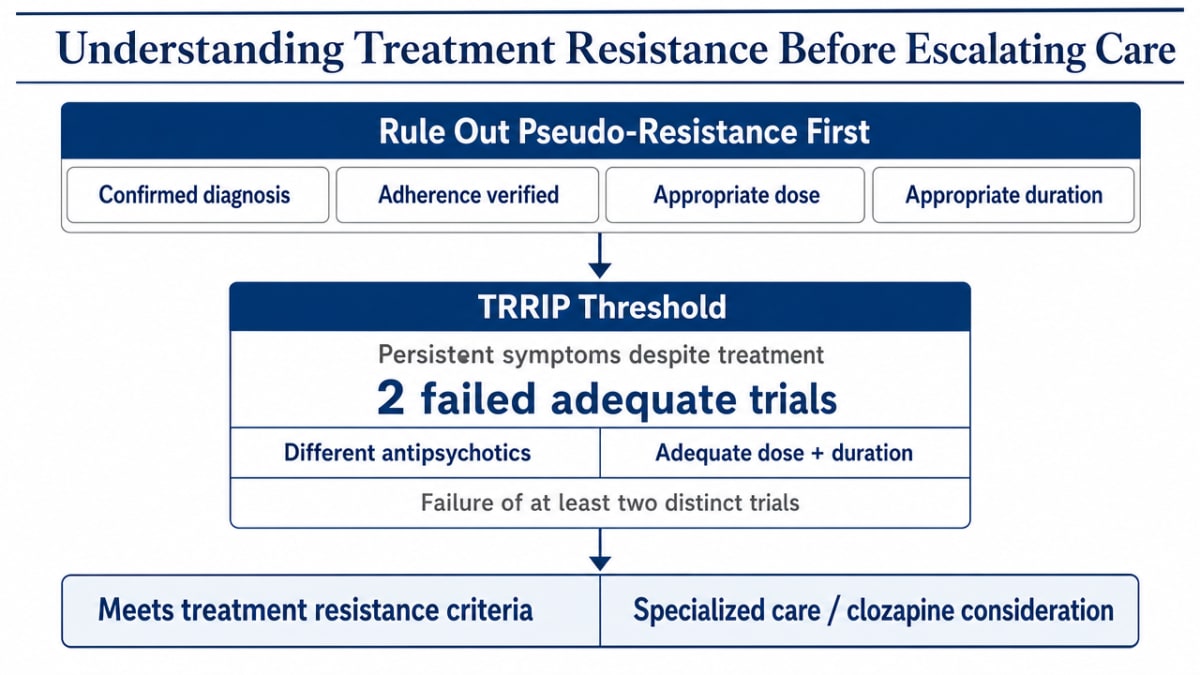
Before considering specialized care, it is crucial to determine if a case truly meets the clinical criteria for treatment resistance. The Treatment Response and Resistance in Psychosis (TRRIP) working group provides a widely used framework. TRRIP requires a confirmed diagnosis, adequate pharmacological treatment, and persistent symptoms despite that treatment. “Adequate” means the failure of at least two trials with different antipsychotics, each at an appropriate dose and duration, with verified adherence 6. Schizophrenia pharmacotherapy guidelines similarly state that two adequate but failed antipsychotic trials establish treatment-resistant schizophrenia (TRS), and clozapine should be offered 2.
It is important to understand the specifics:
- “Two trials” means distinct attempts with different medications, not just two prescriptions of the same drug.
- “Appropriate dose” implies titration to a therapeutic level, not just a starter dose.
- “Appropriate duration” typically means several weeks at the target dose, not a brief hospital stay.
- “Adherence verified” means confirming the medication was actually taken.
If your loved one has experienced multiple hospitalizations with various antipsychotics, or if medications were discontinued before reaching a therapeutic dose or duration, they might meet TRS criteria. Understanding whether past trials were truly adequate is essential for determining the correct next steps.
Pseudo-Resistance: What Needs to Be Ruled Out First
Often, cases that appear resistant are not. This phenomenon, known as pseudo-resistance, is frequently overlooked in acute settings. Non-response can stem from comorbid substance misuse, medication issues, or physical illness rather than true pharmacologic resistance 7. For instance, in treatment-resistant schizophrenia, medication compliance and co-occurring substance abuse are common factors that mimic TRS 1. Bipolar guidelines emphasize verifying adherence before concluding that the illness is resistant 3.
Practically, this means a thorough admission workup must address questions often missed in previous discharge summaries:
- Was medication consistently taken between hospitalizations?
- Is ongoing stimulant, cannabis, or alcohol use destabilizing the illness?
- Are there untreated medical conditions like thyroid problems, sleep apnea, or metabolic issues affecting medication processing?
- Was the last antipsychotic ever pushed to a therapeutic dose, or was it quietly under-dosed due to side effects?
These questions are critical for differentiating between a case requiring clozapine and one needing integrated substance use treatment, a medical evaluation, or consistent medication adherence. While some of these factors may have been addressed in prior episodes, acute stays prioritize stabilization over the detailed investigation needed to rule out pseudo-resistance. A specialized psychiatric admission for complex cases integrates this detective work into the treatment process. When discussing with a facility, inquire about their methods for assessing adherence, screening and treating co-occurring substance use, and conducting medical workups before attributing issues solely to the illness.
How Private Pay Influences Clinical Design
Treatment Duration Determined by Illness, Not Authorization
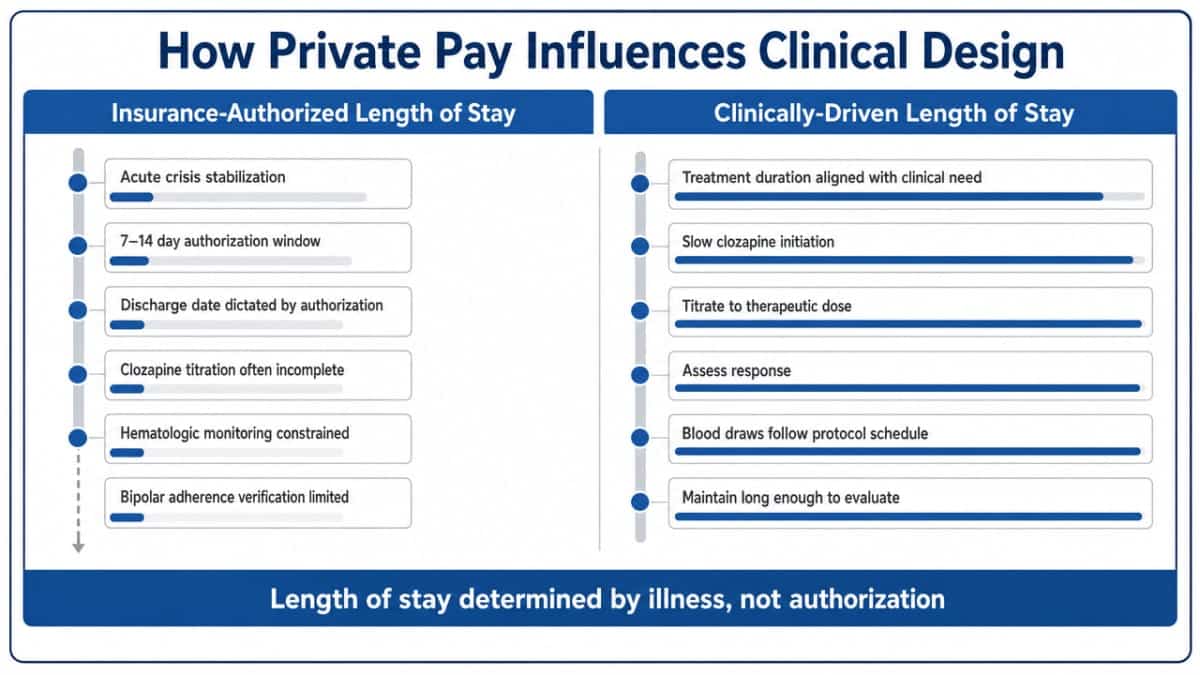
The primary advantage of private pay is the ability to align treatment duration with clinical need. Insurance authorizations often dictate discharge dates, which may be sufficient for acute crisis stabilization but rarely for comprehensive interventions. For example, a proper clozapine titration, with its required hematologic monitoring, often cannot be completed within a typical 7-14 day authorization window 9. Similarly, verifying bipolar medication adherence takes longer than an acute stay allows 3.
A clinically-driven treatment duration transforms treatment possibilities. Clozapine can be initiated slowly, titrated to a therapeutic dose, and maintained long enough to assess response. Blood draws follow the protocol’s schedule, not an arbitrary end date 9. If a co-occurring substance use disorder is present, the patient can progress through acute withdrawal and begin early recovery while still in the program. Family sessions can extend beyond initial defensive conversations to address deeper issues.
Integrated Dual Diagnosis vs. Sequential Handoffs
Insurance-driven care often separates psychiatric and substance use treatment, leading to sequential handoffs between programs. A psychiatric admission might stabilize acute symptoms and then refer for substance use treatment, while a substance use program might refer back for psychiatric care. This fragmented approach allows the illnesses to interact without integrated clinical oversight, perpetuating the cycle of relapse.
For treatment-resistant schizophrenia, comorbid substance abuse is a known factor that can mimic pharmacologic resistance 1. Non-response may reflect ongoing substance misuse rather than medication failure 7. If these issues are treated in isolation, decisions regarding advanced strategies like clozapine may be based on incomplete information.
A facility designed for dual diagnosis integrates both conditions into a single treatment plan. The psychiatrist adjusting antipsychotics is informed by the substance use counselor’s observations, and vice versa. Family sessions address both aspects of the illness. This integration is challenging within authorization windows that treat conditions as separate billable episodes. Private pay enables a single team to manage both. When evaluating facilities, ask specifically how psychiatric and substance use teams collaborate, share information, and make decisions. Vague answers suggest a lack of true integration.
Medication Management for Treatment-Resistant Schizophrenia
Clozapine: A Consensus Treatment
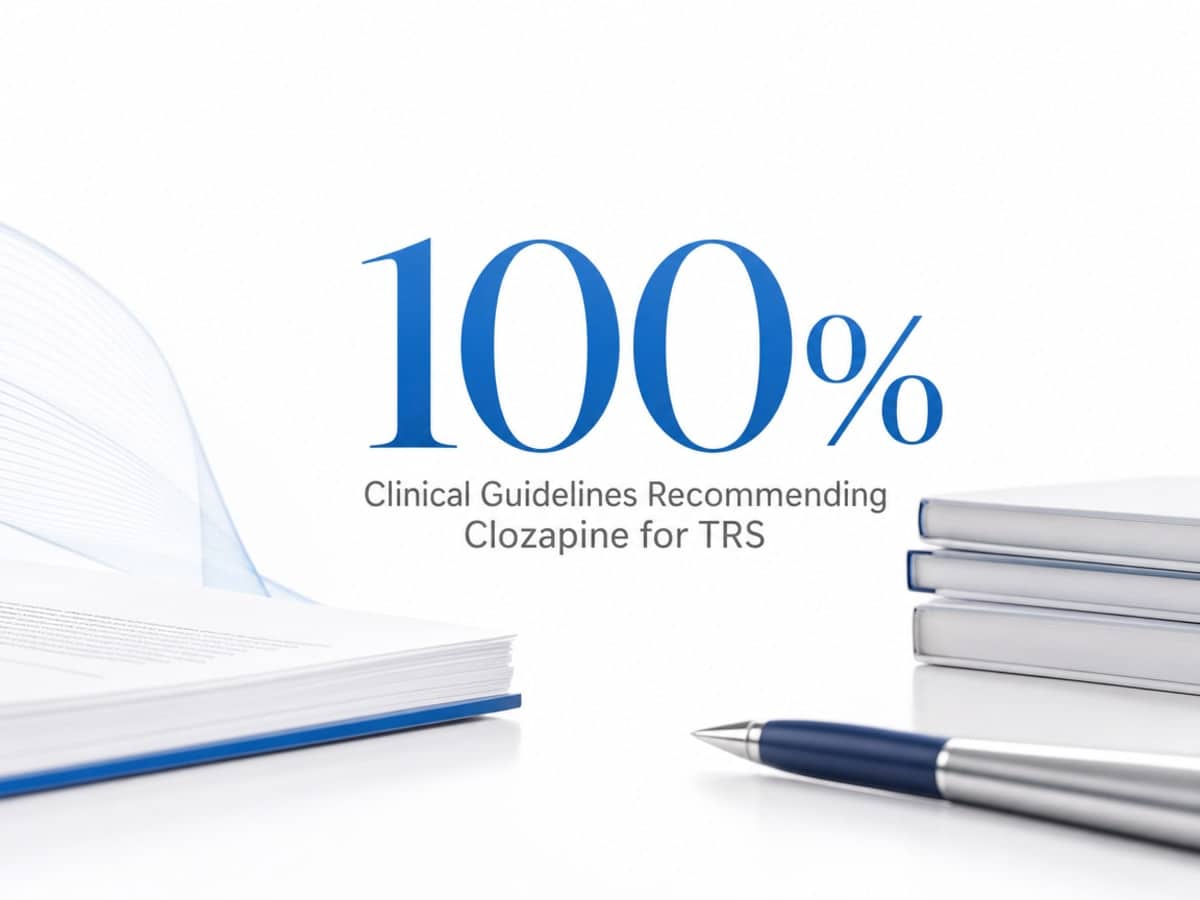
In psychiatry, widespread agreement across international guidelines is rare, but for clozapine in treatment-resistant schizophrenia, the consensus is absolute. A systematic review found that all 17 clinical guidelines reviewed recommend clozapine as the treatment of choice for TRS 9. Schizophrenia pharmacotherapy guidelines explicitly state that clozapine should be offered to patients with TRS 2, and another guideline identifies it as the first choice 8. The peer-reviewed literature also supports clozapine as the primary treatment for this population 1.
Despite this strong evidence, clozapine is often underutilized. This is largely because its administration is demanding, requiring structured hematologic monitoring, careful titration, and a clinical team capable of managing potential side effects during the initial weeks 9. Acute settings often lack the time, and outpatient psychiatrists may hesitate to initiate it without a controlled environment. This leads to a documented gap between recommended guidelines and actual prescription rates 4. Importantly, earlier clozapine initiation is associated with better response rates 4.
A facility structured around this protocol treats clozapine initiation as routine. Monitoring, dose escalation, side effect management, and response assessment all occur within one program. If your loved one meets TRS criteria and has not had an adequate clozapine trial, this conversation is paramount.
Beyond Clozapine: Augmentation and ECT
While clozapine is the most effective medication for TRS, it does not achieve full remission in every patient. When clozapine alone is insufficient, schizophrenia pharmacotherapy guidelines suggest augmentation strategies, such as adding lamotrigine or using maintenance ECT in specific cases 8. These are not initial interventions but are considered after an adequate clozapine trial has been given sufficient time to work. The same pseudo-resistance questions are re-evaluated: medication adherence, co-occurring substance use, and medical factors affecting drug metabolism 1, 7.
The evidence base for these later-line treatments is less robust than for clozapine itself. A program that can manage partial responses, carefully adjust augmentation, and consider ECT when clinically indicated offers a distinct approach compared to programs that discharge patients when initial medications fail. Progress at this stage may appear subtle, such as fewer hours of active psychosis, more coherent conversations, or sustained sleep, but these are significant wins as medication adjustments continue.
Rapid-Cycling and Treatment-Resistant Bipolar Disorder
Bipolar disorder that remains unstable presents unique challenges. The illness involves fluctuating moods—low periods, hypomania, mixed states, and crashes. If your loved one has cycled through various mood stabilizers, atypical antipsychotics, and antidepressant trials without achieving stability, the treatment history can indeed appear complex. Rapid-cycling and treatment-resistant bipolar disorder are inherently messy conditions.
Clinically, treatment resistance in bipolar disorder is defined as non-response to two or more evidence-based agents, with adherence verified 3. Current guidelines provide first-, second-, and third-line recommendations, emphasizing that proper sequencing and complete trials are crucial; skipping steps can create the appearance of resistance when treatment was simply incomplete 5.
The adherence caveat is particularly important in bipolar disorder, as medication-taking can be challenging during hypomanic phases (when medication feels unnecessary) or depressive phases (when motivation is low). A specialized admission offers one of the few programs where medication adherence is closely tracked over an extended period, allowing clinicians to understand the illness’s true course on a stable regimen.
For truly resistant cases, treatment options expand, though the evidence base may thin. For resistant bipolar depression, consensus guidance includes lithium plus lamotrigine, modafinil, pramipexole, ketamine, and ECT, depending on the clinical context 10. These are valid tools, but they are later-line interventions, and their evidence base is narrower than for established first-line treatments like lithium. Progress in these cases is measured in sustained stability—weeks without a mood switch, consistent sleep, or a depressive episode resolving without transitioning into a mixed state. These are the indicators that the treatment sequence is finally effective.
Prescott as a Clinical Variable
While geography is not therapy, it can significantly impact the effectiveness of treatment. Prescott, situated at a mile of elevation in Arizona’s central highlands, offers a different pace than larger cities. For psychiatric admissions focused on treatment resistance and dual diagnosis, this location provides several advantages.
First, distance from the previous environment is crucial. If a loved one has been caught in cycles involving the same social patterns or triggers, physical separation allows for clean observation of adherence, genuine cessation of substance use, and accurate assessment of pseudo-resistance factors on a stable baseline 1, 7. Adherence cannot be verified in an environment that has never permitted it.
Second, the slower pace of Prescott supports longer clozapine titrations, careful bipolar sequencing, and integrated substance use work without manufactured urgency 9.
Third, despite its smaller size, Prescott maintains practical access to medical support, laboratory monitoring for clozapine, and coordination with outpatient providers. The setting supports clinical work without romanticizing it, which is the core benefit.
The Referral and Admission Conversation
The initial phone call is a clinical conversation, not an interview to pass. Honesty about the treatment history is key. Family members should provide discharge summaries, outpatient clinicians should share medication trials (doses, durations, adherence information), and patients should recall which medications had any perceived effect.
The admissions team at ViewPoint Dual Recovery will ask specific questions:
- Which antipsychotics or mood stabilizers were tried, at what dose, and for how long.
- Whether adherence between hospitalizations was verified or assumed 3.
- Details about co-occurring substance use.
- Whether clozapine was ever offered, and if not, why 9.
These questions help build a clinically informed admission plan before arrival.
An end date will not be provided on this call, as treatment duration is a clinical decision, not an authorization-driven one. Instead, you can expect clear next steps: a timeline for the intake assessment, instructions for sending records, and information on coordination with outpatient providers. This marks the beginning of the treatment process.
Discover if advanced care aligns with your needs
Gain expert insight on your eligibility for private pay psychiatric treatment in Prescott, AZ.
Frequently Asked Questions
What qualifies someone as having treatment-resistant schizophrenia?
Treatment-resistant schizophrenia is defined by the failure to respond to two adequate antipsychotic trials using different agents, each at an appropriate dose and duration, with verified adherence 2, 6. The term “adequate” is crucial; a medication started and stopped within a brief acute stay typically does not count. Before escalating care, it is important to rule out comorbid substance use, medication adherence issues, and physical illnesses, as these can mimic true pharmacologic resistance 1.
Why does private pay matter for complex psychiatric cases?
Private pay is not about luxury amenities; it is about allowing the illness to determine the length of stay. When insurance authorization dictates discharge dates, critical processes like a proper clozapine titration with its required hematologic monitoring 9, or sufficient time to verify bipolar medication adherence 3, often cannot be completed. Private pay enables the necessary time for integrated dual diagnosis work and full medication trials within a single admission.
How is treatment-resistant bipolar disorder defined and treated?
Bipolar treatment resistance is generally defined as non-response to two or more evidence-based agents, with adherence verified first 3. Current guidelines outline first-, second-, and third-line treatment sequences, meaning that incomplete or improperly sequenced treatments can appear as resistance 5. For resistant bipolar depression, consensus guidance suggests options like lithium plus lamotrigine, modafinil, pramipexole, ketamine, and ECT, depending on the clinical context, while acknowledging that the evidence base for these later-line options is narrower than for initial treatments 10.
Can substance use be treated at the same time as the primary psychiatric condition?
Yes, and for treatment-resistant cases, integrated treatment is often essential. Comorbid substance misuse is a recognized factor that can mimic pharmacologic resistance 1, 7. When psychiatric and substance use care are managed by separate programs, the conditions can exacerbate each other. An integrated dual diagnosis admission addresses both diagnoses within one treatment plan, fostering collaboration between psychiatrists and substance use clinicians through shared notes, meetings, and decisions.
What happens if clozapine does not produce a full response?
Clozapine is the most effective medication for TRS, but it may not fully resolve symptoms in all patients. If a partial response occurs after an adequate trial at therapeutic levels, schizophrenia guidelines recommend augmentation strategies, such as lamotrigine or maintenance ECT in selected cases 8. Before adding new treatments, pseudo-resistance factors like adherence, ongoing substance use, and medical contributors are re-evaluated 1, 7. Even small improvements, such as reduced psychosis or improved sleep, are considered significant progress at this stage.
How does a family or outpatient clinician start the referral conversation?
Initiate the call with a comprehensive treatment history, including discharge summaries, details of medication trials (doses and durations), information on adherence between hospitalizations 3, and whether clozapine has ever been offered 9. The admissions team will ask specific questions about co-occurring substance use and prior treatment responses. The initial call will not provide a discharge date, as this is a clinical decision. Instead, you will receive clear next steps for the intake assessment.
References
- Treatment-Resistant Schizophrenia. https://pmc.ncbi.nlm.nih.gov/articles/PMC7725152/
- Guidelines for the Pharmacotherapy of Schizophrenia in Adults. https://pmc.ncbi.nlm.nih.gov/articles/PMC5593252/
- Clinical practice guidelines for the management of bipolar disorder. https://pmc.ncbi.nlm.nih.gov/articles/PMC12900052/
- Treatment-Resistant Schizophrenia: Definition, Predictors, and Outcomes. https://pubmed.ncbi.nlm.nih.gov/34496461/
- The CANMAT and ISBD Guidelines for the Treatment of Bipolar Disorder. https://pubmed.ncbi.nlm.nih.gov/38695002/
- Treatment Response and Resistance in Psychosis (TRRIP). https://pmc.ncbi.nlm.nih.gov/articles/PMC6231547/
- Psychosis and schizophrenia in adults: prevention and management. https://www.ncbi.nlm.nih.gov/books/NBK555203/
- Guideline for Pharmacological Therapy of Schizophrenia. https://pmc.ncbi.nlm.nih.gov/articles/PMC8411321/
- A Guideline and Checklist for Initiating and Managing Clozapine Treatment in Patients with TRS. https://pmc.ncbi.nlm.nih.gov/articles/PMC9243911/
- The CINP Guidelines on the Definition and Evidence-Based Interventions for Treatment-Resistant Bipolar Disorder. https://pmc.ncbi.nlm.nih.gov/articles/PMC7177170/