

Key Takeaways
- Kansas psychiatric care is licensed and structured by KDADS around stabilization and community reintegration, which caps what CMHCs, short inpatient stays, PRTFs, and RCFs can deliver for complex cases 11.
- Repeated short admissions signal that intervention length is shorter than the illness requires, particularly for treatment-resistant schizophrenia, where roughly 30% of patients do not respond to standard antipsychotics 2.
- Dual diagnosis responds poorly to parallel or sequential care; integrated treatment by one team, in one setting, over sustained time outperforms split approaches on both fronts 1.
- Families in Kansas should score current and prospective programs on duration, integration, medication complexity, family involvement, and aftercare before considering longer-term, out-of-state options 3.
When Stabilization Keeps Failing: Where This Article Starts
If you are reading this, you have almost certainly already done the hard things. You have sat in a community mental health center intake. You have driven to an ER at 2 a.m. You have watched your loved one come home from a five-day inpatient stay a little steadier, only to slide again within weeks. Maybe there has been a PRTF placement. Maybe there have been three medication trials that each promised to be the one.
This article is not for families starting from zero. It is for the parent, spouse, or adult sibling who has run the full local playbook and is now asking a harder question: is the problem that we haven’t found the right Kansas program yet, or is the problem that our loved one needs a different kind of care than the Kansas system is built to deliver?
That is a fair question, and it deserves a fair answer. Kansas has real, dedicated clinicians and a real structure of care. It also has a structure organized primarily around stabilization and return to the community, which works well for many people and stops short for a meaningful minority — particularly those with treatment-resistant psychiatric illness or co-occurring substance use.
What follows is a map of what Kansas actually offers, an honest read on where each level of care tends to cap out, and a comparison framework for deciding whether a longer-term, integrated model — including out-of-state options — is a reasonable next step. You are not behind. You are asking the right question.
The Kansas System Was Built for a Different Problem
How Kansas Actually Structures Psychiatric Care
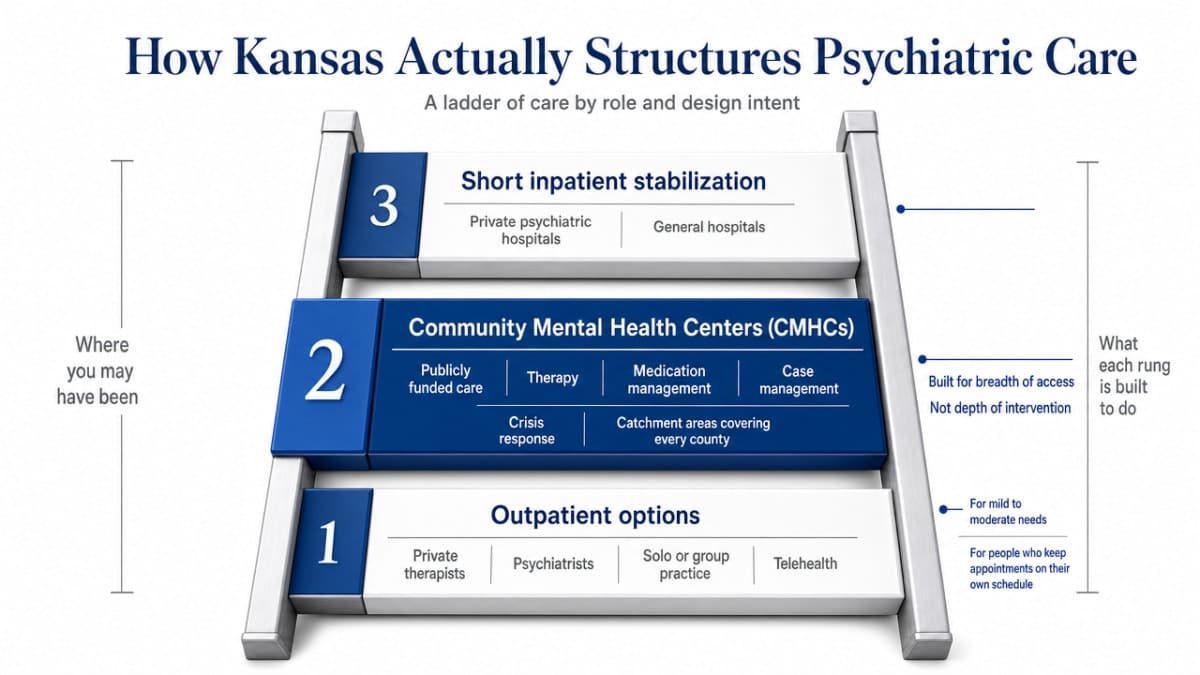
Kansas psychiatric care is best understood as a ladder, and each rung was designed for a specific job. Knowing what each rung is built to do helps you see, honestly, where you have already been and why it may not have held.
At the bottom are outpatient options: private therapists, psychiatrists in solo or group practice, and telehealth. These work well for mild to moderate presentations and for people who can keep appointments on their own schedule.
Next come Community Mental Health Centers (CMHCs), the backbone of publicly funded care in Kansas. CMHCs offer therapy, medication management, case management, and crisis response across catchment areas covering every county. They are designed for breadth of access, not depth of intervention.
Above outpatient sits short inpatient stabilization at private psychiatric hospitals and general hospital psych units. These stays are typically measured in days. The job is to keep someone safe, adjust medications, and hand them back to outpatient providers.
For children and adolescents whose needs cannot be safely met in the community, Kansas licenses Psychiatric Residential Treatment Facilities (PRTFs). KDADS describes PRTFs as out-of-home residential psychiatric programs serving youth with mental health diagnoses, substance use, and co-occurring conditions 6.
Above PRTFs, and often confused with them, are Residential Care Facilities (RCFs). KDADS is explicit here: RCFs are housing and support programs, not treatment facilities. Residents who need mental health treatment get it from a CMHC or a private provider 7.
Beyond that rung, Kansas points families outward — to specialized, longer-term programs in other states.
Why the System Caps Out at Stabilization
Notice what the ladder is optimized for: getting someone safe, then getting them home. That is not a criticism of the clinicians. It is the design.
Kansas care is licensed, funded, and measured around community reintegration. KDADS sets the standards for and licenses every provider serving people with mental illness, and no facility can operate without a KDADS-issued license 11. That framework produces consistency and safety across the state. It also standardizes what a psychiatric bed, a CMHC service, or a residential program is expected to accomplish — and standardization tends to draw a ceiling.
Short inpatient stays exist to resolve a crisis, not to rebuild a life. CMHCs are staffed to see hundreds of clients across a catchment, not to run intensive daily treatment teams around one complex case. PRTFs offer real residential structure, but they operate within state-defined service standards and expected lengths of stay that do not always match a family’s need for longer, highly individualized psychiatric rehabilitation for treatment-resistant illness 6. RCFs, by explicit design, are not treatment at all 7.
None of that is wrong for the population most of these rungs were built to serve. Most people who touch the Kansas system are helped by it and go home better. But if your loved one has cycled through several of these rungs and each one has stabilized without resolving, you are not encountering a gap in your effort. You are encountering the ceiling of a stabilization model applied to a case that needs something more sustained.
The Rising Severity the System Was Not Designed to Absorb
The demand pressure on that stabilization ceiling has been climbing. SAMHSA’s Behavioral Health Barometer for Kansas shows past-year major depressive episodes among youth aged 12–17 reaching 15.3% — about 35,000 young people — during 2016–2019, and serious mental illness among young adults 18–25 reaching 10.5%, roughly 34,000 people, during 2017–2019, higher than the national average 9.
Those are not abstract numbers. They describe more kids and young adults arriving at CMHC intake with more severe presentations, more suicidal ideation, more co-occurring substance use, and more complexity than the same doors were built to hold. When more people need more, and the levels of care above outpatient stay structured around brief stays and community handoff, the math starts to strain.
You may have felt that strain personally. Long waits for a PRTF bed. A five-day inpatient stay that ended before medications had a chance to settle. A CMHC therapist who cares deeply and carries a caseload that does not allow the kind of frequency your loved one actually needs.
If your family has been running into that strain, you have been reading the system correctly. The state is doing what it was built to do, at a moment when a growing subset of patients needs something the design does not produce.
Reading Your Own Family’s History as Data
What Repeated Short Admissions Are Actually Telling You
Pull up the calendar in your head. Count the admissions. Two in the last year? Four in the last two? Add the ER visits that did not turn into admissions. Add the medication changes. Add the therapist your loved one saw for six weeks before the next crisis reset everything.
That timeline is not a record of failure. It is data.
Here is what a pattern of repeated short admissions typically means. Each stay accomplished exactly what it was designed to accomplish — safety, an acute medication adjustment, a discharge plan handed to an outpatient team. And each discharge returned your loved one to a level of care that could not sustain what the inpatient stay started. The gap between what stabilization can produce and what recovery requires is where the cycle lives.
You may have heard some version of “they were doing well when they left.” That is often true. Five days of structure, sleep, supervised medication, and no substances will look like improvement in almost anyone. The harder question is what happens on day fourteen, day thirty, day ninety, when the medication has fully taken effect or clearly has not, when co-occurring substance use resurfaces, when trauma symptoms that were quiet in a locked unit come back into a house with its own history.
Treatment-Resistant Illness and Dual Diagnosis: Naming What You May Be Facing
Sometimes the honest next step is putting a name to what has been happening. Two names matter here, because they change what kind of care actually fits.
The first is treatment-resistant illness. In schizophrenia, the clinical literature is direct about the scope of the problem: roughly 30% of patients with schizophrenia do not respond adequately to standard antipsychotic treatment, and this group is associated with high rates of hospitalization, functional impairment, and comorbid substance use 2. That figure is specific to schizophrenia, not to every psychiatric diagnosis, and it matters because it reframes what your family may have been living through. If your loved one has cycled through two or three antipsychotics without meaningful response, you are not watching a failure of effort. You are watching a well-described clinical pattern that calls for specialized strategies — clozapine protocols, structured psychosocial rehabilitation, and integrated care sustained long enough to actually work 2. Similar patterns of partial or non-response exist in bipolar disorder and treatment-resistant depression, each with their own definitions and pathways.
The second name is dual diagnosis: a psychiatric condition and a substance use disorder happening in the same person, at the same time, shaping each other. This is not one problem plus another problem. It is one problem that presents as two, and it responds poorly when the two halves are treated in separate buildings by separate teams on separate schedules 4.
If either of these names fits your loved one, the implication is the same. Standard sequential care — a hospital stay, then outpatient therapy, then a substance use program, then back to a psychiatrist — is running the wrong play. The play that has evidence behind it is integrated, individualized, and long enough for medication strategy, therapy, and stabilization of substance use to happen together rather than in relay.
Naming the problem does not make it heavier. It makes it addressable.
A Comparison Framework for Deciding What Comes Next
Five Variables That Actually Predict Outcomes
When you start comparing programs, marketing pages all start to sound the same. Every facility is compassionate. Every team is expert. That vocabulary will not help you decide anything. What will help is looking at five specific variables that actually move outcomes for complex cases, and asking each program you consider — including the ones you have already used — to answer plainly.
- Duration.
- How long does the program treat a patient like your loved one, and who decides when treatment ends? The residential outcomes literature is direct: treatment duration and individualized care plans are key determinants of success 3. A four-week ceiling on a treatment-resistant case is not individualization.
- Integration.
- Are psychiatry and therapy on the same team, meeting about the same patient, in the same building? Or are they separate providers who exchange notes when they can? For dual diagnosis in particular, integration is the variable with the strongest evidence base 1.
- Medication complexity.
- Is the program equipped to run advanced protocols — clozapine titration and monitoring for treatment-resistant schizophrenia, complex mood stabilizer combinations, medication-assisted treatment for opioid use disorder — or does it default to standard first- and second-line agents 2?
- Family involvement.
- Is your family part of the treatment plan, with structured family sessions and real communication, or are you the emergency contact who gets called at discharge?
- Aftercare.
- What happens on day one after discharge? Does the program build a step-down plan with specific providers, or hand you a printed list?
Score each program you have used against those five. The pattern that emerges is usually more honest than any brochure.

Insurance-Timeline Length of Stay vs. Clinically-Determined Length of Stay
There is a quiet difference underneath every psychiatric admission that shapes what the stay can accomplish. Some programs discharge when the insurance authorization runs out. Others discharge when the clinical team, the patient, and the family agree the work is done. Those are not the same program.
Insurance-timeline stays are built around utilization review. Every few days, a reviewer decides whether the patient still meets criteria for that level of care. The clinical team writes to those criteria. When acute risk drops, coverage typically ends, even if the underlying illness is nowhere near stable. That is why a five-day stay can produce a calmer patient without producing a durable change.
Clinically-determined length of stay works from the other direction. The team asks how long this specific case, with this specific diagnosis, medication history, and substance use pattern, actually needs — and builds a plan around that answer. For treatment-resistant presentations, the residential outcomes evidence suggests duration and individualization are what change trajectories, not brevity 3.
The hidden cost of repeated short admissions is not just financial. It is the wear on your family, the erosion of your loved one’s belief that treatment can work, and the loss of continuity every time a new team starts from scratch. If you have paid that cost three or four times already, a longer stay that is actually long enough is not extravagant. It is arithmetic.
Integrated Care for Dual Diagnosis: Why Parallel and Sequential Fall Short
If substance use is part of your loved one’s picture, the way care is organized matters as much as who delivers it.
Two organizing patterns dominate the American system. In parallel care, the patient sees a psychiatrist for the mental illness and a separate substance use program for the addiction, often in different buildings with different records and different rules. In sequential care, one is treated first and the other is treated after — usually the addiction has to be under control before the psychiatric program will fully engage, or the psychiatric side has to stabilize before the substance use program will admit. Both patterns treat the two conditions as if they were separate problems living in the same body.
They are not separate problems. Depression drives the drinking. The drinking deepens the depression. Untreated psychosis makes substance use feel like the only way to sleep. Every relapse resets the psychiatric progress. Every psychiatric decompensation resets the sobriety. Drake and colleagues found that integrated treatment — where the same team addresses both conditions at the same time, in the same setting, over a sustained period — outperforms non-integrated approaches on both substance use and psychiatric outcomes 1.
Integration is harder to build than to describe. It requires clinicians cross-trained in both worlds, a treatment plan that does not split the person in half, and enough time in one program for both threads to move together. When you evaluate what comes next, ask directly: are these two conditions treated by one team, or by two teams that share a fax number?
Honest Criteria for Considering Out-of-State, Longer-Term Care
Leaving Kansas for care is not a small decision. It costs money you may not have. It means fewer weekend visits. It means trusting a team you cannot drop in on. So the question deserves honest criteria, not marketing.
Here is a plain checklist. If most of these describe your family, out-of-state longer-term care is a reasonable next conversation — not a last resort, not a betrayal of the local clinicians who have tried.
- Your loved one has had two or more inpatient stays in the last eighteen months that stabilized the crisis without changing the trajectory.
- They have tried two or more medications in the same class (for example, two antipsychotics or two mood stabilizers) without sustained response, a pattern the treatment-resistance literature associates with the need for specialized strategies like clozapine and structured psychosocial care 2.
- A substance use disorder and a psychiatric disorder are both active, and they have been treated in separate programs or in sequence rather than together by one integrated team 1.
- A PRTF or short residential stay ended on a schedule that did not match your clinical read of where your loved one actually was 6.
- You have been offered an RCF placement and understood, correctly, that supportive housing is not treatment 7.
- The residential outcomes evidence points to duration and individualization as key drivers of success, and no local program you have used has offered a length of stay set by clinical progress rather than authorization 3.
If you recognize your family in three or more of those, you are not being dramatic. You are being accurate. The next step is comparing what a longer-term, integrated, out-of-state model actually offers against what you have already lived through — with the same five variables from the last section as your scorecard.
What a Longer-Term Integrated Model Looks Like in Practice
So what does the alternative actually look like on a Tuesday afternoon, when your loved one is in the program and you are back home in Wichita or Topeka trying to picture it?
A longer-term integrated model, at its most basic, means one team and enough time. The psychiatrist who manages medications sits at the same table as the therapist running trauma work and the clinician tracking substance use. They talk about your loved one by name, not by chart number, and they adjust the plan together rather than in separate lanes. For dual diagnosis, that shared-table structure is the variable with the strongest evidence behind it 1.
Enough time means the length of stay is set by clinical progress, not by an authorization clock. For treatment-resistant schizophrenia, that often includes a clozapine trial with the weeks of titration and blood monitoring the protocol actually requires 2. For a young adult with rapid-cycling bipolar disorder and alcohol use, it means both threads move together — the mood stabilizer combination gets time to settle while the drinking is addressed by the same team, not queued for a separate program after discharge 4.
ViewPoint Dual Recovery in Prescott, Arizona is one example of this model: individualized treatment duration, integrated psychiatry-and-therapy team, clozapine-capable, dual-diagnosis integrated, with structured family involvement. There are others. The point is not the address. The point is comparing what this shape of care offers against the five variables — duration, integration, medication complexity, family involvement, aftercare — and against what your family has already lived through in Kansas. If the comparison changes what feels possible, that is worth a phone call.
See if a new path is possible today
Get expert feedback on next-step care options for complex or treatment-resistant psychiatric needs.
Frequently Asked Questions
How do we know when Kansas options have actually been exhausted?
Look for a pattern, not a single event. Two or more inpatient stays in eighteen months that stabilized without changing the trajectory, two medications in the same class without sustained response, and a substance use disorder still active alongside the psychiatric one are strong signals 2. If duration and integration have never been part of the plan, you have not run out of options — you have run out of the ones Kansas is built to offer.
What is the difference between a PRTF and a Residential Care Facility in Kansas?
A PRTF is an out-of-home residential psychiatric treatment program for children and adolescents whose needs cannot be safely met in the community 6. A Residential Care Facility is housing and support for adults with mental illness — KDADS states plainly that RCFs are not treatment facilities, and residents get their mental health care from a CMHC or private provider 7. One is treatment. The other is a place to live while receiving treatment elsewhere.
Why do short inpatient stays keep failing for our loved one?
Short stays are designed to resolve an acute crisis, adjust medications, and hand care back to outpatient providers. That is the job. For treatment-resistant illness, the intervention length is shorter than the illness needs, and the residential outcomes literature identifies duration and individualized care plans as key determinants of success 3. Your loved one is not failing the stays. The stays are not built to produce the change you are hoping for.
What does integrated care for dual diagnosis actually mean?
It means one team treating the psychiatric condition and the substance use disorder at the same time, in the same setting, with a shared plan. Not a psychiatrist in one building and a substance use program in another exchanging faxes. Drake and colleagues found integrated treatment outperforms parallel or sequential approaches on both substance use and psychiatric outcomes when sustained over time 1. Ask directly: is this one team, or two teams sharing a fax number?
Is traveling out of state for longer-term psychiatric care reasonable?
Yes, when the pattern justifies it. Repeated short admissions without lasting change, treatment-resistant medication history, active dual diagnosis treated in separate programs, and no local option offering clinically-determined length of stay are the signals 4. Distance is a real cost, and so is another cycle through a stabilization model that has not held. Weigh the two honestly against the five variables — duration, integration, medication complexity, family involvement, aftercare — before deciding.
What should we ask when comparing a longer-term residential program to what we’ve already tried?
Ask who sets the length of stay — the clinical team or the insurance authorization. Ask whether psychiatry and therapy sit at the same table for your loved one’s case. Ask whether the program runs advanced protocols like clozapine when indicated 2. Ask how family sessions are structured, not whether they exist. Ask what day one after discharge looks like, with named providers. Vague answers to specific questions are their own answer.
References
- Integrated Treatment for Co-Occurring Disorders: Evidence-Based Practices (Drake et al.). https://www.ncbi.nlm.nih.gov/pmc/articles/PMC5561726/
- Treatment-Resistant Schizophrenia: Review and Clinical Implications (Correll & Schooler). https://www.ncbi.nlm.nih.gov/pmc/articles/PMC6518709/
- Residential treatment for children and adolescents with severe mental illness: review of outcomes. https://www.ncbi.nlm.nih.gov/pmc/articles/PMC5768284/
- Integrated treatment for co-occurring mental health and substance use disorders: evidence and implications. https://www.ncbi.nlm.nih.gov/pmc/articles/PMC3862496/
- Treatment-resistant schizophrenia: challenges and future directions. https://www.ncbi.nlm.nih.gov/pmc/articles/PMC6213896/
- Psychiatric Residential Treatment Facilities. https://www.kdads.ks.gov/services-programs/behavioral-health/psychiatric-residential-treatment-facilities
- Residential Care Facilities | Department for Aging and Disability Services. https://www.kdads.ks.gov/services-programs/behavioral-health/residential-care-facilities
- Behavioral Health Barometer: Kansas, Volume 5. https://www.samhsa.gov/data/sites/default/files/cbhsq-reports/Kansas-BH-BarometerVolume5.pdf
- Behavioral Health Barometer: Kansas, Volume 6. https://www.samhsa.gov/data/sites/default/files/reports/rpt32833/Kansas-BH-Barometer_Volume6.pdf
- Behavioral Health Barometer: Kansas, Volume 4. https://www.samhsa.gov/data/sites/default/files/Kansas_BHBarometer_Volume_4.pdf
- KDADS Statutes Update; Prohibition on State Hospital Outsourcing or Privatization; Other Provisions. https://www.kslegislature.gov/li_2016/b2015_16/measures/documents/summary_sb_449_2016.pdf