Key Takeaways
- NYSHIP’s Empire Plan covers inpatient psychiatric care, crisis intervention, outpatient therapy, IOP, and tele-behavioral health as unlimited when medically necessary, with New York parity law and Timothy’s Law setting a statutory floor beneath those benefits 3, 13.
- Calling the Mental Health and Substance Use program before any inpatient admission is what triggers paid-in-full status, and freestanding psychiatric hospitals carry a 190-day lifetime limit while general hospital psychiatric units have none 1, 2.
- Empire Plan benefits follow retirees to out-of-state specialty facilities when medical necessity is documented, and after 65 Medicare pays first with Empire Plan wrapping around as secondary coverage 1, 4.
- Fail-first denials, shorter authorization windows, and higher MH/SUD cost-sharing are parity red flags that can be reported to DFS, DOH, or the Attorney General’s Health Care Bureau 7, 8.
What NYSHIP Actually Covers When Local Care Isn’t Working
If you’re a New York State retiree — or you’re the adult child reading this because a parent or your own grown child is struggling — you’ve probably hit a wall with local outpatient care. Medications aren’t holding. The depression keeps circling back. A bipolar episode won’t settle. Maybe substance use is tangled up with a psychiatric diagnosis, and no single program seems to handle both. You are exactly the person NYSHIP’s mental health benefits were designed to reach, even if it doesn’t feel that way yet.
Here’s the honest picture: your Empire Plan coverage is stronger than most families assume. The Mental Health and Substance Use (MHSU) program built into the Empire Plan covers inpatient care, crisis intervention, outpatient therapy, intensive outpatient programs, and tele-behavioral health — and network benefits are described as “unlimited when medically necessary” once you follow the plan’s call-first rule 3. That phrase matters for treatment-resistant cases, because it means duration is a clinical question, not just a calendar one.
New York layers additional protection on top. State law requires MH/SUD coverage to be consistent with the federal parity act, and the Department of Financial Services has spent years tightening those rules 11. Timothy’s Law sets a statutory floor your plan cannot drop below 13.
You’ve already done the hardest part by starting to look. The next sections walk through the specific mechanics — copays, the pre-call rule, Medicare coordination, and how to reach an out-of-state specialty facility when local care hasn’t worked.
Your Empire Plan Mental Health and Substance Use Benefits, Line by Line
The Pre-Call Rule That Changes Everything
If you remember one thing from this whole article, make it this: before any inpatient psychiatric admission, someone needs to call the Empire Plan’s Mental Health and Substance Use (MHSU) program. That single phone call is what turns inpatient services into paid-in-full care under your retiree benefits 1. Skip it, and you can be looking at a much larger bill for care that would have otherwise been covered.
You don’t have to make the call in a specific voice. A spouse, an adult child, or the admitting facility can dial the MHSU number on the back of the Empire Plan card. What matters is that the call happens before the admission when possible, or as soon as reasonably possible in a true emergency. The MHSU program then opens a medical necessity review, which is the mechanism that authorizes the level of care your loved one actually needs — inpatient, residential, intensive outpatient, or something else.
Crisis Intervention, Outpatient Therapy, and IOP Copays for Retirees
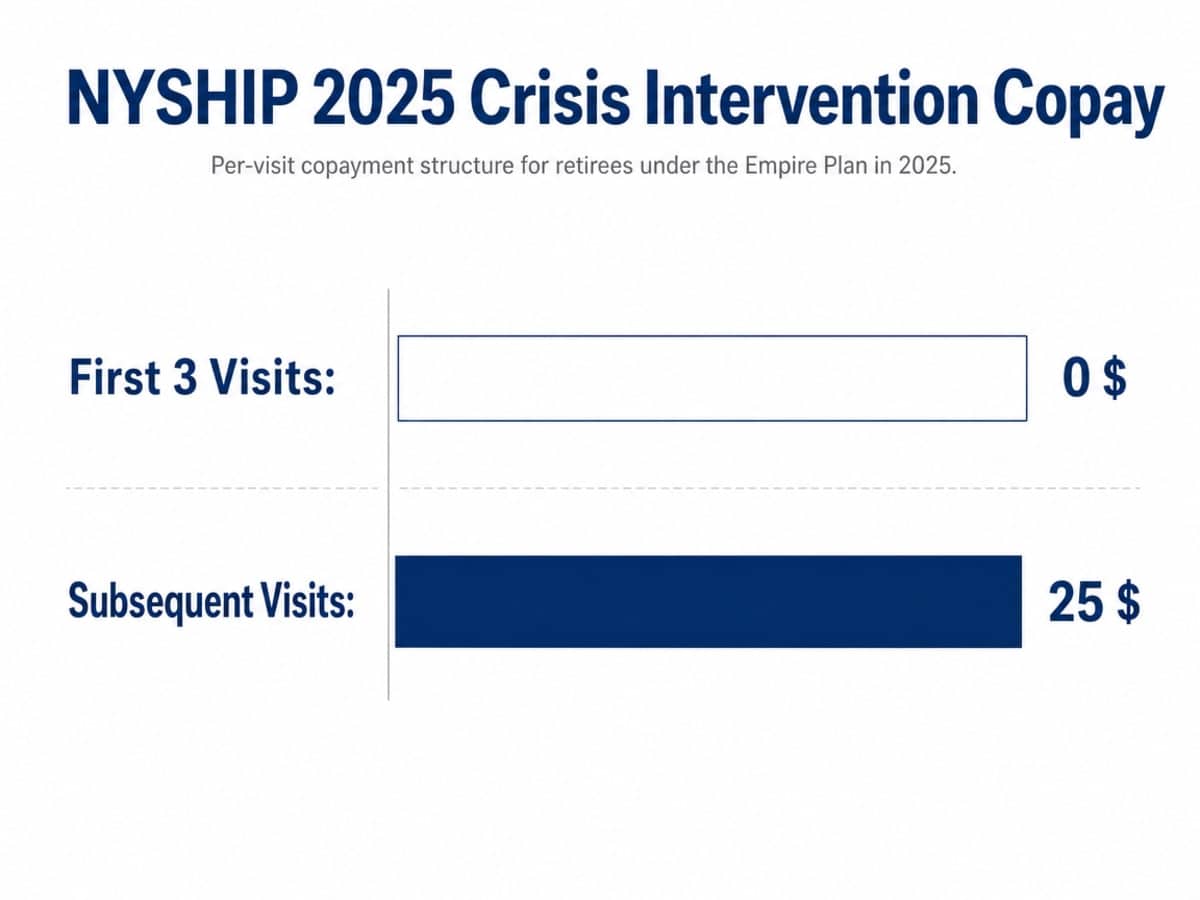
Crisis intervention under the Empire Plan is built for exactly the moment you’re probably in right now. When network MHSU providers handle a crisis, the first three visits per crisis are paid in full — $0 out of pocket. Starting with the fourth visit, a $25 copay per visit applies for the rest of that crisis episode 1. That’s a meaningful structure for a retiree family: the plan front-loads access so cost doesn’t stop you from calling for help early.
Here’s how that copay curve looks in practice:
| Crisis Intervention Visit (per crisis) | Your Copay (Empire Plan Retiree, 2025) |
|---|---|
| Visit 1 | $0 |
| Visit 2 | $0 |
| Visit 3 | $0 |
| Visit 4 | $25 |
| Visit 5 and beyond | $25 per visit |
Outside of crisis visits, standard outpatient mental health and substance use therapy sits inside the MHSU program’s network benefits, which prior NYSHIP guides describe as “unlimited when medically necessary” once program requirements are met 3. In plain terms: your plan is not counting therapy sessions against a hard annual cap when a network clinician says the treatment is needed. That matters for treatment-resistant depression, rapid-cycling bipolar disorder, and dual diagnosis, where progress is measured in months, not weeks.
Intensive outpatient programs (IOP) — the step between weekly therapy and inpatient — carry their own per-day copay under the Empire Plan’s IOP benefit for mental health or substance use treatment 2. If your parent or your adult child needs more structure than a weekly appointment but doesn’t need a hospital bed, IOP is often where that middle ground lives. Ask the MHSU program to confirm the current per-day amount for your specific coverage year before admission, so you know the daily number before it starts.
Inpatient Psychiatric Care: The 190-Day Number Every Family Should Know
This is the piece that trips up almost every retiree family, so read it slowly. Under NYSHIP’s Empire Plan, inpatient psychiatric care in a freestanding psychiatric hospital is covered up to a 190-day lifetime limit. Inpatient psychiatric care in a general hospital’s psychiatric unit has no lifetime limit 2. Same illness, same diagnosis, same person — different day count depending on the type of facility.
That distinction shapes real decisions. For a first hospitalization or a shorter stabilization, a psychiatric hospital may be the right clinical setting, and the 190-day pool is more than enough. For someone with a long history of treatment-resistant illness who has already used significant psychiatric-hospital days over decades, that lifetime pool may be smaller than you assume. Before an admission to a freestanding psychiatric hospital, it’s worth asking the MHSU program how many of those 190 days have already been used across a lifetime of care. You want that number in your notes.
Residential and specialty psychiatric programs — including out-of-state facilities that treat treatment-resistant and dual-diagnosis cases — are reviewed under the same medical necessity framework you triggered with the pre-call 1. The MHSU reviewer decides the level of care, and coverage terms follow the facility category the program falls into. When you call ViewPoint’s admissions team, or any specialty facility, ask them directly how they’re categorized for NYSHIP purposes so you can match that against your day counts and copay structure with confidence.
How Medicare and Empire Plan Work Together After 65
Once you turn 65, the mechanics of your coverage shift in a way that catches almost every retiree family off guard. Medicare becomes primary, and your Empire Plan coverage moves into a secondary role, wrapping around whatever Medicare pays. That two-layer structure is actually good news for psychiatric care — it usually means less out-of-pocket cost, not more — but it changes who you call, in what order, and what paperwork the facility needs.
For a specialty psychiatric admission, Medicare Part A generally covers inpatient hospital psychiatric care, and Part B covers outpatient behavioral health services. Empire Plan then picks up coordinated cost-sharing behind Medicare according to the retiree plan rules published each year in the CHOICES booklet 1. The Empire Plan Health Insurance Certificate is the official document that spells out how that coordination works for your specific benefit year, and it’s worth pulling directly from the state’s site so you have the current version in hand 4.
Here’s the sequence that tends to trip people up. Even when Medicare is primary, the Empire Plan Mental Health and Substance Use (MHSU) pre-call still matters for the secondary benefit to attach cleanly. Make the MHSU call, get the reference number, and give both your Medicare card and your Empire Plan card to the facility’s admissions team. They will bill Medicare first, then submit the balance to Empire Plan.
One more piece worth naming: Medicare has its own rules about freestanding psychiatric hospitals versus general hospital psychiatric units, and those rules interact with the NYSHIP day counts described earlier. If your parent has been hospitalized psychiatrically before, ask the admissions team to check both Medicare’s lifetime psychiatric-hospital day balance and any prior NYSHIP usage. Two numbers, one phone call, no surprises later.
If you’re helping a retiree under 65 who isn’t yet on Medicare, the Empire Plan MHSU program is your primary contact and the mechanics from the earlier sections apply directly. If you’re helping someone over 65, you’re simply adding Medicare as the first stop in a two-stop process. That’s it. You’ve got this.
Parity Law Is a Tool You Own
Timothy’s Law and the Floor Your Plan Cannot Go Below
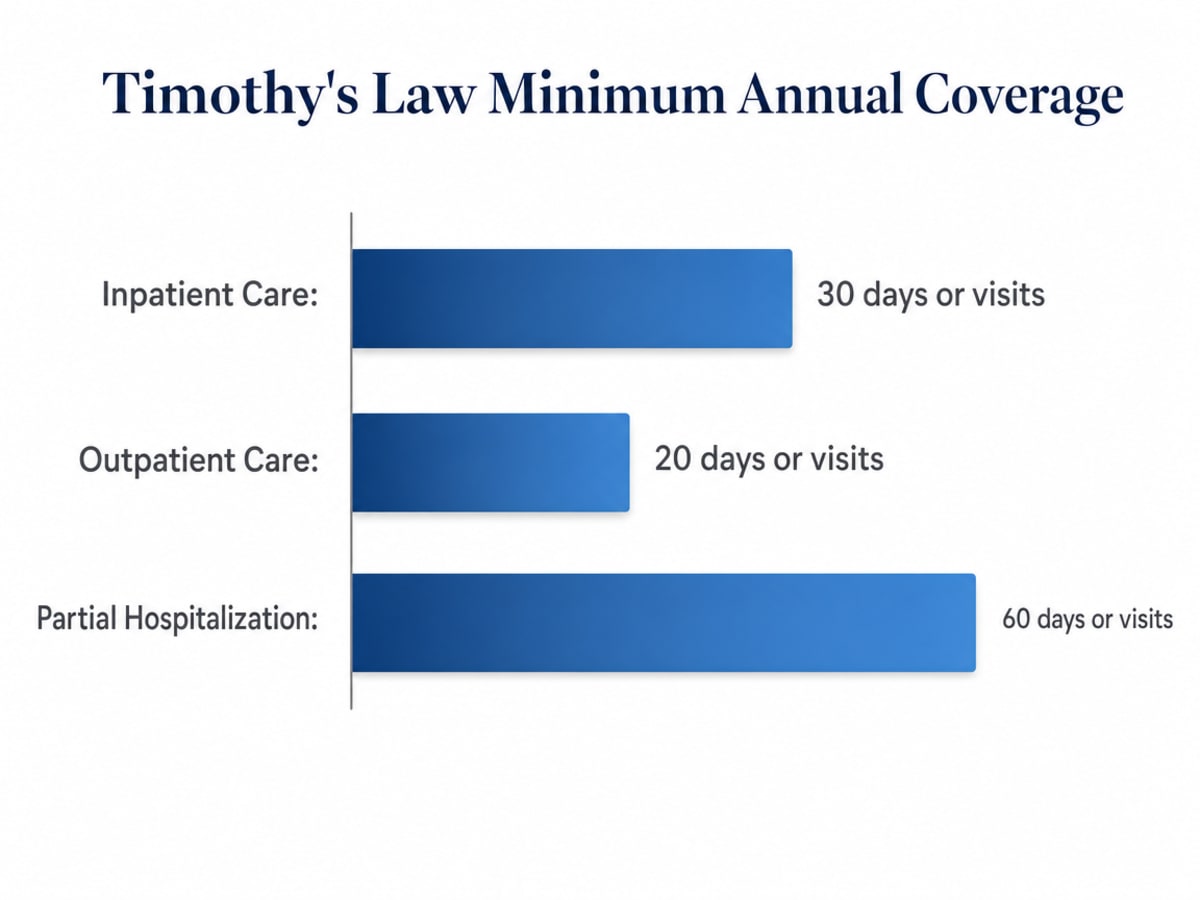
When a denial letter shows up in the mail, it can feel like the plan holds all the cards. It doesn’t. New York’s Timothy’s Law sets a statutory floor for mental health coverage in group health plans, and the New York Attorney General’s parity report spells the numbers out plainly. Every year, your plan must cover at least 30 inpatient days, 20 outpatient visits, and 60 partial hospitalization visits for mental health treatment 13. That’s the minimum. Your Empire Plan retiree benefits sit well above that floor for medically necessary care, but the law itself is the safety net underneath everything else.
| Timothy’s Law Minimum Annual Coverage | Amount |
|---|---|
| Inpatient mental health care | 30 days |
| Outpatient mental health visits | 20 visits |
| Partial hospitalization visits | 60 visits |
Timothy’s Law also requires that mental health coverage be “broad-based” and “at least equal to the coverage provided for other health conditions” 13. Read that phrase twice. It means your plan cannot quietly attach stricter limits to psychiatric care than it applies to a cardiac admission or a knee replacement. If a reviewer tells you your loved one has “used up” mental health benefits at a number lower than these statutory minimums, or if the plan treats a psychiatric hospitalization differently from a comparable medical one, that’s a legal problem, not just a customer service problem. Keep the letter. You’ll want it.
Fail-First Denials and Other Red Flags for Treatment-Resistant Cases
If you’re reading this article, chances are your loved one has already tried the “lower level of care.” Weekly therapy. Two or three medication trials. Maybe an IOP that didn’t hold. So when a plan reviewer says the family needs to try one more round of outpatient before inpatient or residential care will be approved, something is off — and New York’s Office of Mental Health says so directly. The state’s parity red flag resource is unambiguous: plans are “forbidden to require you to ‘fail first’ a lower level of care before they cover treatment recommended by your doctor or therapist, such as inpatient hospitalization” 7. That’s the rule. If you hear a version of “we need to see her try outpatient again first,” you’re looking at a red flag.
There are others:
- A plan that imposes shorter authorization windows for psychiatric admissions than for medical ones.
- A reviewer who insists on daily concurrent review for a psychiatric inpatient stay in a way the plan wouldn’t do for a comparable medical hospitalization.
- A copay or coinsurance structure for MH/SUD that runs higher than the predominant medical cost-sharing.
Under New York Insurance Law and MHPAEA, coverage for mental health and substance use disorders must be consistent with parity requirements 11, and 2020 DFS regulations explicitly require insurers to run parity compliance programs that “identify discrepancies in coverage” and remediate improper practices 14.
Write down what the reviewer says. Ask for the medical necessity criteria in writing. Ask which comparable medical/surgical benefit the plan is using as its parity benchmark. Those three requests, calmly made, change the tone of the conversation immediately.
Where to File a Complaint: DFS, DOH, and the AG’s Health Care Bureau
If a denial doesn’t get resolved on the phone, you have three doors you can knock on, and you don’t have to pick just one. The New York Office of Mental Health is explicit that the state “is overseeing and enforcing parity laws to ensure MH/SUD services are accessible to the people who need them, when they need them,” and it lists multiple complaint channels for exactly this situation 8.
- The Department of Financial Services regulates commercial insurers and NYSHIP-adjacent plan mechanics, and it maintains formal reporting and enforcement infrastructure for MH/SUD parity issues 12.
- The Department of Health handles managed care and public-program complaints.
- The Attorney General’s Health Care Bureau investigates coverage disparities and has a documented track record of enforcement actions against noncompliant plans 13.
Before you file, gather three things: the denial letter, your notes from the pre-call and any concurrent review conversations (names, dates, reference numbers), and the clinician’s written recommendation for the level of care. That packet is enough to open a complaint. You are not being difficult by using these channels. You are using the system the way New York built it to be used.
Reaching an Out-of-State Specialty Facility Through Empire Plan Benefits
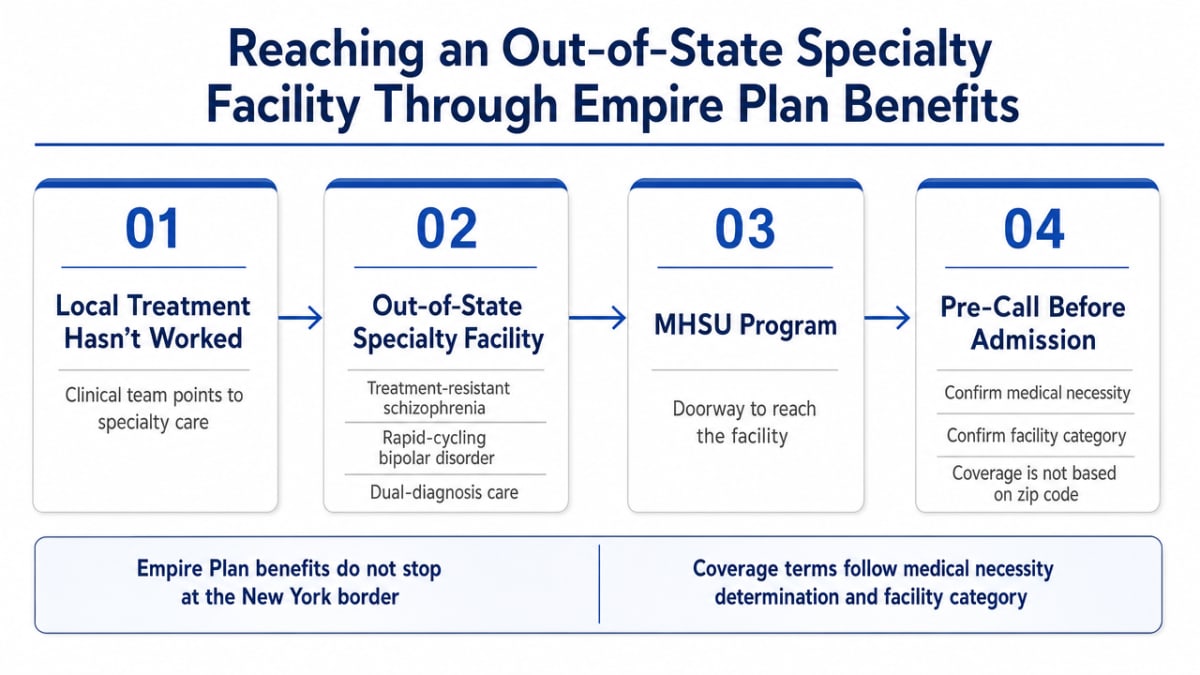
Here’s something a lot of retiree families don’t realize until they start asking: your Empire Plan benefits don’t stop at the New York border. When local treatment hasn’t worked and the clinical team is pointing toward a specialty facility in another state — a program that handles treatment-resistant schizophrenia, rapid-cycling bipolar disorder, or a dual-diagnosis case that needs psychiatric and substance use care under one roof — the MHSU program is the door you walk through to reach it.
The mechanics are the same ones you’ve already read about in earlier sections, just applied to a facility that happens to be outside New York. Coverage terms follow the plan’s medical necessity determination and the type of facility category, not the zip code. That’s why the pre-call matters so much for an out-of-state admission: it’s the trigger that pulls the specialty program into your covered benefits 1.
Here’s the sequence to run, in order, on the day you make the call:
- Call the Empire Plan MHSU program before admission. Use the number on the back of the Empire Plan card. This is what triggers paid-in-full inpatient status under the retiree plan 1.
- Request the medical necessity review. Give the reviewer the clinician’s recommendation, the diagnosis, the treatment history, and the name and location of the proposed facility. Ask for the reference number in writing.
- Coordinate with Medicare if the retiree is 65 or older. Confirm that the facility will bill Medicare first and Empire Plan as secondary, and make sure both cards are on file with admissions.
- Share the authorization details with the facility’s admissions team. Give them the MHSU reference number, the reviewer’s name, the authorized level of care, and the date range. That handoff is what lets admissions confirm the coverage picture before your loved one arrives.
A word about the Arizona question specifically, since it comes up often. A specialty facility like ViewPoint Dual Recovery in Prescott sits outside your local network by definition — it’s an out-of-state program that treats the kinds of complex cases that don’t fit into standard outpatient care. That doesn’t mean it’s off the table. It means the medical necessity review is doing the heavy lifting, and your job is to give the MHSU program a clean, well-documented picture of why local care hasn’t been enough. Pull the Empire Plan Health Insurance Certificate from the state’s Civil Service site so you have the current benefit-year language in your hand while you make the calls 4. One phone call moves the whole process forward. You’re closer than you think.
Questions to Bring to the Admissions Call
By the time you’re ready to call a specialty facility’s admissions team, you’ve been carrying a lot. A short list of questions in front of you makes the call shorter and the answers cleaner. Here’s what to have on the page:
- How is your facility categorized for NYSHIP purposes — freestanding psychiatric hospital, general hospital psychiatric unit, residential, or specialty behavioral health program? The answer determines whether the 190-day lifetime limit applies to a stay there 2.
- Have you worked with Empire Plan retirees and the MHSU program before? Ask how they typically handle the pre-call and medical necessity review process 1.
- If the retiree is 65 or older, will you bill Medicare primary and Empire Plan secondary? Confirm both cards will be on file before admission.
- What clinical information do you need from the current treating team — medication history, prior hospitalizations, therapy notes, diagnoses — to support the medical necessity review?
- What is your admissions timeline from first call to arrival, and how do you coordinate travel from New York?
- How do you handle dual-diagnosis cases where psychiatric and substance use treatment need to happen under one roof?
- What happens if the initial authorization runs shorter than the clinical team recommends? Ask how they support continued-stay reviews.
Bring the Empire Plan card, the Medicare card if applicable, and the clinician’s written recommendation. One organized call gets you a real answer.
If You’re the Adult Child Making This Call for a Parent
You may be reading this on your lunch break, or at 11 p.m. after your parent went to bed, trying to figure out what to do next. Maybe your mother’s depression has gotten worse since your father died. Maybe your father’s drinking has come back on top of a bipolar diagnosis he’s carried for forty years. Whatever brought you here, the fact that you’re the one reading a NYSHIP article at all means you’ve already stepped up in a real way.
You can make the Empire Plan MHSU call on your parent’s behalf. You can be on the line during the medical necessity review. You can talk to admissions at an out-of-state facility. What you may need first is a simple verbal consent from your parent that you’re allowed to discuss their benefits and care, and in some cases a signed authorization the facility or plan will send you. Keep a folder — physical or digital — with the Empire Plan card, the Medicare card if your parent is 65 or older, the current medication list, prior hospitalization dates, and the name of the treating psychiatrist or therapist. When the reviewer asks a question, you’ll have the answer in front of you instead of on the tip of your tongue.
One more thing worth naming: your parent may resist help, or feel embarrassed, or insist things aren’t that bad. That’s part of the illness talking, not a verdict on your judgment. Pull the Empire Plan Health Insurance Certificate from the Civil Service site so you have the official benefit language in hand 4, make the MHSU call 1, and keep moving one step at a time. You don’t have to solve everything today. You just have to make the next call.
Start Your Psychiatric Care Eligibility Assessment Now
Find out if specialized treatment is a fit for your unique needs as a New York state retiree.
Frequently Asked Questions
Does NYSHIP cover psychiatric treatment at an out-of-state facility like ViewPoint in Arizona?
Your Empire Plan benefits follow you outside New York when the care meets medical necessity criteria. Coverage terms depend on the facility category and the outcome of the Mental Health and Substance Use (MHSU) program’s review, not on the state where the program sits 1. Call the MHSU number on your card before admission, ask for the medical necessity review, and then share the reference number and authorized level of care with the facility’s admissions team.
What happens if I don’t call the Empire Plan Mental Health/Substance Use program before an inpatient admission?
The pre-call is what triggers paid-in-full inpatient status under the Empire Plan retiree benefit 1. Skip it, and the same admission can shift to a reduced benefit level with meaningfully higher out-of-pocket cost. In a true emergency, call as soon as reasonably possible — a spouse, adult child, or the facility itself can make the call. Get the reference number, the reviewer’s name, and the date and time in writing.
How does Medicare coordinate with Empire Plan benefits for a retiree over 65 who needs psychiatric care?
After 65, Medicare pays first and Empire Plan wraps around it as secondary. The facility bills Medicare, then submits the balance to Empire Plan under the coordination rules published in the annual retiree guide 1. Even so, make the MHSU pre-call so the secondary benefit attaches cleanly. Give admissions both cards. For the exact coordination language for your benefit year, pull the Empire Plan Health Insurance Certificate from the Civil Service site 4.
What can I do if my plan denies coverage because my parent hasn’t tried enough outpatient treatment first?
That’s a fail-first denial, and New York’s Office of Mental Health says plans are “forbidden to require you to ‘fail first’ a lower level of care” before covering clinician-recommended treatment such as inpatient hospitalization 7. Ask for the medical necessity criteria in writing and the medical/surgical benefit the plan is using as its parity benchmark. If it doesn’t resolve on the phone, file a complaint with DFS, DOH, or the Attorney General’s Health Care Bureau 8.
What’s the difference between the 190-day psychiatric hospital limit and general hospital psychiatric unit coverage?
The Empire Plan covers inpatient psychiatric care in a freestanding psychiatric hospital up to a 190-day lifetime limit, while care in a general hospital’s psychiatric unit carries no lifetime cap 2. Same diagnosis, different day count depending on the facility type. Before a freestanding-hospital admission, ask the MHSU program how many of those 190 days have already been used across your parent’s lifetime. Then confirm with admissions how their program is categorized.
As an adult child, can I make the admissions and benefits calls on behalf of my retired parent?
Yes. You can make the MHSU pre-call, join the medical necessity review, and speak with admissions once your parent gives verbal consent — and a signed authorization when the plan or facility requests one. Keep a folder with the Empire Plan card, Medicare card if applicable, medication list, prior hospitalizations, and treating clinician’s name. Pull the Empire Plan Health Insurance Certificate so you have current benefit language in hand 4. One organized call moves everything forward.
References
- Retiree Choices for 2025. https://www.cs.ny.gov/employee-benefits/nyship/shared/publications/choices/2025/retiree-choices-2025.pdf
- Retiree Choices for 2022. https://www.cs.ny.gov/employee-benefits/shared/publications/choices/2022/retiree-choices-2022.pdf
- Retiree Choices for 2021. https://www.cs.ny.gov/employee-benefits/shared/publications/choices/2021/retiree-choices-2021.pdf
- Health Benefits – Retiree – Empire Plan. https://www.cs.ny.gov/employee-benefits/group/5/17/1/health-benefits.cfm
- Compliance with the Mental Health Parity and Addiction Equity Act: New York Medicaid Managed Care, Alternative Benefit Plan, and Children’s Health Insurance Program. https://health.ny.gov/health_care/managed_care/reports/compliance_report_3-21.htm
- Mental Health Parity and Addiction Equity Act Report. https://health.ny.gov/health_care/managed_care/reports/docs/2019-04-18_rpt.pdf
- NYS MH and SUD Parity – Red Flag Resource. https://omh.ny.gov/omhweb/bho/docs/nys_mh_sud_parity_redflag_resource.pdf
- Behavioral Health Parity. https://omh.ny.gov/omhweb/bho/parity.html
- New York State Office of Mental Health Parity Compliance Toolkit. https://omh.ny.gov/omhweb/bho/parity-compliance-toolkit.pdf
- Behavioral Health Parity – Medical Necessity Criteria. https://omh.ny.gov/omhweb/bho/parity/medical_necessity_criteria.html
- Mental Health and Substance Use Disorder. https://www.dfs.ny.gov/apps_and_licensing/health_insurers/mental_health_and_substance_use_disorder
- Mental Health and Substance Use Disorder Parity Reporting and …. https://www.dfs.ny.gov/apps_and_licensing/health_insurers/mh_sud_parity_reporting
- Mental Health Parity: An Examination of Disparities in Mental Health and Substance Use Disorder Coverage. https://ag.ny.gov/sites/default/files/hcb_mental_health_parity_report.pdf
- Governor Cuomo Announces Final Regulations Requiring Insurers to Provide Fair Coverage for Mental Health & Substance Use Disorders. https://www.dfs.ny.gov/reports_and_publications/press_releases/pr202010012
- Health Insurance: Behavioral Health Services. https://www.nyc.gov/site/doh/health/health-topics/health-insurance-behavioral.page