Key Takeaways
- Gaming disorder is defined by impaired control, gaming taking priority over other activities, and continued play despite harm, usually across about 12 months with real functional impairment.2, 13
- Compulsive gaming rarely travels alone, clustering with depression, anxiety, ADHD, trauma, and substance use like cannabis, alcohol, stimulants, and nicotine.3, 9, 10
- An honest assessment covers six domains at once: gaming pattern, mood and anxiety, sleep, ADHD and trauma history, substance use, and family and school function.13
- CBT, motivational interviewing, and family therapy carry the strongest support, with a 2025 meta-analysis showing large drops in gaming symptoms and moderate mood gains sustained at 90 days.4, 7
The 11pm fight about the console is rarely just about the console
It is late. Dinner went cold hours ago. You knocked, then you asked, then you raised your voice, and now you are standing in a hallway wondering when a hobby turned into the thing running your family’s nights.
You are not overreacting for asking the question. When gaming pushes past school, sleep, friendships, and mood, something else is usually happening underneath. Compulsive gaming behaves like a process addiction, and it rarely shows up alone. Recent longitudinal work found that gaming disorder and depression feed each other over time, and that anxiety often shows up first and predicts heavier gaming later.9 In a network study of more than 3,000 young people, gaming as escape, depressed mood, self-blame, and social withdrawal clustered together as bridge symptoms, not separate problems.11
That matters for what you do next. If the games are one visible piece of a bigger pattern, a plan that only touches screen time will keep sliding. The rest of this guide walks through where a hobby ends and a disorder begins, what an honest assessment covers, and what treatment can realistically change, so the next hard conversation has somewhere useful to go.
Where a hobby ends and a disorder begins
The ICD-11 line: impaired control, priority, and harm over 12 months
Loving a game is not a diagnosis. Playing four hours on a Saturday is not a diagnosis. What clinicians are looking for is a pattern, not a number on a screen-time report.
The ICD-11 draws the line with three features you can actually recognize at home:
- Impaired control: your son knows he wants to stop at 10pm, plans to stop at 10pm, and still cannot stop at 10pm.
- Gaming taking priority over other life activities, so schoolwork, showers, meals, and friendships keep getting pushed to the edge of the day.
- Continuing to play even after clear harm, like a failed semester, a lost job, or a fight that ended a relationship.2
A 2025 review of the ICD-11 framework adds an important qualifier: this pattern usually needs to be present for about 12 months and must cause real functional impairment before a clinician calls it a disorder.13
That 12-month window is not a waiting-room policy. It is there so a rough semester or a breakup binge does not get labeled as a disease. If the pattern has been building for a school year and things at home, at work, or at school are visibly worse, you are in the territory this diagnosis was written for.
How common gaming disorder actually is in young people
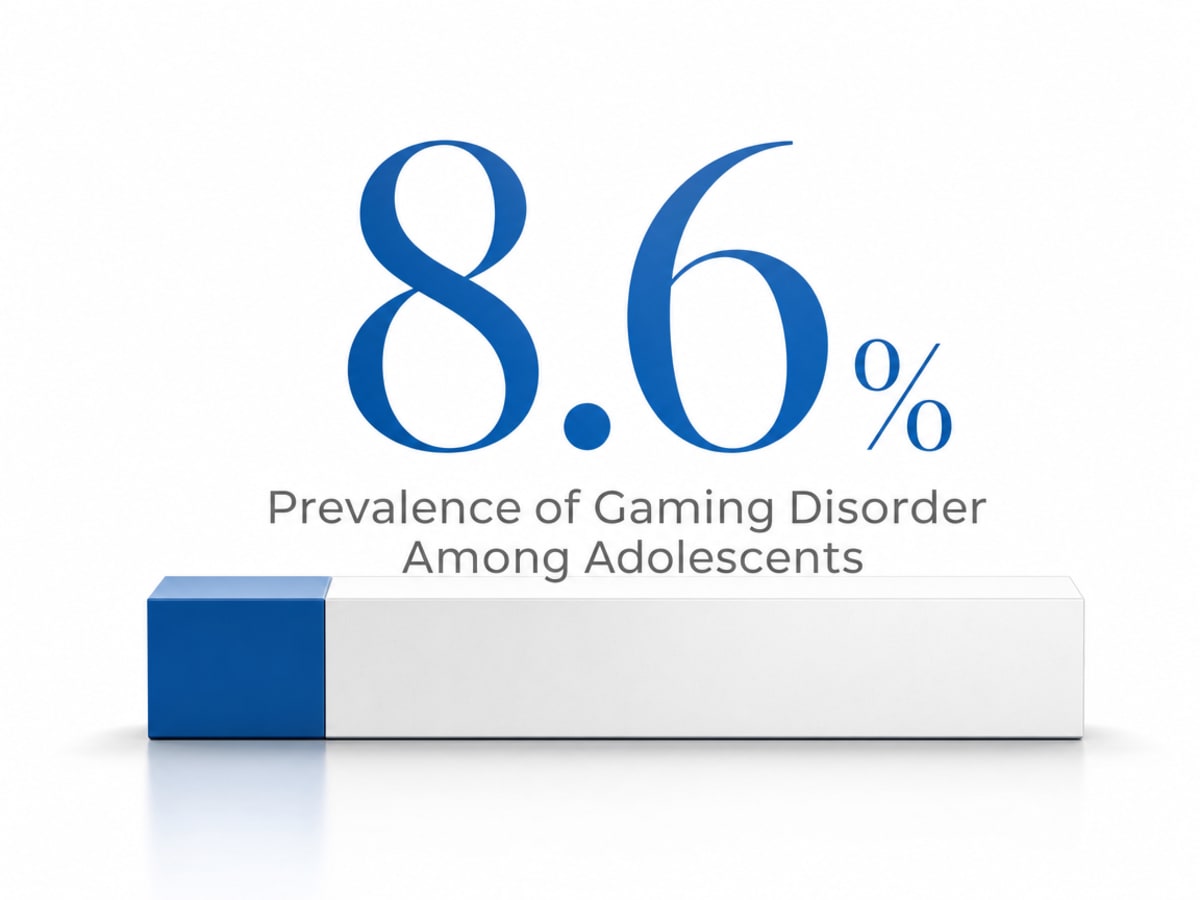
You are not the only parent asking this question at midnight. A 2024/2025 meta-analysis pooled 84 studies covering 641,763 adolescents and estimated the prevalence of gaming disorder at around 8.6%, with the authors noting that rates varied widely by country, setting, and which screening tool was used.15 So think of that number as a signal, not a verdict. Depending on where you look and how you measure, the real rate in any given school or clinic can be higher or lower.
Here is why that scope matters for your family. Nearly 1 in 12 young people meeting criteria means the teachers, coaches, and pediatricians in your life have almost certainly seen this before. You are not asking a strange question. You are asking a common one that the field is finally catching up to. If the pattern in your house looks like the one described above, you are inside a group large enough to have real answers waiting.
Warning signs that push the conversation toward psychiatry
Some patterns you can watch for weeks. Others are the moment you realize this is bigger than a screen-time argument. The signs below are the ones that most often move a family from “we need better rules” to “we need a clinician.”
Sleep collapses first. Bedtimes slide past 2am on school nights, mornings become impossible, and your kid is either dozing through first period or skipping it entirely. Grades follow. Assignments pile up, teachers start emailing, and a formerly B+ student is failing classes he used to enjoy. Then the friendships thin out. Invitations stop, the group text goes quiet, and the only people he talks to are voices in a headset. In a network study of more than 3,000 young people, gaming as escape or mood relief, depressed mood, self-blame, and marked social isolation at home showed up as bridge symptoms that tie the whole pattern together.11
Watch the mood around gaming, not just the hours on it. Irritability, panic, or a flat, hopeless tone when the game is taken away is different from a teenager being annoyed. So is lying about hours, hiding devices, or catching him gaming at 4am after he swore he was asleep. Pay attention to what is on the desk too: energy drinks stacked up, a vape charger, the smell of cannabis in the room, a prescription stimulant that is disappearing faster than it should. Substance use often shows up quietly alongside heavy gaming, and recent evidence points to frequent overlap with alcohol, tobacco, cannabis, and stimulants in this group.3
Why gaming rarely travels alone
Depression, anxiety, and the bidirectional loop
Here is the part that catches most families off guard. Gaming does not just cause mood problems, and mood problems do not just cause gaming. They pull on each other.
A 2025 meta-analysis of longitudinal studies, which followed young people across months and years rather than snapshotting them once, found that gaming disorder and depression each predicted the other over time. The same review found that anxiety earlier on predicted heavier gaming later, even when gaming looked mild at the starting line.9 Translated for the hallway outside your kid’s room: the panic he feels about a chemistry test on Monday is part of why the controller is still in his hand on Sunday night, and the more Sunday nights end that way, the flatter and more hopeless Monday morning gets.
This is why treating only the screen time tends to fail. Take the console away and the anxiety is still there, looking for a new place to land. Treat the anxiety without touching the gaming and the escape hatch stays open. It is worth naming that reviews of this literature have flagged methodological problems in some of the older studies linking gaming to depression and anxiety.14 The direction of the arrow is real. The exact size of the effect is still being worked out.
ADHD, trauma, and the adolescent picture
Then there is the wiring underneath. A systematic review focused specifically on adolescents found that problematic gaming clusters with ADHD, inattention, anxiety, depression, and a range of behavioral and emotional problems.10 ADHD shows up so often in this literature that it deserves its own line. A brain that struggles to sustain attention on a slow chemistry worksheet can lock in for six hours on a game engineered to deliver a reward every ninety seconds. That is not a character flaw. It is a fit between how the game is built and how his attention works.
Trauma belongs in the same conversation. A kid who was bullied for two years, who lost a parent, who lived through a divorce that nobody explained, often finds that the game is the one place his nervous system quiets down. In a network study of more than 3,000 young people, gaming as escape or mood relief showed up as a bridge symptom sitting right next to social isolation and depressed mood.11 If you have wondered why he seems calmer with the headset on than off, that is not your imagination. It is also a clue about what a real assessment needs to ask about.
Cannabis, alcohol, stimulants, and nicotine in the same room
You may have already noticed the vape charger, or smelled something in the laundry, or watched an Adderall prescription run out a week early. If gaming is the loud problem, substances are often the quiet one sitting next to it.
A 2026 scoping review pulled together 36 studies on people with internet gaming disorder or gaming disorder and found high rates of co-occurring substance use, especially alcohol, tobacco, cannabis, and stimulants.3 That pattern is not unique to gaming. Reviews of gambling disorder, another behavioral addiction, describe the same kind of clustering with substance and alcohol use disorders and with mood and anxiety disorders on top.8 Process addictions and chemical ones tend to keep each other company.
What this means for your family is practical. If your daughter is gaming twelve hours a day and also vaping nicotine through class, or your son is up until 4am and borrowing a friend’s stimulant to stay awake for school, you are not dealing with two separate problems. You are dealing with one system that has learned to lean on several things at once. A plan that only addresses the console, and quietly ignores the cannabis or the alcohol, is a plan that will keep losing ground.
What an honest assessment looks like
A real intake for compulsive gaming is not a 10-question quiz and a printout. It is a conversation that touches six areas of your kid’s life, because the game is almost never the whole story.
- The gaming pattern itself, checked against ICD-11 core criteria: impaired control, gaming taking priority over other activities, and continuing to play despite clear harm, usually across about a 12 months.2
- Mood and anxiety, because a 2025 longitudinal meta-analysis showed those symptoms and gaming disorder pull on each other over time.9
- Sleep, since the schedule collapses early and quietly.
- ADHD and trauma history, which a review of adolescent studies flagged as some of the most common wiring underneath problematic gaming.10
- Substance use, screened for alcohol, cannabis, stimulants, and nicotine, because a 2026 scoping review found these show up together far more often than families expect.3
- Family and school function, so the clinician sees where things are actually breaking, not just what the screen-time report says.
A 2025 review of the ICD-11 framework is direct about the reason for that breadth: no gold-standard screening tool exists, and other conditions, including substance use, have to be considered in the differential.13 Translated for your family, that means the clinician should be asking about the vape and the sleep and the panic on Sunday nights, not just how many hours the console logged. If the intake you are offered is quick, narrow, and gaming-only, you are getting a snapshot instead of an assessment.
Why one screening questionnaire is not enough
If someone hands you a 10-item quiz and tells you your kid does or does not have a gaming problem, be skeptical. The tools themselves are not that clean.
A systematic review of the field identified 32 different gaming disorder screening instruments used across 320 studies, and found that coverage of DSM-5 and ICD-11 criteria was uneven from tool to tool. Continued use despite harm, one of the most clinically important features, was inconsistently measured.5 A separate face-validity review found that about 83% of items across these tools looked reasonable on the surface, but many still contained wording that could pathologize normal, engaged gaming.6 A kid who plays a lot because he loves the game and has friends inside it can score in the concerning range on the wrong questionnaire.
The practical takeaway for you is simple. A screener is a starting point, not a verdict. What you want is a clinician who uses one or two instruments to open the conversation and then spends real time on the interview, the family history, and the differential. That is how you avoid both missing a real disorder and labeling a hobby as one.
What treatment actually changes
The therapies with the strongest support
Here is the good news you may not have heard yet. The therapies that help most families are not exotic, and none of them require a magic pill.
An expert consensus on gaming disorder treatment points to three psychosocial approaches with the strongest track record:
- Cognitive behavioral therapy
- Motivational interviewing
- Family therapy
The same consensus is clear that no medication currently has a specific indication for gaming disorder itself.7 That last part matters. If a provider promises a prescription that will fix the gaming, walk out. What medication can do is treat the wiring underneath, like the ADHD, the depression, or the anxiety that a review of adolescent studies has linked with problematic gaming.10
In practice this looks less dramatic than families expect. CBT gives your kid tools for the moment at 10pm when he wants to stop and cannot. Motivational interviewing meets him where he actually is, not where you wish he were, and helps him find his own reasons to change. Family therapy pulls you into the room too, because the fights, the bedroom door, and the hallway standoffs are part of what has to shift. An earlier systematic review of 22 treatment studies documented this same mix of psychotherapy and psychosocial work as the core of the field.12
How much recovery to expect, in plain numbers
You want to know if this actually works. Fair. Here is what the strongest recent evidence says, in numbers you can hold onto.
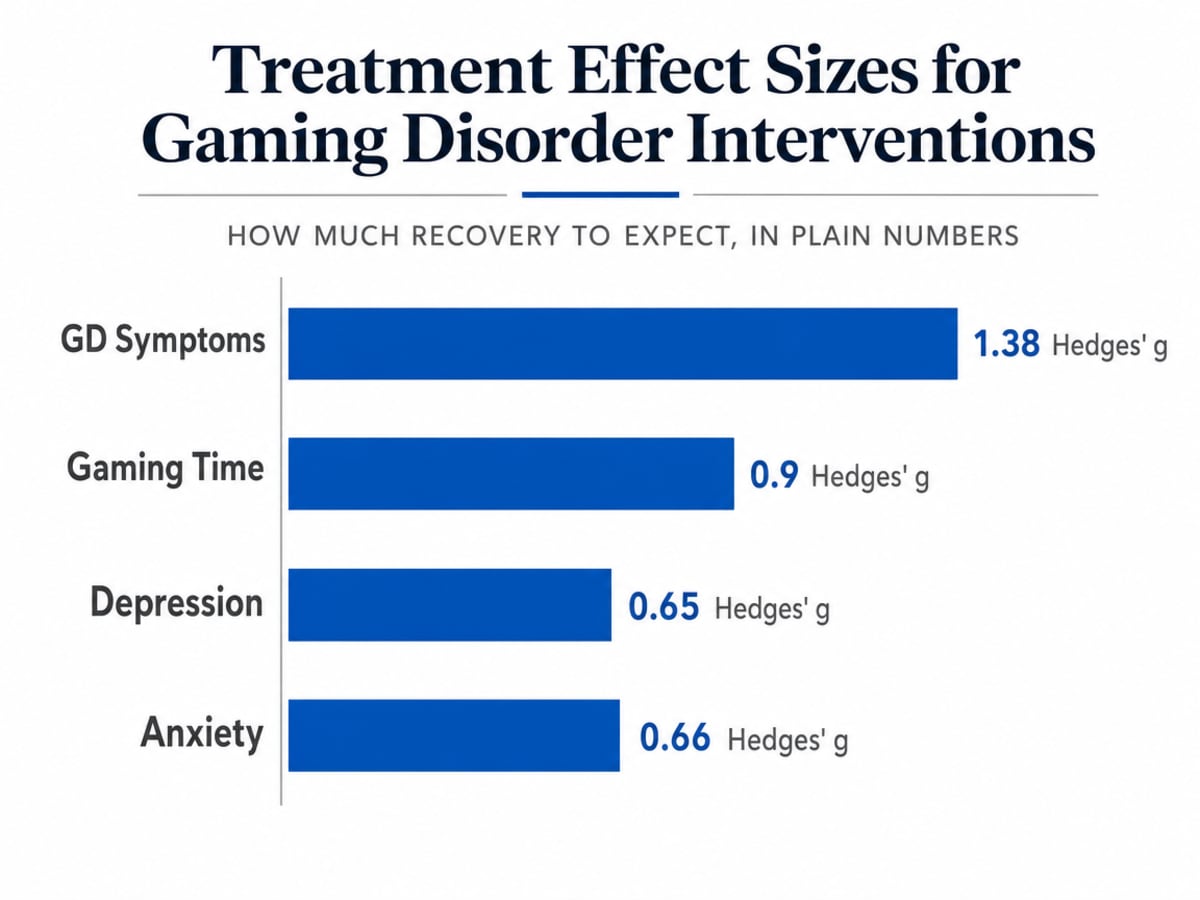
A 2025 meta-analysis pooled controlled trials covering 1,360 participants and reported treatment effects using a standard metric called Hedges’ g, where anything above about 0.5 is considered a moderate effect and above 0.8 a large one:
- Gaming disorder symptoms dropped with a very large effect size of 1.38.
- Time spent gaming came down with a large effect of 0.90.
- Depression improved with a moderate effect of 0.65.
- Anxiety improved with a moderate effect of 0.66.
The authors also reported sustained gains at 90-day follow-up for gaming symptoms and gaming time.4
Read those four numbers together and you can see why integrated care matters. The mood and anxiety pieces move too, not only the hours on the console. That is the whole argument for treating the underlying pattern, not just the visible one. A couple of honest caveats belong here. The trials varied in quality, and reviews of the broader gaming-and-mood literature have flagged methodological gaps that the field is still working through.14 Progress is real. It is also uneven, and your kid’s path will not be a clean line down the chart.
When outpatient counseling is not enough
You have probably already tried the reasonable things. A therapist once a week. A contract about hours. A router that shuts off at midnight. If the pattern in your house keeps snapping back within a few weeks, that is not your failure and it is not his. It is information about what the game is holding in place.
A few situations tell you that outpatient is being outmatched:
- Sleep is inverted and school or work has stopped functioning, not just wobbled.
- Depression has deepened to the point of hopeless talk, or panic attacks are landing daily.
- Substances are in the picture, especially cannabis, alcohol, stimulants, or nicotine used to keep the play going, which a 2026 scoping review found co-occurs with gaming disorder far more often than families expect.3
- There is any mention of self-harm.
- You keep discovering that the gaming and the mood symptoms are feeding each other in the pattern that a 2025 longitudinal meta-analysis described as bidirectional between gaming disorder and depression.9
When two or three of those are true at once, a higher level of care is not an overreaction. It is a structured intake that treats the sleep, the mood, the substances, and the gaming in the same plan instead of handing them to three different providers who never speak. That is the gap outpatient counseling was never built to close.
Talking with ViewPoint about an assessment
If you have read this far, you already know the answer to the question you started with. The gaming is not the whole story, and the plan you have tried is not reaching what sits underneath.
A conversation with ViewPoint Dual Recovery starts with a real intake, not a sales call. Board-certified psychiatrists and therapists in Prescott, Arizona look at the gaming pattern, mood, sleep, ADHD or trauma history, any substance use, and how school, work, and family are actually functioning. Where a co-occurring substance problem is in the picture, it gets treated in the same plan, by the same team, on a timeline set by what your kid needs rather than what an insurance clock says.
You do not have to be certain to make the call. You just have to be worried enough to ask someone to look with you. Reach out to ViewPoint, describe what you are seeing at home, and ask what an assessment would involve for your family. One honest conversation is a smaller step than the one you have already taken tonight.
Start an Expert Review of Gaming Compulsivity
Get clarity on how gaming habits relate to underlying mental health and substance use concerns.
Frequently Asked Questions
How do I know if my child’s gaming is an addiction or just a phase?
Watch for the pattern, not the hours. Under ICD-11, the concern is impaired control, gaming taking priority over other activities, and continuing despite clear harm, usually across about a 12-month period with real functional impairment.2, 13A rough semester is not a disorder. Sleep, grades, and friendships steadily eroding for a school year is.
Can gaming disorder cause depression, or does depression cause the gaming?
Both, and that is the honest answer. A 2025 meta-analysis of longitudinal studies found gaming disorder and depression predict each other over time, and anxiety earlier on predicts heavier gaming later.9So the games can deepen a low mood, and a low or anxious mood can pull your kid toward the games. That is why treating only one side rarely holds.
Is there a medication that treats video game addiction?
No medication is currently indicated specifically for gaming disorder itself. An expert consensus on treatment names cognitive behavioral therapy, motivational interviewing, and family therapy as the psychosocial approaches with the strongest support.7Medication can still matter when it treats what sits underneath, like ADHD, depression, or anxiety, which a review of adolescent studies has linked with problematic gaming.10
We already tried outpatient counseling and it did not stick. What is different about a psychiatric assessment?
A psychiatric assessment looks at the whole system in one intake: gaming pattern, mood, sleep, ADHD or trauma history, substance use, and school and family function. A 2025 ICD-11 review is direct that no single screening tool is a gold standard and that other conditions must be considered in the differential.13That breadth is what a weekly session and a screen-time contract cannot deliver.
Should we be worried about substance use if the main problem looks like gaming?
Yes, quietly worried and openly asking. A 2026 scoping review of 36 studies on people with internet gaming disorder or gaming disorder found high rates of co-occurring alcohol, tobacco, cannabis, and stimulant use.3The vape, the smell in the laundry, or a stimulant prescription running out early are not side issues. They belong in the same assessment and the same treatment plan.
What actually happens in treatment, and how much improvement is realistic?
Expect CBT, motivational interviewing, and family therapy, with medication used only for co-occurring conditions.7A 2025 meta-analysis of 1,360 participants reported large reductions in gaming symptoms and gaming time and moderate improvements in depression and anxiety, with gains sustained at 90-day follow-up.4Real progress. Not a straight line, and your kid’s path will have setbacks along the way.
References
- Internet Gaming Disorder in the DSM-5. https://pubmed.ncbi.nlm.nih.gov/26216590/
- (Internet) Gaming Disorder in DSM-5 and ICD-11. https://pmc.ncbi.nlm.nih.gov/articles/PMC8107956/
- Substance use amongst individuals with internet gaming disorder and gaming disorder: A scoping review. https://pubmed.ncbi.nlm.nih.gov/41817607/
- Treatment of gaming disorder: A systematic review and meta-analysis. https://pubmed.ncbi.nlm.nih.gov/41187384/
- Screening and assessment tools for gaming disorder. https://pubmed.ncbi.nlm.nih.gov/32143109/
- Face validity evaluation of screening tools for gaming disorder. https://pubmed.ncbi.nlm.nih.gov/32359228/
- An Overview of the Expert Consensus on the Prevention and Treatment of Gaming Disorders in China. https://pmc.ncbi.nlm.nih.gov/articles/PMC7340689/
- Gambling disorder comorbidity a narrative review. https://pmc.ncbi.nlm.nih.gov/articles/PMC11980244/
- Bidirectional relationship between gaming disorder, internalizing psychopathology, psychological distress, and well-being: A systematic review with meta-analysis of longitudinal studies. https://pubmed.ncbi.nlm.nih.gov/40288452/
- Problematic gaming, psychiatric comorbidities, and adolescence: A systematic review of the literature. https://pubmed.ncbi.nlm.nih.gov/38901145/
- Comorbidity among symptoms of internet gaming disorder, social withdrawal, and depression in 3430 young people in Hong Kong: A network analysis. https://pubmed.ncbi.nlm.nih.gov/38777272/
- Treatments of internet gaming disorder: a systematic review of the literature. https://pmc.ncbi.nlm.nih.gov/articles/PMC6930980/
- Gaming disorder in the ICD-11: the state of the game. https://pmc.ncbi.nlm.nih.gov/articles/PMC12640003/
- Evaluating the quality of evidence for gaming disorder: A summary of systematic reviews of associations between gaming disorder and depression or anxiety. https://pmc.ncbi.nlm.nih.gov/articles/PMC7588081/
- Burden of gaming disorder among adolescents: A systemic review and meta-analysis. https://pubmed.ncbi.nlm.nih.gov/40115446/