

Key Takeaways
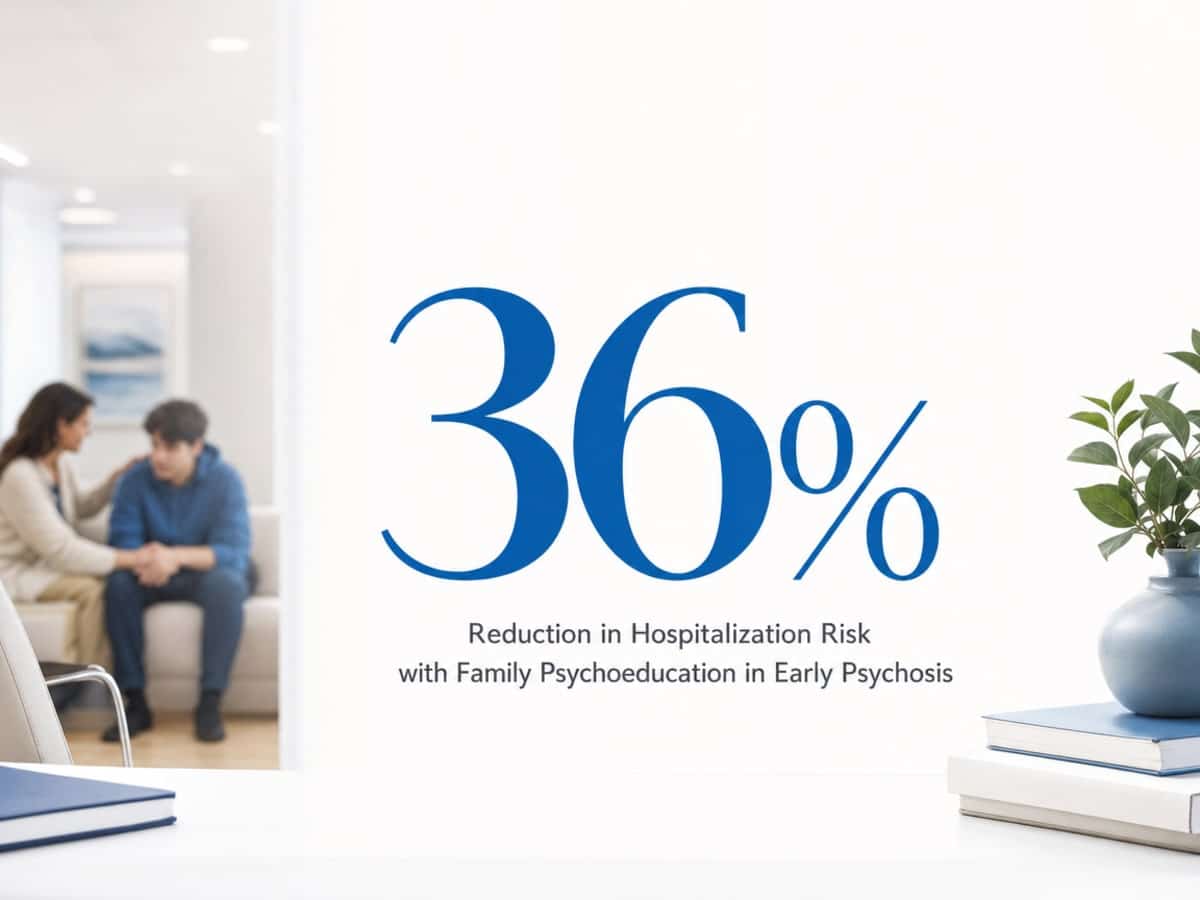
- Waiting for a crisis to force treatment is not neutral; structured family involvement in early psychosis was linked to a 36% relative reduction in hospitalization risk 3, so engaging sooner changes measurable outcomes.
- Most families see only outpatient or inpatient, missing rungs like IOP, PHP, residential, and specialty treatment-resistant care; matching the correct level to the diagnosis prevents cycles of under-treatment.
- Insurance timelines rarely match clinical ones, and premature step-downs drive relapse; ask whether treatment length is set by clinical response or payer authorization, since three months is often a floor 6.
- Families arrive without the right intake questions because nobody hands them the list; NIDA’s five questions, adapted for dual diagnosis, plus asking what you’ll be told and when, close that gap 5.
- Confidentiality feels like a wall but functions as a door with specific hinges; relatives are entitled to general information, education, and support without a signed release 10, and can request it directly.
- Standard family psychoeducation underperforms in co-occurring cases; a dual-disorders family intervention averaged 19.6 sessions versus 6.7 and produced better symptom, functioning, and knowledge outcomes 12.
- Adult family psychoeducation evidence does not translate cleanly to youth psychosis, where a 2026 review found no significant effect on symptoms or functioning 4; ask programs to be honest about age-specific evidence.
- A good first call is an assessment conversation, not a bed date; programs willing to slow down on the phone and answer hard questions about integration, family involvement, and duration signal how the treatment plan will run.
The 2 a.m. Conversation Nobody Prepared You For
If you are reading this while the house is quiet and your phone is warm from too much scrolling, you are not the first person to end up here. Someone you love is struggling in a way that has stopped responding to the things that used to help. Maybe a medication stopped working. Maybe a program discharged them too early. Maybe you are watching a pattern you have seen before and you already know where it ends.
You are tired. You are also, quietly, second-guessing every decision you have made so far.
Here is what most families do not get told: the regrets you are carrying are almost never personal failures. They are the predictable result of a system that hands families a phone number and expects them to know what to ask. Waiting too long. Confusing a 30-day residential stay with the kind of care a treatment-resistant illness actually needs. Signing paperwork without understanding what you would and would not be told afterward. These are information gaps, not character flaws.
This piece is not a brochure. It is the conversation a knowledgeable friend would have with you before you make the next call, so the next placement is chosen with clearer eyes. You do not need to commit to anything tonight. You just need to know what a good first conversation should sound like when you are ready to have one.
Why Waiting Feels Safer Than It Is
The Quiet Cost of Watching and Hoping
Waiting rarely feels like a decision. It feels like patience. You tell yourself the last episode passed, so this one might. You remember the fight that erupted the last time you suggested a higher level of care, and you decide to give it another week. Another appointment. Another refill.
None of that makes you negligent. It makes you a person who loves someone and does not want to be wrong.
But there is a cost to the waiting that families rarely see until they are looking backward. When symptoms build without structured support around the whole household, small setbacks turn into hospital admissions, and hospital admissions turn into the kind of disruptions that unravel jobs, housing, and trust. A 2026 systematic review of family psychoeducation in early psychosis, pooling 15 studies and 2,271 participants, found that structured family education was associated with a 36% relative reduction in hospitalization risk (RR 0.64) and shorter inpatient stays compared with usual care 3. The scope matters: this evidence is strongest for early psychosis specifically, not every diagnosis, and the review found no clear effect on caregiver burden or day-to-day functioning. Still, the direction is unambiguous. Bringing the family into the plan earlier changes hard, countable outcomes.
What Guidelines Say Should Have Happened Sooner
Here is the part that stings a little: most of what families later wish they had known is already written down. It sits inside clinical guidelines that clinicians know well and families almost never see.
International bodies, including the World Psychiatric Association, describe family collaboration as a default part of psychiatric care in acute and rehabilitation settings, not a bonus feature reserved for the compliant or the well-connected 9. The NIMH’s implementation manual for early psychosis care instructs teams to discuss family involvement at intake, document the client’s preferences, and revisit those preferences over time rather than settling them once and forgetting 1. Family-centered collaborative care summaries from WHO and NICE go further, tying early caregiver engagement to better adherence, higher quality of life, and lower relapse and rehospitalization rates in chronic mental illness 11.
So why didn’t your last program do these things? Often because they didn’t. A 2023 review of guideline implementation for psychotic disorders found that even where family psychoeducation is endorsed as a first-line treatment worldwide, delivery in routine practice is inconsistent and frequently limited by training, staffing, and organizational priorities 8. The gap you sensed was real. It was not something you missed. It was something the system did not hand you.
You cannot rewind. You can, however, ask the next program a very different set of questions, starting with what family involvement will actually look like from day one.
Reading Levels of Care Without Getting Lost
The Ladder From Outpatient to Specialty Care
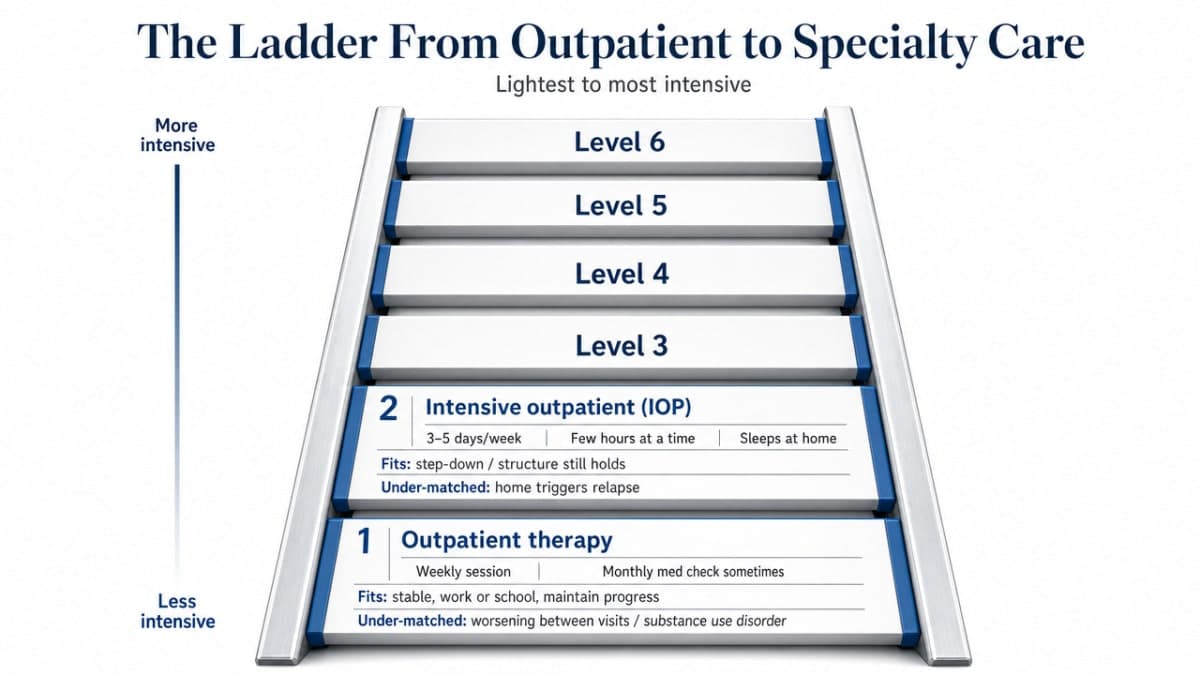
Most families arrive at treatment thinking there are two options: outpatient or inpatient. There are actually six, and the gap between them is where a lot of regret lives.
Here is the ladder, in plain language, from lightest to most intensive.
- Outpatient therapy
- A weekly session, sometimes paired with a monthly medication check. It fits someone who is stable, working or in school, and using the appointments to maintain progress. It is under-matched when symptoms are actively worsening between visits or when a substance use disorder is in play.
- Intensive outpatient (IOP)
- Runs three to five days a week for a few hours at a time. Your loved one sleeps at home. It fits step-down from a higher level, or someone whose life still has enough structure to hold. It is under-matched when the home environment is part of what is triggering relapse.
- Partial hospitalization (PHP)
- A full clinical day, five or six days a week, without an overnight stay. It fits people who need daily psychiatric contact but not 24-hour supervision. It is under-matched when safety concerns don’t pause at 5 p.m.
- Residential treatment
- 24-hour non-hospital care in a home-like setting, often for several weeks. It fits people who need to be away from their environment to stabilize. It is under-matched when the underlying psychiatric picture is more complex than the program’s medical staffing can handle.
- Inpatient psychiatric hospitalization
- Short-term, locked or unlocked, and focused on acute stabilization. It fits imminent safety crises. It is under-matched, almost by design, for the long work of sustained recovery.
- Specialty treatment-resistant care
- The rung most families do not know exists. It is built for people who have cycled through the levels above without lasting improvement, often carrying diagnoses like treatment-resistant schizophrenia, rapid-cycling bipolar disorder, or a co-occurring substance use disorder that keeps unraveling the psychiatric work. Duration is set by clinical response, not a preset number of days.
NIDA notes that research suggests treatment of three months or longer produces better outcomes in substance use recovery 6. Complex psychiatric presentations often need at least that runway to see whether a new medication strategy, like a clozapine protocol, is actually working. When you look at the ladder this way, the question stops being “inpatient or outpatient” and starts being “which rung actually matches what we’re dealing with.”
When Insurance Timelines Create Their Own Regret
You may already know this feeling: the utilization reviewer on the other end of the phone has decided your loved one is “stable enough” for step-down after 14 days, and the clinical team disagrees. The paperwork wins. Two months later, you are back in an emergency room.
This is one of the sharpest regrets families name, and it is not because anyone was careless. It is because the clock a program runs on and the clock a treatment-resistant illness runs on are almost never the same clock. NIDA’s own guidance is that adequate duration matters, with three months as a common floor for meaningful change in substance use recovery 6. Complex psychiatric cases frequently need longer to titrate medications, work through trauma, and rebuild function.
When you interview a program, ask this directly: is treatment length set by clinical response, or by what a payer will approve? Ask what happens if the team recommends more time than insurance covers. Ask what the appeal process looks like, and who runs it. A program that treats duration as a clinical decision rather than a billing outcome will answer these questions without flinching. That answer, more than any brochure, tells you what the next 90 days are likely to look like.
The Questions You Wish You Had Asked at Intake
Five Questions Adapted for Dual-Diagnosis Families
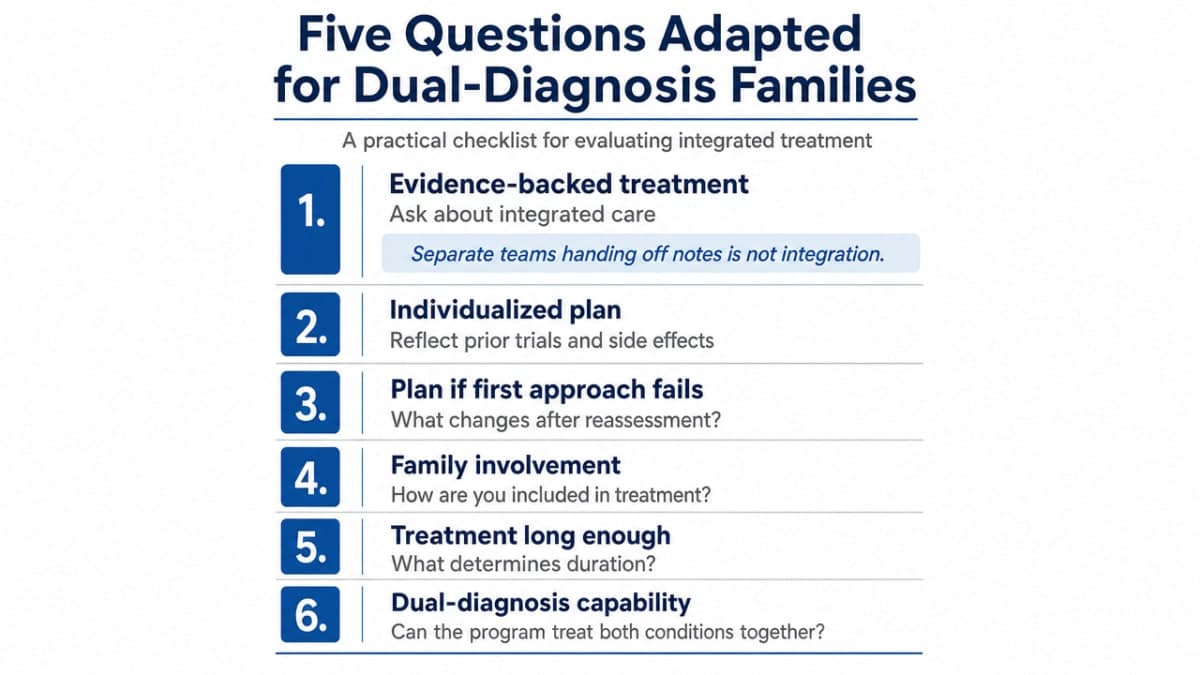
You did not fail because you didn’t ask the right questions. Nobody handed you the list. NIDA has published one for years, aimed at families evaluating substance use treatment, and it turns out to be the closest thing to a universal starter kit for dual-diagnosis families too 5. Here it is, translated for what you are actually facing.
Does the program use treatments backed by scientific evidence? For a co-occurring case, that means asking specifically about integrated care, not two parallel tracks. If the psychiatric team and the addiction team meet separately and hand off notes, that is not integration. That is a hallway.
Is treatment tailored to the individual? A treatment-resistant diagnosis needs a plan that reflects prior medication trials, side-effect history, and what has already failed. Ask what changes if the first assessment reveals something the referral did not mention.
Does the program adapt as needs change? Six weeks in, the picture usually looks different than it did on day one. Ask who reviews the plan, how often, and what triggers a change. “Weekly team meeting” is a real answer. “We’ll see how it goes” is not.
Is treatment long enough to work? NIDA points to three months or longer as the floor for meaningful change in substance use recovery 6. Complex psychiatric care often needs more. Ask whether length is set clinically or by insurance authorization.
How does the program integrate with mutual-help or continuing care? Discharge is not the finish line. Ask what the first 30 days after residential look like on paper, including who calls whom.
Add a sixth question that NIDA does not cover: what will I be told, and when? Confidentiality rules are real, but so are your rights to general information and education 10. A program that has thought about this will have an answer ready.
What a Good Assessment Call Actually Sounds Like
A good first call does not feel like an interview or a sales pitch. It feels like someone slowing down to understand what you are dealing with before anyone talks about a bed date.
In the NIMH’s implementation manual for early psychosis care, intake is described as a conversation that surfaces family involvement preferences, documents them, and revisits them over time rather than settling them on a single form 1. The team should be asking how your loved one wants family included, what has helped or hurt in past treatment episodes, and what the household actually looks like when things are hardest. If nobody asks those questions, that tells you something.
You should hear the assessor ask about:
- diagnosis history,
- prior medications and doses,
- substance use in context rather than in isolation,
- safety concerns at home, and
- what a realistic day looks like right now.
You should hear them explain what happens next in plain sentences: who reviews the assessment, how a level-of-care recommendation gets made, and what happens if the recommendation is a level your insurance may not fully cover.
You should also hear them describe family involvement as a default, not a favor, consistent with how the World Psychiatric Association frames engagement in acute and rehabilitation care 9. Ask what family sessions look like in the first two weeks. Ask what education is offered to you, not just to your loved one.
What you should not hear: pressure to admit today, vague answers about duration, or a promise that everyone gets better in 30 days. A program willing to slow down on the phone is usually a program willing to slow down in the treatment plan. That is what you are actually trying to learn.
Confidentiality: What You Can Know, and What You Can Ask For Anyway
Few things blindside families more than the moment a clinician says, “I can’t share that.” You have driven them to the ER. You have paid for the last three admissions. And now a stranger in scrubs is telling you the rules have changed at the door.
The rules did not change. They were always there. But nobody explained what sits inside them and what sits outside them, so it feels like a wall when it is actually a door with hinges in specific places.
Here is what most families are not told: even without your loved one’s consent, relatives have the right to general information, education, and support. A 2022 analysis of confidentiality in family involvement puts it plainly, arguing that“family involvement should be discussed with all patients as a default approach” and that relatives are entitled to general information, training, and support even when specific clinical details cannot be shared 10.That means you can ask a program to explain the diagnosis in general terms, walk you through what the medications do and their common side effects, teach you what a warning sign looks like at home, and tell you who to call at 11 p.m. when something shifts. None of that requires a signed release.
What does require consent is the specific clinical detail: what your loved one said in session, what their labs showed, what dose changed on Tuesday. If they sign a release naming you, the door opens further. If they don’t, you can still ask the team to sit down with you as an educational session about the illness, not the individual. Programs that treat family engagement as a default, the way the World Psychiatric Association frames it in acute and rehabilitation care 9, usually offer this without you having to fight for it.
Ask the admissions team directly, before day one: what information can I receive without a release, what changes with one, and how do you handle the gap? A program that has an answer ready has thought about you before you called.
Family Involvement in Co-Occurring and Treatment-Resistant Cases
When a psychiatric illness and a substance use disorder are running at the same time, the standard family psychoeducation script is often not enough. It was not built for the moment your loved one leaves a group session and stops at the liquor store on the way home. It was not built for the medication that keeps getting skipped because it feels like it dulls the high.
A randomized trial comparing a comprehensive dual-disorders family intervention (FIDD) with standard family psychoeducation (FPE) in co-occurring substance use and severe mental illness found that FIDD families completed a mean of 19.6 sessions versus 6.7 in FPE, and clients in FIDD had significantly less severe overall psychiatric symptoms and psychotic symptoms, along with better functioning outcomes and stronger mental health and knowledge gains for relatives 12. More sustained family work, aimed at both disorders at once, produced measurably different results than a lighter, single-disorder approach.
What that means for you, practically, is worth asking about before admission. When you interview a program, ask:
- whether family sessions are built around the co-occurring picture or whether they only address the psychiatric side and hand off the substance use conversation to a separate track;
- how many family sessions are typical over a treatment episode, not just how many are offered on paper;
- what problem-solving skills and crisis-intervention training you will learn, which the VA’s evidence review names as core elements of family-involved psychosocial treatment in serious mental illness 7.
You are not being demanding by asking. You are matching the intensity of the family plan to the intensity of what you are actually living with.
An Honest Note About Youth Psychosis
If the person you love is a teenager or a child, some of what you have read so far comes with an asterisk you deserve to see.
Most of the family psychoeducation evidence is drawn from adult populations. A 2026 systematic review focused specifically on children and adolescents with psychotic disorders found no significant effect of family interventions on psychosis symptoms or functioning in that younger group, and flagged substantial methodological problems across the studies it reviewed 4. That does not mean family involvement is pointless for a young person. It means the confident numbers you see quoted for adults do not translate cleanly downward.
Ask the program directly: what does the evidence look like for someone my child’s age, with this diagnosis? A team that answers honestly, including where the research is thin, is a team you can trust with the harder conversations later.
Starting With a Call, Not a Commitment
You do not have to decide anything today. You just have to learn what a good first conversation sounds like when you are ready to have one.
At ViewPoint Dual Recovery, the first call is an assessment conversation, not an intake form. Someone listens to what has already been tried, what your loved one carries diagnostically, and what your household actually looks like when things are hardest. A level-of-care recommendation comes out of that call, not a bed date. If the right next step is another program, you will hear that too.
Bring the questions this piece gave you. Ask about integrated dual-diagnosis care, how family involvement works from day one 9, what you will be told without a release 10, and whether treatment length is set clinically or by insurance 6. If a program flinches at any of those, you have learned something important before signing anything.
Start with a call. Not a commitment. That is the first step you will not regret.
Start with a conversation, not a commitment
Connect with a clinical expert to clarify next steps for complex, treatment-resistant cases—no pressure, just understanding.
Frequently Asked Questions
How do I know if it’s time to push for treatment instead of waiting?
If you are noticing shorter gaps between episodes, missed medication doses, worsening substance use, or safety concerns you now scan for automatically, the pattern itself is the signal. You do not have to wait for a crisis to earn the right to ask for help. An assessment conversation costs you nothing and gives you a clinical read on whether a higher level of care matches what you are seeing at home.
What’s the real difference between IOP, PHP, residential, and inpatient care?
IOP is a few hours, several days a week, sleeping at home. PHP is a full clinical day without an overnight. Residential is 24-hour non-hospital care in a home-like setting, usually for weeks. Inpatient psychiatric hospitalization is short-term acute stabilization, often locked. Specialty treatment-resistant care sits above these, built for complex cases that have not responded to standard programs, with duration set by clinical response rather than a preset number of days.
What should I ask on the first call to a treatment program?
Ask whether treatments are evidence-based, tailored to the individual, adapted as needs change, and long enough to work, which NIDA identifies as the core questions for evaluating a program 5. For dual-diagnosis cases, ask specifically about integrated psychiatric and substance use care rather than parallel tracks. Then add two more: how family involvement works from day one, and what information you can receive with and without a signed release.
Can the treatment team tell me anything if my loved one is an adult?
Yes, more than most families are told. Relatives have the right to general information, education, training, and support even without patient consent, and family involvement should be discussed as a default approach rather than an exception 10. The team can explain the illness in general terms, teach warning signs, and tell you who to call in a crisis. Specific clinical details, like session content or dosages, require a signed release.
How involved should family be when there’s both a psychiatric and substance use diagnosis?
More involved than standard psychoeducation typically offers. A randomized trial of a comprehensive dual-disorders family intervention found families completed a mean of 19.6 sessions versus 6.7 in standard family psychoeducation, with better psychiatric symptom and functioning outcomes for clients and stronger knowledge gains for relatives 12. Ask whether family sessions address both disorders together and whether you will learn concrete crisis-intervention and problem-solving skills, not just receive information 7.
What if insurance only approves a shorter stay than the team recommends?
This is one of the most common sources of relapse and regret. Ask the program upfront whether treatment length is set by clinical response or by payer authorization, and what the appeal process looks like when the two disagree. NIDA points to three months or longer as a common floor for meaningful change in substance use recovery, and complex psychiatric cases often need more runway to see whether a new medication strategy is working 6.
References
- Manual II: Implementation Coordinated Specialty Care for First Episode Psychosis. https://www.nimh.nih.gov/sites/default/files/documents/health/topics/schizophrenia/raise/csc-for-fep-manual-ii-implementation-manual.pdf
- Evidence-Based Treatments for First Episode Psychosis. https://www.nimh.nih.gov/sites/default/files/documents/health/topics/schizophrenia/raise/evidence-based-treatments-for-first-episode-psychosis.pdf
- Optimizing Early Psychosis Care through Family Psychoeducation: A Systematic Review and Meta-Analysis. https://pubmed.ncbi.nlm.nih.gov/42068331/
- Family Interventions for Children and Adolescents with Psychotic Disorders: A Systematic Review and Meta-Analysis. https://pubmed.ncbi.nlm.nih.gov/41973371/
- SEEKING DRUG ABUSE TREATMENT: KNOW WHAT TO ASK. https://www.nida.nih.gov/sites/default/files/treatmentbrochure_web.pdf
- Treatment Options. https://nida.nih.gov/sites/default/files/pdf/treatment_options_download_nidamed.pdf
- Family Involved Psychosocial Treatments for Adult Mental Health Conditions: A Review of the Evidence. https://www.hsrd.research.va.gov/publications/esp/family-interventions-report.pdf
- Implementation of Guidelines on Family Involvement for Persons with Psychotic Disorders. https://pmc.ncbi.nlm.nih.gov/articles/PMC9934504/
- Family engagement as part of managing patients with mental illness. https://pmc.ncbi.nlm.nih.gov/articles/PMC8801858/
- The duty of confidentiality during family involvement. https://pmc.ncbi.nlm.nih.gov/articles/PMC9764492/
- Family-centered collaborative care for patients with chronic mental illness. https://pmc.ncbi.nlm.nih.gov/articles/PMC10039105/
- Family Intervention for Co-occurring Substance Use and Severe Mental Illness. https://pmc.ncbi.nlm.nih.gov/articles/PMC3262454/
- Seeking Drug Abuse Treatment: Know What To Ask. https://nida.nih.gov/sites/default/files/treatmentbrochure_web.pdf