Key Takeaways
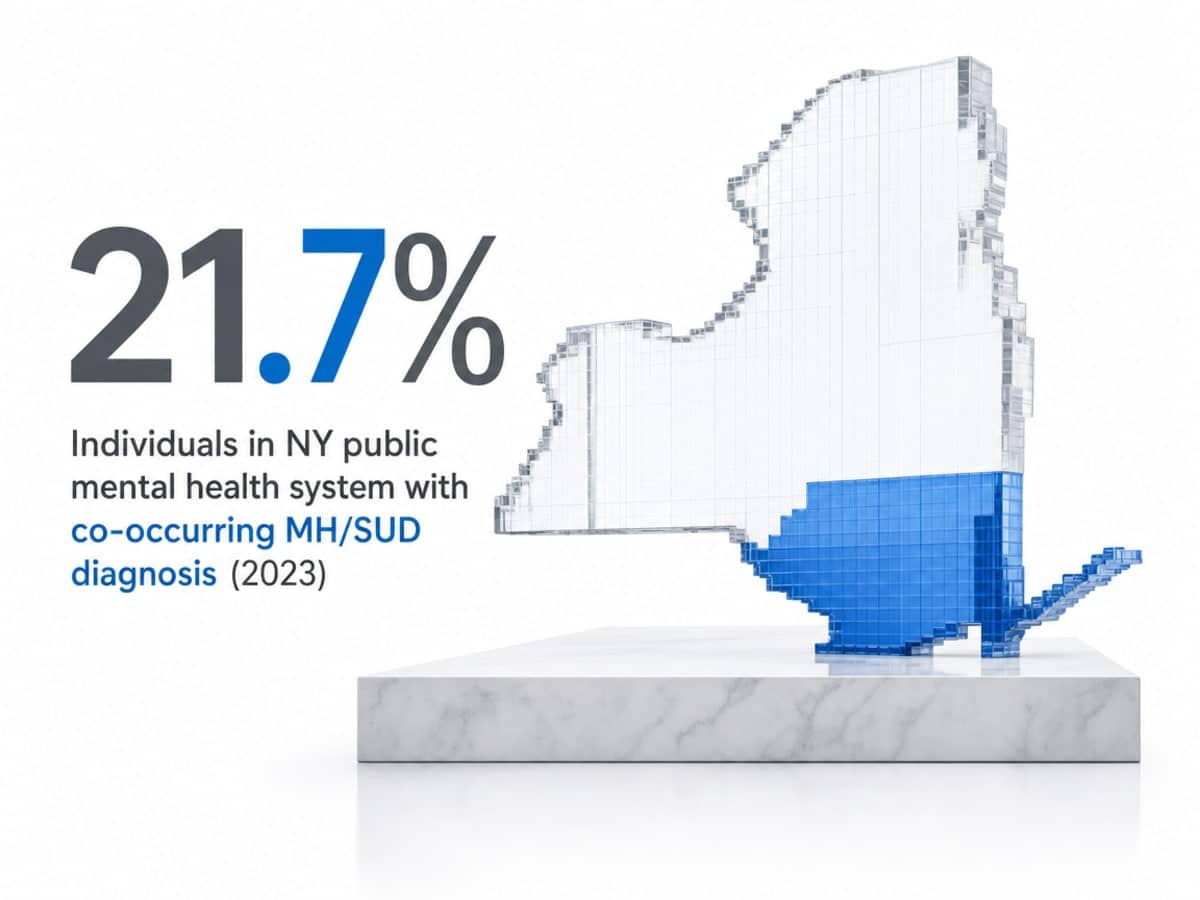
- New York funds a large behavioral health system, with 21.7% of public mental health patients carrying a co-occurring diagnosis and 38% in state-operated settings 1.
- OMH and OASAS operate as separate authorities, so programs are licensed around one primary condition, leaving long-stay residential care for psychosis plus active substance use thin.
- Stay in-state when outpatient integration through a CCBHC or MHOTRS clinic can hold the case; look elsewhere after failed antipsychotic trials, repeat short stays, or unresolved cycling.
- Before committing to any program, ask about on-site clozapine capability, whether length of stay is clinical or insurance-driven, and the protocol when psychosis and withdrawal collide.
Why New York Families Keep Hitting the Same Wall
You already know the pattern by heart. A psychiatric hold that ends after 72 hours. A rehab that says your daughter is too psychotic for their program. A mental health clinic that says your son is too actively using for theirs. A discharge planner who hands you a photocopied list of numbers, half of which have full waitlists. Somewhere in there, someone said the word integrated and meant it kindly, and it did not change what happened next.
If you are the parent, spouse, or sibling doing this work, you have probably been told that New York has one of the largest behavioral health systems in the country. That is true. It is also true that the specific thing you are looking for — a program that can hold a loved one with treatment-resistant psychosis and active substance use, keep them long enough for medication to actually work, and not send them back out at day 28 — is one of the hardest pieces of care to find inside the state.
This piece is not a directory of New York rehabs. It is a map of why the wall is where it is, and what it means for a small group of families whose situation does not fit the shape the system is built for. You will see what New York does well, where the regulatory seam between mental health and addiction treatment leaves a gap, and how to tell whether your person is in the routine co-occurring category or the narrower one that often ends up looking out of state.
You are not missing something obvious. The gap is real, and naming it is the first honest step toward a plan.
The Abundance Illusion: What New York Actually Has
Before naming the gap, give New York its due. The state runs one of the country’s largest public mental health systems, funds a sprawling network of OASAS-certified addiction programs, has expanded Certified Community Behavioral Health Clinics, and has spent years writing joint OMH–OASAS policy to push integrated care into everyday practice. If you live in Buffalo, Syracuse, the Hudson Valley, or any of the five boroughs, you are not in a treatment desert. On paper, you are in one of the most resourced places in the country to have this problem.
The numbers back that up — and also quietly explain why you are still stuck. In the most recent OMH profile, 21.7% of individuals served in New York’s public mental health system carried a co-occurring mental health and substance use diagnosis. Inside state-operated settings — the more intensive end of public care, where the sickest people tend to land — that figure jumps to 38%.1 Read that again. The system is absorbing dual diagnosis at real volume, and the higher you go in acuity, the more concentrated it gets.
That concentration is doing something to the shape of care. Community clinics see a lot of anxiety-plus-alcohol and depression-plus-cannabis. State-operated and long-stay settings see a much heavier mix: schizophrenia with stimulant use, bipolar with opioids, PTSD with alcohol, often layered with housing instability and prior hospitalizations. Two very different clinical worlds, both technically “dual diagnosis,” both counted in the same broad category.
What that means for you is uncomfortable but useful. When someone tells you New York has dual diagnosis capacity, they are not lying. There genuinely is a large, funded, regulated system doing this work every day. But “capacity” is a blended average, and your loved one is not an average. If your person is in the top slice of acuity — the 38% concentrated in the most intensive settings, or the group that keeps cycling in and out of them — the abundance you keep hearing about is not the abundance you can actually reach. That is not a failure of your searching. It is what the data quietly says when you look at where the hardest cases pile up.
The Clinical Profile That Falls Through the Cracks
Not every dual diagnosis case looks alike, and that is the part most articles skip. When a clinic says they treat co-occurring disorders, they are usually thinking of a specific kind of patient: someone with anxiety who drinks too much, or depression paired with cannabis, or PTSD with alcohol. Those cases are real, common, and often manageable in outpatient care with a good therapist, a psychiatrist for medication, and a peer support group. New York has a lot of that. If your loved one fits there, the system generally works.
The profile that keeps getting bounced looks different. It is a person whose primary story is a serious psychiatric illness — treatment-resistant schizophrenia, schizoaffective disorder, rapid-cycling bipolar with psychotic features — and whose substance use is layered on top, sometimes as self-medication, sometimes as a symptom of the illness itself. The psychosis does not politely wait for the drugs to leave the system. The drugs do not politely wait for the psychosis to be stabilized. Both are active. Both are dangerous. And most programs are built to handle one at a time.
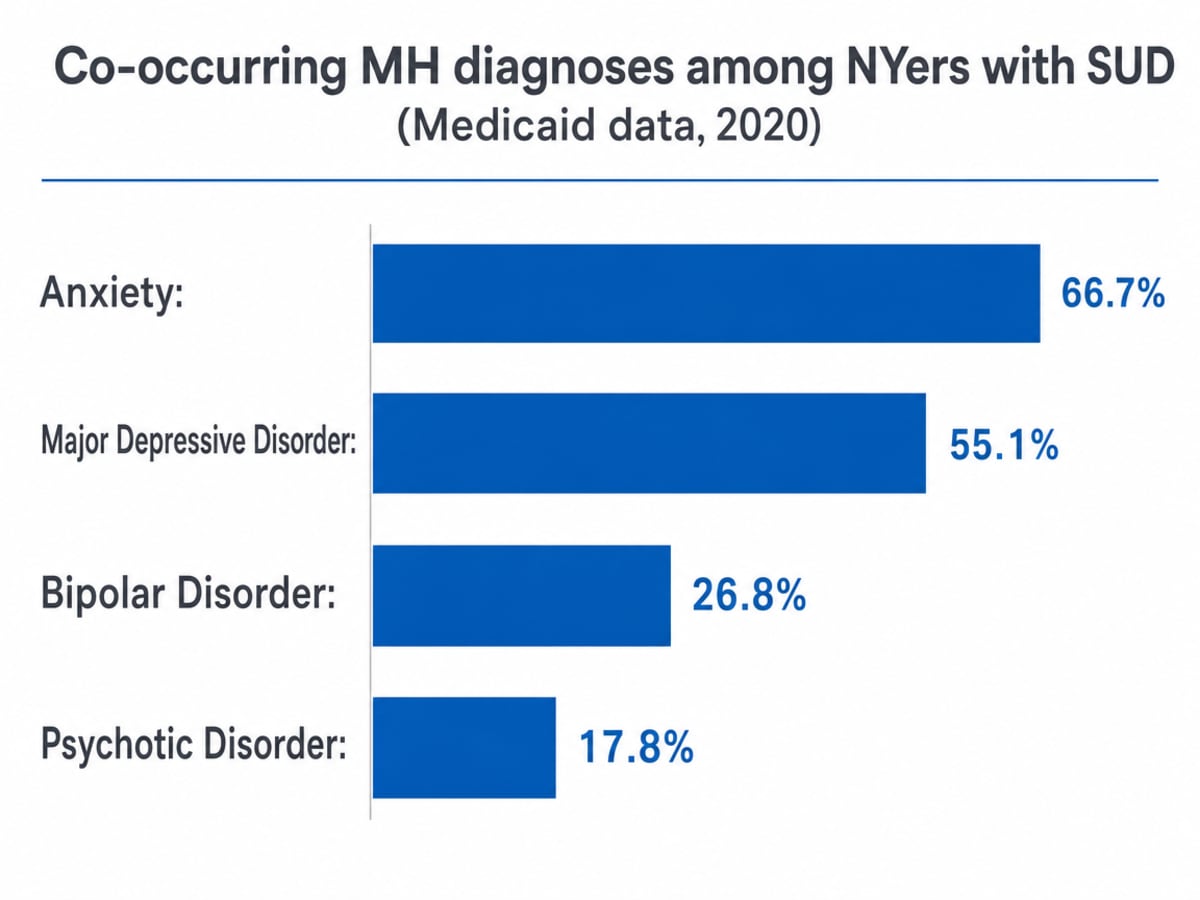
The scale of this group is easy to miss. Among New Yorkers with a substance use disorder on Medicaid:
- 66.7% also had anxiety
- 55.1% had major depressive disorder
- 26.8% had bipolar disorder
- 17.8% had a psychotic disorder3
That last number is the one to sit with. Nearly one in five people in the SUD population is also carrying a psychotic illness. In a state where OASAS admits over 100,000 non-crisis patients a year, that is not a rare edge case — it is a substantial subpopulation, big enough to fill programs, small enough that no one program has been built specifically around them at long-stay residential intensity.
Layer on what the state’s own planners have described as the highest-need slice: people with repeated psychiatric hospitalizations, periods of homelessness, criminal justice involvement, and a co-occurring substance use disorder all in the same chart.13 If any of that sounds like your loved one, you are looking at the exact profile that outpatient integration was not designed to hold. These are cases that need weeks, sometimes months, of stable housing, careful medication trials — often including clozapine for treatment-resistant psychosis — and staff who are not thrown by a patient who is both actively psychotic and in withdrawal at the same time.
Naming this matters because it changes what you are searching for. You are not looking for “dual diagnosis treatment in New York” in the generic sense. You are looking for a program that can hold psychosis-first, SUD-second cases at residential intensity for longer than a typical 28-day stay. That is a much narrower ask, and it is why the phone calls keep ending the same way. The programs that say yes to the first framing often say no, or discharge early, when the second one shows up in the room.
The Regulatory Seam Between OMH and OASAS
Here is the part that took most families months to piece together, if anyone bothered to explain it at all. New York has two behavioral health authorities. The Office of Mental Health licenses mental health programs. The Office of Addiction Services and Supports certifies substance use programs. They are cooperating with each other, they have signed joint agreements, and they have both told their programs to handle co-occurring cases. But they are still two different systems with two different admission rules, and the space where they overlap is narrower than the policy documents make it sound.
On the OMH side, a mental health program can admit someone who also has a substance use disorder, as long as that person meets the mental health program’s admission criteria. The SUD gets managed alongside the mental health treatment, and the program does not need a separate OASAS license to do it.5 The joint OMH–OASAS memorandum of agreement lays this out plainly: each side can hold onto a patient with a co-occurring condition and manage the secondary diagnosis without dual certification.9 That is what “integrated care” means in the New York regulatory vocabulary. It is a single-certification model, not a dual-licensed one.
On the OASAS side, the mirror image applies with one important catch. To be admitted to an OASAS-certified program, substance use has to be a primary reason for seeking care. Even the optional “co-occurring capable” designation — which recognizes OASAS programs that do strong integrated work — keeps that primary-SUD requirement in place.7 The Department of Health’s own licensure guidance says the same thing: OASAS certification is required for any SUD services, and admission to an OASAS clinic assumes a primary SUD.8
Now put your loved one back in the room. If the treating team looks at the chart and sees psychosis as the driving condition, the OASAS door gets harder to open, no matter how much active substance use is also present. If the team looks at the chart and sees substance use as the driving condition, the OMH long-stay residential door gets harder to open, because those beds are prioritized for people whose mental illness is the primary reason they need that level of care. Both doors are technically capable of holding a co-occurring patient. Neither is designed to be the long-stay, dual-licensed, psychosis-capable residential setting that the hardest cases actually need.
What CCBHCs and Outpatient Integration Do Well — And Where They Stop
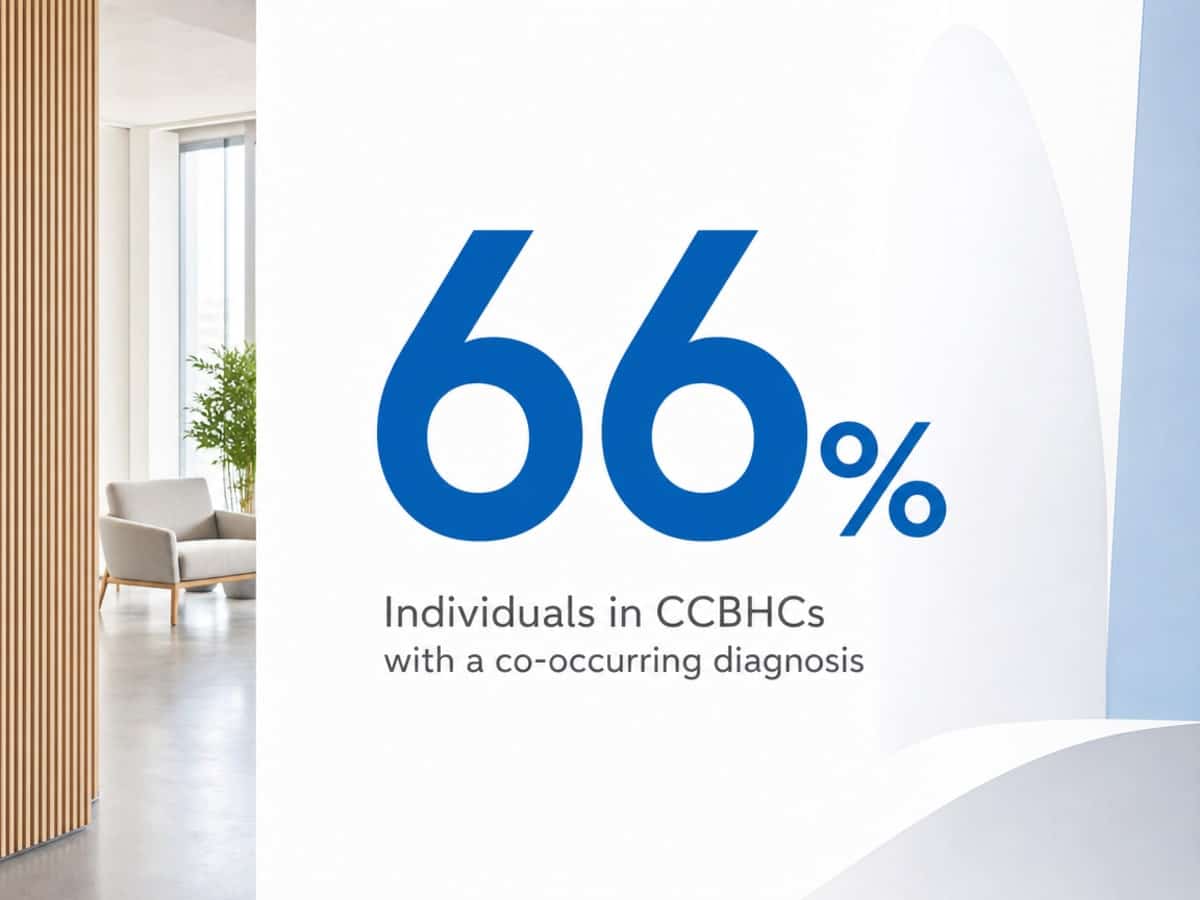
Certified Community Behavioral Health Clinics are the piece of New York’s system that most closely resembles the integrated care the policy documents promise. They are built to serve people with serious mental illness, they screen for substance use as a matter of course, and they coordinate care across mental health and addiction treatment under one roof. In OASAS’s own numbers, 62% of individuals served in CCBHCs had serious mental illness and 66% carried a co-occurring diagnosis.4 That is not a rounding error. Two-thirds of the people walking through those doors are exactly who this article is about, at least on paper.
Give the model credit for what it does. A well-run CCBHC will get your loved one a psychiatrist, a therapist, a case manager, and a warm handoff to an OASAS program when substance use flares, without making you start over at every step. MHOTRS outpatient clinics operate under similar expectations, with written policies for co-occurring cases, naloxone training, and formal collaboration with SUD providers.6 If your person is stable enough to show up to appointments, take medication, and stay out of the hospital between visits, this is a real level of care and worth using fully.
Where it stops is the part families learn the hard way. Outpatient integration, no matter how well coordinated, is still outpatient. It cannot hold a person overnight when withdrawal triggers a psychotic break. It cannot titrate clozapine safely for someone who is also using stimulants and disappearing for three days at a time. It cannot enforce the weeks of continuous observation a treatment-resistant case often needs before the right medication combination becomes visible. When the same person cycles from a CCBHC to an ER to a short rehab and back to the CCBHC three times in a year, the system is not failing on effort. It is being asked to do something the outpatient level was never built to do.
The Questions That Actually Sort Programs
By the time you are making calls, everyone sounds the same on the phone. Every program treats co-occurring disorders. Every intake coordinator is warm. Every website has a page about integrated care. What separates the programs that can actually hold your loved one from the ones that will discharge them in three weeks is not the marketing copy. It is a handful of specific questions, most of which intake staff are not expecting a family to ask.
Start with medication capability. “Do you have psychiatrists on staff who prescribe and monitor clozapine, and can you initiate it during this admission if clinically indicated?” Clozapine is the gold-standard medication for treatment-resistant schizophrenia, and it requires weekly blood draws early on, tight coordination with the lab, and a prescriber comfortable with the protocol. Many residential programs, in New York and elsewhere, will say they “handle medication” but cannot start or manage clozapine on site. If your loved one has failed two or more antipsychotics, this question alone eliminates a large share of the list.
Ask about length of stay in plain language. “Is your length of stay driven by clinical progress or by insurance authorization?” A program that gives you a firm 28 or 30 days regardless of how the patient is doing is telling you something important about who is really making treatment decisions. Programs that can hold someone for eight, twelve, or sixteen weeks when the medication trial demands it are rare, and they will usually say so directly when asked.
Ask what happens when psychosis and withdrawal collide. “If my son is actively psychotic during opioid or alcohol withdrawal, what is your protocol, and where does that care happen?” You are listening for whether they have on-site medical detox capacity, 24/7 psychiatry, and a plan that does not involve shipping the patient to a hospital ER at the first sign of trouble. If the answer is vague, the answer is no.
Ask about the family. “How often will we hear from the treatment team, and who is our point of contact?” A weekly scheduled call with the psychiatrist or primary therapist is a reasonable expectation for a long-stay program. Silence for two weeks at a time is not.
Finally, ask about the exit. “What does discharge planning look like if we live in New York and the program is not?” A serious program has answers about prescribers who will accept the handoff, medication supply for the trip home, and coordination with an OMH clinic or CCBHC on the receiving end. These are the questions that reveal, in about twenty minutes, whether you are talking to a program built for your loved one or a program hoping you will be a good fit for them.
When to Stay in New York, When to Look Out of State
Most of the time, the answer is stay. If your loved one’s primary struggle is depression with alcohol, anxiety with cannabis, PTSD with prescription misuse, or bipolar II that has responded to at least one mood stabilizer, New York’s system is genuinely built for you. A CCBHC, an MHOTRS clinic, an OASAS outpatient program, a short residential stay when things escalate — that stack works for a lot of people, and leaving the state means leaving the prescribers, case managers, and family supports who already know the chart. Do not uproot a workable plan because a website in another state has nicer photos.
The conversation changes when a specific pattern shows up:
- Two or more failed antipsychotic trials without clozapine ever being offered.
- Three or more short residential stays that ended in early discharge because the patient was “too psychotic for the milieu” or “too actively using for the unit.”
- A cycle of ER hold, 72-hour stabilization, and discharge back to the same conditions, running four or five times in a year.
- Active psychosis that does not clear with a week of sobriety.
- A treating team in New York who has quietly told you, more than once, that they are out of ideas at their level of care.
That is the profile the state’s own planners describe when they talk about the highest-need subpopulation — repeated hospitalizations, housing instability, justice involvement, and co-occurring substance use all in the same person.13 For that profile, a long-stay, psychosis-capable, dual-focused residential program is a legitimate next step, and the honest truth is that this specific slice of care is thin in New York.
This is the narrow gap ViewPoint Dual Recovery is built to sit in. The Prescott, Arizona facility focuses on treatment-resistant psychiatric conditions and dual diagnosis at the same time, with board-certified psychiatrists, clozapine protocols on site, and treatment duration driven by clinical progress rather than a fixed insurance calendar. It is not the right call for a routine co-occurring case, and no one should pretend otherwise. It is worth a phone call if your loved one’s chart looks like the pattern above and you have already worked the New York options in good faith. Ask directly whether the clinical profile fits. If it does not, a good intake team will tell you and point you back toward what will.
A Practical Path Forward for This Week
You do not have to solve the whole thing by Friday. You do have to move one or two pieces so that next week is not identical to this week. Pick a night, sit down with the paperwork you already have, and work through a short list.
- Get the chart in one place. Recent hospital discharge summaries, the current medication list, any antipsychotics that have been tried and stopped, and dates of past admissions. If clozapine has never been offered despite two failed antipsychotic trials, circle that. It is the single most useful piece of information a specialized program will ask about.
- Call the current treating team and ask one direct question: at their level of care, are they out of ideas? Not to shame them, but to get an honest answer on record. Many New York clinicians will tell you plainly when a case has outgrown outpatient or short residential care. That sentence, said out loud, changes what you are allowed to consider next.
- Make two phone calls this week. One to a CCBHC or intensive OMH program if you have not fully worked the in-state options. One to a specialized out-of-state program — ViewPoint or another that names treatment-resistant psychiatric care as its focus — and ask whether your loved one’s profile fits what they actually do. A good intake conversation takes twenty minutes and either opens a door or closes one cleanly. Either outcome is progress.
See If Advanced Dual Diagnosis Care Fits
Find out if your complex needs match specialized long-term psychiatric support unavailable in most New York programs.
Frequently Asked Questions
Why is it so hard to find a New York program that treats both psychosis and active substance use in one place?
The state has capacity for co-occurring cases, but most programs are licensed as either mental health primary or substance use primary. OASAS-certified programs require SUD to be the main reason for admission, even under the co-occurring capable designation.7That structure quietly steers psychosis-first patients toward MH settings that manage SUD as a secondary concern, leaving the long-stay, dual-focused residential slice thin.
What is the difference between an OMH-licensed and an OASAS-certified program?
OMH licenses mental health programs, and OASAS certifies substance use programs. An OMH program can admit someone with a co-occurring SUD and manage it alongside mental health treatment without needing OASAS certification, as long as the person meets the MH admission criteria.5An OASAS program does the mirror image for MH, but only if substance use is the primary reason the person needs care.8
Are CCBHCs enough for a loved one with treatment-resistant psychosis and substance use?
Certified Community Behavioral Health Clinics are strong at coordinated outpatient care, and 66% of their clients carry a co-occurring diagnosis.4For someone who is stable enough to keep appointments and take medication, a CCBHC can be a real anchor. It cannot hold a person overnight through withdrawal-triggered psychosis or run a supervised clozapine trial. If your loved one keeps cycling to the ER, outpatient integration is not the level of care needed.
What questions should I ask any dual diagnosis program before we commit?
Five questions sort programs quickly. Can you prescribe and monitor clozapine on site? Is length of stay driven by clinical progress or insurance authorization? What is your protocol when psychosis and withdrawal happen at the same time? How often will the treatment team call us, and who is our contact? What does discharge planning look like across state lines? Vague answers to any of these are answers. Trust what you hear.
When does it make sense to look at an out-of-state program instead of staying in New York?
Look out of state when a specific pattern is on the chart: two or more failed antipsychotic trials without clozapine offered, multiple short residential stays that ended in early discharge, repeated ER holds in a single year, and a treating team that has said they are out of ideas at their level. That profile matches what OMH describes as the highest-need subpopulation,13and it is the slice New York’s residential capacity is thinnest for.
Does insurance or Medicaid typically cover out-of-state dual diagnosis residential care?
Coverage depends on the plan, the medical necessity documentation, and whether the out-of-state facility is in-network or accepts single-case agreements. New York Medicaid generally covers in-state services, and out-of-state residential care is harder to authorize. Commercial plans vary widely. Ask any program’s intake team directly what they accept, whether they will pursue a single-case agreement, and what a self-pay or partial-coverage path looks like before you commit to travel.
References
- Profile of the New York State Public Mental Health System. https://omh.ny.gov/omhweb/planning/docs/profile-of-the-new-york-state-public-mental-health-system.pdf
- OMH Assessment of Clinical Care – Treatment-Based Prevalence Rates of Individuals with Co-occurring Disorders in New York State. https://omh.ny.gov/omhweb/statistics/clinical_care_assessment/
- OASAS System Overview and Data Presentation (August 29, 2022). https://oasas.ny.gov/system/files/documents/2022/08/oasas_ppt_presentation_8.29.22.pdf
- OASAS Presentation on Mental Health and Certified Community Behavioral Health Clinics (CCBHCs). https://oasas.ny.gov/system/files/documents/2023/07/osfab-pp-mh_july.pdf
- FAQs Regarding Mental Health and Chemical Dependency Services in OMH-Licensed Settings. https://omh.ny.gov/omhweb/resources/providers/co_occurring/adult_services/faq.html
- MHOTRS Programmatic Guidance. https://omh.ny.gov/omhweb/clinic_restructuring/docs/mhotrs_programmatic_guidance.pdf
- Co-Occurring Capable Designation. https://oasas.ny.gov/co-occurring-capable-designation
- Approaches to Integrated Care: Licensure Thresholds FAQs. https://www.health.ny.gov/health_care/medicaid/redesign/dsrip/2016/2016-01_integrated_care_faqs.htm
- OMH and OASAS Memorandum of Agreement on Co-Occurring Disorders. https://omh.ny.gov/omhweb/resources/providers/co_occurring/adult_services/moa.html
- OMH and OASAS Guidance Document: Assessment for Co-Occurring Disorders. https://omh.ny.gov/omhweb/resources/providers/co_occurring/adult_services/assessment.html
- Reimagining Behavioral Health Services: Overview and Discussion Document. https://www.ny.gov/sites/default/files/atoms/files/omh-oasas-overview.pdf
- OASAS Regulations Part 819. https://omh.ny.gov/omhweb/bh_services_council/oasas-reg-part_819.pdf
- 2017 Interim Report to the Statewide Comprehensive Plan for Mental Health Services. https://omh.ny.gov/omhweb/planning/docs/2017-interim-report-web.pdf