Key Takeaways
- Illinois has real dual diagnosis infrastructure through Community Mental Health Services and the SUPR system, but much of what’s labeled integrated care is actually parallel care with disconnected teams.
- The Behavioral Health Transformation 1115 waiver, extended in July 2024, expanded Medicaid coverage for residential SUD treatment, case management, and recovery coaching, though it doesn’t create specialty psychiatric capacity outside Chicago 7, 9.
- Downstate and rural families face the sharpest gaps for treatment-resistant cases, where patterns like three failed medication trials, repeat hospitalizations, or cycling through the same levels of care signal local options have run out.
- Before traveling out of state, name the specific clinical gap, confirm waiver-expanded options have been tried, involve your loved one in the decision, and plan the handoff back to an Illinois outpatient team.
When Illinois Care Has Not Been Enough
If you’re reading this, something has probably already been tried. Maybe a stint in a Rockford IOP that ended in another relapse. Maybe a good psychiatrist in Peoria who ran out of medication combinations. Maybe a short residential stay near Springfield that helped for a few weeks, then didn’t. And now you’re sitting with the quiet, awful question of what comes next.
That exhaustion is real. It doesn’t mean you failed the system, and it doesn’t mean the system failed you in some simple way either. Co-occurring mental health and substance use conditions are common across the country — CDC data from 2022 documents substantial overlap between mental health conditions and substance use among U.S. adults 4— and Illinois has built genuine infrastructure to address them. For a lot of families, that infrastructure is enough. For some, it isn’t.
This piece is for the second group. If you live outside the Chicago metro — in the Quad Cities, Champaign-Urbana, Carbondale, or a small county where the nearest psychiatric hospital is an hour away — you already know the specialty options thin out fast. And if the person you love has a treatment-resistant piece to their picture (multiple failed medications, cycling in and out of programs, a complex bipolar or schizophrenia diagnosis tangled up with substance use), the gap gets wider.
What follows is an honest map of what Illinois offers, where it runs short, and when it becomes reasonable — clinically, not just emotionally — to look beyond your state line for care. You don’t have to decide anything by the end. You just have to know what you’re actually looking at.
What Integrated Dual Diagnosis Care Actually Means
Integrated, Parallel, and Sequential Care Explained
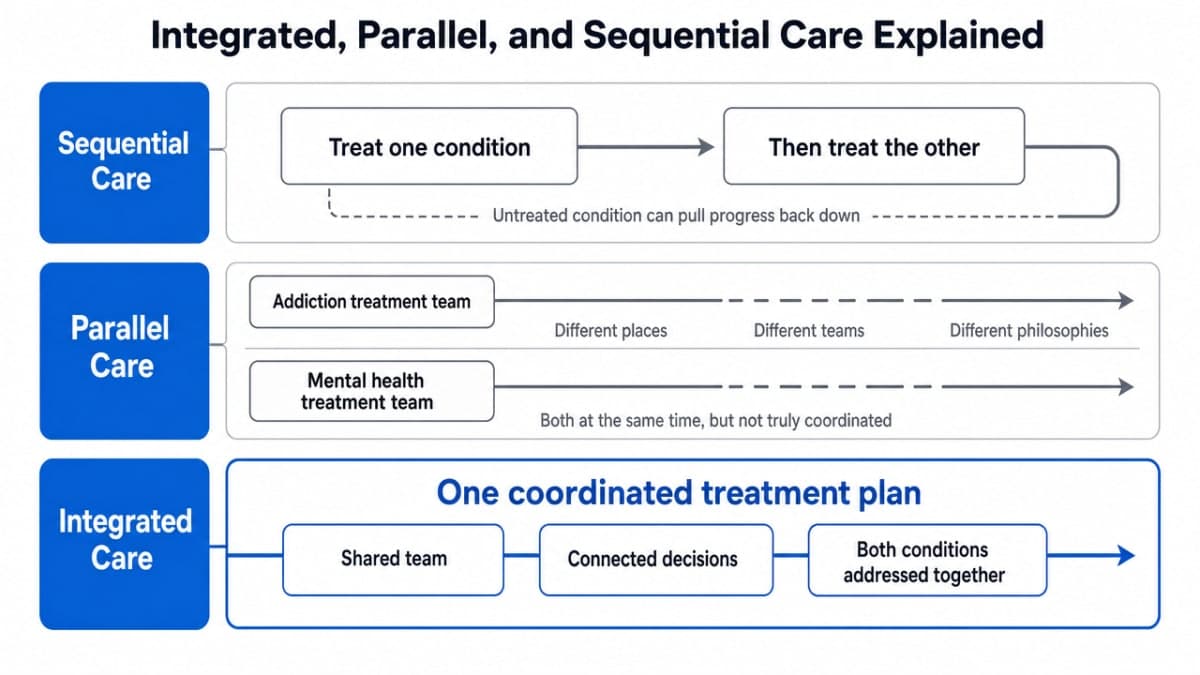
The word “dual diagnosis” gets used loosely, and that’s part of why the search for help can feel so frustrating. Three very different models often hide behind the same label, and knowing which one you’ve actually been offered matters more than the brochure suggests.
- Sequential care
- Treats one condition, then the other. You get sober first, then someone will look at the depression. Or you stabilize the bipolar disorder, then a separate program tackles the drinking. On paper it sounds orderly. In practice, the untreated condition tends to pull the treated one back down, and people cycle.
- Parallel care
- Treats both at the same time — but in two different places, by two different teams, often with two different treatment philosophies. The addiction counselor doesn’t talk to the psychiatrist. The psychiatrist adjusts medication without knowing you relapsed last weekend. You end up being the messenger between clinicians who never meet, which is a lot to ask of someone in the middle of a crisis.
- Integrated care
- Puts both conditions in front of the same team, in the same setting, at the same time. The psychiatrist managing your medications and the therapist working through trauma are talking to each other about you every week. Substance use is not treated as a moral side issue to the “real” mental health work, and vice versa.
The clinical case for integration isn’t a preference — it’s what the evidence points to. A peer-reviewed review of treatment approaches for co-occurring disorders concluded that integrated treatment models generally show better outcomes than parallel or sequential treatment 3. SAMHSA guidance reaches the same place, recommending that treatment of co-occurring disorders be integrated or closely coordinated with substance use treatment 1.
If you look back at the programs your loved one has already tried, ask yourself which model they actually delivered. A lot of what gets called dual diagnosis in Illinois is parallel care wearing an integrated label. That distinction is not a small one.
The Five Principles Behind Good Co-Occurring Care
SAMHSA’s TIP 42 lays out five guiding principles for treating co-occurring mental and substance use disorders, and they’re worth knowing because they give you a plain-language checklist for evaluating any program you’re considering 2.
- The first is that co-occurring disorders should be treated as the expectation, not the exception. If a program still talks about dual diagnosis as a special track for a small subset of patients, that’s an old frame.
- The second is empathy and hope. That sounds soft, but it has clinical teeth. Shame and confrontation-heavy models tend to push people with serious mental illness right back out the door. You want a program where staff know how to hold someone without hardening them.
- The third is a comprehensive, integrated assessment. Not a screening at intake and a separate psychiatric eval three weeks later — a single, layered picture of what’s happening. Medications, trauma history, substance use patterns, family dynamics, medical issues, all in one file that the whole team reads.
- The fourth is stage-wise treatment. Someone who is still ambivalent about change needs a different intervention than someone in active recovery. Good programs match the intervention to where the person actually is, not where the paperwork says they should be.
- The fifth is access to a full range of services over time. Co-occurring disorders don’t resolve in 28 days. Real integrated care assumes you’ll need different intensities of support at different points, and it plans for that from the start 2.
Hold these five up to any program that’s been offered. If most of them are missing, you already have your answer.
The Illinois Landscape: What the State Built and Where It Thins Out
Community Mental Health Services and the SUPR System
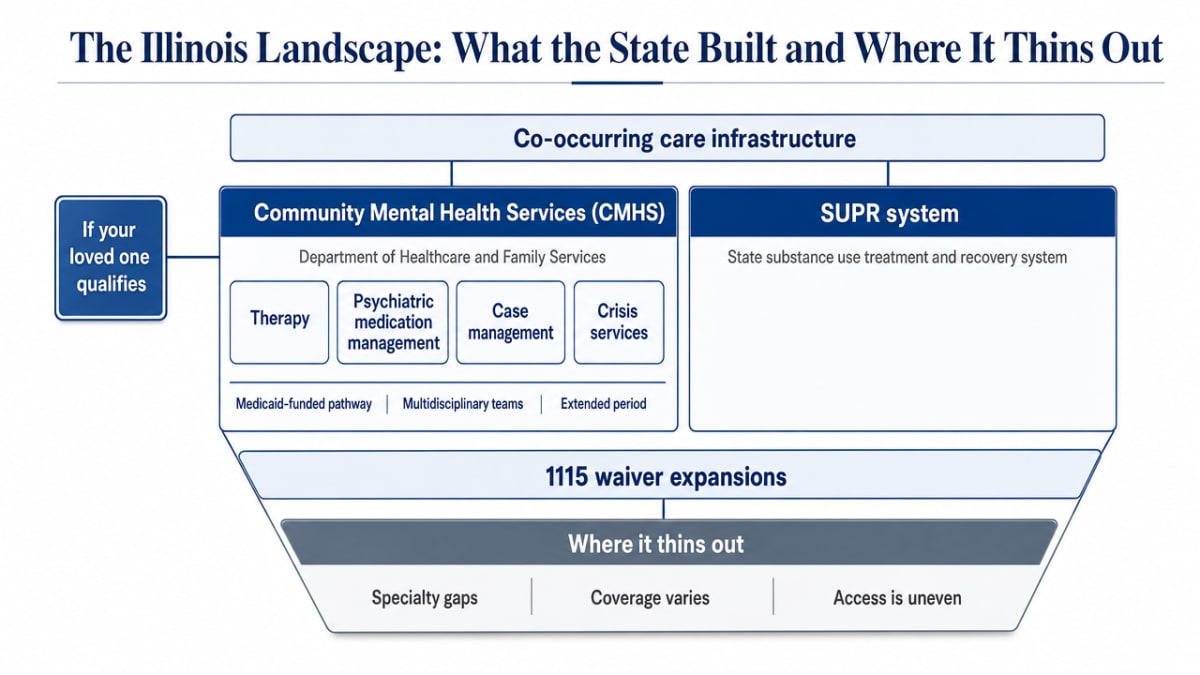
Illinois has more infrastructure for co-occurring care than most families realize when they’re first thrown into it. The state’s Community Mental Health Services program, run through the Department of Healthcare and Family Services, covers an inclusive array of community-based mental health and supportive services for adults with serious and persistent mental illness or co-occurring mental health and alcohol or substance use disorders 5. That’s the formal language. What it means in practice is that if your loved one qualifies, there’s a Medicaid-funded pathway to therapy, psychiatric medication management, case management, and crisis services delivered by multidisciplinary teams over an extended period 5.
Alongside that runs the SUPR system — the state’s Division of Substance Use Prevention and Recovery — which licenses addiction treatment providers across Illinois. Between the two, most counties have at least one door you can knock on. Rockford has community mental health centers. Peoria has SUPR-licensed outpatient programs. Springfield has both. Champaign-Urbana has residential and outpatient options tied to the university medical system.
For a moderate co-occurring case — someone whose depression and alcohol use are tangled but not yet unmanageable, or whose first serious mental health episode is showing up alongside cannabis use — this is often enough. The teams are trained, the framework is there, and the door opens.
What the framework doesn’t promise is that every door leads to the same room.
The 1115 Waiver and What It Covers Now
The bigger recent shift in Illinois is the Behavioral Health Transformation 1115 waiver, which CMS approved for extension in July 2024 7. If you’ve been in and out of programs for a few years, you may have felt some of these changes without knowing what they were called.
The waiver expanded what Illinois Medicaid pays for on the substance use side. It covers ASAM Level III.5 residential SUD treatment for eligible Medicaid members for up to 30 days, along with case management, withdrawal management, and recovery coaching 9. That’s meaningful — residential coverage used to be one of the sharpest cliffs in Illinois care. The approval document also states directly that where members have dual diagnoses, the waiver enhances the behavioral health services provided to them 9.
Statewide, Illinois projected about 400,000 Medicaid eligibles per year under the extension and built in coverage for health-related social needs, pre-release services for people leaving jails and prisons, violence prevention, and non-medical transportation 6, 7. Those pieces matter because dual diagnosis rarely shows up alone. Housing instability, transportation gaps, and re-entry from a short jail stay are often what pull a stable week apart.
Why Downstate and Rural Illinois Feel the Gaps First
The math of specialty care is not gentle to smaller markets. A community mental health center in a county of 40,000 people can staff generalists. It usually cannot staff a board-certified psychiatrist who has managed hundreds of clozapine titrations, or a trauma clinician who works exclusively with complex PTSD alongside active substance use. Those clinicians tend to cluster where the patient volume is — in Chicago, and to a lesser extent in the academic medical centers near Springfield, Peoria, and Urbana.
The clinical need in downstate and central Illinois is not smaller. If anything, it runs the other way. A 2023 peer-reviewed study of 2018 Illinois Medicaid claims covering more than 1.1 million adults found that beneficiaries with opioid use disorder or probable prescription opioid misuse had very high rates of multiple co-occurring substance use and mental health diagnoses — the authors described the findings as unequivocally indicating this population is at high risk for co-occurring conditions and highly likely to present with multiple SUDs and mental health disorders requiring coordinated interventions 8. That’s a state-specific picture of exactly the complexity that generalist teams struggle to hold.
What this looks like on the ground: you drive 90 minutes to the nearest psychiatrist who takes your insurance, get 20 minutes with them every six weeks, and the medication changes you need happen too slowly to catch a mood cycle before it breaks. Or the one dual-diagnosis-capable residential program within a reasonable radius has a six-week waitlist, and the crisis you’re in doesn’t wait six weeks.
None of this is a failure of the people working inside the Illinois system. Most of them are stretched. It’s a distribution problem, and if you live outside Chicago, you feel it first.
Signs a Case Has Moved Past Standard Local Care
Clinical Markers That Suggest a Higher Level of Specialization
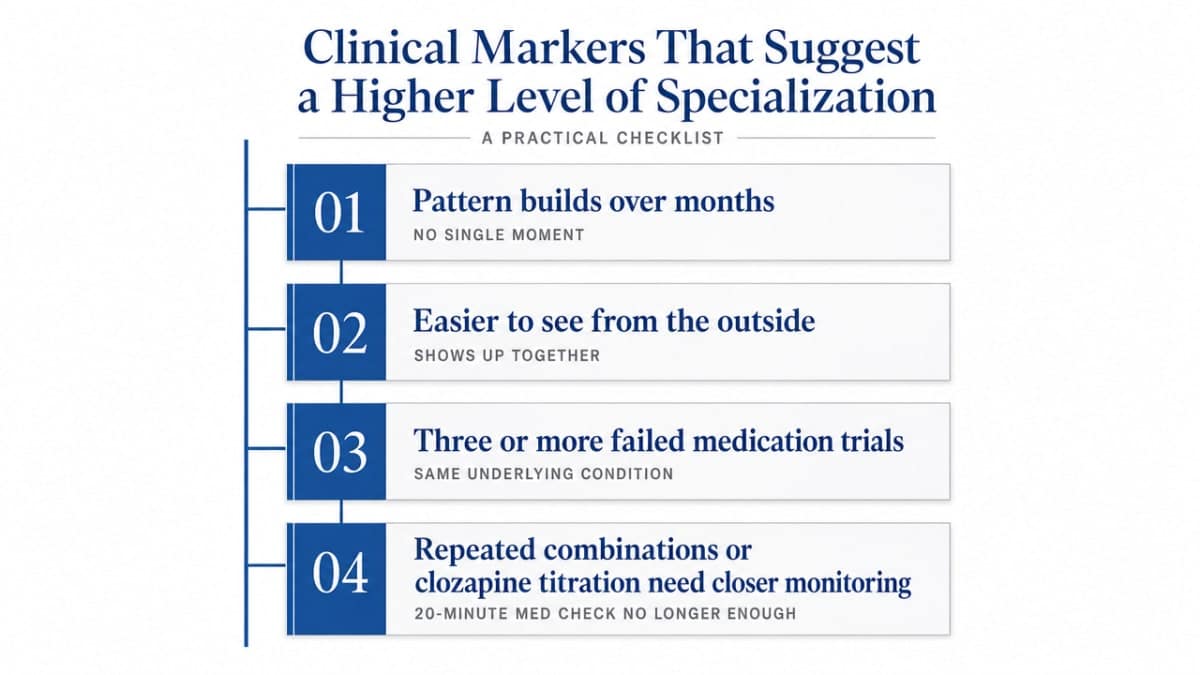
There isn’t a single moment when a case crosses from “still workable locally” to “time to look further.” It’s usually a pattern that builds over months, and it’s easier to see from the outside than from inside your own life. Here are the markers that most often show up together.
Multiple failed medication trials. If your loved one has been through three or more medications for the same underlying condition — antipsychotics that didn’t hold, mood stabilizers that stopped working, antidepressants that never quite landed — and the current prescriber is starting to repeat combinations you’ve already tried, the case has outgrown a 20-minute med check every six weeks. Complex regimens like clozapine titration for treatment-resistant psychosis require the kind of close monitoring most community outpatient settings aren’t staffed to provide.
Cycling through the same levels of care. A residential stay, then IOP, then a relapse, then another residential stay. If the loop has run more than twice, the level of care isn’t the problem. Something in the assessment or the integration between mental health and substance use treatment is missing. SAMHSA guidance is direct that co-occurring disorders call for integrated or closely coordinated treatment 1, and repeated cycling is often a sign that integration hasn’t actually happened.
Repeat hospitalizations or ER visits. Two or more psychiatric hospitalizations in a year, or a pattern of crisis ER visits between programs, points to a stabilization problem that outpatient care isn’t catching.
Stage mismatch. TIP 42’s principle of stage-wise treatment matters here — if every program has offered the same intensity of intervention regardless of where your loved one actually was in their readiness, the fit was probably never right 2.
One of these alone isn’t a verdict. Three of them together usually is.
What a Treatment-Resistant Presentation Actually Looks Like
“Treatment-resistant” sounds like a label reserved for the sickest of the sick, and that framing keeps a lot of families from using the term about someone they love. It shouldn’t. In psychiatric care, treatment-resistant is a working description, not a judgment. It means the standard menu has been tried in good faith and hasn’t produced durable stability.
In practice, the presentations tend to cluster. Rapid-cycling bipolar disorder tangled up with alcohol or stimulant use, where the mood swings and the substance use keep triggering each other. Schizophrenia or schizoaffective disorder with cannabis, methamphetamine, or opioid use layered on top, where medication non-adherence and substance use blur into one another. Complex PTSD with a decade of self-medication that never got named as trauma treatment. Severe depression that has survived multiple antidepressant trials and now sits alongside a benzodiazepine or alcohol dependence that started as sleep help.
These pictures are not rare. The Illinois Medicaid data on beneficiaries with opioid use disorder showed exactly this kind of layered complexity is common in the state’s own population 8. What makes them treatment-resistant isn’t the diagnosis — it’s that the standard approach of treating one piece at a time, in the settings most communities can staff, hasn’t been enough to hold the whole picture together.
If any of that sounds like the person you’re trying to help, you’re not exaggerating the situation. You’re describing it accurately, probably for the first time.
When Traveling Out of State Becomes a Clinical Decision
What Accreditation and Specialization Change Operationally
When people hear “accredited,” they think of a plaque on a wall. The operational reality is different, and it’s what actually matters for a treatment-resistant case.
Joint Commission accreditation means a facility has been audited against national standards for how care is delivered, how medications are managed, how staff are credentialed, and how safety events are tracked. For a dual diagnosis program, that translates into concrete things: a board-certified psychiatrist available on-site rather than a prescriber who visits twice a week, medication reconciliation that catches interactions before they cause a crisis, and a chart your loved one’s whole team actually reads together.
Specialization changes what that team can hold. A facility built specifically for treatment-resistant psychiatric conditions and complex dual diagnosis presentations doesn’t have to route someone with rapid-cycling bipolar and an opioid use history through three separate departments. The psychiatrist, the therapist, and the addiction clinician are the same team, and they’re already fluent in the pattern. Clozapine protocols for treatment-resistant psychosis, close monitoring during medication changes, and trauma-focused work that runs alongside substance use treatment instead of after it — these are things a specialty program does daily.
ViewPoint Dual Recovery, in Prescott, Arizona, is one of the facilities Illinois families end up looking at for this reason. It’s Joint Commission-accredited, focused on treatment-resistant mental health and dual diagnosis cases, and staffs 24/7 board-certified psychiatry. Length of stay is set by clinical need rather than by a fixed program calendar, which matters when the whole reason you’re looking further afield is that 28-day cycles haven’t held. That model reflects the SAMHSA guidance that co-occurring care should be integrated and delivered with the intensity the case actually requires 1.
How to Weigh the Move Without Overselling It to Yourself
Deciding to travel for care is heavy. It costs money, it pulls a family apart geographically for a stretch, and it carries the weight of “if this doesn’t work either.” You should be honest with yourself about all of it.
A few questions worth sitting with before you make the call.
- Has the local system genuinely been given a fair try, including any newer options the 1115 waiver expansion has opened up around residential coverage and case management 9? If a specialty program 90 minutes away exists and hasn’t been tried, that’s a shorter first step than a plane ticket.
- What is the specific clinical gap you’re trying to close? “Nothing is working” is a feeling; “three antipsychotics have failed and no one nearby manages clozapine” is a gap a specialty facility can actually address. The clearer the gap, the more useful the conversation with any out-of-state program will be.
- What does your loved one want? Someone who has been in and out of programs may need to be part of the decision to travel, not moved like a package. Stage-wise treatment starts with readiness 2.
- What does your support network look like during and after? Travel-for-care works best when there’s a plan for what happens when your loved one comes home to Illinois — a local prescriber, an outpatient team, a way to keep the gains from unraveling.
If most of those questions have real answers, the move isn’t overselling. It’s a next step.
Talking to Admissions: A Call, Not a Commitment
The hardest part of picking up the phone is the feeling that dialing means agreeing to something. It doesn’t. A first call with an admissions team is a conversation, and a good one will feel that way — someone asking careful questions about what’s been tried, what’s happening now, and what you’re actually trying to figure out.
When you call ViewPoint’s admissions team, expect the questions to go deeper than intake paperwork. What medications have been tried and for how long? What diagnoses are on the chart, and which ones have shifted over the years? What did the last few programs look like — residential, IOP, PHP — and where did things unravel? Is there a current prescriber in Illinois, and what have they said about next steps? The point isn’t to gatekeep. It’s to figure out, honestly, whether a specialty program built for treatment-resistant and complex dual diagnosis presentations is actually the right next move, or whether something closer to home hasn’t been fully explored yet.
You can also ask your own questions. What does the psychiatric team look like day to day? How is length of stay decided? What happens when your loved one comes back to Illinois — how does the handoff to a local prescriber and outpatient team work? A serious program will answer those directly.
If you’re the family member making the call, you don’t have to have your loved one on board yet. Plenty of first conversations start with someone gathering information for a decision that isn’t fully made. That’s allowed. Getting clearer on what’s possible is its own kind of progress, and this week, that might be the step that counts.
Start a conversation about complex dual diagnosis care
Connect with specialists who understand the unique needs of Illinois families facing treatment-resistant conditions.
Frequently Asked Questions
What does integrated dual diagnosis treatment actually mean?
Integrated care means one team treats both the mental health condition and the substance use condition at the same time, in the same setting, with clinicians who actually talk to each other about your loved one. The psychiatrist adjusting medications knows what happened in yesterday’s therapy session. SAMHSA guidance is direct that co-occurring disorders should be treated with integrated or closely coordinated care rather than in separate silos 1.
Does Illinois Medicaid cover dual diagnosis treatment?
Yes, in meaningful ways. Illinois Medicaid covers community-based mental health services for adults with serious mental illness and co-occurring substance use disorders through the state’s Community Mental Health Services program 5. The Behavioral Health Transformation 1115 waiver, approved for extension in July 2024, also expanded coverage to include ASAM Level III.5 residential SUD treatment for up to 30 days, case management, withdrawal management, and recovery coaching 7, 9.
How do I know if local Illinois programs are no longer the right fit?
Look for a pattern rather than one bad month. Three or more failed medication trials for the same underlying condition, repeat hospitalizations within a year, and cycling through the same levels of care (residential, then IOP, then relapse, then residential again) usually mean the assessment or the integration between mental health and substance use treatment is missing. If most of those show up together, the current level of local support probably isn’t enough.
Why are specialized dual diagnosis options thinner outside of Chicago?
Sub-specialists cluster where patient volume supports them. A community mental health center in a small downstate county can staff generalists but rarely a psychiatrist who runs clozapine protocols daily or a trauma clinician who works alongside active substance use. The need is not smaller downstate — Illinois Medicaid data shows beneficiaries with opioid use disorder present with very high rates of multiple co-occurring conditions 8. It’s a distribution problem, not a demand one.
When does it make clinical sense to travel out of state for care?
Travel becomes reasonable when you can name a specific clinical gap the local system hasn’t closed — like failed antipsychotic trials with no nearby prescriber managing clozapine, or complex bipolar with substance use that keeps unraveling after short residential stays. Confirm the newer waiver-expanded options have been tried first 9. If the gap is still there, a specialty program built for treatment-resistant presentations is a legitimate next step, not an overreaction.
What should I expect from a first call with an admissions team?
A conversation, not a commitment. Expect careful questions about medications tried, diagnoses on the chart, previous programs, and what your current Illinois prescriber has said. You can ask your own: what the psychiatric team looks like day to day, how length of stay is decided, and how the handoff back to a local outpatient team works. A serious program answers directly. You don’t need your loved one on board yet to gather information.
References
- Chapter 12. Treatment of Co-Occurring Disorders (Treatment Improvement Protocol). https://www.ncbi.nlm.nih.gov/books/NBK64163/
- Substance Abuse Treatment for Persons With Co-Occurring Disorders (TIP 42). https://library.samhsa.gov/product/substance-abuse-treatment-persons-co-occurring-disorders/sma10-4531
- Co-occurring Mental Health and Substance Use Disorders: A Review of Treatment Approaches. https://pubmed.ncbi.nlm.nih.gov/32007085/
- Mental Health Conditions and Substance Use Among Adults — United States, 2022. https://www.cdc.gov/mmwr/volumes/73/wr/mm7302a1.htm
- Community Mental Health Services. https://hfs.illinois.gov/content/dam/soi/en/web/hfs/medicalproviders/medicaidreimbursement/cmhp/archive/07011cmhs.pdf
- [PDF] Illinois Behavioral HEalth Transformation 1115 Demonstration. https://www.medicaid.gov/medicaid/section-1115-demonstrations/downloads/il-behave-health-transform-pa-06232023.pdf
- About the Illinois Healthcare Transformation 1115 Waiver. https://hfs.illinois.gov/medicalproviders/cc/abouttheiht1115waiver.html
- Mental health and substance use disorder comorbidities among Illinois Medicaid beneficiaries with opioid use disorder and probable prescription opioid misuse. https://pmc.ncbi.nlm.nih.gov/articles/PMC10567978/
- Illinois Behavioral Health Transformation 1115 Demonstration Waiver (Approval Document). https://www.medicaid.gov/Medicaid-CHIP-Program-Information/By-Topics/Waivers/1115/downloads/il/il-behave-health-transform-pa.pdf
- Co-occurring Mental Health and Substance Use Disorders of Women in Prison: An Evaluation of the WestCare Foundation’s Dual Diagnosis Program in Illinois. https://icjia.illinois.gov/researchhub/articles/co-occurring-mental-health-and-substance-use-disorders-of-women-in-prison-an-evaluation-of-the-westcare-foundation-s-dual-diagnosis-program-in-illinois