

Key Takeaways
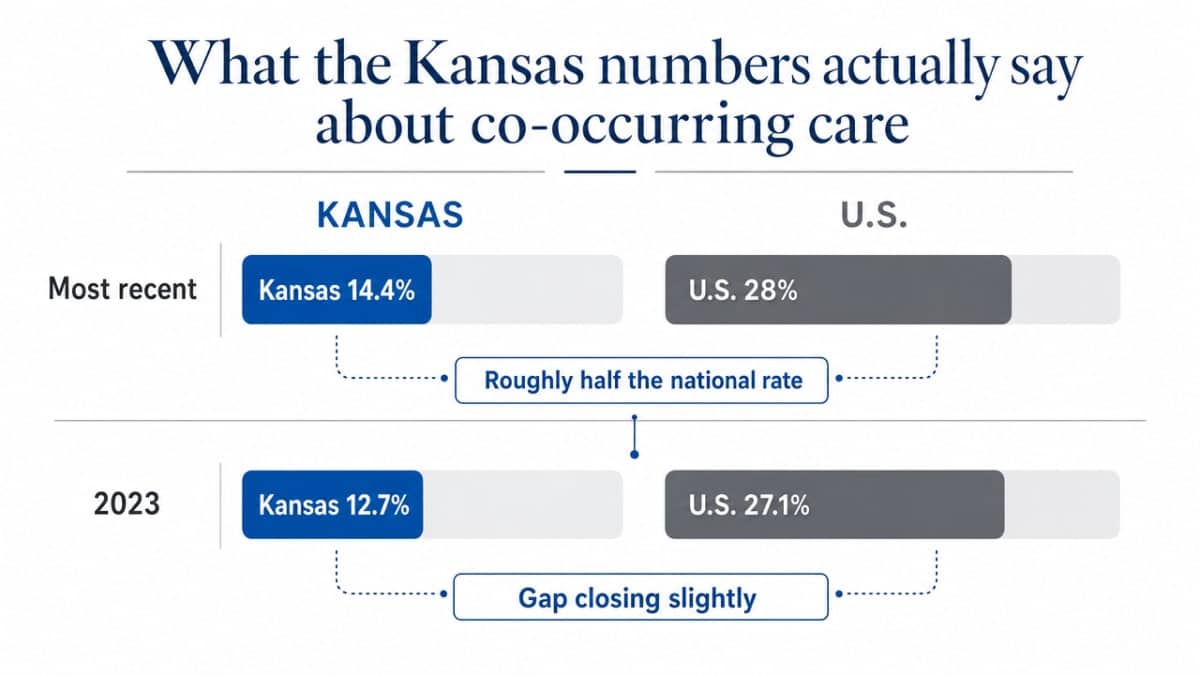
- Kansas identifies co-occurring disorders in only 14.4% of adults served through its state mental health system, roughly half the 28% national rate 7.
- In-state capacity falls short because 129 of 450 licensed Psychiatric Residential Treatment Facility beds sit unstaffed, and rural regions lack psychiatrists and substance use specialists 8, 4.
- Kansas parity law requires equal financial treatment for behavioral health, but plans still require prior authorization and may need single case agreements for out-of-network residential care 11, 12.
- Families should verify out-of-network residential benefits, gather prior treatment records and medication lists, and ask discharge planners to line up Kansas outpatient providers before returning home.
What the Kansas numbers actually say about co-occurring care
If you’ve been trying to find real dual diagnosis care for someone you love in Kansas, you’ve probably already sensed that the system isn’t catching what you’re seeing at home. The state data confirms it.
In the most recent Uniform Reporting System tables, only 14.4% of adults served through the Kansas State Mental Health Authority were identified as having a co-occurring mental health and substance use disorder, compared with a U.S. average of 28% 7. That’s roughly half the national identification rate. The 2023 figure was 12.7% against a national rate of 27.1%, so the gap is closing slightly, but slowly 10. When you’ve watched a family member cycle through detox, then a psych admission, then back to detox because no one seemed to be treating both conditions at the same time, this is the number underneath that experience.
A low identification rate doesn’t mean fewer Kansans have co-occurring disorders. It means the public system is coding fewer of them as co-occurring, which shapes what treatment gets built, funded, and referred to. When SAMHSA describes integrated treatment as combining mental health and substance use services “in a coordinated fashion” for the same person at the same time, it assumes a system that first recognizes the two conditions are showing up together 1. Kansas often doesn’t get past the first step.
So when a discharge planner tells you they’re not sure where to send your loved one next, or when a program says they can address the depression once the drinking is stable, they aren’t necessarily wrong about their own scope. They’re operating inside a state system that identifies co-occurring cases at about half the national rate. That’s the starting point for the rest of your search.
How many Kansans this actually involves
The scale of what you’re up against isn’t small, and it’s worth seeing the number so you stop second-guessing whether your family’s situation is unusual. According to the 2023 National Survey on Drug Use and Health, roughly 181,000 Kansas adults live with a co-occurring substance use disorder and any mental illness, and about 65,000 Kansas adults have a co-occurring substance use disorder alongside a serious mental illness 5. That second group is the one most likely to have been through detox, a psychiatric hold, an outpatient program, and another detox without anyone stitching the pieces together.
Compare those population numbers to what actually gets identified inside the state mental health system, and the mismatch is easier to see. Kansas serves a fraction of the co-occurring population through its public system, and even inside that system, dual diagnosis is coded at rates well below national averages. The people who fall between those lines are usually the ones private families end up trying to place on their own.
What this means practically: you are not looking for a rare bed because your loved one is unusual. You are looking for a rare bed because the specialized supply hasn’t scaled to the actual population. Tens of thousands of Kansans need integrated care in any given year. Only a small share of programs anywhere in the country are built to deliver it, which is why the search feels the way it does. Naming the size of the group isn’t meant to overwhelm you. It’s meant to move the shame out of the room so you can keep making calls with a clearer head.
Why in-state capacity keeps falling short
The shortage you’re running into isn’t a matter of Kansas providers not caring. It’s a structural mismatch between what exists on paper and what can actually admit your loved one this week.
Start with the workforce. The Kansas Department of Health and Environment’s 2024 behavioral health report names the problem plainly: several rural regions face significant shortages of behavioral health professionals, particularly psychiatrists and substance use disorder specialists 4. If you live outside Wichita, Topeka, Kansas City, or Lawrence, the pool of clinicians credentialed to manage complex psychiatric medications alongside active addiction treatment thins out quickly. A general outpatient therapist an hour from home is not the same as a board-certified psychiatrist who can adjust a mood stabilizer while a person is also being treated for alcohol dependence.
Then there’s the bed math. Kansas has 450 licensed Psychiatric Residential Treatment Facility beds, but as of March 2025, 129 of them sit unstaffed, mostly because there aren’t enough workers to open them 8. That’s roughly 29% of the state’s most intensive youth psychiatric capacity sitting dark. The wait list attached to the beds that are running included 58 individuals, 25 of them in foster care 8. When you hear “there’s a wait,” this is what’s underneath the sentence. It isn’t that Kansas doesn’t want the capacity. The licenses are issued. The people to run the units aren’t there.
The adult side has its own version of the same problem. A SAMHSA facility survey found that about 87.7% of treatment facilities nationally offer both mental health and substance use services 6. That sounds encouraging until you sit with what “offer both” actually covers. A facility can hold both licenses, run parallel programs down separate hallways, and still hand your loved one two treatment plans that don’t talk to each other. Offering both is a checkbox. Integrating them, in the way SAMHSA’s evidence-based practices kit describes coordinated care for the same person at the same time, is a clinical model that requires cross-trained staff, shared documentation, and unified case conceptualization 1.
So when your search keeps producing the same short list, it isn’t your effort that’s the problem. It’s the supply. Licensed beds you can’t get into, rural regions without a prescriber, and facilities that technically offer both services but treat them in parallel. That combination is why families in your position start looking at what specialized programs outside Kansas can do differently.
What ‘dual diagnosis capable’ actually means clinically
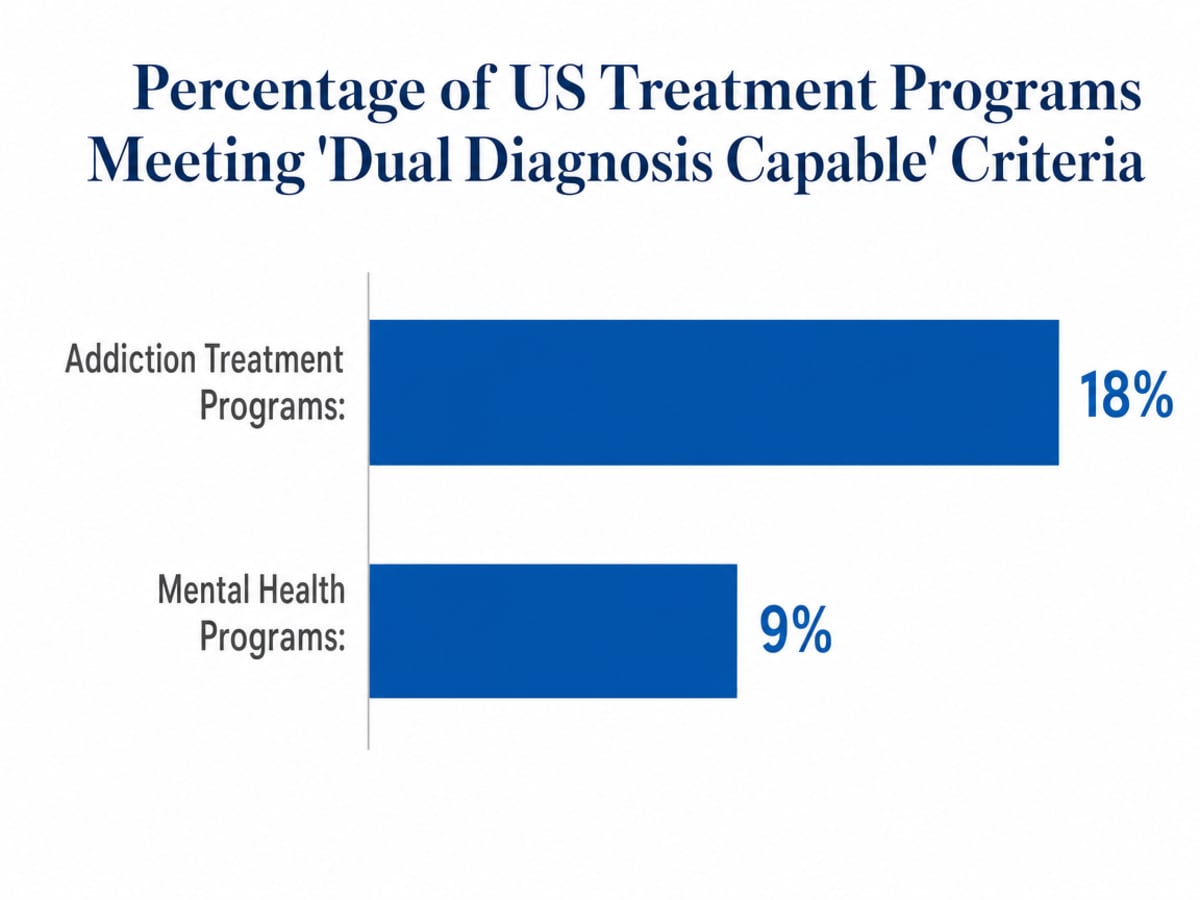
When a program tells you they treat dual diagnosis, it’s fair to ask what that phrase means to them, because it isn’t a protected term. Researchers have actually tried to answer this. Using standardized measurement tools, a national survey by McGovern and colleagues assessed how many U.S. programs meet the criteria for being dual diagnosis capable, meaning they can address co-occurring mental health and substance use disorders in an integrated, evidence-based way. The result: about 18% of addiction treatment programs and 9% of mental health programs cleared that bar 2. Roughly one in six on the addiction side. Fewer than one in ten on the mental health side. That’s the national floor you’re searching against.
Set that next to SAMHSA’s definition of integrated treatment, which combines mental health and substance use services in a coordinated fashion for the same person, delivered by the same clinical team, at the same time 1. That last phrase does most of the work. Coordinated care is not two treatment plans stapled together at discharge. It’s one case conceptualization where the psychiatrist adjusting a bipolar medication is talking to the therapist running relapse prevention groups, and both of them are working from a shared understanding of how the trauma history, the drinking, and the mood cycling feed each other.
A dual diagnosis capable program, in practice, has a few markers you can listen for on an intake call:
- Staff are cross-trained in both mental health and addiction, not siloed by license.
- Screening for both conditions happens at admission for every patient, not only when a red flag surfaces.
- Psychiatric medication management continues through the substance use portion of treatment rather than being paused.
- Group and individual therapy address both conditions in the same room, using clinicians who can hold both frames at once.
- Family sessions include education about how the two disorders interact, not just about addiction or just about mental illness.
This is why the earlier N-SUMHSS figure, that 87.7% of facilities nationally offer both services, doesn’t answer the question you actually need answered 6. Offering both is a directory listing. Integrating both is a clinical model, and the McGovern numbers tell you how rare the model is. When you ask an admissions team how they handle a patient whose depression drives the drinking and whose drinking derails every antidepressant trial, listen for whether they describe one team or two.
When crossing state lines is a clinical decision, not a defeat
There’s a moment in most of these searches when someone, often a case manager or a therapist you trust, says the quiet part out loud: you might need to look outside Kansas. If that landed hard, it makes sense. You’d rather your loved one recover an hour from home than a plane ride away. Nothing about that instinct is wrong.
But consider what the map actually looks like. Kansas isn’t an outlier. Missouri families run into the same pattern: a rural workforce shortage, a small number of programs that treat both conditions in one coordinated model, and long waits for the intensive beds that do exist. The KDHE 2024 report is direct about the psychiatrist and SUD specialist shortages across rural Kansas 4. When you widen the search to a regional footprint, you’re not giving up on in-state care. You’re acknowledging that specialized dual diagnosis capable programs are geographically clustered, and the closest one that fits your loved one’s clinical picture may sit across a state border.
For a person who has already been through two or three programs that didn’t hold, the clinical question isn’t “in-state or out-of-state.” It’s “who can actually treat what’s happening.” A residential program built around integrated psychiatric and substance use care, with 24/7 board-certified psychiatry and medication strategies for complex presentations, is a different intervention than another round of the local option that didn’t work last time. If a program has told you your family member is “too complex,” that phrase is worth taking seriously, and it’s worth matching to a setting designed for exactly that.
Crossing state lines also changes something practical: distance can reduce the daily triggers, the familiar places, the phone calls that pull someone back into the pattern they came to break. That’s not a marketing point. It’s a clinical variable clinicians talk about when they recommend residential care in the first place. You aren’t abandoning Kansas. You’re choosing the setting most likely to hold.
Kansas insurance rules you should understand before you call
Before you get on the phone with an admissions team, it helps to know what your policy actually has to cover, what it will ask for in return, and what the person on the other end of the line will need from you. The Kansas rules aren’t hostile to dual diagnosis treatment for Kansas residents. They just have specific mechanics, and understanding them ahead of time keeps you from being surprised in the middle of an already hard conversation.
What Kansas parity law does and does not guarantee
Kansas has a statute on the books, § 40-2,105a, that requires group health insurance policies covering medical, surgical, or hospital expenses to also cover the diagnosis and treatment of mental illnesses, alcoholism, drug abuse, and other substance use disorders 11. The coverage has to extend to both inpatient and outpatient care in licensed medical facilities, and it has to sit under the same deductibles and limitations as medical-surgical benefits 11. That’s the parity floor.
What the statute does not do is guarantee that any specific program will be in your plan’s network, or that the plan will approve any specific length of stay. Parity means the plan can’t apply harsher financial rules to behavioral health than it does to a knee surgery. It doesn’t override utilization review, network design, or medical necessity determinations.
So when you call about a residential dual diagnosis program, the right question isn’t “is this covered?” It’s more specific: what’s the plan’s out-of-network benefit for inpatient behavioral health, what’s the deductible and coinsurance at that tier, and does the plan use a single case agreement process when an in-network option isn’t clinically appropriate? Those are the answers that tell you what a Kansas policy will actually do for an out-of-state admission.
Prior authorization for inpatient behavioral health
Almost every plan a Kansas family will encounter requires prior authorization for inpatient behavioral health. The state employee plan spells this out directly: all medical, behavioral health, and substance use disorder inpatient admissions require prior authorization, and notice should be given in advance of any planned inpatient behavioral health or SUD admission 12. Commercial plans in Kansas follow a similar pattern, even if the exact wording varies.
In practice, that means the admitting facility, not you, will call the plan’s third-party administrator with a clinical picture: current symptoms, prior treatment history, failed lower levels of care, safety concerns, and the reason a residential level of care is medically necessary right now. The plan then issues an initial authorization for a set number of days, with continued stay reviews after that.
The reason this matters before you call: a good admissions team will ask you for the exact information they need to make that authorization call. Insurance card front and back, subscriber name and date of birth, prior treatment records, current medications, and a description of the recent episode that brought you to this decision. Having those ready shortens the gap between your first call and an actual admission date. It also lets the admissions team push back on a plan’s initial length-of-stay determination with real clinical detail rather than a generic request.
A short checklist for your verification call
When you’re ready to have a benefits conversation, whether you’re calling your plan directly or asking an admissions team to run verification for you, these are the specifics worth having in front of you. Write the answers down. Plans change their positions across a single case, and a written record protects you.
- Policy details: subscriber name, date of birth, member ID, group number, plan administrator phone number on the back of the card.
- Benefit tier: in-network and out-of-network benefits for residential inpatient behavioral health and SUD treatment, listed separately.
- Cost share: current deductible, amount met year to date, coinsurance percentage after deductible, out-of-pocket maximum, amount met year to date.
- Authorization path: whether prior authorization is required, who submits it, and typical turnaround time.
- Length of stay: how initial authorizations are set and how continued stay reviews are conducted.
- Single case agreements: whether the plan will consider one if no in-network program meets the clinical need.
- Appeals: the process and timeline for appealing a denial or a shortened stay.
An out-of-state admissions team that works with Kansas families regularly should be able to run most of this for you once you share the policy details. You don’t have to assemble the whole picture alone.
What an out-of-state admission from Kansas usually looks like
Once you’ve decided a specialized program outside Kansas is worth a real look, the process itself is more predictable than it feels from where you’re standing. Most out-of-state residential admissions move through the same five stages, and knowing the shape of them helps you keep your footing.
The first call. This is a clinical conversation, not a sales pitch. An admissions coordinator will ask what’s been happening recently, what programs your loved one has already tried, what medications are in play, and what the current safety picture looks like. Expect it to run 20 to 45 minutes. You don’t need a polished summary. Bring the messy version, including the phrase “too complex” if a prior program used it, because that phrase actually helps a specialized team decide whether their model fits.
Insurance verification. With the policy details from your checklist in hand, the admissions team runs benefits directly with your plan and comes back with an out-of-network residential quote: deductible remaining, coinsurance, out-of-pocket maximum, and an estimate of what the stay will cost you at that tier. Because Kansas parity law puts behavioral health under the same financial rules as medical-surgical care, the numbers should track with what a similar-length medical admission would cost 11. This is also when the team submits the prior authorization request that most Kansas plans require for inpatient behavioral health 12.
Clinical intake. A psychiatrist or clinical lead reviews the records, medication list, and prior treatment history to confirm the program can actually treat what’s happening. If your loved one has been called “too complex,” this is the step where a specialized team either says yes with a plan or refers you somewhere better suited. A yes here is worth more than a yes at the front desk.
Travel logistics. From Kansas, this usually means a flight into the closest regional airport with a facility pickup on the other end, or a driven route if that fits better clinically. The admissions team coordinates the timing so your loved one arrives during clinical hours, not at 11 p.m. into an empty lobby. If there’s a safety concern about traveling alone, they’ll walk you through options, including sober transport.
Arrival and family communication. Admission day includes a medical check, a psychiatric evaluation, and a room. You’ll get a named contact for family updates and a schedule for the first family call. That last piece matters more than families expect. Being 900 miles away is easier when you know exactly when the next phone call happens.
Bringing care home: discharge planning back to Kansas
Good residential programs start planning discharge on the intake call, not the week before the flight home. From the Kansas side, that means the out-of-state team should be asking early about who’s on the ground where you live: the outpatient psychiatrist, the therapist, the primary care doctor, the sponsor or peer support person if there is one, and any community mental health center already involved. If any of those slots are empty, the discharge planner’s job is to help you fill them before your loved one lands back in Wichita or Topeka.
The practical handoff usually includes a written discharge summary sent to the receiving Kansas providers, a medication list with recent adjustments and reasoning, a relapse prevention plan, and a scheduled first outpatient appointment ideally within a week of return. If your plan required prior authorization for the residential stay, the same utilization review process may apply to any step-down level of care like a partial hospitalization or intensive outpatient program back home 12. Ask the discharge planner to start those authorizations while your loved one is still in residential.
Start Your Dual Diagnosis Assessment Today
Get expert guidance on next steps for Kansas families facing complex, treatment-resistant challenges.
Frequently Asked Questions
Why is it so hard to find dual diagnosis treatment in Kansas?
The shortage is structural, not personal. Kansas has 129 licensed Psychiatric Residential Treatment Facility beds sitting unstaffed out of 450 total, mostly for lack of workers 8, and rural regions face documented shortages of psychiatrists and substance use specialists 4. The supply of programs that can truly integrate both conditions hasn’t scaled to meet the need, so families keep hitting the same short list.
What does ‘dual diagnosis capable’ actually mean, and how is it different from a program that treats both mental health and substance use?
SAMHSA defines integrated treatment as coordinated mental health and substance use care delivered by one team, for the same person, at the same time 1. A dual diagnosis capable program meets standardized criteria for that model. Only about 18% of addiction programs and 9% of mental health programs cleared that bar in a national survey 2. Offering both services on paper isn’t the same as integrating them clinically.
Will my Kansas insurance cover an out-of-state residential dual diagnosis program?
Kansas parity law, § 40-2,105a, requires group health policies to cover diagnosis and treatment of mental illness and substance use disorders under the same financial rules as medical-surgical care, including inpatient and outpatient benefits 11. That doesn’t guarantee any specific program is in-network. Ask about out-of-network residential benefits, coinsurance, out-of-pocket maximum, and single case agreements. Expect the plan to require prior authorization for any inpatient behavioral health admission 12.
Is it a bad sign that we’re being told to look outside Kansas for care?
No. It’s often a clinical read of the map. KDHE’s 2024 report is direct about workforce shortages in rural Kansas, particularly for psychiatrists and SUD specialists 4. Specialized dual diagnosis capable programs are geographically clustered, and the closest one that fits a complex presentation may sit across a state line. Choosing that setting is a treatment decision, not a failure of your local search.
What should I have ready before I call an out-of-state admissions team?
Have the insurance card front and back, subscriber name and date of birth, group number, and the plan administrator phone number. Add a brief history: prior programs, current medications, recent psychiatric or detox admissions, and what’s happening at home right now. If any provider used the phrase “too complex,” mention it. That description helps an admissions team decide quickly whether their model actually fits.
What happens when my loved one comes back to Kansas after residential treatment?
Discharge planning should start on the intake call. Expect a written summary sent to Kansas providers, an updated medication list, a relapse prevention plan, and a first outpatient appointment ideally within a week of return. Any step-down level of care, like a partial hospitalization or intensive outpatient program back home, will likely need its own prior authorization 12. Ask the discharge planner to start that process early.
References
- Integrated Treatment for Co-Occurring Disorders Evidence-Based Practices (EBP) KIT. https://library.samhsa.gov/product/integrated-treatment-co-occurring-disorders-evidence-based-practices-ebp-kit/sma08-4366
- Dual diagnosis capability in mental health and addiction treatment services: A national survey. https://pmc.ncbi.nlm.nih.gov/articles/PMC3594447/
- KanCare Section 1115 Demonstration – Interim Evaluation Report on Substance Use Disorder (January 4, 2023). https://www.medicaid.gov/medicaid/section-1115-demonstrations/downloads/ks-kancare-appvd-int-eval-rpt-sud-01042023.pdf
- Behavioral Health in Kansas: 2024 Report. https://www.kdhe.ks.gov/documentcenter/view/26958/behavioral-health-in-kansas-2024-report
- KANSAS – National Survey on Drug Use and Health State Tables, 2023. https://www.samhsa.gov/data/sites/default/files/reports/rpt56188/2023-nsduh-sae-state-tables_0/2023-nsduh-sae-state-tabs-kansas.pdf
- 2024 Data on Substance Use and Mental Health Treatment Facilities – N‑SUMHSS Annual Report. https://www.samhsa.gov/data/report/2024-n-sumhss-annual-report
- 2024 Uniform Reporting System (URS) Output Tables for Kansas. https://www.samhsa.gov/data/report/2024-uniform-reporting-system-urs-table-kansas
- Kansas KDADS Presentation to Robert G. (Bob) Bethell Joint Committee on Home and Community Based Services and KanCare Oversight (April 14, 2025). https://www.kslegislature.gov/li/b2025_26/committees/ctte_jt_robert_g_bob_bethell_joint_committee_1/documents/testimony/20250414_23.pdf
- Kansas 2020 Uniform Reporting System Mental Health Data Results. https://www.samhsa.gov/data/sites/default/files/reports/rpt35288/Kansas.pdf
- Kansas 2023 Uniform Reporting System Mental Health Data Results. https://www.samhsa.gov/data/sites/default/files/reports/rpt53119/Kansas.pdf
- Kansas Statutes § 40-2,105a – Mental Illness and Substance Use Disorder Coverage. https://www.kslegislature.gov/b2025_26/laws/040_000_0000_chapter/040_002_0000_article/040_002_0105a_section/040_002_0105a_k
- Kansas State Employee Health Plan – 2026 Plan C Benefit Description (BCBSKS). https://sehp.healthbenefitsprogram.ks.gov/media/cms/2026_Plan_C__BCBSKS_final_21c4375c88d59.pdf