Key Takeaways
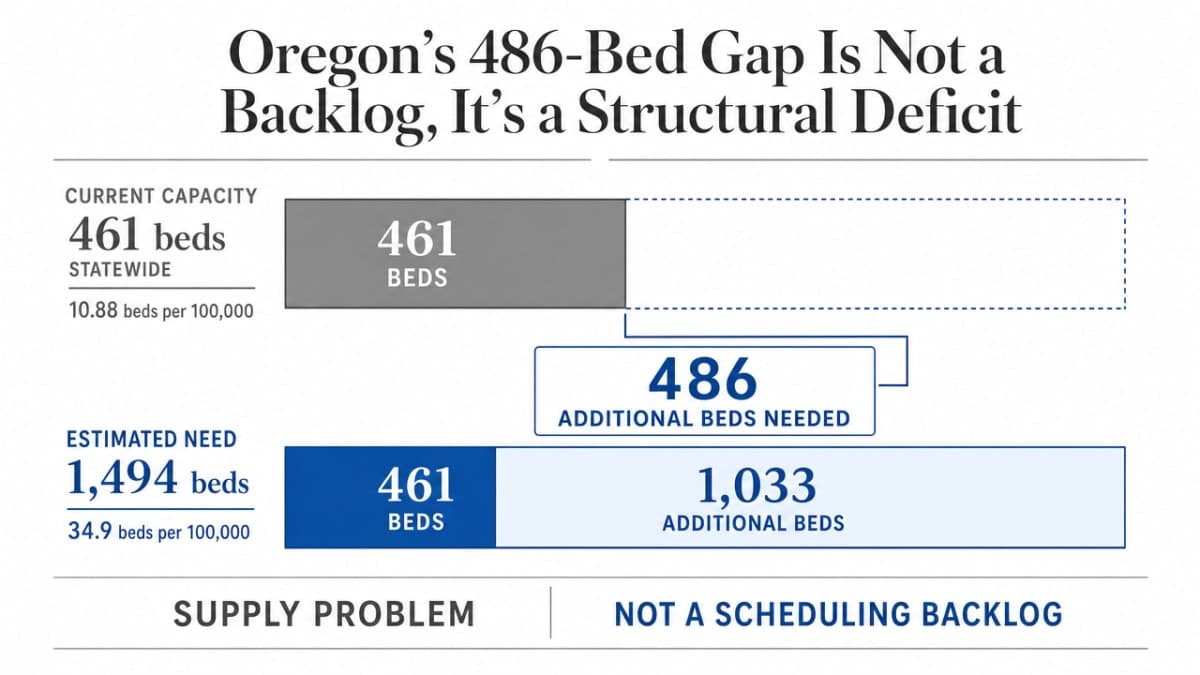
- Oregon operates roughly 461 inpatient psychiatric beds against an estimated need of 1,494, a structural 486-bed deficit that no local waitlist can eventually clear 7, 8.
- Washington’s LTCC expansion and state hospitals cannot absorb high-acuity civil patients, with Western State running at 98 percent civil capacity and several counties still uncovered 3, 4.
- Voluntary, long-term specialty care for treatment-resistant schizophrenia, rapid-cycling bipolar, and dual diagnosis was largely never built in the Northwest, pushing families to look across state lines.
- Before releasing records out of state, confirm psychiatrist coverage, clozapine experience, integrated dual-diagnosis staffing, and whether length of stay is set clinically rather than by an insurance clock.
When the Northwest Runs Out of Beds Before You Run Out of Options
You already know the pattern. A crisis, an ED, a hold, a discharge back to a situation nobody thinks is safe. Maybe a 90-day order that ended in a placement nobody would call treatment. Maybe a call from a case manager saying the waitlist for a long-term civil bed is what it is, and there is no realistic date attached to it.
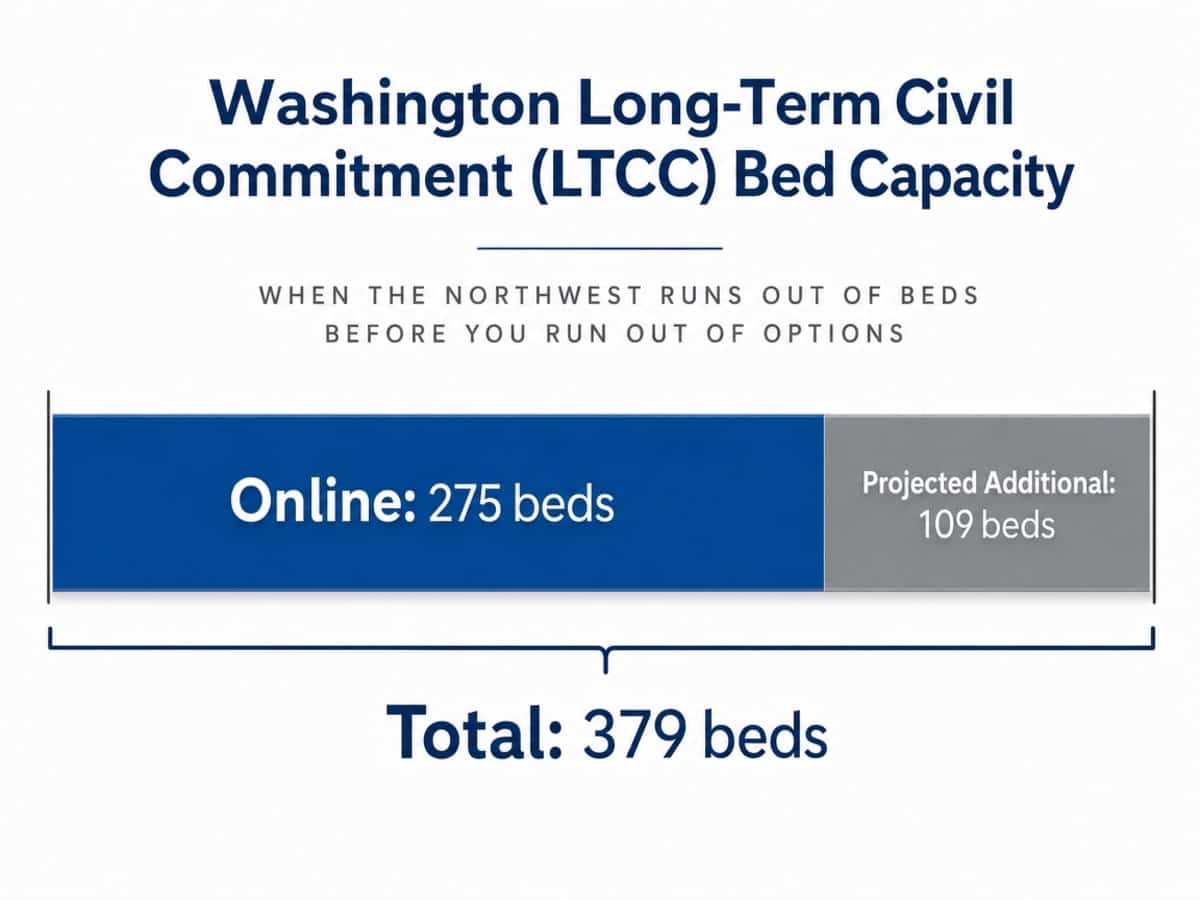
If you are reading this from Portland, Spokane, Bend, or somewhere along the Columbia Gorge, you are not imagining the shortage. Oregon’s own state-commissioned analysis puts current inpatient psychiatric capacity at 461 beds against an estimated need of 1,494, a gap of roughly 486 beds 7, 8. Washington has 275 long-term civil commitment beds online, with another 109 anticipated, and state hospitals are running near full 1, 3. Those numbers are the reason your local system keeps telling you the same thing in different words.
Looking out of state is not abandonment. It is arithmetic. When the beds built for treatment-resistant schizophrenia, rapid-cycling bipolar, and dual diagnosis do not exist in the region, families and referring clinicians do what the math requires and search where the beds actually are.
This piece names the shortage in specifics, walks through what happens to a high-acuity patient inside the current Northwest pipeline, and lays out how to weigh an out-of-state placement without pretending the decision is simple.
The Math Behind the Shortage
Oregon’s 486-Bed Gap Is Not a Backlog, It’s a Structural Deficit
When your case manager says there is nowhere to send your family member for long-term psychiatric care, that is not a scheduling problem. It is a supply problem, and Oregon has done the counting to prove it.
The state’s own commissioned analysis, conducted by Public Consulting Group for the Oregon Health Authority, put current inpatient psychiatric capacity at roughly 461 beds statewide, or 10.88 beds per 100,000 population 8. Using a benchmark of 34.9 beds per 100,000, the same analysis estimated Oregon actually needs about 1,494 acute inpatient psychiatric beds 7. The final June 2024 report translated that gap into a concrete number: 486 additional inpatient psychiatric beds are needed to bring the infrastructure in line with the population it serves 8.
For families dealing with treatment-resistant schizophrenia or rapid-cycling bipolar, this matters in a specific way. Complex cases need longer stays, more staff time, and specialized medication protocols. The scarcer the beds, the more the remaining capacity gets rationed toward the shortest, most stabilizable admissions. Yours is not that.
Washington’s LTCC Expansion Was Designed to Fix This. It Hasn’t.
Washington saw the same math earlier and tried to move on it. The Health Care Authority began contracting with community hospitals and freestanding evaluation and treatment centers to build long-term civil commitment (LTCC) beds outside the state hospitals, aiming to serve adults on 90- and 180-day orders in their own regions rather than warehousing them at Western or Eastern State 6.
The current scoreboard: 275 LTCC beds are contracted and online, with an anticipated 109 additional beds expected to come online, bringing the near-term total to 379 1. The 2025–27 budget projects a future total of 511 beds under current plans, and names the counties still in need after that build-out: Spokane, Benton, Chelan, Whatcom, Kitsap, Grays Harbor, and Clark 4.
Notice what that means if you live in one of those counties. Even in the optimistic scenario, where every contracted bed opens on time and every projected bed materializes, the map still has holes where you are standing. And the fine print matters here: facility participation in the LTCC program is voluntary 6. Community hospitals can decline to contract, contract for fewer beds than the state hoped for, or step back if the reimbursement math stops working. The 2024 legislative implementation plan acknowledges as much, tying continued expansion to specific contracting and financial strategies that have to hold together over multiple biennia 2.
If you are calculating whether to keep waiting for a Washington LTCC bed to open near home, the honest read is this: the pipeline is real, the pipeline is late, and even when it finishes, several of Washington’s most populous counties will still be sending patients elsewhere.
Why State Hospitals Cannot Absorb the Overflow
A reasonable question at this point is why the state hospitals do not simply take the overflow. Western and Eastern exist. They have beds. Why can’t your family member be admitted there while the community system catches up?
Because those beds are already full, and the ones that open are largely spoken for before civil patients get a chance at them.
The Inpatient Psychiatric Care Risk Model Report commissioned by Washington’s Office of Financial Management documented Western State Hospital operating at 98 percent capacity for civil beds and 96 percent capacity for forensic beds 3. That is not a busy hospital. That is a hospital with essentially no slack. When occupancy sits in the high 90s, every admission is contingent on a discharge, and every delay in a discharge closes the door to someone waiting outside.
The forensic side of the ledger makes the squeeze worse. Courts have first call on state hospital capacity for competency evaluations and restoration, and those referrals are not negotiable. When forensic demand rises, civil admissions get pushed further down the queue, regardless of how acute a civilly committed patient’s presentation is 5. This is the reason Washington built the LTCC program in the first place, to route civil patients away from a state hospital system that was never going to have room for them.
So when the community LTCC pipeline runs slow and the state hospitals run full, your loved one lands in the space between: an acute unit, an ED bed, a single-bed certification in a medical hospital. That is not a policy failure you can outwait. It is the current design of the system.
What Actually Happens to a High-Acuity Patient Right Now
Single-Bed Certifications and the Medical Hospital Workaround
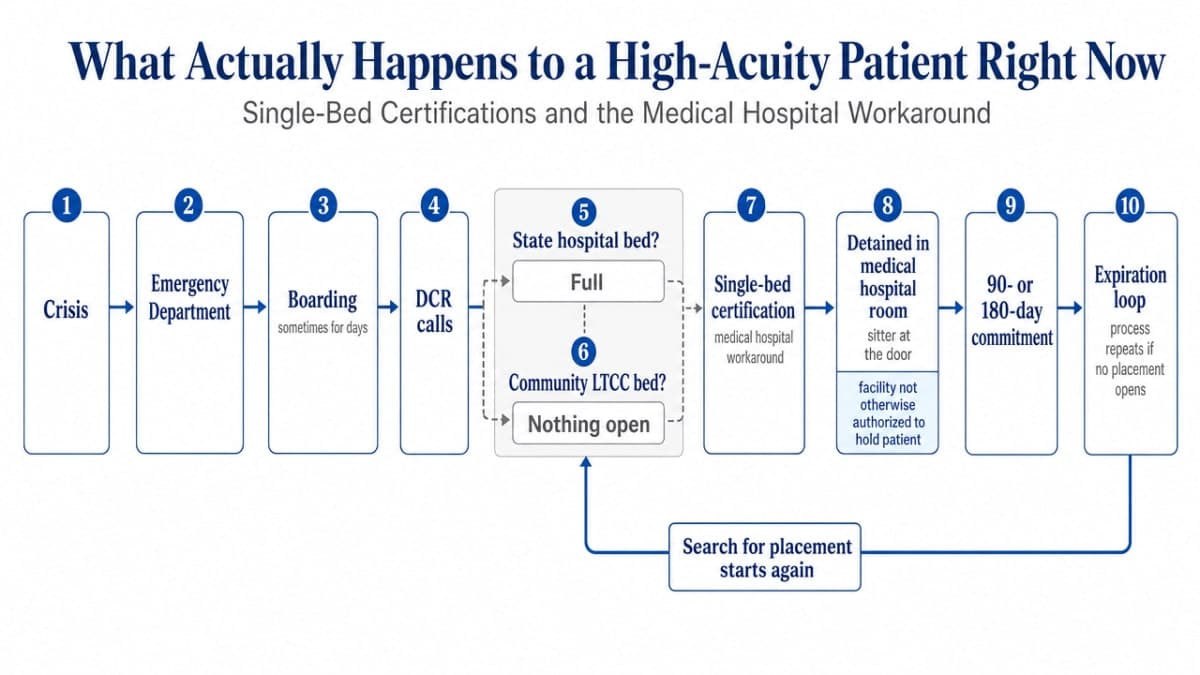
If you have watched your family member sit in a medical hospital room with a sitter at the door, no psychiatric unit in sight, you have watched a single-bed certification in action. You may not have known what it was called at the time. The mechanism is documented in Washington’s own reports: when no state hospital bed is available, a single-bed certification allows detention for a 90- or 180-day commitment inside a facility that would not otherwise be authorized to hold that patient 5.
Here is what the current path actually looks like. A crisis brings your loved one to the emergency department. They board there, sometimes for days, while a designated crisis responder starts making calls. State hospital? Full. Community LTCC bed in the region? Nothing open. So the responder pivots to the workaround, calling private facilities and medical hospitals one by one, trying to find any licensed space that will accept a single-bed certification 10. What eventually opens is often a room on a general medical floor rather than a psychiatric unit built for the acuity in front of you.
The care inside that room is not psychiatric hospitalization in any meaningful sense. There is a bed. There is a hold. There is medication continuation, usually. What there often is not: milieu therapy, a full psychiatric team, structured programming, or a treatment plan built for treatment-resistant schizophrenia or rapid-cycling bipolar. The certification keeps your family member legally detained. It does not treat them.
Then the acute unit discharges, the certification expires, and the search starts again, this time with a shorter runway. That loop is the reason so many Northwest families end up looking beyond the region for anything that resembles sustained, specialized care.
The Zero-Bed Regions: Columbia Gorge and Eastern Oregon
Geography carries a specific weight in this conversation. If your family lives in Hood River, The Dalles, Pendleton, Ontario, or anywhere east of the Cascades in Oregon, the shortage is not abstract. It is the absence of a building.
Oregon’s June 2024 final study spelled it out plainly: trauma system areas 6 (Columbia Gorge) and 9 (Eastern Oregon) have zero inpatient psychiatric beds, serving a combined population of 226,458 residents 8. Zero. Not few. Not scarce. None.
What that means in practice is that any high-acuity psychiatric episode in those regions triggers a transfer before treatment can begin. A patient in a crisis in Baker City may end up in Portland, Boise, or Salt Lake before they see a psychiatric bed at all. Family visits become a full-day drive each direction. Discharge planning happens across a distance that makes local step-down almost impossible to coordinate.
When people in those counties consider an out-of-state placement, they are often not adding travel to their situation. They are choosing between one long drive and another. The difference is that a specialized program built for treatment-resistant cases is a destination that matches the clinical need, rather than a general acute unit that happens to have the next open bed. If you are already going to travel, the question shifts from how far to what your family member will find when they arrive.
The Voluntary Long-Term Gap Nobody Advertises
Something the state-level reports rarely say out loud: most Northwest families searching out of state are not looking for a forensic bed or a court-ordered LTCC placement. They are looking for a voluntary, long-term, high-acuity program for a family member who is willing, or willing enough, to engage in real treatment. That category of care is where the local map goes almost entirely blank.
Washington’s LTCC expansion is aimed at civilly committed patients, adults on 90- or 180-day involuntary orders 11. Oregon’s bed-need analysis measures acute inpatient capacity, the short-stay stabilization end of the spectrum 7. Neither pipeline is designed to answer the question a lot of you are actually asking: where can our family member go for a stay measured in weeks or months, staffed with board-certified psychiatry, that will actually engage a clozapine trial or work through a complex mood-stabilizer sequence?
The answer, inside the region, is mostly silence. State hospitals are full and civilly focused 3. Community LTCC beds are involuntary by design. Acute units discharge on insurance timelines, not clinical ones. Voluntary long-term specialty psychiatric care, the middle of the range, was largely never built out.
That is the gap that sends Northwest families across state lines. Not because their situation is unusual. Because the specific level of care their loved one needs, longer than acute, voluntary, and equipped for treatment-resistant complexity, does not have a shelf in the Northwest system to sit on.
Weighing an Out-of-State Placement Without Pretending It’s Easy
A Placement Comparison for the Decision in Front of You
You are not choosing between good options. You are choosing between imperfect ones, and the honest way to do that is to lay them next to each other and look at what each one actually delivers for a treatment-resistant case.
| Option | Realistic Wait | Length of Stay | Fit for Treatment-Resistant / Dual Diagnosis | Key Limit |
|---|---|---|---|---|
| Local acute unit (rehospitalization) | Days, if a bed opens | Insurance-driven, usually short | Stabilization only | Discharges before a clozapine trial or complex mood-stabilizer sequence can be evaluated |
| Washington LTCC waitlist | Unpredictable; several counties still uncovered even after planned expansion 4 | 90 or 180 days, involuntary | Civilly committed patients only | Involuntary by design; voluntary patients do not qualify 11 |
| Oregon acute inpatient | Depends on region; zero beds in Columbia Gorge and Eastern Oregon 8 | Short-stay stabilization | Acute, not long-term specialty | Statewide capacity is roughly a third of estimated need 7, 8 |
| Single-bed certification in a medical hospital | Same day, when nothing else exists 5 | Up to 90 or 180 days | Detention, not psychiatric programming | Not a psychiatric unit; limited therapy or milieu |
| Out-of-state long-term specialty program | Days to weeks for admission review | Set by clinical need, not the calendar | Built for treatment-resistant and dual diagnosis | Distance from family; travel logistics |
Look at the rows honestly. Three of the local options do not treat what your loved one has. One of them treats it, but the bed is not there. That is the pattern that keeps pointing families out of the region. Not preference. Not marketing. Elimination.
The Guilt of Crossing State Lines
There is a specific kind of guilt that shows up when you start seriously considering an out-of-state placement. It sounds like: we should be able to take care of him here. It sounds like: what kind of family sends their daughter to another state. It sounds like: if I were doing this right, I would have found something closer.
None of that is true. It is just loud.
You did not create Oregon’s 486-bed shortfall. You did not vote against Washington’s LTCC contracts or make Western State Hospital run at 98 percent civil capacity. You are responding to a system that was not built to hold the person you love, and you are doing it with less sleep than you have had in years.
Say the guilt out loud to someone who will not try to fix it. Then go back to the placement question.
What to Ask Before You Send Records Anywhere
Before you release records to any out-of-state facility, get concrete answers to the questions that separate a specialty program from a general residential center. Vague answers here mean vague care later.
- Who is on the psychiatric team, and how often will they see the patient? Ask for board certifications, weekday and weekend coverage, and whether a psychiatrist rounds daily or weekly. “Medical director available” is not the same as “psychiatrist on the unit.”
- What is your experience with clozapine initiation and titration? If the case involves treatment-resistant schizophrenia, this is not a general question. Ask about REMS protocols, ANC monitoring frequency, and how they handle the first 18 weeks.
- How is length of stay determined? Insurance clock, program-standard 30 or 60 days, or clinical benchmarks the treatment team defines and revisits? The answer tells you whether the program is built for complexity or for turnover.
- How do you handle co-occurring substance use during a psychiatric admission? Integrated on the same unit with the same team, or referred out? For dual diagnosis, sequential care usually means neither condition gets treated well.
- What is your accreditation and licensing? Joint Commission accreditation and state licensure are the floor, not the ceiling. Ask when the last survey was.
- What does family communication look like across state lines? Scheduled family sessions, weekly clinical updates, secure video for visits.
If the answers are specific, you have a real candidate. If they are marketing language, keep dialing.
Where ViewPoint Fits in a Treatment-Resistant Case
By the time a Northwest family is seriously reading about a facility in Prescott, Arizona, the shortlist has already been narrowed by everyone else’s inability to help. The question is not whether ViewPoint sounds appealing. The question is whether it matches the specific clinical shape of the case you have been carrying.
ViewPoint Dual Recovery is a Joint Commission-accredited psychiatric treatment facility built for the cases other programs describe as too complex: treatment-resistant schizophrenia, rapid-cycling bipolar, co-occurring mental health and substance use disorders, and trauma-related presentations that have not moved on standard protocols. Board-certified psychiatry is available 24/7, clozapine protocols are part of the standard toolkit rather than a referral-out, and length of stay is set by the clinical team based on what the case actually needs, not by an insurance authorization clock or a fixed 30-day program calendar.
That last piece matters more than it sounds. Most of what breaks down inside the Northwest pipeline breaks down because timelines were set by something other than the patient. Acute units discharge when coverage ends. LTCC orders run to statutory deadlines 11. Single-bed certifications hold a person in a medical room without treating them 5. A program that sets duration by clinical benchmarks is a different category of care, and it is the category most treatment-resistant cases were needing all along.
ViewPoint’s integrated model, where psychiatrists and therapists work the same case rather than passing it back and forth, is also the answer to the dual diagnosis problem that fractures across most local systems. If your family member has been told repeatedly that the substance use has to be addressed before the psychiatric care can begin, or vice versa, you already know why sequential care usually fails. Simultaneous care, staffed by a team that talks to each other daily, is what the presentation calls for.
For families in Oregon and Washington running out of local options, ViewPoint is not a novelty. It is a common next step, and worth a direct conversation about whether the case in front of you fits.
Discover next-step care for complex cases
Receive expert guidance on tailored psychiatric treatment options for challenging, treatment-resistant conditions.
Frequently Asked Questions
Can we legally transport a civilly committed family member across state lines for psychiatric care?
Yes, but it requires coordination. A patient under an active 90- or 180-day order in Washington or Oregon cannot simply be driven to another state. The commitment has to be lifted, converted to voluntary status, or handled through an interstate compact with the receiving facility. Your county’s designated crisis responder, the treating psychiatrist, and the admitting facility need to align on paperwork before travel.
Will Oregon or Washington Medicaid pay for an out-of-state psychiatric placement?
Sometimes, and rarely without work. Medicaid coverage across state lines depends on prior authorization, the receiving facility’s ability to bill your state’s plan, and whether the level of care is deemed medically necessary and unavailable locally. Many families use a combination of commercial insurance, single-case agreements, and private pay. Ask the admissions team to run benefits before you assume the answer is no.
How do we transfer a patient directly from an acute unit or single-bed certification to an out-of-state program without discharging home first?
Direct facility-to-facility transfer is the goal, and it is possible when the current attending physician signs off and the receiving program accepts the clinical package. Ask the acute unit’s social worker to coordinate with the out-of-state admissions team on medical clearance, medication reconciliation, and travel. A discharge-to-home step is what most families are trying to avoid, and it is avoidable with early coordination.
What records and documentation should we have ready before contacting an out-of-state facility?
Have the recent psychiatric hospitalization records, current medication list with doses and dates, prior medication trials with outcomes, any clozapine or long-acting injectable history, substance use history, court paperwork if applicable, insurance cards, and identification. A written release signed by the patient or legal guardian lets the admitting facility talk directly to prior treaters. The more complete the package, the faster the clinical review moves.
How do family visits and continuity of care work when the patient is receiving treatment in another state?
Most specialty programs schedule weekly family therapy by secure video, plus periodic in-person visits timed to treatment milestones. Ask about visitor policies, phone access, and how the team coordinates with an outpatient psychiatrist back home for eventual step-down. Continuity of care is a planning problem, not a barrier. A good program starts building the return-to-Northwest handoff on day one, not at discharge.
What happens if our loved one wants to leave treatment early once they’re out of state?
Voluntary patients can request discharge, and any accredited program will have a defined process for that request, including a clinical review and a safety plan. Ask upfront how the team handles ambivalence, treatment refusal, and against-medical-advice requests, especially for someone with treatment-resistant illness. Knowing the protocol before admission helps you and the team respond calmly if that moment comes, rather than reacting in crisis.
References
- 90 or 180-day long term civil commitment (LTCC) bed capacity – Fact Sheet. https://www.hca.wa.gov/assets/program/fact-sheet-long-term-civil-commitment.pdf
- Implementation plan to continue the expansion of civil long-term inpatient capacity. https://www.hca.wa.gov/assets/program/expanding-long-term-inpatient-capacity-leg-report-2024.pdf
- Inpatient Psychiatric Care Risk Model Report. https://ofm.wa.gov/wp-content/uploads/sites/default/files/public/publications/PCGInpatientPsychiatricCareRiskModelReport.pdf
- Proposed 2025–27 Budget and Policy Highlights. https://ofm.wa.gov/wp-content/uploads/sites/default/files/public/budget/statebudget/highlights/budget2527/25-27_Budget_Highlights.pdf
- State Psychiatric Hospital Forensic and Civil Bed Need Report (Washington, 2021). https://app.leg.wa.gov/ReportsToTheLegislature/Home/GetPDF?fileName=State%20Hospital%20Bed%20Need%20Report_2021_295effd4-3be2-432e-9b23-50cd0a6202f7.pdf
- Treatment for adults on civil commitment orders: long-term behavioral health inpatient involuntary care access and purchasing integration. https://www.hca.wa.gov/assets/program/treatment-adults-civil-commitment-orders-20191215.pdf
- Oregon Health Authority Behavioral Health Residential+ Facility Study (January 2024). https://www.oregon.gov/oha/HSD/AMH/docs/OR-BH-Residential-Facility-Study-January-2024.pdf
- Oregon Behavioral Health Residential+ Facility Study – Final Report (June 2024). https://www.oregon.gov/oha/BH/Reports/Behavioral-Health-Residential-Facility-Study-June-2024.pdf
- 2025 Annual Report on Psychiatric Residential Facility Capacity. https://www.oregon.gov/oha/HSD/BH-Child-Family/Documents/2025%20Annual%20Report%20on%20Psychiatric%20Residential%20Facility%20Capacity.pdf
- Long-Term Behavioral Health Inpatient Involuntary Care Access and Purchasing Integration (2019). https://www.hca.wa.gov/assets/program/longterm-behavioral-health-inpatient-involuntary-care-access-purchasing-integration-20191215.pdf
- 90- and 180-day civil commitment beds | Washington State Health Care Authority. https://www.hca.wa.gov/billers-providers-partners/program-information-providers/90-and-180-day-civil-commitment-beds