Key Takeaways
- Grief driving substance use is a documented bidirectional loop, so a program that treats only the drinking or drug use sends you back to the trigger that started it.6
- Learn precise terms like complicated grief, prolonged grief disorder, and integrated dual diagnosis care before intake so coordinators respond with specific plans instead of vague reassurances.
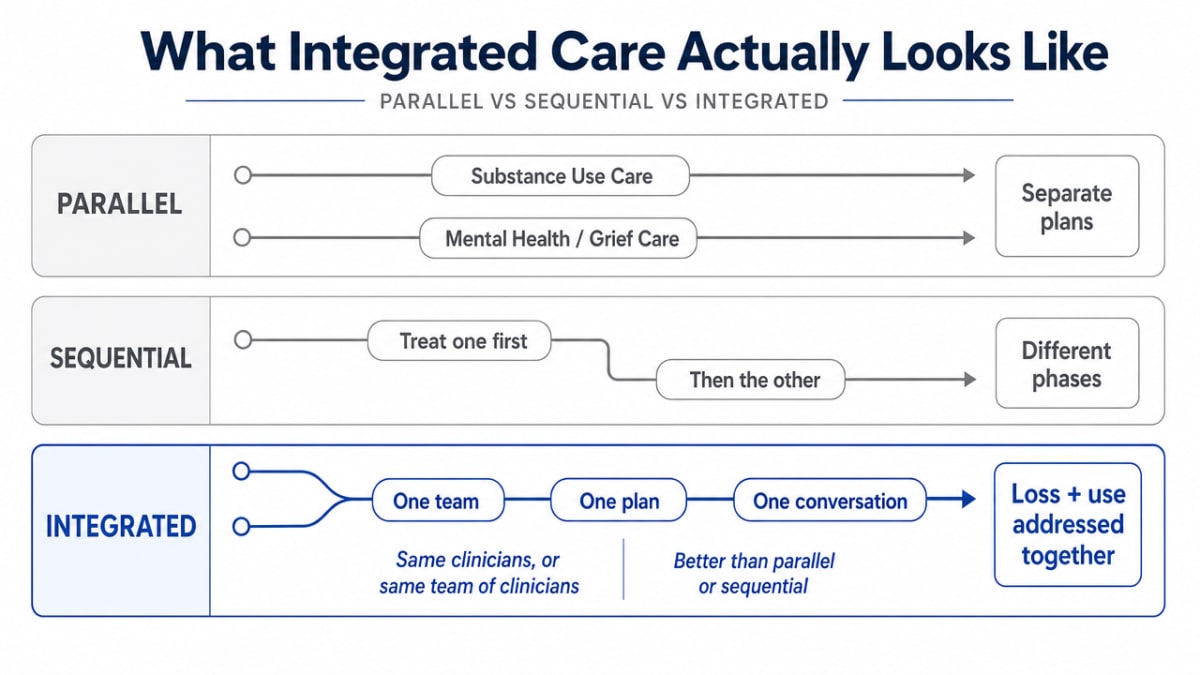
- Integrated care under SAMHSA TIP 42 means one team, one plan, and shared case meetings for grief, medication, and substance use, not referrals to separate agencies.10
- A pilot of a 24-session integrated protocol combining complicated grief therapy with motivational interviewing raised abstinent days and lowered cravings, grief, and depression at the same time.1
- Good grief work targets specific stuck patterns like self-criticism, ‘if only’ thinking, and social withdrawal, which are tied to worse grief and substance use outcomes in bereaved patients.2
- Ask by name about Complicated Grief Treatment techniques such as imaginal revisiting, situational revisiting, and restoration work to confirm a program delivers evidence-based grief therapy.5
- For overdose or suicide loss, ask about clinician training in traumatic bereavement, since integrated trauma-informed care reduces both PTSD symptoms and substance use more effectively than sequential treatment.9
When the Loss Is What’s Driving the Use
You already know what most treatment brochures skip. The drinking or the pills got heavier after someone died. Maybe it was your dad. Maybe it was your kid. Maybe it was a friend you found, or a spouse you sat with in a hospital, or a string of overdose funerals that stopped feeling separate. And every time you tried to stop using, the loss came back louder, so you didn’t.
That is not a character problem. That is how grief and substance use actually work together. The research on bereavement and addiction describes a bidirectional loop: loss can set off substance misuse, and substance-related losses pile up and make mourning harder, so people carry multiple, cumulative losses at the same time.6For bereaved parents specifically, studies have documented rising alcohol and psychotropic medication use tied to loss-related distress.7If you started drinking after a death and could not stop, you are inside a pattern researchers have been watching for years.
Here is why this matters for picking a program. If the grief is what is driving the use, a treatment center that treats only the use will send you home to the exact trigger that started it. You do not need a program that mentions grief in a pamphlet. You need one that puts your loss on the treatment plan the first week, and keeps it there. The rest of this guide shows you how to tell the difference.
Name What You’re Actually Dealing With Before You Tour a Program
Normal Grief vs. Grief That Has Started Running Your Life
Grief doesn’t come with a timeline, and anyone who tells you it does is selling something. You will have days a year later that flatten you. You will laugh at a memory and then cry in the grocery store. That is grief doing what grief does.
There is a different pattern, though, and it has a clinical name worth knowing before you sit down with an intake coordinator. Researchers describe prolonged grief disorder as persistent yearning or longing for the person who died, intense emotional pain, and significant impairment in functioning that continues well past the mourning period your culture or family would expect.3The word that matters there is impairment. Not sadness. Not missing them. Impairment. It means the grief is running your calendar, your relationships, your job, your sleep, and, if you are reading this, probably your drinking or using too.
Ask yourself a few plain questions. Are you organizing your days around avoiding reminders, or around chasing them? Has it been more than a year and the ache is still the first thing you feel when you wake up? Do you feel stuck in the moment of the loss, replaying the phone call, the hospital hallway, the front door? Are you using more to get through the anniversaries, the birthdays, the ordinary Tuesdays?
If you answered yes to a few of those, you are not weak and you are not broken. You are describing a pattern that has a name, and a name is the first thing a good treatment plan can work with.
The Vocabulary That Sharpens Your Intake Call
Here is the quiet advantage most families don’t know they have: a few precise words on the phone will change how a program answers you. Vague questions get vague answers. Specific vocabulary gets specific plans.
Keep four terms in your back pocket.
- Complicated grief. A clinical term for grief that stays stuck and interferes with daily life. Clinicians can assess for it using standardized tools and can distinguish it from depression and PTSD, which often look similar on the surface but respond to different treatments.4Ask: “Do you screen for complicated grief on intake, and with what tool?”
- Prolonged grief disorder. The diagnostic name now recognized in major diagnostic systems. Using this phrase signals you want grief on the problem list, not in a support group brochure.
- Bereavement-related substance use. This tells the intake coordinator that your drinking or drug use is tied to a loss, and that treating one without the other will likely fail. Ask: “How do you build bereavement into the treatment plan from week one?”
- Integrated dual diagnosis care. This is the standard you are asking the program to meet, not a feature you are hoping they include.
Write these down before you call. Say them out loud once so they don’t stick in your throat. You are not quizzing anyone. You are giving the person on the other end of the line a chance to show you whether they actually do this work, or just mention it.
Why Sequential Care Keeps Failing Grieving Clients
The ‘Get Sober First, Grieve Later’ Trap
You have probably heard some version of it already. “Let’s stabilize the drinking first. We can look at your mom’s death down the road.” It sounds reasonable in an intake office. It falls apart the second you get home.
Here is why. If the loss is a big part of what pulled you toward the bottle or the pills, walling it off doesn’t shrink it. It waits. You finish detox, you learn some coping skills, you sit through groups about triggers and cravings, and the whole time the actual trigger, the person who is not there anymore, is still not there. The first anniversary hits. A song plays in a parking lot. Someone asks how many kids you have. And you are back where you started, because the program treated the symptom and left the engine running.
Reviews of the grief-and-addiction literature describe exactly this loop: bereavement can precipitate substance misuse, and unresolved loss keeps pulling people back toward it.6Sequential care, where grief is scheduled for “later,” almost guarantees that later never comes. You relapse before you get there, or you white-knuckle through months of sobriety with the loss still untouched underneath. Neither is recovery. Both are exhausting. You deserve a plan that names the loss on day one, not one that keeps promising to get to it.
What Integrated Care Actually Looks Like
Integrated care is not a buzzword you should let a program throw at you without a definition. It has a specific meaning, and federal guidance has been clear about it for years.
SAMHSA’s Treatment Improvement Protocol 42, the government’s guidance for co-occurring conditions, sets the standard bluntly: the same clinicians, or the same team of clinicians, provide treatment for both disorders inside one coherent plan, and this approach is associated with better outcomes than parallel or sequential treatment.10That standard was written about depression, anxiety, and PTSD showing up alongside substance use, but the logic applies to grief just as directly. One plan. One team. One conversation about how the loss and the use are talking to each other.
In practice, that looks like a few concrete things. Your psychiatrist knows your daughter’s name and knows when her birthday is coming up. Your therapist and your addiction counselor are the same person, or they are in the same weekly case meeting looking at the same chart. Your medication management appointments include questions about how you are sleeping around the anniversary, not just how the naltrexone or the antidepressant is landing. Your grief work isn’t a Tuesday night support group tacked onto the schedule; it is a named goal on your treatment plan, with the tools and the clinician assigned to it.
Contrast that with parallel care, where you see an addiction counselor at one office and a grief therapist at another and hope they somehow line up. Or sequential care, where grief is a folder in a drawer marked “after discharge.” When you tour a program, ask directly: Who on your team will be treating my grief, and are they in the same clinical meetings as the person managing my medication and my substance use? If the answer involves a referral out, a separate group at a different agency, or a promise to circle back, you are looking at parallel or sequential care wearing an integrated label.
The Evidence That Grief and Substance Use Can Be Treated in One Protocol
You may have been told, gently or otherwise, that grief work and addiction treatment need to happen in different rooms with different people at different times. The research does not agree.
A pilot study of a 24-session manualized protocol did something the field had mostly avoided: it treated complicated grief and substance use disorder inside a single integrated intervention, combining an empirically supported complicated grief therapy with motivational interviewing and coping and communication skills.1The results are worth reading slowly. Timeline Followback percent days abstinent increased significantly, cravings declined significantly, and complicated grief and depressive symptoms both dropped.1In plain language: when clinicians treated the grief and the substance use in the same protocol, people drank and used less, wanted to drink and use less, and hurt less around the loss. All at once. Not in sequence.
That study was small and open-label, and the authors are careful to say so.1It is a pilot, not a final verdict. But it lines up with what larger reviews have been saying about co-occurring conditions for years: concurrent, integrated care tends to outperform the “fix one thing, then the other” approach that still shapes many programs.8The trauma and substance use literature reaches the same conclusion from a different angle, showing that integrated treatments reduce both PTSD symptoms and substance use when they are delivered together rather than in separate silos.9Grief is not identical to trauma, but the design principle transfers: you get better results when the clinician sitting across from you is allowed to work on all of it.
Bring this with you when you tour a program. If an intake coordinator tells you grief has to wait, you now know the evidence points the other direction. Ask them what protocol they use, who delivers it, and how they measure whether it is working.
What Good Grief Work Should Actually Target
The Habits That Keep Grief Stuck
Grief work is not just talking about the person. If it were, every long phone call with a sibling would count as therapy. Good grief work targets specific mental habits that keep the loss stuck in the loop, and those habits happen to be some of the same ones that pull you back toward a drink or a pill.
A study of 196 bereaved, drug-dependent patients mapped this out clearly. Three coping patterns were tied to worse grief and worse substance use outcomes: harsh self-criticism (the running commentary that you should have done more, seen it sooner, said something different), desiderative thinking (the “if only” loop that replays a version of events where they lived), and social withdrawal (canceling on people until your world is you, the couch, and whatever is in the cabinet).2Three other patterns were tied to better outcomes: problem-solving, cognitive restructuring, and leaning on social support.2
Notice what that means for a program. Good grief work isn’t a candle-lighting ceremony on Friday. It is a therapist naming the exact loop in your head, showing you what it costs you, and giving you something to do with it. If a program can’t tell you which habits they target, they don’t have a plan. They have a room.
The Therapy Techniques Worth Asking About by Name
You don’t need to memorize a textbook. You need three or four phrases that tell a clinician you know what evidence-based grief therapy looks like, so they either meet you there or reveal that they can’t.
Complicated Grief Treatment, or CGT, is the best-studied option. A randomized controlled trial found it outperformed a standard interpersonal psychotherapy for people stuck in complicated grief.5It uses a handful of specific techniques worth asking about by name. Imaginal revisiting is guided retelling of the death itself, in the therapist’s office, in a way that lets the memory stop ambushing you. Situational revisiting is gradual, planned re-entry into the places and rituals you have been avoiding, from the cemetery to your kid’s old bedroom. Restoration work helps you rebuild a life with the loss inside it instead of a life organized around avoiding it.5
When you tour a program, ask: “Does anyone on your team deliver Complicated Grief Treatment or an adapted version of it? Who? How often?” Listen for a real person’s name and a real schedule. A good program will also tell you how the grief techniques are woven into your substance use work, not run on a parallel track that never meets your main plan.
A Screening Checklist for Your Intake Call
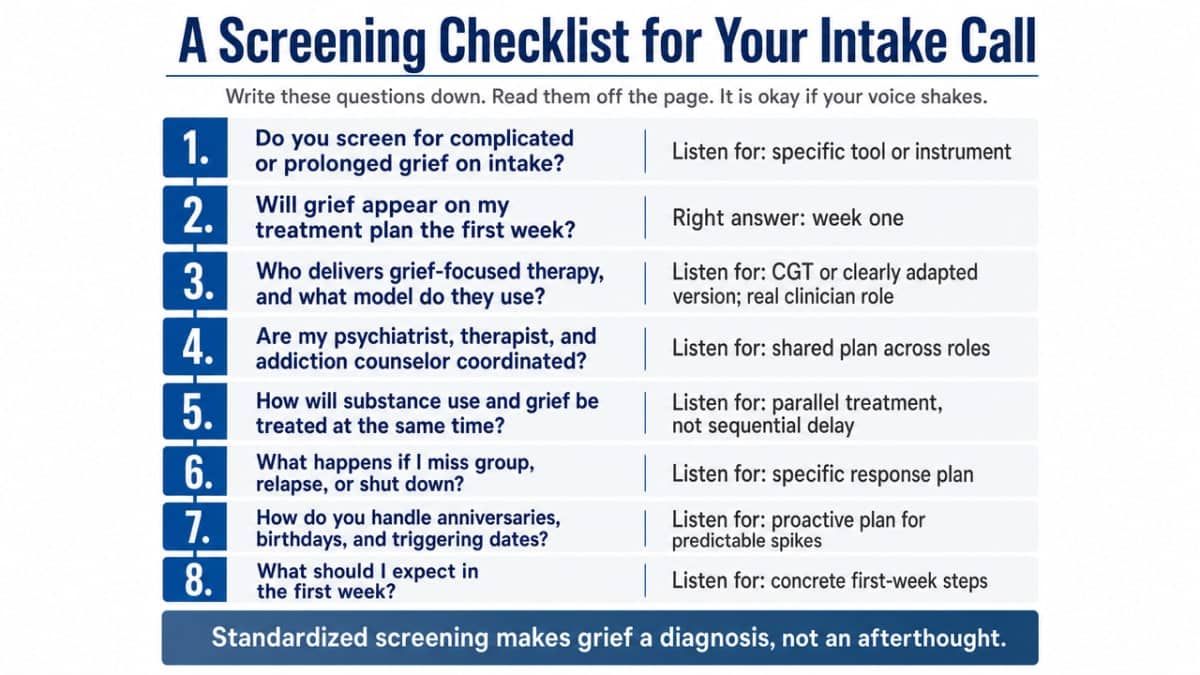
You are going to be tired when you make this call. Write these questions down so you don’t have to remember them under pressure. Read them off the page. It is okay if your voice shakes.
- Do you screen for complicated or prolonged grief on intake, and what tool do you use? Listen for a specific instrument, not “we ask about it in the assessment.” Standardized screening is how grief stops being an afterthought and starts being a diagnosis.
- Will grief appear as a named goal on my treatment plan the first week, or later? The right answer is week one. “After you stabilize” is the trap.
- Who on your team delivers grief-focused therapy, and what model do they use? Listen for Complicated Grief Treatment or a clearly adapted version, and a real clinician’s role, not “our therapists all do grief.”
- How is my treatment length decided? Listen for clinical progress, not a fixed 28- or 30-day insurance window.
- How do you handle anniversaries, birthdays, and the days I know will be hard? A prepared program has an answer already.
- What happens to my grief work when I discharge? Ask about the handoff, the frequency of follow-up, and who owns it.
- Can you treat my other psychiatric conditions at the same time? Depression, PTSD, bipolar, and sleep problems often ride alongside grief and substance use, and they belong on the same plan.
You do not need every answer to be perfect. You need most of them to be specific. Vague answers are the answer.
If You Are Grieving an Overdose or Suicide Loss
This kind of loss carries a weight the world doesn’t know what to do with. People bring casseroles when someone dies of cancer. When your person dies of an overdose or by suicide, the room gets quiet. Neighbors stop asking. You learn which relatives will say the cause out loud and which ones won’t. On top of the grief, you are carrying a second layer: shame that isn’t yours, questions with no answers, and a running loop of what you saw, what you found, what the officer said at the door.
That loop matters clinically. Loss like this often sits at the intersection of grief and trauma, and the two feed each other. Reviews of trauma and substance use show that integrated treatments, ones that address the traumatic material and the substance use at the same time inside a trauma-informed frame, reduce both PTSD symptoms and substance use more effectively than treating them in sequence.9The same principle applies here. If you are drinking to blur the image of finding them, a program that only teaches relapse prevention will leave the image intact.
When you tour a program, add two questions to your list. Do your clinicians have specific training in traumatic bereavement, including overdose and suicide loss? And how do you handle the intrusive memories, the guilt, and the “I should have known” loop alongside the substance use work? You are not asking for a specialty boutique. You are asking whether the people treating you know that this kind of grief has its own contours, and that skipping them will cost you the recovery you came for.
Where ViewPoint Dual Recovery Fits
Most of this guide is about how to judge any program, not sell you one. But you are reading an article on ViewPoint Dual Recovery’s site, so it is fair to tell you plainly where ViewPoint fits and where it doesn’t.
ViewPoint is a Joint Commission-accredited psychiatric facility in Prescott, Arizona built for the cases other programs call too complex. That means people whose grief, substance use, and other psychiatric conditions have not responded to standard 28-day models. If you have already been to treatment once or twice, and the loss never made it onto the plan, this is the population ViewPoint is set up to treat.
Three things shape how the work happens here. First, treatment length is set by clinical progress, not an insurance clock, which matters when grief work is on the plan because grief does not resolve on a fixed schedule. Second, the psychiatrist managing your medication and the therapist doing your grief and substance use work sit in the same case meetings, the one-team standard the co-occurring literature keeps pointing back to.10Third, the intake assessment is built to name the loss, not skip it, so bereavement lands on your treatment plan the first week alongside the drinking, the depression, the trauma, or whatever else you brought through the door.
Making the Call This Week
You have read enough. The next thing that will change anything is a phone call, and you can make it before the end of the week.
Here is what to do first. Write down the name of the person you lost and the date. Write down when your drinking or using got heavier. Write down the two or three questions from earlier in this guide that matter most to you. That is your intake note. You are already doing grief work by putting it on paper.
Then call. If you want to talk to someone at ViewPoint Dual Recovery in Prescott, the intake team will ask about the loss and the substance use in the same conversation, because that is the only way the plan gets built right. You do not need to have the words perfect. You need to make the call.
Take the First Step Toward Integrated Healing
Get professional insight into how grief and substance use can be addressed together in your care plan.
Frequently Asked Questions
Can I go to treatment if I just started drinking or using after a death?
Yes, and honestly, the earlier the better. You don’t have to wait until it’s a full-blown disorder to ask for help. If your drinking or using climbed after a loss and you can’t pull it back on your own, that is exactly what integrated grief and substance use programs are built for. Call and describe both pieces in the same sentence. That’s the plan.
What’s the difference between a program that ‘addresses grief’ and one that actually treats it?
A program that addresses grief mentions it in a brochure or runs a weekly support group. A program that treats it screens for complicated or prolonged grief on intake, puts the loss on your treatment plan the first week, assigns a clinician trained in a specific model, and keeps grief in the same case meetings as your medication and substance use work.10
Do I have to be sober before I can start grief work?
No. The old “get sober first, grieve later” sequence is not what the evidence supports. A pilot study of a 24-session integrated protocol treated complicated grief and substance use together and saw more days abstinent, fewer cravings, and lower grief and depression scores.1Grief work belongs on the plan from the start, alongside detox and stabilization, not after them.
What questions should I ask on my first call to a treatment center?
Ask if they screen for complicated or prolonged grief and with what tool. Ask if grief will be a named goal on your plan in week one. Ask who delivers grief therapy and what model they use. Ask if your psychiatrist, therapist, and addiction counselor sit in the same weekly case meeting. Ask how they handle anniversaries. Listen for specifics.
How is care different for someone grieving an overdose or suicide loss?
This kind of loss often sits at the intersection of grief and trauma, with intrusive images, guilt, and “I should have known” loops that fuel using. Integrated, trauma-informed treatment that addresses the traumatic material and the substance use together reduces both PTSD symptoms and substance use more effectively than treating them in sequence.9Ask specifically about clinician training in traumatic bereavement.
How long does grief-integrated substance use treatment usually take?
Longer than a 28-day insurance window often allows, and the honest answer is that it varies. Grief doesn’t resolve on a fixed schedule, and evidence-based SUD care emphasizes individualized plans matched to the full picture, including co-occurring conditions.8Look for programs that set length by clinical progress, not a calendar, and that plan the handoff to outpatient grief work before you discharge.
References
- Treating complicated grief and substance use disorders: a pilot study. https://pubmed.ncbi.nlm.nih.gov/16616164/
- Coping Strategies and Complicated Grief in a Substance Use Disorder Sample. https://pmc.ncbi.nlm.nih.gov/articles/PMC7848780/
- Prolonged Grief Disorder: A Review of the Evidence and Proposals for ICD-11. https://pmc.ncbi.nlm.nih.gov/articles/PMC4314344/
- Complicated grief: a case series using assessment and differential diagnosis. https://pmc.ncbi.nlm.nih.gov/articles/PMC3384448/
- Treatment of complicated grief: a randomized controlled trial. https://pmc.ncbi.nlm.nih.gov/articles/PMC4544925/
- Grief and addiction: an overview. https://pubmed.ncbi.nlm.nih.gov/25274160/
- Bereavement, depression, and substance use in parents following the death of a child. https://pubmed.ncbi.nlm.nih.gov/22001027/
- Substance Use Disorder Treatment: Medications, Counseling, and Related Conditions (StatPearls / NCBI Bookshelf). https://www.ncbi.nlm.nih.gov/books/NBK571059/
- Trauma and substance abuse: consequences, mechanisms, and treatment of co-occurring disorders. https://pmc.ncbi.nlm.nih.gov/articles/PMC3878022/
- SAMHSA TIP 42: Substance Use Disorder Treatment for People With Co-Occurring Disorders. https://www.ncbi.nlm.nih.gov/books/NBK207191/