

Key Takeaways
- OCD symptoms often appear years before substance use, with individuals turning to alcohol or drugs to self-medicate intrusive thoughts and anxiety 16.
- Arizona sees 18.1% of residents aged 12+ with a past-year substance use disorder and 23.9% of adults with any mental illness, yet workforce shortages outside metro areas limit access to psychiatric-level OCD care 6, 8.
- Sequential ‘sobriety first’ models frequently fail for OCD because early withdrawal intensifies intrusive thoughts; SAMHSA identifies concurrent integrated treatment as best practice 4, 5.
- When vetting Arizona programs, confirm ADHS licensure, look for Joint Commission accreditation, and ask about on-site board-certified psychiatry, ERP from week one, and clinically determined length of stay 15, 9.
When substance use becomes a coping mechanism for intrusive thoughts
If you find yourself reaching for a drink or other substances to quiet intrusive thoughts, you are not alone. This pattern, where alcohol or drugs function as an off-label anxiety medication for untreated obsessive-compulsive disorder (OCD), is well-documented in clinical literature. Researchers note that individuals with OCD are“highly vulnerable to abuse of drugs or alcohol because they often find their symptoms to be distressing and are motivated to seek relief.”3This suggests that substance use often attempts to solve an underlying problem.
A common scenario involves seeking treatment for addiction, where OCD is either overlooked or deferred. This can lead to relapse, as the underlying intrusive thoughts return with intensity, and the individual lacks effective coping strategies. This is not a personal failing but a flaw in the treatment design.
This guide explores the connection between OCD and addiction, the benefits of integrated care where both conditions are treated as primary, and how to identify programs equipped for this comprehensive approach.
The chronological link: OCD often precedes addiction
For many, intrusive thoughts, checking behaviors, or mental rituals manifest years before heavy drinking or regular drug use begins. This chronology is crucial for understanding the dynamic between OCD and addiction.
A study of individuals at a specialized OCD clinic revealed that 27% met lifetime criteria for a substance use disorder. Among those with co-occurring SUD, 70% reported that their OCD symptoms emerged at least a year, and often much longer, before their substance use became problematic.16 This highlights that for a significant portion of individuals, OCD was the primary issue, and substance use developed as a coping mechanism that eventually became ineffective.
The mechanism is straightforward: the constant distress from OCD exhausts the nervous system. Substances like alcohol, benzodiazepines, cannabis, or opioids can temporarily reduce this distress. Clinicians often describe substance use in OCD as a form of self-medication for anxiety and intrusive thoughts, offering short-term relief but ultimately worsening functioning and complicating OCD treatment over time.17
Recognizing that OCD often comes first reframes the problem: addiction becomes a downstream symptom of an untreated condition. Treating addiction without addressing the underlying OCD is often an unsustainable approach, as the original drivers of distress remain active. This understanding shifts the focus from “how do I stop drinking?” to “who can help me treat the OCD that makes me feel I need to drink?”
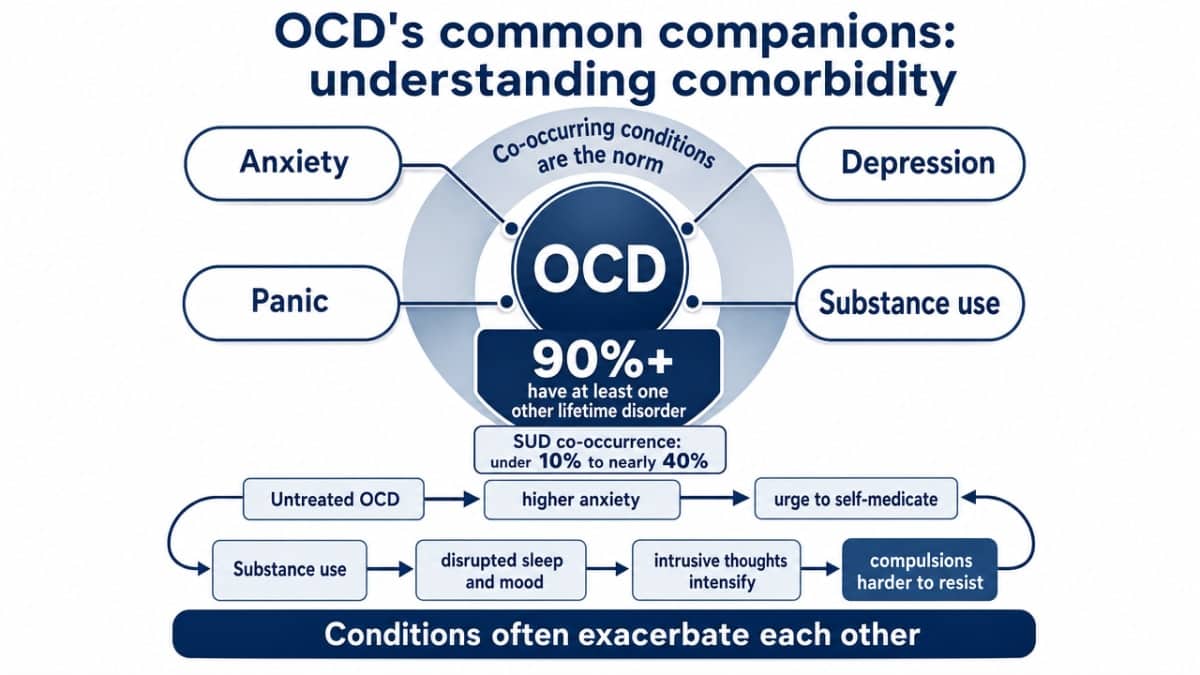
OCD’s common companions: understanding comorbidity
If managing OCD feels like just one part of a larger struggle with anxiety, depression, panic, or other issues, this is a common experience. OCD rarely occurs in isolation.
SAMHSA’s clinical advisory on OCD and substance use states that studies show 90% or more of individuals with OCD meet lifetime criteria for at least one other diagnosable mental or substance use disorder. Rates of co-occurring SUD in OCD vary from under 10% to nearly 40% depending on the sample studied.2 This indicates that co-occurring conditions are the norm, not an exception, for individuals with OCD.
The co-occurring conditions often exacerbate each other. Untreated OCD heightens anxiety, increasing the urge to self-medicate. Substance use can disrupt sleep and mood, intensifying intrusive thoughts and making compulsions harder to resist. This interconnectedness underscores why treating conditions sequentially is often ineffective; addressing them simultaneously is crucial for lasting recovery.
The pitfalls of sequential treatment: why “sobriety first” often fails for OCD
The common advice to “get sober first, then address anxiety” is often counterproductive for individuals with OCD. The initial weeks of sobriety are characterized by heightened nervous system activity, with withdrawal symptoms intensifying anxiety, intrusive thoughts, and compulsions. During this critical period, if OCD is not actively treated, individuals are left to manage severe symptoms without their previous coping mechanism.
The clinical literature confirms that substance use in OCD often begins as an attempt to reduce anxiety and intrusive thoughts. While it may offer brief relief, it ultimately worsens functioning and complicates OCD treatment.17 Removing the substance without replacing its anxiolytic function with appropriate OCD treatment (such as SSRIs and Exposure and Response Prevention) creates a void, making relapse highly probable.
SAMHSA’s guidance advocates for integrated treatment, where mental health and substance use are addressed concurrently by a coordinated team. This approach yields superior outcomes in terms of substance use reduction, psychiatric symptom control, treatment retention, and patient satisfaction compared to parallel or sequential care. The best practice for co-occurring disorders is simultaneous treatment from the outset.
Integrated care for OCD and addiction: a comprehensive approach
True integrated care for OCD and addiction means both conditions are treated as primary from day one within a unified clinical framework.
The intake process involves a coordinated assessment by a board-certified psychiatrist and an addiction-trained therapist. This evaluation screens for specific OCD subtypes (e.g., contamination, harm intrusions, checking) alongside a detailed substance use history, identifying how and why substances became a tool for anxiety management. SAMHSA recommends this integrated assessment approach for co-occurring disorders, rather than treating one condition as primary and the other as secondary.
Medication management begins early. SSRIs, the first-line pharmacotherapy for OCD, require six to twelve weeks to reach therapeutic effect. In an integrated model, a psychiatrist manages withdrawal, cravings, and OCD pharmacology concurrently, coordinating any medication-assisted treatment for addiction with SSRI titration for OCD. This prevents the high-risk period of early sobriety from being unaddressed by OCD medication.
Therapy runs in parallel. Exposure and Response Prevention (ERP), the evidence-based psychotherapy for OCD, involves confronting intrusive thoughts without engaging in rituals. Delivering ERP while an individual is also navigating early sobriety requires clinicians who understand both conditions. Alongside ERP, addiction-focused work continues, including relapse prevention, group therapy, and family involvement.
The hallmark of genuinely integrated care is the regular team meeting, where psychiatrists and therapists collaboratively review and adjust treatment plans based on the evolving needs of both conditions. This coordinated approach leads to better outcomes across substance use, psychiatric symptoms, treatment retention, and patient satisfaction compared to fragmented care models. ViewPoint Dual Recovery, a Joint Commission-accredited psychiatric facility in Prescott, exemplifies this model with 24/7 board-certified psychiatry and flexible lengths of stay tailored to clinical need.
Navigating OCD and SUD treatment in Arizona
Understanding the landscape of behavioral health in Arizona is crucial for finding appropriate care. SAMHSA’s Behavioral Health Barometer for Arizona reports that 18.1% of Arizonans aged 12 and older had a substance use disorder in the past year, and 23.9% of adults experienced any mental illness. These statistics underscore the prevalence of these issues within the state.
However, Arizona faces challenges in its behavioral health workforce, particularly outside major metropolitan areas, with shortages of qualified providers. This means that finding facilities equipped to treat OCD as a primary condition alongside addiction at a psychiatric level can be difficult.
When evaluating programs, it’s essential to verify their legitimacy. All mental health and substance use treatment facilities in Arizona must be licensed by the Arizona Department of Health Services (ADHS), which can be verified through their Licensing Management System. While national accreditation by bodies like the Joint Commission is not mandatory in Arizona, it signifies a higher operating standard and can substitute for certain state compliance inspections. Recent policy changes, such as Arizona’s SB1062, have expanded the scope of addiction counselor credentials to include compulsive behavioral patterns, acknowledging the link between compulsion and substance use.
Therefore, when vetting a program, confirm current ADHS licensure, national accreditation, and the presence of on-site board-certified psychiatry. ViewPoint Dual Recovery in Prescott meets these criteria, offering a Joint Commission-accredited psychiatric facility with 24/7 board-certified psychiatry and ADHS licensure, providing a strong foundation for integrated OCD and addiction treatment.
Key questions for finding integrated OCD and SUD care
When contacting treatment programs, specific questions can quickly reveal whether they are equipped to provide integrated care for OCD and addiction:
- Staffing: Ask about the availability of a board-certified psychiatrist. Inquire how often they see patients (daily, weekly, or remotely). OCD pharmacology, particularly SSRI titration, requires consistent oversight and adjustment, often at higher doses than general practitioners might prescribe.
- Therapy Modalities: Specifically ask if they offer Exposure and Response Prevention (ERP) for OCD and if it’s integrated into the weekly schedule from the start, not deferred to aftercare. Programs serious about OCD treatment will confirm this readily.
- Team Coordination: Inquire how the psychiatric and addiction teams communicate. A truly integrated program will have weekly treatment team meetings where your psychiatrist and therapist collaboratively review your case. SAMHSA’s guidance emphasizes that coordinated planning within one team leads to better outcomes.
- Length of Stay: Be wary of programs with a fixed 28 or 30-day length of stay, as this is often insurance-driven rather than clinically determined. Effective SSRI treatment for OCD can take six to twelve weeks. A program that adjusts treatment duration based on clinical need, like ViewPoint Dual Recovery in Prescott, is better suited for the timeline of OCD treatment.
Additionally, verify the facility’s ADHS licensure through the state’s Licensing Management System and check for national accreditation like the Joint Commission. The recent changes under Arizona’s SB1062, expanding addiction counselor credentials to include compulsive behavioral patterns, further support the integrated treatment of OCD-driven compulsion and substance use.
Prescott, located ninety minutes north of Phoenix, offers a quieter environment that can be beneficial for nervous system regulation during treatment, especially with flexible lengths of stay that allow for thorough and effective care.
Seeking integrated care for OCD and substance use
If the patterns described—using substances to quiet intrusive thoughts, experiencing relapse after addiction-only treatment, or finding early sobriety exacerbates OCD symptoms—resonate with your experience, consider seeking integrated care.
ViewPoint Dual Recovery’s clinical team in Prescott is equipped for this comprehensive approach, offering board-certified psychiatric leadership, therapists trained in effective OCD modalities, and treatment duration determined by clinical need. You don’t need a complete plan before reaching out; simply describing your experiences is a valuable first step. Acknowledging this pattern and inquiring about integrated care is a proactive move toward effective treatment.
Frequently Asked Questions
Can OCD and addiction be treated simultaneously, or must I achieve sobriety first?
Yes, current evidence supports treating both conditions concurrently. SAMHSA’s guidance identifies integrated care, where one team addresses mental health and substance use together, as the best practice. This approach leads to better substance use outcomes, symptom control, and retention than sequential care. Early sobriety often intensifies anxiety and OCD symptoms, making it counterproductive to delay OCD treatment.
How can I determine if my substance use is a form of self-medication for OCD?
Key indicators include increased substance use when intrusive thoughts are prominent, temporary relief from rituals or checking behaviors through substance use, and OCD symptoms appearing years before substance use became heavy. Clinicians note that individuals with OCD are highly susceptible to alcohol and drug misuse due to distressing symptoms and a strong motivation for relief. An integrated assessment can clarify these connections.
What questions should I ask an Arizona treatment program to ensure they treat OCD as a primary condition?
Ask these four questions: Is a board-certified psychiatrist on-site, and how frequently will you see them? Do therapists provide Exposure and Response Prevention (ERP) from the first week? Does the psychiatric and addiction team meet weekly to discuss your case? Is the length of stay determined by clinical need rather than a fixed insurance schedule? Integrated care requires coordinated planning within a single team, not just parallel providers.
Why might my previous rehab or 30-day program have failed to address my OCD?
Most standard SUD programs prioritize addiction as the primary condition, viewing anxiety as a secondary issue that will resolve with sobriety. For OCD, this logic is flawed. Substance use in OCD often originates as an attempt to alleviate anxiety and intrusive thoughts; removing the substance without treating the underlying OCD leaves the core problem unaddressed and potentially intensified. This represents a program design gap, not a personal failure.
What does a typical day in integrated OCD and addiction treatment look like?
A typical week includes psychiatric appointments for SSRI titration and any medication-assisted treatment for addiction, ERP sessions with an OCD-trained therapist, group therapy for relapse prevention, and family or skills work. The psychiatric and therapy teams meet weekly to review your case and adjust the plan based on how both conditions are responding. SAMHSA’s integrated screening guidance supports assessing OCD and SUD together at intake.
Is licensure or accreditation necessary for facilities treating co-occurring OCD and SUD in Arizona?
Yes, all mental health or substance use treatment facilities in Arizona must be licensed by the Arizona Department of Health Services (ADHS), verifiable through their Licensing Management System. National accreditation, such as by the Joint Commission, is not mandatory but indicates a higher operating standard and can substitute for certain state compliance inspections. For complex OCD and SUD cases, both licensure and accreditation, along with on-site board-certified psychiatry, are important indicators of quality care.
References
- Advisory: Obsessive-Compulsive Disorder and Substance Use Disorders. https://library.samhsa.gov/product/advisory-obsessive-compulsive-disorder-and-substance-use-disorders/sma16-4977
- Obsessive-Compulsive Disorder and Substance Use Disorders (Full PDF). https://library.samhsa.gov/sites/default/files/sma16-4977.pdf
- Integrated Treatment of Substance Use and Psychiatric Disorders. https://www.psychiatry.wisc.edu/wp-content/uploads/2023/05/Kelly-and-Daley-2013.pdf
- Chapter 7—Treatment Models and Settings for People With Co-Occurring Disorders. https://www.ncbi.nlm.nih.gov/books/NBK571024/
- Advisory: Substance Use Disorder Treatment for People with Co-Occurring Disorders. https://library.samhsa.gov/product/advisory-substance-use-disorder-treatment-people-co-occurring-disorders-based-tip-42/pep20
- Behavioral Health Barometer: Arizona, Volume 8. https://www.samhsa.gov/data/sites/default/files/reports/rpt56781/2023-nsduh-barometer-arizona.pdf
- 2023–2024 NSDUH State Estimates – Arizona Tables. https://www.samhsa.gov/data/sites/default/files/reports/rpt56986/2024-nsduh-sae-state-tabs1/2024-nsduh-sae-state-tabs-arizona.pdf
- The Arizona Behavioral Health Workforce. https://crh.arizona.edu/sites/default/files/2022-03/20210702_AZ_BH_WorkforceReport_FINAL_0.pdf
- Arizona Summary – State Residential Treatment for Behavioral Health Conditions. https://aspe.hhs.gov/sites/default/files/2021-08/StateBHCond-Arizona.pdf
- Arizona Statute 32-3321 – Substance Abuse Counseling Licensure Requirements (PDF). https://bbhe.az.gov/sites/default/files/2025-01/statute%202010.pdf
- SB1062 – Senate Fact Sheet (Addiction Counselor Scope and Credential Changes). https://www.azleg.gov/legtext/56leg/2R/summary/S.1062HHS.DOCX.htm
- Arizona Revised Statutes 32-3274 – Licensure by Endorsement. https://www.azleg.gov/ars/32/03274.htm
- Behavioral Health Barometer: Arizona, Volume 5. https://www.samhsa.gov/data/sites/default/files/cbhsq-reports/Arizona-BH-BarometerVolume5.pdf
- Arizona – NSDUH State Estimates 2018–2019. https://www.samhsa.gov/data/sites/default/files/reports/rpt32885/2019NSDUHsaeSpecStates/NSDUHsaeArizona2019.pdf
- Behavioral Health Facilities Licensing Resources – Arizona Department of Health Services. https://www.azdhs.gov/licensing/bbhl-facilities/index.php
- Substance Use Disorders in an Obsessive Compulsive Disorder Clinical Sample. https://pmc.ncbi.nlm.nih.gov/articles/PMC2705178/
- Comorbidity of Obsessive-Compulsive Disorder and Substance Use Disorders: Epidemiology and Clinical Management. https://www.ncbi.nlm.nih.gov/pmc/articles/PMC4143793/