

Key Takeaways
- Rejection from other programs usually reflects structural limits — separate funding streams, narrow licensing, thin staff training, and risk avoidance — rather than any judgment about your loved one’s case 10.
- Sequential care requiring 30 or 90 days of sobriety before psychiatric treatment is a leftover policy, not a clinical requirement; SAMHSA endorses treating both conditions concurrently 1, 11.
- Integrated care — one multidisciplinary team, one plan, both conditions treated together in one setting — produces measurable gains: reduced substance use, improved psychiatric symptoms, and fewer hospitalizations 9.
- Families should plan for a screening process: ask admissions about 24/7 psychiatry, shared charts, sobriety requirements, and advanced medication protocols before committing, since unclear answers signal a program that will not hold the full case 2, 8.
The Phone Call That Ended With “We’re Not the Right Fit”
You already know how the call goes. You pull up the number, take a breath, and start explaining. Maybe you mention the psychosis. Maybe you mention the last hospitalization, or the medication list that runs longer than your grocery list, or the fact that they’re still drinking, still using, still in the middle of it. The voice on the other end goes quiet for a second. Then comes the sentence you’ve now heard three, five, maybe ten times: “We’re not really the right fit for that.”
Sometimes it’s softer. “We’d need them to be stable first.” “We don’t take active psychosis.” “They’d have to detox somewhere else and come back at 30 days sober.” Sometimes an intake coordinator just stops returning your calls after you filled out the questionnaire honestly. Either way, the message lands the same. Not here. Not you. Not this.
The clinical standard for someone with both a psychiatric condition and a substance use disorder is integrated care, delivered by one team, at the same time, in the same building1. Most programs cannot offer that. Some can. The rest of this guide will help you tell the difference and find the door that actually opens.
Why Programs Actually Say No (It’s Not About You)
The Real Reasons Behind the Rejection
When an intake coordinator tells you their program “isn’t equipped” for your loved one, they are usually telling the truth. Not about your loved one being unequippable. About their own building. Researchers who studied why so few programs deliver integrated dual diagnosis care found four structural reasons most facilities decline complex cases, and none of them have anything to do with the patient’s worth or willingness to get better10.
Separate funding streams. Mental health services and addiction services are, in most states, paid for out of different buckets, with different billing codes, different documentation rules, and different auditors. A program licensed and reimbursed as an addiction facility often cannot bill for the psychiatric hours a complex case actually needs. So they don’t take the case10.
Differing regulations between systems. Mental health licensing and substance use licensing were built as two different worlds. A program set up under one framework may not legally be permitted to deliver the other kind of care, or may only be permitted to deliver a thin slice of it. When your loved one presents with active psychosis and active drinking, the intake staff run a fast mental calculation about what their license actually covers, and if the answer is “only half of this,” they pass10.
Limited staff training. A counselor trained in addiction is not automatically trained to manage antipsychotic medications, and a psychiatric nurse is not automatically trained in relapse work. Integrated care needs staff who can hold both lenses at once, and that workforce is thin. Programs that don’t have it know they don’t have it10.
Risk avoidance around high-acuity patients. Suicide attempts, self-harm, active psychosis, complicated medication regimens, and recent hospitalizations all raise a program’s liability exposure. Facilities without 24/7 psychiatric coverage often decline these cases rather than absorb the risk10.
Read that list again. Every one of those “no” answers is a description of the building you called, not a description of the person you love.
How Common Complex Dual Diagnosis Really Is
Here is something the rejection calls never tell you: your situation is not rare. It only feels rare because the system keeps sorting you into the “too complicated” pile.
The National Institute on Drug Abuse has documented for years that people with mental health disorders are more likely than people without them to develop a substance use disorder, and the reverse is also true — people who develop a substance use disorder are more likely to also live with a mental health condition7. Depression, anxiety, bipolar disorder, PTSD, and schizophrenia all overlap heavily with alcohol and drug use. That is not a fluke. That is the normal shape of what walks into a psychiatric emergency room.
If your loved one has both a psychiatric condition and a substance use disorder, they are inside the mainstream of what addiction and mental health systems are supposed to treat. They are not an edge case. They are the case the field has known about for decades7.
So why does it feel like you’re the only family calling ten programs to find one that will pick up? Because the supply side never caught up with the reality of who actually needs help. The prevalence is common. The programs built to handle it are not. That gap is what you’ve been running into, phone call after phone call. It is exhausting, and it is not proof that something is uniquely wrong with your family.
The Sequential Care Trap: ‘Get Sober First, Then We’ll Treat the Rest’
There is one rejection sentence that stings more than the others: “We can help once they’re 30 days clean.” Or 60. Or 90. Some programs even ask for six months of documented sobriety before they’ll book a psychiatric intake. If your loved one could pull off six months of sobriety without psychiatric support, they probably wouldn’t need the program in the first place.
This is called sequential care, and it is a leftover from an older era of treatment. The old logic went like this: get the substance out of the body, wait for the psychiatric symptoms to settle, and then, if anything is still there, treat it. Historically, sequential treatment required patients to achieve abstinence before receiving mental health care11. That model still shows up in program policies and admissions scripts today, even though the research has moved on.
The problem is obvious to anyone who has lived it. Untreated depression fuels drinking. Untreated psychosis fuels self-medication. Untreated trauma fuels everything. Asking someone to hit a sobriety milestone before they can access the psychiatric care that would actually make sobriety possible is a loop with no exit. People fall out of the loop and blame themselves.
The current clinical standard rejects that loop. SAMHSA’s guidance is that substance use disorders and mental disorders should be treated concurrently, not one after the other, to address the full range of a person’s symptoms1. Integrated models — one team, one plan, both conditions at once — now show better outcomes than the sequential approach that keeps turning your loved one away11.
If a program tells you they need 30 days of sobriety before they can help, they are not describing a clinical requirement handed down from the evidence base. They are describing their own limits. That is important information. It just means you keep dialing.
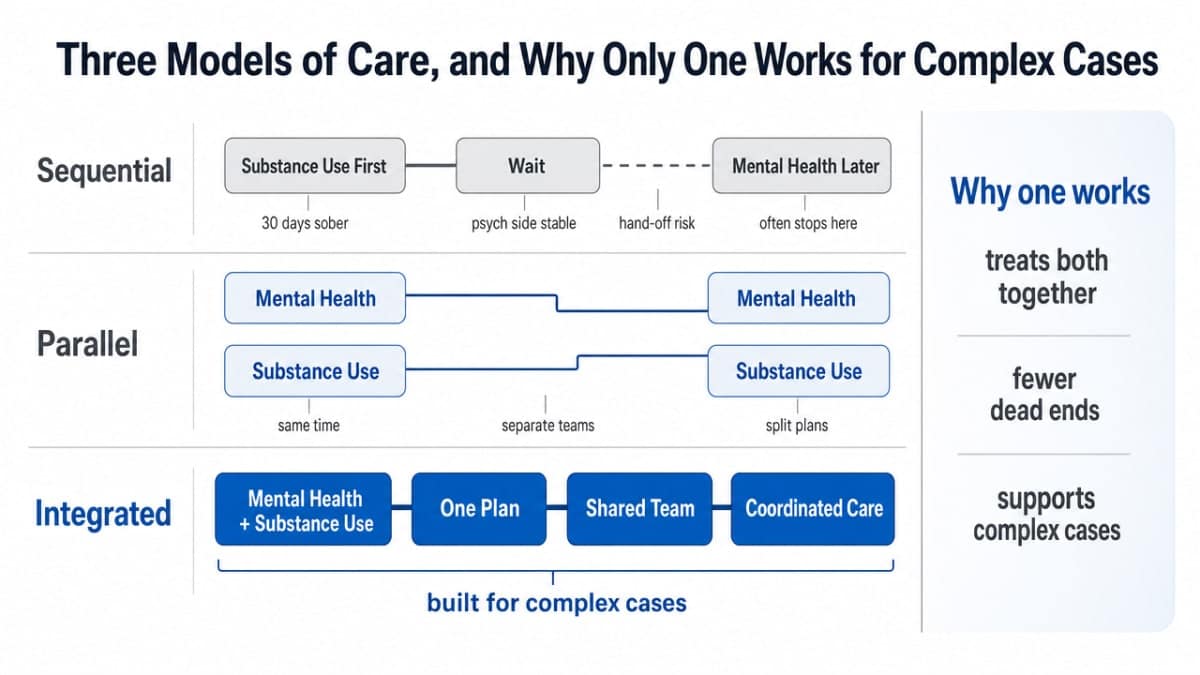
Three Models of Care, and Why Only One Works for Complex Cases
When you call around, you are really calling into three different care philosophies, even if nobody names them out loud. Knowing which one a program runs on will save you a lot of dead-end conversations.
Sequential care is the oldest of the three. In this model, one condition gets treated first, and the other waits its turn. Historically, that meant abstinence had to come before any mental health treatment11. In practice today, it sounds like: “Come back at 30 days sober,” or “We need the psychiatric side stable before we can address the substance use.” The patient becomes a relay baton passed between systems that will not both hold on at the same time. If the first hand-off fails — and with untreated psychosis, depression, or trauma driving the substance use, it usually does — the patient never reaches the second provider.
Parallel care looks better on paper and often worse in practice. Here, two providers work at the same time, but in separate buildings, under separate treatment plans, with separate charts. A psychiatrist at one clinic manages medication. A counselor at a different clinic runs relapse work. Nobody has authority over the whole case. When the antipsychotic dose changes, the addiction counselor may not hear about it for weeks. When cravings spike, the psychiatrist may never know. Families end up as the informal case managers, faxing records and repeating history at every appointment. It’s not integration. It’s two monologues.
Integrated care is what the research actually endorses. One multidisciplinary team, working in one setting, delivers mental health and substance use treatment together, under a single unified plan1, 11. The psychiatrist and the therapist sit in the same case conference. Medication decisions and relapse triggers get discussed in the same room by the same people. The treatment plan covers both conditions and gets updated on a set clinical schedule, not whenever two disconnected offices happen to sync up.
For a straightforward case, sequential or parallel care can sometimes get by. For a complex case — active psychosis, treatment-resistant depression, high medication acuity, recent hospitalizations, trauma driving the drinking — sequential and parallel models tend to collapse under the weight of the coordination they cannot do. That is why integrated care is the standard SAMHSA points to for co-occurring disorders, and why the sequential model that keeps requiring 30 days of sobriety is the one the evidence has moved past1, 11.
When you make the next call, listen for which of these three models the program is describing. If they cannot answer, that is its own answer.
What Integrated Care Actually Looks Like Inside the Building
It helps to picture it. When a program tells you they deliver integrated care, what should actually be happening on the inside of that building?
Start with the team. A real integrated program runs on a multidisciplinary team working in one setting, not a psychiatrist in one clinic and a counselor in another2. That means a board-certified psychiatrist, therapists trained in both mental health and addiction work, nurses who can manage psychiatric medications alongside withdrawal symptoms, and case managers who share one chart. When the medication changes on Tuesday, the therapist knows about it before Wednesday’s session.
Next, look at the treatment plan. SAMHSA’s implementation guidance is specific: integrated treatment plans should cover both the mental illness and the substance use disorder, and they should be updated on a set clinical schedule rather than whenever two disconnected offices happen to talk3. One plan. Both conditions. Written down. Revisited.
Then look at the screening. Programs actually built for dual diagnosis use standardized tools to catch what a rushed intake would miss — instruments like the DALI and structured diagnostic interviews, not a single checkbox question about “any mental health history”3. That’s how a program catches trauma driving the drinking, or a bipolar pattern hiding underneath what looked like depression.
Medications get coordinated in the same room. Effective substance use treatment often requires addressing co-occurring mental disorders at the same time, and that includes advanced protocols for treatment-resistant presentations — clozapine for stubborn psychosis, mood stabilizers for rapid cycling, medication-assisted treatment for opioid or alcohol use8. In an integrated setting, one prescriber holds the whole picture instead of two prescribers guessing at each other’s decisions.
Finally, notice what is not happening: nobody is being told to come back at 30 days sober. Nobody is being handed a referral to a clinic across town. The care travels with the patient, inside one building, under one team.
Outcomes: What Changes When the Care Model Changes
The care model is not an abstract debate. It shows up in the body of the person you love, in whether they sleep, in whether they pick up again a week after discharge, in whether they end up back in the emergency room by the end of the month.
Here is what the research actually shows. When someone with a co-occurring mental health and substance use disorder receives integrated treatment — one team, one plan, both conditions handled together — the outcomes measurably improve across three dimensions that matter to families in crisis: substance use goes down, psychiatric symptoms improve, and hospitalizations become less frequent9. That review of the literature reached a plain conclusion: integrated treatment is more effective than non-integrated treatment for people with co-occurring disorders9.
Read that in the context of your last six months. Every rejection your loved one absorbed from a program that could only handle half the picture was, in outcome terms, a step away from those three shifts. Every parallel-care arrangement where the psychiatrist and the counselor never spoke was a coordination gap that the research already predicts will cost you.
The reverse is also true. When the model changes, the trajectory can change. Fewer relapse episodes. Fewer inpatient stays. A psychiatric picture that finally starts to settle because the substance driving it is being addressed in the same room, by the same team, on the same week. This is not a promise about any one person. It is what the evidence says happens on average when families finally find a program built for the whole case.
So if you’re weighing whether it’s worth making one more call after being told no, this is your answer. The model you choose next is not a formality. It is the variable most likely to change what happens in the next ninety days.
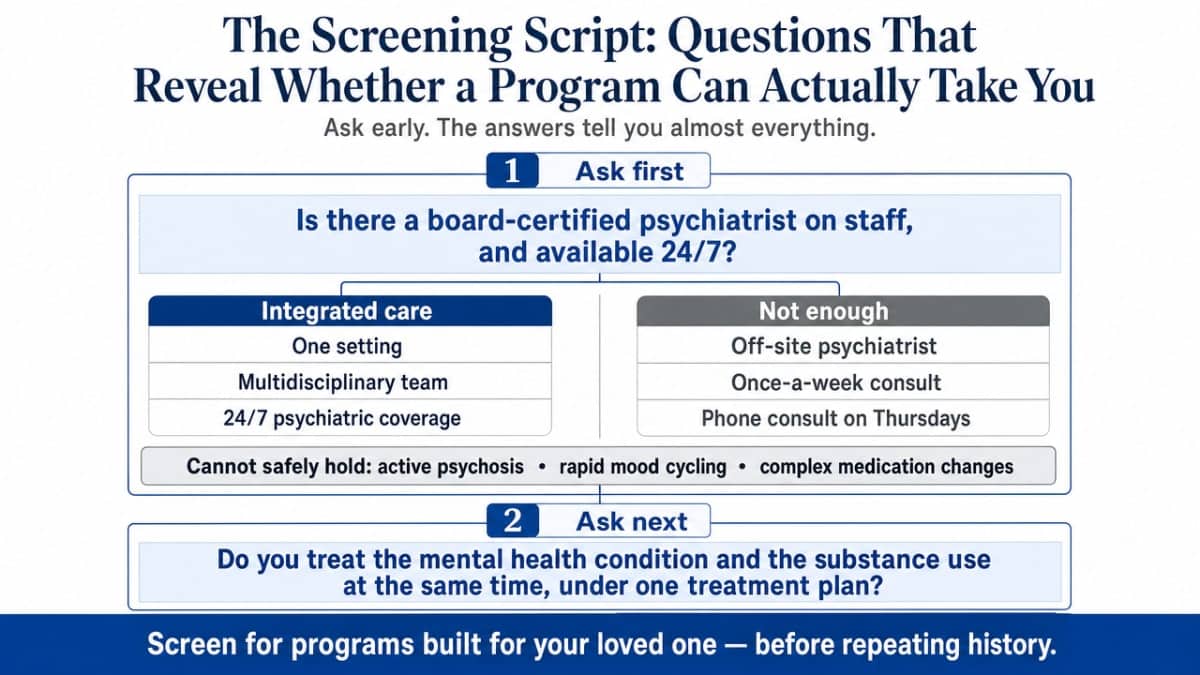
The Screening Script: Questions That Reveal Whether a Program Can Actually Take You
You should not have to make ten more calls to figure out which programs are built for your loved one and which ones will waste another week of your life. The next time an admissions line picks up, ask these questions early, before you spend twenty minutes rehashing history. The answers will tell you almost everything.
“Is there a board-certified psychiatrist on staff, and are they available 24/7?” If the answer is a therapist who consults with a psychiatrist off-site once a week, that program cannot safely hold active psychosis, rapid mood cycling, or complex medication changes. Integrated care requires a multidisciplinary team working in one setting, not a phone consult on Thursdays2.
“Do you treat the mental health condition and the substance use at the same time, under one treatment plan?” Listen for the word concurrent. SAMHSA’s standard is that both conditions get treated together to address the full range of symptoms1. If they say you’ll do the addiction track first and then get referred out for psychiatric care later, that is sequential care wearing a new coat.
“Do you require a period of sobriety before admission?” A yes here is disqualifying for most complex cases. The evidence has moved past the abstinence-first requirement, and programs that still enforce it are not equipped for someone whose drinking is fueled by untreated psychiatric symptoms11.
“What is your policy on active psychosis, recent suicide attempts, or self-harm?” Programs without 24/7 psychiatric coverage often decline these presentations because of the liability exposure they carry10. You want a straight answer, not a hedge.
“Can you manage advanced medication protocols, including clozapine and medication-assisted treatment for substance use?” Effective treatment often requires addressing co-occurring mental disorders pharmacologically at the same time as the substance use, and treatment-resistant presentations need prescribers comfortable with the harder protocols8.
“How is length of stay decided?” If the answer is “whatever your insurance authorizes,” the clinical picture is not driving the plan. Ask whether length of stay can extend based on clinical need.
“Do the psychiatrist and the therapist share the same chart and meet about my loved one’s case together?” This is the parallel-care test. Two providers in one building who never talk is not integration.
If a program stumbles on three or more of these, thank them and hang up. The right program will answer clearly and quickly, because they built the building around these exact questions.
What ViewPoint Was Built to Do
Everything in this guide points at one thing: you need a program that was designed, from the studs up, for the case other programs decline. That is the exact reason ViewPoint Dual Recovery exists in Prescott, Arizona.
Board-certified psychiatry is available in-house, not on a Thursday consult schedule. That matters because the presentations that scare other admissions lines — active psychosis, recent suicide attempts, self-harm, rapid mood cycling, complex medication regimens — are the presentations ViewPoint was staffed to hold safely, rather than route away out of liability concern10.
The mental health condition and the substance use disorder are treated concurrently, under one plan, by one team that shares the same chart and meets about your loved one’s case together. That is the integrated model SAMHSA points to as the preferred standard for co-occurring disorders, delivered by a multidisciplinary team working in one setting rather than two clinics passing paperwork1, 2.
Medication management includes the advanced protocols that treatment-resistant cases actually need — clozapine for stubborn psychosis, mood stabilizer strategies for rapid cycling, and coordinated pharmacology that addresses the psychiatric condition and the substance use at the same time, in the same prescriber’s hands8. Trauma-focused therapy runs in the same building as the psychiatric care and the addiction work, because pulling those apart is what breaks most treatment plans.
Length of stay is decided by clinical need, not by whatever an insurance reviewer authorized on a Tuesday afternoon. ViewPoint is Joint Commission-accredited, licensed by Arizona ADHS, and LegitScript certified.
If other programs have already said no, ViewPoint is the program built to say yes. Call admissions. Bring the whole picture — the psychosis, the drinking, the medication list, the hospitalizations, all of it. That is the case this building was made for.
Find out if your complex case qualifies here
Get expert feedback on eligibility for advanced dual diagnosis treatment when other doors have closed.
Frequently Asked Questions
Why do treatment programs keep telling us they’re ‘not the right fit’ for dual diagnosis?
Most of the time, that phrase describes their building, not your loved one. Programs decline complex dual diagnosis cases because of separate funding streams, licensing that only covers one side of the picture, limited staff training in both disciplines, and risk avoidance around high-acuity patients like active psychosis or recent suicide attempts10. The rejection is a structural limit, not a judgment on the person you’re trying to help.
Does being turned away mean my loved one’s case is too severe to treat?
No. It means the programs you called are not built for the full picture. Co-occurring mental health and substance use disorders are common, not rare — people with mental disorders are more likely to develop a substance use disorder, and the reverse is also true7. Your loved one sits inside the mainstream of what the field is supposed to treat. Some programs are simply staffed and licensed to hold that complexity, and some are not.
Do we really have to get sober first before a program will treat the psychiatric condition?
Not according to current clinical standards. SAMHSA’s guidance is that substance use disorders and mental disorders should be treated concurrently, not one after the other, to address the full range of symptoms1. The old sequential model that required abstinence before mental health care has been outperformed by integrated approaches11. If a program still enforces a 30-day sobriety requirement, that is their policy limit, not a rule handed down from the evidence base.
What questions should I ask an admissions line to find out if they can actually handle a complex case?
Ask whether a board-certified psychiatrist is on staff and available 24/7, whether the mental health condition and substance use are treated concurrently under one plan, and whether the psychiatrist and therapist share the same chart2. Ask about their policy on active psychosis, suicide attempts, and self-harm10. Ask if they can manage advanced protocols like clozapine and medication-assisted treatment8. Ask how length of stay is decided. Clear answers mean the program was built for this.
What makes integrated dual diagnosis care different from what most rehabs offer?
Integrated care puts one multidisciplinary team in one setting, working from one treatment plan that covers both conditions together2, 3. Most rehabs run sequential or parallel models — treating one condition first, or splitting care between two clinics that rarely talk. Research shows integrated treatment produces better outcomes for co-occurring disorders: reduced substance use, improved psychiatric symptoms, and fewer hospitalizations9. The difference is not marketing language. It is how the care is physically organized.
How do I reach ViewPoint if other programs have already said no?
Call admissions directly. ViewPoint Dual Recovery is a Joint Commission-accredited psychiatric facility in Prescott, Arizona, staffed with 24/7 board-certified psychiatry and built for the presentations other programs decline — active psychosis, treatment-resistant conditions, complex medication needs, and co-occurring substance use1. Bring the full history when you call: the psychiatric picture, the substance use, the medication list, prior hospitalizations. That is exactly the case this program was designed to accept.
References
- Substance Use Disorder Treatment for People with Co-Occurring Disorders (TIP 42 2020). https://library.samhsa.gov/sites/default/files/pep20-06-04-006.pdf
- Integrated Treatment for Co-Occurring Disorders: The Evidence. https://library.samhsa.gov/sites/default/files/ebp-kit-the-evidence-10242019.pdf
- Integrated Treatment for Co-Occurring Disorders: Building Your Program. https://library.samhsa.gov/sites/default/files/ebp-kit-building-your-program-10112019.pdf
- Substance Use Disorder Treatment for People With Co-Occurring Disorders. https://www.ncbi.nlm.nih.gov/books/NBK571020/
- Concurrent (Dual) Disorder Management Guidelines. https://pmc.ncbi.nlm.nih.gov/articles/PMC13117480/
- Treatment Guidelines for Substance Use Disorders and Co-occurring Mental Disorders. https://pmc.ncbi.nlm.nih.gov/articles/PMC3285548/
- Common Comorbidities with Substance Use Disorders. https://www.nida.nih.gov/publications/research-reports/common-comorbidities-substance-use-disorders
- Medications for Substance Use Disorders. https://www.nida.nih.gov/publications/principles-drug-addiction-treatment-research-based-guide-third-edition/evidence-based-approaches-to-drug-addiction-treatment/medications-for-substance-use-disorders
- Integrated Treatment for Co-occurring Disorders: A Review. https://www.ncbi.nlm.nih.gov/pmc/articles/PMC3753025/
- Barriers to Implementing Integrated Dual Diagnosis Treatment. https://www.ncbi.nlm.nih.gov/pmc/articles/PMC2898838/
- Care for People with Co-occurring Mental and Substance Use Disorders. https://www.ncbi.nlm.nih.gov/pmc/articles/PMC5104203/