

Key Takeaways
- An integrated care plan means one team, one record, and one set of goals treating mental health and substance use together — not two separate providers who rarely communicate 1.
- Programs use ‘integrated’ loosely, so ask whether care is coordinated, co-located, or fully integrated, and whether medications for opioid use disorder are prescribed onsite rather than referred out 5.
- Current VA and VA/DoD guidance rejects blanket ‘get sober first’ rules — trauma therapies like CPT, PE, and EMDR can begin alongside substance use treatment when clinically appropriate 12, 13.
- Judge a plan by measurable follow-up: concurrent assessment, shared goals in your words, PHQ-9 and GAD-7 rescoring, substance use day counts, and plan changes when numbers aren’t moving 2, 10.
When Half-Treatment Is the Problem You’re Trying to Solve
If you’ve been shuttled between a therapist who won’t touch the drinking and a rehab that won’t touch the PTSD, you already know what half-treatment feels like. One hand treats the panic attacks. The other hand treats the pills. Neither hand talks to the other, and you’re the one carrying the weight between them.
That split isn’t your fault, and it isn’t rare. In 2024, an estimated 59.3% of adults aged 26 to 49 with a co-occurring mental illness and substance use disorder received either mental-health or substance-use treatment — but “either” is the hinge word, because getting one service is not the same as getting coordinated care for both 4. SAMHSA has been clear for years that these conditions should be screened and treated together, not sorted into separate lines 1.
An integrated care plan is the fix for that split. It’s one document, one team, and one set of goals that treat your mental health and substance use at the same time, from day one. The rest of this guide shows you what belongs inside that plan, how to spot the real thing, and what good care should feel like in the first few weeks.
What an Integrated Care Plan Actually Is
One Plan, One Team, One Record
An integrated care plan is one working document, built by one clinical team, held in one shared record. Your psychiatrist, your therapist, your case manager, and whoever is managing your medications are all looking at the same assessment, the same goals, and the same notes from last week’s session. When the therapist learns you’ve started drinking again, the psychiatrist sees it before your next medication check. When the psychiatrist changes a dose, your therapist knows why.
That’s the shape of it. SAMHSA describes integrated care as treating the whole person and coordinating mental-health and substance-use interventions rather than running them as separate projects 1. The TIP 42 advisory goes further and sets the clinical standard: both conditions are treated concurrently, with staged care matched to your readiness, individual and group formats, family involvement, and ongoing medication review by a team that actually talks to itself 2.
If you’ve been handed two different plans by two different offices that don’t share records, you don’t have an integrated plan. You have two plans that happen to belong to the same person.
Coordinated vs. Co-Located vs. Fully Integrated: Three Models, Very Different Experiences
Programs use the word “integrated” loosely. SAMHSA actually names three different models, and the difference between them changes what your week looks like 1. Knowing which one you’re being offered gives you a fair question to ask on the first phone call.
- Coordinated care
- The lightest version. Your mental-health provider and your substance-use provider work at separate organizations, but they communicate — phone calls, shared faxes, release-of-information forms. The relationship depends on two humans picking up the phone. When it works, it works. When one provider is on vacation or a referral falls through a crack, you feel it immediately.
- Co-located care
- Puts both services under the same roof. You walk into one building and see the therapist in one office and the substance-use counselor down the hall. Scheduling is easier, and warm handoffs are possible. But co-location is a floor plan, not a clinical practice. The two providers may still write separate notes, hold separate case conferences, and never sit down together to look at your plan as one document.
- Fully integrated care
- What the editorial brief and the clinical literature actually mean by “integrated.” One team shares one assessment, one treatment plan, and one record. Decisions about trauma therapy, psychiatric medications, and substance-use interventions are made together, in the same meeting, with you in the room when possible. SAMHSA’s practice principles describe this as both disorders treated concurrently by providers trained in both, with multidisciplinary medication review built into the workflow 3.
If a program’s website says “integrated,” it is reasonable to ask: Are you coordinated, co-located, or fully integrated? Clinicians who do this work will know exactly what you mean.
Why ‘Get Sober First’ Is Out of Step With Current Guidance
If someone has told you to “get sober first” before starting trauma therapy or psychiatric treatment, that message doesn’t match what the current guidelines say. The VA National Center for PTSD is direct about it: patients with PTSD and a substance use disorder can tolerate and benefit from evidence-based trauma-focused treatment, and having one disorder should not be a barrier to treatment for the other 12. The 2023 VA/DoD clinical practice guideline carries the same message — co-occurring substance use disorder should not automatically rule out recommended trauma therapies like cognitive processing therapy, prolonged exposure, or EMDR when the clinical picture supports it 13.
This matters because the “sober first” rule has kept a lot of people stuck. If drinking or using is partly a way of coping with trauma, waiting until you’ve white-knuckled sobriety before touching the trauma is asking you to climb the mountain without the oxygen. Concurrent care gives you a different deal: your psychiatric symptoms, your substance use, and your trauma all get attention at the same time, with the team watching how each piece affects the others.
Inside the Plan: The Seven Components That Should Be There
Concurrent Assessment and Diagnosis
The first thing a real integrated plan does is look at both conditions at the same time, with the same clinicians, in the same intake. Not a psychiatric evaluation this week and a substance-use intake three weeks later at a different office. One assessment, one biopsychosocial history, one differential diagnosis that asks how the drinking is shaping the depression and how the depression is shaping the drinking.
SAMHSA’s TIP 42 advisory describes this as screening, assessment, and diagnosis handled concurrently so that treatment planning is built on a complete picture rather than half of one 2. The “no wrong door” principle backs it up: whichever system you walk into first — mental health or substance use — should screen for the other condition and keep you in care, not bounce you across town 1.
Shared Goals Written With You, Not At You
Your goals belong on the plan in your own words. “Sleep through the night without a nightmare.” “Get through my daughter’s birthday without drinking.” “Stop feeling flat on this medication.” Those sit alongside the clinical targets your team is tracking.
SAMHSA’s practice principles call for care tailored to your stage of readiness, which means the plan meets you where you are instead of demanding a readiness you don’t have yet 3. Motivational interviewing is part of how good teams get there — a conversation style that explores your reasons for change rather than lecturing you into them. If you read your plan and don’t recognize yourself in it, say so. That’s useful clinical information, not a complaint.
Psychiatric and Substance Use Interventions on the Same Schedule
In a fragmented system, you might see a therapist on Tuesday for depression and a substance-use counselor on Thursday at a different clinic — and neither one knows what the other is working on. An integrated plan puts both kinds of intervention on one weekly schedule, with providers who share notes and case conferences.
TIP 42 is specific about the mix: individual therapy, group work, family sessions, and peer support, chosen based on what you actually need rather than what the schedule has open 2. The underlying principle is concurrent treatment by a team trained in both conditions, with staged care that adjusts as you move through different phases of recovery 3. The schedule itself tells you whether the integration is real: if the two sides never share a calendar, they’re not really sharing a plan.
Medication Strategy — Including the OUD Gap You Should Ask About
Medications sit at the center of an integrated plan for anyone with a serious psychiatric condition, a substance use disorder, or both. That means a psychiatrist who reviews your full list — not just the antidepressant, not just the Suboxone — and watches how they interact. SAMHSA’s practice principles describe this as multidisciplinary medication review built into the workflow, with ongoing monitoring of adherence, safety, and response rather than a prescription handed over and forgotten 3.
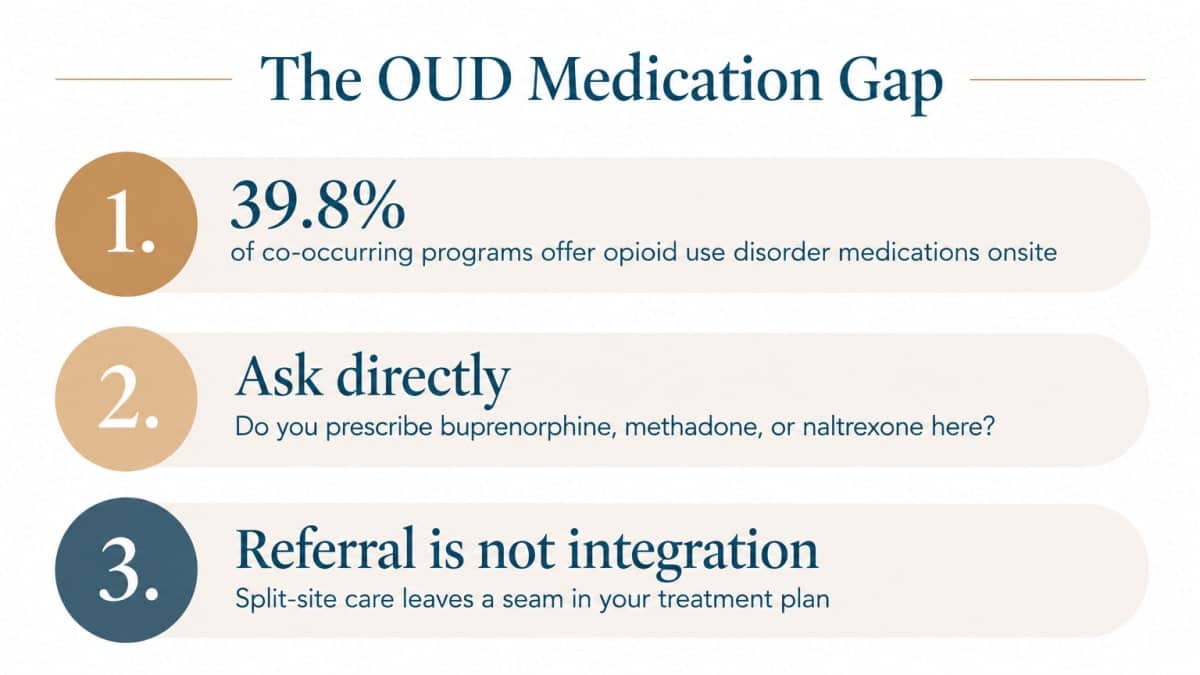
If opioids are part of your story, ask directly: Do you prescribe medications for opioid use disorder here, or do you refer out? A referral is not the same as integration. A plan that treats your psychiatric medications in one building and your OUD medication somewhere else is a plan with a seam running down the middle.
Trauma-Informed Therapy Without a Sobriety Gate
If trauma is part of why you drink or use, your plan should name it and address it — not file it away for later. The VA National Center for PTSD is clear that patients with PTSD and a substance use disorder can tolerate and benefit from evidence-based trauma-focused treatment, and that having one disorder should not block treatment for the other 12. The 2023 VA/DoD clinical practice guideline agrees: co-occurring SUD should not automatically rule out recommended trauma therapies like cognitive processing therapy, prolonged exposure, or EMDR when the clinical picture supports it 13.
What this looks like on paper: trauma therapy appears in your weekly schedule from early in treatment, paced to what you can carry, with the team watching for triggers and adjusting as needed. Clinical judgment still matters — acute withdrawal, acute psychosis, or immediate safety risks may shift the timing 12. But “come back when you’ve been sober six months” is not a plan. It’s a closed door.
Family and Peer Support Built Into the Plan
Recovery doesn’t happen in a vacuum, and your plan shouldn’t pretend it does. The people you live with, the people you’ve hurt, and the people walking a similar road all belong somewhere on the page. TIP 42 lists family and peer formats alongside individual and group work, not as an add-on but as part of the core mix 2.
What that looks like in practice: a family session scheduled in month one, with releases signed so your spouse or parent can be in the room. A peer support specialist assigned to you — someone who has lived through co-occurring recovery and can translate what the clinical team is saying. If your plan treats you as a solo project, something is missing.
Measurement-Based Follow-Up: PHQ-9, GAD-7, and Substance Use Days
A plan without measurement is a plan on autopilot. AHRQ’s guidance for integrated behavioral health is specific: use short, validated tools at regular intervals, track them over time, and change the plan when the numbers aren’t moving in the right direction 10.
The PHQ-9 is a nine-question depression screen you’ll likely fill out every few weeks. The GAD-7 does the same for anxiety. Alongside those, your team should be tracking substance use days — simply, how many days in the past week or month you drank or used — plus general functioning, side effects, and whether you’re actually showing up to sessions 10. CMS’s Universal Foundation measures echo this on the system side: depression screening with follow-up, initiation and engagement in substance-use treatment, and follow-up after an emergency-department visit or psychiatric hospitalization are the kinds of indicators a serious program tracks 15.
If you’re six weeks in and no one has rescored your PHQ-9 or asked you to count your drinking days, that’s a fair thing to flag. Measurement-based care is how your plan knows whether to stay the course or change it.
What the Evidence Actually Says (And Where It’s Mixed)
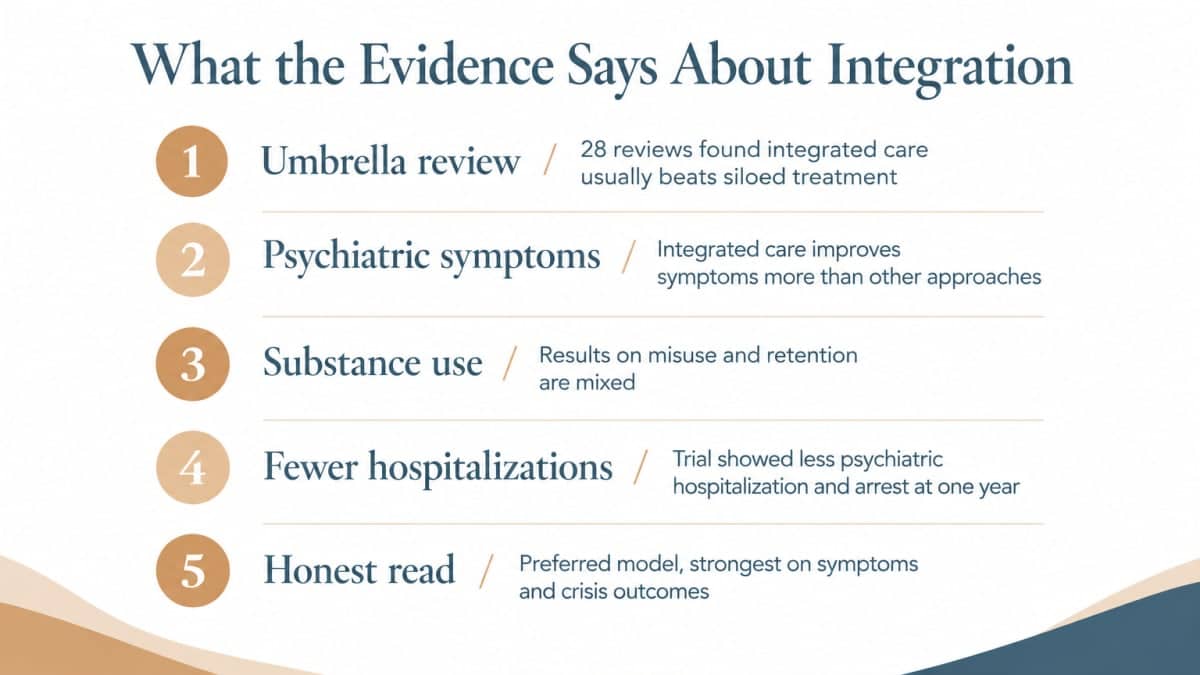
You deserve a straight answer about whether integrated care actually works, so here it is: the evidence leans in favor of integration, but it’s not a clean sweep. A 2025 umbrella review of 28 systematic reviews — pulled from more than 5,400 records — found that integrated or coordinated treatment was usually better than treating one condition alone, and sometimes better than parallel, uncoordinated services 7. A separate systematic review of randomized trials found that integrated treatment significantly improved psychiatric symptoms, though it did not consistently outperform other approaches on substance misuse or treatment retention 6. A peer-reviewed review added a sobering note: in some long-term trials, integrated psychosocial care did not outperform usual care on alcohol or substance use, functioning, or life satisfaction 8.
The service-utilization picture is stronger. An older randomized study of 216 adults with severe mental illness and substance use found greater reductions in psychiatric hospitalization and arrest in the integrated group over one year, though its findings may not fully generalize to today’s programs, populations, or staffing levels 9. That matters because fewer hospital stays and fewer run-ins with police translate directly into a steadier life.
Here’s the honest read: integrated care is the preferred model and usually helps, especially with psychiatric symptoms and crisis-level outcomes. But “integrated” is not a magic word. The intervention, your diagnosis, and the team’s skill all shape the result. And access is the other half of the problem — in 2024, 59.3% of adults aged 26 to 49 with a co-occurring mental illness and substance use disorder received either mental-health or substance-use treatment, which still leaves a sizable gap and does not tell us how many of those adults got care that was actually coordinated 4. The question isn’t just whether you can get into treatment. It’s whether the treatment you get is built as one plan.
A Reader’s Checklist: How to Tell if a Program’s ‘Integrated’ Label Matches Its Practice
You don’t need a clinical degree to tell the difference between a program that integrates care and one that uses the word on a brochure. You need a short list of questions and the willingness to ask them before you commit. Here’s what to work through on the intake call or the first family meeting.
Do your psychiatrists and therapists share one treatment record? One chart, one plan, one set of notes everyone can see. If the answer involves faxes, release forms between organizations, or “our therapist will call theirs,” you’re looking at coordinated care at best, not full integration 1.
Who writes the treatment plan, and when do they meet? A fully integrated team sits down together — psychiatrist, therapist, case manager, nurse — and builds one plan in one meeting. Ask how often that team conferences on your case. “Weekly” is a real answer. “The providers communicate as needed” is not 3.
Can you start medications for opioid use disorder onsite? If opioids are part of your history, this is non-negotiable. Buprenorphine, methadone, or naltrexone prescribed in the same building as your psychiatric care means one team watching both. A referral to an outside clinic is a seam 5.
Is trauma therapy available before you’ve hit a sobriety milestone? The current VA guidance is that co-occurring substance use should not automatically block trauma-focused treatment like cognitive processing therapy, prolonged exposure, or EMDR 12, 13. If the program requires 30, 60, or 90 days of sobriety before trauma work begins, that’s a sequencing policy, not integrated care.
How will you measure whether the plan is working? Ask specifically about the PHQ-9, GAD-7, and tracking of substance use days. AHRQ’s measurement-based care guidance expects regular rescoring and plan changes when the numbers aren’t moving 10. CMS’s priority measures add depression screening with follow-up and documented engagement in substance-use treatment 15. A program that can name the tools it uses is a program that uses them.
If a program answers four or five of these cleanly, you’re probably looking at the real thing. If answers get vague, that vagueness is your answer.
Evaluating Options in Arizona: A Licensing Distinction Worth Knowing
If you’re searching for residential care in Arizona, one licensing detail can save you a lot of grief: a sober living home and a behavioral health residential facility are not the same thing. They sound similar, and families often use the names interchangeably, but the care behind each door is very different.
The Arizona Department of Health Services defines a behavioral health residential facility as a health care institution that provides treatment for a behavioral-health issue, including substance use disorder, with behavioral-health services delivered onsite. These facilities maintain treatment records and may be eligible for insurance or AHCCCS reimbursement 14. That means a licensed clinical team — not just a house manager — is running the care, and your psychiatric medications, therapy sessions, and substance-use interventions can live under the same roof.
A sober living home is a supportive living environment. It can be a real asset after or alongside treatment, but it is not a treatment program. If you need an integrated care plan, the behavioral-health residential license is the category to look for. Ask directly which license the facility holds, and ask to see which clinical services are delivered on the premises versus referred out.
What Good Looks Like Over the First 90 Days
You deserve to know what progress actually feels like, so here’s a rough shape of the first three months inside a real integrated plan — not a promise, just a picture.
Weeks 1–2. You complete one concurrent assessment, not two 2. Your team sits down together and drafts a plan you can read in your own words. Baseline PHQ-9 and GAD-7 scores go in the chart. If opioids are part of your history, you want to know whether medication for opioid use disorder can be prescribed onsite, since only 39.8% of mental-health facilities using medications for co-occurring clients offered OUD medications in 2024 5. A family session is on the calendar.
Weeks 3–6. Trauma-focused therapy begins if it fits your clinical picture, without a sobriety gate 12. Your psychiatrist adjusts medications based on how you’re actually responding. You rescore the PHQ-9 and GAD-7 and count substance use days with your therapist 10.
Weeks 7–12. Numbers get compared to baseline. If they haven’t moved, the plan changes — different therapy, different medication, different intensity 10. Follow-up after any ED visit or hospitalization is documented, not assumed 11. You should feel known by your team by now. That’s the quiet proof integration is working.
Explore Integrated Care for Both Conditions
Discuss your mental health and substance use needs and learn what level of care may fit.
Frequently Asked Questions
What is the difference between an integrated care plan and getting mental health and substance use treatment separately?
An integrated care plan is one document built by one team that treats both conditions at the same time, with shared goals and a shared record. Separate treatment usually means two offices, two charts, and two providers who rarely talk. SAMHSA names integrated care the preferred model because it treats the whole person rather than splitting you in half 1.
Do I have to be sober before I can start trauma therapy or psychiatric treatment?
No. The VA National Center for PTSD says having a substance use disorder should not block access to evidence-based trauma-focused treatment 12. The 2023 VA/DoD guideline agrees that co-occurring SUD should not automatically rule out therapies like cognitive processing therapy, prolonged exposure, or EMDR 13. Clinical judgment still matters for acute withdrawal or safety, but a blanket sobriety gate is out of step with current guidance.
How can I tell if a program is actually integrated or just says it is?
Ask whether psychiatrists and therapists share one record, how often the full team conferences on your case, and whether medications for opioid use disorder are prescribed onsite. Only 39.8% of mental-health facilities using medications for co-occurring clients offered OUD medications in 2024, so that question alone separates many programs 5. Clear answers signal real integration; vague answers signal co-located or coordinated care at best 1.
What should be included in an integrated care plan document?
A strong plan includes concurrent assessment of both conditions, shared goals written in your words, psychiatric and substance-use interventions on one schedule, a medication strategy with multidisciplinary review, trauma-informed therapy without a sobriety gate, family and peer support, and measurement-based follow-up using tools like the PHQ-9 and GAD-7 with substance-use day counts 2, 3, 10. If any piece is missing, ask why.
Does integrated care actually work better than treating one condition at a time?
Usually, yes, with honest limits. A 2025 umbrella review found integrated or coordinated treatment was generally better than single-condition care 7. An older randomized study of 216 adults reported fewer psychiatric hospitalizations and arrests in the integrated group, though its findings may not fully generalize to current programs 9. Other reviews show mixed results for substance use and retention 6, 8, so the intervention, your diagnosis, and the team’s skill all shape the outcome.
What is the difference between a sober living home and a behavioral health residential facility in Arizona?
A behavioral health residential facility is a licensed health care institution that delivers behavioral-health treatment onsite, maintains treatment records, and may be eligible for insurance or AHCCCS reimbursement 14. A sober living home is a supportive living environment, not a treatment program. If you need an integrated care plan with psychiatry, therapy, and medications under one roof, look for the behavioral health residential license.
References
- Managing Life with Co-Occurring Disorders. https://www.samhsa.gov/mental-health/serious-mental-illness/co-occurring-disorders
- Substance Use Disorder Treatment for People with Co-Occurring Disorders: Advisory Based on TIP 42. https://www.samhsa.gov/resource/ebp/advisory-substance-use-disorder-treatment-people-co-occurring-disorders-based-tip-42
- Substance Use Disorder Treatment for People with Co-Occurring Disorders. https://library.samhsa.gov/sites/default/files/pep20-06-04-006.pdf
- Key Substance Use and Mental Health Indicators in the United States: Results from the 2024 National Survey on Drug Use and Health. https://www.samhsa.gov/data/sites/default/files/reports/rpt56287/2024-nsduh-annual-national-report.pdf
- National Substance Use and Mental Health Services Survey 2024. https://www.samhsa.gov/data/sites/default/files/reports/rpt56696/2024-nsumhss-annual-report.pdf
- Integrated vs non-integrated treatment outcomes in dual diagnosis disorders: A systematic review. https://pmc.ncbi.nlm.nih.gov/articles/PMC10157410/
- Effectiveness of Psychosocial Interventions for Adults With Substance Use Disorders and Co-Occurring Common Mental Health Disorders: An Umbrella Review. https://pmc.ncbi.nlm.nih.gov/articles/PMC12682421/
- Integrating Treatment for Co-Occurring Mental Health Conditions. https://pmc.ncbi.nlm.nih.gov/articles/PMC6799972/
- Integrated versus parallel treatment of co-occurring disorders in a community mental health setting. https://pubmed.ncbi.nlm.nih.gov/16377455/
- Track Patients and Monitor Their Outcomes. https://integrationacademy.ahrq.gov/products/playbooks/behavioral-health-and-primary-care/implementing-plan/track-patients-and-monitor-their-outcomes
- Innovation in Behavioral Health (IBH) Model Frequently Asked Questions. https://www.cms.gov/priorities/innovation/innovation-behavioral-health-ibh-model-frequently-asked-questions
- Treatment of Co-Occurring PTSD and Substance Use Disorder in VA. https://www.ptsd.va.gov/professional/treat/cooccurring/tx_sud_va.asp
- The Management of Posttraumatic Stress Disorder and Acute Stress Disorder. https://healthquality.va.gov/guidelines/MH/ptsd/PTSD-in-Annals-2024.pdf
- Licensing Info – Arizona Department of Health Services. https://www.azdhs.gov/documents/licensing/special/sober-living-homes/brochure-on-sober-living-and-behavioral-health-facilities.pdf
- The Universal Foundation. https://www.cms.gov/medicare/quality/cms-national-quality-strategy/universal-foundation