Key Takeaways
- Being labeled too complex often signals under-assessment, not true resistance: diagnosis, adequate medication trials with verified adherence, and documented inadequate response must all be tested first 3.
- Standardized programs fail severe cases because compressed intakes skip comorbidity and adherence work, and insurance-driven length of stay ends treatment before clinical response data does 5, 4.
- Genuine personalization runs on measurement-based care and integrated dual-diagnosis treatment, with one team, shared data, and specific scales triggering plan revisions rather than clinical impression 9, 10.
- Before admission, press programs on assessment scope, which rating scales drive plan changes, who controls length of stay, and how functional recovery and post-discharge continuity are tracked 1, 2.
When ‘Try the Same Protocol Again’ Stops Being an Answer
If you have been told your case is too complex, that sentence is data, not a verdict. It usually means the last program ran out of tools before it ran out of you.
You already know the pattern. A 14-day inpatient stay. An IOP that runs the same curriculum whether you are stabilizing from a first episode or cycling through your fifth medication failure. A discharge summary that recommends the protocol you just finished. Somewhere along the way, the word personalized stopped meaning much, because the plan looked identical to the plan the person next to you received.
For severe, treatment-resistant presentations, that sameness is the problem. The consensus criteria for treatment-resistant schizophrenia and treatment-resistant bipolar depression require documented diagnostic accuracy, adequate medication trials with adherence verified, comorbidity assessment, and standardized symptom tracking before anyone can honestly say a case has failed treatment 3, 4, 5. None of that fits inside a compressed, one-size protocol.
This piece walks through what individualized psychiatric treatment actually requires when the stakes are this high: how treatment resistance is technically defined, where standardized programs predictably break, what an extended assessment should investigate, and how to tell a program that individualizes from one that only advertises the word. ViewPoint Dual Recovery’s extended assessment process shows up later as a working example, not a sales pitch.
Defining Treatment Resistance: The Three-Part Test
Correct Diagnosis, Adequate Trial, Inadequate Response
Before the label “treatment-resistant” is applied, three conditions must be met:
- the diagnosis must be correct,
- treatment trials must be adequate in dose, duration, and adherence, and
- the response must be documented as inadequate using rigorous measures 3.
This three-part test is designed to identify specific failures in previous treatment. A correct diagnosis ensures that underlying issues like an untreated thyroid problem, an unrecognized personality disorder, or unaddressed substance use are not misdiagnosed as treatment-resistant bipolar depression. An adequate trial verifies that medication was given at the right dose, for sufficient duration, and that adherence was confirmed. An inadequate response requires objective measurement with validated scales, preventing subjective impressions from masking actual symptom shifts 3.
If prior programs skipped any of these steps, it suggests that treatment resistance was never properly tested, rather than indicating a failure on the part of the patient.
Disorder-Specific Criteria for Schizophrenia and Bipolar Depression
The general three-part test becomes even more specific for particular disorders, often exceeding the capabilities of standardized programs.
For schizophrenia, the TRRIP consensus guidelines require a confirmed diagnosis, at least two adequate antipsychotic trials at therapeutic doses with verified adherence, and persistent significant symptoms 4. These guidelines also emphasize standardized symptom ratings and documented functional impairment, which are difficult to achieve in short-term inpatient stays and contribute to delays in effective treatments like clozapine 4.
For bipolar depression, consensus criteria for treatment-resistant and multi-therapy-resistant forms demand a thorough medical workup, exclusion of organic causes, and systematic assessment of psychiatric comorbidities like substance use, personality disorders, and anxiety disorders, as these significantly impact treatment response 5. The 2025 refinement further includes psychosocial dimensions such as early trauma, current stressors, and social support as essential components of a comprehensive assessment 6.
These guidelines collectively underscore that if a program did not investigate comorbidities, verify adherence, or track symptoms with validated scales, it was not equipped to accurately determine treatment resistance. Instead, it was likely processing patients through a predetermined schedule.
Limitations of Standardized Programs for Severe Cases
Inadequate Assessment and Adherence Verification
Standardized programs often fail severe cases from the outset due to compressed intakes. A brief intake with an intake coordinator and a quick psychiatrist interview are typically insufficient to challenge previous diagnoses or thoroughly investigate critical factors.
Crucially, these compressed intakes often miss comorbidities that the treatment-resistance literature deems essential. Substance use, personality features, anxiety disorders, and medical contributors significantly affect how bipolar depression responds to treatment, and their assessment is non-optional according to consensus criteria 5. The 2025 refinement extends this to include early trauma, current psychosocial stressors, and social support 6. A compressed intake may acknowledge these factors but rarely investigates them deeply enough to influence the treatment plan.
Another common oversight is the lack of adherence verification. TRRIP criteria for treatment-resistant schizophrenia mandate that adherence during prior antipsychotic trials be actively assessed, not merely assumed from pharmacy records or patient recall 4. Group-model programs seldom reconstruct this history in detail, making it difficult to determine whether a subsequent medication failure is due to the drug itself or the conditions surrounding its use.
Insurance-Driven vs. Clinician-Driven Length of Stay
A significant structural flaw in standardized programs is the reliance on insurance-driven lengths of stay. Treatment plans are often constrained by payer-approved timeframes, meaning medication titration or comprehensive workups may be cut short when authorization ends, rather than when clinical readiness dictates.
For severe cases, this mismatch can undermine progress. Guidelines for treatment-resistant schizophrenia and bipolar depression assume a workup that unfolds over sufficient time to observe treatment response, comorbidity effects, and adherence patterns 4, 5. Such comprehensive assessment is incompatible with arbitrary length-of-stay limits imposed by benefit design.
Individualized, continuous care coordination, as seen in intensive case management for severe mental illness, has been shown to reduce trial dropout by approximately 32% compared to standard care 2. This suggests that patients remain engaged when treatment plans are tailored to their needs, rather than dictated by a calendar. When the calendar drives the plan, disengagement often occurs, which can be mislabeled as noncompliance.
The Scope of an Extended Assessment
An extended assessment is a structured investigation designed to address critical questions that compressed programs often miss. It goes beyond a typical intake interview to build a comprehensive understanding of a patient’s condition.
The first area of investigation is diagnostic accuracy. This involves a careful review of the patient’s history to confirm the current working diagnosis or identify if it has been carried forward without re-evaluation. For instance, the consensus criteria for treatment-resistant bipolar depression emphasize a thorough medical workup to exclude organic causes like thyroid dysfunction, sleep disorders, or neurological issues before applying the resistance label 5.
Secondly, comorbidity is thoroughly examined. Substance use, personality features, and anxiety disorders are known to alter how severe mood or psychotic illnesses respond to treatment, making their assessment critical 5. The 2025 refinement further mandates the inclusion of early trauma, current stressors, and social support in this comprehensive workup 6. These are not merely checkboxes but variables that fundamentally reshape the treatment plan.
Thirdly, the assessment reconstructs medication history to determine the adequacy of prior trials, verifying correct dosage, sufficient duration, and consistent adherence. This detailed reconstruction is essential for meeting TRRIP guidelines for treatment-resistant schizophrenia 4 and requires extensive record review and clinical conversation, not just a screening form.
Finally, a baseline is established by quantifying symptoms, functioning, and distress using validated rating scales 3. This objective measurement allows for accurate tracking of progress against a clear starting point, ensuring that future responses are measurable rather than subject to subjective recall.
ViewPoint’s extended assessment is specifically structured around these four investigations, which often leads to a treatment plan significantly different from what a patient might initially expect.
Measurement-Based Care: Verifying Personalized Treatment
The true indicator of a program’s commitment to individualized care is its use of measurement-based care (MBC) and how it utilizes the data collected.
MBC involves systematically tracking symptoms, functioning, and treatment response with validated rating scales at regular intervals, then using these scores to adjust the treatment plan. This process transforms personalized care from a theoretical promise into a practical feedback loop. Without MBC, treatment decisions rely solely on subjective impressions from both clinicians and patients, which can be unreliable, especially when illness distorts perception.
Evidence strongly supports MBC. A 2024 psychiatry review highlights that systematic tracking is linked to increased remission rates, reduced relapse risk, improved medication adherence, and a stronger therapeutic alliance 8. Multiple review articles confirm that MBC outperforms standard care in outcomes, particularly for non-responders, which is precisely the population that has not benefited from conventional programs 7.
Despite this evidence, a systematic review found that fewer than 20% of behavioral health practitioners routinely use MBC 9. This indicates that many programs claiming personalization operate on clinical impression rather than objective data. When a large behavioral health system implemented structured MBC, patient outcomes improved by approximately 5 percentage points on combined PHQ-9 and GAD-7 measures, a relative improvement of 23.5%, demonstrating how data can change clinician behavior 11.
To assess a program’s personalization, inquire about the specific scales used (e.g., PHQ-9, GAD-7, PCL-5, PSYRATS), their administration frequency, who reviews the trends, and what criteria trigger a plan adjustment. Specific answers indicate a functional, personalized system, while vague responses suggest that personalization is more of a marketing term than a practical approach. This specificity is both established during an extended assessment and maintained through a clinician-driven treatment duration.

Integrated Dual-Diagnosis Care: A Core Personalization Variable
When a co-occurring substance use disorder is present in severe psychiatric cases, many systems still treat it as a logistical challenge, separating mental health and substance use treatment into different tracks. This approach is not personalization; it is two partial plans running in parallel, placing the burden of coordination on the patient.
The evidence strongly supports integrating these treatments. SAMHSA’s review of integrated dual-diagnosis care found that programs where a single team delivers both mental health and substance use interventions in one setting achieve better outcomes in terms of relapse, hospitalization, arrests, housing stability, and quality of life compared to non-integrated care 10. For severe cases, sequencing or referring out for one aspect of treatment is not a neutral choice.
The treatment-resistance literature reinforces the necessity of integration. Bipolar consensus guidelines explicitly state that substance use is a comorbidity highly likely to impede response to subsequent treatments and must be included in the primary assessment 5. The 2025 refinement incorporates substance use into a comprehensive psychosocial workup alongside trauma and current stressors 6. This technical rationale for integration views substance use as a variable that modifies the psychiatric plan, rather than a separate diagnosis requiring its own distinct plan.
Practically, integration means the psychiatrist adjusting medications and the clinician addressing substance use are part of the same team, reviewing the same measurement data, and collaboratively revising a single, unified plan. This integrated approach is central to ViewPoint’s care model, where dual-diagnosis work is an inherent dimension of the psychiatric plan, not a separate referral.
Personalization in Functional Recovery, Beyond Symptom Scores
A reduction in symptom scores does not always equate to an improvement in a patient’s life. It is common for symptom checklists like the PHQ-9 or PANSS to show improvement while an individual remains unable to work, attend school, or engage in activities that define their life. If personalization focuses solely on symptom tracking, it overlooks this crucial gap.
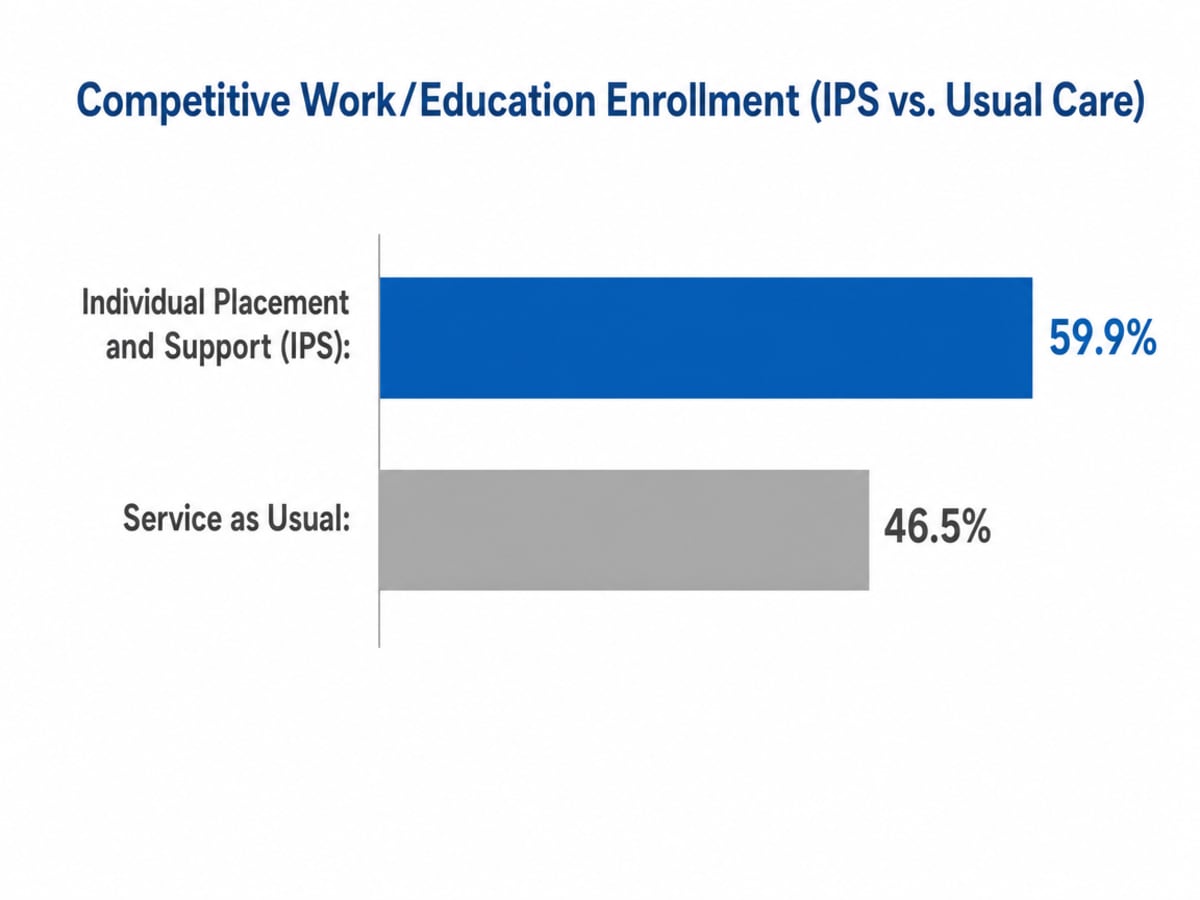
Individualized care demonstrates its true impact through functional recovery. A randomized trial involving 720 adults with severe mental illness compared individualized supported employment (Individual Placement and Support model) with usual care over 18 months. The IPS group achieved competitive employment or educational enrollment at a rate of 59.9%, significantly higher than the 46.5% in the usual care group 1. This 13.4 percentage point difference highlights recovery in terms of tangible life outcomes, such as employment or education, rather than just symptom reduction.
The success of IPS stems from its personalized approach: vocational planning is tailored to individual preferences and clinical profiles, integrated with the treating team, and adjusted based on response data. The study also noted that additional enhancements like cognitive remediation did not significantly outperform standard IPS, suggesting that the individualization itself is the primary active ingredient 1.
Patient retention is also a key factor. Intensive case management, which provides individualized, continuous care coordination for severe mental illness, reduced trial dropout by approximately 32% compared to standard care 2. Patients are more likely to remain engaged in treatment when it is tailored to them as individuals, rather than as generic cases. Sustained engagement is essential for rebuilding functional capacity, which is the outcome most noticeable to families and future employers.
When evaluating programs, inquire how they measure functional recovery, including aspects like work, school, housing stability, relationships, and days out of crisis. If a program only reports symptom scores, it is providing an incomplete picture of recovery.
Evaluating Programs Claiming Individualized Treatment
Key Questions Before Admission
Asking thorough questions before admission is not being difficult; it is performing the necessary diagnostic work that previous programs may have neglected.
- Begin by inquiring about the initial assessment: its duration and the specific investigations conducted. A program for severe cases should detail a medical workup, a comprehensive comorbidity screen covering substance use, personality features, anxiety, and trauma, and a reconstruction of medication history to determine trial adequacy 4, 5, 6.
- Next, focus on measurement. Ask about the specific rating scales used, their frequency, who reviews the trends, and what score changes trigger plan revisions. If the answers are vague, the personalization is likely superficial. A systematic review of psychiatric measurement-based care revealed that despite its proven benefits, it is underutilized by clinicians 9, making this question a crucial differentiator for programs.
- Determine who controls the length of stay. If it is dictated by insurance benefits, the treatment plan will be constrained by time. If it is determined by the treating team based on documented response data, the duration of stay will align with clinical needs.
- Finally, ask how substance use is addressed: is it handled by one integrated team and plan, or through external referrals 10?
Ensuring Continuity of Care
Individualized treatment must extend beyond discharge to ensure sustained recovery and prevent a recurrence of previous patterns.
Continuity of care has measurable benefits. A review of intensive case management for severe mental illness showed that individualized, continuous care coordination reduced trial dropout by approximately 32% and modestly decreased hospitalization days compared to standard care 2. This highlights the importance of tracking individuals rather than just case numbers. Look for programs that offer:
- a named coordinator,
- a written aftercare plan referencing specific measurement data,
- warm handoffs to outpatient providers, and
- scheduled follow-up that does not rely on patient initiation during difficult periods.
Inquire about the program’s protocol if a discharged patient’s scores decline. Is there a re-engagement strategy, or does the file simply close? Ask how the psychiatrist, therapist, and dual-diagnosis clinician communicate during the stay—do they share team meetings and charts, or do they maintain separate, uncoordinated notes? Also, ascertain what data will be transferred upon discharge.
A program that individualizes only at admission but neglects continuity post-discharge has personalized the entry process, not the entire recovery journey.
ViewPoint’s Approach to Extended Assessment and Personalized Care
The comprehensive requirements for addressing treatment resistance—including verified diagnosis, comorbidity investigation, adherence reconstruction, measured baseline, integrated substance use treatment, and a clinician-driven treatment duration—are rigorous. Yet, these are the standards against which severe cases should be evaluated.
ViewPoint Dual Recovery is structured to meet these exact standards. Its extended assessment window is designed to conduct the medical workup and comorbidity screening mandated by bipolar consensus criteria 5, 6. It reconstructs medication history in detail to address the trial-adequacy question required by TRRIP guidelines for treatment-resistant schizophrenia 4 and establishes a measured baseline using validated rating scales to objectively track response 3. Psychiatry, therapy, and dual-diagnosis clinicians collaborate using shared charts and data, reflecting SAMHSA’s evidence-based approach to integrated care 10.
If your case has been deemed too complex, the next logical step is to explore how an extended assessment could thoroughly investigate your history. This inquiry is crucial for finding effective, individualized treatment.
Find out if tailored care fits your case
Receive expert insight into the best path forward for complex, treatment-resistant needs.

Frequently Asked Questions
How do I know if my case is truly treatment-resistant or just under-treated?
Apply the three-part test from the treatment-resistance literature: was the diagnosis confirmed, were prior trials adequate in dose, duration, and verified adherence, and was inadequate response documented with standardized rating scales 3? If any of those steps were skipped in your prior programs, the honest answer is that resistance was never properly tested — you may be under-assessed rather than truly resistant.
Why do standardized inpatient and group-model programs keep failing severe cases?
Compressed intakes cannot complete the comorbidity assessment, adherence reconstruction, and psychosocial workup that treatment-resistance criteria treat as non-optional 5, 6. Length of stay is set by benefit design rather than clinical response, so titration stops before the data does. The result is a plan that fits the schedule, not your case — and a discharge summary that recommends the same protocol you just finished.
What should an extended psychiatric assessment actually include?
Four investigations: a medical workup that rules out organic contributors, a comorbidity screen that names substance use, personality features, anxiety, and trauma 5, 6, a detailed reconstruction of your medication history to test which trials were actually adequate 4, and a measured baseline using validated rating scales so future response can be tracked rather than guessed at 3. Anything less is an intake, not an assessment.
How can I tell if a program’s ‘personalized treatment’ claim is real or marketing?
Ask whether they practice measurement-based care and what they do with the numbers. Fewer than 20% of behavioral health practitioners actually use MBC in routine care, despite strong evidence it improves outcomes 9. A real answer names specific scales, a schedule, who reviews the trend, and what score change triggers a plan revision. A vague answer means the personalization is running on impression, not signal.
If I have a co-occurring substance use disorder, should it be treated separately from my psychiatric care?
No. SAMHSA’s evidence review found that integrated programs — where one team delivers mental health and substance use interventions in a single setting — produce better outcomes on relapse, hospitalization, housing, and quality of life than non-integrated care 10. Substance use is a variable that changes your psychiatric plan, so it belongs inside the assessment and inside the same team meeting, not on a parallel referral track.
What questions should families or referring clinicians ask before admission?
Four questions sort programs quickly. How long is the assessment, and what specifically gets investigated? Which rating scales are used, how often, and what score change revises the plan 8? Who sets length of stay — the insurer or the treating team? How is co-occurring substance use handled: one team and one plan, or a referral out 10? Clear answers signal individualization. Vague answers signal a schedule.
References
- Effects of Individual Placement and Support Supplemented With Cognitive Remediation and Work-Focused Social Skills Training for People With Severe Mental Illness: A Randomized Clinical Trial. https://pmc.ncbi.nlm.nih.gov/articles/PMC6727676/
- Intensive Case Management for Severe Mental Illness. https://pmc.ncbi.nlm.nih.gov/articles/PMC5472103/
- Treatment resistance in psychiatry: state of the art and new directions. https://pmc.ncbi.nlm.nih.gov/articles/PMC8960394/
- Treatment Response and Resistance in Psychosis (TRRIP Working Group Consensus Guidelines). https://pmc.ncbi.nlm.nih.gov/articles/PMC6231547/
- Treatment-resistant and multi-therapy-resistant criteria for bipolar depression: consensus definition. https://pmc.ncbi.nlm.nih.gov/articles/PMC7613090/
- Defining Treatment‐Resistant Bipolar Depression. https://pmc.ncbi.nlm.nih.gov/articles/PMC12393891/
- Implementing Measurement-Based Care in Behavioral Health. https://pmc.ncbi.nlm.nih.gov/articles/PMC6584602/
- The Impact of Measurement-Based Care in Psychiatry. https://pubmed.ncbi.nlm.nih.gov/37264644/
- A systematic review of measurement-based care in psychiatry. https://pmc.ncbi.nlm.nih.gov/articles/PMC12406929/
- Integrated Treatment for Co-Occurring Disorders: The Evidence. https://library.samhsa.gov/sites/default/files/ebp-kit-the-evidence-10242019.pdf
- The impact of measurement based care at scale. https://pmc.ncbi.nlm.nih.gov/articles/PMC12698511/