Key Takeaways
- Family-centered psychiatric care in Prescott treats spouses, parents, and siblings as part of the clinical team through structured sessions, psychoeducation, and written crisis plans built with treating clinicians.
- For treatment-resistant and dual-diagnosis cases, family involvement improves early relapse detection, medication adherence, and crisis response — with inpatient family contact roughly tripling outpatient follow-through within 30 days 2.
- Before admission, compare programs on specifics: named family curriculum, who calls before discharge, integrated dual-diagnosis treatment, caregiver check-ins, and honest screening for when involvement isn’t safe.
- Family psychoeducation is a structured evidence-based intervention distinct from a support group, and it’s recommended as standard care under APA schizophrenia guidance and SAMHSA’s integrated treatment model 5, 11.
When You’re the One Making the Calls
You’re probably reading this at an odd hour. Maybe your adult son stopped answering texts three days ago. Maybe your wife came back from another hospitalization with a new medication list and the same blank stare. Maybe your sister’s drinking is tangled up with a bipolar diagnosis nobody has managed to stabilize, and the last program discharged her after two weeks with a follow-up appointment she never made.
If you’re the one making the calls, you already know what a fifth or sixth attempt at treatment feels like. You’ve heard the intake coordinator’s script. You’ve filled out the same insurance forms. You’ve been told, kindly but firmly, that once your loved one is admitted, HIPAA limits what anyone can tell you. And then you’ve watched the same crisis unfold six months later.
That pattern is not your fault. It also isn’t random. When someone with a treatment-resistant psychiatric condition or a dual diagnosis is treated in isolation from the people who actually live with them, one of the strongest predictors of staying well gets removed from the care plan on purpose.
This guide is written for you — the spouse, parent, adult child, or sibling doing the searching. It walks through what family-centered psychiatric care actually looks like in Prescott, why it matters more the more complex the case, and what to ask a facility before you sign anything. You don’t need to be a clinician to use it. You just need to keep making the calls.
What Family-Centered Psychiatric Care Actually Means
Family-centered psychiatric care is not visiting hours. It is not a Sunday afternoon phone call from the unit. And it is not the polite pamphlet handed to you at intake that says the program “welcomes family participation.”
In a real family-centered model, the people who live with your loved one — or who will pick up the phone at 2 a.m. when something goes wrong — are treated as part of the clinical picture. That means the treatment team asks you what the last relapse actually looked like, not just what the discharge summary said. It means a psychiatrist sits down with you to explain why they are trying clozapine or a mood stabilizer combination, what side effects to watch for, and what a warning sign looks like from the outside. It means you get taught the same relapse-prevention plan your loved one is learning, so you’re not guessing.
The American Psychiatric Association’s 2020 schizophrenia guideline is direct about this: patients with ongoing family contact should be offered family interventions as part of standard care, not as an optional extra 5. The same principle appears across the broader evidence base for serious mental illness, where family engagement is tied to better medication adherence, earlier detection of relapse, and improved quality of life 1.
What that looks like in practice at a Prescott facility built for treatment-resistant and dual-diagnosis cases is a structured mix of family sessions with the treating clinicians, psychoeducation on the specific diagnosis, communication coaching, and a written crisis plan you actually helped write. You are not a visitor. You are part of the plan.
Why Isolation-Model Programs Keep Failing Treatment-Resistant Cases
The Mechanisms Family Involvement Actually Changes
When a program keeps your loved one at arm’s length from you, it isn’t protecting anyone. It’s removing specific, measurable levers that change how well treatment works. It helps to know what those levers actually are, because “family support helps” is the kind of vague reassurance you’ve probably stopped believing.
The first lever is early relapse detection. You know what your daughter looks like three days before a psychotic break. You know your husband stops sleeping before he stops taking his lithium. Clinicians who see your loved one for a 20-minute med check every few weeks do not have that baseline. Across schizophrenia, depression, and bipolar disorder, family engagement is tied to earlier recognition of warning signs and faster access to help, which shortens episodes before they escalate 1. SAMHSA’s guidance on serious mental illness is blunt about it: families and caregivers are often the first to notice symptoms returning and the first to push for care.
The second lever is medication adherence. Treatment-resistant cases often involve complicated regimens — a mood stabilizer stacked with an antipsychotic, or clozapine (a specialized antipsychotic used when others haven’t worked) that requires regular blood draws. Someone at home who understands why each pill matters is a very different situation from someone at home who assumes the pills stopped being necessary because the voices got quieter.
The third lever is crisis response. When a program teaches you what a crisis actually looks like for this specific diagnosis, and gives you a written plan with names and phone numbers, you stop guessing at 11 p.m. on a Sunday. That is not a soft benefit. That is the difference between a phone call and an emergency room.
What the Evidence Shows for Chronic Mental Illness
Zoom out from any one mechanism and the pattern holds. A systematic review of family-centered collaborative care in chronic mental illness — pulling together randomized trials and other studies — found that involving family members in the care process is associated with reduced disease recurrence and reduced rehospitalization 7. In plain language: fewer relapses, fewer readmissions, over time, in the exact population you’re worried about.
That matters because treatment-resistant schizophrenia, rapid-cycling bipolar, and severe recurrent depression are chronic illnesses. They are not one-time problems solved by one admission. The measure of a program is not whether your loved one leaves stable in three weeks. It is whether they are still stable in six months, and whether the next crisis lands in a family session or in a hospital bed.
Honesty check: the same body of research also shows that when family involvement gets rolled out in ordinary community clinics rather than tightly controlled trials, some patient-reported outcomes are mixed even when the family environment clearly improves 10. That is not a reason to skip it. It is a reason to pick a program that runs family involvement as a real clinical protocol — with trained staff, a defined curriculum, and measured outcomes — rather than an informal welcome. A Prescott facility built for treatment-resistant and dual-diagnosis cases should be able to describe exactly how they do that when you ask.
The Discharge Cliff: Where Families Change the Odds
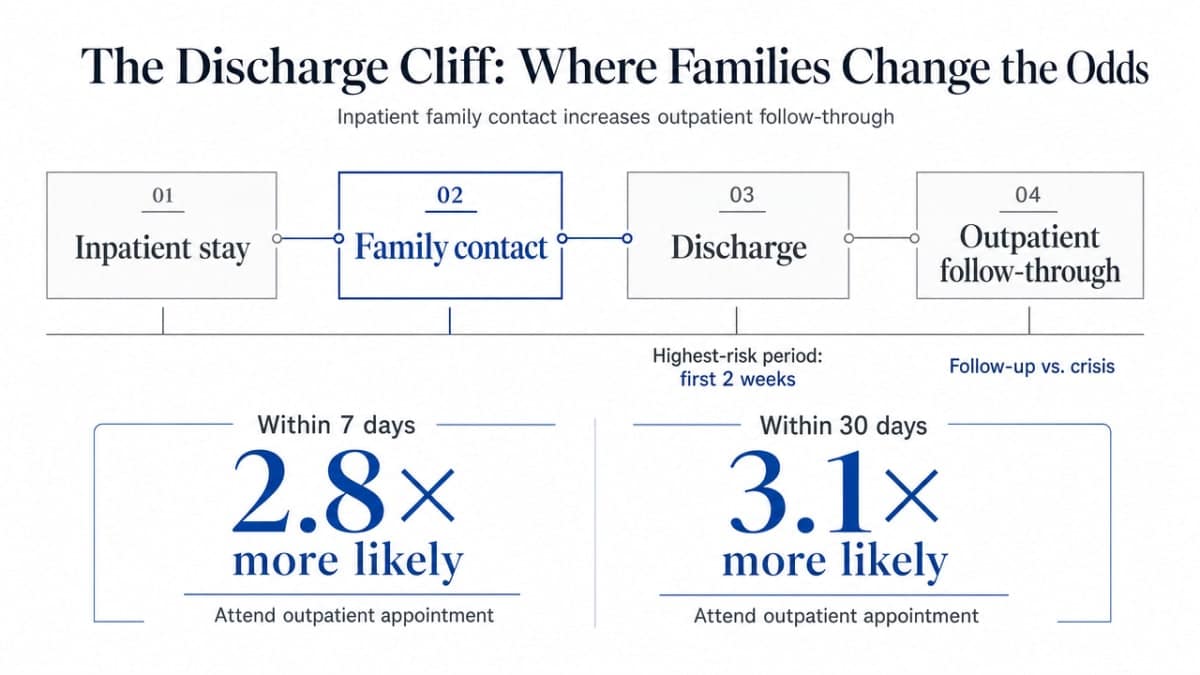
The most dangerous stretch in psychiatric care is not usually the admission. It’s the two weeks after discharge. Your loved one goes home with a new medication, a folder of paperwork, and an outpatient appointment scheduled for eight or fourteen or thirty days out. Whether they actually walk into that appointment is what decides if the next crisis lands in a follow-up visit or in an emergency room.
This is where families change the math. A prospective cohort study of psychiatric hospitalizations found that when inpatient staff actually made contact and communicated with a family member or support person, patients were roughly 2.8 times more likely to attend an outpatient appointment within 7 days, and about 3.1 times more likely within 30 days, after controlling for demographic and clinical factors 2. That’s not a small nudge. That’s the difference between a plan on paper and a plan that survives contact with a Tuesday morning.
Think about what that looks like from your side. If the treatment team called you before discharge, you know when the appointment is. You know which pharmacy has the prescription. You know that your brother tends to sleep through morning alarms after a hospital stay, so you offer to drive. You know the psychiatrist’s name, so when your brother says “I don’t think I need to go,” you have something concrete to say back. None of that happens if the program treated you as a name on an emergency contact form.
For treatment-resistant cases, this window matters even more. A missed first appointment often means a lapsed prescription. A lapsed prescription for clozapine or lithium is not a small setback — it can mean starting the titration process over, or losing months of hard-won stability. When you ask a Prescott facility how they handle discharge, listen for specifics: Who calls the family, and when? Are you invited to the discharge planning meeting, not just informed of the outcome? Is there a written crisis plan with your phone number on it, and do you have a direct line back to the treatment team if something shifts in the first two weeks?
Family Psychoeducation: What It Covers and Why It’s Guideline-Level Care
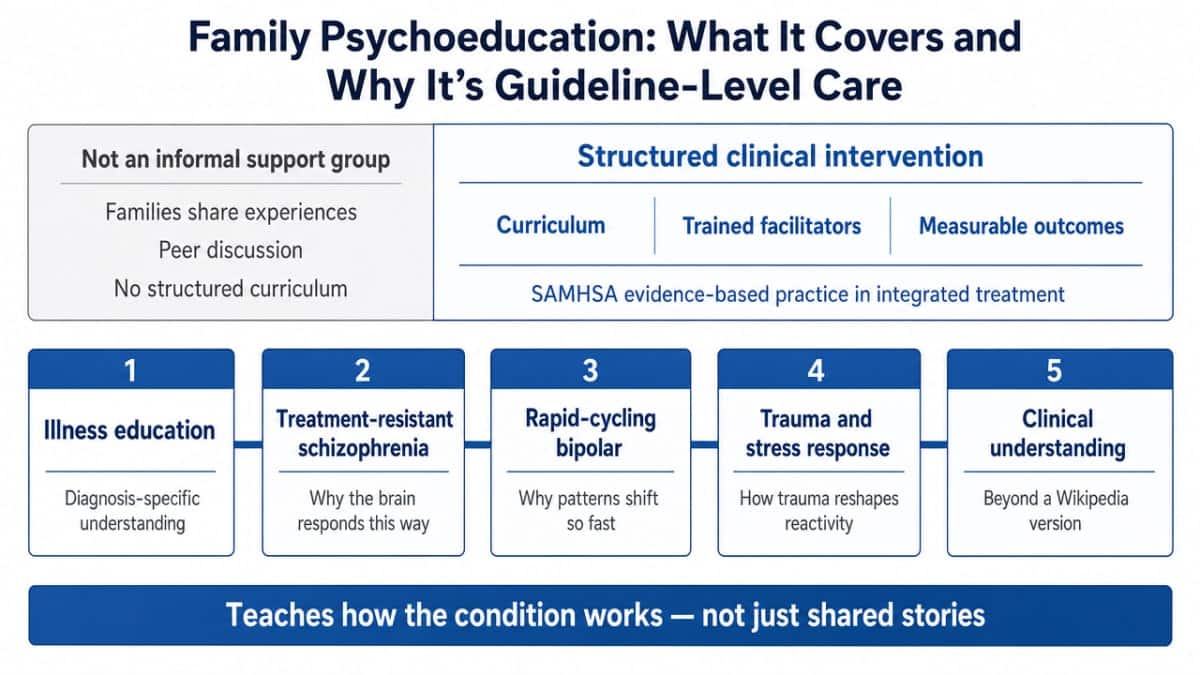
The word “psychoeducation” sounds like a workshop. It isn’t. Family psychoeducation is a structured clinical intervention with a curriculum, trained facilitators, and measurable outcomes — and SAMHSA lists it as one of six evidence-based practices in integrated treatment for co-occurring mental illness and substance use disorders 11. That is a different category of thing than a support group where families sit in a circle and share.
Here is what a real family psychoeducation program actually teaches you. First, illness education specific to the diagnosis: what treatment-resistant schizophrenia actually is, why rapid-cycling bipolar behaves the way it does, how trauma reshapes response to stress. Not the Wikipedia version — the version that explains why your loved one’s brain is doing what it’s doing. Second, warning-sign recognition tailored to this person: what their prodrome looks like, which sleep changes matter, which shifts in speech or spending are early relapse signals. Third, communication skills — how to raise a concern without triggering a shutdown, how to say the medication observation out loud without it sounding like an accusation. Fourth, a written relapse-prevention plan you help build, with names, numbers, and specific actions for specific warning signs. And in dual-diagnosis cases, a fifth layer: how substance use and psychiatric symptoms feed each other, and what to do when one flares before the other.
The clinical evidence for this is not soft. Psychoeducation, including family-focused versions, is treated as standard therapy for schizophrenia under APA guidance and is associated with higher medication compliance, lower relapse rates, and improved psychopathology 6. That is why the APA’s condensed 2020 schizophrenia guideline recommends that patients with ongoing family contact be offered family interventions as part of care, not as an elective 5.
If you ask a Prescott facility about family involvement and the answer is “we have visiting hours and a family day,” that program does not offer family psychoeducation. If the answer includes a defined curriculum, a set number of sessions with the treating clinicians, and a written plan you leave with, that is the intervention the guidelines are actually pointing at. Ask which one you’re getting.
Dual Diagnosis: When Substance Use and Psychiatric Illness Both Need the Family
If your loved one is drinking through a bipolar mood swing, using stimulants on top of an antipsychotic, or self-medicating trauma with opioids, you already know that treating one problem while ignoring the other is how the cycle keeps restarting. Dual diagnosis is not two conditions taking turns. It’s two conditions feeding each other, often in ways that only make sense when someone at home fills in the pieces the patient won’t or can’t describe in an intake interview.
That is exactly why family psychoeducation is one of the six core evidence-based practices SAMHSA names in its integrated treatment model for co-occurring mental illness and substance use disorders 11. It’s not paired with integrated care because it’s nice. It’s paired because someone has to see both problems at the same time, and families are usually the only people who watched the drinking and the mania rise together over the same six months.
The clinical evidence lines up with what you’ve probably lived. In a randomized trial of adults with severe mental illness — mostly schizophrenia-spectrum — and co-occurring substance use disorders, families who received a longer-term Family Intervention for Dual Disorders (FIDD) saw patients improve more on overall and psychotic symptom severity than those who got only brief education, and relatives themselves improved in mental health functioning and knowledge of co-occurring disorders 8. SAMHSA’s substance use treatment guidance reinforces the same pattern from the addiction side: family counseling in SUD care is tied to higher treatment engagement, better retention, and improved outcomes for both clients and their families 3.
Two honest caveats before you take this to a Prescott admissions call. First, even in that dual-disorder trial, only about 55 to 61 percent of families received the core program elements 8. Sustained participation is hard when everyone is exhausted, and a program that pretends otherwise is selling you something. Ask specifically how they handle families who miss sessions — do they reschedule, offer phone options, keep going? Second, family inclusion is not automatic in every case. SAMHSA is direct that some family systems are chaotic or unsafe, and inclusion has to be assessed, not assumed 3. A serious dual-diagnosis program will screen for that at intake instead of either forcing family sessions or writing you off entirely.
The Caregiver Isn’t a Bystander: Your Own Burden Is Clinical Data
Somewhere in the last few years, you stopped sleeping through the night. You check your phone before you check the coffee. You’ve missed work, canceled trips, and rehearsed emergency-room scripts in the shower. That exhaustion is not a personal failing. It’s caregiver burden, and it is a measurable clinical outcome — one that a serious program should track alongside your loved one’s symptoms.
A randomized trial of family psychoeducation added to standard medication in schizophrenia found significant reductions in family burden at six months compared with medication alone 9. Structured education, delivered to the people at home, made the load lighter — not because the illness got easier, but because the guessing stopped. You knew what to watch for. You knew what to say. You knew when a change in sleep was a warning and when it was just a bad Tuesday.
This matters for how you evaluate a Prescott facility. If the program only asks how your loved one is doing and never asks how you are doing, they are treating you as a witness instead of a person in the care plan. Ask directly: Do family members get their own check-ins? Is there support for the caregiver’s own stress and grief? A first family session where someone finally asks about your sleep is a real step forward. So is admitting, out loud, that you’re running on fumes.
When Family Involvement Is Not the Right Call
Everything in this guide assumes something that isn’t always true: that pulling your family in will help. Sometimes it won’t. And a serious program should be honest about that at intake rather than either forcing family sessions or writing you off entirely.
SAMHSA is direct that some family systems are chaotic, controlling, or actively unsafe, and that automatic inclusion in those cases can hurt the patient or reignite the exact dynamics that fueled the substance use or the psychiatric crisis in the first place 3. An abusive parent does not become a co-therapist. A partner in active addiction is not a stable discharge contact. A sibling who has spent a decade weaponizing the diagnosis does not belong in the treatment room.
If any of that describes your situation, you are not disqualified from being supported. You may still get your own psychoeducation, your own check-ins, and your own crisis guidance — just not shared clinical sessions with the person you’re worried about. And if you are the safe family member watching from the outside while other relatives are not safe, say so on the admissions call. A program that takes family involvement seriously will screen for this instead of assuming a family is either all in or all out. Being honest about the limits is a step forward, not a setback.
Questions to Ask a Prescott Facility Before Admission
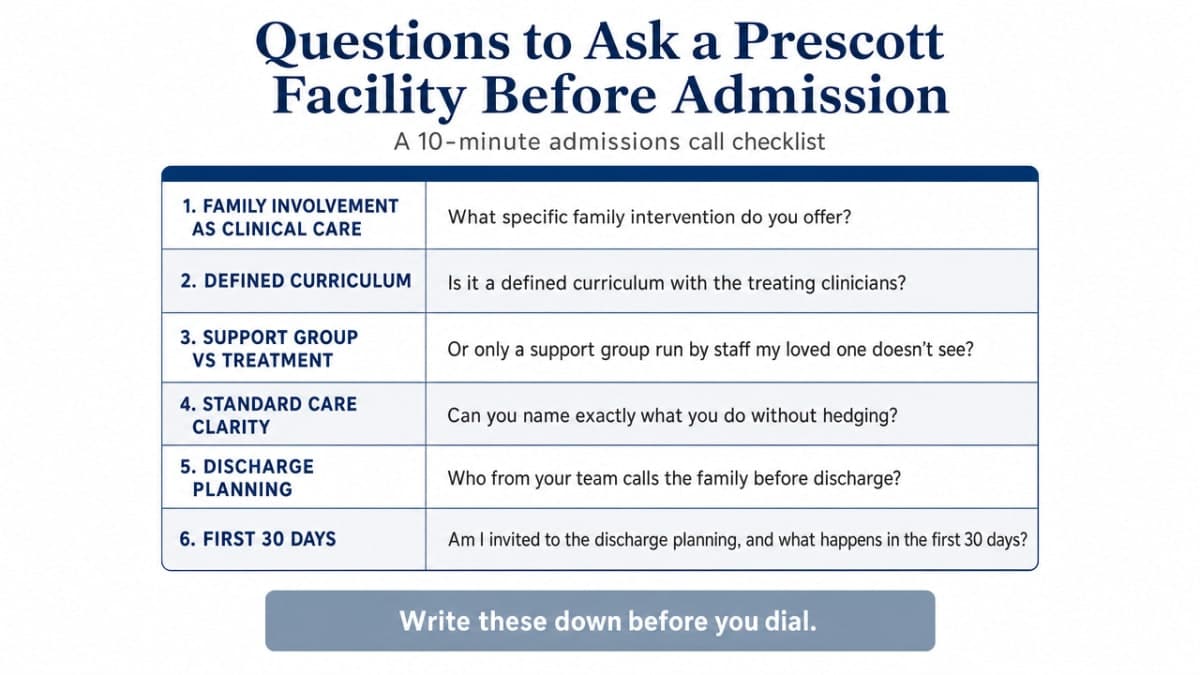
By the time you’re on an intake call, you’re tired and you’re being handed a lot of soothing language. Here is a short list of questions that will tell you, in about ten minutes, whether a Prescott program actually practices family-centered care or just markets it. Write them down before you dial.
On family involvement as clinical care: “What specific family intervention do you offer, and is it a defined curriculum with the treating clinicians — or a support group run by staff my loved one doesn’t see?” The APA’s 2020 schizophrenia guideline recommends family interventions for patients with ongoing family contact as part of standard care 5, so a serious program should be able to name what they do without hedging.
On discharge and the first 30 days: “Who from your team calls the family before discharge, am I invited to the discharge planning meeting, and is there a written crisis plan with my phone number on it?” This is the window where family contact roughly triples the odds of outpatient follow-through 2 — so vague answers here are a red flag.
On dual diagnosis: “If substance use and psychiatric symptoms are both active, do you treat them together in one plan, and does the family piece cover both?” Family psychoeducation is one of the six evidence-based practices SAMHSA names in integrated co-occurring disorder treatment 11. If the program treats them in sequence or refers out for one, keep looking.
On the caregiver: “Do family members get their own check-ins and psychoeducation, or only sessions about the patient?”
On limits: “How do you handle families where involvement isn’t safe or straightforward, and how do you screen for that at intake?” A program that has an honest answer here is a program that has thought about this.
On the specifics of this case: “My loved one has been through [X previous programs]. What will you do differently, and how will you use what I know?” You are handing them years of observation. A family-centered program treats that as clinical data, not small talk.
What to Do Tonight, and What to Ask Tomorrow
Tonight, do one small thing. Write down what the last three months have actually looked like — not the polished version for the intake coordinator, but the real one. When did the sleep change? Which prescriptions ran out? What did the last crisis sound like at the kitchen table? That page is clinical data no one else has, and it’s the single most useful thing you can bring to a first conversation with a Prescott program.
Tomorrow, make the call. Use the questions from the last section, and listen for specifics instead of soothing language. If a facility can name its family curriculum, tell you who calls before discharge, and screen honestly for when involvement isn’t safe, you’re in the right conversation. If they can’t, keep dialing.
You are allowed to call on someone else’s behalf. You are allowed to ask hard questions when you’re exhausted. And you are allowed to count a first phone call as a real step forward — because for a family that has been shut out of care before, it is one.
Connect Your Family to Expert Psychiatric Support
Get personal guidance on the next steps for your loved one’s psychiatric care in Prescott.
Frequently Asked Questions
Does my loved one have to agree to family involvement before I can be included?
Yes, in most cases. Adults control who the treatment team can share clinical information with, and HIPAA rules apply. But there is more room than families realize. A good program will ask your loved one directly at intake whether they want you included, will re-ask if the first answer is no, and can accept information from you even when they can’t share information back. Say that on the admissions call.
What if previous psychiatric programs shut us out or told us almost nothing?
That’s common, and it’s not your fault. Many programs default to minimal family contact even though guideline-level care recommends family interventions for patients with ongoing family contact 5. When you call a new Prescott facility, tell them plainly what past programs did and did not do. Ask what their family curriculum actually is. If they can name it, that’s a different program than the one you left.
How is family psychoeducation different from a family support group?
A support group is peers sharing experiences in a circle. Family psychoeducation is a structured clinical intervention with a curriculum, trained facilitators, and defined sessions with the treating team — and it’s tied to higher medication compliance and lower relapse rates in schizophrenia 6. Both can help. Only one is the evidence-based treatment the guidelines point to. Ask which one the program actually delivers before you assume they’re the same.
Can family-centered care work when substance use and psychiatric illness are both active?
Yes — and it’s exactly the situation it was designed for. SAMHSA names family psychoeducation as one of six evidence-based practices in integrated treatment for co-occurring mental illness and substance use disorders 11. Ask whether the program treats both conditions in one plan rather than in sequence, and whether the family piece covers both. Sequential referrals across two programs is often where dual-diagnosis cases fall apart.
What if our family relationships are strained, chaotic, or unsafe?
Then automatic inclusion is not the goal. SAMHSA is clear that some family systems are chaotic or unsafe and inclusion has to be assessed, not assumed 3. Say this out loud at intake. You may still get your own psychoeducation, your own check-ins, and crisis guidance without shared clinical sessions. If you’re the safe family member and others are not, name who is who. A serious program will screen carefully.
I don’t live in Prescott. Can I still be involved from out of town?
Yes. Distance is a scheduling problem, not a clinical disqualifier. Ask specifically about phone and video family sessions, whether you can join the discharge planning meeting remotely, and whether the written crisis plan will include your out-of-town number. When family contact triples the odds of a patient making that first outpatient appointment 2, your phone counts — whether you’re twenty minutes away or two time zones out.
References
- Family engagement as part of managing patients with mental illness. https://pmc.ncbi.nlm.nih.gov/articles/PMC8801858/
- Family Involvement in Psychiatric Hospitalizations. https://pmc.ncbi.nlm.nih.gov/articles/PMC6773477/
- Chapter 1—Substance Use Disorder Treatment (SAMHSA TIP 63 context). https://www.ncbi.nlm.nih.gov/books/NBK571084/
- Finding and Treating Serious Mental Illness Promptly (SAMHSA State TA). https://library.samhsa.gov/sites/default/files/early-recognition-esmi-pep24-01-006.pdf
- The American Psychiatric Association practice guideline for the treatment of patients with schizophrenia (condensed 2020 version). https://www.med.unc.edu/psych/epi-nc/wp-content/uploads/sites/720/2024/01/APA-2020-guidelines-1.pdf
- Psychoeducation: A Basic Psychotherapeutic Intervention for Patients With Schizophrenia and Other Psychotic Disorders. https://pmc.ncbi.nlm.nih.gov/articles/PMC2683741/
- Family-centered collaborative care for patients with chronic mental illness: A systematic review. https://pubmed.ncbi.nlm.nih.gov/36974116/
- A Randomized Controlled Trial of Family Intervention for Co-occurring Substance Use and Severe Psychiatric Disorders. https://pmc.ncbi.nlm.nih.gov/articles/PMC3627753/
- Psychoeducation and the family burden in schizophrenia: a randomized controlled trial. https://pubmed.ncbi.nlm.nih.gov/19638229/
- Effectiveness of implementing family involvement on patient outcomes in routine mental health services. https://pmc.ncbi.nlm.nih.gov/articles/PMC12676765/
- Integrated Treatment for Co-Occurring Disorders Evidence-Based Practices KIT. https://library.samhsa.gov/product/integrated-treatment-co-occurring-disorders-evidence-based-practices-ebp-kit/sma08-4366