Key Takeaways
- Prescott-area care for layered conditions like PTSD with substance use, treatment-resistant psychosis, or bipolar instability calls for integrated individual therapy rather than standard weekly counseling 1, 2.
- Parallel care stalls because separate therapists, psychiatrists, and addiction counselors rarely coordinate; integrated treatment where one team holds both conditions generally outperforms uncoordinated services 15.
- AHCCCS members in Yavapai County can contact behavioral-health providers directly without a referral, and Arizona telehealth coverage parity makes hybrid in-person and remote scheduling realistic 7, 9.
- Before committing to a program, compare how often the therapist and psychiatrist actually coordinate, which evidence-based modality fits your presentation, and what happens when symptoms spike mid-treatment 13, 16.
When Weekly Talk Therapy Stops Being Enough
You’ve done the work. You showed up to the Tuesday sessions, filled out the mood logs, tried the breathing exercises when the panic came. And still, something keeps pulling you back under — a depression that won’t lift, voices that return when the medication wears thin, a drink or a pill you reach for before you’ve even decided to.
That isn’t failure. It’s a signal that the care you’ve had hasn’t matched what you’re actually carrying.
Standard weekly counseling is built for a single, relatively stable concern. When the picture is more tangled — treatment-resistant symptoms, psychosis, rapid mood cycling, PTSD layered with a substance use disorder — the honest clinical answer is a different kind of individual therapy. One that moves at the pace of your psychiatry, uses modalities matched to what you’re living with, and treats mental health and substance use at the same time rather than handing you off between two systems that don’t talk 1, 2.
The rest of this guide walks through what complex really means, which therapies have the evidence behind them, and how to access that level of care in Prescott and the surrounding Quad Cities.
What Makes a Case ‘Complex’ in Clinical Terms
Treatment Resistance, Co-Occurring Substance Use, and Trauma-Driven Relapse
Clinicians don’t call a case complex because it feels hard. They use the word when the picture has layers that interact — and when those layers predict that a single, standard treatment track is unlikely to hold.
A few patterns show up again and again.
- Treatment resistance means you’ve had adequate trials of medication or therapy for a condition like depression, schizophrenia, or bipolar disorder, and the symptoms haven’t meaningfully budged.
- Co-occurring substance use means a mental health condition and a substance use disorder are both active, each one feeding the other — the drinking that quiets the PTSD flashbacks, the stimulants that chase a depressive crash.
- Trauma-driven relapse is the specific pattern where a trigger — an anniversary, a smell, a conflict — reopens the trauma wound, and the substance comes back before you’ve even named what happened.
SAMHSA groups these presentations under the umbrella of co-occurring disorders and recommends that both the mental health condition and the substance use disorder be treated concurrently rather than in sequence or in isolation 1, 2. That recommendation isn’t a style preference. It reflects decades of watching people get discharged from one program only to be told the other system has to pick up the pieces.
If any of that sounds like your story, you’re not an outlier case. You’re the case the research was written for.
Why Parallel Care Often Stalls
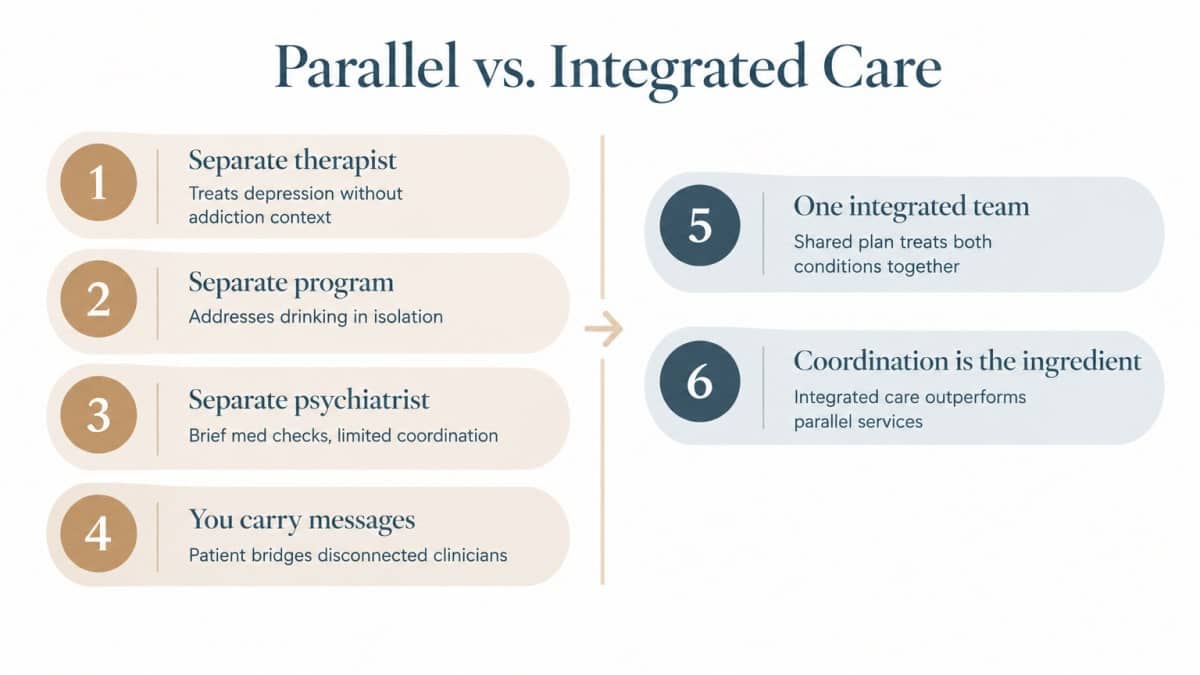
Here’s the pattern you’ve probably lived. A therapist for the depression. A separate program for the drinking. A psychiatrist who sees you for fifteen minutes every six weeks and asks whether the medication is working. Three charts, three schedules, three slightly different stories about what’s wrong.
That’s parallel care, and it’s the default in most communities — not because anyone designed it that way, but because mental health and addiction treatment grew up in separate buildings with separate funding. The result is that your clinicians rarely talk to each other. The therapist doesn’t know you had a relapse last Thursday. The addiction counselor doesn’t know your antipsychotic dose just changed. You become the messenger between people who are supposed to be treating the same person.
A 2026 umbrella review of psychosocial interventions for adults with substance use disorder and a co-occurring common mental health condition found that integrated treatment — where the same team addresses both conditions together — generally outperformed treating only one condition or using parallel, uncoordinated services 15. The review covered a broad slice of the systematic-review literature, so the finding isn’t about one modality winning. It’s about coordination itself being the active ingredient.
That’s the gap most stalled therapy stories fall into. Not a lack of effort on your part. A care structure that was never built to hold both halves of what you’re carrying.
Matching the Modality to What You’re Actually Living With
PTSD With a Substance Use Disorder: Integrated Trauma-Focused Therapy
If your trauma and your substance use grew up together, you already know that treating one without the other doesn’t last. You get sober and the nightmares come back. You start processing the trauma and reach for the bottle on the drive home. The pattern isn’t a willpower problem. It’s two conditions wired into the same nervous system, and the care has to meet them there.
Integrated trauma-focused therapy means the PTSD work and the substance use work happen inside the same treatment plan, with one clinician holding both threads. You’re not told to get sober first and come back for the trauma later. You’re not asked to pick which half of your life gets attention this month.
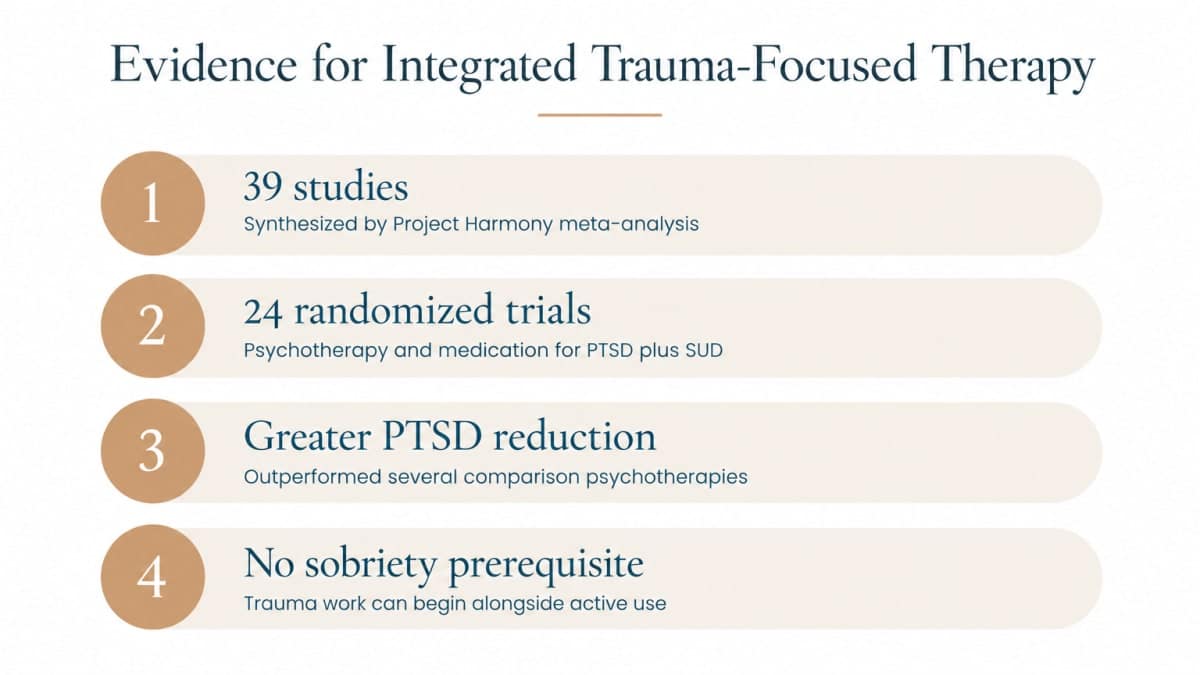
The strongest evidence base for this approach comes from the Project Harmony network meta-analysis, which synthesized 39 studies, including 24 randomized controlled trials, of psychotherapy and medication trials for comorbid PTSD and alcohol or other drug use disorders. Integrated trauma-focused therapy showed greater reductions in PTSD symptoms than several comparison psychotherapy approaches 3.
That matters because for years, the field debated whether people with active substance use could tolerate trauma work. The newer evidence says yes, when the therapy is designed from the start to hold both. If a prior therapist told you to come back once you’d put down the drinking, that advice is behind the current science.
First-Line Trauma Therapies: CPT, EMDR, and PE
Within trauma-focused work, three names come up again and again: Cognitive Processing Therapy, Eye Movement Desensitization and Reprocessing, and Prolonged Exposure. The VA/DoD Clinical Practice Guideline recommends all three as individual, manualized trauma-focused psychotherapies for PTSD and recommends selecting among them based on patient preference when feasible 13.
That last part is worth sitting with. The guideline doesn’t crown one modality as the winner. It treats your preference as a clinical variable — because the therapy you’ll actually show up for and complete is the one that works.
- CPT
- Asks you to examine the beliefs that formed around the trauma — about safety, trust, power, self-worth — and rework the ones that aren’t holding up. It’s structured, cognitive, and heavy on writing between sessions.
- EMDR
- Uses bilateral stimulation, usually eye movements, while you briefly revisit the trauma memory. For some people, it offers a way to process what happened without needing to narrate every detail out loud.
- PE
- Involves gradual, repeated engagement with the memory and with real-world situations you’ve been avoiding. It’s demanding and effective, and it works best when you have a therapist who paces it with you rather than at you.
None of these is better than the others on average. The right one is the one you can commit to with a therapist who knows how to deliver it well.
Psychosis and Treatment-Resistant Symptoms: CBT for Psychosis
When voices, paranoia, or disorganized thinking don’t fully quiet with medication — or when the side effects of pushing the dose higher cost more than they return — individual Cognitive Behavioral Therapy for psychosis (CBTp) enters the picture. It isn’t a replacement for antipsychotic treatment. It’s a parallel track that works on how you relate to the symptoms, the beliefs built around them, and the day-to-day functioning that gets squeezed when symptoms persist.
A 2024 review of CBTp noted that it is recommended internationally as a treatment for psychosis, while meta-analyses generally show modest average effects compared with treatment as usual or supportive counseling, with the therapeutic alliance playing a central role in outcomes 16. That’s an honest frame to hold. CBTp isn’t a dramatic reset. It’s a patient, skilled relationship that over time can shift distress, isolation, and the grip a belief has on your week.
What people who’ve lived through psychosis actually report from good individual therapy fills in what the effect-size numbers miss. A systematic review of qualitative studies described therapy for psychosis as a process that can support engagement, help make meaning of frightening experiences, build coping skills, restore hope, and improve functioning — mechanisms that extend beyond symptom suppression alone 6.
If your symptoms are treatment-resistant, that doesn’t mean therapy has nothing left to offer. It means the therapist needs to be experienced with psychosis specifically, and the alliance has to be built with care.
Bipolar Instability With Substance Use: Where the Evidence Is Thinner
You deserve to know when the research is strong and when it isn’t. For bipolar disorder with a co-occurring substance use disorder, it’s thinner than most service pages admit.
An earlier systematic review of psychotherapy for comorbid bipolar disorder and substance use included only five bipolar psychotherapy studies and two studies of integrated psychotherapy for the dual presentation, and concluded there was little evidence that interventions targeting both conditions were more efficacious 4. A more recent 2024 review of psychosocial and medication interventions for the same comorbidity found that no single intervention was consistently effective across both mood and substance-use outcomes compared with placebo 5.
That doesn’t mean therapy doesn’t help. It means the honest answer is individualization. A plan built around your specific pattern — which pole you cycle into harder, which substances show up around which mood states, what has worked even partially before — is more defensible than a brand-name protocol lifted from a brochure.
Evidence Base at a Glance Across Complex Presentations
Pulling the picture together: the strength of evidence behind individual therapy varies by presentation, and knowing where you sit on that map helps you ask the right questions of any program you talk to.
For PTSD with a co-occurring alcohol or other drug use disorder, integrated trauma-focused therapy has the firmest comparative evidence, built on dozens of trials including a substantial randomized core 3. For PTSD itself, CPT, EMDR, and PE are first-line recommendations with decades of guideline support 13.
For psychosis, CBTp is internationally recommended, with modest average effect sizes and a strong role for the therapist-patient alliance 16. Qualitative evidence adds that recovery pathways include engagement, meaning-making, coping, and hope, not just symptom reduction 6.
For bipolar disorder with substance use, the trial base is small and no single therapy has shown consistent superiority across both mood and substance outcomes 4, 5. Individualized, coordinated care is the honest standard here.
A good clinician will tell you where your presentation falls on that evidence map before they tell you what the plan is. That’s the conversation to listen for. It’s the difference between a program selling you certainty and one that respects what the research actually says.
What Integrated Individual Therapy Actually Looks Like Week to Week
The Therapist and Psychiatrist Working the Same Case
Picture a Tuesday. You sit down with the therapist you’ve been seeing for a few weeks. You tell her the new mood stabilizer has you flat by mid-afternoon, and the cravings got loud again on Sunday night. In a parallel-care world, that information would sit in her notes until your next psychiatry appointment three weeks out, and you’d be the one carrying it there.
In integrated care, something different happens. Before the end of the day, your therapist and your psychiatrist have talked — a hallway conversation, a secure message, a shared chart note. By Thursday, the psychiatrist has already adjusted the timing of the dose, and your therapist knows to spend part of Friday’s session on the Sunday-night craving pattern rather than the trauma work you’d planned.
That’s what SAMHSA means when it describes integrated care as the preferred model for co-occurring disorders: both conditions treated concurrently by clinicians who can actually deliver individualized services together, not two providers running on separate schedules 1, 2.
Week to week, this shows up in small, concrete ways. One treatment plan, not two. Shared language about your triggers and your medications. A therapist who knows the half-life of what you took this morning, and a psychiatrist who knows what came up in session yesterday. You stop being the courier.
How Progress Gets Measured Without Overpromising
Progress in complex cases doesn’t look like a straight line, and any program that tells you otherwise is selling you something.
What good integrated therapy tracks instead is a handful of honest signals. Sleep that holds for more than a few nights in a row. A week where the voices stayed quieter, or quieter in a way you could work around. One fewer drink on the hard days. Showing up to Thursday’s session when a month ago you would have canceled. The qualitative psychosis-recovery literature points to exactly these kinds of markers — engagement, coping, meaning-making, hope, and functional gains — as the pathways people actually describe when therapy is helping, even when symptom scores move slowly 6.
Your clinicians should name what they’re watching for, and they should name it with you, not at you. Measurement might include brief standardized check-ins at the start of some sessions, review of medication side effects, and open conversation about what felt different this week.
A week of steadier sleep is not a small thing when you’ve been cycling. Neither is a Sunday night you got through without the bottle. Those are the data points that matter here.
Accessing Care in Prescott and the Quad Cities
AHCCCS, Direct Access, and What a Referral Is (or Isn’t)
One of the quieter barriers to getting help is the belief that you need permission to start. You don’t.
If you’re covered by AHCCCS, Arizona’s Medicaid program, you can contact a behavioral-health provider directly to begin services. AHCCCS states plainly that a referral is not required to start behavioral-health screening, therapy, substance-use treatment, case management, or peer support, though specific plan rules and treatment-plan requirements still apply once you’re in care 7.
That matters in practice. You don’t have to wait for a primary-care appointment to open a door that’s already open. You can call a Prescott-area program, ask whether they take your plan, and ask for an intake assessment. If you have commercial insurance instead, the rules are different — network, prior authorization, and cost-sharing vary by plan — so verify benefits before the first session.
What a good intake looks like: a conversation about what’s actually happening, not a checklist designed to route you out.
In-Person vs. Telehealth for High-Acuity Cases
Telehealth has made therapy reachable for people who couldn’t drive the forty minutes from Prescott Valley on a bad week, or who can’t sit in a waiting room without their symptoms climbing. Arizona law generally requires health-care service organizations to cover telehealth when the equivalent in-person service would be covered, including behavioral-health and substance-use services 9. The access question is largely answered.
The clinical question is a separate one. Arizona telepractice guidance expects providers to verify your physical location each session, document the modality, and have local emergency contacts on file — precautions that exist because remote care carries real limits for high-acuity presentations 10.
If you’re stable between episodes and the therapeutic relationship is already built, telehealth can carry a lot of the work. If you’re in active psychosis, early in trauma processing, or newly stabilizing from a substance use crisis, the hands-on presence of in-person sessions — and faster access to psychiatry down the hall — usually matters more than convenience. A hybrid rhythm is common: in-person when the week is heavy, telehealth when it isn’t.
If You’re in Crisis Right Now
In Arizona, you can call or text 988 to reach the Suicide and Crisis Lifeline. For Yavapai County residents, AHCCCS also lists a local crisis line, and these services are available to any Arizona resident regardless of insurance 8.
Crisis lines can send mobile teams, help with same-day evaluation, and connect you to ongoing care once the acute moment passes. Use them. The therapy conversation can wait a few hours. Your safety can’t.
Choosing a Program When You’ve Already Tried Therapy
If you’ve been through therapy before and it didn’t hold, the next program deserves harder questions than the last one got.
Ask who will actually be in the room with you week to week, and ask how often that therapist talks to the psychiatrist managing your medications. If the answer is a monthly treatment-team meeting, that’s still parallel care wearing a nicer coat. Integrated care means the two clinicians move together, in the same week, on the same plan 1, 2.
Ask which modality they’d use for your specific presentation, and why. A program that names CPT, EMDR, or PE for PTSD and can explain how patient preference shapes the choice is working from the current guideline 13. A program that offers CBT for psychosis should also be honest that average effects are modest and that the alliance with your therapist does a lot of the work 16.
Ask what happens when you relapse or when symptoms spike mid-treatment. The honest answer isn’t discharge. It’s a plan.
You’ve already done the hard part of trying. The next program should earn the next try.
Explore Individual Therapy for Complex Needs
Discuss your needs and learn whether individualized psychiatric care in Prescott may be a fit.
Frequently Asked Questions
How is individual therapy for complex needs different from standard weekly counseling?
Standard weekly counseling is built for a single, relatively stable concern. Individual therapy for complex needs is coordinated with your psychiatrist in real time, uses modalities matched to presentations like PTSD with substance use or psychosis, and treats both mental health and substance use together rather than in separate silos. SAMHSA names that integrated approach as the preferred model for co-occurring disorders 1, 2.
Do I need a referral to start individual therapy in Prescott?
If you’re covered by AHCCCS, no. AHCCCS states that referrals are not required to start behavioral-health services, including therapy and substance-use treatment, though plan and treatment-plan rules still apply once you’re in care 7. If you have commercial insurance, check your plan’s network and prior-authorization rules before the first session. Either way, you can call a Prescott-area program directly and ask for an intake.
Can telehealth work for high-acuity conditions, or do I need in-person sessions?
Arizona law generally requires coverage for behavioral-health telehealth when the equivalent in-person service would be covered 9, and telepractice guidance expects providers to verify your location and have local emergency contacts on file 10. If you’re stable and the relationship with your therapist is already built, telehealth can carry a lot of the work. If you’re in active psychosis, early trauma processing, or just stabilizing from a substance-use crisis, in-person sessions usually matter more.
What should I do if I’m in a mental health crisis right now in Yavapai County?
Call or text 988 to reach the Suicide and Crisis Lifeline, or use the Yavapai County crisis line listed by AHCCCS. Crisis services are available to any Arizona resident regardless of insurance 8. These teams can send mobile support, help with same-day evaluation, and connect you to ongoing care once the acute moment passes. Individual therapy can start after you’re safe.
If previous therapy didn’t help my co-occurring depression and substance use, what might be different this time?
The most common reason earlier therapy stalls isn’t effort — it’s structure. A 2026 umbrella review found that integrated treatment, where the same team addresses both conditions together, generally outperformed treating only one condition or using parallel uncoordinated services for adults with substance use and a co-occurring mental health condition 15. A program where your therapist and psychiatrist actually work the same case week to week is the structural change to look for.
Is there strong evidence that therapy helps with psychosis or bipolar disorder with substance use?
The evidence is uneven, and that’s worth knowing. CBT for psychosis is recommended internationally, with meta-analyses showing modest average effects and a central role for the therapist-patient alliance 16. For bipolar disorder with substance use, the trial base is small and no single intervention has shown consistent superiority across both mood and substance outcomes 4, 5. Individualized, coordinated care between a therapist and psychiatrist is the honest standard for both.
References
- Substance Use Disorder Treatment for People With Co-Occurring Disorders. https://library.samhsa.gov/sites/default/files/pep20-06-04-006.pdf
- Managing Life with Co-Occurring Disorders. https://www.samhsa.gov/mental-health/serious-mental-illness/co-occurring-disorders
- Project harmony: A systematic review and network meta-analysis of psychotherapy and pharmacologic trials for comorbid posttraumatic stress, alcohol, and other drug use disorders. https://pubmed.ncbi.nlm.nih.gov/37971855/
- Effects of psychotherapy on comorbid bipolar disorder and substance use disorder: A systematic review. https://pubmed.ncbi.nlm.nih.gov/32615028/
- Psychosocial and Psychopharmacological Interventions for Comorbid Bipolar Disorder and Substance Use Disorders: A Review. https://pubmed.ncbi.nlm.nih.gov/40843035/
- How Does Individual Psychotherapy Promote Recovery for Persons with Psychosis? A Systematic Review of Qualitative Studies to Understand the Patient’s Experience. https://pmc.ncbi.nlm.nih.gov/articles/PMC11201174/pdf/behavsci-14-00460.pdf
- How To Access Behavioral Health Services – AHCCCS. https://www.azahcccs.gov/AHCCCS/Downloads/HowToAccessBehavioralHealth.pdf
- Crisis Hotlines. https://www.azahcccs.gov/BehavioralHealth/crisis.html
- 20-1057.13 – Telehealth; coverage of health care services. https://www.azleg.gov/ars/20/01057-13.htm
- Effective January 3, 2021. https://bbhe.az.gov/sites/default/files/2025-01/Telepractice%20guidelines010321.pdf
- YAVAPAI COUNTY COMMUNITY HEALTH ASSESSMENT 2017. https://www.yavapaiaz.gov/files/sharedassets/public/v/1/resident-services/community-health/documents/2017yavapaicha_final.pdf
- Quad Cities. https://www.yavapaiaz.gov/files/sharedassets/public/v/1/resident-services/community-health/documents/quad-cities-chip.pdf
- VA/DoD Clinical Practice Guideline for Management of Posttraumatic Stress Disorder and Acute Stress Disorder. https://www.healthquality.va.gov/healthquality/guidelines/mh/ptsd/va-dod-cpg-ptsd-full-cpg-edited-111624-v5-81825.pdf
- Interventions targeting patients with co-occuring severe mental illness and substance use (dual diagnosis) in general practice settings – a scoping review of the literature. https://pubmed.ncbi.nlm.nih.gov/39097682/
- Effectiveness of Psychosocial Interventions for Adults With Substance Use Disorder That Have a Co-Occurring Common Mental Health Disorder: An Umbrella Review. https://pubmed.ncbi.nlm.nih.gov/41192364/
- Cognitive behavioural therapy for psychosis: The end of the line or time for a new approach?. https://pubmed.ncbi.nlm.nih.gov/37804105/