Key Takeaways
- Arizona meets only about 40% of its mental health workforce need, with shortages documented across all 15 counties and rural gaps concentrated in Northern Arizona 15, 13.
- CBT carries the strongest evidence for depression and anxiety, while for bipolar and schizophrenia it functions as an adjunct to medication rather than a stand-alone treatment 2.
- In Prescott, Flagstaff, and Sedona, split-referral care leaves patients as couriers between therapists and prescribers who don’t share notes, stalling treatment for complex diagnoses.
- When evaluating a Northern Arizona program, ask whether the CBT clinician and psychiatrist share one chart, hold case conferences, and set length of stay by clinical response.
When Therapy and Prescribing Live in Different Buildings
If you’re reading this, you probably already know the routine. You see a therapist in one office who’s warm and thoughtful and asks you to track your thoughts between sessions. Then you drive somewhere else, weeks later, to see a psychiatrist for fifteen minutes about your medication. Neither one has talked to the other. Neither one has read the other’s notes. And when something shifts — a new symptom, a side effect, a bad week — you’re the messenger carrying incomplete information across the gap.
That gap is the problem. It’s not that your therapist isn’t skilled or your psychiatrist isn’t competent. It’s that the standard American model of mental health care asks you to be the integration layer between two clinicians who never meet. For most people, that’s inconvenient. For someone with treatment-resistant depression, rapid-cycling bipolar, PTSD layered onto a substance use disorder, or schizophrenia that hasn’t responded to first-line antipsychotics, it’s a clinical liability. Federal guidance is clear that co-occurring and complex conditions do better when treatment is delivered in a single coordinated model rather than assembled from separate referrals.9
This piece is about Cognitive Behavioral Therapy — what it actually does, where the evidence is strong, where it isn’t, and what to look for in a Northern Arizona treatment center that can offer CBT and psychiatric medication management under the same roof. You’ve done the fragmented version. You know what it costs. The question is what a same-team model would look like instead.
What CBT Actually Looks Like Inside a Treatment Program
You’ve probably already had a taste of CBT in outpatient work, so the broad strokes aren’t new: identify the thought, notice the feeling, change the behavior, repeat. What’s less obvious is how the same modality behaves inside a residential or intensive psychiatric program, where a psychiatrist is down the hall instead of across town.
The structure is tighter. Sessions run on a predictable cadence — typically several individual CBT sessions per week, plus group work built around the same skills. Each session opens with an agenda, revisits homework from the prior session, works a specific target (a thought record, a behavioral activation plan, an exposure hierarchy, a relapse-prevention worksheet), and ends by setting the next between-session task. Nothing is meandering. That’s the point. CBT gives clinicians a shared language for what’s being worked on, which matters when a psychiatrist, a therapist, and a case manager are all trying to move in the same direction.
The homework is where a lot of the actual therapy happens. Thought records, activity logs, sleep and mood tracking, exposure practice — these generate data. In a same-team program, that data doesn’t stay in your therapist’s notebook. It shows up in your psychiatric appointment too, because your prescriber is reading the same chart. If your mood diary shows a flat, non-responsive stretch after a medication change, the psychiatrist sees it that week, not at your next quarterly follow-up. If your exposure work is stalling because a new medication is making you sedated, that gets caught in the next case conference instead of at month three.
CBT inside an integrated program also flexes to the diagnosis. For depression, it leans on behavioral activation and cognitive restructuring — the modality NIMH names as first-line for the disorder alongside medication when symptoms are moderate or severe.8For PTSD, it takes a trauma-focused form (cognitive processing, prolonged exposure) that has been shown feasible and effective even in people with severe mental illness and borderline personality disorder — populations that generic outpatient CBT often screens out.5For co-occurring substance use, CBT threads relapse-prevention and coping-skills work into the same sessions, which SAMHSA guidance treats as a core piece of integrated dual-diagnosis care.11
That’s what CBT looks like when it’s not sitting alone: structured, data-driven, tuned to the diagnosis, and readable by the person adjusting your medication.
What the Evidence Actually Says About CBT
Depression and Anxiety: Where CBT Carries the Most Weight
If you’ve been told CBT is “evidence-based” without anyone showing you the evidence, here’s the plain version. The largest meta-analysis pooled 144 trials and 184 comparisons of CBT for major depressive disorder, generalized anxiety disorder, panic disorder, and social anxiety disorder. Against waiting-list controls, the effects were large across all four — Hedges’ g ranged from 0.75 for MDD to 0.88 for social anxiety.1Those are numbers that hold up in clinical literature. They’re the reason CBT keeps showing up on first-line treatment lists for these conditions.
A caveat you should know about, because it changes how you read the number: when CBT was compared to usual care or pill placebo — not a waiting list — the effects shrank.1That doesn’t mean CBT stops working. It means the honest read is “CBT clearly beats doing nothing, and adds meaningful benefit on top of standard care, but the magnitude depends on what you compare it to.” For depression specifically, NIMH names CBT as one of the evidence-based psychotherapies and treats therapy plus medication as the standard combination when symptoms are moderate or severe.8
For generalized anxiety, panic, and social anxiety, the practical implication is that a structured CBT course — the kind built around exposure, cognitive restructuring, and between-session practice — is doing real work, especially when your medication is being adjusted in parallel by someone reading the same clinical notes. If depression and anxiety are the primary reasons you’re looking for a treatment center, CBT is not a soft, supplementary offering. It’s the modality with the deepest research base for exactly what you’re dealing with, and the one most likely to move the needle when your prescriber is in the same conversation.
Bipolar, Schizophrenia, and PTSD With Severe Mental Illness: Adjunct, Not Monotherapy
Here’s where you deserve a straight answer, because the marketing on some treatment center websites glosses over it. For bipolar disorder and schizophrenia, CBT is not a stand-alone treatment. The NIH-hosted review of meta-analyses across psychiatric disorders is direct about this: there is little evidence that CBT on its own effectively treats bipolar disorder, and its role is as an adjunct to pharmacotherapy.2For schizophrenia, the same review finds small-to-medium effects on positive and negative symptoms — real, measurable, and worth having, but built on top of antipsychotic medication, not instead of it.2
PTSD in people with severe mental illness is the other place where the honest picture is more nuanced than headline claims. A secondary analysis of two randomized trials looked specifically at trauma-focused CBT in individuals with severe mental illness and borderline personality disorder — a population that outpatient CBT clinics often decline to treat. The finding: CBT for PTSD was feasible and tolerated in this group, and was associated with improvements in PTSD symptoms, depression, and functioning.5That’s directly relevant if trauma sits underneath a substance use disorder or a psychotic-spectrum diagnosis. The therapy can be done. It just has to be delivered inside a program that can hold the acuity — which, again, means a prescriber and a therapist working from the same treatment plan, not a solo therapist hoping the psychiatry piece resolves itself elsewhere.
Treatment-Resistant Depression and Durability of Gains
If standard antidepressants haven’t worked — one trial, two trials, an augmentation strategy that didn’t hold — you’re in the population the research calls treatment-resistant. A 2021 narrative review of CBT across psychiatric and medical conditions found that CBT was effective in the short term for most conditions studied, including treatment-resistant depression and depression complicated by co-occurring physical illness.3That’s not a promise of remission. It’s evidence that adding structured CBT to an ongoing medication strategy is a reasonable next move when monotherapy has stalled, and that the benefits show up even in complex, comorbid presentations.
Durability is the other question worth asking, because a lot of therapies produce short-term gains that fade. A randomized controlled trial of CBT for generalized anxiety disorder in older adults followed patients for two years. At the two-year mark, 68.8 to 83.9 percent of those who received CBT combined with additional interventions either achieved high end-state functioning or no longer met criteria for GAD, depending on which measure was used.6That population is narrower than yours may be — older adults with GAD — so read it as suggestive rather than definitive. What it tells you is that CBT gains, when paired with continued medical and psychiatric management, can hold. The skills don’t evaporate at discharge. That’s the point of the homework and the structure. You leave with tools you can still use in month eighteen.
The Northern Arizona Access Problem
Here’s the arithmetic you’re up against. Arizona meets only about 40% of its current mental health workforce need, and shortages are documented in all 15 counties — not a rural-versus-urban split, but a statewide gap.15, 13Roughly 766,272 Arizonans, about 10.7% of the state’s 2020 population of 7.15 million, live in rural areas where the psychiatrist bench is thinnest.14Yavapai, Coconino, Mohave, Navajo, Apache — the counties that make up most of Northern Arizona — carry federal Mental Health Professional Shortage Area designations across large portions of their geography, which is HRSA’s way of saying there are not enough licensed prescribers for the people who live there.7
Translate that into what actually happens when you try to build a treatment plan. If you’re in Prescott, Flagstaff, Sedona, Cottonwood, or anywhere along the rim, a new-patient psychiatric appointment can land eight to twelve weeks out. Your therapist, if you have one, is booked two weeks between sessions. A medication change that should be evaluated in two to four weeks gets evaluated in three months, if the follow-up slot holds. If your symptoms worsen in the gap — a hypomanic swing, a new suicidal ideation, an antipsychotic side effect that’s making you stop the medication on your own — there is no one on the same team to catch it. You go to an emergency department, or you white-knuckle it until the appointment.
That’s the access problem in plain terms. It’s not that Northern Arizona clinicians aren’t trying. It’s that the math doesn’t work: too few prescribers, too much distance, too many split referrals across separate practices that don’t share a chart. For someone with a stable, single diagnosis on a stable medication, the fragmented model is frustrating but survivable. For someone with treatment-resistant depression, active dual diagnosis, or a psychotic-spectrum illness that needs weekly medication calibration alongside CBT, the fragmented model is where treatment stalls. This is the specific reason an integrated program — where the CBT clinician and the prescribing psychiatrist are on the same team, in the same building, reading the same notes — stops being a nicety and starts being the difference between progress and another year of waiting rooms.
Split-Referral vs. Same-Team Care: What the Difference Feels Like Clinically
Picture two versions of the same eight weeks of your life.
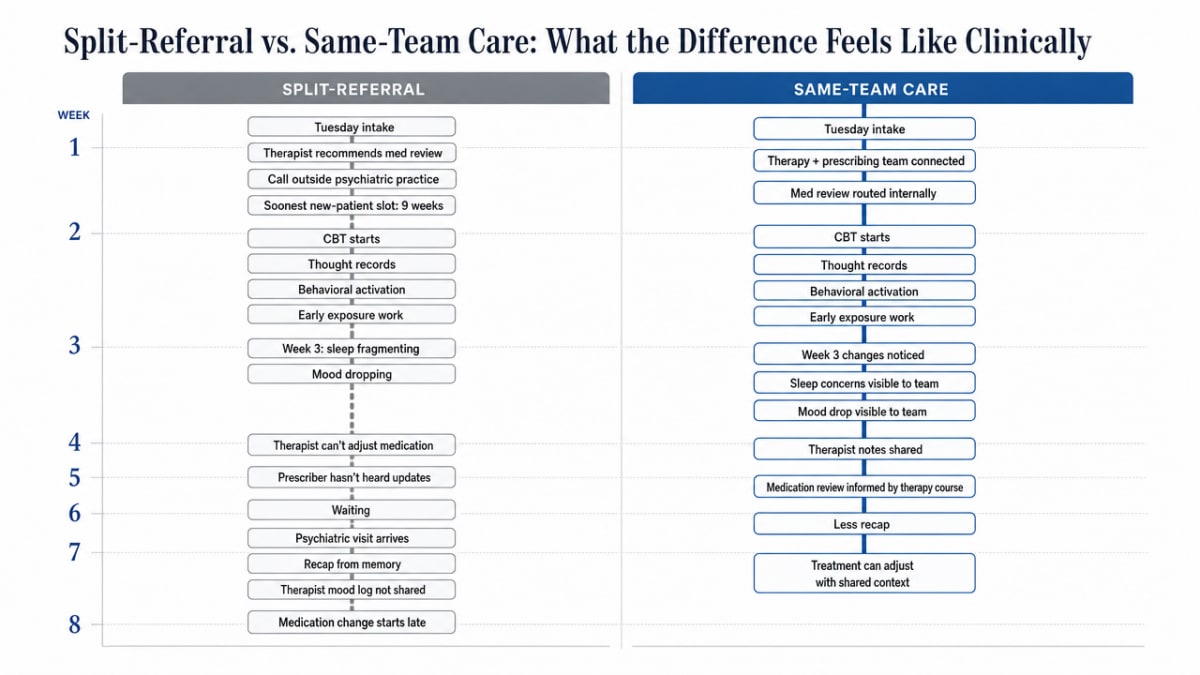
In the split-referral version, you finish an intake with a new therapist on a Tuesday. They recommend a medication review, so you call the psychiatric practice they suggest. The soonest new-patient slot is nine weeks out. In the meantime, your therapist starts CBT — thought records, a behavioral activation plan, some early exposure work. Three weeks in, you notice your sleep is fragmenting and your mood is dropping despite the therapy. Your therapist can’t touch the medication. Your prescribing physician, whoever refilled your last script, hasn’t heard about any of it. You wait. When the psychiatric appointment finally arrives, you spend most of it recapping what happened, from memory, without the mood log your therapist has been keeping. A medication change is made. The next follow-up is six weeks out. Nobody sends your therapist a note. You are, again, the courier.
In the same-team version, that intake Tuesday triggers something different. Your CBT clinician and a board-certified psychiatrist are in the same chart by the end of the week. The mood log your therapist starts is visible in your psychiatric appointment. When your sleep fragments in week three, it shows up in a case conference before your next therapy session, and the medication adjustment happens in days, not months. Your CBT homework is calibrated around what your prescriber is doing. Your prescriber is calibrating around what your homework is showing. Neither one is guessing about what the other is thinking.
This is what SAMHSA’s evidence-based practice guidance means when it names integrated treatment as the standard for co-occurring and complex conditions: not two competent clinicians working parallel to each other, but one team working the same treatment plan.9The federal co-occurring disorder guidelines go further, describing CBT-based approaches that let providers address mental health and substance use “in an integrated way” rather than sequentially.11
The clinical difference isn’t philosophical. It’s measured in weeks. It’s the antipsychotic side effect caught at day four instead of month two. It’s the exposure exercise that doesn’t get abandoned because someone finally adjusted the sedating medication interfering with it. It’s the hypomanic shift documented in a therapy session on Monday and factored into a prescribing decision on Wednesday, instead of waiting until it escalates into a crisis visit.
If you’ve done the split version — and if you’re reading this, you probably have — you already know what the gaps cost. The question is whether you keep paying that price, or find a program built to close it.
How to Evaluate a CBT Treatment Center in Northern Arizona
Questions That Reveal Whether Care Is Actually Coordinated
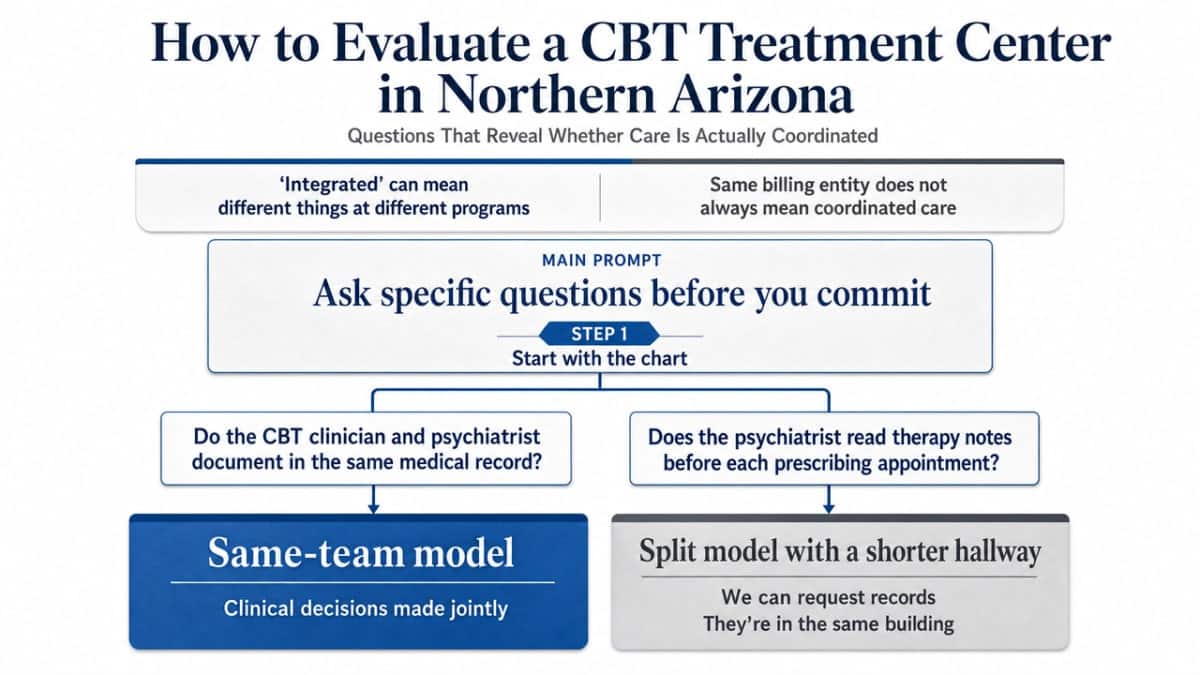
The word “integrated” appears on almost every treatment center website. It means different things at different programs. Some centers use it to describe having a therapist and a prescriber under the same billing entity, even if they never speak to each other. Others use it to describe a genuine same-team model where clinical decisions are made jointly. The way to tell the difference is to ask specific questions before you commit.
Start with the chart. Ask whether the CBT clinician and the psychiatrist document in the same medical record, and whether the psychiatrist reads therapy notes before each prescribing appointment. If the answer includes phrases like “we can request records” or “they’re in the same building,” that’s a split model with a shorter hallway. If the answer is that both clinicians work from one chart in real time, that’s the integrated version SAMHSA guidance describes as the standard for co-occurring and complex presentations.9
Ask about case conference cadence. How often does the treatment team meet about your case specifically — weekly, twice weekly, only at admission and discharge? Ask who attends: psychiatrist, primary therapist, group facilitator, case manager, family liaison. A program that can name the meeting and the attendees is running one. A program that describes coordination in the abstract usually isn’t.
Ask what happens when a medication change is needed mid-week. In a same-team program, the answer is measured in days. In a fragmented one, the answer is a referral or a wait. Ask how CBT homework — mood logs, thought records, exposure data — actually reaches the prescribing psychiatrist. Ask whether family members can be looped into treatment planning with your consent, and how. The specific answers tell you what the daily workflow looks like, not what the brochure claims.
Signals That a Program Can Handle Complexity
If your history includes treatment-resistant depression, rapid-cycling bipolar, psychotic-spectrum symptoms, PTSD layered on substance use, or medication trials that didn’t hold, you need a program built for that level of acuity — not one that will accept you and then discover it’s out of its depth in week two.
A few signals to look for:
- Board-certified psychiatry available on site, not through a telehealth contract with a group in another state.
- Experience with advanced medication strategies, including clozapine protocols for treatment-resistant schizophrenia, which most outpatient practices don’t run because they require close monitoring.
- A stated willingness to admit people other programs have declined — the “too complex” cases — rather than a screening process that quietly routes acuity elsewhere.
- Trauma-focused CBT delivered inside a program equipped to hold severe mental illness, which the research shows is feasible and tolerable when the clinical container is right.5
Ask about accreditation. Joint Commission accreditation and state licensing through Arizona ADHS are baseline markers that the program is being audited against clinical standards. Ask about treatment duration. If the answer is a fixed 28 or 30 days because that’s what insurance pays, that’s an insurance-driven program. If the answer is that length of stay is set by clinical response and reviewed regularly, that’s a clinically driven program — which matters when your presentation isn’t going to resolve on a standard timeline.
The combination you’re looking for is capacity plus willingness. Capacity to run the medication strategy your diagnosis actually requires. Willingness to keep working the case when the first plan doesn’t produce the response everyone hoped for.
Where ViewPoint’s Prescott Program Fits
ViewPoint Dual Recovery sits in Prescott, inside the same Northern Arizona geography where the split-referral problem is at its worst. It is a Joint Commission-accredited psychiatric facility, licensed by Arizona ADHS, built specifically for the presentations that outpatient offices tend to hand off: treatment-resistant depression, rapid-cycling bipolar, treatment-resistant schizophrenia (including clozapine protocols, which require close blood monitoring most community practices are not equipped to run), PTSD tangled up with substance use, and the dual-diagnosis cases where the mental health piece and the addiction piece have to be worked at the same time rather than in sequence.
What makes it worth a call, if you’re looking for CBT in this part of the state, is the workflow. Board-certified psychiatry is on site, not contracted out. CBT is delivered by clinicians who share a chart with the prescriber and meet in case conference about your care, not about a caseload in the abstract. That is the same-team model SAMHSA’s evidence base treats as the standard for co-occurring and complex conditions, rather than the parallel-provider arrangement most people have already tried.9Treatment duration is set by clinical response, not by a 28-day insurance default, which matters when your presentation has already outlasted a shorter program.
If you’ve been doing the courier work between a therapist and a prescriber who don’t talk, an inquiry call is a reasonable next step. Ask the questions from the evaluation section. See whether the answers describe a workflow or a brochure.
See if integrated CBT and psychiatry fit your needs
Find out if this combined therapy and medication approach matches your clinical complexity.
Frequently Asked Questions
Does insurance typically cover CBT at a treatment center that also provides psychiatry?
Most commercial plans and many Arizona Medicaid (AHCCCS) plans cover both psychotherapy and psychiatric services when delivered at a licensed, accredited facility. Coverage specifics — deductible, out-of-pocket max, prior authorization for residential or inpatient levels of care — vary by plan. Call the admissions line at the program you’re considering and ask for a verification of benefits before you commit. That call is free and usually same-day.
What does the first week at a CBT treatment center usually look like?
The first few days are heavy on assessment: a full psychiatric evaluation, medical history, medication review, trauma and substance use screening, and CBT-oriented baseline measures for mood, anxiety, and functioning. By mid-week, individual CBT sessions and skills groups start, and your treatment team meets to align the therapy plan with any medication changes. It’s a lot. Sleep is usually the first thing that stabilizes. Expect to feel tired before you feel better.
Can family members be involved in CBT-based treatment, and should they be?
Yes, with your consent. Most programs offer family sessions, psychoeducation about your diagnosis, and coaching on how loved ones can support CBT skills at home without becoming a second therapist. Involvement matters most when family is part of your daily environment after discharge — you’ll be practicing thought records and behavioral changes in the same house. If family relationships are part of what’s driving symptoms, that’s a reason for careful involvement, not avoidance.
When is CBT not the right primary treatment approach?
CBT isn’t the lead modality when acute psychosis, severe manic episodes, or active withdrawal need to stabilize first — medication and medical management come before structured therapy in those windows. For bipolar disorder and schizophrenia, the meta-analytic evidence treats CBT as an adjunct to pharmacotherapy, not a stand-alone treatment.2Once acute symptoms settle, CBT re-enters as a core piece of relapse prevention, adherence work, and functional recovery.
How long does CBT-based treatment usually last before someone steps down to outpatient care?
It depends on your presentation, not a calendar. Outpatient CBT typically runs 12 to 20 sessions for depression or anxiety. Residential or intensive programs vary — a straightforward stabilization might take a few weeks; a treatment-resistant or dual-diagnosis case often needs longer. A clinically driven program sets length of stay by response, not by an insurance default, and steps you down to outpatient CBT and psychiatric follow-up when your team agrees you’re ready.
Do I need a referral from my current therapist or psychiatrist to be evaluated?
No. Most psychiatric treatment centers, including ViewPoint, accept direct inquiries from you or a family member — no outside referral required. If you have current providers, bringing their records helps the intake team understand what’s already been tried, but it’s not a prerequisite for the evaluation call. If you’re inquiring on behalf of someone else, be ready to describe recent symptoms, current medications, and any safety concerns so the team can triage appropriately.
References
- How effective are cognitive behavior therapies for major depressive disorder, generalized anxiety disorder, panic disorder, and social anxiety disorder?. https://pmc.ncbi.nlm.nih.gov/articles/PMC5032489/
- The Efficacy of Cognitive Behavioral Therapy: A Review of Meta-analyses. https://pmc.ncbi.nlm.nih.gov/articles/PMC3584580/
- Cognitive–behavioral therapy for management of mental and physical health problems. https://pmc.ncbi.nlm.nih.gov/articles/PMC8489050/
- Randomized clinical trial of cognitive behavioral therapy (CBT) versus acceptance and commitment therapy (ACT). https://pmc.ncbi.nlm.nih.gov/articles/PMC4718567/
- Cognitive behavioral therapy for posttraumatic stress disorder in individuals with severe mental illness and borderline personality disorder. https://pubmed.ncbi.nlm.nih.gov/28086181/
- A randomized controlled trial of cognitive-behavioral therapy for generalized anxiety disorder in older adults. https://pubmed.ncbi.nlm.nih.gov/22515352/
- Health Professional Shortage Areas (HPSA): Mental Health. https://data.hrsa.gov/topics/health-workforce/shortage-areas
- Depression. https://www.nimh.nih.gov/sites/default/files/health/publications/depression/depression.pdf
- Integrated Treatment for Co-Occurring Disorders: The Evidence. https://library.samhsa.gov/sites/default/files/ebp-kit-the-evidence-10242019.pdf
- Integrated Treatment for Co-Occurring Disorders: Building Your Program. https://library.samhsa.gov/sites/default/files/ebp-kit-building-your-program-10112019.pdf
- Substance Use Disorder Treatment for People With Co-Occurring Disorders. https://www.psychiatry.wisc.edu/wp-content/uploads/2023/05/SAMHSA-TIP-42.pdf
- The Arizona Behavioral Health Workforce. https://crh.arizona.edu/sites/default/files/2022-03/20210702_AZ_BH_WorkforceReport_FINAL_0.pdf
- Quantifying Arizona’s Mental Health Workforce Shortage Using Health Professional Shortage Area (HPSA) Data. https://crh.arizona.edu/sites/default/files/2025-01/250108_MH_HPSA.pdf
- U.S. Census Updates: Arizona’s Rural Population. https://crh.arizona.edu/sites/default/files/2023-06/2300601_Census-RuralUpdate-Brief.pdf
- Workforce Reports & Briefs – Arizona Center for Rural Health. https://crh.arizona.edu/publications/workforce-reports-briefs