Key Takeaways
- Recognizing when outpatient care has reached its ceiling is a distinct clinical skill, and referring a treatment-resistant patient reflects pattern recognition rather than alliance failure.
- Apply TRRIP criteria before labeling a case resistant: 12 weeks of persistent symptoms, two adequate antipsychotic trials at therapeutic dose, standardized scale documentation, and verified adherence 1, 2.
- Certain presentations routinely outstrip outpatient scaffolding, including clozapine-candidate TRS, rapid-cycling bipolar with medication instability, and co-occurring SMI with active substance use 3, 9, 5.
- Demand psychiatric depth over milieu: on-site prescribers, clozapine capability, integrated dual diagnosis workflow rather than colocated tracks, and length of stay driven by clinical trajectory rather than authorization windows 5, 7, 10.
- A failed placement costs more than money: it damages the therapeutic alliance, exhausts family resources, burns annual benefits, and delays the next appropriate escalation like clozapine 1, 10.
- Treat the handoff as ongoing collaboration by sending detailed trial history, scale data, and formulation, then requiring early psychiatry notes, weekly updates, medication rationale, and a jointly built aftercare plan 1, 5, 7.
When the Outpatient Ceiling Is Real
You already know the case. The one whose chart keeps thickening. Adequate trials of two, maybe three antipsychotics. A mood stabilizer that worked for a month. A therapist doing careful work between crises. A family that keeps calling. And a clinical gut feeling that you’ve been managing decompensation rather than moving anyone forward.
Recognizing the ceiling of what outpatient can offer is itself a skill, and it’s a different skill from delivering outpatient care well. The two get conflated. Clinicians sometimes read a referral as a personal failure or a rupture in the therapeutic alliance, when in fact the alliance is often what makes the referral land. You’ve held the case long enough to see the pattern the patient can’t yet see.
This piece is written for that moment. Not for families searching for hope, and not for administrators comparing brochures. It’s for the therapist, psychiatrist, case manager, or IOP director who’s trying to decide two things at once: whether a specific patient has actually crossed the threshold into residential-level need, and how to evaluate a program that claims it can hold a treatment-resistant or dual diagnosis presentation without discharging them, worse, in three weeks.
What follows is a clinical framework, not a shopping guide. TRRIP-anchored criteria for calling resistance real 1, 2, the presentations that most often outstrip outpatient scaffolding, and the specifications you should demand of whoever takes the handoff.
Defining Resistance Before You Refer
TRRIP Criteria as Shared Vocabulary
You already use TRRIP language, probably without labeling it that way when you’re charting at 9 p.m. Naming it explicitly helps at the handoff, because the residential program you’re calling should be able to speak the same operational grammar back to you.
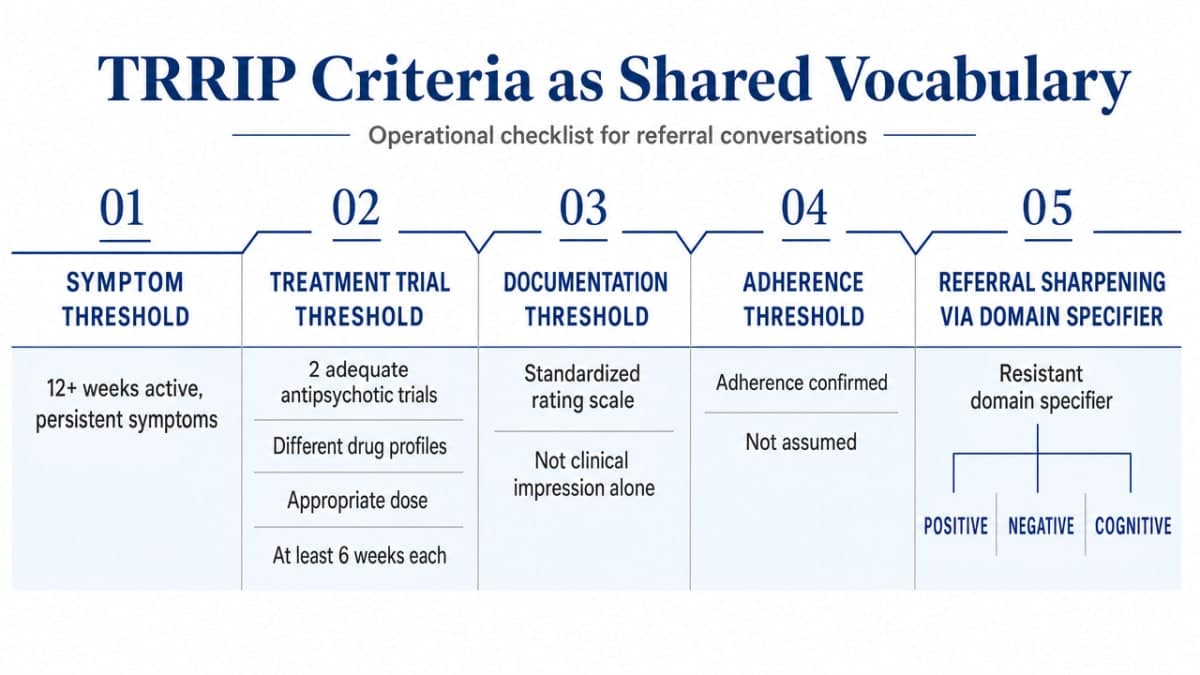
The consensus criteria for treatment-resistant schizophrenia converge on a few concrete thresholds:
- at least 12 weeks of active, persistent symptoms with measurable functional impairment;
- a minimum of two adequate antipsychotic trials drawn from different drug profiles;
- each trial delivered at an appropriate dose for at least 6 weeks;
- symptoms documented on a standardized rating scale rather than clinical impression alone;
- and adherence confirmed, not assumed 1, 2.
Nucifora and colleagues add specifiers for the resistant domain, positive, negative, or cognitive, which sharpens the referral question from “this isn’t working” to “which cluster is driving the impairment” 3.
This matters at the point of referral for two reasons. First, it protects the patient from being labeled resistant prematurely, which closes doors on future trials and can bias the receiving team toward heavier interventions than the case requires. Second, it gives you a shared substrate with the residential psychiatrist. When you can say “PANSS-documented positive symptoms over 14 weeks, adequate risperidone and olanzapine trials at therapeutic dose, confirmed adherence via plasma level,” the conversation moves in minutes rather than hours. The program either recognizes the picture and tells you what they can add, or they don’t, and you’ve learned something useful either way.
Ruling Out Pseudo-Resistance First
Before you make the call, walk the case back through the pseudo-resistance filter. This isn’t a challenge to your clinical judgment. It’s the same discipline the TRRIP framework builds in, because misclassifying pseudo-resistance as true resistance sends patients to higher levels of care they may not need and delays the intervention that would have worked.
Start with adherence. Self-report and pharmacy fill data are a starting point, not a conclusion. A plasma level or a documented trial on a long-acting injectable resolves the question in a way that chart notes cannot 1. Then confirm dose and duration: was each antipsychotic at a therapeutic dose for a minimum of six weeks, or did side effects, cost, or a rushed cross-titration cut the trial short of what TRRIP would accept as adequate 2? Next, screen actively for substance use. Cannabis, stimulants, and alcohol can drive apparent non-response, and if you haven’t retested recently, you’re working from stale data.
Medical workup deserves the same rigor. Thyroid dysfunction, B12 deficiency, occult infection, and metabolic disturbances all produce psychiatric noise that no antipsychotic will quiet. And, harder to sit with, revisit the diagnosis itself. A patient who has failed two antipsychotics may be failing them because the underlying condition isn’t primary schizophrenia at all.
Working through this filter honestly sometimes changes the referral question. Sometimes it confirms it. Either result is a clinical win, and the residential program you eventually call will trust the handoff more when you can show you did the work.
Presentations That Commonly Outgrow Outpatient
Treatment-Resistant Schizophrenia and Clozapine Candidacy
The TRS case that keeps surfacing in your caseload usually has a shape you can describe from memory: positive symptoms that never fully quiet, two adequate antipsychotic trials from different receptor profiles documented on a standardized scale, at least 12 weeks of persistent impairment, and adherence you’ve verified rather than assumed 1, 2. You’ve probably already started the clozapine conversation. That’s often where outpatient care hits its practical wall.
Clozapine candidacy is where the referral question sharpens. Initiation demands close hematologic monitoring, titration against orthostasis and sedation, cardiac surveillance, and a psychiatrist available when a white count drifts on a Friday afternoon. Community clinics can and do run clozapine, but the infrastructure required, especially in the first weeks, often exceeds what a 45-minute med check and a shared phone line can hold. Nucifora and colleagues also point out that TRS is not monolithic; positive, negative, and cognitive specifiers should shape both the trial you’re considering and the setting you’re considering it in 3. A residential level of care lets you compress the initiation window, verify blood levels alongside behavior, and address the negative-symptom functional deficits that outpatient CBT rarely gets traction on.
Rapid-Cycling Bipolar and Medication Instability
Rapid cycling, four or more mood episodes in twelve months, is the presentation that most often makes you feel like you’re chasing the illness rather than treating it. The literature backs that experience: rapid cycling carries higher rates of treatment resistance and greater functional impairment than non-rapid-cycling bipolar, and outpatient pharmacology often can’t move fast enough to catch the next switch 9.
The operational problem is timing. A mood stabilizer cross-titration that needs weekly labs and daily symptom tracking is hard to run when the patient’s phone is off during a depressive episode and unreachable during a hypomanic one. Add antidepressant-induced cycling, thyroid contribution, or covert stimulant use, and the outpatient signal-to-noise ratio collapses. Residential care isn’t a cure for rapid cycling, and no honest program will tell you it is. What it offers is a controlled environment where medication changes can be observed hour by hour rather than reconstructed from a two-week retrospective, and where the diagnostic question, bipolar I versus II, mixed features, borderline overlay, can be revisited with continuous data.
Co-Occurring SMI and SUD
You know the pattern. The schizophrenia patient whose voices worsen every time cannabis re-enters the picture. The bipolar patient whose manic episodes track cocaine use you didn’t know about until the third hospitalization. The trauma survivor whose alcohol use is both symptom and driver. SAMHSA is direct that these are not two problems to sequence; they are one clinical picture that requires concurrent treatment by a team trained in both domains 5, 7. It also documents that patients with co-occurring disorders carry higher hospitalization risk than those with either condition alone 6.
Outpatient networks default to the sequential model almost by structural necessity: your prescriber is here, the SUD counselor is there, and the referral loop between them is measured in weeks. That’s the gap where relapse and decompensation compound each other. When the presentation includes active use plus SMI plus a history of failed sequential treatment, the case has usually crossed the threshold. A residential setting that runs psychiatry and addiction services under one roof, with shared documentation and unified medication oversight, is the operational answer, provided the program actually does that rather than colocating two parallel programs and calling it integration.
What to Require of a Residential Program That Claims It Can Hold Complexity
Psychiatric Depth, Not Just Milieu
Milieu is the easy part. Most residential programs can offer a structured day, group programming, a therapist you’ll like on the intake call, and a clean facility. That baseline is table stakes, not a differentiator, and it is not what your treatment-resistant patient needs.
What you should be asking about is psychiatric depth. Specifically: who prescribes, how often they see the patient in the first week, and what happens at 2 a.m. when a clozapine titration produces orthostatic syncope or a rapid-cycling patient flips into a mixed state. A program that answers “our psychiatrist rounds twice a week and we call an on-call service after hours” is describing an outpatient practice with beds attached. That is not what will hold a TRS case in the initiation phase, and it is not what will safely re-sequence a complex polypharmacy regimen 1, 3.
Ask about clozapine explicitly. A program that hesitates, refers out for hematologic monitoring, or won’t accept patients already stable on clozapine is telling you something important about their psychiatric bandwidth. Ask about long-acting injectables, plasma-level monitoring, and how medication decisions are documented back to you. The answers separate programs that can hold complexity from programs that manage it until it becomes inconvenient.
Integrated Dual Diagnosis, Honestly Defined
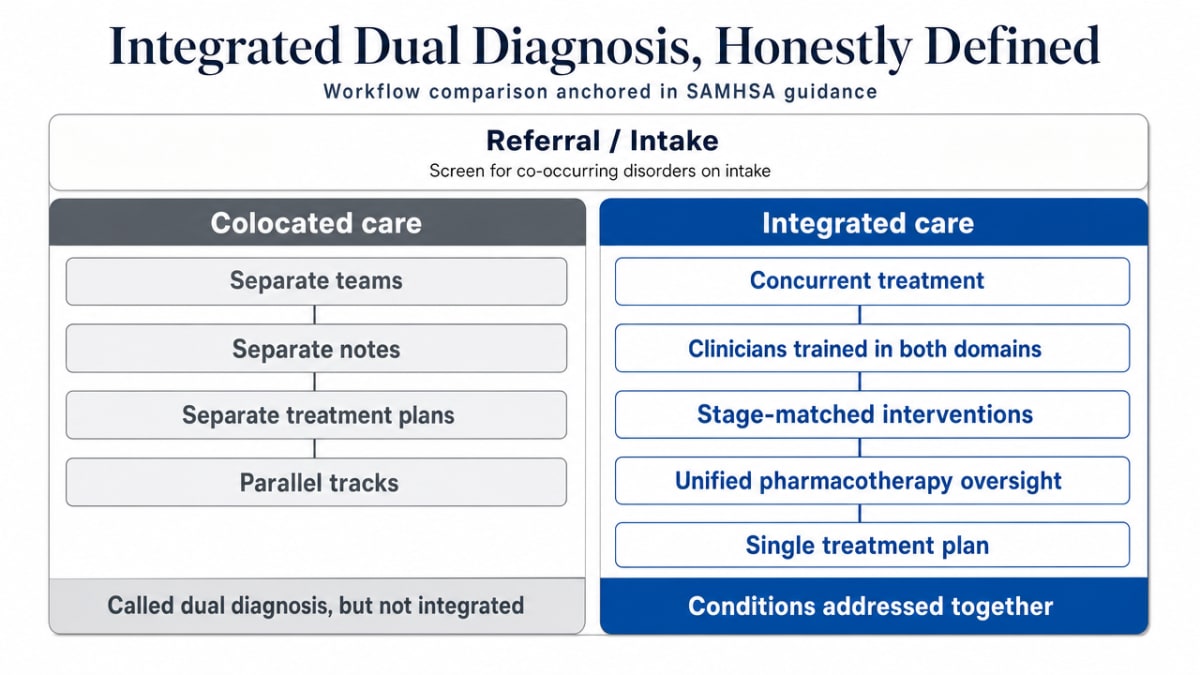
Almost every residential program uses the phrase “dual diagnosis.” Very few mean what SAMHSA means by it. The distinction matters at the point of referral, because a program that treats mental illness and substance use in parallel tracks, with separate teams, separate notes, and separate treatment plans, is not doing integrated care. It is doing colocated care and calling it something else.
SAMHSA is unambiguous that integrated care is the preferred model for co-occurring disorders: both conditions treated concurrently by clinicians trained in both domains, stage-matched interventions, unified pharmacotherapy oversight, and a single treatment plan that reflects how the two conditions actually interact in the patient in front of you 5, 7. TIP 42 elaborates the operational requirements, screening for co-occurring disorders on intake, multidisciplinary team review, and psychiatric medication decisions made with the addiction picture in view rather than despite it 7.
What you can require is structural:
- one psychiatrist responsible for the whole medication picture,
- therapists trained in both SUD and SMI modalities,
- shared documentation across the team,
- and a single case formulation that names how the substance use and the psychiatric illness feed each other in this specific patient.
If the program can’t describe that at the level of workflow, they aren’t integrated.
Length of Stay Driven by Clinical Need, Not Benefit Design
The 28-day model is a benefit-design artifact, not a clinical one. It exists because that is what most commercial plans will authorize without protracted negotiation, and it survives because programs have built their operations around it. For a treatment-resistant patient, that timeline is arbitrary at best and clinically harmful at worst. A clozapine initiation isn’t complete in 28 days. A rapid-cycling bipolar patient stabilizing on a lithium-plus-atypical combination isn’t stable in 28 days 9. A co-occurring SMI plus SUD case with active use on intake often hasn’t cleared the acute withdrawal and early abstinence window in 28 days, let alone begun the psychiatric work underneath 6, 7.
Ask any program you’re considering how they handle length of stay when clinical need exceeds authorization. Do they discharge on the authorization date and call the case closed? Do they negotiate continued stay reviews aggressively? Will they extend on a self-pay or blended basis when the clinical picture demands it, and do they say so up front rather than at the point of crisis?
The residential literature is candid that program quality varies widely, and that some patients benefit while others do not 10. Length of stay is one of the few variables where a program’s operational choices are visible before the patient arrives. A program willing to build stay length around the clinical trajectory, and to tell you honestly what that will require of the patient, the family, and the referring team, is a program worth continuing the conversation with.
The Hidden Cost of a Failed Placement
The dollar figure on a failed residential stay is the least of what it costs you. The real ledger is clinical, and you carry it forward into the next appointment.
A patient who returns from a 28-day placement mid-titration, discharged because the authorization ended rather than because the work did, comes back worse than they left. The medication story is half-written, the reasoning behind the last cross-titration didn’t travel with them, and the therapeutic alliance you spent eighteen months building now has to absorb the patient’s read that residential care doesn’t work for them. It does work, for the right case, at the right depth. But you’ll spend months walking that back.
The collateral damage compounds. Family members who took leave, drained savings, or moved a sibling into the guest room don’t have another round in them. Commercial benefits burned on a placement that ended in a lateral transfer to acute inpatient are gone for the calendar year. And the clozapine conversation you were finally ready to have gets postponed again, because the patient now associates any escalation with the last failure 1, 10.
The residential literature is candid that program quality varies widely and outcomes are heterogeneous 10. Choosing where you send the case is the intervention. Getting it right the first time is worth the extra hour on the phone.
Handoff as Collaboration, Not Transfer
What the Referring Team Should Send
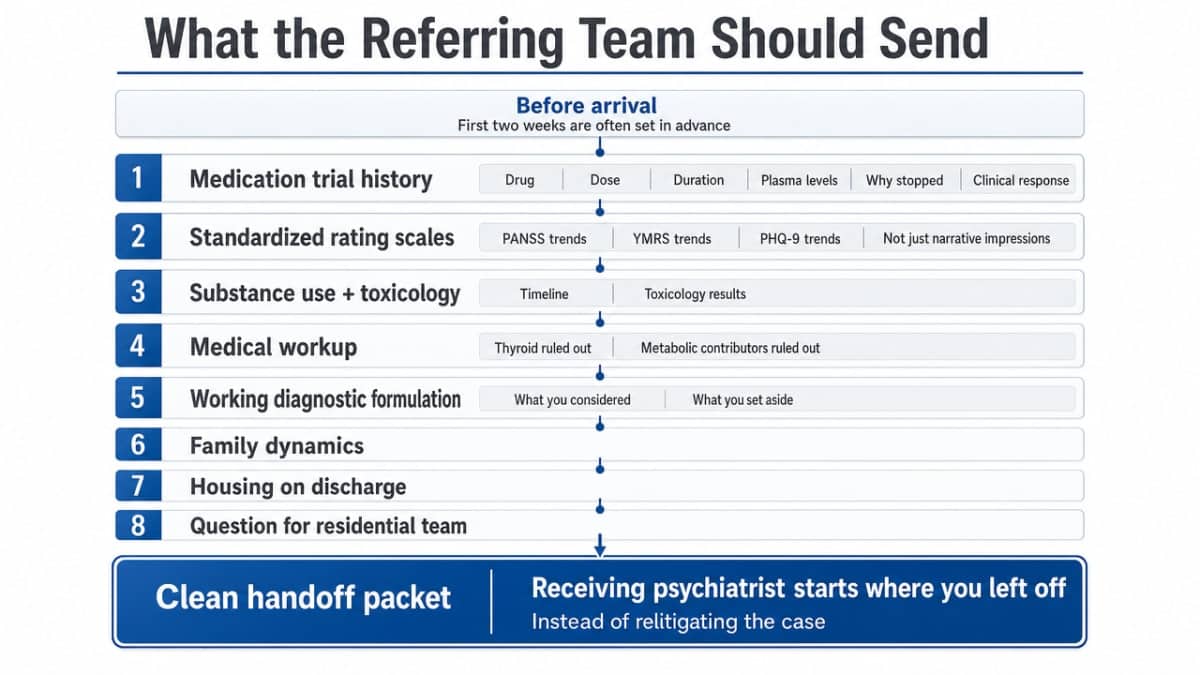
The quality of the first two weeks in residential care is usually set before the patient arrives. Send the medication trial history in detail: drug, dose, duration, plasma levels if drawn, reason for discontinuation, and what you saw clinically on each. Send the standardized rating scale data you have, PANSS or YMRS or PHQ-9 trends, not just narrative impressions 1, 2. Send the substance use timeline and any toxicology results, the medical workup that ruled out thyroid or metabolic contributors, and your working diagnostic formulation including what you’ve considered and set aside. Include the family dynamics that matter, the housing situation waiting on discharge, and the specific question you want the residential team to answer. A clean handoff packet lets the receiving psychiatrist start where you left off instead of relitigating the case for a week.
What You Should Get Back
Set the expectation in the first call, not after the first missed update. You should get:
- a psychiatry note within 72 hours of admission that names the working formulation and the initial medication plan,
- then weekly clinical updates in a format you can actually read between sessions, not a discharge summary that arrives after the patient is already home.
- When a medication change happens, you should get the rationale, not just the new regimen, so you can hold continuity if the patient re-decompensates later.
- Ask for a mid-stay case conference with the residential psychiatrist and therapist, especially for co-occurring presentations where the integrated formulation is doing real work 5, 7.
- And the aftercare plan should be built with you, not delivered to you: medication continuation, therapy modality, SUD supports, and a specific follow-up date on your calendar before discharge.
That loop is what separates collaboration from a transfer you’ll be cleaning up in six weeks.
Where ViewPoint Fits the Specification
ViewPoint Dual Recovery in Prescott exists for the specification the previous sections just built. Board-certified psychiatry is on site around the clock, which is what a clozapine initiation actually requires, and what a rapid-cycling patient in a mixed state needs at 2 a.m. rather than an answering service 1, 9. Length of stay is set by the clinical trajectory, not the authorization letter, so a titration that needs six weeks gets six weeks. That single operational choice removes the failure mode most residential programs bake into their model 10.
Dual diagnosis at ViewPoint is integrated in the structural sense SAMHSA describes: one psychiatrist responsible for the whole medication picture, therapists trained across SMI and SUD, a unified formulation, and shared documentation across the team 5, 7. Clozapine patients are accepted. Complex polypharmacy is expected. The referring team gets a psychiatry note early, weekly clinical updates, medication rationale in writing, and a mid-stay case conference when the case warrants it.
If you have a specific patient in mind, call the clinical team and describe the case. They will tell you honestly whether ViewPoint is the right fit, or point you elsewhere.
Discuss complex case options with expert clinicians
Receive tailored insights to guide your next steps for treatment-resistant or dual diagnosis cases.
Frequently Asked Questions
How do I know a patient has truly crossed the threshold from outpatient to residential care?
The threshold is clinical, not emotional. When symptoms persist beyond 12 weeks despite two adequate antipsychotic trials at therapeutic dose, adherence is verified, and functional impairment is measurable on a standardized scale, outpatient scaffolding is likely undersized for the case 1, 2. Add active substance use, rapid cycling, or clozapine candidacy requiring close monitoring, and the residential question answers itself 9.
What should I document before sending a treatment-resistant case for residential referral?
Send the medication trial history with drug, dose, duration, plasma levels, and reason for discontinuation. Include standardized scale trends (PANSS, YMRS, PHQ-9), the substance use timeline with toxicology, medical workup ruling out thyroid or metabolic contributors, and your current diagnostic formulation 1, 2. Name the specific question you want the residential psychiatrist to answer. A clean packet lets the receiving team start where you left off.
How do I evaluate whether a residential program can actually manage dual diagnosis rather than treating disorders sequentially?
Ask about workflow, not brochure language. One psychiatrist responsible for the whole medication picture, therapists trained across SMI and SUD, shared documentation, and a single case formulation naming how the two conditions feed each other in this patient. SAMHSA defines integrated care as concurrent treatment by a multidisciplinary team 5, 7. If the program describes two parallel tracks with separate notes, that is colocation, not integration.
Will a residential program accept a patient already on clozapine or a complex medication regimen?
Some will, many will not, and the answer tells you a great deal about the program’s psychiatric bandwidth. A program that refers out for hematologic monitoring or won’t admit patients stable on clozapine is not equipped for TRS in the initiation or maintenance phase 1, 3. Ask directly whether their on-site psychiatry runs clozapine, manages complex polypharmacy, and covers after-hours titration decisions rather than routing to an answering service.
What communication should I expect back from the residential team during and after the stay?
Expect a psychiatry note within 72 hours of admission naming the working formulation and initial plan, then weekly clinical updates in a readable format. When medications change, ask for the rationale, not just the new regimen. A mid-stay case conference is reasonable for co-occurring presentations 5, 7. The aftercare plan should be built with you before discharge, with medication continuation, therapy modality, SUD supports, and a follow-up date on your calendar.
What happens if the case isn’t the right fit for the program I call?
A clinical team worth referring to will tell you so on the first call. Residential program quality varies widely, and no single facility is right for every treatment-resistant presentation 10. When you describe the case to ViewPoint, the response should be a direct clinical read: whether the psychiatric depth, dual diagnosis capability, and length-of-stay flexibility match what this patient needs, or a specific pointer toward a program that fits better.
References
- Treatment resistant schizophrenia. https://pmc.ncbi.nlm.nih.gov/articles/PMC6231547/
- Treatment-Resistant Schizophrenia. https://pmc.ncbi.nlm.nih.gov/articles/PMC7725152/
- Treatment Resistant Schizophrenia: Clinical, Biological, and Therapeutic Aspects. https://pmc.ncbi.nlm.nih.gov/articles/PMC6395548/
- Integrated Treatment for Co-Occurring Disorders: The Evidence. https://library.samhsa.gov/sites/default/files/ebp-kit-the-evidence-10242019.pdf
- Substance Use Disorder Treatment for People with Co-Occurring Disorders. https://library.samhsa.gov/sites/default/files/pep20-06-04-006.pdf
- Managing Life with Co-Occurring Disorders. https://www.samhsa.gov/mental-health/serious-mental-illness/co-occurring-disorders
- Substance Use Disorder Treatment for People With Co-Occurring Disorders (TIP 42). https://www.psychiatry.wisc.edu/wp-content/uploads/2023/05/SAMHSA-TIP-42.pdf
- Efficacy of integrated dual disorder treatment for dual disorder patients: a systematic literature review. https://pubmed.ncbi.nlm.nih.gov/29638237/
- Rapid Cycling in Bipolar Disorder: Conceptual and Treatment Issues. https://pmc.ncbi.nlm.nih.gov/articles/PMC5639689/
- Residential treatment for adults with severe mental illness: A review of the clinical evidence. https://pubmed.ncbi.nlm.nih.gov/25882438/