Key Takeaways
- In New York, the hours between a loved one’s ‘yes’ and a confirmed clinician are where interventions fail, so admissions, beds, and transport must be arranged before the family meeting 1.
- Dual diagnosis requires one integrated placement that holds psychiatric and substance use care from day one, not sequential handoffs between programs that leave families stuck in the middle 1.
- OASAS Part 818 and Part 820 require clinical level-of-care screening and voluntary admission, while Article 9 limits involuntary psychiatric holds to physician-confirmed emergencies at a hospital or CPEP 14, 17.
- New York families should call an admissions team this week to verify insurance, confirm a bed, map transport, and save 988, county mobile crisis, and nearest CPEP numbers before setting a meeting date 10, 11.
The gap between “yes” and the first clinician is the most dangerous moment
You already know this part is hard. You have watched the ER discharges, the short detox stays that did not hold, the promises made at 2 a.m. and broken by morning. If you are preparing an intervention planning for New York families dual diagnosis — a loved one with both a psychiatric diagnosis and active substance use — the question you are really trying to answer is not how do we get them to say yes. It is what happens in the hours right after they do.
That gap is where interventions quietly fail. Your loved one agrees. The adrenaline drops. No bed is confirmed, no clinician is on the phone, no transport is arranged, and the window closes. By the next morning, the yes is gone.
SAMHSA’s guidance on co-occurring disorders treats engagement, screening, level-of-care decisions, and placement as sequential clinical tasks, not something a living-room meeting can replace on its own 1. In plain English: the family meeting is the handoff, not the treatment plan. Your job before anyone sits down is to make sure there is something on the other side of yes — a prepared landing, not a cliff. The rest of this guide walks you through how to build that landing, step by step, with New York’s specific rules and crisis supports in mind.
Why dual diagnosis changes everything about an intervention
Co-occurring conditions need one coordinated plan, not two separate ones
If your loved one has been shuttled between a psychiatric unit and a detox bed, you have probably felt it already: each system treats one half of the problem and politely points at the other. The depression stabilizes for a week, the drinking picks back up. The drinking stops for ten days, the paranoia returns. One side keeps handing off to the other, and your loved one keeps falling through the middle.
SAMHSA’s advisory on co-occurring disorders is direct about this. Integrated care — one team addressing mental health and substance use at the same time — is the preferred model, because the two conditions interact in ways that disconnected programs cannot track 1. Screening, assessment, level-of-care decisions, and treatment planning are meant to happen as one sequence, not two parallel ones.
What that means for your intervention is simple but important. You are not trying to choose between a psychiatric program and a substance use program. You are looking for one placement that can hold both at once, from the first day. If the program you are considering says it treats dual diagnosis but asks your loved one to stabilize the substance use somewhere else first, that is a coordination problem waiting to happen — and it is exactly the gap that a family meeting cannot close on its own.
What New York families are up against right now
You are not imagining the weight of this. The numbers behind what New York families are managing are real, and they are a reminder that dual diagnosis is not a quiet, slow-moving problem you have time to perfect a plan for.
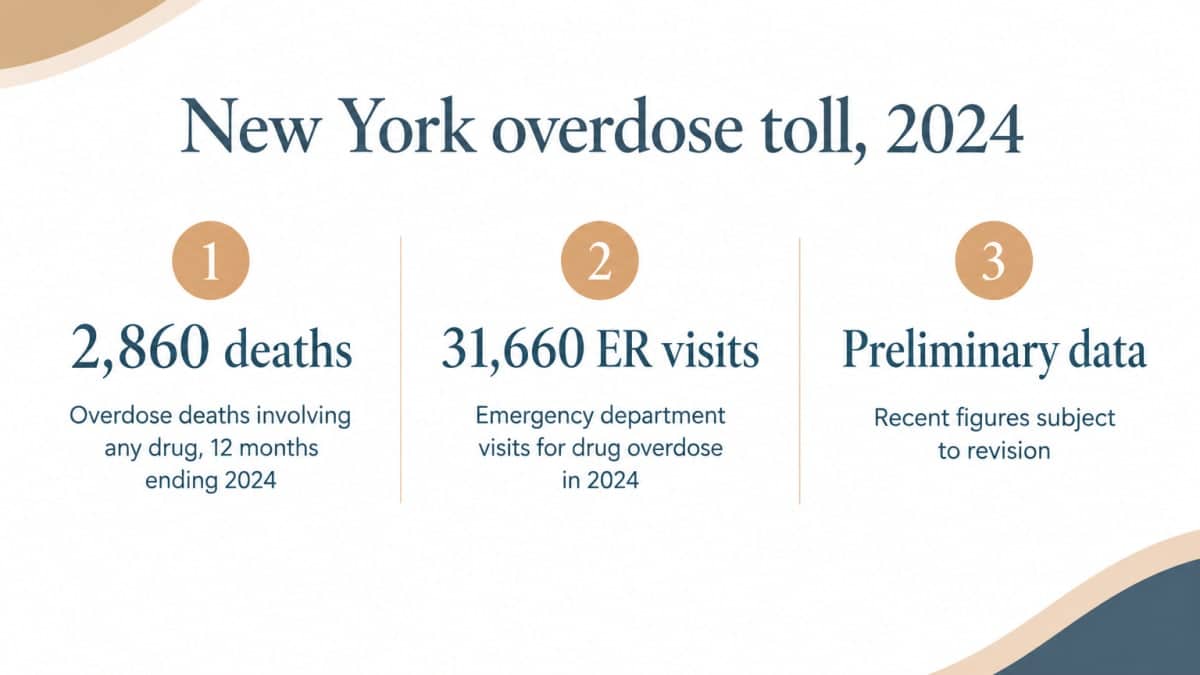
The New York State Department of Health estimated 2,860 overdose deaths involving any drug in the 12-month period ending in 2024, and recorded 31,660 emergency-department visits involving any drug overdose during 2024, with recent figures reported as preliminary and subject to revision 12. Those are state totals, not a distant national average. Behind each one is a family that, in many cases, was already trying.
Why that matters for your intervention: when your loved one has both an active psychiatric condition and ongoing substance use, the risk of a medical emergency between “yes” and “admitted” is not theoretical. It shapes how you plan the day. It is the reason you want a bed confirmed, a transport plan in writing, naloxone within reach if opioids are part of the picture, and a crisis number saved before anyone sits down to talk.
You cannot control every variable. You can control whether the hours after the meeting are organized or improvised. Treating medical risk as part of the plan, not an afterthought, is one of the most protective things you can do — and it is already a step forward that most families do not take until it is too late.
Structured preparation outperforms the ambush model
What the research actually shows about family-led engagement
If the picture in your head when you hear the word intervention is a surprise circle in the living room with a scripted letter and an ultimatum, you are picturing television. The research on what actually gets a treatment-refusing loved one through the door looks different — and gentler — than that.
The most-cited study on family-led engagement compared Community Reinforcement and Family Training (CRAFT), which coaches family members on communication, safety, and timing, against the Johnson-style confrontational intervention and against Al-Anon/Nar-Anon facilitation. In that randomized trial of concerned significant others of treatment-refusing drug users, treatment engagement was reported for:
- 58.6% of cases in the CRAFT-alone arm
- 76.7% in CRAFT plus aftercare
- 29.0% in the Al-Anon/Nar-Anon facilitation arm 4
The population studied was families of people refusing drug treatment, so these numbers do not translate to every substance, every diagnosis, or every acute psychiatric presentation.
Still, the direction is useful for you. Structured preparation — practicing what you will say, picking the right moment, planning how you respond if things get tense — outperforms the ambush. SAMHSA’s family guidance lines up with that: identify an appropriate time and place, express concerns directly, listen without judgment, and offer concrete help connecting to services 2. You are not performing a confrontation. You are opening a door and showing your loved one that something real is already waiting on the other side.
Honest expectations: even a prepared meeting may not produce a same-day yes
Here is the part no one wants to say out loud, so you should hear it from someone who respects you enough to say it: a well-prepared family meeting may still not produce a same-day yes. That does not mean you failed.
A 2022 cluster-randomized trial of CRAFT delivered to significant others of problem drinkers found that at three months, 29% of participants in group or individual CRAFT reported that the identified person had engaged in treatment, compared with 15% in self-administered CRAFT; the difference was not statistically significant 5. Different population, different substance, same honest message: engagement often takes more than one conversation.
Plan for the long version. If your loved one says yes, your scaffolding catches them. If they say “not today,” the preparation you did — the admissions contact, the crisis numbers, the family practicing one calm script instead of five frantic ones — is still there tomorrow. Progress is not only the yes. It is the fact that you built a door that stays open.
The pre-intervention handoff sequence
Call admissions before you set the family meeting date
The single most protective thing you can do this week is pick up the phone before you pick a date. Call the admissions team at the program you are considering and tell them, honestly, what you are planning. Not after the meeting. Before.
You can make that call yourself. SAMHSA’s advisory on co-occurring disorders describes engagement, information-gathering from family and other providers, and placement decisions as sequential clinical tasks that start well before the person walks through a door 1. In practice, that means an admissions team wants to hear from you — the parent, spouse, adult child, or sibling — so they can begin building the picture before your loved one ever says yes.
Ask three things on that first call:
- Can this program hold both the psychiatric diagnosis and the active substance use from day one, or will it ask for stabilization somewhere else first.
- What information do you need from me now so we are not scrambling later.
- Who do I call back the moment the meeting ends.
Write those answers down. You are no longer improvising.
Clinical screening and level-of-care determination
Here is where many families get caught off guard: calling admissions is not the same as getting a bed. A clinician still has to decide whether the program is the right level of care for your loved one, and that decision is made on clinical grounds, not on how prepared your family is.
In New York, OASAS Part 818 requires that the level-of-care determination for inpatient substance use services be made no later than 24 hours after the patient’s first on-site visit, that admission is voluntary, and that the person must be told they can discharge themselves at any time 14. Part 820 adds that residential applicants must be assessed as not needing acute hospital or acute psychiatric care that the residential service cannot provide 15. Translation: if your loved one is in active withdrawal, acutely psychotic, or medically unstable, a residential bed is not the right first stop, and a good program will say so.
New York’s 2008 OMH/OASAS outpatient-clinic guidance recommends collecting information across psychiatric symptoms, substance use, medical needs, risk, functioning, supports, and service history for people with co-occurring conditions 6; specific requirements can differ by program and level of care, so families should confirm what a given admissions team will ask. An admissions clinician will typically ask questions in each of those areas. The more honest and specific you can be — what they are using, how much, last psychiatric prescriber, last ER visit, any recent overdose — the faster the right placement comes into focus. Guessing or softening the picture to protect your loved one does not help them. It slows the match.
Insurance verification and benefits review
You do not need to become an insurance expert this week. You do need to let the admissions team become one for you.
OASAS guidance on utilization review for addiction services tells New York plans they cannot require prior authorization for medically necessary in-network OASAS-authorized substance use services on the specified list, while providers are expected to submit admission notification and an initial treatment plan within set timelines 16. Those protections are specific. They do not guarantee coverage for every facility, every diagnosis, every length of stay, or every out-of-network placement.
What that means for you is practical. On your first admissions call, give the full name on the insurance card, the member ID, the group number, and the subscriber’s date of birth. Ask what the admissions team can verify in writing before the family meeting: in-network status, estimated out-of-pocket, what the notification timeline looks like, and whether an out-of-network placement is possible if that is where the right level of care lives. Get the answers back before you set the date. The call you make now spares you the call you do not want to make at 10 p.m. with your loved one in the car.
Transport, bed hold, and the first 48 hours
Say the meeting goes well. Your loved one says yes. Now what.
This is where the handoff either works or quietly collapses. You want three things lined up in writing before you sit down:
- A specific bed or admission slot the program has agreed to hold, with the name of the person who confirmed it and the hours they are reachable.
- A transport plan: who is driving, which airport if it is a flight, what documents and medications travel with your loved one, and what the plan is if they change their mind in the car.
- A direct phone number for the admissions team that your loved one can hear ring, so they are not being handed off to a stranger they have never spoken to.
If the program you are coordinating with is out of state, New York families are usually arranging a flight, not a drive. Looping the admissions team in before the meeting is what makes that flight bookable the same evening instead of three days later, when the yes has already slipped.
Building a crisis backup plan before anyone sits down
988, mobile crisis, and CPEP: what each one actually does
Before anyone sits at that kitchen table, you want three phone numbers written down where everyone in the room can see them. Not because you expect the worst, but because knowing what each one does keeps you from freezing if the mood shifts.
- 988
- The Suicide and Crisis Lifeline, free, confidential, and available 24/7. New York has 14 contact centers operating for all 62 counties 10.
- Mobile crisis
- A team that can come to you for an urgent, voluntary, short-term evaluation when things feel unsafe but not immediately medical 9.
- CPEP
- The Comprehensive Psychiatric Emergency Program, the hospital-based psychiatric ER for people who need in-person evaluation, medical stabilization, or an acute psychiatric bed decision.
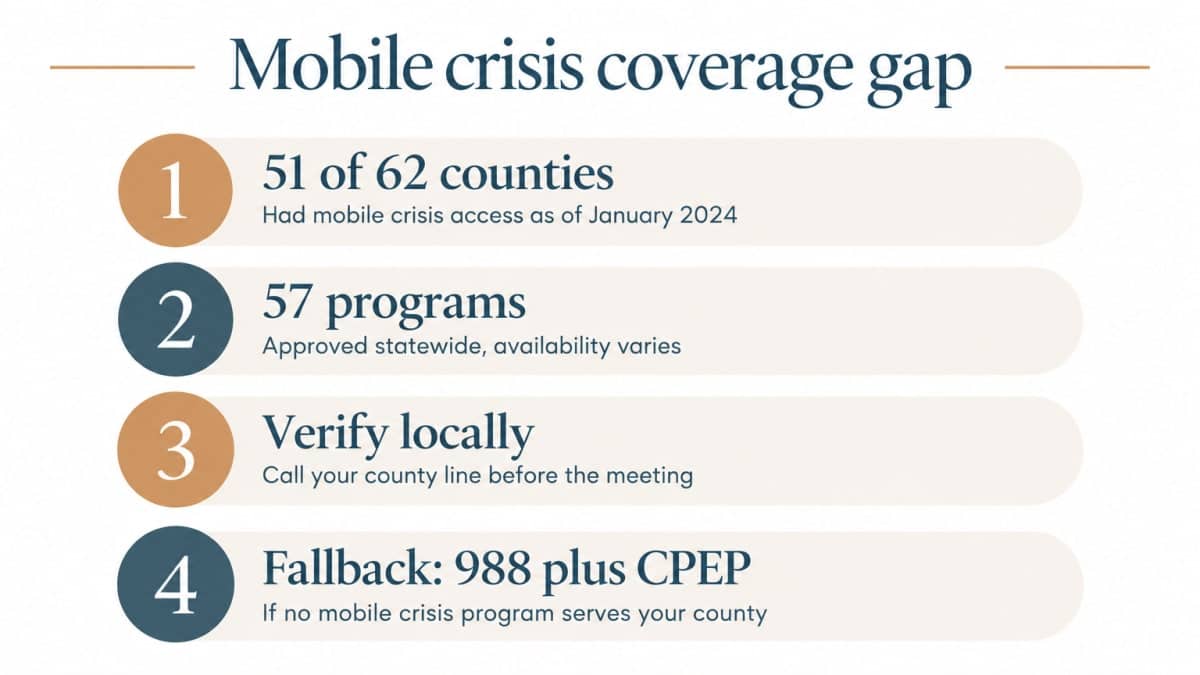
Here is the catch families upstate run into: mobile crisis coverage is not uniform. As of January 2024, 51 of 62 New York counties had access to mobile crisis services, with 57 approved programs statewide — and availability can vary, so county-level verification is important 11. Call your county’s mobile crisis line this week, before the meeting, and ask their current response window. If your county does not have a mobile crisis program, your fallback is 988 plus your nearest CPEP or ER. Save all three numbers in your phone under names you will recognize at midnight.
What an intervention cannot do: Article 9 and involuntary admission
This is a hard thing to hear, and you deserve the straight version: a family intervention cannot, by itself, force your loved one into psychiatric treatment in New York. The legal standard is narrower than most families expect, and misunderstanding it is one of the most painful surprises on an already hard day.
Involuntary emergency psychiatric admission in New York runs through Mental Hygiene Law Article 9. Under MHL §9.39, a physician must examine the person and determine that the emergency standard is met — a substantial threat of harm along with impaired judgment about the need for care — and a staff psychiatrist must then confirm that finding within 48 hours 17. That evaluation happens at a hospital or CPEP, by a physician, not in your living room.
What New York admission rules mean for your family’s plan
Part 818, Part 820, and why admission is never automatic
It would be easier if a signed yes from your loved one meant a guaranteed bed the same night. In New York, it does not, and understanding why protects you from the whiplash of hearing “we need to screen them first” at the worst possible moment.
Under OASAS Part 818, inpatient substance-use programs must make a qualified clinical level-of-care determination no later than 24 hours after the person’s first on-site visit, admission must be voluntary, and your loved one must be told they can discharge themselves at any time 14. If the program decides they are not appropriate — because the psychiatric picture is too acute, or because the medical situation needs a hospital first — the program is required to connect them to a more appropriate service rather than hold them in a mismatched placement.
Part 820 adds a parallel rule for residential services: a face-to-face or equivalent clinical determination, and an assessment that your loved one does not need acute hospital or acute psychiatric care the residential service cannot provide 15. For dual diagnosis families, that is the sentence that matters. A residential bed is not a substitute for a psychiatric unit when your loved one is actively psychotic, severely withdrawing, or medically unstable. A program that admits anyway is not doing them a favor. One that pauses to screen is doing exactly what the rules ask it to do, and it is one reason you want the admissions conversation started days before the meeting, not minutes after.
Confidentiality limits: what a provider can and cannot tell you
This part surprises almost every family, so hear it now rather than at a locked front desk: once your adult loved one is in a New York treatment program, the staff may not be able to confirm to you that they are even there.
The OMH/OASAS FAQ is explicit that federal confidentiality requirements cannot simply be waived by the state agencies, and that 42 CFR Part 2 and HIPAA shape what substance-use and mental-health providers may share without the person’s authorization 7. In practice, that means an admissions team can talk with you freely before your loved one engages, but after admission, information flows through a signed release.
Ask the admissions team to walk your loved one through a release-of-information form during intake, naming you specifically. If they sign it, you stay in the loop. If they do not, that is their right — and your preparation before the meeting is what makes that outcome survivable.
How ViewPoint’s admissions team holds the scaffolding in place
You do not have to build this landing alone. ViewPoint Dual Recovery works with families coordinating care for loved ones with co-occurring mental health and substance use conditions. For New York families, looping admissions in before the family meeting is what turns a hopeful conversation into a plan that can actually move the same day.
On a confidential call, the admissions team can gather the kind of clinical picture New York’s co-occurring guidance for outpatient clinics describes — psychiatric symptoms, substance use, medical needs, risk, supports, and service history 6— and start the integrated screening SAMHSA’s co-occurring guidance treats as a sequential clinical task, not a same-day coin flip 1. Benefits review can happen in parallel, so you have a clearer sense of what network and notification requirements apply before anyone sits down 16.
What that gives you on the day of the meeting: a prepared admissions contact who already knows your loved one’s story, so the yes does not land on an empty line. Call ViewPoint’s admissions line before you set the date.
The day of the family meeting
By the morning of the meeting, most of the real work is already done. The admissions call happened last week. The bed is held. The flight is on standby. The crisis numbers are in your phone. What is left is the conversation itself, and the hours right after it.
Keep the room small. SAMHSA’s family guidance is plain about this: pick an appropriate time and place, speak directly, listen without judgment, and offer concrete help 2. Two or three people who love your loved one, not a crowd. A quiet room, not after a fight. One calm script the family has practiced, not five frantic ones.
Have the overnight bag packed by the door. Medications, ID, insurance card, phone charger. If opioids are part of the picture, have naloxone within reach. When your loved one says yes, you call the admissions line in front of them so they hear a real person pick up. If they say “not today,” you keep the door open, confirm the crisis numbers are saved, and plan the next conversation. The preparation does not expire.
Plan the Next Step Before the Intervention
Talk with the admissions team about whether integrated dual diagnosis care may fit your loved one’s needs.
Frequently Asked Questions
Can an intervention force my loved one into treatment in New York?
No. A family meeting does not create a legal hold. Involuntary emergency psychiatric admission runs through Mental Hygiene Law Article 9, which requires a physician to examine your loved one and find the emergency standard met, with a staff psychiatrist confirming within 48 hours 17. If they are in immediate danger, call 911 or go to a CPEP. Otherwise, your path is voluntary admission, which is what the preparation protects.
What should we have in place before the family meeting happens?
Three things, in writing. One, a confirmed placement that can hold both the psychiatric and substance use picture from day one, with admissions already briefed on your loved one’s history 1. Two, insurance verified and transport mapped out. Three, a crisis backup saved in your phone: 988, your county’s mobile crisis line, and your nearest CPEP 9. The meeting lands on a prepared runway, not an improvised one.
What if our loved one agrees to go but we have not called a program yet?
You can still move, but the window is narrower than you want it to be. In New York, a program must make its own clinical level-of-care determination, and admission is voluntary, so no one can promise a same-day bed without screening 14. Call admissions immediately with your loved one present if possible. If a bed is not available tonight, use 988 or mobile crisis to hold the ground until morning 9.
What is the difference between 988, mobile crisis, and a CPEP?
988 is a free, confidential phone and text line staffed around the clock for emotional and crisis support 9. Mobile crisis is a team that comes to your home for an urgent, voluntary, in-person evaluation when things feel unsafe but not immediately medical. A CPEP is the hospital-based psychiatric emergency program for in-person evaluation, medical stabilization, and acute admission decisions. Use 988 first, mobile crisis for in-home de-escalation, CPEP for emergencies.
Why can’t the treatment program tell us whether our loved one was admitted?
Because federal law limits what they can share. The OMH/OASAS FAQ makes clear that confidentiality requirements under 42 CFR Part 2 and HIPAA cannot simply be waived by state agencies, so a program may not confirm your adult loved one is even there without a signed release 7. Ask the admissions team to walk your loved one through a release-of-information form naming you specifically during intake.
What happens if our loved one says no on the day of the meeting?
You did not fail. Even strong family-engagement formats produce engagement in a minority of cases on any given attempt 5. Keep the door open: thank them for listening, confirm the crisis numbers are saved on their phone, and ask the admissions team to keep your file active. Many loved ones say yes on the second or third conversation, not the first. The scaffolding you built today is still there tomorrow.
References
- Substance Use Disorder Treatment for People With Co-Occurring Disorders. https://library.samhsa.gov/sites/default/files/pep20-06-04-006.pdf
- Starting the Conversation Guide. https://www.samhsa.gov/sites/default/files/starting-the-conversation-guide.pdf
- The Importance of Family Therapy Advisory 39. https://library.samhsa.gov/sites/default/files/pep20-02-02-016.pdf
- A randomized trial of two methods for engaging treatment-refusing drug users through concerned significant others. https://pubmed.ncbi.nlm.nih.gov/12362968/
- Primary Outcome from a cluster-randomized trial of three formats for delivering Community Reinforcement and Family Training (CRAFT) to the significant others of problem drinkers. https://pubmed.ncbi.nlm.nih.gov/35538465/
- OMH and OASAS Guidance Document. https://omh.ny.gov/omhweb/resources/providers/co_occurring/adult_services/assessment.html
- FAQs Regarding Mental Health and Chemical Dependency Regulations. https://omh.ny.gov/omhweb/resources/providers/co_occurring/adult_services/faq.html
- MHOTRS Guidance 2025. https://omh.ny.gov/omhweb/clinic_restructuring/docs/mhotrs_programmatic_guidance.pdf
- Comprehensive Crisis Response System. https://omh.ny.gov/omhweb/bho/crisis-intervention.html
- The 988 Suicide and Crisis Lifeline Legislative Report for New York State. https://omh.ny.gov/omhweb/statistics/988-suicide-crisis-lifeline-legislative-report.pdf
- Coordinated Behavioral Health Crisis Response System. https://omh.ny.gov/omhweb/planning/docs/coordinated-behavioral-health-crisis-response-system.pdf
- Substance Use in NY State: Streamlined Set of Key Tracking Indicators, May 2025. https://healthweb-back.health.ny.gov/statistics/opioid/docs/summary_key_drug_indicators.pdf
- New York State Opioid Data Dashboard. https://apps.health.ny.gov/public/tabvis/PHIG_Public/opioid/
- Substance Use Disorder Inpatient Services (Part 818). https://oasas.ny.gov/part-818
- Residential Services (Part 820). https://oasas.ny.gov/part-820
- Guidance for Implementation and Utilization Review for Addiction Services. https://oasas.ny.gov/implementation-and-utilization-review-guidance
- DAL 16-03: OMH & DOH Addressing Emergency Mental Health Patient Transfers. https://www.health.ny.gov/professionals/hospital_administrator/letters/2016/2016-11-15_dal_16-03_quidance_to_phl.htm