Key Takeaways
- HRSA identifies 101 of Kansas’s 105 counties as mental-health professional shortage areas 5, which is why families with treatment-resistant or dual-diagnosis cases often look beyond state lines for specialized care.
- Staying involved from Kansas depends on structured family therapy, psychoeducation, and scheduled clinical update calls, with telehealth making regular contact workable even from rural counties 18.
- HIPAA permits team communication with involved family when the patient consents 16, while 42 CFR Part 2 requires a specific written release for substance-use information, now available as a single consent covering coordinated care 10.
- A sound handoff back to Kansas includes warm introductions to local providers, a written relapse plan, telehealth continuity under state law 3, 4, and continuing-care contact extending well past the first month 14.
When the suitcase is already packed
The suitcase sits by the door. You’ve folded the hoodie she asked for, tucked in the paperback she probably won’t read, and double-checked the flight to Phoenix one more time. Somewhere between the laundry and the TSA printout, the quiet caught up with you: your daughter, your husband, your brother is leaving Kansas for treatment, and you are not going with him.
If guilt showed up this week, you’re not alone. A lot of Kansas families carry it. The quiet second-guessing about whether you should have found something closer. The ache of a hug at a gate instead of a kitchen table. The fear, maybe the loudest one, that distance will mean you get edged out of your own loved one’s care.
Here is what we want you to hear first: choosing a specialized program outside Kansas, when the condition is treatment-resistant or complicated by substance use, is not abandonment. It is one of the hardest acts of love a family makes. Rural geography and a thin behavioral-health workforce make distance a real factor for many Kansas families 5, and reaching for a program equipped for complex cases is a reasonable response to a hard situation 6.
Distance also does not have to mean disconnection. Meaningful family involvement during residential psychiatric and dual-diagnosis treatment is not measured in miles or flights. It is built from scheduled family therapy, structured education, clear consent paperwork, and a discharge plan that starts the week your loved one arrives, not the week they leave 1, 2.
This guide walks you through what that looks like in practice, what questions to bring to ViewPoint Dual Recovery in Prescott, and how to stay a trusted voice in your loved one’s recovery from a kitchen table in Hays, Topeka, or Garden City. The suitcase is packed. You are still in this.
Why Kansas families end up looking across state lines
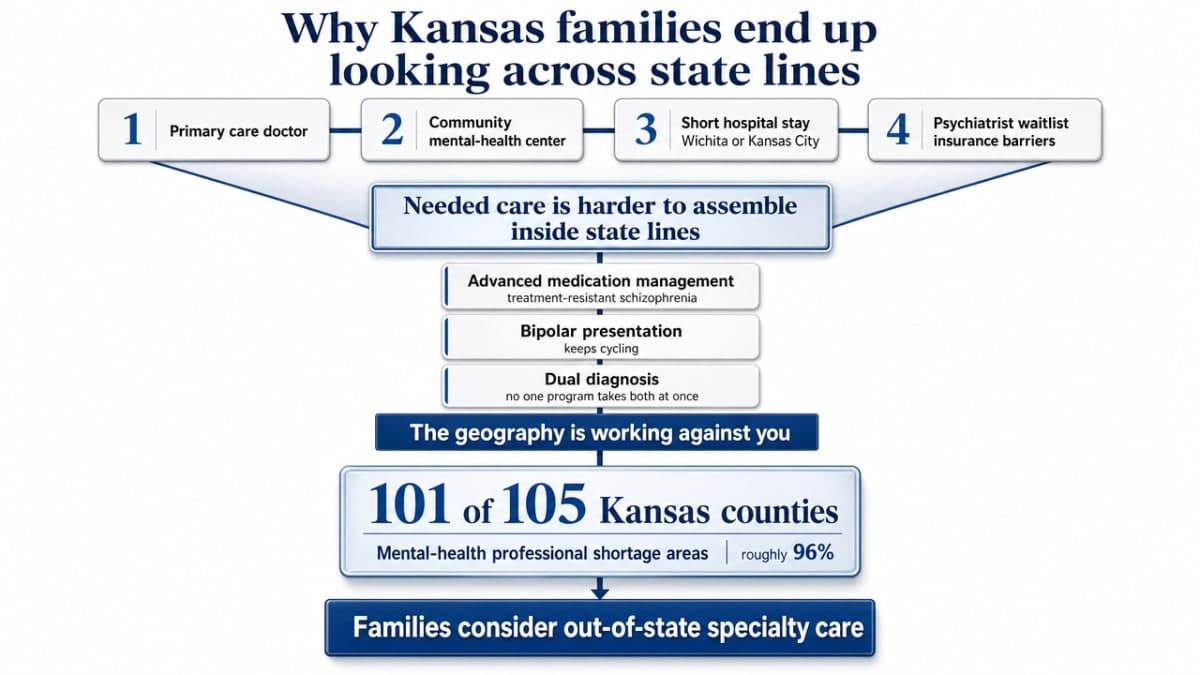
You probably didn’t start here. Most Kansas families don’t. You started with a primary care doctor, a community mental-health center, maybe a short hospital stay in Wichita or Kansas City, and a long waitlist for a psychiatrist who takes your loved one’s insurance. Somewhere along the way, you learned that the care your person actually needs — advanced medication management for treatment-resistant schizophrenia, a bipolar presentation that keeps cycling, a dual diagnosis that no one program will take on at once — isn’t easy to assemble inside state lines.
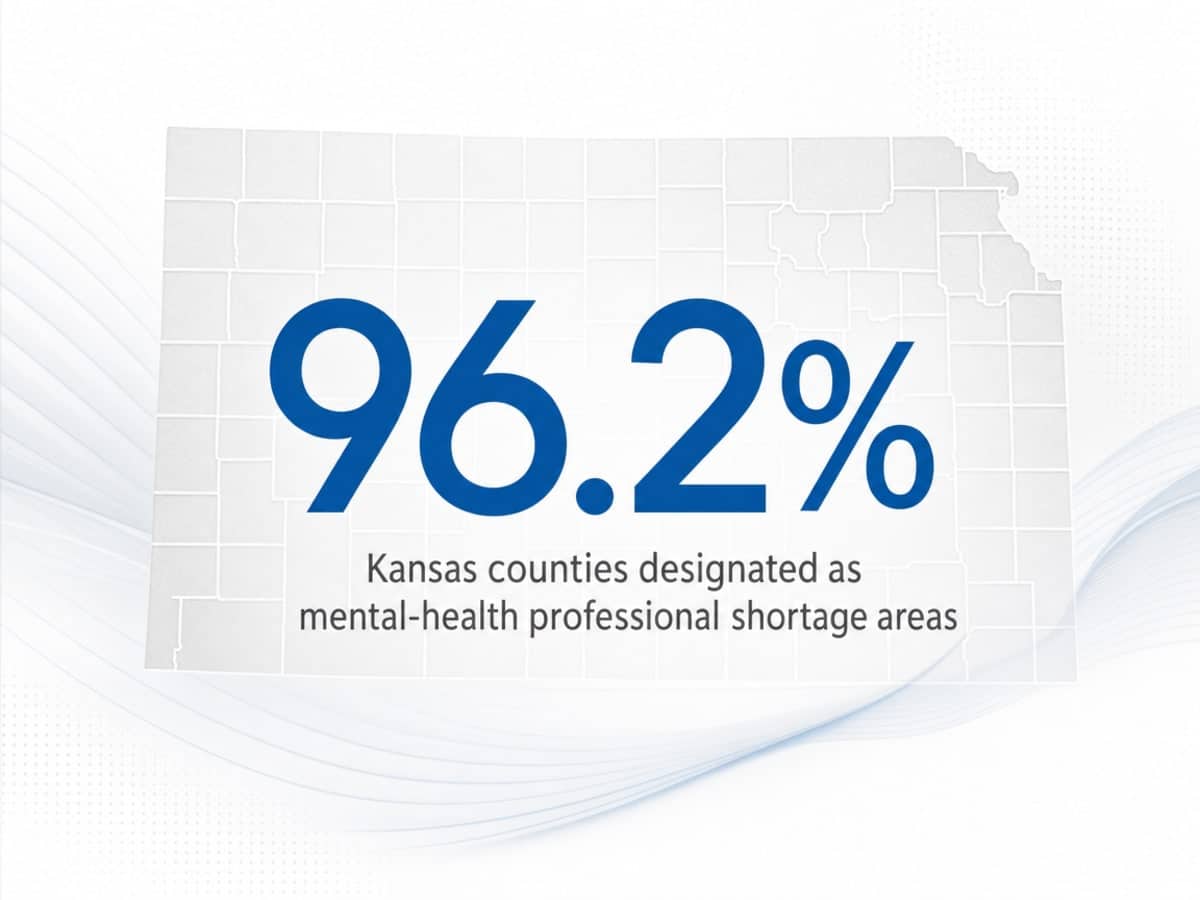
The geography is working against you, and it’s not your imagination. HRSA’s Kansas needs assessment identifies 101 of the state’s 105 counties — roughly 96% — as mental-health professional shortage areas 5. That doesn’t mean there is no one practicing in Kansas. It means that if you live in Liberal or Colby or Independence, the nearest psychiatrist who can manage a complex case may already be scheduling six months out.
The federal picture backs up what you already feel. The Government Accountability Office has documented that rural residents are less likely to receive behavioral-health treatment despite having similar rates of illness, with workforce shortages and long travel distances cited as persistent barriers 6. HRSA’s 2025 workforce brief reports the same gap: rural counties are more likely than urban ones to lack behavioral-health providers at all 7. That is the quiet math behind the drive to the Wichita airport.
None of this means Kansas care has failed your family. Community mental-health centers do real work, and many Kansans never need to look further. But when the diagnosis is treatment-resistant, when the medications haven’t held, when a substance-use disorder is tangled into the psychiatric picture, the search widens. A program like ViewPoint Dual Recovery in Prescott exists for exactly those cases — the ones other settings consider too complex to hold.
So if you’ve found yourself researching Arizona at midnight, you’re not being dramatic. You’re responding to a real access gap with a reasonable question: where can my person actually get the level of care they need? The answer sometimes points west. What matters next is how you stay close while they get it.
What meaningful involvement actually looks like from 1,000 miles away
Here is the reframe that helps most Kansas families breathe a little easier: being involved is not the same as being in the room. The clinical evidence on family participation in serious mental illness and substance-use treatment doesn’t measure success in miles driven. It measures it in whether families received structured education, whether they had a regular seat at the clinical table, and whether they were part of transition planning from the start 1, 2.
That matters because the research actually says something. A 2024 systematic review of family-based interventions for schizophrenia-spectrum disorders found that structured family involvement may reduce relapse and time in hospital and probably reduces caregiver burden — the exhaustion you’re carrying right now 12. A 2023 randomized trial of a brief six-session multifamily psychoeducation program showed reduced caregiver depression, better illness knowledge, and a stronger therapeutic alliance at 12-month follow-up 13. For the dual-diagnosis piece, a systematic review of randomized trials from 2012 through 2024 found that eleven of fifteen qualifying studies reported significant positive effects on substance use and family functioning when families were actively engaged 15.
Translated into what your week could look like: a scheduled family therapy session on a Tuesday evening over secure video. A psychoeducation group on Thursdays where you learn, alongside other families, what a clozapine titration actually involves, or why your spouse’s bipolar medication is being adjusted. A clinical update call with the treatment team every week or two, built into the calendar rather than squeezed in when someone remembers.
AHRQ’s care coordination framework gives you a concrete standard to hold a program to: a shared plan everyone works from, deliberate communication across participants, and ongoing refinement as the picture changes 11. If you can see those three things happening — not just promised, but happening — you are involved, even from Hutchinson.
Telehealth makes most of this possible. A 2024 systematic review of telehealth for mental-health and substance-use care found that virtual contact can meaningfully support access and continuity, including for serious mental illness, though quality varies and broadband access still matters 18. For a family in western Kansas, that means a family session with the Prescott team doesn’t require a Southwest flight. It requires a quiet room, a reliable connection, and a program that treats the Tuesday call as sacred, not optional.
The consent conversation: HIPAA, 42 CFR Part 2, and what ViewPoint can share
One of the quietest fears Kansas families carry into an out-of-state admission is this: once he’s in Prescott, will they even tell me how he’s doing? The honest answer is more layered than yes or no, and understanding the layers up front saves you a lot of heartbreak later.
Start with HIPAA, because most families already think they know it and most families have it slightly wrong. HIPAA does not forbid a treatment team from talking to you. HHS Office for Civil Rights is explicit: when the patient is present and has capacity, providers may communicate with family members involved in care if the patient does not object, as long as disclosures stay limited to information directly relevant to that involvement 16. In practice, that means your adult son can sit in a session with his psychiatrist and verbally okay you being on the call. It also means that even without a signed release, clinicians can usually listen to what you have to say — the history, the warning signs you’ve seen, the medication reactions in the past. One-way communication isn’t the team shutting you out. It’s the team honoring the law while still taking your input seriously.
The second layer is where dual-diagnosis treatment gets more specific. Substance-use records are protected under 42 CFR Part 2, a stricter standard than HIPAA alone. The 2024 final rule, with a February 2026 compliance date, now allows a single written consent that covers future treatment, payment, and health-care-operations disclosures — a meaningful improvement for coordinated care — while preserving heightened protections for SUD counseling notes and limiting use in legal proceedings without specific consent or a court order 10. In plain language: for ViewPoint to speak with you about the substance-use side of your loved one’s care, they will need a Part 2 release in writing, naming you specifically.
The third layer is the one families forget until discharge is already looming: a release to the Kansas-based clinicians who will pick up care when your person comes home. The outpatient psychiatrist in Topeka, the therapist in Overland Park, the case manager at the community mental-health center in Salina — none of them can receive records or coordinate medication unless they’re named in a release signed during the stay.
When you talk to ViewPoint, ask who walks your loved one through these three documents during intake, and whether releases can be updated if the picture changes. Ask what you’ll be told, what you won’t, and what you can share in the other direction without needing permission at all. The goal isn’t to pry open a locked door. It’s to understand which keys exist and whose signature turns them.
A structured rhythm: what the weeks look like
If you have ever white-knuckled a phone, waiting for a call that was supposed to come at 6 p.m. Central and didn’t, you already know why rhythm matters more than reassurance. A good residential program doesn’t ask you to trust that someone will reach out. It builds a calendar you can set your week around.
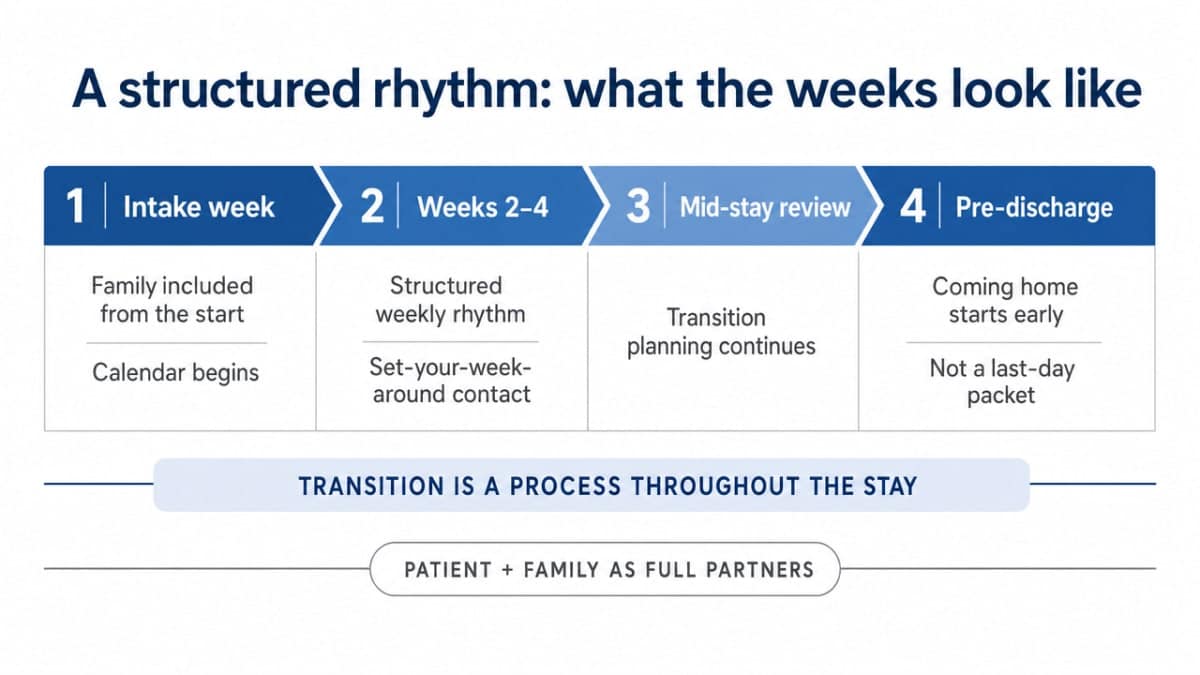
AHRQ’s IDEAL discharge framework is useful here even though your person isn’t being discharged yet. The framework treats transition as a process that runs across the entire stay — not a packet handed over on the last day — and names the patient and family as full partners from the start 1. The implementation handbook puts it bluntly: discharge is a process throughout the stay, not a one-time event 2. For a Kansas family, that reframes the whole timeline. The work of coming home starts the week your person arrives in Prescott.
Here is roughly what that rhythm looks like when a program takes it seriously.
- Intake week.
- Someone from the treatment team should contact you within the first few days, not to deliver clinical details, but to walk through paperwork. Which releases need signing. Which family members are named. What the HIPAA conversation and the 42 CFR Part 2 consent cover. You should also be scheduled, by name and time, into the first family education session and the first family therapy call.
- Weeks two through four.
- Family therapy becomes a standing appointment — a Tuesday evening video session, say, with the therapist who sees your loved one most. A clinical update call from the psychiatrist or care coordinator lands on a predictable cadence. You start attending the psychoeducation group, where you learn alongside other families what the medication plan actually involves and what the next phase looks like.
- Mid-stay treatment plan review.
- You get a seat — or a dial-in — at a formal review of how things are going. Not a status update. A review. What is working, what is being adjusted, what the team is watching for.
- Pre-discharge weeks.
- This is where IDEAL earns its name. The team walks you and your loved one through what life at home will look like, reviews medications, highlights warning signs, explains results, and makes the follow-up appointments with the Kansas providers who will take over 1. The relapse plan gets written down, not just discussed.
When you talk with ViewPoint, ask for this calendar in writing. A program that treats family involvement as a clinical process will hand you one. A program that improvises will promise to “stay in touch.” You already know which answer helps you sleep.
Dual diagnosis and the family education you should expect
When the diagnosis is both psychiatric and substance-related, the education you need as a family gets more layered — and more important. You are not just learning about one condition. You are learning how the two feed each other, which warning signs belong to which, and what a bad night at home could actually mean.
The clinical case for pulling families into that learning is strong. The 2024 CDC MMWR analysis of overdose deaths across 43 states and D.C. found that 21.9% of people who died from overdose in 2022 had a reported non-substance-related mental-health disorder, with depressive, anxiety, and bipolar disorders among the most frequently named 9. That is not a statistic to scare you. It is the reason integrated treatment exists in the first place, and the reason the education ViewPoint offers you should cover both sides of the picture, not just the one that put your person in the car to Prescott.
A good family education curriculum for dual diagnosis gives you working knowledge of a few concrete things:
- what the psychiatric medications do and what side effects to watch for,
- how substance use can mask or mimic psychiatric symptoms,
- what withdrawal and post-acute withdrawal actually look like, and
- what a relapse warning sign is versus a bad day.
A 2026 systematic review of randomized trials from 2012 through 2024 found that eleven of fifteen qualifying studies of family-based interventions in SUD reported significant positive effects on substance use and family functioning when families were actively engaged — not simply informed 15.
Ask ViewPoint who teaches the family education group, whether sessions are live and interactive or recorded, and whether the curriculum specifically addresses co-occurring conditions rather than treating substance use and mental illness as separate tracks. Ask what you’ll be taught about overdose risk and naloxone, because that is a conversation that belongs in the stay, not at the front door the day your person comes home.
The handoff back to Kansas
The flight home is almost always quieter than the flight out. Your person is coming back to the same house, maybe the same job, definitely the same triggers that were there before Prescott. What makes that first month different is whether a handoff actually happened or whether discharge was a packet and a handshake.
The clinical literature is clear that residential treatment only works when it connects to sustained continuing care. One foundational review of the continuing care model recommends at least three months of structured follow-up and ongoing contact points stretching out to six and twelve months, specifically because the risk window after discharge is long 14. That is the frame to bring to the conversation about coming home: not a finish line, but a baton pass.
Ask ViewPoint who on their team is responsible for making warm introductions to the Kansas providers who will carry the care forward. The outpatient psychiatrist managing a clozapine protocol in Wichita needs more than a faxed discharge summary. They need a phone call, the current medication rationale, the lab schedule, and a named contact in Prescott if something looks off in week two. AHRQ’s care coordination framework calls this a shared plan with deliberate communication among all participants, and it is a reasonable standard to hold a program to 11.
Kansas law helps here more than most families realize. The state’s telemedicine statute recognizes behavioral-science professionals as covered providers and defines telemedicine broadly enough to include ongoing psychiatric and counseling contact 3. Kansas also requires that covered services generally not be excluded from insurance or Kansas medical-assistance coverage solely because they are delivered by telehealth, subject to medical necessity and plan terms 4. In practice, that means the therapist in Lawrence or the case manager in Garden City can start seeing your loved one by video the week they land, closing the gap between discharge and the first in-person Kansas appointment.
You are not being handed a cured person. You are being handed a plan, a team, and a schedule. If all three are in place, the drive from the airport feels different than the one that started this.
Questions to ask ViewPoint before and during the stay
You don’t have to walk into the first phone call with a legal pad and a list of acronyms. You do get to ask real questions, and the answers tell you a lot about how a program will treat you across the next several weeks.
Before admission, ask who on the team becomes your point of contact and when they will reach out during the first week. Ask which releases need signing for both HIPAA and 42 CFR Part 2, and whether a single consent can cover coordinated care with the Kansas providers who will take over later 10, 16. Ask for the family education and family therapy schedule in writing, with days, times, and the names of the clinicians who lead them.
During the stay, ask whether the treatment plan review includes a family dial-in and how often it happens. Ask what the team is watching for, what is being adjusted, and what you can share from home that would help. Ask whether telehealth family sessions can accommodate a sibling in Dodge City and a parent in Kansas City on the same call 18.
Before discharge, ask who makes the phone call to the Kansas psychiatrist, who writes the relapse plan, and how continuing contact works at 30 days, three months, and beyond 14. Ask for the plan on paper.
Then ask ViewPoint the question this whole guide is built around: how will you keep our family connected while our person is in Prescott? Listen for specifics. Specifics are how distance stops meaning disconnection.
Find out if expert care is the next step
Get clear guidance on whether advanced, out-of-state treatment fits your family’s needs.
Frequently Asked Questions
Why would a Kansas family need to send a loved one out of state for psychiatric treatment?
Kansas’s behavioral-health workforce is thin, especially outside the metro areas. HRSA’s needs assessment identifies 101 of the state’s 105 counties as mental-health professional shortage areas 5, and federal reporting confirms rural residents face longer travel and fewer specialty options 6. When a case is treatment-resistant or involves dual diagnosis, families often widen the search to find a program equipped to hold complex presentations.
What can ViewPoint actually tell me about my loved one’s treatment?
It depends on what your loved one has signed. HIPAA allows the team to communicate with involved family when the patient is present, has capacity, and does not object 16. Substance-use records require a specific written release under 42 CFR Part 2, though a single consent can now cover coordinated care 10. Even without a release, clinicians can usually listen to what you share from home.
How often will I get to talk with my loved one and their treatment team?
Ask for a written schedule. A structured program typically offers weekly family therapy by secure video, a psychoeducation group, and clinical update calls on a predictable cadence, with a mid-stay treatment plan review you can join. A 2024 telehealth review found virtual contact can meaningfully support continuity for mental-health and substance-use care 18. Named times on a calendar matter more than a general promise to stay in touch.
Can Kansas-based therapists or psychiatrists stay involved during the stay?
Yes, with the right releases in place. Kansas telemedicine law recognizes behavioral-science professionals as covered providers and defines telemedicine broadly enough to include ongoing psychiatric and counseling contact 3. Covered services generally cannot be excluded from insurance or Kansas medical-assistance coverage solely because they are delivered by telehealth 4. A Kansas therapist can keep a standing video session during the Prescott stay if everyone agrees in writing.
What should discharge planning back to Kansas look like?
Discharge is a process across the whole stay, not a packet handed over at the end 2. Expect a warm handoff to the Kansas psychiatrist and therapist, a written relapse plan naming your person’s warning signs, scheduled follow-up appointments, and continuing-care contact that stretches past the first month 14. AHRQ’s IDEAL framework also calls for medication review and a clear description of what life at home should look like 1.
Does family involvement really change outcomes, or is it just emotional support?
It changes outcomes. A 2024 systematic review of family-based interventions for schizophrenia-spectrum disorders found reduced relapse, less time in hospital, and lower caregiver burden 12. A 2023 randomized trial of brief multifamily psychoeducation showed improved caregiver depression, illness knowledge, and therapeutic alliance at 12 months 13. On the substance-use side, eleven of fifteen qualifying trials reported significant positive effects when families were actively engaged 15. Involvement is clinical, not decorative.
References
- Strategy 4: Care Transitions From Hospital to Home: IDEAL. https://www.ahrq.gov/patient-safety/patients-families/engagingfamilies/strategy4/index.html
- IDEAL Discharge Planning (Implementation Handbook). https://www.ahrq.gov/sites/default/files/wysiwyg/professionals/systems/hospital/engagingfamilies/strategy4/Strat4_Implement_Hndbook_508_v2.pdf
- Kansas Statutes. https://www.kslegislature.gov/b2023_24/laws/040_000_0000_chapter/040_002_0000_article/040_002_0211_section/040_002_0211_k/
- Kansas Statutes. https://www.kslegislature.gov/b2023_24/laws/040_000_0000_chapter/040_002_0000_article/040_002_0213_section/040_002_0213_k/
- Select a State. https://mchb.tvisdata.hrsa.gov/Narratives/IIBFiveYearNeedsAssessmentSummary/a685d269-9402-4dba-ab10-b4bd7e340798
- CRITICAL ACCESS HOSPITALS: Views on How Medicare Payment and Other Factors Affect Behavioral Health Services. https://www.gao.gov/assets/gao-23-105950.pdf
- State of the Behavioral Health Workforce, 2025. https://bhw.hrsa.gov/sites/default/files/bureau-health-workforce/data-research/Behavioral-Health-Workforce-Brief-2025.pdf?8ab1b292_page=1&pp=1
- Substance Use & Mental Health. https://www.cdc.gov/mental-health/about-data/substance-use-mental-health.html
- Mental Health Conditions and Treatment Among Adults Who Died from Drug Overdose — 43 States and the District of Columbia, 2022. https://www.cdc.gov/mmwr/volumes/73/wr/pdfs/mm7334-H.pdf
- Fact Sheet 42 CFR Part 2 Final Rule. https://www.hhs.gov/hipaa/for-professionals/regulatory-initiatives/fact-sheet-42-cfr-part-2-final-rule/index.html
- Chapter 3. Care Coordination Measurement Framework. https://www.ahrq.gov/ncepcr/care/coordination/atlas/chapter3.html
- Family-based interventions versus standard care for people with schizophrenia or schizophrenia-like disorders. https://pmc.ncbi.nlm.nih.gov/articles/PMC11450935/
- Family psychoeducation to improve outcome in caregivers and patients with schizophrenia: a randomized clinical trial. https://pubmed.ncbi.nlm.nih.gov/37426102/
- The Continuing Care Model of Substance Use Treatment. https://pmc.ncbi.nlm.nih.gov/articles/PMC4007701/
- Efficacy of Family-based Interventions in Addressing Substance Use Disorders: A Systematic Review on Randomized Controlled Trials. https://pubmed.ncbi.nlm.nih.gov/41970367/
- HIPAA Privacy Rule and Sharing Information Related to Mental Health. https://www.hhs.gov/sites/default/files/ocr/privacy/hipaa/understanding/special/mhguidancepdf.pdf
- Drug Overdose Deaths in Kansas 2020-2024. https://www.kdhe.ks.gov/DocumentCenter/View/55471/2020-2024-Kansas-Overdose-Deaths-PDF
- Telehealth Use and Health Equity for Mental Health and Substance Use Disorder During the COVID-19 Pandemic: A Systematic Review. https://pmc.ncbi.nlm.nih.gov/articles/PMC12868971/