

Key Takeaways
- Wisconsin’s crisis lines, county programs, and state hospitals serve a broad behavioral health population, but they are rarely scoped to deliver the fully integrated dual diagnosis care that treatment-resistant cases require 5, 8.
- SAMHSA distinguishes coordinated, co-located, and fully integrated care, and only the integrated model puts one team, one assessment, and one treatment plan around both psychiatric and substance use conditions 10.
- Treatment-resistant schizophrenia, rapid-cycling bipolar with active substance use, and trauma-driven opioid use with psychotic features are the profiles that most often outrun general Wisconsin behavioral health settings 16, 15.
- When evaluating an out-of-state program, ask about a single comprehensive assessment, psychiatry-led care with clozapine capability, and length of stay set by clinical response rather than insurance authorization 11, 16.
When Wisconsin’s Behavioral Health System Runs Out of Room
If you are reading this, you have probably already tried the closest options. A county crisis stabilization stay. An inpatient admission at a general hospital. Maybe an intensive outpatient program that helped for a few weeks before the voices came back, or the drinking, or both. You did not miss a step. Wisconsin’s system did what it was built to do. What you are running into is the outer edge of what a general behavioral health setup can hold when psychosis and substance use are tangled together and neither is responding to standard care.
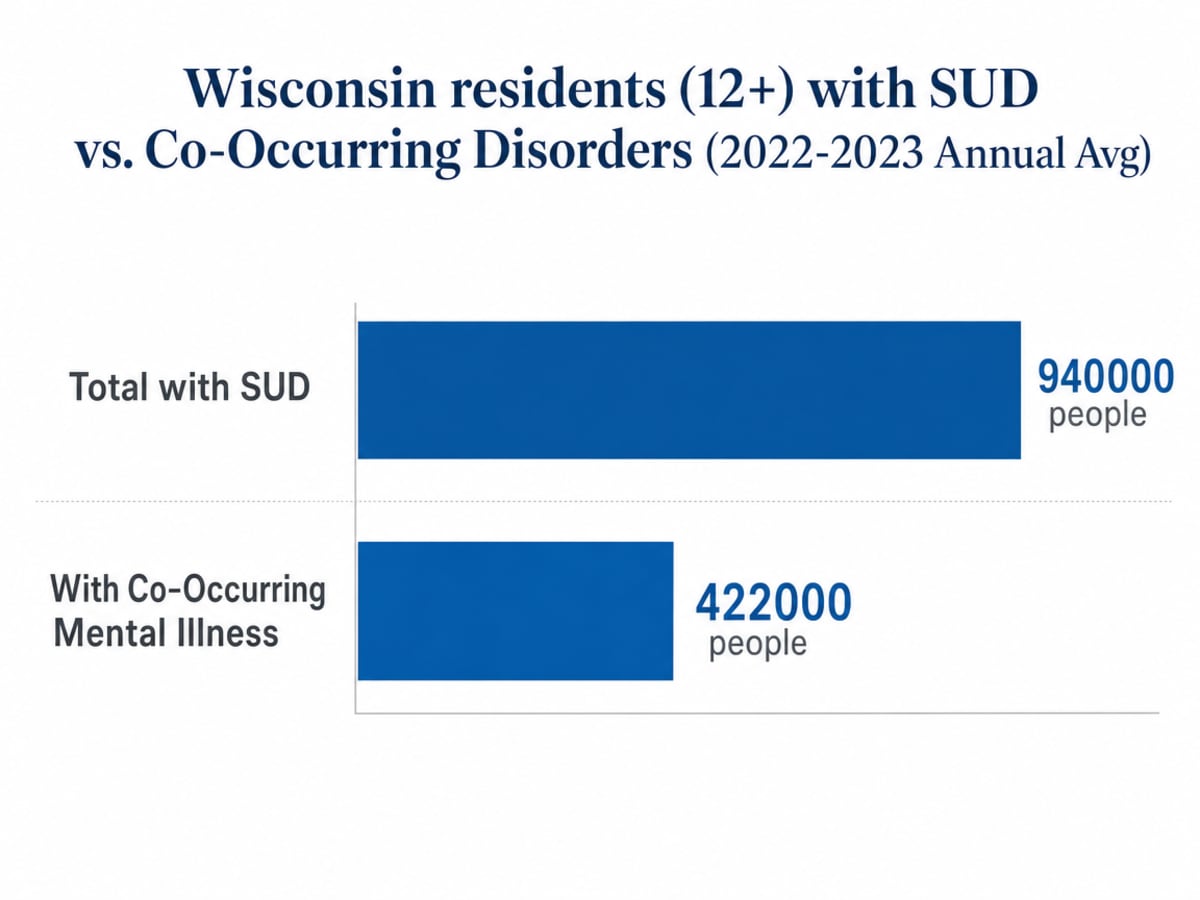
The scale of that overlap is not small. Between 2022 and 2023, an annual average of 940,000 Wisconsin residents age 12 and older met criteria for a substance use disorder, and 422,000 of them also had a co-occurring mental illness 2. Wisconsin’s overall prevalence for mental health issues and substance use runs slightly above national averages, with alcohol use significantly higher than national norms 1. That is a lot of people leaning on the same community programs, county crisis lines, and inpatient beds.
Volume alone does not explain the gap you are hitting, though. The harder issue is scope. Most Wisconsin programs are designed for the broad middle of behavioral health need. When a case involves treatment-resistant schizophrenia, rapid-cycling bipolar with active substance use, or trauma-driven opioid use with psychotic features, the model itself starts to strain, no matter how skilled the staff.
This article walks through that gap honestly: where Wisconsin’s care pathway ends, what a specialized dual diagnosis program actually looks like on the inside, and how to tell whether your situation fits one. You are not out of options. You are looking in a narrower part of the field.
The Wisconsin Care Pathway You’ve Probably Already Walked
988, County Crisis Lines, and Where Stabilization Ends
You know the sequence by now. Something breaks at 2 a.m. You call 988, or your county crisis line, or you drive to the ER. Someone competent picks up. Your loved one gets a bed, or a mobile team, or a few days on a stabilization unit. The acute danger passes. Then comes the discharge plan, and the ground gives way again.
This is not a failure of the crisis system. Wisconsin’s 988 Suicide & Crisis Lifeline is designed to give free, confidential support and connect callers to local resources, including mental health and substance use services 7. The state’s broader crisis network layers in county crisis lines, mobile teams, and stabilization options for people in acute distress 6. For a night when things are unraveling, that infrastructure matters, and you should keep using it.
What crisis services are not built to do is carry someone through the long, layered work of dual diagnosis recovery. A 72-hour hold can steady a psychotic episode. It cannot titrate clozapine over weeks, run trauma-focused therapy, or hold a rapid-cycling bipolar case through withdrawal. Once the immediate risk is contained, the system hands you back to outpatient care and expects the next chapter to happen there. When it does not, you end up in the ER again, and the loop starts over.
County Community Programs, State Hospitals, and the Scope Gap
Below crisis, Wisconsin runs a layered public system. The Department of Health Services oversees community programs and specialized services for adults and children through its mental health services structure 13. The Division of Care and Treatment Services sits above that, overseeing state psychiatric hospitals, secure treatment centers, and contracted programs for people with the most complex behavioral health needs 14. County-level substance use treatment adds another layer, with real variation from one county to the next in what is actually available 4.
This is a genuine safety net, and for a lot of Wisconsin residents it works. The gap you are hitting is not about whether these services exist. It is about what they are scoped to do. State-run facilities and county programs are built to serve a broad population across many diagnoses. They treat co-occurring disorders when they show up, and Wisconsin’s own data track the share of adults with serious mental illness in the state system who also carry a substance use disorder 5. But treating co-occurring conditions inside a general mental health or addiction framework is not the same as running a program purpose-built around them.
That distinction is where families of someone with treatment-resistant psychosis or complex dual diagnosis start to feel the wall. Your loved one may be getting antipsychotics in one setting and substance use counseling in another, with case management trying to hold the seams together. Care is happening. Integration, in the clinical sense the evidence base describes, often is not. That gap has a name, and the next section walks through what it looks like when a program is actually built to close it.
What ‘Specialized’ Actually Means in Dual Diagnosis Care
Coordinated, Co-Located, and Fully Integrated: SAMHSA’s Three Models
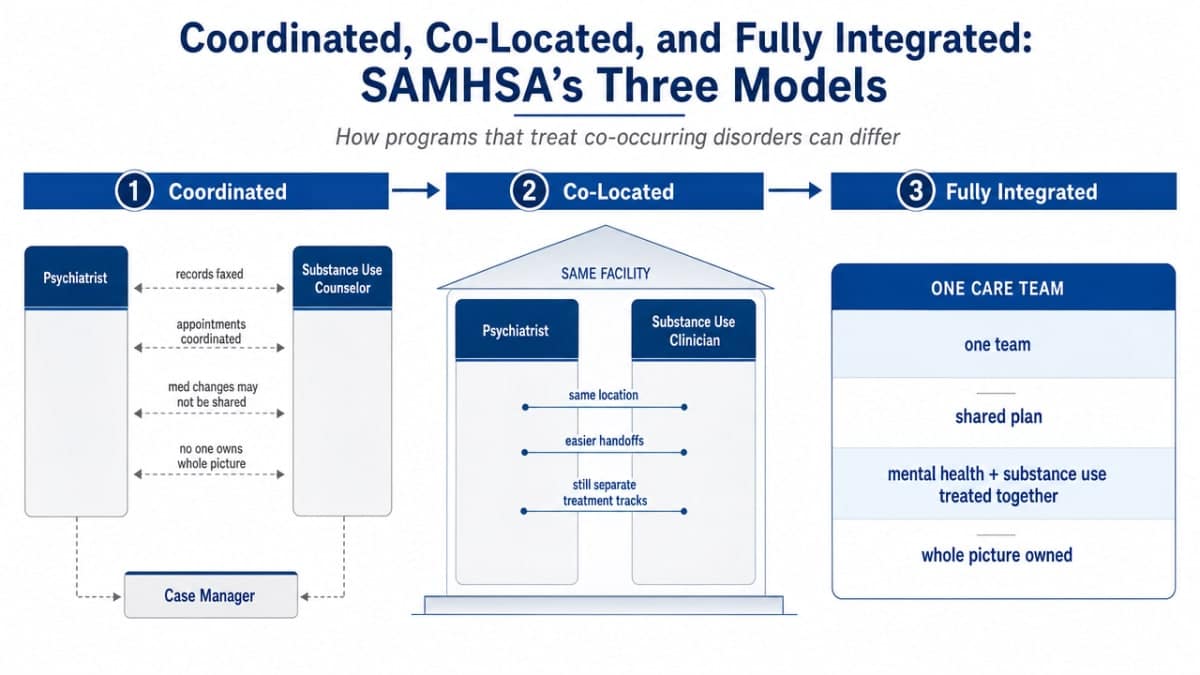
When someone says a program “treats co-occurring disorders,” that phrase can mean three very different things. SAMHSA lays out the distinction in plain terms, and once you have it, you can hold it up against every program you’ve already tried.
- Coordinated care
- is the most common version, and probably what you have been experiencing. Your loved one has a psychiatrist at one clinic, a substance use counselor at another, and maybe a case manager trying to keep both sides talking. Records get faxed. Appointments get scheduled around each other. Each provider is competent inside their lane, but no one owns the whole picture. When the antipsychotic dose changes, the addiction counselor may not hear about it for weeks.
- Co-located care
- puts the providers under one roof. The psychiatrist and the substance use clinician are down the hall from each other, which cuts down on scheduling chaos and makes warm handoffs possible. This is a real improvement, and a lot of Wisconsin community mental health centers work hard to offer it. But co-location is still two teams sharing a building. Treatment plans can still run on parallel tracks.
- Fully integrated care
- is the model the evidence base actually points to. One team, one treatment plan, one set of goals that address mental health and substance use as a single condition rather than two problems stacked on top of each other. SAMHSA describes it as linking people to individualized services that treat the physical and emotional aspects of both mental and substance use disorders through the same coordinated effort 10. Staff are cross-trained. The psychiatrist knows what happened in group last Tuesday. The therapist knows why the mood stabilizer was adjusted.
Building that kind of program takes deliberate design, not a rebranded intake form 9. When you evaluate any facility, this is the yardstick. Ask which of the three models describes what actually happens on the unit, and listen for whether the answer is specific.
Eight Principles That Separate Integrated Care from Parallel Care
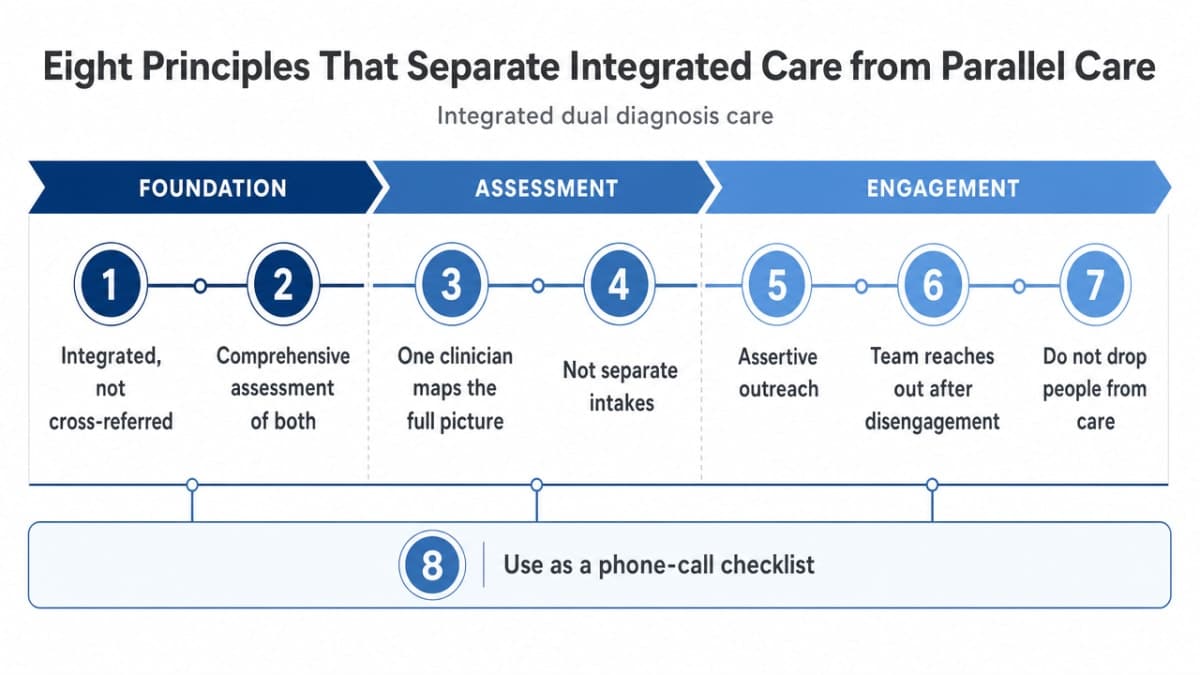
The three-model framework tells you the shape of a program. The next question is what happens inside it. A practice brief from the University of Minnesota lays out eight guiding principles for integrated dual diagnosis care that are worth knowing, because they double as a checklist you can use on a phone call 11.
The first two are foundational: mental health and substance use services should be genuinely integrated, not just cross-referred, and every person should receive a comprehensive assessment that looks at both sides at once 11. That means one clinician sitting down and mapping the full picture, not a psychiatric intake at one visit and a substance use screen at another.
The rest sharpen the model. Care should be assertive, meaning the team reaches out when someone disengages rather than dropping them from the caseload. It should include harm reduction, because people in early recovery from psychosis and substance use rarely move in a straight line. It should be stage-wise, matching the intensity of the intervention to where the person actually is, not where the discharge plan wishes they were. And it should hold a long-term perspective, treating relapse and symptom flare-ups as expected chapters rather than program failures 11.
SAMHSA’s evidence review echoes these components, pointing to eight controlled studies that show integrated dual diagnosis programs improve outcomes on substance use, psychiatric symptoms, and functioning compared with non-integrated approaches for people with severe mental illness 8. That is the gap between parallel care and integrated care, put in outcome terms. When you are evaluating programs, these principles are the questions worth asking out loud.
The Cases Wisconsin General Facilities Often Cannot Fully Hold
It helps to name the specific clinical shapes that tend to outrun a general behavioral health setup. If your loved one looks like one of these, you are not being dramatic when you say the local plan is not working. You are describing a scope mismatch.
Treatment-resistant schizophrenia. Roughly 20 to 30 percent of people with schizophrenia meet criteria for treatment resistance, meaning symptoms persist despite adequate trials of standard antipsychotics 16. For this group, the next step is usually clozapine, an antipsychotic that works when others have not but requires close blood monitoring, careful titration over weeks, and a team that can respond to side effects in real time 16. NIMH is direct that schizophrenia care needs to be coordinated and long-term, and that co-occurring substance use should be treated alongside the psychiatric illness rather than after it 12. A general inpatient unit can stabilize an acute episode. Running a clozapine trial through active substance use is a different order of work.
Rapid-cycling bipolar with an active substance use disorder. When mood shifts happen four or more times a year and drinking or stimulant use is layered on top, standard mood-stabilizer protocols get muddied. Withdrawal mimics mania. Intoxication mimics depression. Medication decisions that would be clear in a sober patient become guesswork. The stage-wise, assertive approach the evidence base describes for co-occurring severe mental illness is built exactly for this kind of moving target, and it depends on one team holding both threads at once 15.
Trauma-driven opioid use with psychotic features. Someone using opioids to quiet flashbacks, hearing things during withdrawal, cycling through detox and relapse, does not fit neatly into a substance use track or a psychiatric track. Care that treats the trauma without addressing the opioid use, or vice versa, tends to lose the person between appointments. Integrated programs are the ones designed to hold all three pieces, trauma, substance use, and psychosis, inside a single treatment plan 15.
If any of these profiles sounds like the loved one you are trying to help, that is useful information, not a verdict. It tells you what kind of program to look for next, and what questions to ask when you call one.
How to Evaluate a Specialized Program Before You Commit
Questions That Reveal Real Integration Versus a Label
Almost every program you call will say they treat co-occurring disorders. Almost none will volunteer where they sit inside the coordinated, co-located, and fully integrated framework. You have to ask, and the answers you get will sort programs faster than any brochure.
Start with the assessment. Ask who does the initial evaluation and whether the psychiatric history and the substance use history are gathered in the same conversation by the same clinician. In a truly integrated program, one comprehensive assessment covers both sides at once, which is the first of the eight guiding principles the University of Minnesota practice brief names as foundational 11. If the answer describes a psychiatric intake on Monday and a separate substance use screen later in the week, you are looking at parallel care with better scheduling.
Then ask about the treatment plan. Is there one plan or two? Who signs it? Does the psychiatrist know what happened in group yesterday, and does the therapist know why the mood stabilizer was changed this morning? SAMHSA’s description of integrated care hinges on this: individualized services that treat the physical and emotional aspects of both conditions through one coordinated effort, not two 10.
Psychiatry-Led Care, Clozapine Protocols, and Length of Stay
The next layer of questions is about clinical horsepower. For treatment-resistant psychosis or complex dual diagnosis, the psychiatrist is not a consulting figure who signs off on medications once a week. Ask how often board-certified psychiatry is on-site, whether coverage runs 24/7, and who makes medication decisions when something changes at 3 a.m. NIMH is clear that schizophrenia care needs to be coordinated and long-term, with co-occurring substance use treated alongside the psychiatric illness 12.
Clozapine is a specific test. It is the antipsychotic most often reached for when standard medications have not worked, and it requires close blood monitoring and careful titration over weeks 16. Ask directly whether the program runs clozapine protocols in-house, how they handle the required lab work, and whether they have started clozapine on patients who were also actively working through substance use. Programs that hesitate on this question are telling you something useful.
Finally, ask how length of stay is decided. If the answer is a fixed 30, 60, or 90 days keyed to what insurance will authorize, you are back inside the same timeline pressure that has probably already failed your loved one at least once. The evidence base for co-occurring severe mental illness points toward long-term engagement, not calendar-driven discharges 8. A specialized program should be able to explain, in plain terms, how clinical progress and stability, not the payer’s clock, set the exit point.
ViewPoint in Prescott as One Out-of-State Option
Once you know what to look for, the field of programs actually built around treatment-resistant psychiatric conditions and complex dual diagnosis is smaller than the internet makes it seem. ViewPoint Dual Recovery in Prescott, Arizona is one of them. It is worth describing plainly, not as a pitch, but as an example of what the criteria from the last two sections look like in practice.
ViewPoint is a Joint Commission-accredited psychiatric facility that focuses specifically on treatment-resistant mental health conditions and dual diagnosis cases, including treatment-resistant schizophrenia, rapid-cycling bipolar disorder, and trauma-linked substance use. Board-certified psychiatry is on-site 24/7, which matters when medication decisions cannot wait until the next weekday appointment. The program runs clozapine protocols in-house, which is the specific question the treatment-resistant schizophrenia literature says to ask 16. Psychiatrists and therapists work as one team on each case rather than as two departments sharing a chart, which is the structural marker of the fully integrated model SAMHSA describes 10.
Two other details are worth noting. Treatment duration at ViewPoint is set by clinical need rather than by what insurance will authorize on a given calendar. And the program is Arizona ADHS licensed and LegitScript certified, which are the baseline regulatory signals to look for in any out-of-state facility.
ViewPoint is not the only specialized program in the country, and the point of this article is not to say it is. It is one option built for the cases Wisconsin’s general system was not designed to hold. If the clinical profiles earlier in this article sound like your loved one, it is reasonable to call and ask whether the situation qualifies.
The Honest Part: Sending Someone You Love Out of State
Nobody talks about this part on a website’s tour page, so it’s worth talking about here. Choosing an out-of-state program means putting your loved one on a plane, or in a car for two days, and then going home to an empty bedroom or a quiet phone. That is a hard thing. The guilt is real. The distance is real. The wondering whether you should have tried one more local option is real.
Here is what usually helps. Name what you are actually deciding. You are not choosing between Wisconsin and Arizona. You are choosing between another round of the same care model that has not held, and a model built for the shape of your loved one’s illness. When you frame it that way, the geography stops being the main variable.
Talk about family involvement before admission, not after. A specialized program worth its accreditation will have a plan for how you stay part of the treatment: scheduled family therapy sessions, regular clinical updates from the psychiatrist or therapist actually running the case, and structured visits when they make clinical sense. Ask what that looks like in weeks one, four, and eight. If the answer is vague, keep asking.
Handle the practical logistics early so they don’t ambush you later. Insurance verification, what the facility bills versus what you pay, travel for family sessions, and what discharge back to Wisconsin will look like when the time comes. A program running the long-term, stage-wise approach the evidence base describes should already have answers to the discharge question on day one, because they know relapse and symptom flare-ups are expected chapters rather than failures 11.
And give yourself some grace. You are not abandoning your loved one by looking outside the state. You are doing the thing families do when they have already tried the closer options and the illness kept moving. That is love with a passport, not love with a compromise.
A Note for Wisconsin Discharge Planners and Referring Clinicians
A brief scope shift here, for the case managers, hospital social workers, and outpatient prescribers who end up on these pages looking for a referral option they can defend.
You already know the pattern. A patient with treatment-resistant psychosis and active substance use cycles through your unit, gets stabilized, and lands back on your census within weeks. Wisconsin’s public system, from community programs to the state hospitals overseen by the Division of Care and Treatment Services, is built to serve a broad SMI population and does document co-occurring substance use in the adults it serves 5, 14. What it is not consistently built to deliver is the fully integrated, stage-wise, assertive model the evidence base for co-occurring severe mental illness actually calls for 8, 11.
When you are looking outside the state for a patient, the criteria in sections three and five double as a referral screen:
- one comprehensive assessment,
- one treatment plan,
- psychiatry-led medication management including clozapine capability 16, and
- a treatment duration set by clinical response rather than authorization.
ViewPoint in Prescott is one program that meets those markers. A phone call to confirm fit for a specific patient is a reasonable next step.
Find Out If Specialized Dual Diagnosis Care Fits
Receive expert input on whether advanced dual diagnosis care matches your unique treatment needs.
Frequently Asked Questions
How is a specialized dual diagnosis program different from a general behavioral health hospital in Wisconsin?
A general behavioral health hospital treats a wide range of psychiatric and substance use presentations, usually with separate tracks that coordinate as best they can. A specialized dual diagnosis program is built around one team, one treatment plan, and one set of goals that address both conditions together, which is the fully integrated model SAMHSA describes and the evidence base supports for people with severe mental illness 10, 8.
When should a Wisconsin family consider an out-of-state program instead of staying local?
When local admissions have not held, when the diagnosis involves treatment-resistant psychosis or complex co-occurring conditions, and when the care model you keep encountering is coordinated or co-located rather than fully integrated. If your loved one needs clozapine titration alongside active substance use treatment, or if standard antipsychotics have not worked, that is the point where a specialized program built for treatment-resistant cases becomes a reasonable next step 16, 8.
Can 988 or a county crisis line connect us to long-term dual diagnosis treatment?
988 and Wisconsin’s county crisis lines are built to give immediate support and connect you to local resources during an acute episode 7, 6. They can point you toward outpatient care and stabilization options, but crisis services are not designed to deliver the longitudinal, stage-wise dual diagnosis treatment the evidence base calls for. Use them for the emergency, then keep searching for the longer plan.
What does ‘fully integrated’ care actually look like day to day?
One clinician does the comprehensive assessment covering both psychiatric and substance use history in the same conversation 11. One team writes one treatment plan. The psychiatrist adjusting medication knows what happened in group that morning, and the therapist knows why the dose changed. Care is assertive when someone disengages, harm-reduction friendly, and stage-wise rather than one-size-fits-all 11. It is coordination that lives inside the team, not between agencies.
Does our loved one’s diagnosis need to include psychosis to qualify for a specialized program?
No. Specialized dual diagnosis programs are built around complexity, not a single diagnostic label. Treatment-resistant depression with active substance use, rapid-cycling bipolar with alcohol dependence, or trauma-driven opioid use can all fit the profile 15. Psychosis raises the clinical stakes, especially when treatment-resistant schizophrenia enters the picture 16, but it is not the only entry point. Call and describe the actual situation; the program can tell you whether it fits.
How do we stay involved as a family if treatment is out of state?
Ask about family involvement before admission, not after. A specialized program should offer scheduled family therapy sessions, regular clinical updates from the psychiatrist or therapist running the case, and structured visits when they support the treatment plan. Ask what weeks one, four, and eight actually look like for families. A program running the long-term, stage-wise model plans discharge back to Wisconsin from day one 11.
References
- Wisconsin Mental Health and Substance Use Needs Assessment (2023 update overview). https://www.dhs.wisconsin.gov/publications/p00613.pdf
- 2023 National Survey on Drug Use and Health: Wisconsin State Tables. https://www.samhsa.gov/data/sites/default/files/reports/rpt56188/2023-nsduh-sae-state-tables_0/2023-nsduh-sae-state-tabs-wisconsin.pdf
- Mental Health: Statistics (Wisconsin DHS data dashboard). https://www.dhs.wisconsin.gov/stats/mental-health.htm
- Substance Use: Statistics (Wisconsin DHS AODA dashboard). https://www.dhs.wisconsin.gov/stats/aoda.htm
- Wisconsin 2023 Uniform Reporting System (URS) Mental Health Data Results. https://www.samhsa.gov/data/sites/default/files/reports/rpt53156/Wisconsin.pdf
- Crisis Services (Wisconsin DHS overview). https://www.dhs.wisconsin.gov/crisis/index.htm
- 988 Suicide & Crisis Lifeline | Wisconsin Department of Health Services. https://www.dhs.wisconsin.gov/crisis/988.htm
- Integrated Treatment for Co‑Occurring Disorders: The Evidence (SAMHSA EBP KIT). https://library.samhsa.gov/sites/default/files/ebp-kit-the-evidence-10242019.pdf
- Integrated Treatment for Co‑Occurring Disorders: Building Your Program. https://library.samhsa.gov/sites/default/files/ebp-kit-building-your-program-10112019.pdf
- Managing Life with Co‑Occurring Disorders (SAMHSA consumer guidance). https://www.samhsa.gov/mental-health/serious-mental-illness/co-occurring-disorders
- Co‑occurring Mental Health and Substance Use Disorders: Guiding Principles and Recovery Strategies in Integrated Care (Part 1). https://practicetransformation.umn.edu/practice-tools/co-occurring-mental-health-and-substance-use-disorders-guiding-principles-and-recovery-strategies-in-integrated-care-part-1/
- Schizophrenia. https://www.nimh.nih.gov/health/topics/schizophrenia
- Mental Health Services (Wisconsin DHS overview). https://www.dhs.wisconsin.gov/mh/index.htm
- Division of Care and Treatment Services (Wisconsin DHS). https://www.dhs.wisconsin.gov/dcts/index.htm
- Integrated Treatment for Co‑Occurring Disorders: Evidence‑Based Practices. https://www.ncbi.nlm.nih.gov/pmc/articles/PMC5672603/
- Treatment‑Resistant Schizophrenia: Definition, Epidemiology, and Management. https://www.ncbi.nlm.nih.gov/pmc/articles/PMC5221648/