Key Takeaways
- Kansas licenses psychiatric residential treatment facilities only for individuals under 21 2, leaving adults with treatment-resistant or dual-diagnosis presentations without a licensed residential step-down layer inside the state.
- The Kansas discharge protocol requires outpatient follow-up within three working days and a medication appointment within one week 8, windows a residential step-down absorbs through continuous clinical contact rather than skips.
- K.S.A. 59-2946 defines a treatment facility broadly enough to support out-of-state placement 3when the receiving facility holds proper licensure, accreditation, and clinical staffing matched to the acuity being transferred.
- Evaluate step-down partners on 24/7 psychiatry, integrated dual-diagnosis care, clozapine and advanced medication management, clinically driven length of stay, and a named CMHC loop-back written into the admission plan 1.
The Kansas Adult Step-Down Gap You’re Discharging Into
You know the moment. Your patient is medically stable, out of acute crisis, and the utilization review clock is loud. The unit says ready. Your clinical read says not yet — not for a stabilized adult with treatment-resistant schizophrenia, rapid-cycling bipolar, or a dual-diagnosis picture that got them here in the first place. Handing them a CMHC appointment card and a bus route is not a plan. It’s a bounce-back waiting to happen.
Here is the structural reality you’re working inside. Kansas defines a psychiatric residential treatment facility as a non-hospital facility providing intensive inpatient services for individuals under the age of 21 2. That statutory age ceiling matters. It means the level of care that would obviously fit your 34-year-old with three admissions this year — highly structured, residential, psychiatric — does not exist as a licensed PRTF option for adults in Kansas. KDADS’ PRTF service standards, medical necessity criteria, and coordinated CMHC handoff expectations all sit inside that youth framework 6.
What you have for adults is a two-tier system: the inpatient psychiatric unit you’re discharging from, and the community mental health center on the other side. Kansas’ residential behavioral health frame requires treatment planning with reviews at intervals of no more than 90 days and discharge planning that includes referrals to community providers and supportive services 1. That regulatory language assumes something sits between the hospital and outpatient life. For adults with high-acuity presentations, that middle layer is thin.
This piece is written to that gap. You’ll get a working checklist for evaluating a step-down partner, a direct answer on out-of-state placement, and the mechanics of how a coordinated handoff actually runs from a Kansas discharge desk.
What Kansas Actually Requires of a Discharge
The 3-Working-Day and 1-Week Clocks
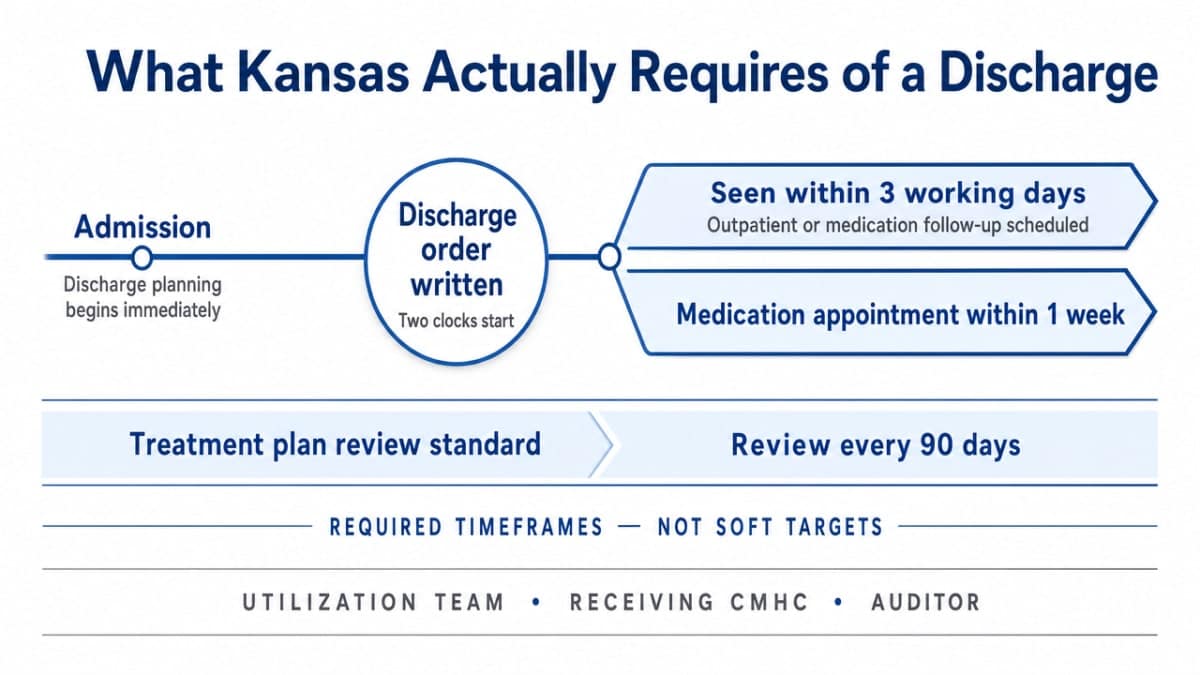
You already know the two clocks that start ticking the minute the discharge order is written. The Kansas Mental Health Screening and Discharge Planning Protocol sets them plainly: outpatient or medication follow-up must be scheduled so the patient is seen within three working days of discharge from a psychiatric hospital, and a medication appointment must land no more than one week after discharge 8. Same document also puts the earliest stake in the ground — discharge planning begins immediately upon admission 8.
Those windows are not soft targets. They are what your utilization team, the receiving CMHC, and any auditor will read back to you if the patient bounces. When a stabilized adult with a treatment-resistant presentation walks out with a card that says “call this number Tuesday,” you are betting the three-day clock against symptom drift, transportation gaps, and medication confusion. Sometimes that bet works. Often it does not.
Who Legally Counts as a Treatment Facility
Before you place a patient anywhere, the statutory definition matters. K.S.A. 59-2946 defines a treatment facility as any mental health center or clinic, psychiatric unit of a medical care facility, state psychiatric hospital, psychologist, physician, or other institution or person authorized or licensed by law to provide inpatient or outpatient treatment to a patient 3. That language is intentionally broad. It does not tie a Kansas patient to a Kansas building.
What it does require is that the receiving entity is licensed to deliver the care you are transferring. For a stabilized adult moving to a residential psychiatric step-down, that means the receiving facility must hold licensure to provide inpatient psychiatric treatment in its own jurisdiction, with clinical staffing that matches the acuity you are handing off. Joint Commission accreditation and state behavioral health licensure in the receiving state satisfy the intent of the Kansas definition when you document the transfer.
The practical takeaway for your chart: name the receiving facility, cite its licensure and accreditation, and note the clinical rationale for the level of care. That is the record that defends the placement if anyone asks later.
The 90-Day Treatment Plan Review Standard
Kansas’ residential behavioral health frame expects treatment planning with reviews and revision at intervals of no more than 90 days, and it requires discharge planning that includes referrals to other treatment providers and supportive services when appropriate 1. Read that carefully. The state assumes the treatment plan is a living document, not a form completed at admission and filed.
For your handoff, that standard tells the receiving facility what the ongoing rhythm has to look like: documented reviews, revisions when the clinical picture shifts, and referrals built into the plan rather than tacked on at the end. When you evaluate a step-down partner, ask how they run their treatment plan review cycle and how referrals back to a Kansas CMHC are written into the plan from week one — not week ten. A partner that cannot describe that cadence in operational terms is not ready for a Kansas handoff.
Why Stabilized Isn’t Ready for CMHC Alone
Stabilized is a hospital word. It means the immediate crisis is contained, the patient is oriented, the medications are on board, and the unit can defend a discharge decision. It does not mean the patient can hold that stability inside their own apartment, with their own transportation problems, and their own history of stopping clozapine when the side effects hit week three.
For treatment-resistant and dual-diagnosis adults, the CMHC-only handoff asks the community system to do something it was not built to do. A CMHC delivers outpatient care — scheduled appointments, medication checks, case management, group work. The Kansas discharge protocol expects that outpatient intake to happen within three working days of hospital discharge 8. Between the hospital door and that appointment sits 72 hours of unstructured time for a patient whose psychiatric ceiling is still fragile and whose substance use pattern has not been touched.
The evidence on this is not soft. Structured discharge planning interventions — individualized plans, scheduled follow-up, active linkage — reduce psychiatric readmissions compared with usual care in psychiatric populations, though the size of the effect depends on which components are actually delivered 5. Read that plainly: a card with a phone number is not a discharge plan. A residential step-down is a discharge plan.
The patients who bounce are the ones you already know by name. Rapid-cycling bipolar with alcohol relapse. Schizophrenia with a clozapine titration that never got monitored. Trauma with opioid use that the CMHC medication clinic is not staffed to co-treat. For those handoffs, a residential step-down partner is not an upgrade. It is the level of care the clinical picture actually requires.
A Working Checklist for Evaluating a Step-Down Partner
Clinical Intensity That Matches the Handoff
Clinical intensity is the first line to draw. If the receiving facility cannot deliver a level of psychiatric supervision that is meaningfully closer to your inpatient unit than to a weekly outpatient appointment, it is not a step-down. It is a soft landing that will fail.
For a stabilized adult with a treatment-resistant or dual-diagnosis picture, that means:
- board-certified psychiatric leadership on site or on call, not a psychiatrist who rounds twice a week.
- Daily clinical contact, not scheduled therapy blocks with unstructured time in between.
- A nursing presence that can catch a decompensation at 2 a.m., not a residential program that pages an off-site provider and hopes.
The right partner reviews the treatment plan far more often than the 90-day floor in the first weeks after a hospital handoff, because the clinical picture is still moving. When you interview a step-down facility, ask directly: who sees the patient each day, at what license level, and how quickly can the psychiatrist adjust the medication plan when something shifts. Vague answers are your answer.
Integrated Dual-Diagnosis Capability
Integrated is the word that carries the weight. A facility that treats psychiatric symptoms in one program and refers substance use out to a partner is not integrated. Neither is a program that runs a substance use track with a consulting psychiatrist tacked on. For the patients you are placing — the trauma with opioid use, the bipolar with alcohol relapse, the schizophrenia with stimulant use — the two pictures are one clinical problem and have to be treated by one team.
What that looks like in practice:
- The same psychiatrist managing the antipsychotic and the addiction medication.
- The same therapist working the trauma and the substance use.
- Group work that assumes co-occurring conditions rather than sorting patients into separate rooms.
- Case formulation that names how the psychiatric and substance use symptoms feed each other, not two parallel treatment plans stapled together.
When you evaluate a partner, ask them to describe a recent case that mirrors yours. Listen for whether the psychiatric and substance use pieces are told as one story or two. If they are two, keep looking.
Advanced Medication Management, Including Clozapine
Advanced medication management is the capability that separates a residential program that accepts psychiatric patients from one that actually treats treatment resistance. The clearest test is clozapine. If a facility cannot run a clozapine protocol — REMS enrollment, ANC monitoring cadence, titration management, side effect response, coordination with the dispensing pharmacy — it cannot hold your treatment-resistant schizophrenia patient at the level of care they need.
The same test applies to lithium in a rapid-cycling bipolar patient who needs level checks and dose adjustments, to long-acting injectables in a patient with adherence history, and to MAT for the opioid or alcohol use disorder sitting underneath the psychiatric picture. Ask what medications the facility manages in-house without outside consultation. Ask how they handle a patient whose clozapine level has to move up while an antidepressant has to come off. The answer tells you whether the psychiatry team is running the case or reacting to it.
Length of Stay Driven by Clinical Need
Length of stay is where a lot of programs quietly fail your patient. If the facility quotes a fixed 30-day or 60-day track before they have met the patient, they are treating the insurance authorization, not the clinical picture. For treatment-resistant and dual-diagnosis presentations, the honest answer is that stabilization on a new medication regimen, trauma work, and a real step-down to community care do not fit a predetermined window.
The partner you want will describe length of stay as a clinical decision reviewed on a defined cadence, with the patient, the family, and the receiving Kansas CMHC in the loop. They will tell you what triggers a step-up, a step-down, or a discharge — and none of those triggers will be a calendar date alone.
Standard CMHC Handoff vs. High-Acuity Residential Step-Down
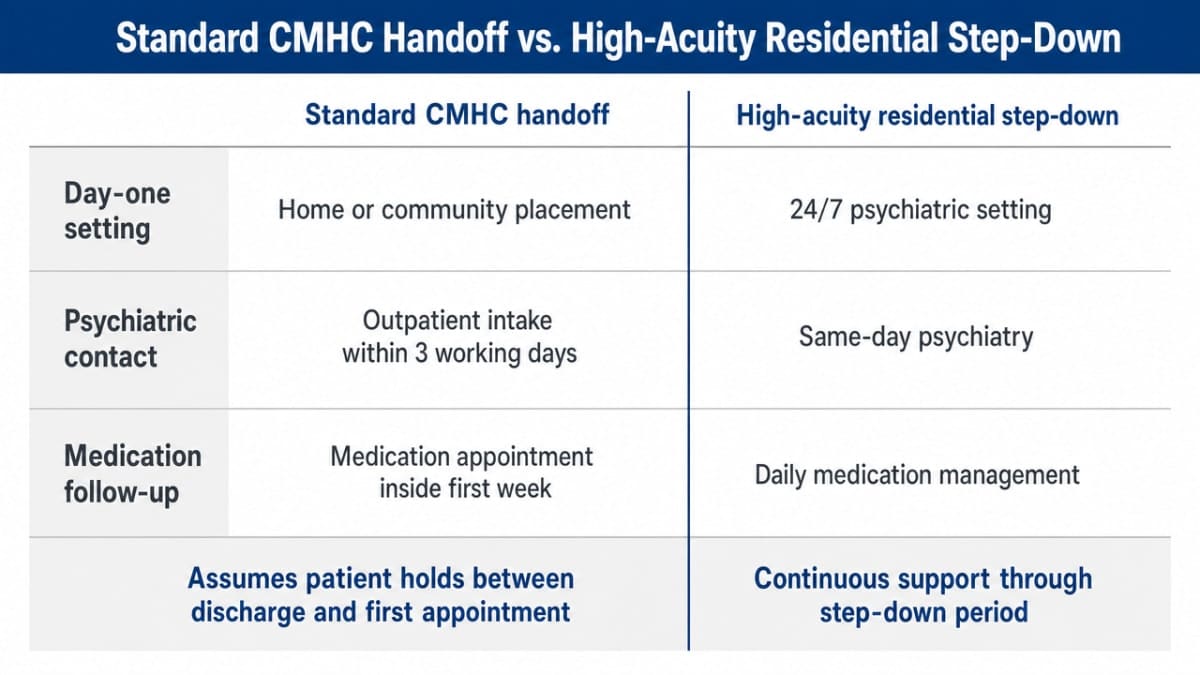
Put the two pathways side by side and the difference stops being abstract. The standard Kansas handoff for a stabilized adult runs hospital discharge to CMHC outpatient intake within three working days, with a medication appointment inside the first week 8. That pathway assumes the patient can hold their own between the discharge door and the first appointment, keep the medication on schedule, and make it to the CMHC on time. For a lot of patients, that is a fair assumption. For your treatment-resistant and dual-diagnosis adults, it is the assumption that broke last time.
| Element | Standard CMHC handoff | High-acuity residential step-down |
|---|---|---|
| Setting on day one | Patient at home or community placement | Patient inside 24/7 psychiatric setting |
| Psychiatric contact | Outpatient intake within 3 working days 8 | Same-day psychiatry, daily clinical contact |
| Medication oversight | Appointment within 1 week 8 | Direct observation, in-house adjustment |
| Dual diagnosis | Coordinated across providers | Integrated within one clinical team |
| Treatment plan reviews | Community provider cadence | Reviews at intervals of not more than 90 days, with referrals built in 1 |
| CMHC re-entry | Same-day linkage | Coordinated warm handoff at discharge |
The high-acuity pathway is the same Kansas discharge standard, honored more tightly. Use this comparison when you brief the payer or defend the placement in team review.
The Out-of-State Placement Question, Answered Directly
When Kansas Capacity Can’t Match the Clinical Picture
You have probably already worked the Kansas phone tree on this patient. State hospital wait, CMHC crisis bed full, no adult PRTF option because the statute puts that level of care under 21 2. That is not a failure of your placement skills. It is a capacity reality baked into how Kansas licenses residential psychiatric care.
For a stabilized adult with treatment-resistant schizophrenia on a clozapine titration, a rapid-cycling bipolar patient with alcohol use disorder, or a trauma-and-opioid presentation the CMHC medication clinic is not staffed to co-treat, the clinical picture asks for a level of care that is not sitting empty inside Kansas. Sending the patient home with a three-working-day appointment 8 is not the same thing as placing them in one. You know the difference. The patient knows the difference.
How ViewPoint Dual Recovery Fits the Kansas Handoff
ViewPoint Dual Recovery is a Joint Commission-accredited psychiatric treatment facility in Prescott, Arizona, built around the presentations Kansas discharge planners have the hardest time placing: treatment-resistant schizophrenia, rapid-cycling bipolar, and co-occurring mental health and substance use disorders. The clinical model is what a strong step-down partner is supposed to look like on paper — board-certified psychiatric leadership, integrated dual-diagnosis treatment inside one clinical team, advanced medication management including clozapine protocols, and treatment duration set by clinical need rather than a preset authorization window.
What matters for your handoff is how those pieces line up with Kansas expectations. The state’s residential behavioral health frame requires treatment planning with reviews at intervals of not more than 90 days and discharge planning with referrals to community providers and supportive services 1. ViewPoint’s team runs treatment plan reviews on a tighter cadence in the first weeks after a hospital handoff, because the medication picture is still moving and the plan needs to reflect what is actually happening.
The out-of-state distance does add coordination steps. A good partner absorbs that work for you. The next section walks through exactly how the admissions handoff runs from the first call at your Kansas discharge desk to the coordinated warm handoff back to the receiving CMHC.
How the Admissions Handoff Actually Runs
The First Call and What Moves in the First Hour
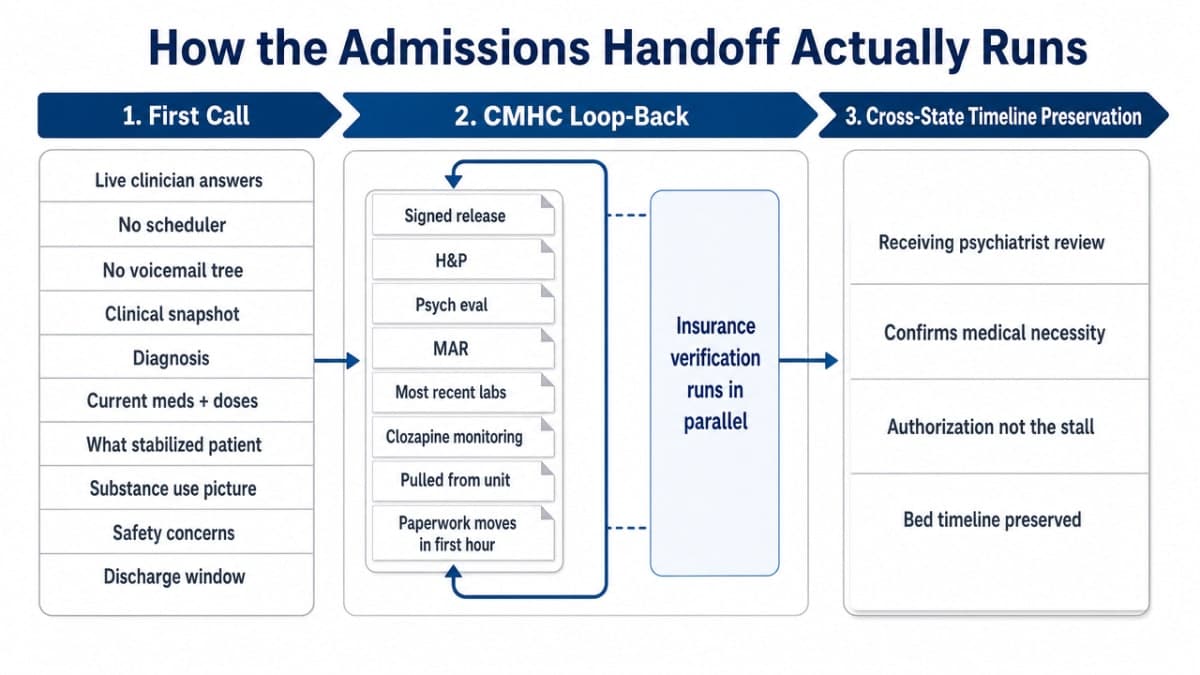
You place one call. A live clinician picks up — not a scheduler, not a voicemail tree. That is the baseline for a step-down partner that is serious about hospital handoffs. In that first conversation, you give the clinical snapshot: diagnosis, current medications with doses, what stabilized the patient, substance use picture, safety concerns, and the discharge window you are working against.
Inside the first hour, the paperwork moves:
- A signed release lets the receiving facility pull the H&P, psychiatric evaluation, medication administration record, most recent labs, and any clozapine monitoring data straight from your unit.
- Insurance verification runs in parallel so authorization is not the thing that stalls admission.
- The receiving psychiatrist reviews the clinical package and confirms medical necessity for the level of care being transferred 3.
You leave that first call with a named clinical contact, an admission decision timeline, and the documents in motion. That is what a Kansas discharge desk needs to keep the plan defensible.
Preserving the CMHC Loop-Back From Arizona
The handoff you are protecting is not just the outbound one. It is the return trip to the Kansas CMHC that will hold this patient after residential care. That loop-back has to be written into the treatment plan on admission, not scoped out at discharge.
Kansas’ residential behavioral health frame requires discharge planning that includes referrals to other treatment providers and supportive services when appropriate, with treatment plan reviews at intervals of no more than 90 days 1. For an out-of-state placement, that means the receiving facility names the specific Kansas CMHC on the admission plan, contacts them within the first week, and shares the treatment plan and medication changes as they happen — not in a discharge summary that lands after the patient is already home.
Ask the receiving facility who owns the CMHC relationship on their side. There should be a named case manager whose job includes calling your Kansas CMHC contact, sharing chart updates on a defined schedule, and coordinating the warm handoff meeting before discharge. When you brief the family, that continuity is what makes the placement feel like part of one plan rather than a detour.
Handling the 3-Working-Day Appointment Expectation Across State Lines
The three-working-day outpatient follow-up and the one-week medication appointment 8 do not go away because the patient crossed a state line. They get honored differently.
Inside a residential step-down, the patient sees psychiatry on admission day and takes medications under direct observation from the first dose. The three-working-day window is not a scheduled outpatient appointment — it is continuous clinical contact that started before day one closed. When you document the transfer, name it that way: the Kansas protocol timeline is met and exceeded by the level of care.
The three-working-day expectation returns when the patient discharges from residential care back to Kansas. That is when the receiving CMHC appointment has to be scheduled before the patient leaves Arizona, medication scripts have to be active, and the warm handoff call has to happen with your CMHC contact on the line. A step-down partner built for Kansas handoffs owns that scheduling. You should not be booking that appointment from your desk two months after the placement.
Connect Your Patient to Seamless Step-Down Care
Get rapid feedback on clinical fit for advanced inpatient-to-step-down transitions.
Frequently Asked Questions
Can a Kansas patient legally be placed at an out-of-state psychiatric step-down facility?
Yes. K.S.A. 59-2946 defines a treatment facility broadly, including any institution or person authorized or licensed by law to provide inpatient or outpatient treatment, without tying that definition to Kansas borders 3. Document the receiving facility’s licensure and accreditation in your chart, name the clinical rationale for the level of care, and the placement holds up in team review.
How do we meet the 3-working-day outpatient follow-up expectation when the patient is placed in Arizona?
The three-working-day outpatient window and one-week medication appointment 8 are absorbed by the residential setting. Your patient sees psychiatry on admission day and takes medications under direct observation, which exceeds what an outpatient appointment would deliver. Document the transfer as continuous clinical contact starting day one. The three-day clock returns when the patient discharges back to their Kansas CMHC.
Why not just discharge a stabilized adult to their local CMHC?
For most stabilized adults, the CMHC pathway works. For treatment-resistant and dual-diagnosis presentations, it asks the community system to hold a clinical picture it was not built to hold in 72 unstructured hours. Structured discharge planning interventions reduce psychiatric readmissions compared with usual care 5. A residential step-down is that structured intervention when the acuity requires it.
What clinical capabilities should we require from any psychiatric step-down partner?
Require board-certified psychiatric leadership, integrated dual-diagnosis treatment inside one clinical team, advanced medication management including clozapine protocols, and treatment duration set by clinical need rather than authorization windows. Also require documented treatment plan reviews at intervals of no more than 90 days and referrals to community providers written into the plan from week one 1. Vague answers on any of these are your answer.
Why is adult residential psychiatric step-down capacity so limited in Kansas?
Kansas defines a psychiatric residential treatment facility as a non-hospital facility providing intensive inpatient services for individuals under the age of 21 2. That statutory age ceiling, reinforced by KDADS’ PRTF service standards 6, means the licensed PRTF level of care does not exist for adults in Kansas. The result is a two-tier adult system — inpatient units and community outpatient — with a thin middle layer.
How is the CMHC handoff preserved when a Kansas patient completes step-down care out of state?
The receiving facility names the specific Kansas CMHC on the admission treatment plan, contacts them within the first week, and shares plan updates on a defined schedule rather than waiting for the discharge summary 1. Before the patient leaves Arizona, the CMHC intake appointment is scheduled, scripts are active, and a warm handoff call happens with your CMHC contact on the line.
References
- Kansas Summary — State Residential Treatment for Behavioral Health Conditions. https://aspe.hhs.gov/sites/default/files/2021-08/StateBHCond-Kansas.pdf
- 2026 Kansas Statutes — 39-20-2 (Psychiatric Residential Treatment Facility Definition). https://www.kslegislature.gov/b2025_26/laws/039_000_0000_chapter/039_020_0000_article/039_020_0002_section/039_020_0002_k
- 59-2946 — Definitions for Mental Health Treatment Facilities and Patients. https://ksrevisor.gov/statutes/chapters/ch59/059_029_0046.html
- Session of 2022 — Senate Bill 500 (Psychiatric Residential Treatment Facility Program). https://www.kslegislature.gov/li_2022/b2021_22/measures/documents/sb500_00_0000.pdf
- The Effects of Discharge Planning on Readmission Rates in Psychiatric Populations. https://www.ncbi.nlm.nih.gov/pmc/articles/PMC5314893/
- Psychiatric Residential Treatment Facilities. https://www.kdads.ks.gov/services-programs/behavioral-health/psychiatric-residential-treatment-facilities
- PRTF Service Standards. https://tthree.wichita.edu/trainingrepository/Document/PRTFServiceStandardsFINAL032207.pdf
- Mental Health Screening and Discharge Planning Protocol. https://tthree.wichita.edu/trainingrepository/Document/Mental_Health_Screeners_Handbook_with_Discharge_Planning_Protocol.pdf
- Kan. Admin. Regs. § 26-39-102 – Admission, transfer, and discharge (adult care homes). https://www.law.cornell.edu/regulations/kansas/K-A-R-26-39-102
- Mental Health Intervention Team Grant – Kansas State Legislature Testimony (includes K.A.R. 26-39-102 context). https://www.kslegislature.gov/li/b2025_26/committees/ctte_jt_robert_g_bob_bethell_joint_committee_1/documents/testimony/20260123_11.pdf