Key Takeaways
- Midwest states have lost a large share of staffed long-term psychiatric beds, leaving treatment-resistant patients cycling through short admissions that end before real stabilization can happen 8.
- Treatment resistance affects roughly one in four people with schizophrenia and requires sustained clozapine trials and psychosocial work that brief inpatient units cannot finish 11.
- Integrated dual diagnosis care, delivered by one cross-trained team treating both conditions concurrently, outperforms fragmented handoffs between separate mental health and substance use programs 4, 5.
- Traveling out of state can be a sound clinical match when local capacity is thin, but families should verify team structure, length-of-stay criteria, and Midwest discharge coordination before committing.
When the local system keeps discharging your person too soon
You already know the pattern. A crisis. A 72-hour hold. A quick medication adjustment. A discharge summary that says “stable” when you can see, standing right there in the parking lot, that stable is not the word for what is in front of you. Two weeks later, maybe a month, you are back in the same emergency department, waiting on the same plastic chair, hoping a different clinician will say something different.
If you are reading this from Missouri, Kansas, Iowa, Nebraska, or Illinois, you are not imagining the ceiling on what your local system can offer. Missouri has seen a sharp reduction in long-term state psychiatric beds, and the peer-reviewed record openly describes the difficulty of placing patients who need a higher level of care 8. That is not a failure of the nurses who kept your person safe last week. It is the shape of the system they work inside.
You are the person who has read the discharge paperwork, refilled the clozapine, driven back to the ER at 2 a.m., and asked, quietly, whether there is somewhere that actually treats what your person has. There is a real answer to that question. It starts with naming what is missing, why short stays keep ending too soon, and what a program built for treatment-resistant illness actually looks like when you find one.
What’s actually missing in Missouri and next door
Missouri’s long-term bed loss, in plain numbers
Here is the number that explains a lot of what you have been living through. Between 1990 and 2008, Missouri lost close to 40% of its staffed psychiatric beds, and the peer-reviewed record specifically describes ongoing difficulty finding long-term care for patients who need a higher level of care 8. That is not a talking point. That is the shape of the system your local hospital operates inside.
When you hear a discharge planner say there is nowhere to send your person for a longer stay, they usually mean it literally. The beds that used to hold someone for months while a real medication trial finished, while a psychosocial plan actually took root, while family visits rebuilt some trust — many of those beds are gone. What replaced them, on paper, was community care. What replaced them, in practice, for someone with treatment-resistant illness, is often another short admission and another discharge.
You are not misreading the situation. When your person cycles through three admissions in six months, or gets stabilized enough to leave and destabilized enough to come back within weeks, the pattern is not a personal failure. It is what happens when the tier of care built for their level of acuity has been thinned out over a generation. Naming that changes how you talk to the next provider, and it changes what you ask for.
Kansas as a mirror: beds on paper vs. beds staffed
Cross the state line and the story rhymes. In testimony to the Kansas House Health and Human Services Committee, experts documented that adult state mental health hospital beds fell from 256 in December 2018 to 188 in recent years — and, importantly, that a significant number of beds are currently out of service because of staffing shortages 3. Read that twice. It is not only that there are fewer beds on the roster. It is that some of the beds still on the roster are not actually available to admit anyone tonight.
That gap between beds-on-paper and beds-staffed is why the referral you get from a Kansas City hospital, or a Wichita ER, can look so strange. On the surface, a bed “exists” at a state facility. In practice, it might be closed because there are not enough nurses or psychiatric technicians to open it safely. The Kansas testimony ties this directly to long wait times for competency evaluation and restoration, which then backs up into local jails and community hospitals 3.
If you have been told your person is on a waiting list without any real estimate of when a bed will open, this is often what is happening behind the scenes. The list is not moving because the workforce that would run those beds does not exist yet. Knowing that lets you ask a sharper question: not “is there a bed,” but “is there a staffed bed, and when.”
Forensic saturation and the jail waiting room
The Missouri Department of Mental Health is candid, in its own FY 2026 program book, about what is squeezing the state hospitals: a steadily increasing number of individuals referred by the criminal courts, hospitals operating at capacity relative to the available workforce, and people waiting in jails for long periods before admission 2. DMH goes further and describes reconceptualizing developmental disability campuses to help fill capacity gaps in the state psychiatric hospital system 2. When a state agency is repurposing DD infrastructure to prop up psychiatric capacity, that is an admission the tier you are looking for is thin.
What this means for your person is concrete. If they are civilly ill — no charges, no forensic status — they are competing for admission with a pipeline of court-ordered patients who legally must be admitted for competency restoration. The civilly ill patient, the one you brought in voluntarily, often loses that competition quietly. They get sent home earlier. They wait longer for a step-up bed.
You did not imagine the sense that the system was full of people the courts sent in. It is. That is not a reason to give up on your local hospital. It is a reason to stop expecting the state facility to be the long-stay option it once was.
Why this isn’t a Missouri-only story
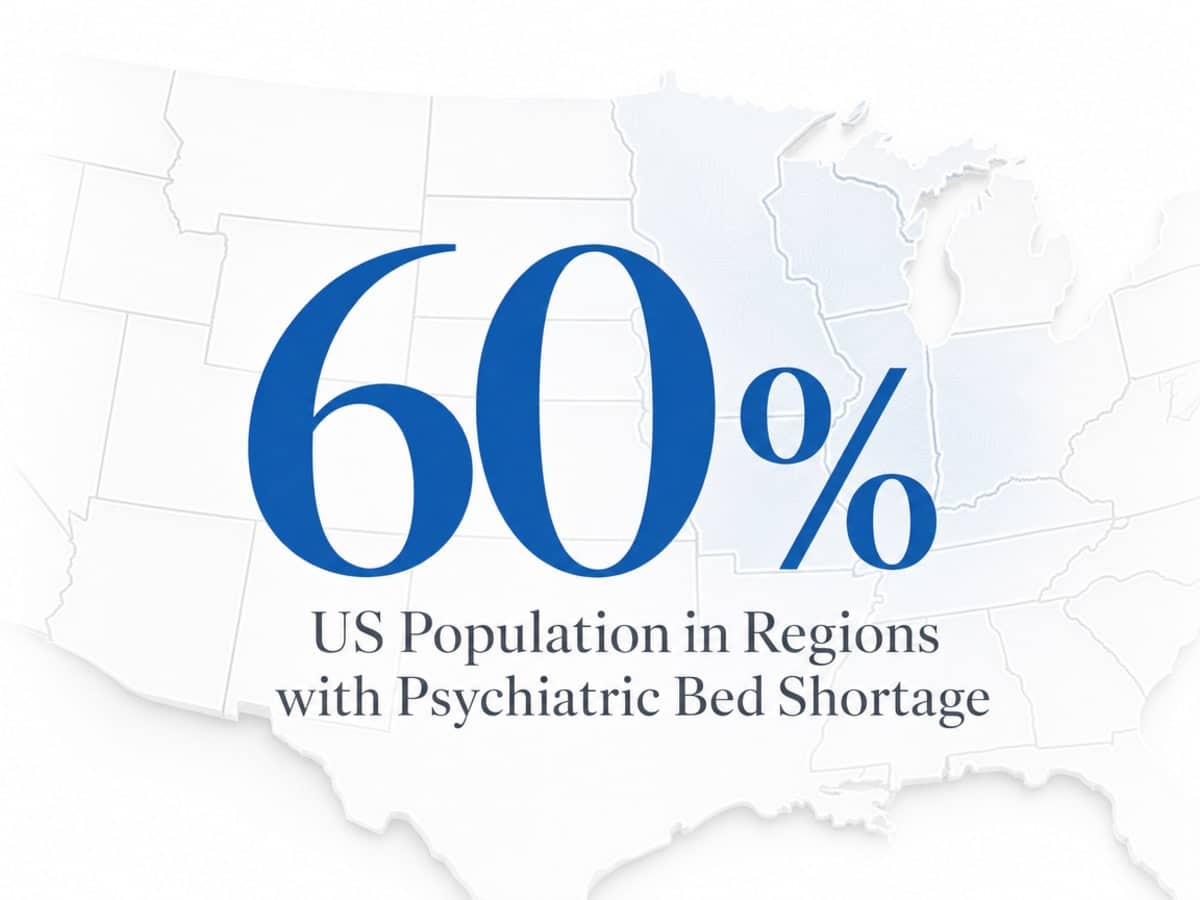
Zoom out once, and then we will not need to again. A 2025 study of regional psychiatric bed capacity found that more than 60% of the US population consistently lives in a region with an inpatient psychiatric bed shortage, with the Midwest showing persistent shortages across many counties 1. A separate systematic review links insufficient inpatient capacity to exactly what you have been seeing on the ground: more emergency department boarding and more incarceration of people with mental illness when adequate community and inpatient alternatives are missing 9.
Say that out loud to yourself. Your family is not uniquely unlucky. You landed in a region and a moment where the specific tier of care your person needs is the thinnest. That reframing matters because it moves the next conversation from “why can’t we fix this locally” to “where does the care actually exist, and how do we get there.”
Why treatment-resistant cases fall through standard care
Treatment resistance is common, and it needs a different tier
You have probably been told, at some point, that your person is “complicated.” What that word usually means, when a hospitalist says it, is that the standard playbook did not work. Two antipsychotics. Maybe a mood stabilizer. Maybe an SSRI on top. Then a discharge, and the same symptoms three weeks later.
Here is what is worth knowing: about 20 to 30% of people with schizophrenia meet criteria for treatment resistance and need more intensive, specialized management, including clozapine and sustained psychosocial care 11. That is not a rare edge case. That is roughly one in four. And clozapine, the medication most likely to help, requires ongoing monitoring, dose titration, and side-effect management that a five-day unit is not built to deliver well.
When your person has been through three or four medication trials without lasting response, you are not looking at a motivation problem or a compliance problem. You are looking at a clinical category that has its own research literature and its own care requirements. Short inpatient stays can start a clozapine trial. They rarely have time to finish one, watch it stabilize, and layer in the psychosocial work that makes the medication actually hold.
Fragmented SUD and mental health systems fail dual diagnosis
If your person also uses substances, you have almost certainly run into the wall. The mental health unit says the substance use has to be treated first. The rehab program says the psychiatric symptoms are outside their scope. You end up shuttling between two systems that were built separately and are still, in most communities, funded and staffed separately.
Clinical reviewers have been direct about what that does. Nonintegrated care is associated with poorer outcomes for people with co-occurring disorders, and the field has moved toward integrated treatment precisely because sequential or parallel handoffs keep failing complex patients 10. SAMHSA goes further and names integrated care as the preferred model and a best practice for individuals with co-occurring disorders, with concurrent treatment of both conditions by a cross-trained team 5.
Access makes the fragmentation worse. A review of treatment barriers for people with co-occurring disorders found that those without Medicaid access services at much lower rates than those with coverage, and that rural and geographic disparities compound the problem 6. In much of the Midwest, that is not a footnote. It is the daily reality of trying to find one program that will actually hold both diagnoses at once.
What integrated, long-stay care actually includes
When a program tells you it is “integrated” or “dual diagnosis,” you have earned the right to ask what that means structurally. The SAMHSA evidence review found that integrated dual diagnosis programs outperform nonintegrated ones across substance use, psychiatric symptoms, hospitalization, and quality of life — but the programs studied share specific features, not a marketing label 4.
The IDDT toolkit spells out what a real integrated program looks like: one clinical team, cross-trained in both mental health and substance use, treating both conditions concurrently in the same setting, with multiple formats — individual, group, family, and peer work — layered over time 7. Not two teams that occasionally consult. Not a mental health track that refers out for substance use. One team, one plan, one record.
Long stay matters because these interventions need time. A clozapine trial has to reach a therapeutic dose and then hold there. Trauma work cannot begin until psychosis is quieter. Family sessions have to happen more than twice. When you evaluate a program, ask how the psychiatrist and the therapist coordinate, whether length of stay is driven by clinical response or by an insurance clock, and how they handle a patient whose substance use flares mid-admission. The answers will tell you more than any brochure.
Sorting three things that get confused: crisis, rehab, and long-stay integrated care
When you tell relatives you are looking at a specialized program, you will hear three responses that mean three very different things. “He just went to rehab.” “She was in the crisis unit last month.” “They kept him inpatient for a week.” Each of those is a real level of care. None of them is what a treatment-resistant, dual diagnosis patient usually needs next.
Crisis stabilization is measured in hours to a few days. Its job is to keep someone alive and get them past the acute danger. It is not designed to finish a clozapine titration or run a trauma protocol. Thirty-day rehab is built around a substance use timeline and often screens out patients with active psychosis or unstable psychiatric medication regimens — which is exactly the person you are trying to place. Standard inpatient psychiatric admissions in general hospitals run days, sometimes a week or two, and end when the patient is no longer an imminent danger, not when they are well.
Long-stay integrated care is a different animal. One clinical team, cross-trained in mental health and substance use, treating both concurrently, with length of stay driven by clinical response rather than a fixed program length 5, 7. It is the tier that lets a medication trial actually finish, that lets psychosocial work take hold, and that keeps substance use in the room instead of exiled to a separate program down the road 4. If you have been pushed between the first three levels for a year, it is not because you did the wrong thing. It is because the fourth level is the one your person needed, and it is the hardest one to find.
Traveling for care as a clinical decision, not a last resort
Reframing out-of-state care for your family and your clinicians
Somewhere along the way, traveling for psychiatric care got labeled as giving up on the local system, or as something only wealthy families do. Neither is accurate. When the tier of care your person needs is not present in your region, going where it does exist is a clinical decision, not a last resort.
You are not the first person in your family to have this conversation, and you will not be the only one who has to explain it. The short version, when your sister or your mother-in-law asks why you would send him so far, is this: the specific level of care he needs — long-stay, high-acuity, integrated psychiatric and dual diagnosis treatment on one team — is thin across the Midwest, and a systematic review has linked that kind of shortage to more ER boarding and more incarceration, not better community outcomes 9. You are not chasing a nicer building. You are chasing the level of care that finishes what a five-day admission cannot.
Tell your referring clinician the same thing, in the same words. Most will recognize the gap immediately. Some will help with records and warm handoffs once they hear it framed as a match to acuity rather than a rejection of their work.
What traveling for care actually involves
Here is what to ask about, without invented numbers attached.
- Length of stay: is it set by clinical response, or by an insurance clock?
- Insurance verification: what does the program do in-house before admission, and what will you be asked to sign?
- Transportation: who arranges the flight or the drive, and who is with your person on the way?
- Family involvement: how often are family sessions scheduled, and are they by phone, video, or in person?
- Discharge planning: which Midwest providers, prescribers, and outpatient teams will the program coordinate with before your person comes home?
These are not luxury questions. They are the operational spine of whether a program can actually receive your person and hand them back to a local team that can hold the gains. SAMHSA’s integrated-care guidance treats family and multi-format involvement as core practice principles, not add-ons 5. A program that cannot answer these questions clearly is telling you something. A program that can is telling you something too.
How to evaluate a high-acuity program on clinical structure, not marketing
By the time you are reading brochures, you have earned a shorter list of questions. Skip the photography and the campus map. Ask about structure.
Start with the team. Is there one clinical team, cross-trained in both mental health and substance use, treating both concurrently — or a mental health track that hands substance use off down the hall? SAMHSA names the concurrent, cross-trained model as a best practice for co-occurring disorders, not a nice extra 5. If a program cannot describe how its psychiatrist and its addiction clinician sit in the same treatment plan, that answer is your answer.
Ask how length of stay gets decided. Clinical response, or an insurance clock? A real high-acuity program should be able to explain, in specifics, how it handles a clozapine trial that needs more weeks, or a trauma protocol that cannot start until psychosis quiets. The IDDT toolkit describes integrated programs as layered work across individual, group, family, and peer formats — that takes time to deliver, not days 7.
Is ViewPoint an honest fit for your person?
Not every family who reads this far should book a call. Here is a candid way to think about it.
ViewPoint is likely worth a conversation if your person:
- has cycled through multiple short admissions without lasting response,
- carries a treatment-resistant diagnosis (schizophrenia, rapid-cycling bipolar, severe depression),
- has co-occurring substance use that local programs keep punting to a separate track, or
- needs a real clozapine trial that a five-day unit cannot finish.
The facility is a Joint Commission-accredited, Arizona ADHS-licensed, LegitScript-certified psychiatric center in Prescott built for exactly the tier of care that SAMHSA describes as the preferred model for co-occurring disorders — one cross-trained team, both conditions treated concurrently, length of stay driven by clinical response rather than a fixed clock 5, 7.
It is probably not the right call if your person is in acute crisis needing same-day stabilization, if they are court-committed and forensic status ties them to a state facility, or if a local program is currently doing the work and holding.
What ViewPoint invites, honestly, is a phone conversation where you describe what has already been tried and ask whether the clinical team believes they can offer something different. If the answer is no, they should tell you. If the answer is yes, you will have the specifics — team structure, medication approach, family cadence, discharge coordination with your Midwest prescriber — to decide with your eyes open. Asking the question is already a step.
See If Advanced Dual Diagnosis Care Fits
Get expert feedback on complex psychiatric treatment options for your family’s unique Midwest care needs.
Frequently Asked Questions
Why do short inpatient stays in Missouri keep ending before my family member is stable?
Missouri lost close to 40% of its staffed psychiatric beds between 1990 and 2008, and long-term placement for higher-acuity patients has been documented as difficult ever since 8. Short units are built to end acute danger, not to finish a medication trial or hold someone through psychosocial work. When your person is discharged “stable,” that usually means safe to leave — not well.
How is long-stay integrated psychiatric care different from a 30-day rehab or a crisis stabilization unit?
Crisis units run hours to a few days and focus on immediate safety. Thirty-day rehab is built around a substance use timeline and often screens out active psychosis. Long-stay integrated care uses one cross-trained team treating mental health and substance use concurrently, with length of stay driven by clinical response — the model SAMHSA names as the preferred approach for co-occurring disorders 5, 7.
Is it reasonable to travel out of state for psychiatric and dual diagnosis care?
Yes, when the tier of care your person needs is not staffed near you. A systematic review has linked insufficient inpatient capacity to more emergency department boarding and more incarceration of people with mental illness, not better community outcomes 9. Traveling to reach a program that actually matches your person’s acuity is a clinical decision, not a last resort or a luxury.
What should I ask a high-acuity program to tell if it’s clinically real or just marketing?
Ask whether one cross-trained team treats mental health and substance use concurrently, or whether they hand off between tracks 5. Ask if length of stay is set by clinical response or an insurance clock. Ask how they finish a clozapine trial, handle mid-admission destabilization, run family sessions, and coordinate discharge with your Midwest prescriber. Concrete answers, not warm language, tell you the structure is real 7.
My relative has treatment-resistant schizophrenia and a substance use disorder. Can one program actually handle both?
Yes, and it should. Roughly 20 to 30% of people with schizophrenia meet criteria for treatment resistance and need sustained specialty management, often including clozapine 11. SAMHSA’s evidence review found integrated dual diagnosis programs outperform nonintegrated ones across substance use, psychiatric symptoms, and hospitalization 4. A real program treats both diagnoses on the same team, in the same plan, at the same time.
How do I know if ViewPoint is an honest fit for our situation?
ViewPoint is likely worth a call if your person has cycled through short admissions without lasting response, carries a treatment-resistant diagnosis, or has co-occurring substance use that keeps getting punted to a separate track 5. It is not the right call for same-day crisis stabilization or forensic commitments tied to a state facility. Ask for specifics on team structure, length of stay, and discharge coordination.
References
- Regional changes in inpatient psychiatric bed capacity and association with population mental health outcomes in the United States. https://pmc.ncbi.nlm.nih.gov/articles/PMC12610395/
- FY 2026 Department of Mental Health Programs Book (Missouri Office of Administration). https://oa.mo.gov/sites/default/files/FY2026_Department_of_Mental_Health_Programs_Book.pdf
- Testimony to Kansas House Health and Human Services Committee on State Mental Health Hospital Beds. https://www.kslegislature.gov/li/b2025_26/committees/ctte_h_hhs_1/documents/testimony/20250217_02.pdf
- Integrated Treatment for Co-Occurring Disorders: The Evidence. https://library.samhsa.gov/sites/default/files/ebp-kit-the-evidence-10242019.pdf
- Substance Use Disorder Treatment for People with Co-Occurring Disorders. https://library.samhsa.gov/sites/default/files/pep20-06-04-006.pdf
- Treatment Access Barriers and Disparities Among Individuals with Co-Occurring Mental Health and Substance Use Disorders. https://pmc.ncbi.nlm.nih.gov/articles/PMC4695242/
- Integrated Treatment for Co-Occurring Disorders Evidence-Based Practices (EBP KIT). https://library.samhsa.gov/product/integrated-treatment-co-occurring-disorders-evidence-based-practices-ebp-kit/sma08-4366
- Mental Health Access to Care in Missouri. https://pmc.ncbi.nlm.nih.gov/articles/PMC6179595/
- Inpatient psychiatric bed capacity and mental health system reform: a systematic review. https://pubmed.ncbi.nlm.nih.gov/29346056/
- Co-occurring mental illness and substance use disorders: a review of issues and clinical approaches. https://www.ncbi.nlm.nih.gov/pmc/articles/PMC7122474/
- Treatment-resistant schizophrenia: definition, epidemiology and management. https://www.ncbi.nlm.nih.gov/pmc/articles/PMC8530316/