

Key Takeaways
- Schizophrenia care after years of hospitalizations is a decades-long maintenance system, not a repeating crisis loop, and the treatment plan should match that horizon rather than the next authorization window.
- Medication is the spine of care but was never meant to stand alone; cognitive remediation, family psychoeducation, social skills training, and supported employment are evidence-based standards that lower relapse 6.
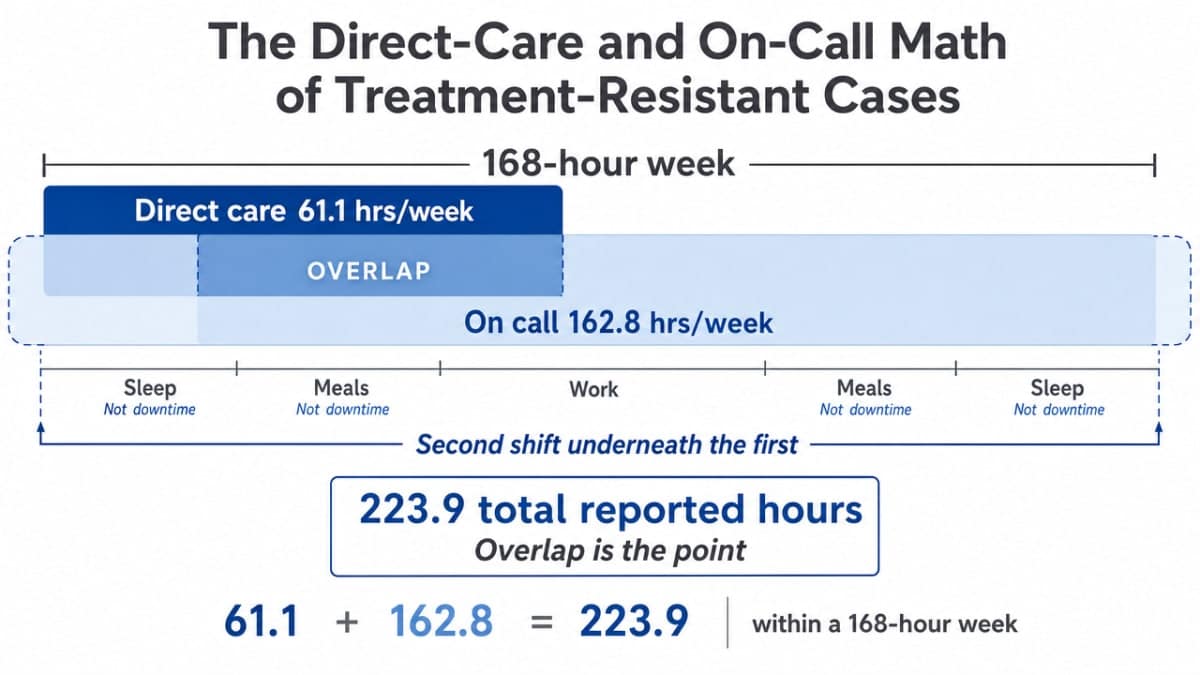
- Caregivers of treatment-resistant cases average 61.1 hours of direct care and 162.8 hours on call weekly, with 76% reporting stress — naming this load is the baseline for any real plan 9.
- Succession planning matters: move what lives in your head into written care summaries, legal instruments like special needs trusts, and treatment-team relationships that outlast you, before you need them to.
The Shift From Crisis Response to a Decades-Long Care System
You already know what schizophrenia is. You have probably known for years. What you may still be searching for is a way to think about the next twenty or thirty years that does not reduce your life to waiting for the next 3 a.m. phone call.
Most content written for you treats each hospitalization as the story. Admission, medication change, discharge summary, home. Then the loop restarts. If your adult child has been diagnosed for a decade, you know the loop is not the story. The loop is the weather. The story is the care system you have been quietly building around your son or daughter, mostly by yourself, for years.
Clinical guidelines have caught up with what you already live. The American Psychiatric Association frames schizophrenia care around long-term maintenance, recovery orientation, and coordinated psychosocial support rather than episodic stabilization 1. Long-term considerations in the literature now include relapse prevention, medication adherence over years, return to work or school, and, plainly stated, “support from and for relatives” 7. That last phrase is not a footnote. It is you.
This guide is written for the horizon you are actually on. It covers what maintenance care looks like across phases, the caregiving load nobody has ever quantified for you, the relapse-prevention posture that replaces emergency-response mode, and the question you may not have said out loud yet: what happens to your child when you cannot be the safety net anymore. It also explains why a longer residential model exists for cases that short stays keep failing to hold, and how to think about that decision when the loop stops being sustainable.
What Long-Term Management Actually Looks Like After the Diagnosis Is Old News
The Four Phases You Are Actually Moving Through
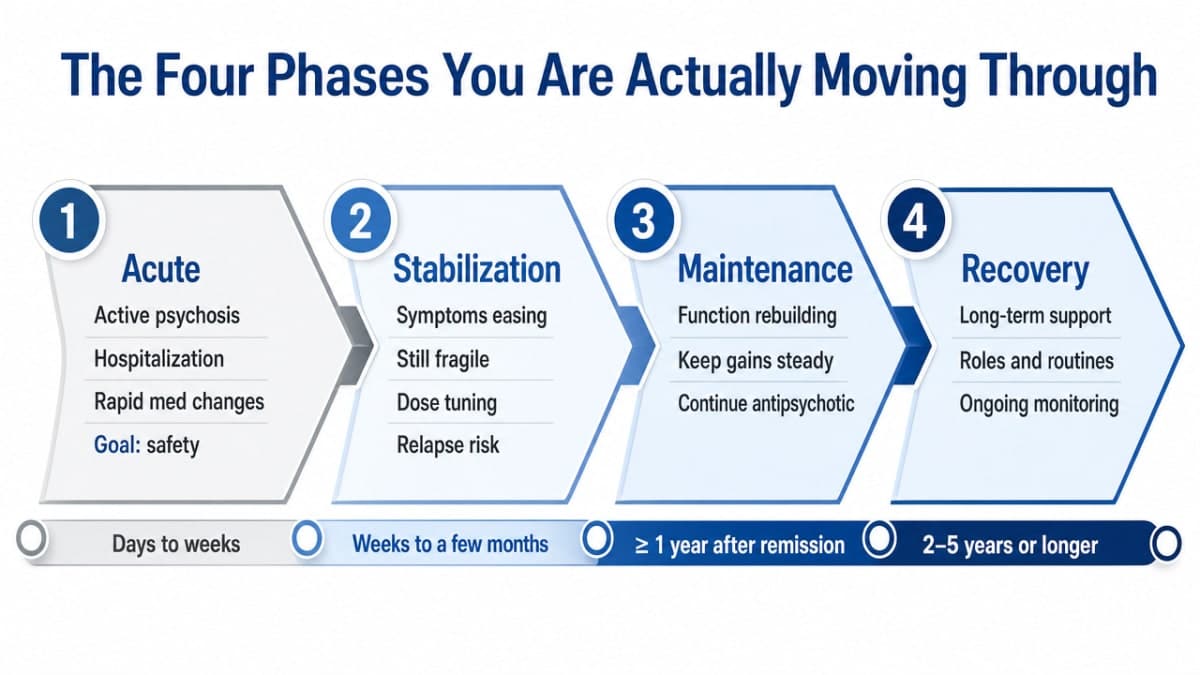
You have probably noticed that clinicians talk about your adult child’s care in a language you were never formally taught. Acute. Stabilization. Maintenance. Recovery. These are not just clinical labels. They are phases of an arc, and knowing which one you are in changes what you should expect from a given month, a given medication trial, and a given conversation with the treatment team.
- The acute phase
- The one you know best. Active psychosis, hospitalization, medication changes made quickly. Success at this stage is narrow: symptoms come down enough that your son or daughter is safe. That is it. If a program tells you they have “fixed” anything in this window, they have redefined the word.
- The stabilization phase
- Follows, usually running weeks to a few months. Symptoms are easing but fragile. Medication doses are being tuned. This is where most short residential stays end and most relapse risk begins, because the underlying work of the next phase has not yet started.
- The maintenance phase
- Where the long horizon actually lives. Indian Psychiatric Society guidelines are unusually direct about the timelines: at least 1 to 2 years of maintenance antipsychotic treatment after a first episode, 5 years or longer after multiple episodes, and lifelong medication for certain high-risk patients 2. If your adult child has cycled through hospitalizations for years, you are looking at the 5-plus band or the lifelong one, and the treatment plan should be built around that reality, not around the next 30-day authorization.
- The recovery-oriented phase
- Not a graduation from maintenance. It runs alongside it. The American Psychiatric Association frames this as care “aimed at developing self-management skills and enhancing person-oriented recovery” — work, relationships, cognition, identity 1. It is the phase where your child gets to be a person again, not a diagnosis being managed.
Locating your family on this arc is the first act of long-horizon planning.
Why Medication Alone Was Never the Plan
If you have ever left a discharge appointment holding a prescription bottle and a follow-up card, wondering where the rest of the plan is, your instinct was right. There is supposed to be more.
The 2024 evidence review on schizophrenia-spectrum disorders is blunt about this: cognitive remediation, metacognitive training, social skills training, psychoeducation, family interventions, CBT, physical exercise, and supported employment “can be fully considered as evidence-based treatments” that change functioning and lower relapse 6. That is not a menu of extras. That is the standard of care sitting next to the pill bottle. When it is missing, the pill is carrying weight it was never designed to carry alone.
Recent guideline synthesis puts the same point in operational language. Begin psychosocial interventions early. Integrate family and community support. Monitor progress on functioning and quality of life, not just symptom scores 3. If your adult child’s care has been a decade of medication adjustments with almost no structured skill-building, cognitive work, or family sessions, that is a gap in the plan, not a personal failure of anyone in your household.
You have probably seen the effect of the gap in real time. Medication holds symptoms down, but your son or daughter still cannot hold a job, still cannot sustain a friendship, still cannot manage the small executive tasks of an adult day. That is the shape of a treatment plan that stopped at pharmacology. The psychosocial layer is what turns symptom control into something your child can actually live inside of.
The Caregiving Load You Are Carrying, Named in Hours
The Direct-Care and On-Call Math of Treatment-Resistant Cases
You have probably never sat down and added up the hours. There has not been time. But somebody finally did the math, and the result is a permission slip for what you already feel.
A quantitative survey of caregivers of people with treatment-resistant schizophrenia found that they spend an average of 61.1 hours per week providing direct care and another 162.8 hours per week on call 9. Add those together and you get 223.9 hours of a 168-hour week, which is mathematically impossible and clinically exact. The overlap is the point. Being on call while you sleep, while you eat, while you try to hold down your own work — that is not downtime. That is a second shift running underneath the first one.
Direct care is the part you can name. Driving to the pharmacy. Sitting through the psychiatrist appointment. Cooking a meal your son or daughter will actually eat. Managing the pill organizer. Filing the ROI so the hospital will talk to you. On-call time is harder to see, because it looks like ordinary life. You are answering a text at 11 p.m. You are listening for the front door. You are checking whether the car is still in the driveway. You are not resting, even when nothing has happened yet.
This is what caregiver burden actually looks like at ground level, and it is why the scoping review on caregiver strain lists duration of care and illness severity among the strongest predictors of long-term burden 13. Years of this math do not leave you the same person. Naming the hours is the first step to protecting whatever hours you have left.
The Emotional Cost of Repeated Medication Failures
Hours are one measure. What those hours do to you is another.
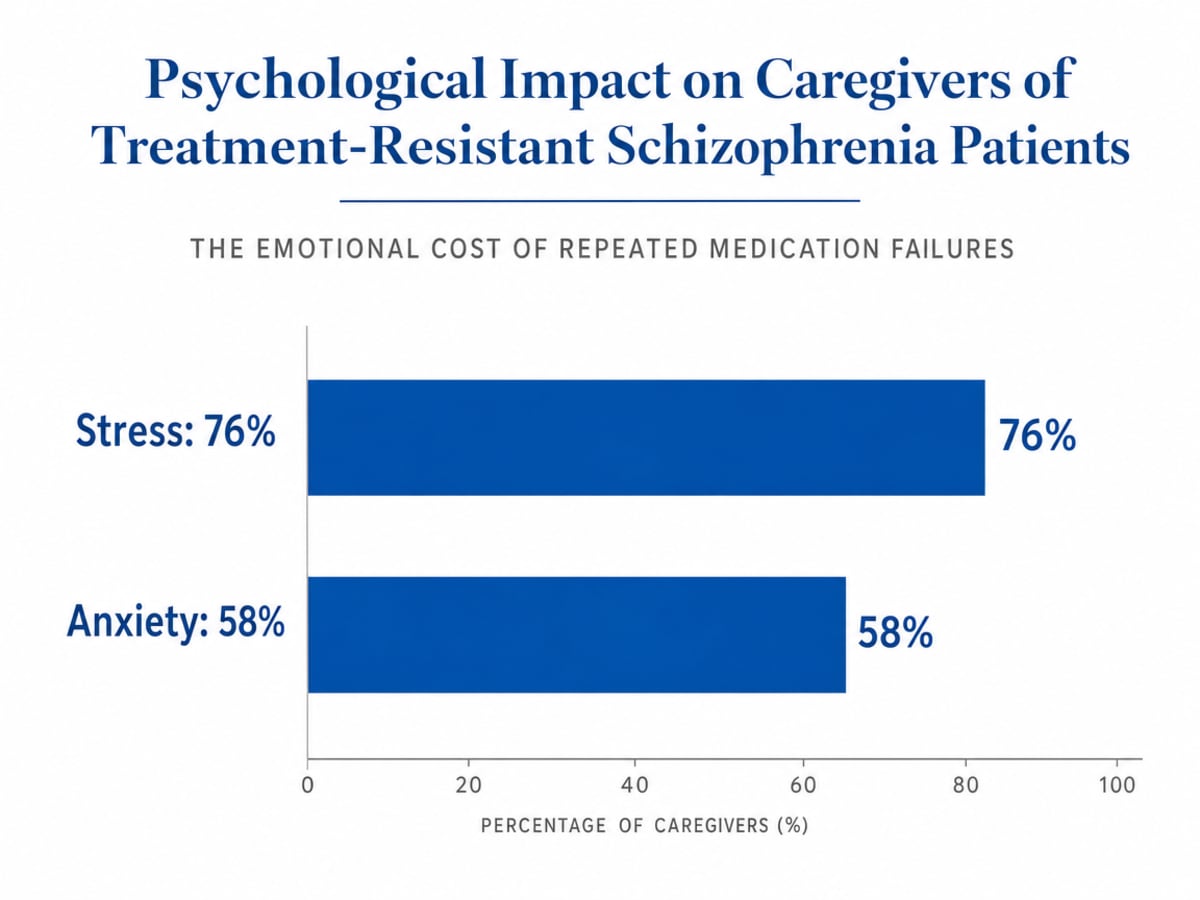
In the same caregiver survey, 76% of caregivers of people with treatment-resistant schizophrenia reported stress and 58% reported anxiety — both markedly higher than in caregivers of patients whose illness responded to standard treatment 9. If you are in the treatment-resistant group, you are not the outlier. You are the majority. The nervous system you are walking around in has been shaped by years of not knowing whether the next medication will hold.
Qualitative work with these same families puts words to what the percentages measure. Caregivers describe persistent positive symptoms — the voices that never fully quiet, the beliefs that never fully lift — as producing“significant perceived burden, feelings of being overwhelmed and having no relief, and substantial negative impacts on caregivers’ emotional and physical health”10. Each new medication trial arrives with a small candle of hope. Each failure blows it out a little more definitively than the last. After enough cycles, you learn to protect yourself by not lighting the candle. That protective flatness has a cost too.
The dimensions of that cost run wider than most parents give themselves credit for. Caregiver burden in schizophrenia has been mapped across emotional well-being, physical health, daily activities, financial demands, and relationships — a multi-dimensional impact, not a single feeling 11. Your marriage, your other children, your sleep, your back, your savings, your friendships: all of it has been paying the tax.
You are allowed to say that out loud. Naming it is not disloyalty to your son or daughter. It is the honest baseline any real long-horizon plan has to start from.
Relapse Prevention as a Standing Order, Not an Emergency Drill
Somewhere along the way, you probably learned to read your adult child the way a meteorologist reads a barometer. The sleep starts sliding. A phone call gets short. A shower gets skipped for the third day. You already know what those small shifts mean, because you have watched the same pattern precede the last three hospitalizations. What you may not have is permission to treat that vigilance as the plan rather than as paranoia.
Long-term schizophrenia care literature is explicit that relapse prevention belongs in the standing treatment plan, alongside medication adherence, stress management, and structured support for relatives 7. That is a different posture than the one most families default to, which is waiting for the wheels to visibly come off and then calling for help. A standing order means the early-warning signs your family has learned the hard way get written down, shared with the treatment team, and paired with a rehearsed response — a same-week psychiatry appointment, a temporary dose adjustment, a step-up in psychosocial contact — before the crisis authorizes itself.
The pharmacologic half of that posture is well established. The APA guideline is clear that ongoing maintenance antipsychotic treatment, including long-acting injectables for patients with a history of nonadherence or repeated relapse, is a central relapse-prevention strategy, not a fallback 1. If your adult child has cycled through discontinuations followed by re-hospitalizations, that pattern is itself a clinical indication, and it deserves to be named in the plan out loud.
The psychosocial half is what most outpatient plans quietly drop. Structured psychoeducation, family involvement, cognitive and social skills work, and monitoring of day-to-day functioning — not just symptom scores — are the interventions that actually catch a drift before it becomes an episode 3, 6. When your observations from home feed into that monitoring loop instead of sitting in your kitchen unread, the years you have spent learning your child’s specific warning signs become a clinical asset. That is the shift. You stop being the emergency responder of last resort and start being a named part of a maintenance system that expects to still be running a decade from now.
Dual Diagnosis: The Relapse Driver Most Parent Guides Skip
If your adult child uses alcohol, cannabis, methamphetamine, or opioids alongside their schizophrenia, you have probably watched the same sequence more than once. A stretch of relative stability. A weekend that goes sideways. A missed dose or three. Then the symptoms you thought were finally quiet come back louder than before. Substance use is often the hidden variable behind what looks like a medication failure, and most parent-facing content on schizophrenia leaves it out entirely.
The psychoeducation guidelines are direct about why this matters. Families of adults with co-occurring conditions need explicit education on“how substance abuse adversely affects mental health and negatively alters the course and outcome of mental disorders,”together with relapse-prevention and coping skills work built for the dual picture rather than either condition alone 4. That is a different curriculum than the one most families receive after a schizophrenia diagnosis, which typically treats substance use as a side issue to be handled once the psychiatric symptoms are stable. In practice, the two conditions feed each other, and any plan that addresses only one keeps failing on schedule.
Structured family programs for co-occurring severe mental illness and substance use exist for exactly this reason. One model delivers six to eight weekly family sessions covering basic facts about the psychiatric disorder, medications, stress-vulnerability, the family’s role, facts about alcohol and drugs, and treatment of dual disorders as an integrated whole 5. If nobody has ever walked your household through that material together, the gap is not yours to apologize for. It is the standard care your family was supposed to receive and did not.
What changes when dual diagnosis is treated as one problem instead of two? The relapse pattern you have been reading as noncompliance often turns out to be self-medication, trauma response, or withdrawal — each of which has its own clinical answer. A program that integrates psychiatric and substance use care under one roof, with one team, stops handing your son or daughter between systems that do not talk to each other. For families whose loop has been driven by that handoff for years, integrated dual recovery is not an upgrade. It is the version of care that was supposed to exist all along.
The Question You Have Not Said Out Loud: What Happens When You Are Gone
You have thought about it. Probably in the car, probably at 2 a.m., probably in the middle of some ordinary Tuesday when your adult child asked you a small question and you realized how many of those small questions land only with you. What happens to your son or daughter when you are not here to answer the phone anymore?
Most guides skip past this question because it feels too heavy to name in print. It is not too heavy. It is a planning problem, and planning problems have parts you can work on. The part you cannot control is the timeline. The parts you can work on are the medical, legal, financial, and relational scaffolding that has to exist independently of you before you need it to.
Start with the clinical scaffolding. If you are currently the person who tracks appointments, refills, insurance authorizations, and side-effect changes, none of that lives in a chart somewhere. It lives in your head. Long-term schizophrenia care literature treats “support from and for relatives” as a core component of maintenance, which means transferring what you know into a documented system — a written care summary, a named case manager, a treatment team that has met more than one member of your family — is itself clinical work 7. It is not administrative overhead. It is succession planning for the person who has been running the case.
Then the legal and financial scaffolding. Guardianship or a supported decision-making arrangement. A special needs trust so any inheritance does not disqualify your adult child from benefits. A representative payee for Social Security if that applies. A letter of intent describing who your child is beyond the diagnosis — favorite foods, warning signs only you have learned to read, the people who matter. None of these are pleasant afternoons. All of them outlast you.
The scoping review on caregiver burden is clear that access to professional support and social support are among the factors that most protect families over the long term 13. That finding cuts both ways. It protects you now, and it protects your child later, because the professionals and support networks you build in are the ones who will still be there. Naming a sibling as the eventual point person is a start. Building a relationship between that sibling and the treatment team, now, while you can still translate, is the actual plan.
You do not have to solve this in one sitting. You do have to stop carrying it alone in your head.
Short Stabilization vs. Extended Specialized Treatment
Why 7 to 30 Days Cannot Do the Clinical Work You Need
By now you can predict the discharge conversation. Symptoms are down. Sleep is back. Your son or daughter is oriented, cooperative, and asking to go home. The bed is needed. The authorization ran out three days ago. Everyone in the room, including you, knows the plan on paper is thinner than it should be. You take the discharge summary and the follow-up card, and the loop resets.
Short stays are built for the acute phase. They are good at bringing a crisis down. They are not built to do what the maintenance phase actually requires.
- Clozapine, the medication specifically indicated when other antipsychotics have failed, needs slow titration and hematologic monitoring measured in weeks and months, not days 1.
- Cognitive remediation, social skills training, and family psychoeducation — the interventions with the strongest evidence for reducing relapse and improving functioning — are dosed in sessions across weeks, not squeezed into a discharge packet 6.
- Integrated dual diagnosis work, when substance use is part of the picture, is structured as six to eight weekly family sessions at minimum, not a single referral on the way out 5.
When any of that work is left unfinished, the plan you go home with is a stabilization plan wearing a maintenance label. That is why the loop keeps closing on the same month it always closes on. The stay was the right intervention for the wrong phase.
How ViewPoint Approaches the Long Horizon
ViewPoint Dual Recovery is a Joint Commission-accredited psychiatric facility in Prescott, Arizona that was built specifically for the cases short stays keep failing to hold — treatment-resistant schizophrenia, complex bipolar presentations, and dual diagnosis where substance use and psychiatric illness feed each other. Treatment duration is set by the clinical work your adult child actually needs, not by an insurance timeline.
What that buys, practically, is time for the pieces of maintenance care that cannot be compressed. Advanced medication management, including full clozapine protocols with the monitoring those protocols require. Research on clozapine in treatment-resistant cases has documented significant reductions in caregiver burden and psychological morbidity once the medication is properly established 8. Individual and group therapy, family counseling, and trauma-focused work run alongside the medication, with psychiatrists and therapists on the same case rather than across separate systems. For families whose relapse pattern has been driven by the handoff between mental health and substance use care, the integration is the point.
The invitation here is not to another short program. It is to a conversation about long-term care planning — where your adult child sits on the arc, what the plan is missing, and whether an extended stay is the right next move for the horizon you are actually on. That conversation is the work. Reach out when you are ready to have it.
Start building a long-term care plan today
Gain insight into the next steps for your adult child’s ongoing schizophrenia management.
Frequently Asked Questions
How long will my adult child need to stay on antipsychotic medication?
For a first episode, guidelines point to 1 to 2 years of maintenance treatment. For multiple episodes, 5 years or longer. For high-risk patients with a history of severe relapse, medication may be lifelong 2. If your adult child has cycled through hospitalizations for years, the honest answer is that the horizon is measured in decades, not months.
Is a residential program worth considering if my child has already been hospitalized many times?
Yes, but the type of program matters. Short stabilization stays repeat the same loop because they end before the maintenance work starts. A longer stay built for treatment-resistant cases has time to run clozapine titration, integrated dual diagnosis care, and structured psychosocial interventions that a discharge packet cannot compress 1, 6. That is a different intervention than another hospitalization.
How do I start planning for my adult child’s care when I am no longer able to provide it?
Begin by moving what lives in your head into documents and relationships. A written care summary, a named case manager, and a treatment team that has met more than one family member. Add the legal layer — guardianship or supported decision-making, a special needs trust, a letter of intent. Professional and social support are among the strongest long-term protective factors 13.
Why do short stabilization stays keep failing to hold, and what does an extended length-of-stay model do differently?
Short stays end when acute symptoms come down. Clozapine titration, cognitive remediation, social skills training, and family psychoeducation are dosed across weeks or months, not days 6. An extended model sets length by the clinical work rather than the authorization. Integrated dual recovery, structured family sessions, and full medication protocols get finished instead of referred out at discharge 5.
What role should I play if my adult child is also using substances alongside their schizophrenia?
Ask for care that treats both conditions together, not in sequence. Psychoeducation guidelines are direct that families need explicit teaching on how substance use alters the course of psychiatric illness, plus relapse-prevention and coping skills built for the dual picture 4. Structured family programs deliver this content across 6 to 8 weekly sessions with all family members present 5.
How can I protect my own health after years of carrying the caregiving load?
Name the load first. Caregiver burden in schizophrenia runs across emotional health, physical health, daily activities, finances, and relationships — not just one dimension 11. Then build in the protective factors the research points to: professional support, social support, and coping strategies you actually use 13. Shifting clinical work to a treatment team is not abandonment. It is sustainability.
References
- The American Psychiatric Association practice guideline for the treatment of patients with schizophrenia. https://www.med.unc.edu/psych/epi-nc/wp-content/uploads/sites/720/2024/01/APA-2020-guidelines-1.pdf
- Clinical Practice Guidelines for the Management of Schizophrenia in Adults. https://pmc.ncbi.nlm.nih.gov/articles/PMC6345123/
- Clinical practice guidelines for management of schizophrenia: psychosocial interventions. https://pmc.ncbi.nlm.nih.gov/articles/PMC12900051/
- Clinical Practice Guidelines for Psychoeducation in Psychiatric Disorders. https://pmc.ncbi.nlm.nih.gov/articles/PMC7001357/
- Family Intervention for Co-occurring Substance Use and Severe Mental Illness. https://pmc.ncbi.nlm.nih.gov/articles/PMC3262454/
- Evidence-based psychosocial interventions in schizophrenia. https://pmc.ncbi.nlm.nih.gov/articles/PMC10990032/
- Schizophrenia: Long-Term Considerations. https://pmc.ncbi.nlm.nih.gov/articles/PMC6526792/
- Effect of clozapine on psychological outcomes of caregivers of patients with treatment resistant schizophrenia. https://pubmed.ncbi.nlm.nih.gov/32820680/
- Caregiver Burdens Associated With Treatment-Resistant Schizophrenia: A Quantitative Caregiver Survey. https://pmc.ncbi.nlm.nih.gov/articles/PMC6743609/
- Experiences, attitudes, and perceptions of caregivers of individuals with treatment-resistant schizophrenia: a qualitative study. https://pubmed.ncbi.nlm.nih.gov/30103719/
- Results from a Qualitative Study Exploring Caregiver Burden in Schizophrenia. https://pmc.ncbi.nlm.nih.gov/articles/PMC4016854/
- The burden of caregivers of schizophrenia outpatients during the COVID-19 pandemic. https://pmc.ncbi.nlm.nih.gov/articles/PMC9968889/
- Factors Related to the Caregiver Burden on Families Caring for Clients with Schizophrenia: A Scoping Review. https://pmc.ncbi.nlm.nih.gov/articles/PMC12400106/