

Key Takeaways
- College crises often erupt when developing brains meet simultaneous demands on sleep, food, money, medication, and social life during the years serious mental illness first appears 2.
- Campus counseling is built for triage, not containment — active suicidal planning, psychosis, mania, or collapsing function despite therapy signal the need for a higher level of care 9.
- Integrated residential treatment that combines psychiatry and addiction care on one team, with root-cause reassessment, addresses treatment-resistant and co-occurring cases that fragmented care misses 2, 8.
- Plan the logistics before acting: confirm medical leave versus withdrawal terms, tuition and financial aid impact, and signed FERPA and clinical releases so parents and providers can coordinate.
What a crisis actually looks like at 19 or 22
A crisis rarely announces itself. It creeps in as three skipped classes that become three skipped weeks. It looks like a sophomore who used to text back in minutes and now goes dark for days. It sounds like a phone call at 2 a.m. that starts with “I’m fine, but…”
If you’re the student reading this, you probably already know something is wrong. Maybe you haven’t slept a full night in two weeks. Maybe you’re drinking to bring yourself down from a racing brain, or you can’t get out of bed even though your paper is due at noon. Maybe the thought of not being here anymore has started showing up during ordinary moments — brushing your teeth, walking to the dining hall.
If you’re a parent reading this, your version of the crisis might be quieter. A dean’s email. A roommate who called. Grades that dropped without explanation. A holiday visit where your kid looked hollow.
This is the age when serious mental illness most often first appears, and it collides with the exact years students are supposed to be launching. That timing is not a personal failure. It is a clinical pattern that specialists who work with transitional-age youth expect, plan for, and treat 2. Naming what’s happening as a crisis, out loud, is the first honest step. Everything in the rest of this article assumes you’ve already taken it.
The pressure stack unique to college years
College isn’t just school. It’s the first time a young adult is running their own sleep, their own food, their own money, their own meds, and their own social life at the same time — usually while their brain is still finishing the wiring that governs impulse control and mood regulation. Every one of those systems can fail alone. In college, they tend to fail together.
Start with the academic layer. Midterms compress a semester’s worth of anxiety into ten days. A single organic chemistry grade can feel like it decides medical school. Researchers who followed college students found that higher perceived academic stress was significantly linked to greater depressive symptoms, anxiety, substance use, and suicidal ideation — four separate outcomes, all pulling in the same direction 6. That is not a soft correlation. It is the pressure of the syllabus showing up in the psychiatric chart.
Stack the rest on top. Sleep gets sacrificed first, and sleep loss destabilizes mood faster than almost anything else. Social life moves onto phones, where every peer looks further along. Alcohol and stimulants are suddenly available at 1 a.m. without a parent noticing. For students on their first antidepressant or mood stabilizer, dosing gets skipped during finals — the exact week they most need it steady.
And this is the age window when serious mental illness tends to make its first appearance. If you’re the student, none of that means you’re weak. If you’re the parent, it means the crisis is neither random nor your fault. It is what happens when a developing brain meets a system built for people who already have their footing.
When campus counseling is not enough
Campus counseling centers do real work. A weekly session with a good therapist can hold a lot — adjustment struggles, first-episode anxiety, a rough breakup, a hard semester. But there is a line where weekly sessions stop being enough, and both students and parents need to know what that line looks like before they cross it without a plan.
The Center for Collegiate Mental Health’s 2024 report, which pools intake data from counseling centers at hundreds of colleges, documents that a significant share of students walking into campus counseling arrive already reporting recent suicidal ideation, self-harm, or prior psychiatric hospitalization — severity indicators that have continued to climb across recent years 9. These are not students who need a study-skills workshop. These are students whose clinical picture is already past the level of care a fifty-minute appointment every other week can safely hold.
Here are the honest signals that campus counseling is not the right container anymore:
- Suicidal thoughts that come with a plan, a method, or a timeline.
- A first episode of psychosis — hearing things, seeing things, or beliefs that don’t match reality.
- Mania: three or four days of almost no sleep, racing thoughts, impulsive spending or sex, a feeling of being unstoppable.
- Not eating, or purging, at a level that is now physically dangerous.
- Drinking or using to the point of blackout or overdose.
- A medication that stopped working, or side effects that no one is tracking closely enough.
- Grades and daily function collapsing despite months of therapy.
If you’re the student, none of this means your counselor failed you or that you failed therapy. It means the acuity of what you’re carrying now needs a setting where a psychiatrist sees you daily, not monthly, and where a clinical team is watching you overnight instead of hoping you make it to Thursday’s appointment.
The four tiers of care, honestly explained
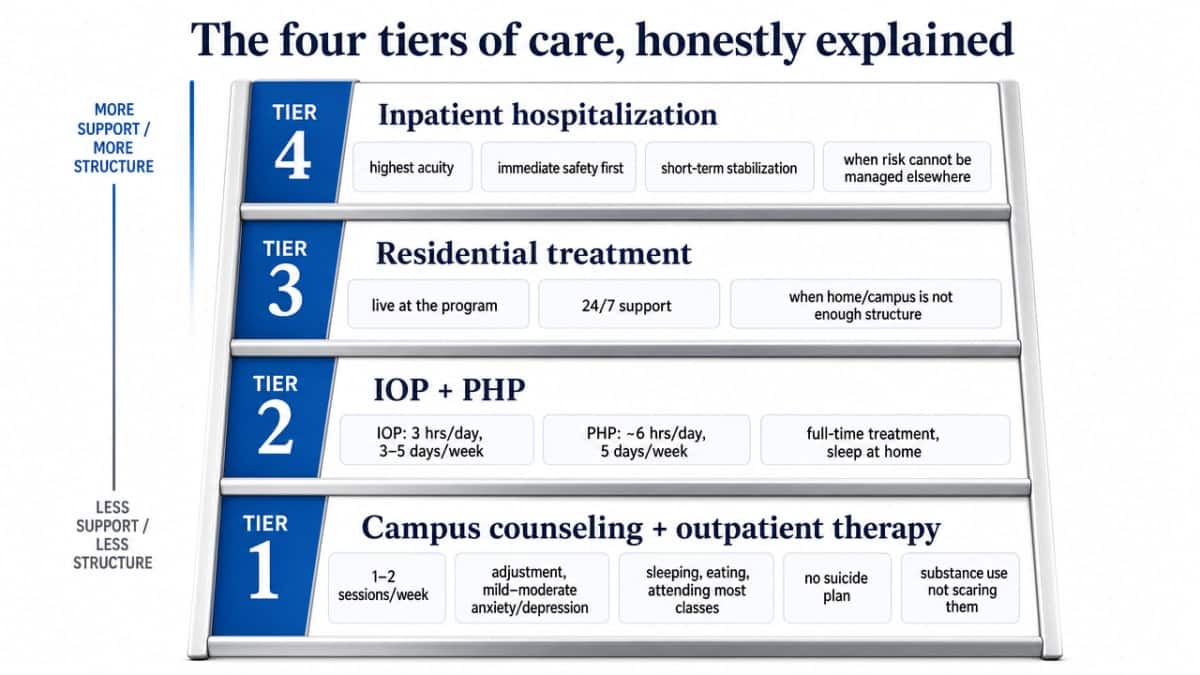
Most families discover the levels of mental health care in the middle of a crisis, when they have the least bandwidth to learn a new vocabulary. Here is the ladder in plain language, with honest criteria for where each rung fits.
Tier one: campus counseling and outpatient therapy. One session a week, sometimes two. Good for adjustment struggles, mild-to-moderate anxiety and depression, a rough breakup, grief, or maintenance after a more intensive episode. Best fit when the student is sleeping, eating, attending most classes, not thinking about suicide with any plan, and not using substances in a way that scares them.
Tier two: intensive outpatient (IOP) and partial hospitalization (PHP). IOP is usually three hours a day, three to five days a week. PHP is closer to six hours a day, five days a week — think of it as full-time treatment where the student sleeps at home or in a nearby apartment. Best fit when weekly therapy is not holding, symptoms are interfering with function, but the student is safe overnight and does not need medical monitoring. Some students step down into IOP after residential care while they re-enter school part-time.
Tier three: inpatient psychiatric hospitalization. Locked unit, typically three to seven days. The job is safety and acute stabilization — starting or restarting medication, keeping someone alive through the worst window, ruling out medical causes. Best fit when there is active suicidal intent with means, a first psychotic break, a manic episode with dangerous behavior, or an overdose. It is not designed to treat the underlying condition. It is designed to keep the person here long enough to treat it somewhere else.
Tier four: residential psychiatric treatment. Twenty-four-hour care in a home-like clinical setting, usually four to twelve weeks, sometimes longer. Daily psychiatry, individual and group therapy, medication trials with actual observation, and — for students with substance use in the picture — integrated addiction treatment on the same team. Federal guidance for transitional-age youth with serious mental illness and co-occurring substance use points specifically to this kind of coordinated, integrated model rather than parallel programs that hand the student between silos 2.
Most college crises that outgrow campus counseling land in tier three for a few days, then tier four for the real work, then tier two on the way back to school. Knowing that shape ahead of time is what keeps a family from mistaking a hospital discharge for a treatment plan.
When symptoms don’t respond to the first round of treatment
One of the hardest conversations in a college crisis happens when the family has already done the right things. You saw a counselor. You started a medication. You gave it eight weeks. And your kid — or you, if you’re the student — is not better. Sometimes worse.
That outcome is more common than most families are told. A significant portion of young adults with major depression do not respond adequately to a first-line antidepressant or a first course of therapy, and clinicians classify this pattern as treatment-resistant depression 8. The label is not a verdict on your effort. It is a signal that the plan needs to change.
What usually needs to change is the depth of the workup and the intensity of the setting. A subset of young adults with persistent depression benefit from multimodal, sometimes intensive treatment: combination pharmacotherapy under close observation, careful re-evaluation of the diagnosis, and structured therapy delivered daily rather than weekly 11. Bipolar II hiding underneath a depression diagnosis is a classic reason a student cycles through three SSRIs with no lasting relief. Emerging psychosis, trauma that was never named, or a thyroid problem no one checked can each mimic ordinary depression.
If the first round didn’t work, the next step is not a fourth prescription written in a fifteen-minute campus appointment. It is a full psychiatric reassessment in a setting where a board-certified psychiatrist can watch how you respond day by day, adjust in real time, and rule out what a rushed intake missed.
When drinking or drugs are tangled into the picture
A lot of college crises arrive with a drink in one hand and an unfilled prescription in the other. That is not a character flaw. It is a pattern that shows up often enough in the research that clinicians expect it. A peer-reviewed study of college students found substantial rates of co-occurring substance use alongside depressive and anxiety disorders, and linked that combination to higher suicidality and worse day-to-day functioning than either problem alone 10.
If you’re the student, you might already know the loop. The Adderall you borrowed for a midterm keeps you up until 4 a.m., so you drink to come down, so you sleep through your morning class, so the anxiety spikes, so you take another pill. Or the depression gets loud enough that a few drinks feel like the only thing that turns down the volume — until the drinking is what’s making the depression worse.
If you’re the parent, this is the part where a lot of programs quietly fail your kid. Many treatment settings handle either mental illness or substance use, and hand the other one off. That handoff is where students fall through. Federal and AHRQ guidance for young adults with mood disorders and co-occurring substance misuse both point to integrated care — psychiatry and addiction treatment delivered by the same team, at the same time, coordinating on the same plan — as the model that actually holds 2, 5. When you’re calling programs this week, ask whether psychiatry and addiction are treated together or in parallel. It is the single most useful question you can ask.
What a medical leave actually involves
Withdrawal, leave of absence, and incompletes
The words matter here, because each one triggers a different paper trail.
- Medical leave of absence
- A formal pause, usually approved by a dean of students or a student affairs office, that holds your enrollment status while you’re gone. Your transcript typically shows a clean break rather than a row of failed classes.
- Withdrawal
- May drop you from the college entirely, which can mean reapplying to come back.
- Incompletes
- Let a student finish specific coursework later, and they only work if a professor agrees and the student was reasonably on track before the crisis.
If you’re the parent, this is a phone call worth making tomorrow morning. Ask the dean of students office three questions:
- What is the difference at this school between a medical leave and a withdrawal?
- What is the deadline this semester to choose one over the other?
- What does re-enrollment look like — automatic, or by application?
Housing, financial aid, and tuition insurance
A medical leave has a financial shape, and no one at the treatment intake will know your school’s specifics. You have to ask the right offices directly.
Housing. Most schools prorate a housing refund based on the leave date, but you may need to formally release the room to stop being billed. If your student lives off-campus on a lease, the lease keeps running regardless of clinical status.
Tuition and tuition insurance. Many colleges refund tuition on a sliding scale — 100% in the first week or two, then dropping fast. If you bought tuition insurance at the start of the semester (a separate product, often through a third party), a documented medical leave is usually what triggers it. If you didn’t, ask the bursar what the refund percentage is as of this week.
Financial aid. Federal aid has satisfactory academic progress (SAP) rules, and a formal medical leave is generally handled better than a string of withdrawals or Fs. Call the financial aid office and ask specifically how a leave affects SAP, Pell eligibility, and any scholarship terms.
Numbers vary by institution. Confirm every figure with the registrar, bursar, and financial aid office in writing before you commit.
FERPA and what parents can and cannot see
Once a student turns 18, federal privacy law shifts. Under FERPA, the college’s default is to share educational records with the student, not the parent, even if the parent is paying tuition. Health records at campus counseling sit under separate confidentiality rules that are usually stricter still.
The workaround is a signed release. If you’re the student, signing a FERPA release for your parents — and a separate release of information at the treatment program — is not a loss of independence. It is you deciding who gets to help you this semester. You can name what they hear and what stays private.
If you’re the parent, ask for two things in writing: a FERPA release at the college covering the dean, registrar, and financial aid, and a release of information at the treatment facility covering the clinical team. Without those, even a well-meaning provider legally cannot return your call.
What the weeks of treatment look like day by day
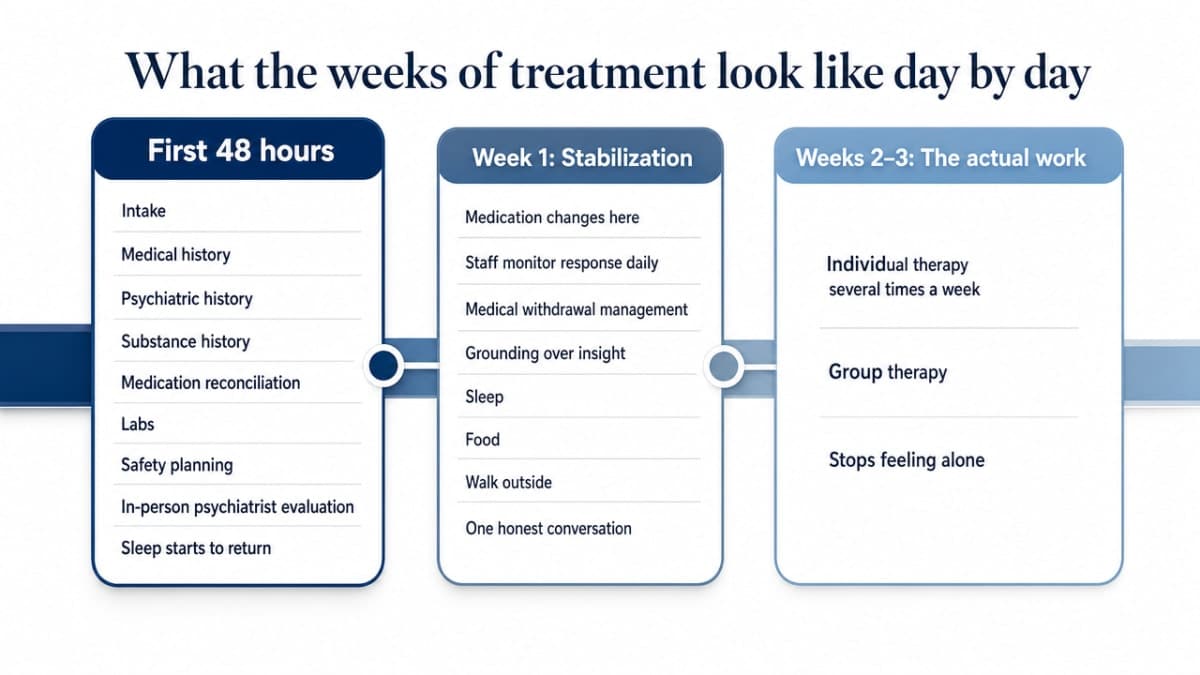
The first 48 hours are the loudest. Intake is long — medical history, psychiatric history, substance history, medication reconciliation, labs, safety planning. A board-certified psychiatrist evaluates in person, not through a portal. Sleep is usually the first thing that starts to come back once someone else is holding the clock.
Week one is stabilization. If a medication needs to change, it changes here, with staff watching the response day by day instead of scheduling a follow-up in six weeks. If withdrawal from alcohol or benzodiazepines is on the table, it is managed medically. Therapy in the first week is light on insight and heavy on grounding — sleep, food, a walk outside, one honest conversation.
Weeks two and three shift into the actual work. Individual therapy several times a week. Group therapy where a student stops feeling like the only 20-year-old whose brain did this. Family sessions, often by phone or video, so parents are not left guessing. For students with a substance use piece, addiction treatment runs on the same team and the same schedule as psychiatry, not in a separate building on a different day 5. Diagnoses get revisited. A student who came in labeled “treatment-resistant depression” sometimes leaves with a bipolar II diagnosis that finally explains the pattern.
Weeks four and beyond are re-entry planning. What medication regimen goes home. Which outpatient psychiatrist takes over. Whether the return is to the same campus next semester, a lighter course load, or a semester at a community college first. The last week of treatment is not a goodbye. It is a handoff.
How a return-focused program differs from stabilize-and-discharge
There is a real difference between a program that keeps a student alive through a bad week and a program built to hand that student back to their life. Both matter. They are not the same product.
Stabilize-and-discharge is what a hospital does well. Seventy-two hours, sometimes a little longer, to get someone off the ledge, restart a medication, and write a discharge summary. The clock is set by insurance and by bed pressure, not by whether the underlying condition has actually changed. Families often mistake the discharge paperwork for a treatment plan. It is not. It is a bridge to one.
A return-focused program is built around a different question: what has to be true for this student to sit in a lecture hall in twelve weeks without unraveling again? That question changes the treatment duration, the depth of the diagnostic workup, and who sits at the table.
ViewPoint Dual Recovery in Prescott, Arizona is structured this way. Treatment duration is set by clinical response, not by a preset insurance window, which matters for treatment-resistant presentations where the first medication change is rarely the last 8. Psychiatry and addiction treatment sit on the same team rather than in parallel buildings, which is the integrated model federal guidance points to for transitional-age youth with co-occurring conditions 2. Root-cause reassessment is baked into the first weeks, so a student who arrived labeled “treatment-resistant depression” gets checked for bipolar II, trauma, or emerging psychosis before another medication is stacked on top.
The practical difference for a family: re-entry planning starts early, not the day before discharge. Which outpatient psychiatrist takes the handoff. What the course load looks like next semester. What the plan is if a bad week returns in October. A leave handled this way is not the end of a college career. It is the interruption that makes finishing one possible.
Talking to each other this week
If you’re the student, here is one sentence that might help you start:“Something is wrong and I can’t hold it by myself anymore.”You don’t have to explain the whole picture. You don’t have to have a diagnosis ready. You just have to let one person in — a parent, a resident advisor, a professor you trust, a counselor. The first sentence is the hardest one. Every sentence after it gets easier.
If you’re the parent, resist the urge to lead with logistics. Not tonight. Ask what the last two weeks have actually felt like. Listen longer than is comfortable. Then, together, make a short list: call the dean of students, call the counseling center and ask about level of care, call a specialized program that treats complex or treatment-resistant presentations and integrates psychiatry with substance use care on one team 2. ViewPoint Dual Recovery in Prescott takes those calls from students and parents together. A leave taken this week is not the end of a college story. It is the pause that lets the next chapter get written.
Take the First Step Toward Stability Today
Connect with experts for a personalized plan to address your mental health crisis and support your next steps.
Frequently Asked Questions
Will taking a medical leave hurt my child’s chances of graduating?
A formal medical leave is generally the least disruptive option. Most schools hold enrollment status, preserve a clean transcript, and allow structured re-entry. The paths that hurt graduation timelines are usually the unplanned ones — a semester of failed courses, a panic withdrawal, or a return with no treatment plan. Call the dean of students office and ask how a leave differs from a withdrawal at your specific school.
How do we know when campus counseling isn’t enough and it’s time for a higher level of care?
Watch for suicidal thoughts with a plan or timeline, a first psychotic episode, mania, dangerous eating patterns, overdose or blackout drinking, or daily function collapsing despite months of therapy. Ask the counseling center directly: is my student’s presentation still appropriate for your level of care, or do you recommend stepping up? Good counselors answer that honestly. Their role is triage, not containment of a full crisis.
What’s the difference between inpatient stabilization and residential psychiatric treatment?
Inpatient stabilization is a locked hospital unit, usually three to seven days, focused on keeping someone safe and restarting medication. Residential psychiatric treatment is a longer stay — often four to twelve weeks — in a home-like clinical setting with daily psychiatry, therapy, and observed medication trials. Hospitalization keeps a student alive through the worst window. Residential treatment does the underlying work that a discharge summary cannot.
What happens if the first antidepressant or therapy round didn’t work?
You are not alone in this. A meaningful share of young adults with major depression do not respond to first-line treatment, and clinicians call this pattern treatment-resistant depression 8. The next step is not another quick prescription. It is a full psychiatric reassessment in a setting where response can be observed daily, the diagnosis rechecked for bipolar II, trauma, or emerging psychosis, and treatment adjusted in real time.
Can a treatment program address both a psychiatric crisis and substance use at the same time?
Yes, and it should. Federal and AHRQ guidance for young adults with co-occurring mood and substance use disorders points to integrated care — psychiatry and addiction treatment delivered by one team, on one plan, at the same time 2, 5. When you call programs, ask whether the two are treated together or handed between separate departments. Parallel treatment is where students most often fall through the cracks.
As a parent, what will I actually be able to see or hear from clinicians once my child is 18?
By default, very little. FERPA protects educational records and health information laws protect clinical records once your child is a legal adult. The workaround is a signed release of information at the treatment program and a FERPA release at the college. With those in place, the clinical team can talk with you, share updates, and include you in family sessions. Without them, they legally cannot.
References
- Suicide prevention on college campuses: What works and what are the existing gaps? A systematic review and meta-analysis. https://pubmed.ncbi.nlm.nih.gov/30908123/
- Treatment Considerations for Youth and Young Adults with Serious Emotional Disturbances and Serious Mental Illnesses and Co-occurring Substance Use. https://library.samhsa.gov/sites/default/files/pep20-06-02-001.pdf
- Evaluation of a Brief Suicide Prevention Training Program for College Campuses. https://pubmed.ncbi.nlm.nih.gov/30118644/
- Crisis-management, Anti-stigma, and Mental Health Literacy Program to Reduce Suicide in College Students: CAMPUS. https://pmc.ncbi.nlm.nih.gov/articles/PMC10422051/
- Treatment for Youth and Young Adults with Mood Disorders and Co-occurring Substance Misuse. https://integrationacademy.ahrq.gov/resources/15091
- Mental Health, Substance Use, and Suicidal Ideation Among College Students: Impact of School Stressors. https://www.ncbi.nlm.nih.gov/pmc/articles/PMC5724375/
- The Impact of the COVID-19 Pandemic on Undergraduate and Graduate Student Mental Health. https://www.ncbi.nlm.nih.gov/pmc/articles/PMC8830476/
- Treatment-Resistant Depression in Adolescents and Young Adults: Clinical Considerations. https://www.ncbi.nlm.nih.gov/pmc/articles/PMC10342644/
- Center for Collegiate Mental Health 2024 Annual Report. https://files.eric.ed.gov/fulltext/ED666611.pdf
- Co-Occurring Substance Use and Mental Health Disorders in College Students. https://www.ncbi.nlm.nih.gov/pmc/articles/PMC10036182/
- Treatment-Resistant Depression in Young Adults: Implications for College Populations. https://www.ncbi.nlm.nih.gov/pmc/articles/PMC9943899/