Key Takeaways
- A rejection from a standard program usually reflects staffing limits and licensure scope, not a judgment about the patient — it points you toward facilities built for higher acuity.
- High acuity is a clinical description covering symptom severity, risk, functional impairment, and complexity, requiring 24-hour management and psychiatry embedded in daily care 11.
- Most residential programs decline complex cases because their staffing math and parallel care structures cannot safely hold psychosis, aggression, or intensive medication regimens overnight 6.
- Ask concretely how many hours a board-certified psychiatrist is on the unit; higher psychiatrist staffing on acute units lowered prolonged hospitalization and 90-day readmission risk 2.
- Staff-to-client ratios only predict outcomes when they reflect real clinical attention, so push for who counts in the number and what those staff actually do through the day 1.
- Ratio alone is not proof of safety — a 2025 review found mixed results on staffing and containment incidents, meaning clinical culture and model matter as much as headcount 3.
- Verify that one clinical team writes one plan for both psychiatric and substance use conditions; integrated care outperforms parallel approaches on symptoms, retention, and satisfaction 4.
- Length of stay should follow clinical milestones, not authorization letters — TIP 42 notes residential co-occurring treatment often runs 6 to 12 months when driven by clinical need 5.
When You’ve Already Heard ‘We Can’t Take This Case’
You know the phone call. The intake coordinator was polite. She said your loved one’s presentation was “outside what we’re set up for,” or “too acute for our program,” or “we’d love to help, but the psychiatric piece is beyond our scope.” Maybe it was the third call that week. Maybe the tenth.
If that has happened to you, take a breath. It is not a verdict on the person you’re trying to help. It is a description of the facility that declined the case.
Most residential and dual diagnosis programs are staffed and licensed for a moderate band of acuity. When symptoms sit outside that band — active psychosis, rapid-cycling episodes, serious suicidality, aggression, treatment-resistant schizophrenia, or a serious mental illness braided into active substance use — the math of their staffing model breaks. Saying no is often the safest thing they can do. It is also, for you, the wrong answer to keep hearing.
This guide is written for that moment. You already understand the diagnoses. You already know what a bad discharge looks like. What you need now is a way to tell, quickly and without brochure language, which programs are actually built to hold a high-acuity case and which ones are going to hand your family another rejection in a softer voice.
That starts with understanding what “high acuity” really means clinically — and what a facility has to be structured to do before it can honestly accept the case.
What ‘High Acuity’ Actually Means in Clinical Terms
“High acuity” is not a marketing word. It is a clinical description of how sick someone is right now, how much risk they carry, and how much staff time and clinical authority it takes to keep them safe while treatment begins to work.
In practice, an admissions team is looking at four things when they use the term:
- Symptom severity: florid psychosis, command hallucinations, catatonia, rapid-cycling mood episodes, severe depressive shutdown, or trauma-driven dissociation that a standard milieu cannot absorb.
- Risk: active suicidality, self-injury, aggression toward others, or elopement risk that requires close observation — sometimes 1:1 or 2:1 staffing where one or two staff members are assigned to a single client during unsafe periods.
- Functional impairment: the person cannot reliably eat, sleep, take medication, or track a group schedule without hands-on support.
- Complexity: treatment-resistant illness, unstable medication regimens like clozapine titration, medical comorbidities, and — very often — a serious mental illness braided into active substance use.
That last piece is where a lot of programs quietly draw the line. A residential SUD program may be comfortable with mild-to-moderate depression or anxiety. It is usually not staffed to hold someone through a psychotic break, manage antipsychotic side effects at 2 a.m., or coordinate concurrent treatment of both disorders in a truly integrated way 4, 6.
So when you hear “high acuity,” translate it like this: the person in front of you needs a facility with 24-hour clinical management, medical monitoring where indicated, psychiatry deeply involved in daily care, and enough staff on the floor to safely stay with them through instability rather than discharge around it 11. That is a specific operational profile — and it is what the next sections will help you verify.
Why Standard Programs Decline These Cases
Here is something worth hearing plainly: when a program tells you they can’t take the case, they are almost never making a judgment about your loved one as a person. They are doing staffing math.
A typical residential dual diagnosis program is built around a specific ratio of clinicians to clients, a specific licensure category, and a specific band of behaviors the milieu can absorb without breaking. If the admissions team looks at your intake packet and sees active psychosis, recent suicide attempts, aggression, or a medication regimen like clozapine that requires close monitoring, they are comparing that presentation to what their staffing model can actually hold overnight, on a Saturday, when the on-call psychiatrist is 40 minutes away. When the numbers don’t work, the answer is no.
There are also model limits. Many programs run a parallel structure — the SUD team treats the addiction, an outside psychiatrist manages the mental illness, and the two rarely sit in the same room. SAMHSA has been explicit for decades that this approach underperforms integrated, concurrent treatment of both conditions 6, 9. A program that knows it cannot deliver integrated care for a complex co-occurring case is often being honest, not obstructive, when it declines.
So reframe the last rejection this way: it told you exactly what kind of facility you are actually looking for. You need a program whose staffing, licensure, and clinical model were designed from the beginning to accept the presentations that break a standard program’s math.
Psychiatry-Led Staffing: The First Filter That Matters
When you’re calling around for a high-acuity bed, the fastest way to sort real capability from marketing language is to ask one question early: how involved is the psychiatrist in daily care?
Not on paper. Not “available for consultation.” How many hours a week is a board-certified psychiatrist actually on the unit, laying eyes on patients, adjusting medications in near real time, and leading treatment decisions instead of signing off on them from a distance?
This matters because psychiatric acuity is a moving target. A person in active psychosis or a rapid-cycling mood episode does not stabilize on a Monday medication decision that gets reviewed the following Monday. They need someone who can tune the regimen mid-week, catch a subtle akathisia before it becomes an outburst, and hold a clozapine titration steady through side effects that would send most programs to the ER.
The outcome evidence here is unusually clear for a behavioral health question. A population-based study of acute psychiatric units compared units meeting a high psychiatrist staffing threshold — at least one psychiatrist per 16 patients — against standard-staffed units. The high-staffing units saw a lower risk of prolonged hospitalization (IRR 0.79) and a lower risk of 90-day psychiatric readmission (IRR 0.90) 2. That is a meaningful gap. People got stable faster and stayed stable longer when psychiatry was present in force.
A few honest caveats before you use that number on a phone call. The study looked at acute inpatient psychiatric units, not residential dual diagnosis programs, so the ratios don’t map one-to-one onto every setting you’ll consider. And the threshold — one psychiatrist per 16 patients — is a floor for what counted as “high staffing,” not a ceiling of what’s possible. Some specialized programs run far denser than that because their case mix demands it.
What the study should change is your default question. Instead of asking “do you have a psychiatrist on staff?” — a yes that could mean almost anything — ask concretely:
- How many board-certified psychiatrists cover the current census, and what is the ratio?
- Is there 24/7 psychiatric coverage, or after-hours phone triage from an on-call physician?
- How often does the treating psychiatrist see each patient in the first week, and after?
- Are they credentialed and willing to run advanced protocols like clozapine, long-acting injectables, or complex mood stabilizer combinations?
If the answers are vague, the program probably is not built for the case you’re placing. If they are specific — with names, hours, and protocols — you have found a real filter. Everything else in this guide sits on top of this one.
Reading Staff-to-Client Ratios Without Getting Sold
Ratios are the second thing to ask about, and they are the number most likely to be sold to you in a way that sounds meaningful but isn’t.
A program that tells you it runs “1:4” might mean during clinical hours only, with a much thinner overnight and weekend picture. “2:1 when needed” might mean 2:1 staffing is available for a client in acute crisis — two staff members assigned to one client — or it might mean the program has done it once. Ask which. Ask when. Ask who counts as staff in the number: are you counting board-certified psychiatrists, psychiatric nurses, and master’s-level therapists, or is the ratio padded with behavioral health techs and administrative staff who don’t touch clinical care?
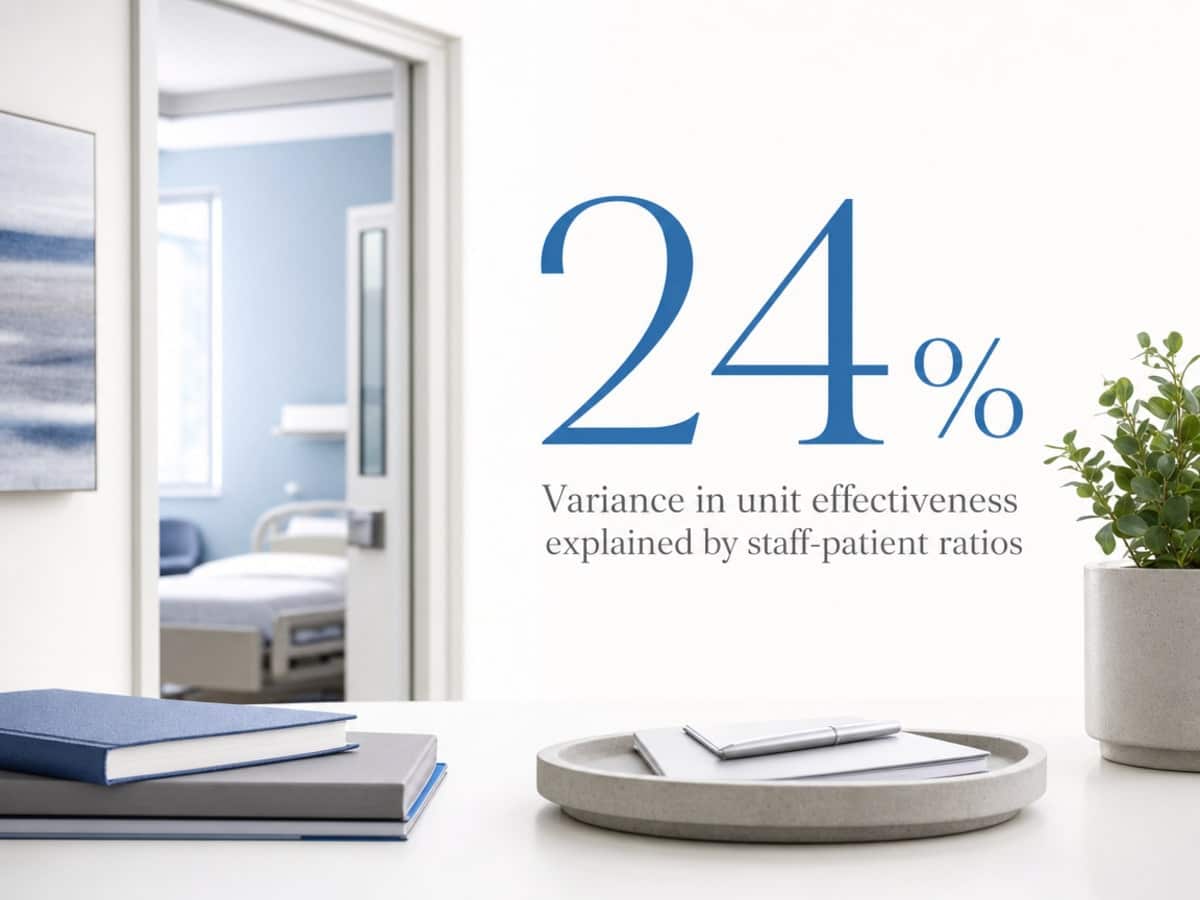
The reason to push this hard is that ratio does move outcomes — but only when it reflects real clinical attention. A foundational study of inpatient psychiatric units found that staff-patient ratios accounted for 24 percent of the variance in unit effectiveness, measured by how long people stayed in the community after discharge. That is a large signal for one operational variable. But the same study was careful to note that the amount and quality of staff attention mediated the effect. In other words, headcount predicted outcomes because higher-staffed units delivered more direct therapeutic time — not because a number on a spreadsheet has magic in it 1.
Translate that into your phone call. A program advertising a 2:1 staff-to-client ratio should be able to describe, without pausing, what those staff members actually do with the client through the day: how many one-on-one clinical contacts, how many psychiatry touchpoints per week, what the overnight coverage looks like, and how the ratio flexes up when a client destabilizes. If the answer is a marketing number without a description of the clinical work behind it, you have a brochure, not a program. If the answer comes back specific — with roles, hours, and how the team actually spends time — you have something you can trust to hold your loved one through the hard nights.
Why Ratio Alone Isn’t the Whole Answer
Here is the honest turn in this conversation. If ratios were the whole story, this article could end at the last section. They are not.
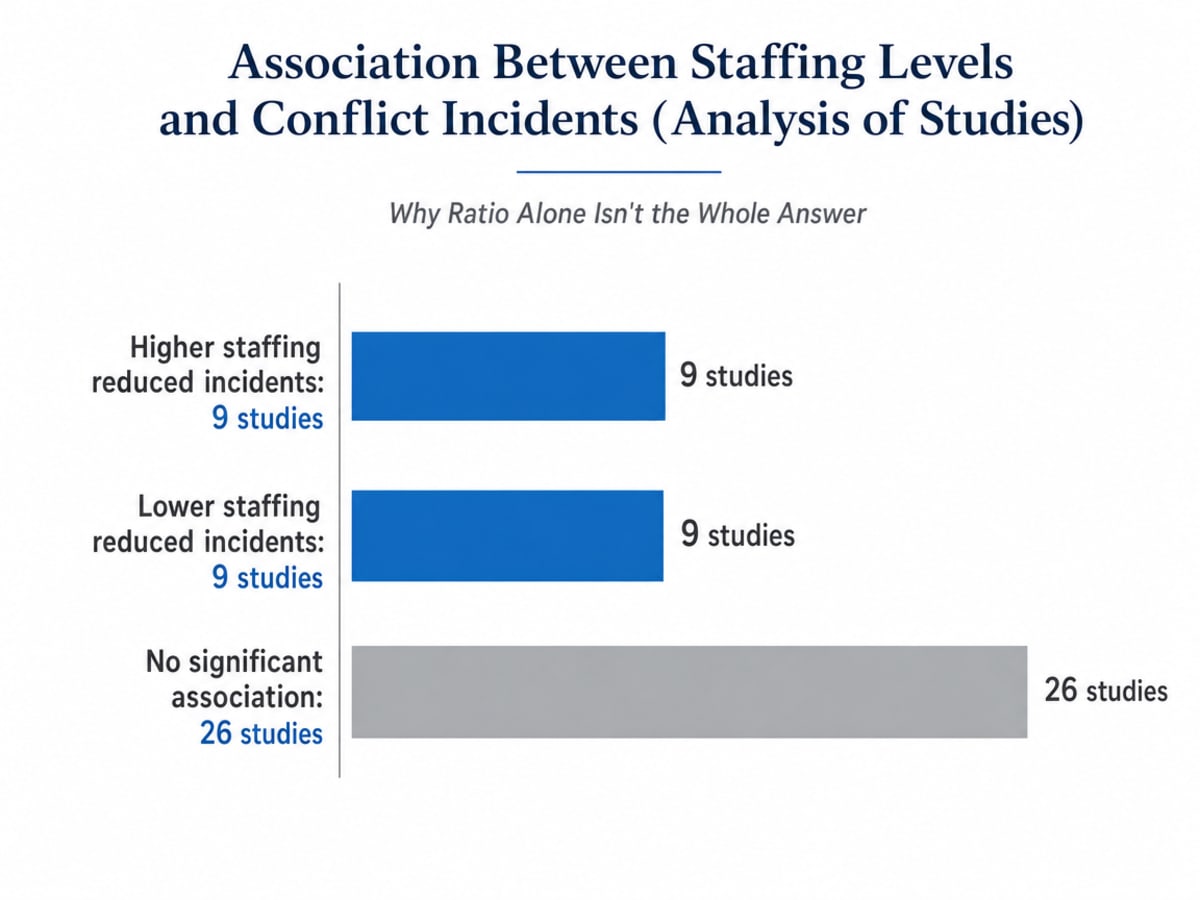
A 2025 updated review looked at nurse staffing and conflict or containment incidents — aggression, seclusion, restraint — on psychiatric inpatient wards. The results were not clean. Nine analyses found that higher staffing was associated with fewer incidents. Nine found the opposite: lower staffing was associated with fewer incidents. Twenty-six found no significant association at all 3. That is a genuinely mixed literature, and any admissions team quoting a ratio at you as proof of safety is skipping past it.
So widen your questions. Beyond the ratio, ask what the clinical model is. Is it trauma-informed in practice, not just on the website? How does the team prevent restraint and seclusion, and how often do they actually happen? What does the psychiatrist do when a client destabilizes at 3 a.m. — is there a plan, or a phone tree? How do the therapists and the psychiatry team share information, and how often do they meet as one team about one client?
A program that can answer those questions with the same specificity it uses to quote its ratio is telling you something important. It is telling you the staffing is real because the clinical culture behind it is real. That combination — dense staffing plus a coherent, integrated model — is what actually holds a high-acuity case through the weeks it takes to stabilize. Ratio is the doorway. What happens on the other side of it is the treatment.
Integrated Dual Diagnosis: The Non-Negotiable Model
If your loved one has a serious mental illness braided into active substance use, the single most important thing to verify about any facility is not its amenities or its brochure. It is whether the psychiatric team and the addiction team are actually the same team.
There is a common structure in this industry that sounds like dual diagnosis but isn’t. A residential SUD program runs its groups, its 12-step work, and its therapy schedule. A psychiatrist visits once or twice a week, or a client keeps an outside prescriber. The two sides trade notes when they can. That is parallel care. It is not integrated care, and the difference is not academic — it shows up in the outcomes.
SAMHSA has been clear on this for over two decades. Integrated treatment for co-occurring disorders — where the same clinical team assesses, plans, and treats both conditions concurrently — outperforms nonintegrated approaches on substance use, symptom severity, retention, cost-effectiveness, and patient satisfaction 4. TIP 42 pushes even further, telling providers not to treat integration as a specialty add-on but as the standard of practice: screen every client for the other condition, and treat both at the same time by the same team 6, 7. The 2024 advisory update says the same thing in plainer language — fragmented care produces worse outcomes, full stop 9.
On a phone call, integration is easy to test. Ask who runs the treatment plan. In an integrated program, one clinical team — psychiatry, therapy, nursing, case management — sits around the same table and writes one plan for one person with two conditions. Ask how often that team meets about your loved one specifically. Ask whether the psychiatrist attends those meetings or reads the notes later. Ask how the team handles a moment when substance craving and psychiatric symptoms flare at the same hour — because they will — and whether the response is coordinated or two separate protocols competing for the same client.
Ask one more thing: what happens when the case is complex enough that the standard integrated plan isn’t enough. Can the program run a clozapine titration while a client is early in recovery from opioids or alcohol? Can it hold someone through a psychotic episode without transferring them out to a hospital and losing the addiction work? Can it treat trauma directly rather than deferring it until after “the addiction is stable” — a sequencing that TIP 42 specifically warns against for many clients 5?
A program that answers those questions with one team, one plan, and one set of clinicians who own the whole picture is doing integrated dual diagnosis. A program that describes two departments coordinating is doing something else, and for a high-acuity co-occurring case, that gap is often the reason the last three facilities said no.
Length of Stay Should Be Clinical, Not Insurance-Driven
One of the quieter tells of a high-acuity program is how it answers a simple question: how long will my loved one stay?
If the answer is “28 days” or “whatever your insurance approves,” you are being told something important. You are being told that length of stay is a billing decision at that facility, not a clinical one. For a moderate case, that may be fine. For a case that has already been declined elsewhere — treatment-resistant symptoms, an unstable medication regimen, a serious mental illness braided into active substance use — it is usually not enough time to stabilize, let alone treat.
SAMHSA’s TIP 42 has been clear about this for years. Residential therapeutic community treatment for co-occurring disorders is typically 6 to 12 months, though that duration has been shrinking under pressure from managed care and other systemic factors 5. The clinical evidence points one direction. The reimbursement environment pushes the other. A program that lets the reimbursement side win will discharge your loved one when the authorization runs out, not when they are actually ready.
Ask the question directly. How is length of stay determined here — by clinical milestones or by insurance authorization? What happens if my loved one needs 90 days and insurance approves 30? Will you keep working the case, appeal for continued stay, or transition to private-pay if clinically indicated? A program that treats duration as a clinical variable will answer without flinching.
Verification Questions to Ask Any Admissions Team
By now you have the framework. What you need is a short list you can keep next to the phone, so the next admissions call moves faster than the last three.
Ask these, in roughly this order, and listen for specifics:
- Psychiatry coverage: How many board-certified psychiatrists cover the current census? Is there 24/7 on-site or on-call psychiatric coverage? How often does the treating psychiatrist see each client in the first week?
- Advanced medication capability: Can you run a clozapine titration on-site? Long-acting injectables? Complex mood stabilizer or antipsychotic combinations for treatment-resistant cases?
- Staffing at real acuity: What is the staff-to-client ratio during the day, overnight, and on weekends? Who counts in that number — psychiatrists, nurses, and therapists, or techs and admin? Can you flex to 1:1 or 2:1 observation when a client destabilizes, and for how long?
- Integrated dual diagnosis: Is there one treatment team writing one plan for both the psychiatric and substance use pieces, or are those two departments coordinating? How often does that team meet about a specific client?
- Holding through instability: If my loved one has a psychotic break, a suicidal crisis, or a serious behavioral episode at 2 a.m., what happens? Do you hold and treat, or transfer out?
- Length of stay logic: Is duration determined by clinical milestones or insurance authorization? What happens if 30 days aren’t enough?
- Accreditation and licensure: Are you Joint Commission accredited? State-licensed for the level of care you’re describing?
If answers come back specific — with names, hours, protocols, and honest limits — you have found a real program. If they come back in brochure language, thank them and move on. You have called enough facilities to know the difference.
If You’ve Been Turned Away: A Clinical Fit for ViewPoint
If the pattern in this guide sounds like the phone calls you’ve been making, ViewPoint Dual Recovery in Prescott, Arizona was built for the presentations that keep getting declined. It is a psychiatric treatment program accredited by The Joint Commission, led by board-certified psychiatrists, a 2:1 staff-to-client ratio at peak acuity, and an integrated dual diagnosis model where the psychiatry and therapy teams sit around the same treatment plan. Clozapine titration, treatment-resistant schizophrenia, rapid-cycling bipolar, trauma-driven relapse, and serious mental illness braided into active substance use are the cases the facility was designed to accept, not the ones it hands off.
Use the verification questions from the last section on that phone call too. Ask about psychiatry hours, ratio at 2 a.m., how the team holds a client through instability, and whether length of stay follows clinical milestones or an authorization letter. You have earned the right to specific answers.
If you’ve already heard “we can’t take this case,” call ViewPoint. Bring the intake packet the last three programs saw. Ask whether this is a clinical fit — and expect a clinical answer.
Find out if complex psychiatric care fits
Get answers on next steps for high acuity psychiatric treatment, tailored to your unique clinical history.
Frequently Asked Questions
What does ‘high acuity’ actually mean in a psychiatric setting?
High acuity describes how sick someone is right now and how much clinical structure it takes to keep them safe. Clinically, that means severe symptoms like active psychosis, rapid-cycling mood episodes, or serious suicidality, paired with significant functional impairment and often a co-occurring substance use disorder. Operationally, it calls for 24-hour clinically managed care, medical monitoring where indicated, and staffing dense enough to sit with a client through instability 11.
Why do most residential and dual diagnosis programs decline high-acuity cases?
Usually it’s staffing math and model limits, not a judgment about the person. A standard program is licensed and staffed for a moderate band of behaviors. When the intake packet shows psychosis, aggression, or a medication regimen like clozapine, the numbers don’t work overnight or on weekends. Many programs also run parallel care rather than integrated care, and SAMHSA is clear that fragmented approaches underperform integrated ones for complex co-occurring cases 9.
What staff-to-client ratio should a high-acuity program be able to provide?
There is no single magic number, but a real high-acuity program should be able to flex down to 1:1 or 2:1 observation when a client destabilizes, and hold that coverage across nights and weekends. Ask who counts in the ratio: psychiatrists, nurses, and therapists — or techs and admin. A 2025 review of nurse staffing found genuinely mixed results on incidents, which means ratio without a coherent clinical model behind it does not guarantee safety 3.
What is the difference between integrated and parallel dual diagnosis treatment?
In parallel care, an addiction team and a psychiatric provider treat the same person separately and trade notes when they can. In integrated care, one clinical team — psychiatry, therapy, nursing, case management — sits around one treatment plan and treats both conditions concurrently. Integrated models outperform nonintegrated approaches on substance use, symptoms, retention, cost-effectiveness, and satisfaction 4. For a high-acuity co-occurring case, that difference often determines whether the case can be held at all.
How long should a high-acuity residential stay actually last?
Long enough to actually stabilize, which is rarely 28 days for a complex case. SAMHSA’s TIP 42 notes that residential therapeutic community treatment for co-occurring disorders is typically 6 to 12 months, though managed care pressures have been shortening that duration 5. Ask whether length of stay is set by clinical milestones or by insurance authorization. A program that treats duration as a clinical variable will keep working the case rather than discharge on a billing cycle.
What questions should I ask an admissions team to verify a facility can hold a complex case?
Ask concretely: how many board-certified psychiatrists cover the census, and how often does the treating psychiatrist see each client in the first week? Higher psychiatrist staffing on acute units has been associated with lower risk of prolonged hospitalization and 90-day readmission 2. Then ask about clozapine capability, ratio at 2 a.m., whether one integrated team writes one plan, and what happens when a client destabilizes — hold and treat, or transfer out. Specifics separate real programs from brochures.
References
- Relationship between staffing ratios and effectiveness of inpatient psychiatric units. https://pubmed.ncbi.nlm.nih.gov/11585955/
- Association of high psychiatrist staffing with prolonged hospitalization, follow-up visits, and readmission. https://pmc.ncbi.nlm.nih.gov/articles/PMC5880415/
- The Association Between Nurse Staffing and Conflict and Containment in Psychiatric Inpatient Wards: An Updated Review. https://pmc.ncbi.nlm.nih.gov/articles/PMC11976120/
- Chapter 7—Treatment Models and Settings for People With Co-Occurring Disorders. https://www.ncbi.nlm.nih.gov/sites/books/NBK571024/?report=reader
- Substance Use Disorder Treatment for People with Co-Occurring Disorders (TIP 42 core PDF). https://library.samhsa.gov/sites/default/files/pep20-06-04-006.pdf
- Substance Use Disorder Treatment for People With Co-Occurring Disorders (Quick Guide based on TIP 42). https://www.psychiatry.wisc.edu/wp-content/uploads/2023/05/SAMHSA-TIP-42.pdf
- Substance Abuse Treatment for Persons With Co-Occurring Disorders (TIP 42 original manual). https://library.samhsa.gov/product/substance-abuse-treatment-persons-co-occurring-disorders/sma10-4531
- Practice Guidelines for Co-Occurring Substance Use and Mental Disorders. https://library.samhsa.gov/sites/default/files/SAMHSA_Digital_Download/PEP20-02-01_004.pdf
- Advisory: Substance Use Disorder Treatment for People with Co-Occurring Disorders (Based on TIP 42). https://www.samhsa.gov/resource/ebp/advisory-substance-use-disorder-treatment-people-co-occurring-disorders-based-tip-42
- Managing Life with Co-Occurring Disorders. https://www.samhsa.gov/mental-health/serious-mental-illness/co-occurring-disorders
- Joint CMCS and SAMHSA Informational Bulletin on Coverage of Behavioral Health Services for Youth. https://www.medicaid.gov/Federal-Policy-Guidance/Downloads/CIB-01-26-2015.pdf