Key Takeaways
- Treatment-resistant schizophrenia has a specific clinical definition: persistent symptoms after two adequate antipsychotic trials at therapeutic dose, duration, and verified adherence 1, 3.
- Clozapine is the gold-standard next step, but requires REMS enrollment, weekly ANC monitoring, and slow titration to 300-450 mg with a 12-16 week trial 5, 6.
- Coordinated specialty care means one team handling medication, CBT for psychosis, case management, family support, and substance use treatment together rather than through separate referrals 7, 12.
- Before choosing a Prescott program, compare in-house clozapine management, integrated dual-diagnosis treatment, family involvement structure, and whether they accept AHCCCS and support SMI designation through the ACC-RBHA 9.
When the Last Program Didn’t Hold
You probably already know the shape of this. A hospitalization that felt stabilizing until it wasn’t. An outpatient program that discharged your son or your wife with a medication list and a follow-up appointment three weeks out. A relapse that arrived quietly, then all at once. And now you’re the one making calls, tracking prescriptions, and trying to figure out what a Prescott program actually needs to be able to do.
That exhaustion is not a personal failing. Schizophrenia care in this country is uneven, and the standards that separate a general outpatient clinic from a program equipped for treatment-resistant cases are specific, technical, and rarely explained to families in plain language. The American Psychiatric Association’s own 2020 guideline names clozapine as the recommended treatment when two prior antipsychotics have failed, yet many programs still refer those patients elsewhere rather than manage the protocol locally 1.
This piece is written for you as a care partner, not a bystander. It walks through what treatment-resistant schizophrenia actually means clinically, why clozapine capability matters, how coordinated specialty care includes families by design, and how Arizona’s SMI system shapes access in Yavapai County. The goal is a shorter list of the right questions, not a longer list of providers.
What ‘Treatment-Resistant’ Actually Means
The Two-Trial Clinical Definition
The phrase gets used loosely. A psychiatrist might say a patient “isn’t responding,” a discharge summary might mention “partial response,” and a family walks out with the impression that the current medication just needs more time. The clinical definition is narrower, and it matters because it unlocks a specific next step rather than another round of the same class of drug.
Treatment-resistant schizophrenia is defined as persistent, significant symptoms after two adequate trials of different antipsychotic medications. Adequate is the operative word. Each trial has to reach a therapeutic dose, run for a sufficient duration (typically at least six weeks at target dose), and be taken as prescribed. If any of those conditions fails, the trial doesn’t count toward the resistance definition 1, 2. International guideline reviews describe the same threshold in almost identical language: non-response to two trials of any other antipsychotic medication, with the caveat that adherence and dose must be verified before the label is applied 3.
That specificity is what makes the label useful. Once two adequate trials have failed, the recommendation stops being “try another antipsychotic” and becomes a directed one: initiate clozapine 1, 3. Families who understand this can ask a Prescott program a concrete question instead of a vague one. Not “what will you try next?” but “have the prior trials met the two-trial standard, and if so, when does a clozapine assessment start?”
If you are keeping notes for the next appointment, write down each antipsychotic your loved one has taken, the highest daily dose reached, how long that dose was maintained, and whether adherence was confirmed (pill counts, long-acting injectable records, plasma levels). That short record does more to move care forward than any general history. It also tells you whether the word “resistant” has actually been earned yet, or whether one of the prior trials was too short, too low, or interrupted.
Why ‘Resistance’ Is Often Something Else
A meaningful share of patients labeled treatment-resistant are actually undertreated, non-adherent, or contending with an untreated co-occurring condition. The NIH review on treatment-resistant schizophrenia is direct about this: before clozapine is considered, clinicians should rule out inadequate dosing, non-adherence, and active substance use, because each of these mimics resistance and each has a different fix 2.
Adherence is the most common culprit and the least often verified. Oral antipsychotics taken inconsistently produce fluctuating blood levels, breakthrough symptoms, and a chart that looks like non-response. A long-acting injectable trial or a plasma level check can settle the question in weeks rather than months.
Substance use is the second. Cannabis, methamphetamine, and heavy alcohol use each destabilize antipsychotic response and each are common in the Prescott and greater Yavapai County population your loved one lives in. A program that treats the psychiatric diagnosis and ignores the substance use is not testing whether the medication works; it is testing whether the medication works despite an ongoing driver of symptoms. That distinction changes what “resistant” means in a specific case.
The third is medical. Thyroid dysfunction, sleep disorders, and certain medications can worsen psychiatric symptoms in ways that look pharmacologic. A thorough reassessment, not another prescription, is often the correct next move. When you are evaluating a Prescott program, listen for whether the intake includes verified adherence history, substance use screening, and medical workup, or whether it jumps straight to a medication change. The former is what separates a specialty assessment from a repeat of what didn’t work last time.
Clozapine: The Gold Standard Prescott Programs Should Handle Locally
Why Clozapine Sits Alone at the Top
Clozapine is the only antipsychotic with a specific indication for treatment-resistant schizophrenia, and that position has held for more than two decades. A review of international practice guidelines concludes that the evidence produced over the last 20 years confirms clozapine as the gold standard for treatment-resistant schizophrenia, with additional indications for persistent suicidality and recurrent aggression 3. The APA guideline is equally direct: patients with treatment-resistant schizophrenia should be treated with clozapine 1.
And yet the same review notes that clozapine remains under-utilized globally. The reasons are structural, not clinical. It requires baseline labs, a titration protocol, ongoing absolute neutrophil count (ANC) monitoring, REMS enrollment, and a prescriber willing to manage side effects like sedation, hypersalivation, and metabolic changes. Programs without that infrastructure tend to refer out, which often means your loved one waits weeks for an intake somewhere else while symptoms continue.
That is the practical question behind the clinical one. If a Prescott program identifies your family member as a clozapine candidate, can they start the medication and manage it, or does the recommendation trigger another referral? The answer determines whether the two failed trials that came before finally lead to something different, or to more delay.
Target Dose, Titration, and the 12-to-16-Week Trial
Clozapine is not a drug you start and evaluate in two weeks. The titration is deliberately slow, the therapeutic window is specific, and the trial length is longer than most families expect. Knowing the numbers helps you tell whether a prior “clozapine trial” your loved one had actually met the standard, or whether it stopped short.
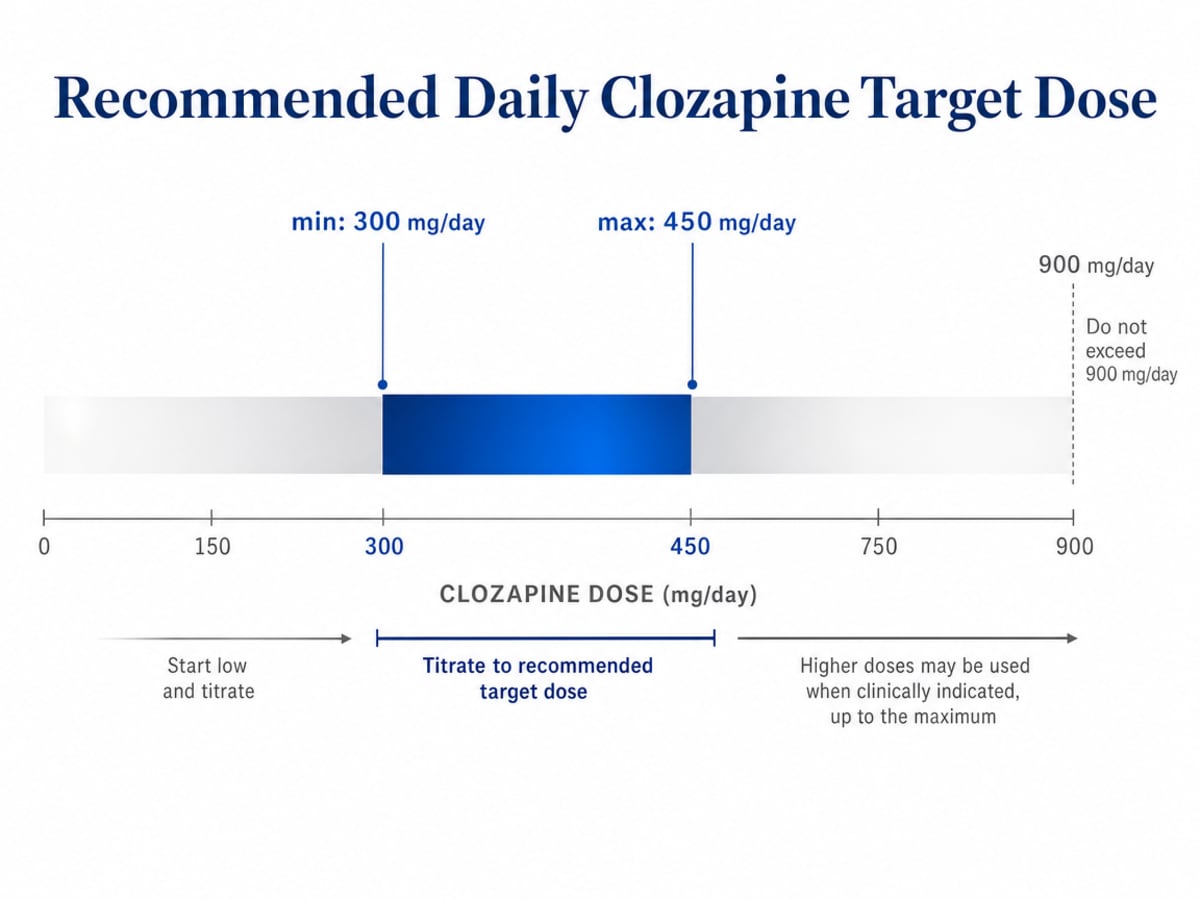
State-level guidance from the Oregon Health Authority lays out the framework used by most specialty programs: start at 12.5 mg, titrate gradually, and aim for a target daily dose of 300 to 450 mg, not exceeding 900 mg per day 5. Response is judged after at least three months at a therapeutic dose. For patients with strong negative symptoms, persistent aggression, or high suicide risk, the recommended minimum trial extends to 16 weeks before a response call is made 5. The consensus checklist for initiating clozapine cites the same threshold, drawing on TRRIP guidelines that patients receive clozapine with careful monitoring for at least 12 weeks, and ideally longer, before evaluating response 4.
What this means in practice: a person who took clozapine for a month at 100 mg and then stopped has not had a clozapine trial in any meaningful sense. Neither has someone who reached 200 mg and was switched after six weeks because “it wasn’t working.” A real trial reaches the therapeutic range, holds there long enough for the receptor and symptom effects to consolidate, and is often supported by plasma level checks when response is slower than expected 2.
When you sit with a Prescott psychiatrist, it is fair to ask what target dose they typically aim for, how long they hold before evaluating, and whether they use plasma levels to guide decisions. Programs that manage clozapine regularly will answer without hesitation. Programs that don’t will often talk around the specifics.
ANC Monitoring and What Continuity Requires
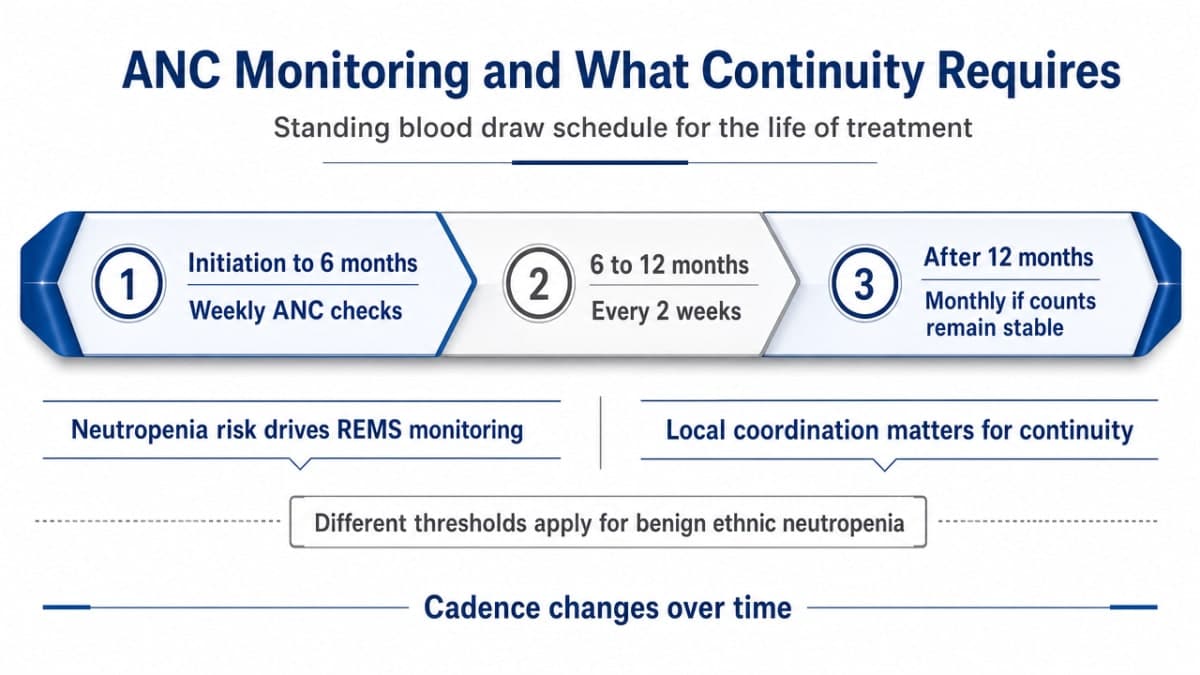
The reason clozapine carries a REMS program is neutropenia risk. It is uncommon, but serious enough that every patient on clozapine has a standing blood draw schedule for the life of the treatment. The cadence changes over time, and understanding it clarifies why local capability matters more than any single office visit.
The Veterans Health Administration’s national protocol, which mirrors the REMS requirements most programs follow, sets the schedule this way: weekly ANC checks from initiation to 6 months, every 2 weeks from 6 to 12 months, and monthly after 12 months if counts remain stable 6. Different thresholds apply for patients with benign ethnic neutropenia, which is one of several reasons the monitoring is not something to hand off casually.
Do the arithmetic and the logistics become obvious. In the first six months alone, that is roughly 26 blood draws, 26 result reviews, 26 opportunities to catch a trending count before it becomes a hold on the next dose. If the psychiatrist is in Prescott, the lab is in Prescott, and the pharmacy that dispenses the weekly or biweekly supply is coordinated with both, the system holds. If any link is 90 minutes away, or the prescriber is out of state, or the lab results route to someone who reviews them next Thursday, small delays compound into missed doses and interrupted treatment.
Coordinated Specialty Care and the Family’s Real Role
What CSC Actually Delivers
Coordinated specialty care is not a synonym for “comprehensive treatment.” It is a defined model, and the definition matters when you are trying to tell one Prescott program apart from another. NIMH describes CSC as a multi-element, recovery-oriented, and patient-centered approach that combines medication management, psychotherapy, family support, shared decision-making, and help with work or school inside a single team 7. The word that does the work there is team. Not a psychiatrist who refers to a therapist who refers to a case manager. One team, one plan, shared notes.
The VA/DoD 2023 synopsis on psychosocial management fills in what that team actually does. Alongside medication, the guideline recommends family and caregiver services, assertive community treatment for people who struggle to stay engaged with office-based care, individual placement and support for employment, cognitive behavioral therapy for psychosis, and skills training 12. These are not add-ons. They are the reason CSC produces different outcomes than a monthly medication check.
For a treatment-resistant or dual-diagnosis case, the CSC framework becomes even more consequential. The person in front of you needs a psychiatrist managing clozapine, a therapist doing CBTp on the persistent voices the medication doesn’t fully quiet, a case manager coordinating labs and housing, and someone who returns your calls when things wobble on a Wednesday afternoon. A program that offers only two of those four is running an outpatient clinic, not coordinated specialty care.
Family as Care Partner, Not Visitor
You have probably already been treated as a visitor somewhere. A quick update in the hallway. A HIPAA form your loved one didn’t sign, so the psychiatrist can’t tell you what changed. A discharge planner who hands you a folder and wishes you luck. That is not what family involvement is supposed to look like in this model.
The VA/DoD psychosocial synopsis names family and caregiver services as a distinct, recommended component of care, not a courtesy 12. NIMH’s description of CSC puts family support and shared decision-making inside the core definition of the model, alongside medication and therapy 7. That means a program built on this framework should be offering you psychoeducation about the illness, a structured way to participate in treatment planning, coaching on how to communicate during early warning signs of relapse, and a clear channel for reporting what you are seeing at home between visits.
Your observations are clinical data. You are the one who notices when sleep starts collapsing, when the paranoia edges back in, when a dose is being skipped. A Prescott program that treats those observations as valuable will build them into the plan. When you ask about family involvement at intake, listen for specifics: how often family sessions occur, whether caregivers get their own education track, and how the team wants to hear from you when something shifts.
Dual Diagnosis: The Reason Many ‘Resistant’ Cases Aren’t
Here is the pattern that gets missed most often. A young man is diagnosed with schizophrenia at twenty-two, tries two antipsychotics, keeps hearing voices, and by the fourth psychiatrist is labeled treatment-resistant. What no one has fully worked through is that he has been smoking cannabis daily since seventeen, drinks on weekends, and used methamphetamine twice in the last month. The medications never had a clean baseline to work against.
The NIH review on treatment-resistant schizophrenia is explicit that active substance use must be ruled out before the resistance label is applied, alongside non-adherence and inadequate dosing 2. The APA guideline builds attention to substance use and comorbidities into its evidence base for integrated care, which is another way of saying that treating the psychiatric diagnosis while ignoring the substance use is not really testing the treatment 1.
Integrated care changes this. One team, one plan, both diagnoses addressed at the same time. That means the psychiatrist adjusting antipsychotics is the same person aware of the drinking, and the therapist working on relapse prevention for substances is the same person tracking early warning signs of psychosis. When you talk to a Prescott program, ask directly: do you treat the substance use alongside the schizophrenia, in-house, or do you refer that out? The answer tells you whether “resistant” is a real finding or a missed variable.
Arizona’s SMI System and What It Means in Yavapai County
SMI Designation, AHCCCS, and the ACC-RBHA Structure
Arizona routes serious mental illness care through a system your family may not have needed to learn until now. If your loved one qualifies for Medicaid through the Arizona Health Care Cost Containment System (AHCCCS), and carries a qualifying diagnosis like schizophrenia with functional impairment, they can be designated as having a Serious Mental Illness. That designation matters. It shifts them into a benefit package administered by an ACC-RBHA, an integrated health plan that combines physical health, behavioral health, and crisis services under one contract for the SMI population.
In Yavapai County, that means eligibility for case management, supported employment, peer support, housing assistance, and 24-hour crisis response alongside the psychiatric care itself. It also means a single plan should be coordinating the pieces rather than leaving your family to stitch them together. Statewide SMI monitoring data from AHCCCS confirms this system-level scaffolding continues to shape access and outcomes for Arizona residents with severe mental illness 9, and the March 2026 population highlights document the ongoing enrollment scale AHCCCS is serving 13.
Practical steps look like this. An SMI evaluation is requested through the local RBHA or a contracted provider. If approved, the designation opens the door to services that private insurance and general outpatient care often do not cover, including assertive community treatment for someone who struggles to stay engaged and long-term case management for someone who needs it. When you interview a Prescott program, ask whether they accept AHCCCS, whether they can support an SMI application if one has not been filed, and how they coordinate with the ACC-RBHA responsible for the region.
The Stakes, Named Honestly
What it tells you is that the system your family is entering has real consequences and rewards persistence. Stable medication, coordinated care, family involvement, and consistent housing move that number. Fragmented care, gaps between prescribers, and untreated substance use pull the other direction. The point is not to frighten you. It is to explain why the questions in the next section are the ones worth asking before you enroll anywhere.
Questions That Separate a Specialty Program From a General Clinic
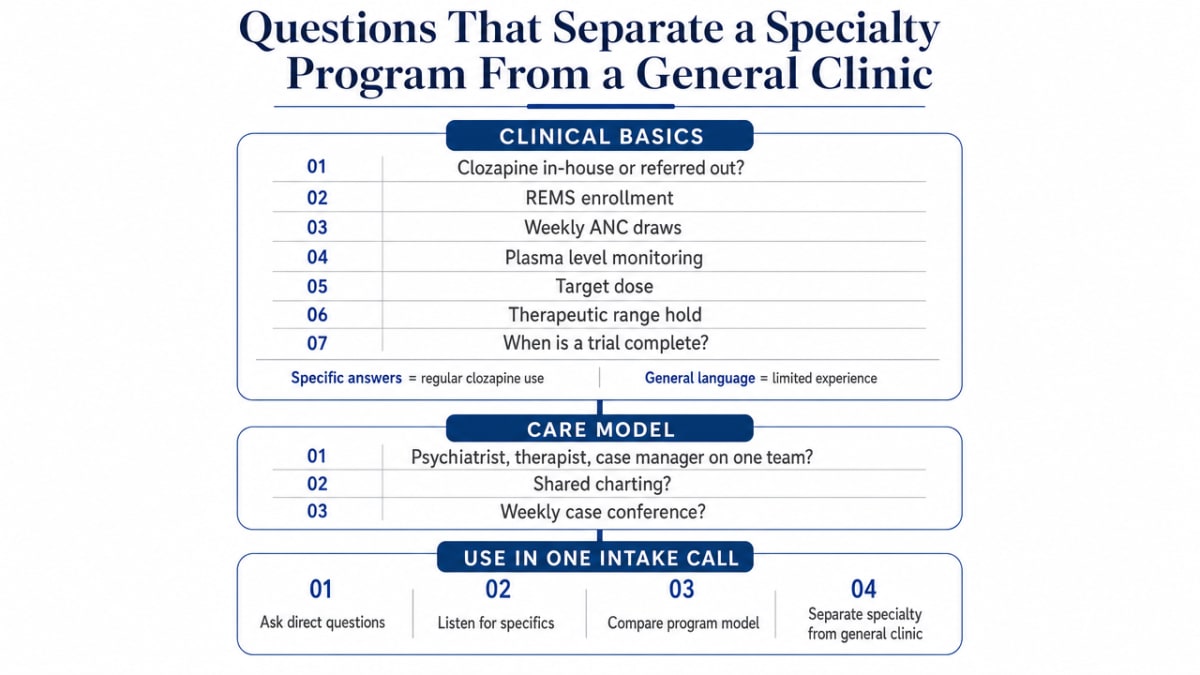
By the time you are placing calls, the difference between programs sounds subtle. Everyone says they treat schizophrenia. Everyone mentions medication management and therapy. The distinctions show up in the answers to a small set of direct questions, and you can ask them in a single intake conversation.
Start with the clinical basics. Do you initiate and manage clozapine in-house, including REMS enrollment, weekly ANC draws, and plasma level monitoring, or do you refer that out 4, 6? What target dose do you aim for, and how long do you hold at therapeutic range before calling a trial complete 5? A program that runs clozapine regularly answers in specifics. One that doesn’t will pivot to general language about medication options.
Then the model itself. Are the psychiatrist, therapist, and case manager on one team with shared notes, or are they separate providers you will be coordinating between? Do you offer CBT for psychosis, assertive community treatment, and supported employment as part of the plan, or only medication visits 7, 12? A coordinated specialty program should be able to name the components without hedging.
The dual diagnosis question is not optional. Do you treat substance use alongside the psychiatric diagnosis in-house, at the same time, with the same team 1, 2? If the answer is a referral to a separate program, you are looking at fragmented care for a case that specifically requires integration.
Finally, the family and system questions. How are caregivers included in treatment planning, and how often do family sessions occur? Do you accept AHCCCS and support SMI designation applications through the ACC-RBHA if one is not yet in place? A program built for complex care in Prescott will answer each of these plainly. That is the sound of a specialty program. Anything vaguer is a general clinic with a schizophrenia line item.
Start a Personalized Schizophrenia Assessment Today
Connect with specialists to clarify next steps for complex schizophrenia care in Prescott.
Frequently Asked Questions
How do we know if our family member’s schizophrenia is actually treatment-resistant?
The clinical bar is specific: persistent significant symptoms after two adequate antipsychotic trials, meaning each medication reached a therapeutic dose, ran long enough (typically at least six weeks at target), and was verifiably taken as prescribed 1, 3. Before the label sticks, adherence, dosing, and active substance use should be ruled out, because each mimics resistance and each has a different fix 2.
Why is clozapine considered the gold standard, and should a Prescott program manage it locally?
Two decades of evidence confirm clozapine as the gold standard for treatment-resistant schizophrenia, with added indications for persistent suicidality and aggression 3. It requires REMS enrollment, careful titration, and ongoing blood monitoring 4. Local management matters because prescriber, lab, and pharmacy need to operate in one loop. Programs that refer clozapine out often introduce delays that undermine the very continuity the medication needs to work.
What does an SMI designation through AHCCCS actually change about access to care in Yavapai County?
SMI designation shifts your loved one into an ACC-RBHA benefit package that combines physical health, behavioral health, and crisis services under one contract 9. That unlocks case management, assertive community treatment, supported employment, peer support, and 24-hour crisis response alongside psychiatric care. Statewide AHCCCS enrollment data confirms the scale of this scaffolding 13. Without SMI status, many of these services are not covered by standard insurance.
How are families included in coordinated specialty care, and what should we expect from that role?
Family support and shared decision-making are named components of coordinated specialty care, not courtesies 7. The VA/DoD synopsis lists family and caregiver services as a distinct recommended intervention 12. Expect psychoeducation, structured participation in treatment planning, coaching on early warning signs, and a defined channel to report what you see at home. Your observations about sleep, paranoia, or missed doses count as clinical data the team should use.
If our loved one uses substances, will a schizophrenia program still take them?
A specialty program should. Active substance use is one of the top reasons treatment resistance gets misdiagnosed, because cannabis, methamphetamine, or heavy alcohol use destabilizes antipsychotic response 2. Integrated care treats both diagnoses at the same time, with the same team, rather than sequencing them. Ask directly whether substance use treatment happens in-house alongside the schizophrenia care. A referral to a separate program means fragmented care for a case that requires integration 1.
What questions should we ask to tell a specialty program apart from a general outpatient clinic?
Ask whether they initiate and manage clozapine in-house, including REMS, weekly ANC draws, and plasma levels 6. Ask what target dose they aim for and how long they hold before calling a trial complete 5. Ask whether psychiatrist, therapist, and case manager share one plan and offer CBT for psychosis and assertive community treatment 12. Ask whether they treat substance use in-house and support AHCCCS SMI applications. Specifics signal capability; vague answers signal a general clinic.
References
- The American Psychiatric Association Practice Guideline for the Treatment of Patients With Schizophrenia (2020). https://www.med.unc.edu/psych/epi-nc/wp-content/uploads/sites/720/2024/01/APA-2020-guidelines-1.pdf
- Treatment-Resistant Schizophrenia. https://pmc.ncbi.nlm.nih.gov/articles/PMC7725152/
- Clozapine: A Review of Clinical Practice Guidelines and Recommendations for Use. https://pmc.ncbi.nlm.nih.gov/articles/PMC3999500/
- A Guideline and Checklist for Initiating and Managing Clozapine Treatment in Patients With Treatment-Resistant Schizophrenia. https://pmc.ncbi.nlm.nih.gov/articles/PMC9243911/
- Clozapine Dosing and Monitoring Guidance (Oregon Health Authority, 2025). https://www.oregon.gov/oha/HPA/DSI-Pharmacy/MHCAGDocs/Clozapine%20Dosing_09-04-2025_final.pdf
- Clozapine National Protocol Guidance – Monitoring (VA, March 2025). https://www.va.gov/formularyadvisor/DOC_PDF/CRE_Clozapine_National_Protocol_Guidance_-_Monitoring_Mar_2025.pdf
- RAISE-ing the Standard of Care for Schizophrenia. https://www.nimh.nih.gov/news/science-updates/2023/raise-ing-the-standard-of-care-for-schizophrenia-the-rapid-adoption-of-coordinated-specialty-care-in-the-united-states
- January 14, 2026 The Honorable David …. https://www.azahcccs.gov/shared/Downloads/Reporting/2025/2025_SMI_AnnualBeahvioralHealthReport.pdf
- April 2, 2026 The Honorable Katie Hobbs Governor of Arizona …. https://www.azahcccs.gov/shared/Downloads/Reporting/2026/SB1311LegislativeSMIMonitoringReport.pdf
- VA/DoD 2023 Guideline for the Management of First-Episode …. https://www.mirecc.va.gov/visn22/VA_DoD_2023_Guideline_for_the_Management_of_First_Episode_Psychosis_and_Schizophrenia.asp
- VA/DoD Clinical Practice Guideline for Management of First-Episode Psychosis and Schizophrenia. https://www.govinfo.gov/app/details/GOVPUB-VA-PURL-gpo218690
- Psychosocial Management of First-Episode Psychosis and Schizophrenia: Synopsis of the US Department of Veterans Affairs and US Department of Defense Clinical Practice Guidelines. https://www.mirecc.va.gov/MIRECC/visn22/Niv_et_al_2025_Psychosocial_Management_of_First-_Episode_Psychosis_and_Schizophrenia_Synopsis_of_VA_DoD_CPG.pdf
- AHCCCS Population Highlights March 2026. https://www.azahcccs.gov/Resources/Downloads/PopulationStatistics/PopulationHighlights03052026.pdf