Key Takeaways
- Treatment resistance has specific clinical thresholds, like two adequate antipsychotic trials with verified adherence, so programs should name those criteria rather than treat resistance as vague 9.
- Length of stay should follow clinical progress, not a fixed calendar. ASAM calls rigid 30, 60, and 90-day models inappropriate for residential care 11.
- Real individualized planning rests on a multi-domain biopsychosocial assessment with regular reassessment, surfacing trauma, medication history, and family context that earlier care may have missed 6.
- Psychiatric depth means 24/7 board-certified prescribers, in-house clozapine protocols, and integrated dual-diagnosis teams, not a weekly medication check with a rotating consultant 12.
- Accreditation from the Joint Commission, ASAM’s framework, and state licensure verifies that staffing, assessment, and discharge practices actually operate as described, giving the other criteria enforceable weight 11.
- On an intake call, four direct questions about discharge decisions, assessment domains, psychiatric protocols, and accrediting bodies can quickly separate serious programs from repackaged standard rehab 7.
When Standard Care Keeps Falling Short
You already know how this feels. Another intake call, another packet of forms, another well-meaning clinician asking you to describe a history you’ve told a dozen times. Maybe you’re the one living with the diagnosis. Maybe you’re a parent, a partner, a sibling holding the phone. Either way, you’ve been here before, and the last program didn’t hold.
That exhaustion is real, and it isn’t evidence that you gave up or didn’t try hard enough. Treatment resistance is a clinical reality. When someone has cycled through medication trials, short residential stays, and standard outpatient care without lasting change, the honest answer is rarely “try harder.” It’s usually that the program design didn’t match the complexity of what’s actually going on, especially when a psychiatric condition and a substance use disorder are tangled together. Federal guidance is direct on this point: integrated, concurrent treatment of mental illness and substance use is the preferred model, not an add-on to be arranged later 7.
The problem is that most of the field still runs on a template. A fixed length of stay. A standardized curriculum. A psychiatrist who consults a few hours a week. For someone whose case has already outrun that template, a longer stay at a similar-looking address usually delivers the same result.
What follows is a rubric you can use on your next intake call. Four criteria, each with specific questions to ask. The goal isn’t to shop harder. It’s to filter faster, so the shortlist gets down to programs actually built for the situation in front of you.
What ‘Treatment-Resistant’ Actually Means Clinically
Before you evaluate a single program, it helps to name what you’re actually dealing with. “Treatment-resistant” isn’t a shrug or a personality trait. In psychiatry, it’s a specific clinical status with specific thresholds, and any program that markets itself as equipped for it should be able to describe those thresholds without hesitation.
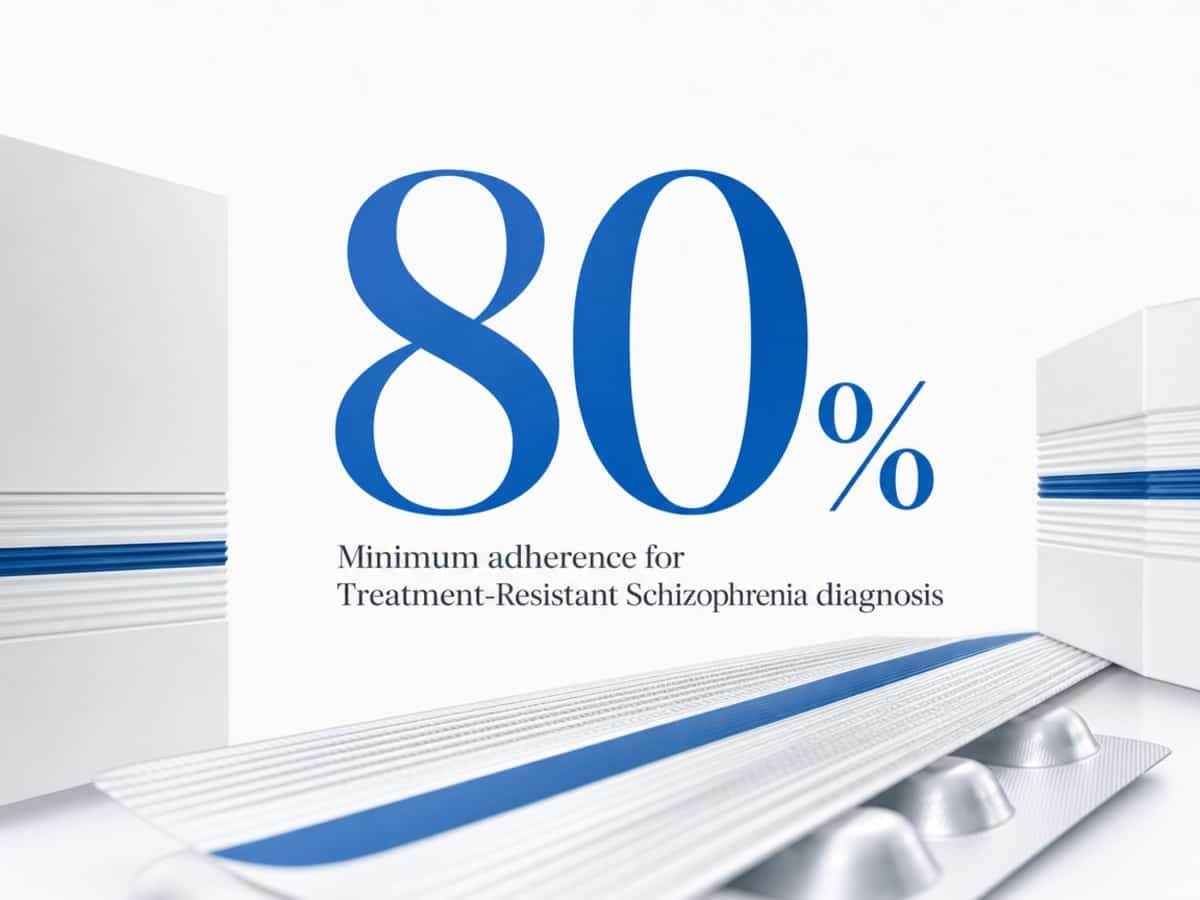
For schizophrenia, the working definition is fairly precise: non-response to at least two adequate antipsychotic trials, each lasting six weeks or more at therapeutic doses, with verified adherence of at least 80% of prescribed doses 9. That last piece matters. If earlier providers never confirmed whether medication was actually taken as prescribed, the case may not have failed treatment so much as never fully received it. A serious program will ask about adherence verification early, not treat it as an afterthought.
For bipolar disorder with a co-occurring substance use disorder, the picture is different but the principle is the same. Comorbidity worsens acute treatment response and the long-term course, which is why guidelines point to integrated group therapy delivered during the initial treatment phase rather than sequenced later 12. If the substance use was treated in one building and the mood disorder in another, that’s not a failed patient. That’s a failed care model.
And for the broad category of co-occurring disorders, SAMHSA is direct: any combination of DSM-5 substance use and mental disorders can co-occur, and integrated concurrent treatment is the preferred approach, not a sequential handoff 8. When you hear a program describe substance use as something to “stabilize first” before the psychiatric work begins, you’re hearing an older model.
Knowing these definitions changes what you listen for on an intake call. You’re not asking whether a program treats your diagnosis. You’re asking whether it recognizes the specific clinical picture that made standard care fall short, and whether it can name the thresholds it uses to decide what treatment-resistant actually means in practice.
Four Criteria That Separate Real Treatment-Resistant Care From Repackaged Rehab
The Rubric at a Glance
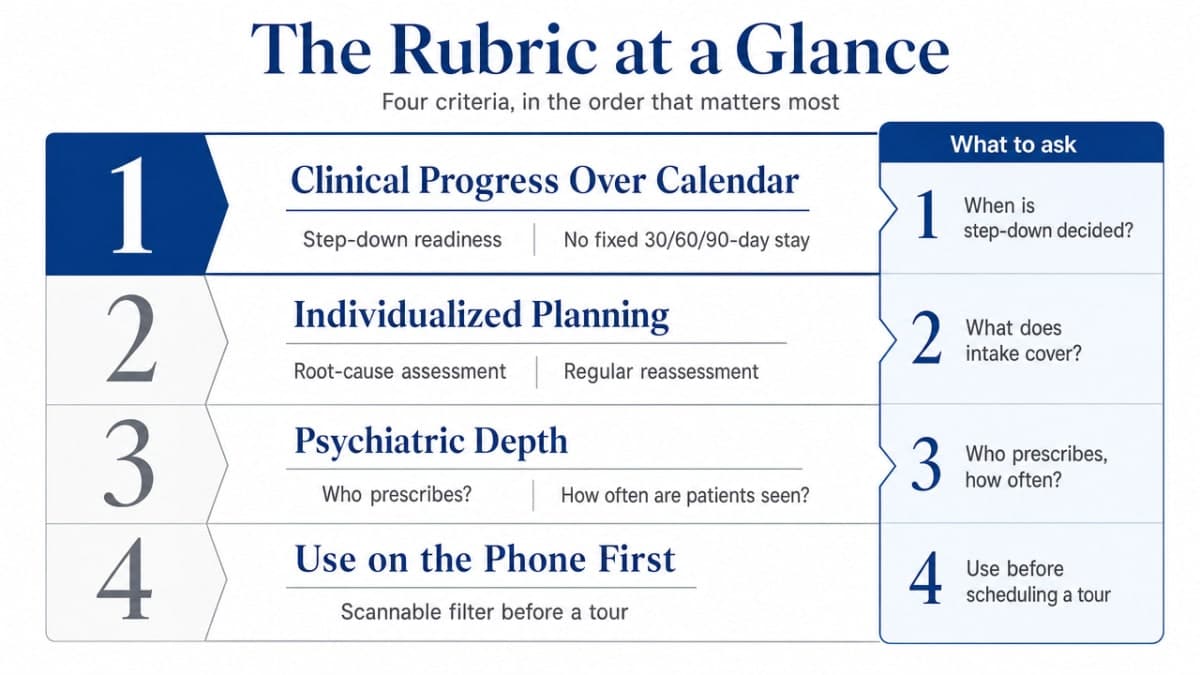
Here is the filter. Four criteria, in the order that matters most when a case has already outrun standard care. Use them on the phone before you use them on a tour.
Treatment duration driven by clinical progress, not the calendar. Ask how the program decides when someone is ready to step down. If the answer is a number of days, you have your answer. ASAM’s own residential guidance calls fixed 30, 60, and 90-day lengths of stay “inappropriate” and directs that duration be set by patient needs and progress 11.
Individualized planning built on root-cause assessment. Ask what the intake assessment covers and how often the plan is revisited. A serious program will describe a multi-domain biopsychosocial assessment and regular reassessment, not a intake form and a curriculum.
Psychiatric depth, not just psychiatric coverage. Ask who prescribes, how often they see patients, and whether the program runs advanced protocols like clozapine for treatment-resistant schizophrenia. “A psychiatrist on staff” is not the same as psychiatry being the spine of the program.
Accreditation that reflects actual clinical standards. Ask which body accredits the facility and what that body actually audits. Names on a website are not the same as standards on the floor.
The next four sections take each criterion apart, name what a strong answer sounds like, and show where ViewPoint Dual Recovery lands on each.
Criterion One: Treatment Duration Driven by Clinical Progress, Not the Calendar
Start here, because this one filter alone will shorten your list fast. Ask the admissions coordinator a direct question: How does your program decide when someone is ready to step down? If the answer arrives as a number of days, or as a range that just happens to line up with common insurance benefit tiers, you already have your finding. The calendar is running the clinical decisions.
For historical context, SAMHSA notes that residential therapeutic community stays have traditionally run six to twelve months, though managed care pressure has pushed those durations down over time 6. You do not need a year of residential care to have a serious program. You do need a program willing to say, on the record, that discharge is a clinical decision keyed to symptom stability, medication response, and functional gains, not a benefit ceiling.
Two follow-up questions tell you almost everything:
- How often is the treatment plan formally reassessed, and by whom? A strong answer names the cadence (often weekly at residential intensity) and the disciplines at the table.
- What happens if I need more time than my insurance authorizes? Listen for whether the program has a real answer, or whether the conversation quietly turns to discharge.
This is where ViewPoint Dual Recovery sits on the rubric. The program in Prescott, Arizona sets treatment duration based on clinical need rather than insurance timelines, with the treatment plan reassessed as the psychiatric picture shifts. For someone with treatment-resistant schizophrenia stabilizing on a clozapine protocol, or a rapid-cycling bipolar presentation with a co-occurring substance use disorder, the runway required is rarely 28 days. Being able to say so, out loud, is part of what the criterion is measuring.
If you take nothing else from this section, take this: a program that leads with duration is selling you a package. A program that leads with reassessment is running treatment. Move that question to the top of your intake call.
Criterion Two: Individualized Planning Built on Root-Cause Assessment
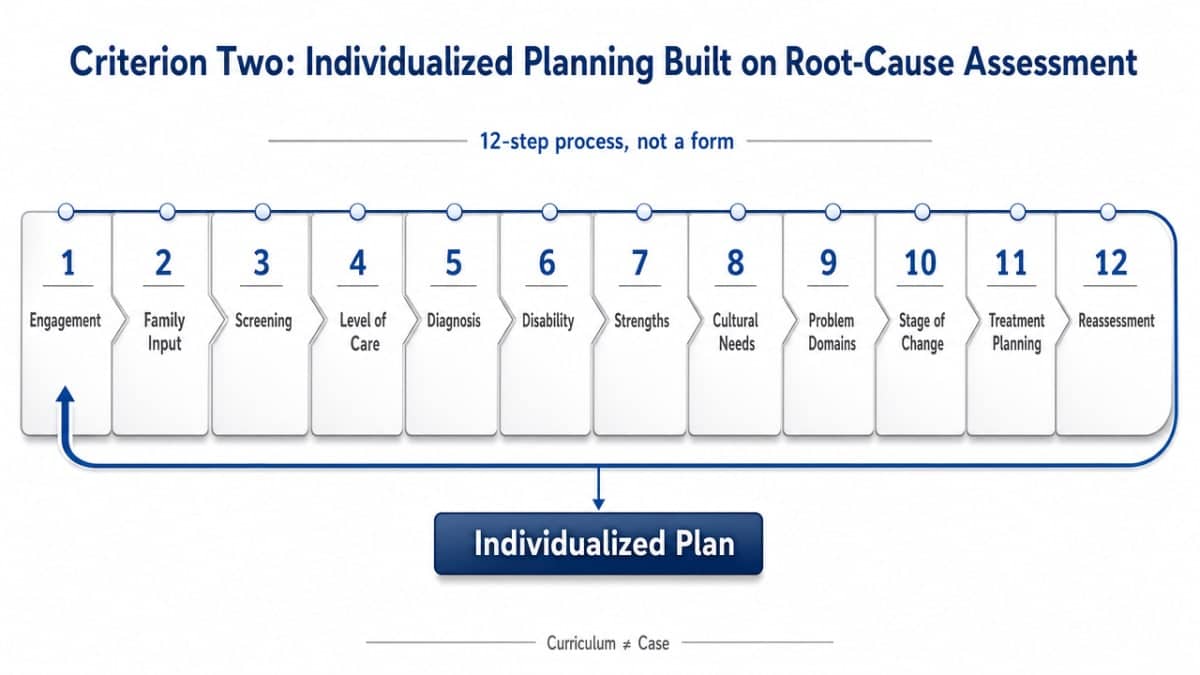
The second filter is quieter than the first, but it does most of the work. Ask what the intake assessment actually covers, and then ask what happens with it after week one. If the plan you leave admissions with looks a lot like the plan the person before you left with, the program is running a curriculum, not a case.
SAMHSA describes assessment for co-occurring disorders as a 12-step process, not a form: engagement, family input, screening, level-of-care determination, diagnosis, disability, strengths, cultural needs, problem domains, stage of change, and treatment planning, with reassessment folded in as the picture changes 6. That is a lot of ground to cover, and it is meant to be. When earlier treatment failed, the reason is often buried in one of those domains no one had time to look at, such as an untreated trauma history, a cognitive deficit that made a prior therapy modality unworkable, or a family system that was quietly undoing gains between visits.
ASAM’s residential framework operationalizes this through a six-dimensional biopsychosocial assessment, with the expectation that reassessment happens on a regular cadence, sometimes daily, sometimes weekly, depending on the intensity of the setting 11. SAMHSA’s program-design guidance points in the same direction, naming six principles for co-occurring care that include a phased approach, planning for cognitive and functional impairments, and addressing real-life problems early rather than deferring them to aftercare 3. None of that is compatible with a fixed track.
Three questions surface a real answer fast:
- What does your initial assessment cover, and how long does it take? A serious program will describe multiple domains and multiple disciplines, not a single interview.
- How often is the treatment plan formally updated, and what triggers a change? Listen for named intervals and named clinical signals, not “as needed.”
- How do you handle findings that don’t fit your standard programming? The honest answer is that they adjust the plan, not the patient.
ViewPoint Dual Recovery is built around this kind of assessment. Intake at the Prescott, Arizona facility uses a root-cause approach that reaches past the presenting diagnosis into trauma history, prior medication response, family context, and functional impairment, and the integrated care team, psychiatry and therapy at the same table, revises the plan as new information surfaces. For someone whose prior treatment ended where the standard track ran out, that willingness to keep looking is the difference between another episode of care and a plan that finally fits.
Criterion Three: Psychiatric Depth, Not Just Psychiatric Coverage
The third filter is where a lot of programs quietly fail. “Psychiatry available” and “psychiatry central” are two very different operating models, and the difference shows up in exactly the cases you’re trying to place. Ask the admissions coordinator two questions: Who prescribes, and how often does that person actually see patients? Then ask a third: What do you do for treatment-resistant schizophrenia? The answers will tell you whether psychiatry is the spine of the program or a Tuesday consult.
Here is what “depth” means in concrete terms. For treatment-resistant schizophrenia, the peer-reviewed threshold is specific: the case has to have failed at least two adequate antipsychotic trials, each lasting six weeks or more at therapeutic doses (roughly 600 mg chlorpromazine-equivalent daily), with verified medication adherence of at least 80% of prescribed doses 9. A program with real psychiatric depth will describe those numbers back to you without looking them up. They will also describe how they verify adherence going forward, because a case that was never properly medicated is not the same as a case that failed medication.
The next test is clozapine capability. Clozapine remains the medication with the strongest evidence for treatment-resistant schizophrenia, but it requires ongoing hematologic monitoring, careful titration, and a prescriber comfortable managing side effects that scare off less experienced clinicians. A program that treats schizophrenia but doesn’t run clozapine protocols is not a program for the treatment-resistant end of the spectrum. Ask directly. The answer should be yes, we do, and here is how we monitor it.
For bipolar disorder with a co-occurring substance use disorder, depth means something adjacent. The clinical guideline for this population identifies integrated group therapy delivered during the initial phase of treatment as the approach with the strongest evidence for substance use outcomes 12. If the program’s answer is that the mood work happens on one track and the substance use work happens on another, that is coverage, not depth. Depth is a psychiatrist and a therapist sitting at the same table, working the same case, in the same week.
Two more questions round out the picture:
- How often does a board-certified psychiatrist see each patient, and is psychiatry available 24/7? Weekly medication checks are not the same as psychiatric management. Complex cases need eyes on them.
- What advanced protocols do you run in-house? Listen for named interventions (clozapine, long-acting injectables, structured mood stabilization for rapid cycling) rather than “we work with your outside psychiatrist.”
ViewPoint Dual Recovery is built around this criterion. The Prescott, Arizona program is led by board-certified psychiatrists, with clozapine protocols available in-house for treatment-resistant schizophrenia and advanced medication strategies for rapid-cycling bipolar presentations. Psychiatrists and therapists work as an integrated team on each case rather than passing charts between siloed departments. For someone whose prior care topped out at a weekly med check with a rotating provider, that shift, from psychiatry as a service line to psychiatry as the operating structure, is often the variable that finally moves the case.
One practical note before you move to the last criterion. When you ask these questions, you are not testing the coordinator. You are testing whether the program has bothered to train intake staff on what treatment-resistant care actually requires. If the person on the phone can speak fluently about adherence thresholds, adequate trials, and clozapine, the program takes this population seriously. If the conversation keeps redirecting to amenities and length of stay, you have your answer there too.
Criterion Four: Accreditation That Reflects Actual Clinical Standards
The last filter is the one most people skim, and it’s the one that quietly determines whether the first three criteria have any teeth. A logo on a website is easy. An audit that actually checks what happens on the floor is not. When you ask about accreditation, you’re not asking for a credential to add to a spreadsheet. You’re asking what an outside body has verified about how this program runs.
The two names worth knowing are the Joint Commission and, on the addiction side, ASAM’s level-of-care framework. Joint Commission accreditation for behavioral health means the facility has been surveyed against standards covering medication management, staffing, patient safety, care planning, and documentation. ASAM’s framework is what serious residential programs are measured against for level-of-care decisions, reassessment cadence, and the six-dimensional biopsychosocial assessment that should drive every treatment plan 11. State licensure adds another layer worth asking about. Residential rules in some states require 24-hour onsite nursing, a physician evaluation within 24 hours of admission, and a written discharge plan tied to the reasons for admission, not a template 13.
Two questions cut through the marketing:
- Who accredits or licenses the facility, and what did their most recent survey look at? A real answer names the body and can describe what the surveyors reviewed.
- Are you separately licensed or certified for the behavioral health side, not just the substance use side? Dual-diagnosis programs need to clear both bars.
ViewPoint Dual Recovery is accredited by the Joint Commission, licensed by Arizona ADHS, and LegitScript certified. Those aren’t badges. They are the outside verification that the length-of-stay policy, the assessment process, and the psychiatric staffing described in the first three criteria are actually in place, day to day, in Prescott. Without that layer, the rest of the rubric is a promise. With it, you have something you can hold a program to.
Using the Rubric on an Intake Call
You do not need a long conversation to apply this. Fifteen minutes on the phone, four questions, and you will know whether a program belongs on your shortlist. Keep the rubric next to you and take notes.
Start with length of stay. Ask how discharge is decided. If the answer names a number of days before it names a clinical signal, thank them and move on. A serious answer will describe reassessment against symptom stability, medication response, and functional gains, consistent with the standard that fixed durations are not clinically appropriate 11.
Move to assessment. Ask what the first week looks like and what domains the intake covers. Listen for something resembling the multi-step biopsychosocial process SAMHSA describes, including trauma history, prior medication response, family context, cognitive function, and stage of change 6. If the answer is a single interview and a schedule, you have your finding.
Then test psychiatric depth. Ask who prescribes, how often that person sees patients, and whether the program runs clozapine protocols in-house. Ask how integrated dual-diagnosis care is actually structured, since concurrent treatment by providers trained in both domains is the recognized standard 7. Vague answers here are the answer.
Close with accreditation. Ask which bodies accredit or license the facility and what was reviewed at the most recent survey.
ViewPoint Dual Recovery in Prescott, Arizona was built to answer these four questions on the first call. If the program you are considering cannot, keep dialing. You have already done the hard work of knowing what to ask.
Get Expert Input on Complex Case Pathways
Receive a personalized clinical review focused on advanced, treatment-resistant psychiatric needs.
Frequently Asked Questions
How do I know if my condition is truly treatment-resistant?
Treatment resistance has clinical thresholds, not just a feeling of being stuck. For schizophrenia, it typically means at least two adequate antipsychotic trials of six weeks or more at therapeutic doses, with verified adherence 9. For depression or bipolar disorder, it usually means multiple failed medication trials at correct doses and durations. A program that specializes in treatment-resistant care should be able to walk you through these thresholds and ask about adherence verification before assuming past treatment truly failed.
Why are 30, 60, and 90-day programs not always the right fit?
Fixed durations tend to match insurance benefit tiers, not clinical progress. ASAM’s residential guidance directs that length of stay be based on the patient’s needs and progress, and describes fixed 30, 60, and 90-day models as inappropriate 11. For treatment-resistant cases, stabilizing a new medication protocol, working through trauma, and restoring function often take longer than a calendar allows. Look for a program that reassesses regularly and adjusts duration to what the clinical picture is actually showing, not what a benefit ceiling permits.
What should I ask a treatment center about their psychiatric expertise?
Ask who prescribes, how often that person sees each patient, and whether psychiatry is available 24/7. Then ask about specific protocols: Do they run clozapine in-house for treatment-resistant schizophrenia? How do they manage rapid-cycling bipolar presentations? How do psychiatrists and therapists coordinate on the same case? A serious program will name adequate trial thresholds and adherence verification without hesitation 9. Vague references to “medication management” or a psychiatrist who consults a few hours a week signal coverage, not depth.
What accreditations actually matter when evaluating a program?
Joint Commission accreditation for behavioral health is the most meaningful national standard, covering medication management, staffing, patient safety, and care planning. ASAM’s level-of-care framework governs residential clinical decisions and reassessment cadence 11. State licensure adds another layer, often requiring 24-hour onsite nursing, physician evaluation within 24 hours of admission, and individualized discharge planning tied to admission reasons 13. Ask which body accredits the facility, what the most recent survey reviewed, and whether the behavioral health side is separately licensed from substance use services.
How is dual-diagnosis care different from treating each condition separately?
Integrated care treats the psychiatric condition and the substance use disorder concurrently, by the same team, in the same setting. SAMHSA identifies this as the preferred model, with providers trained in both domains delivering stage-wise treatment 7. Studies show integrated treatment improves substance use, psychiatric symptoms, hospitalization rates, and housing stability compared with non-integrated care 1. Sequential models, where substance use is “stabilized first” before psychiatric work begins, reflect an older approach that often leaves the underlying condition untreated long enough to derail recovery.
What does a real individualized treatment plan look like?
It starts with a multi-domain biopsychosocial assessment covering engagement, family input, diagnosis, strengths, cultural needs, problem domains, stage of change, and treatment planning 6. The plan names specific clinical goals, the interventions chosen for this person, and the cadence for reassessment as new information surfaces. Program design principles include a phased approach, addressing real-life problems early, and planning for cognitive or functional impairments 3. If the plan you leave admissions with looks like the plan the person before you left with, it isn’t individualized.
References
- Integrated Treatment for Co-Occurring Disorders: The Evidence. https://library.samhsa.gov/sites/default/files/ebp-kit-the-evidence-10242019.pdf
- Integrated Treatment for Co-Occurring Disorders Evidence-Based Practices (EBP) KIT. https://library.samhsa.gov/product/integrated-treatment-co-occurring-disorders-evidence-based-practices-ebp-kit/sma08-4366
- Integrated Treatment for Co-Occurring Disorders: Building Your Program. https://library.samhsa.gov/sites/default/files/ebp-kit-building-your-program-10112019.pdf
- Co-Occurring Disorders Integrated Dual Disorders Treatment (IDDT) Toolkit. https://portal.ct.gov/-/media/dmhas/cosig/iddttoolkitpdf.pdf
- TIP 42: Substance Use Treatment for Persons With Co-Occurring Disorders. https://library.samhsa.gov/product/tip-42-substance-use-treatment-persons-co-occurring-disorders/pep20-02-01-004
- Substance Use Disorder Treatment for People with Co-Occurring Disorders (Supplemental PDF). https://library.samhsa.gov/sites/default/files/pep20-06-04-006.pdf
- TIP 42, Substance Use Disorder Treatment for People With Co-Occurring Disorders (Selected Chapters). https://library.samhsa.gov/sites/default/files/SAMHSA_Digital_Download/PEP20-02-01_004.pdf
- Co-Occurring Disorders and Other Health Conditions. https://www.samhsa.gov/substance-use/treatment/co-occurring-disorders
- Treatment Resistant Schizophrenia: Clinical, Biological, and Therapeutic Perspectives. https://pmc.ncbi.nlm.nih.gov/articles/PMC6395548/
- The ASAM/AAAP Clinical Practice Guideline on the Management of Stimulant Use Disorder. https://pmc.ncbi.nlm.nih.gov/articles/PMC11105801/
- SUD Residential Guidance (ASAM Level of Care Interpretation). https://www.chfs.ky.gov/agencies/dms/ProviderLetters/SUDResidentialGuidance.pdf
- Clinical Practice Guideline on Pharmacological and Psychological Management of Adult Patients With Bipolar Disorder and Comorbid Substance Use. https://pubmed.ncbi.nlm.nih.gov/34171104/
- Mont. Admin. r. 37.106.2202 – Residential Treatment Facility: Licensure Standards. https://www.law.cornell.edu/regulations/montana/Mont-Admin-r-37.106.2202