Key Takeaways
- Chronic relapse in dual diagnosis usually reflects a mismatch between treatment length and clinical complexity, not a failure of willpower or personal commitment 16.
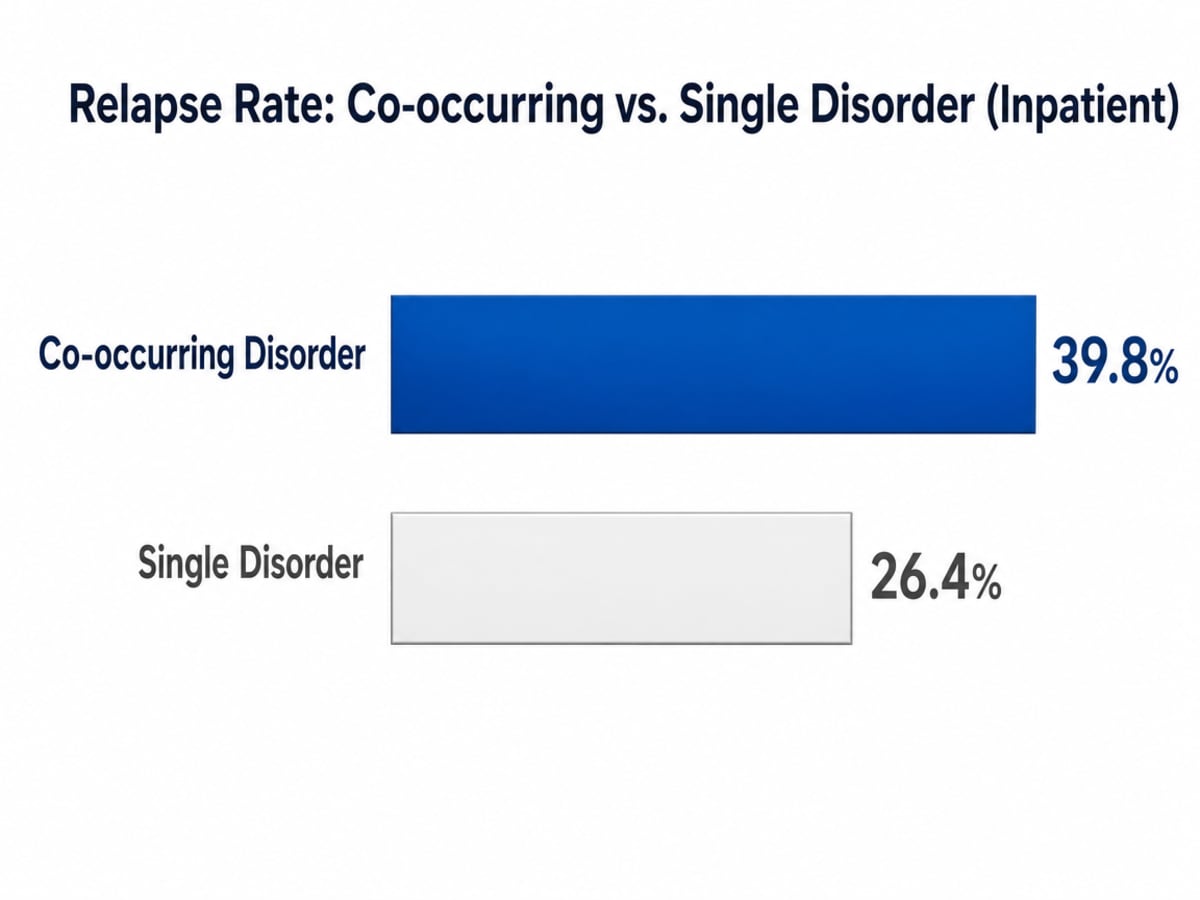
- Co-occurring patients relapse at 39.8% versus 26.4% for substance use alone when placed in programs designed around a single diagnosis 2.
- Staying at least 90 days in truly integrated care — where psychiatrist and therapist share one plan — consistently improves both psychiatric and substance use outcomes 5, 7.
- Integration alone does not move substance use outcomes without adequate duration, so families should plan for stays that extend past insurance-driven 28-day ceilings 15.
When the program ends and the crisis starts again
You know the pattern by heart now. The discharge paperwork. The ride home. The first quiet week where everything feels possible. Then something shifts — a bad night, a panic wave, a depressive flatline that no one prepared you for — and within weeks or months, you or someone you love is back in a bed you swore you’d never see again.
If you’re reading this, you’ve probably done a 28-day program. Maybe two. Maybe five. You’ve cycled through detox, IOP, sober living, aftercare calls that tapered off. You’ve been told to work the steps harder, to be more accountable, to want it more. And somewhere along the way, the message became: the treatment worked; you didn’t.
That framing is wrong, and the clinical literature has been saying so for years. SAMHSA’s TIP 42, the field’s core guidance document for co-occurring disorders, tells clinicians to treat relapse as a learning event — data about what the treatment plan missed — not as a character verdict on the patient 16.
Here’s what that actually means for you. When someone with a dual diagnosis relapses after a short residential stay, the most likely explanation isn’t willpower. It’s a mismatch between how long and how integrated the care was and what your specific brain and history actually needed. Depression that never got treated during your AUD stay. Trauma that got sidestepped. A psychiatrist you saw once for a med refill instead of a clinician on your case.
The rest of this article is about that mismatch — and about what an extended, individualized model looks like when it’s built around the evidence instead of around a 28-day billing cycle.
Why 28 days keeps failing you
The 28-day model wasn’t designed for you. It was designed around a 1970s Medicare billing convention, and it’s still the default because insurance says so — not because the clinical evidence points there.
For someone with an isolated, uncomplicated substance use disorder and a stable psychiatric profile, a month of structured residential care can be enough to interrupt the pattern and hand off to outpatient work. That is not your situation. You have a co-occurring diagnosis, probably more than one substance in the mix, and a nervous system that has been through this before. The math changes.
Look at what the most recent data says about short-term residential stays. A 2025 analysis of adults discharged from non-hospital short-term residential treatment found a 32% relapse rate on opioids after discharge, and adults with combined opioid and methamphetamine use had significantly lower odds of even completing the short-term program in the first place 6. Polysubstance use — which is the norm, not the exception, in dual diagnosis — is exactly the population that short programs are worst at holding onto and worst at stabilizing.
That’s not a knock on the people who work in those programs. Most of them are doing skilled, humane work inside a container that is too small for the clinical problem in front of them. Twenty-eight days is enough time to detox, learn some vocabulary, and start feeling like a person again. It is not enough time to stabilize a mood disorder on the right medication, process any real trauma, or build the kind of psychiatric continuity that keeps you out of the emergency room in month four.
A systematic review of treatment intensity in SUD programs put it plainly: longer duration and greater service intensity are consistently linked to reduced substance use and better psychosocial outcomes, especially for people with co-occurring psychiatric disorders or severe addiction 10. That finding is not controversial in the literature. It is only controversial at the level of what insurance will pay for.
So when you finished your last program feeling shaky, and the aftercare plan was a weekly outpatient appointment and a phone number for a sponsor, that wasn’t a personalized clinical decision. That was a length-of-stay ceiling. The relapse that followed isn’t evidence that treatment doesn’t work for you. It’s evidence that the dose was wrong.
You deserve to know that. And you deserve a next step that actually reflects the complexity of your case instead of pretending the last five didn’t happen.
Why relapse hits dual diagnosis harder
There is a real, measurable penalty attached to having a co-occurring psychiatric diagnosis in a standard SUD program. It is not in your head, and it is not because you didn’t want it enough.
A 2023 prospective cohort study of inpatients in substance use treatment compared people with a co-occurring psychiatric disorder to people with a substance use disorder alone. The relapse rate for the co-occurring group was 39.8%. For the group without a co-occurring diagnosis, it was 26.4% — an odds ratio of 1.85 2. That is a specific inpatient cohort, not a lifetime prevalence figure and not a statement about every program in the country. But the direction of the finding is consistent with everything else in the literature: when you carry both diagnoses into a program built primarily around one, you are structurally more likely to relapse than the person in the bed next to you.
The reasons are not mysterious. Depression that isn’t actively treated during alcohol use disorder care predicts a shorter time to first drink and lower abstinence rates after discharge 4. Untreated PTSD keeps the nervous system in the exact state that made substances feel necessary in the first place 13. Polysubstance patterns, especially opioids combined with stimulants, complicate withdrawal, medication choices, and craving in ways a generalist SUD curriculum isn’t built to address 6.
So if you have relapsed more than the friends you met in your last program, that is not evidence that you are more broken. It is evidence that the standard container was more mismatched to your case than to theirs. The higher risk is real. It is also modifiable when the treatment is actually built for the diagnosis you have.
A diagnostic checklist for your last treatment episode
Before you decide what kind of program to look at next, it helps to actually look backward — honestly, without blame — at what the last stay did and didn’t do. Not to relitigate it. To locate the gap.
Work through these questions about your most recent treatment episode. If you can’t answer one, that itself is information.
Was your depression, bipolar, or PTSD actively treated during the stay — or just noted on intake? Being screened is not the same as being treated. If your discharge summary lists a mood disorder but you left on the same medication (or no medication) you came in with, and no one adjusted the plan based on how you were sleeping, eating, or thinking in week three, your psychiatric condition was documented, not addressed. Untreated depressive symptoms during residential AUD care predict a shorter time to first drink after discharge 4.
Did you see a psychiatrist on your case, or a prescriber for med refills? There is a meaningful difference between a board-certified psychiatrist who knows your history and a rotating clinician who signs off on scripts. Integrated treatment, in the clinical sense, means the person managing your psychiatric medication and the person doing your addiction work are talking to each other about you — consistently 17.
Was trauma addressed inside the program, or deferred to “after you’re stable”? Deferring trauma work is a common structural choice in short programs. It also leaves the driver of use untouched. Trauma-informed integrated residential care produces reductions in both PTSD symptoms and substance use when the two are treated together, not in sequence 13.
How long did you actually stay, and what did the aftercare handoff look like? If your stay was under 90 days and your aftercare was a phone number rather than a scheduled outpatient psychiatric appointment, the continuity variable that most predicts stable outcomes was missing 5.
Were polysubstance patterns treated as one problem or split into categories? If opioids and stimulants were both in the picture but only one got a medication strategy, the plan was incomplete for the diagnosis you actually have 6.
If more than one of these lands, the last episode wasn’t your failure. It was an incomplete match. That distinction matters for what you look for next.
What the research says actually moves the needle
The 90-day retention threshold
Ninety days is not a magic number. It is a threshold that shows up repeatedly in the outcomes literature for people who look like you.
In a longitudinal study of patients with co-occurring disorders discharged from residential drug treatment, staying at least 90 days was linked to less inpatient psychiatric care, more outpatient mental health engagement, and lower substance use at the six-month follow-up 5. The reverse also showed up in the data: patients who relapsed by six months had worse psychological status at both six and twelve months, and used more inpatient mental health services 14. Length of stay and continuity of psychiatric care were doing real work.
Ninety days gives a clinical team enough time to actually stabilize a psychiatric medication trial, watch how you respond across weeks (not days), address sleep and appetite as they shift, and start the trauma or mood work that a 28-day container has to defer. It is also long enough for the nervous system to move past the acute post-acute withdrawal window that drives so many early relapses.
If your last stay was four weeks and you relapsed in month two or three, that timeline is not a coincidence. You were discharged before the therapeutic dose finished. A systematic review of treatment intensity in SUD programs reached the same conclusion — longer duration and greater service breadth consistently produce better outcomes in high-severity and co-occurring populations 10.
Integrated is not the same as co-located
This distinction matters, because a lot of programs use the word “integrated” to mean “we have a psychiatrist in the building.” That is co-location. It is not the same thing.
Integrated care means the psychiatrist managing your medication, the therapist doing your trauma work, and the addiction clinician running your relapse-prevention plan are talking to each other about your case — regularly, in writing, with a shared treatment plan. A review of randomized trials found that this kind of integrated model produces better substance use and psychiatric outcomes than parallel or sequential care 7. A broader review reached the same conclusion: integrated treatment for comorbidity is consistently superior to treating each disorder in isolation 17.
Here is the honest counterweight. A 2023 systematic review comparing integrated to non-integrated dual diagnosis care found that integration reliably improved psychiatric symptoms but did not, on its own, produce clearly better substance use outcomes or retention 15. Read that carefully. It does not mean integration doesn’t matter. It means integration alone — without adequate duration and intensity — is not enough to move the substance use needle for people with your clinical profile.
Which is why the two variables have to travel together. A ninety-day stay in a siloed program leaves the mood disorder untreated. An integrated team on a twenty-eight-day timeline runs out of clock. The combination is what changes trajectories.
Medication management that fits the diagnosis
Medication is often where standard programs quietly underperform for dual diagnosis. Not because the medications don’t work, but because the person prescribing them isn’t building a strategy for two conditions at once.
Consider alcohol use disorder with co-occurring depression or anxiety. A randomized trial of extended-release naltrexone in patients with alcohol dependence and co-occurring psychiatric disorders found fewer heavy drinking days and better treatment adherence compared with placebo 12. That is a specific medication decision, made because the psychiatric diagnosis was actually part of the plan. It is not what happens when a rotating prescriber refills whatever you walked in on.
The same logic applies across the harder presentations. Bipolar disorder with a substance use disorder needs mood stabilization that accounts for how substances interact with the medication. Treatment-resistant schizophrenia with co-occurring use may need clozapine protocols, which require the kind of ongoing monitoring most short-term SUD programs are not built for. Opioid use disorder needs a real MAT strategy that continues past discharge, not a taper timed to your billing cycle.
If your last program handed you a prescription without a psychiatrist who owned the plan across weeks, the medication piece was administrative. It was not clinical.
What sustained integrated care actually changes
When the container is right — long enough, integrated in practice, and built around your specific diagnostic picture — the numbers move in ways that are hard to argue with.
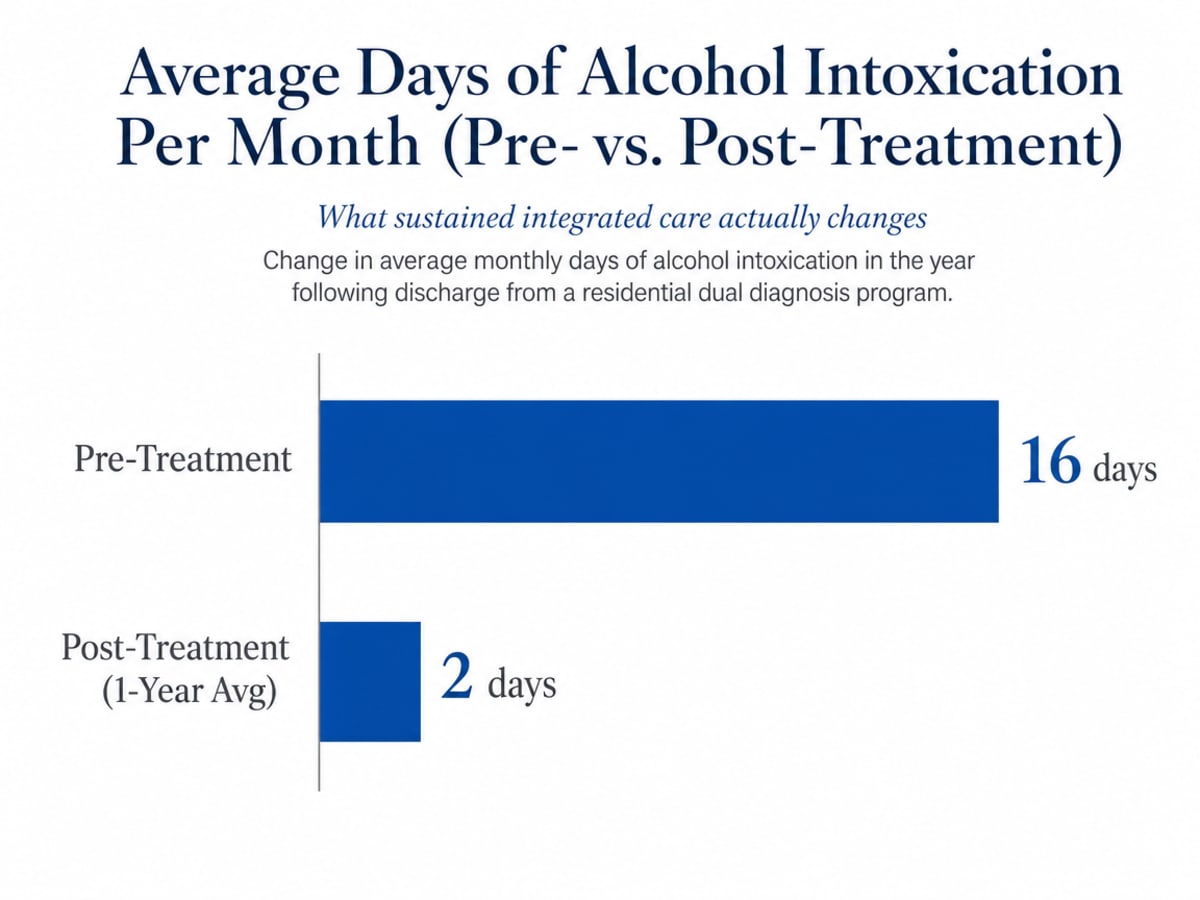
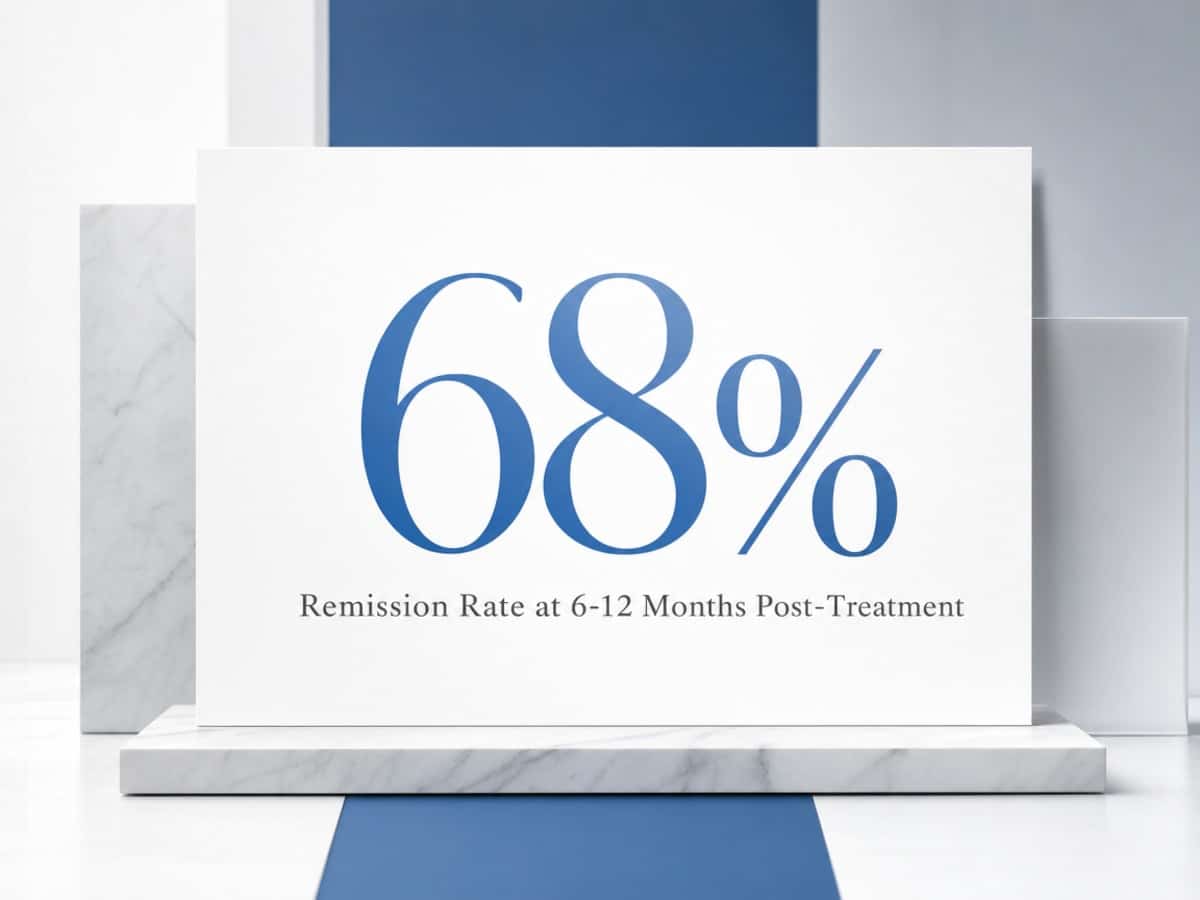
One study of a residential dual diagnosis program that treated alcohol use disorder and co-occurring psychiatric conditions concurrently tracked patients for a year after discharge. Reported average intoxication dropped from 16 days per month before treatment to 2 days per month in the year following discharge 3. That is not a small clinical shift. That is the difference between a life organized around drinking and a life where drinking is a rare, contained event. The same study reported that about 68% of patients were in remission at the six-to-twelve-month mark 3.
What is worth naming: those outcomes came from a program that treated the psychiatric condition and the substance use disorder as one clinical problem, over enough time to actually do the work. Not sequentially. Not in parallel. Together, with a team that shared a treatment plan.
The trauma literature points in the same direction. Participants in trauma-informed integrated residential care show meaningful reductions in both PTSD symptom severity and substance use when the two are addressed together rather than deferred 13. If PTSD has been the engine of your use, treating it inside the same program is the intervention.
None of this is a promise. Relapse still happens for a meaningful share of patients even in strong programs 3, and SAMHSA’s TIP 42 is clear that when it does, it should be treated as clinical information about what the plan missed, not as a discharge trigger 16. The point is that the trajectory can shift. It has, for people whose history looks like yours, when the treatment finally matched the diagnosis.
How ViewPoint’s model is built around the evidence
ViewPoint Dual Recovery, a Joint Commission-accredited psychiatric facility in Prescott, Arizona, is structured around the same variables the literature keeps pointing to: treatment duration determined by clinical need rather than a billing calendar, a psychiatrist and therapist working the same case together, and medication strategies chosen for the two diagnoses in front of them.
Treatment duration is individualized. Instead of ending treatment on day 28 because that is where coverage ends, the team assesses what the psychiatric picture actually needs to stabilize — which lines up with the 90-day retention threshold associated with lower substance use and less inpatient psychiatric care at follow-up 5. For someone with treatment-resistant depression, rapid-cycling bipolar disorder, or a trauma history that has driven every prior relapse, that assessment usually points past the standard month.
Integration is operational, not marketing. A board-certified psychiatrist leads the case, not a rotating prescriber signing off on refills. The psychiatrist and the therapist share a treatment plan and adjust it together, which is the specific arrangement randomized trials of integrated care are describing when they report better psychiatric and substance use outcomes than parallel treatment 7, 17.
Medication management is built for complexity. Advanced protocols — including clozapine for treatment-resistant schizophrenia and MAT options like extended-release naltrexone for alcohol use disorder with co-occurring psychiatric conditions 12— are handled by clinicians who monitor response across weeks. Trauma is treated inside the program rather than deferred to a future outpatient referral, consistent with the trauma-informed integrated model shown to reduce PTSD symptoms and substance use together 13.
And when relapse shows up during or after treatment, it is used the way TIP 42 recommends: as clinical information about what the plan needs to change, not as a reason to close the case 16.
Talking to ViewPoint about extended, individualized care
If your history includes more than one relapse after a short program, the most useful next conversation is not another intake questionnaire. It is a clinical conversation about what the last stays actually did — and what a longer, integrated plan would look like for the specific diagnoses you carry.
When you contact ViewPoint, ask directly:
- How is treatment duration determined for someone with my relapse history, and what does the psychiatric team do differently past day 28?
- Who owns the medication plan and how often does the psychiatrist and therapist meet about your case?
- Does trauma work happen inside the program or get deferred?
Those are the variables the evidence keeps pointing to 5, 17.
You are not being difficult by asking. You are doing the work of finally matching the treatment to the diagnosis. That is what breaks the cycle — not trying harder inside the same container that was too small the last five times.
Break the Cycle of Chronic Relapse Together
Find out if a longer, tailored approach can finally address your persistent dual diagnosis challenges.
Frequently Asked Questions
Why do I keep relapsing after completing multiple 28-day programs?
For dual diagnosis, the 28-day container is often clinically underpowered. Longer duration and greater service intensity are consistently linked to better outcomes in co-occurring and severe cases 10. If depression, PTSD, or a mood disorder wasn’t actively treated alongside your substance use, the driver of use stayed intact. Relapse in that pattern is a signal about treatment design, not about your character or effort 16.
What makes dual diagnosis treatment different from standard rehab?
Standard rehab treats the substance use disorder and refers out the psychiatric piece. True dual diagnosis treatment addresses both conditions together, with a psychiatrist and therapist sharing one plan for your case. Integrated care for comorbid psychiatric and substance use disorders is consistently superior to treating each disorder separately 17, and randomized trials show better outcomes than parallel or sequential models 7. The two diagnoses stop competing for attention.
How long should residential treatment last for someone with a chronic relapse history?
The threshold that shows up in the literature is at least 90 days. Retention of 90 days or more in residential treatment for co-occurring disorders is associated with less inpatient psychiatric care and lower substance use at follow-up 5. For chronic relapse, that’s a floor, not a ceiling. The right length is whatever your psychiatric picture actually needs to stabilize — determined clinically, not by an insurance authorization window.
Is ‘integrated’ treatment the same as having a psychiatrist on staff?
No. Having a psychiatrist in the building is co-location. Integration means the psychiatrist, therapist, and addiction clinician share one treatment plan and adjust it together across weeks. A 2023 systematic review found integrated care improves psychiatric symptoms but doesn’t automatically fix substance use or retention without adequate duration and intensity 15. Ask specifically how often the team meets about your case and who owns the medication plan.
How do I know if my depression, PTSD, or bipolar disorder was actually treated during my last rehab stay?
Look at your discharge summary. If your psychiatric diagnosis is listed but you left on the same medication (or none) you arrived with, and no one adjusted the plan based on sleep, mood, or symptoms in week three, it was documented — not treated. Untreated depressive symptoms during residential AUD care predict a shorter time to first drink after discharge 4. Screening and treating are not the same thing.
Does medication-assisted treatment work when there’s a co-occurring psychiatric diagnosis?
Yes, when a psychiatrist builds the plan around both conditions. A randomized trial of extended-release naltrexone in patients with alcohol dependence and co-occurring psychiatric disorders found fewer heavy drinking days and better adherence than placebo 12. The same principle applies to MAT for opioid use disorder and to advanced protocols like clozapine for treatment-resistant schizophrenia. What matters is a psychiatrist who owns the strategy across weeks, not a rotating prescriber.
References
- Chapter 7—Treatment Models and Settings for People With Co-Occurring Disorders. https://www.ncbi.nlm.nih.gov/sites/books/NBK571024/?report=reader
- Inpatients in substance use treatment with co-occurring psychiatric disorders: a prospective cohort study of characteristics and relapse predictors. https://pmc.ncbi.nlm.nih.gov/articles/PMC9999667/
- The effects of residential dual diagnosis treatment on alcohol abuse. https://pmc.ncbi.nlm.nih.gov/articles/PMC5576155/
- Depressive symptoms as a predictor of alcohol relapse after residential treatment programs for alcohol use disorder. https://pubmed.ncbi.nlm.nih.gov/21546204/
- Stability of Outcomes Following Residential Drug Treatment For Patients with Co-occurring Disorders. https://www.ncbi.nlm.nih.gov/pmc/articles/PMC3146302/
- Risk of Relapse Following Discharge from Non-Hospital Short-Term Residential Treatment for Substance Use. https://pmc.ncbi.nlm.nih.gov/articles/PMC12035408/
- Integrated treatment of substance use and psychiatric disorders: a review of randomized controlled trials. https://pubmed.ncbi.nlm.nih.gov/28471682/
- Residential treatment for co-occurring substance use and mental health disorders: Outcomes and predictors. https://pubmed.ncbi.nlm.nih.gov/28314714/
- Predictors of relapse after inpatient withdrawal treatment for alcohol dependence. https://pubmed.ncbi.nlm.nih.gov/30153855/
- Treatment intensity and outcomes in substance use disorder programs: a systematic review. https://pubmed.ncbi.nlm.nih.gov/31575693/
- Assertive Community Treatment for people with co-occurring severe mental illness and substance use: outcomes over time. https://pubmed.ncbi.nlm.nih.gov/30819418/
- Extended-release naltrexone for alcohol dependence and co-occurring psychiatric disorders: a randomized trial. https://pubmed.ncbi.nlm.nih.gov/25257478/
- Trauma-informed integrated treatment for co-occurring PTSD and substance use disorders: outcomes from a residential program. https://pubmed.ncbi.nlm.nih.gov/33493072/
- Stability of Outcomes Following Residential Drug Treatment for Patients with Co‑Occurring Disorders. https://pmc.ncbi.nlm.nih.gov/articles/PMC3146302/
- Integrated vs non‑integrated treatment outcomes in dual diagnosis: a systematic review. https://pmc.ncbi.nlm.nih.gov/articles/PMC10157410/
- Substance Use Disorder Treatment for People With Co‑Occurring Disorders (TIP 42). https://www.psychiatry.wisc.edu/wp-content/uploads/2023/05/SAMHSA-TIP-42.pdf
- Integrated Treatment of Substance Use and Psychiatric Disorders. https://pmc.ncbi.nlm.nih.gov/articles/PMC3753025/