Key Takeaways
- Advanced depression care in Prescott should start with a structured reassessment that confirms diagnosis, screens for bipolar features, trauma, substance use, and medical contributors, and reviews whether prior trials were truly adequate 1.
- Options range from medication augmentation with agents like aripiprazole, lithium, or liothyronine to TMS, ketamine or esketamine, and ECT, each with different response odds, monitoring needs, and trade-offs 4, 12.
- If substance use or trauma are part of the picture, integrated care that handles both inside the depression plan generally outperforms parallel services where providers never coordinate 13, 14.
- Before committing, compare how a Prescott program reassesses diagnosis, who provides psychiatric and after-hours coverage for monitored treatments, how length of care is decided, and what they refer out rather than offer directly 3, 10.
When You’ve Tried Antidepressants and You’re Still Not Better
You’ve done what the doctor asked. You took the pills, maybe switched to a second one when the first didn’t help, sat through therapy sessions, waited the weeks everyone said to wait. And you’re still waking up heavy. That isn’t failure on your part, and it isn’t proof that nothing will ever work for you. It’s a signal that the plan needs to change.
Depression that hasn’t responded to standard treatment is common enough that federal clinical guidelines include a whole section on what to do next, including fuller reassessment, shared decision-making, and a wider menu of options than most first-line care offers 1. In Prescott, that next step doesn’t have to mean a trial-and-error loop of new prescriptions. It can mean a careful second look at what’s actually driving your depression, what the earlier trials did and didn’t cover, and which advanced treatments fit your specific situation. The rest of this guide walks you through what that process looks like, in plain terms, so you can tell a serious program from a shallow one.
Why Reassessment Comes Before Any New Treatment
What a Thorough Depression Reassessment Actually Includes
Before anyone hands you a new prescription or books you for a device-based treatment, a serious program should back up and look at the whole picture again. That isn’t bureaucracy. It’s the step that keeps you from running the same experiment with slightly different ingredients and getting the same tired result.
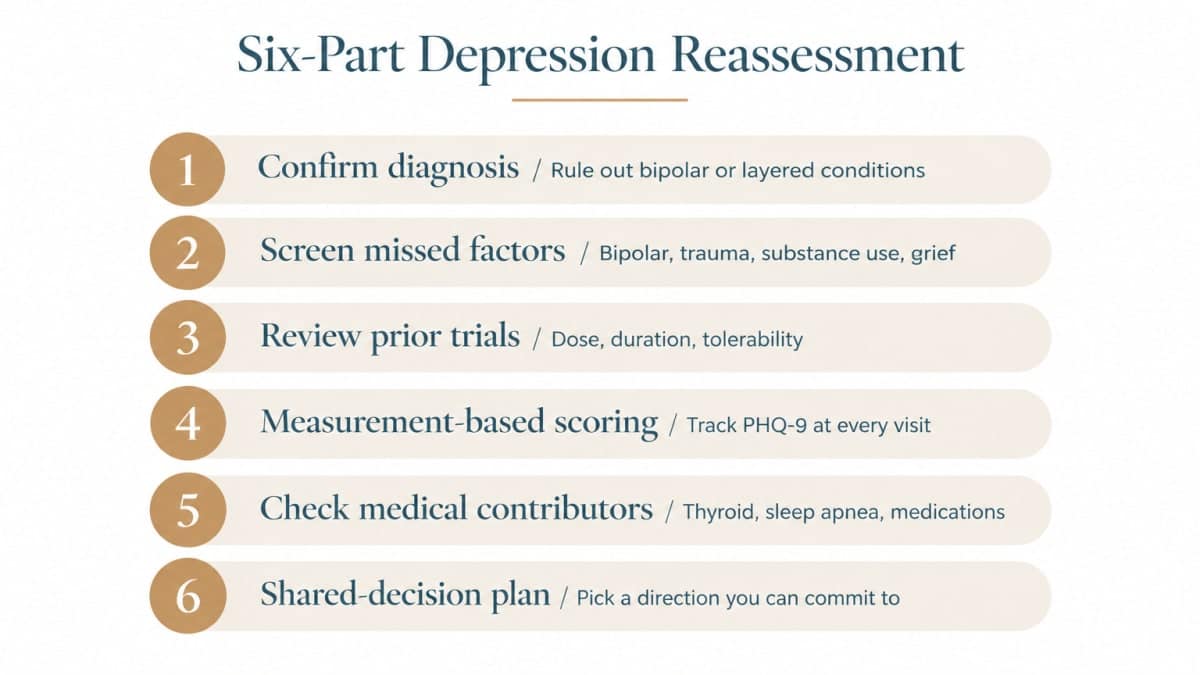
Federal clinical guidance for major depressive disorder lays out a structured reassessment for exactly the point you’re at: when a reasonable round of treatment hasn’t gotten you where you need to be 1. In practice, a careful reassessment covers six things, and you should hear your clinician work through each of them with you, not around you.
- Confirm the diagnosis. Is this major depressive disorder, persistent depressive disorder, a bipolar depression that was never caught, or depression layered on top of another condition? The answer changes the treatment entirely.
- Screen for what the shorter visits missed. Bipolar features, trauma history, substance use, and grief all shift the plan.
- Review how adequate your prior trials really were. Dose, duration, and whether you could actually tolerate the medication long enough to judge it.
- Use measurement-based scoring. A tool like the PHQ-9 at every visit gives you and your clinician a shared number to track, not just a vibe.
- Check medical and medication contributors. Thyroid, sleep apnea, chronic pain, steroids, certain blood-pressure medications — any of these can keep depression stuck.
- Build a shared-decision plan. You weigh the options with your clinician and pick a direction you can actually commit to 2.
If a program skips straight to “here’s what we offer,” you’re being sold a service, not evaluated for care.
What Counts as an ‘Adequate Trial’ of Standard Care
Here’s something that might change how you think about your history: a lot of people who feel like they’ve “tried everything” have actually had several incomplete trials rather than several real ones. That distinction matters, because the plan from here depends on it.
An adequate trial of an antidepressant generally means a therapeutic dose, taken consistently, for roughly six to eight weeks before you can judge whether it’s working 2. If you stopped at week two because of side effects, or stayed on a starter dose because no one followed up, that medication wasn’t really tested — it was interrupted. The same goes for therapy. A handful of sessions that got cancelled around holidays and work travel isn’t a fair run at cognitive behavioral therapy or any other structured approach.
None of this is a scolding. The system makes consistent follow-up genuinely hard, especially when you’re already depressed and tired. But before you label yourself “treatment-resistant” and move to more intensive options, a careful clinician will walk through each prior medication and therapy episode with you and ask: what dose, how long, what side effects, and what actually got in the way. Sometimes the right next move is a true trial of something you only partially tried. Sometimes it’s clearly time for more.
Screening for What Standard Visits Often Miss: Bipolar Features, Trauma, Substance Use, Medical Contributors
A fifteen-minute medication check isn’t built to catch the things that most often keep depression stuck. A full reassessment is, and this is where you often find the piece that explains why the last three plans didn’t hold.
Bipolar features. If you’ve ever had stretches of unusually high energy, little need for sleep, racing thoughts, risky spending, or irritability that your family remembers more clearly than you do, that history changes everything. Standard antidepressants can make bipolar depression worse, and the treatment path shifts to mood stabilization first 2.
Trauma. Depression that follows a car accident, assault, military service, childhood abuse, or an unexpected loss often has a post-traumatic layer that needs its own treatment. Treating only the depression leaves the engine running.
Substance use. Alcohol, cannabis, stimulants, and opioids each interact with mood, sleep, and medication in ways that quietly block recovery. The research on co-occurring conditions is clear that assessment has to look at substance use directly, not around it, including intoxication, withdrawal, and interactions with current prescriptions 14.
Medical contributors. Untreated thyroid disease, sleep apnea, chronic pain, low testosterone, anemia, vitamin deficiencies, and certain medications (steroids, some blood-pressure drugs, interferon) can all mimic or worsen depression. A reassessment that doesn’t include labs and a real medication review is incomplete.
If you leave an evaluation and none of these came up, that’s your signal to ask why.
The Advanced Treatment Menu: What Works, and for Whom
Optimizing and Augmenting Medication Before Moving to Devices
If reassessment confirms you have real treatment-resistant depression, the next move isn’t automatically a device or an infusion room. Often it’s a smarter use of medication than you’ve had so far. That might mean actually reaching a therapeutic dose, switching to a different class, or adding a second agent that works through a different mechanism.
Augmentation is the clinical word for that “adding something” step, and the evidence behind it is more substantial than most people realize. A network meta-analysis of 65 studies and 12,415 participants looked at 19 different add-on agents and found meaningful response signals for several of them, including aripiprazole, brexpiprazole, quetiapine, cariprazine, lithium, liothyronine (a thyroid hormone), olanzapine-fluoxetine, nortriptyline, modafinil, and lisdexamfetamine 12. These agents are not interchangeable. Each carries its own profile for weight, metabolic changes, sedation, movement side effects, kidney or thyroid monitoring, and interaction risk, which is why the choice belongs to a psychiatrist who knows your full history, not a chart template.
What this means for you: before you commit to weeks of office visits for TMS or monitored dosing of esketamine, a careful prescriber should be able to say, in plain language, which augmentation strategies have been tried at a real dose for a real duration, which were ruled out because of a specific medical reason, and which still make sense to try. If your current clinician can’t walk you through that, you’re due for a psychiatric consult with someone who can. Devices are powerful tools. They’re also easier to justify when the pharmacology work has been done honestly.
How Advanced Options Compare on Response Rates
You deserve honest numbers before you choose a direction. The best current comparison comes from a network meta-analysis published online in December 2024 that pooled 69 randomized controlled trials and 10,285 participants with treatment-resistant depression, measuring how different treatments stacked up against placebo or sham 4.
Six interventions beat placebo on response. Expressed as odds ratios — how many times more likely a patient was to respond compared with placebo — the lineup looks like this: electroconvulsive therapy (ECT) at 12.86, minocycline, theta-burst stimulation, repetitive transcranial magnetic stimulation (rTMS), ketamine, and aripiprazole at 1.9 4. ECT sits at the top of the list by a wide margin. The device-based options (rTMS and theta-burst) and ketamine land in the middle. Aripiprazole, a medication augmentation you might have already discussed with your prescriber, holds its own at the lower end.
A few things to hold onto when you look at a chart like this. First, these are group averages, not personal predictions. A 1.9 odds ratio for aripiprazole can still mean a full remission for you, and a 12.86 odds ratio for ECT doesn’t guarantee it works for everyone. Second, response odds don’t measure what the treatment costs you in time, side effects, memory, driving restrictions, or how willing you are to walk back in next week. A separate 2025 network meta-analysis comparing IV ketamine, rTMS, and ECT head-to-head in 2,109 patients found no significant differences in response, remission, or tolerability among the three, with IV ketamine showing higher acceptability — though the authors rated overall confidence as very low 5. Treat the chart as a map, not a verdict.

TMS, Ketamine/Esketamine, and ECT in Plain English
Names like TMS, esketamine, and ECT get thrown around as if everyone already knows what they involve. You shouldn’t have to pretend. Here’s what each one actually is, and the kind of person it tends to suit.
Transcranial magnetic stimulation (TMS). You sit in a chair, awake, while a device held against your scalp sends magnetic pulses into a specific part of the brain involved in mood regulation. No anesthesia, no sedation. A typical course runs daily sessions over about six weeks, and you drive yourself home. Theta-burst stimulation is a shorter version of the same idea. Both showed meaningful response odds in the 69-trial analysis 4. TMS tends to suit people who want to keep working, don’t tolerate medication side effects well, and don’t need an immediate shift.
Ketamine and esketamine (Spravato). Ketamine is given by IV in a monitored clinic. Esketamine is the FDA-approved nasal spray form, indicated for treatment-resistant depression in adults alongside an oral antidepressant, and also for depressive symptoms in adults with major depression and acute suicidal ideation or behavior 3. Both require medical monitoring during and after the dose — blood pressure checks, observation for sedation and dissociation, and a ride home — because of the drug’s safety profile 3, 9. Response can come within days for some people, which matters when you’ve been waiting weeks for something to shift. One important caveat: a 2025 systematic review of 87 articles on esketamine found a small positive effect on depression symptoms but no significant effect on suicidality at any time point measured 7. Short-term mood improvement is not the same as proven suicide prevention.
Electroconvulsive therapy (ECT). Done under brief general anesthesia, ECT uses a controlled electrical pulse to trigger a short seizure. Modern ECT is nothing like its reputation — you sleep through it, and most courses run two to three times a week for several weeks. It’s the strongest option on the chart for severe, psychotic, catatonic, or acutely suicidal depression, and for people who need results quickly or haven’t responded to anything else 4. The main trade-offs are temporary memory effects around the treatment period and the logistics of anesthesia visits.
Targeted Psychotherapy Alongside Biological Treatment
Medication and devices do real work on the biology of depression. They don’t rewrite the patterns of thinking, the relationships, the trauma, or the daily habits that may be feeding it. That’s what structured psychotherapy is for, and the federal guideline treats it as a core option at this stage of care, not an optional add-on 1.
The therapies with the strongest support for depression include cognitive behavioral therapy, behavioral activation, interpersonal therapy, mindfulness-based cognitive therapy, and problem-solving therapy 2. If trauma turned up in your reassessment, trauma-focused approaches belong in the plan too. The point isn’t to collect modalities. It’s to pick one that fits what’s actually keeping you stuck — rumination, avoidance, grief, a specific memory, a conflict at home — and work it consistently.
When therapy runs alongside TMS, ketamine, or an augmented medication plan, each piece makes the other more useful. The device or drug opens a window; the therapy teaches you what to do while it’s open.
What’s Not on the Local Menu: Invasive Neuromodulation
You may have come across vagus nerve stimulation (VNS), deep brain stimulation (DBS), or epidural cortical stimulation in articles about depression research. These are surgically implanted devices, and they live in a different category from the treatments above. A 2024 review found that evidence for invasive neuromodulation remains limited, with most of the signal coming from long-term follow-up in specialized academic centers 10. If a Prescott program ever mentions these, it should be as a referral path to a specialist center, not as a treatment it provides directly.
Depression Rarely Shows Up Alone: Co-Occurring Substance Use and Trauma
For a lot of adults who end up searching for advanced depression treatment in Prescott, depression isn’t the only thing going on. There’s a nightly glass of wine that became three, a prescription that quietly turned into a dependency, old trauma that still shapes how you sleep, or a loss you never fully processed. These aren’t side notes to your depression. They’re often part of why it hasn’t lifted.
The research on co-occurring conditions makes two things clear. First, when substance use and a psychiatric disorder show up together, careful assessment has to look at both directly — intoxication and withdrawal patterns, interactions with your current medications, trauma history, bipolar features, and suicide risk — before any treatment plan is built 14. Skipping that step is how people end up on a new antidepressant that doesn’t stand a chance because the drinking never came up.
What this means for you: if alcohol, opioids, cannabis, stimulants, or a trauma history are part of your story, a Prescott program should treat them as part of the depression work from day one — same team, same chart, same plan. Ask directly how substance use and trauma get folded into the depression treatment. If the answer is “we’ll refer you out for that,” the pieces will keep working against each other.
Older Adults in Prescott: Realistic Expectations and Safer Choices
Older adults are a notable segment of the Prescott population, and that shapes what honest treatment planning looks like. If you’re in your sixties, seventies, or beyond — or you’re reading this for a parent who is — you deserve a clearer picture of what’s realistic than most promotional pages offer.
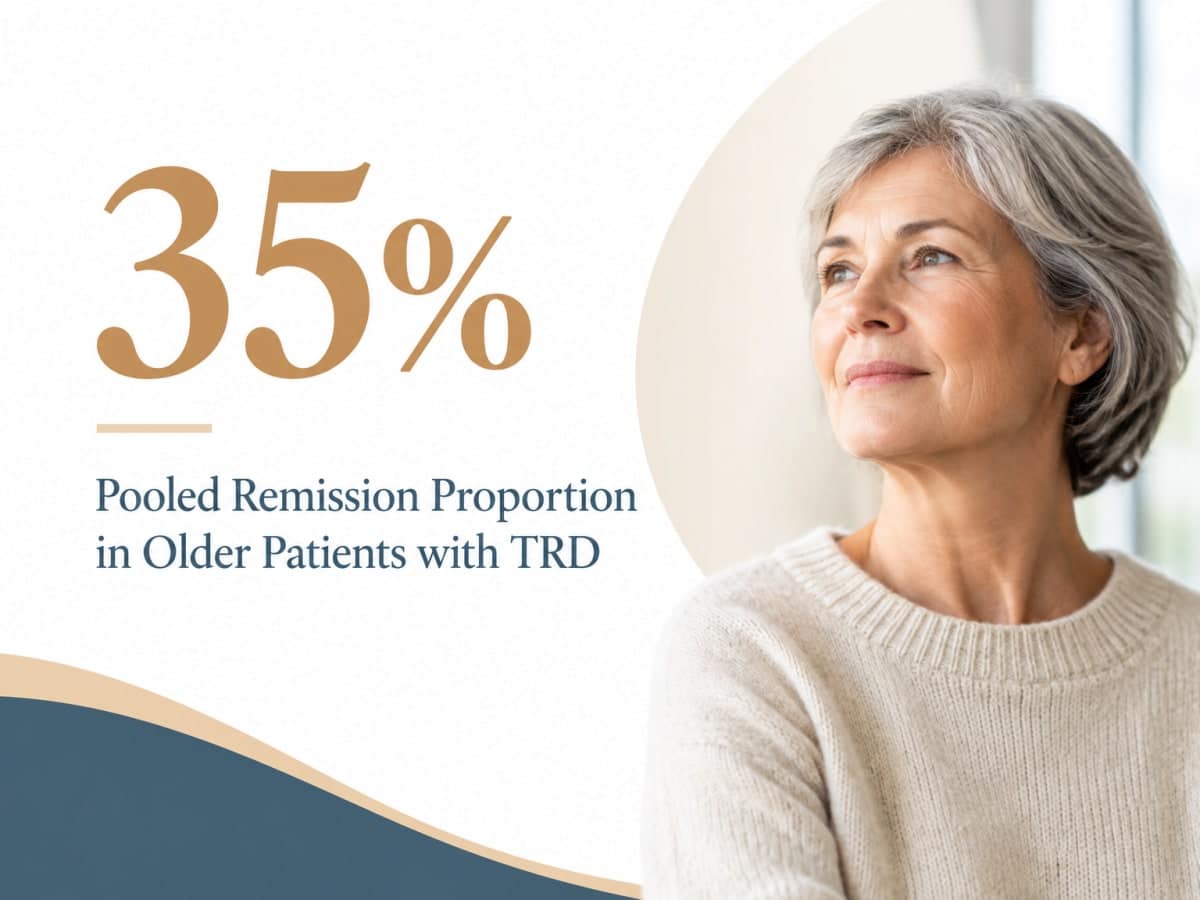
A 2025 systematic review and meta-analysis of treatment-resistant depression in older adults pooled 17 intervention arms and found a remission proportion of 35% across them 11. That number isn’t discouraging — it means roughly one in three older adults with depression that hasn’t responded to standard care reached full remission with an advanced option. It is a reason to try. It’s also a reason to go in with your eyes open about what one round of treatment can and can’t do. The same review found the strongest signal for ketamine over control conditions, while evidence for TMS, pharmacogenetic prescribing, and cognitive remediation was weaker in this age group 11.
Age changes the safety math too. Kidney function, heart rhythm, blood pressure, falls, cognition, and the sheer number of other medications in play all affect which augmentation agents are reasonable and which somatic treatments make sense. A careful prescriber will look at that whole picture — not just the depression score — before recommending lithium, an atypical antipsychotic, ECT anesthesia, or ketamine-class monitoring. Ask directly how your other conditions and your current medication list shaped the recommendation. If the answer is vague, keep asking.
How to Judge Whether a Prescott Program Can Handle a Complex Case
Not every clinic that lists depression on its website is built for a complicated one. If your situation includes failed prior trials, substance use, trauma, bipolar features, or serious medical conditions, the program you choose needs more than a brochure of services. Here’s what to listen for when you call.
They lead with reassessment, not a product. If the first thing you hear is “we do TMS” or “we do ketamine,” you’re being sold. A serious program walks you through evaluation first and matches a treatment to what they find 1.
They have board-certified psychiatric coverage, not just a prescriber who checks in. Ketamine-class treatments require medical monitoring during and after each dose because of blood pressure, sedation, and dissociation effects 3. ECT involves anesthesia. Augmentation choices from the 65-study evidence base — lithium, atypical antipsychotics, thyroid hormone, and others — each carry monitoring requirements that a part-time prescriber can’t realistically carry 12. Ask who is available after hours when something changes.
They treat substance use and trauma inside the depression plan, not as a referral out. Integrated care consistently outperforms parallel services where providers don’t talk to each other 13. If the answer to “what about my drinking?” is “we’ll send you somewhere for that,” the plan is already fractured.
They set length of care by clinical progress, not by a calendar. A program that tells you the stay before they’ve evaluated you is working from a template.
They can say what they don’t do. Honest programs refer out for invasive neuromodulation like VNS or DBS rather than implying everything happens under one roof 10. That candor is a good sign, not a weak one.
What a First Call and First Week Look Like
You don’t have to arrive with a plan. You just have to arrive. A good first call is mostly listening on their end: what’s been tried, what’s happening right now, who else is involved, and whether you’re safe tonight. If you’re in crisis, the conversation shifts to immediate stabilization. If you’re not, you’ll usually be scheduled for a longer evaluation within a few days, not a few weeks.
Week one is evaluation week, not treatment week. Expect a full psychiatric interview, structured screening for bipolar features, trauma, and substance use, a measurement-based score like the PHQ-9, labs and a medication review, and a conversation about options you can actually choose between 1, 2. By the end of that week, you should walk out with a working diagnosis, a plan you helped shape, and a clear next appointment. If what you get instead is a prescription and a vague “let’s see,” that’s your cue to ask for more.
Explore Advanced Depression Care in Prescott
Discuss what hasn’t helped and learn whether specialized depression treatment may fit your needs.
Frequently Asked Questions
How do I know if I have treatment-resistant depression?
The working definition most clinicians use is depression that hasn’t responded to at least two adequate trials of antidepressants from different classes — meaning a therapeutic dose, taken for roughly six to eight weeks each 2. If your trials were shorter or lower-dose, you may not be treatment-resistant yet; you may need a true trial first. A careful reassessment is what tells you which bucket you’re actually in 1.
What’s the difference between TMS, ketamine/esketamine, and ECT?
TMS uses magnetic pulses through the scalp while you sit awake in a chair. Ketamine and esketamine are medications given by IV or nasal spray in a monitored clinic with observation afterward 3. ECT uses a brief electrical pulse under anesthesia to trigger a short seizure. A head-to-head analysis found no significant difference in response, remission, or tolerability among the three, with very-low confidence 5.
Can advanced depression treatment work if I also drink heavily or use substances?
Yes, but only if the program treats both at the same time. Coordinated, integrated care for co-occurring depression and substance use generally outperforms treating one condition alone or shuttling between separate providers 13. Assessment should look directly at your use patterns, withdrawal risk, and medication interactions before any plan is built 14. If a program says they’ll refer the drinking out, the plan is already fractured.
Will I have to stop my current antidepressant to try something new?
Usually not. Many advanced options are added to your current medication rather than replacing it. Esketamine, for example, is FDA-approved for use alongside an oral antidepressant 3. Augmentation agents like aripiprazole, lithium, or liothyronine are specifically designed to layer on top of what you’re already taking 12. Any changes should be made by a psychiatrist who knows your full history — not stopped on your own.
Is ketamine or esketamine proven to reduce suicide risk?
Not in the way the headlines sometimes suggest. A 2025 systematic review of 87 articles on esketamine found a small positive effect on depression symptoms but no significant effect on suicidality at any time point measured 7. These treatments can lift mood for some people quickly, which matters. But short-term symptom improvement is not the same as a demonstrated reduction in suicide risk, and you should hear that honestly.
What should I ask a Prescott program before I commit to treatment?
Ask how they reassess diagnosis before recommending anything 1. Ask who covers you after hours when monitoring matters 3. Ask how substance use and trauma get folded into the depression plan, same team and same chart 13. Ask how length of care is decided. Ask what they don’t do and refer out for — like invasive neuromodulation 10. Vague answers are the answer.
References
- Management of Major Depressive Disorder (MDD) (2022) – VA/DOD Clinical Practice Guidelines. https://www.healthquality.va.gov/guidelines/mh/mdd/index.asp
- VA/DoD Clinical Practice Guideline for the Management of Major Depressive Disorder: Provider Summary. https://www.healthquality.va.gov/guidelines/MH/mdd/VADoDMDDCPG_ProviderSummary_Final_508_updated.pdf
- SPRAVATO (esketamine) nasal spray, CIII. https://www.accessdata.fda.gov/drugsatfda_docs/label/2025/211243s019lbl.pdf
- Relative effectiveness of antidepressant treatments in treatment-resistant depression: a systematic review and network meta-analysis of randomized controlled trials. https://pubmed.ncbi.nlm.nih.gov/39739012/
- Comparative efficacy and safety of intravenous racemic ketamine, repetitive transcranial magnetic stimulation and electroconvulsive therapy for Stage 2 or higher treatment-resistant depression: A systematic review and network meta-analysis. https://pubmed.ncbi.nlm.nih.gov/40590032/
- A systematic review and meta-analysis of the efficacy of ketamine compared to electroconvulsive therapy for treatment-resistant depression. https://pubmed.ncbi.nlm.nih.gov/41117281/
- Esketamine Treatment for Depression in Adults: A PRISMA Systematic Review and Meta-Analysis. https://pubmed.ncbi.nlm.nih.gov/39876682/
- Ketamine for Adults With Treatment-Resistant Depression or Severe Major Depression. https://www.ncbi.nlm.nih.gov/books/NBK602384/
- Guidelines for ketamine use in clinical psychiatry practice. https://pmc.ncbi.nlm.nih.gov/articles/PMC11094435/
- Invasive Neuromodulation Techniques for Treatment-Resistant Depression. https://pubmed.ncbi.nlm.nih.gov/38082109/
- Effectiveness of pharmacological and non-pharmacological interventions for treatment-resistant depression in older patients: a systematic review and meta-analysis. https://pubmed.ncbi.nlm.nih.gov/40032553/
- Augmentation strategies for treatment resistant major depression: a systematic review and network meta-analysis. https://pubmed.ncbi.nlm.nih.gov/34986373/
- Effectiveness of Psychosocial Interventions for Adults With Co-Occurring Mental Health and Substance Use Disorders. https://pubmed.ncbi.nlm.nih.gov/41192364/
- Navigating the Complex Intersection of Substance Use and Psychiatric Disorders: A Comprehensive Review. https://pubmed.ncbi.nlm.nih.gov/103/